Superpolies in Cube Attacks against
Trivium-Like Ciphers
Chen-Dong Ye, Tian Tian
National Digital Switching System Engineering & Technological Research Center, P.O. Box 407, 62 Kexue Road, Zhengzhou, 450001, China.
Abstract. In this paper, we study experimental cube attacks against Trivium-like ciphers and we focus on improving nonlinear superpolies recovery. We first present a general framework in cube attacks to test nonlinear superpolies, by exploiting a kind of linearization technique. It worth noting that, in the new framework, the complexities of testing and recovering nonlinear superpolies are almost the same as those of test-ing and recovertest-ing linear superpolies. To demonstrate the effectiveness of our new attack framework, we do extensive experiments on Trivi-um, KreyviTrivi-um, and TriviA-SC-v2 respectively. We obtain several linear and quadratic superpolies for the 802-round Trivium, which is the best experimental results against Trivium regarding the number of initializa-tion rounds. For Kreyvium, it is shown that the probability of finding a quadratic superpoly using the new framework is twice as large as finding a linear superpoly for Kreyvium. Hopefully, this new framework would provide some new insights on cube attacks against NFSR-based ciphers, and in particular make nonlinear superpolies potentially useful in the future cube attacks.
Keywords: Cube attacks, Linearity tests, Quadracity tests, Trivium-like ciphers.
1 Introduction
Trivium is a bit oriented synchronous stream cipher designed by Can-ni`ere and Preneel, which targets hardware environments with highly re-stricted resources, see [1]. It is one of the eSTREAM hardware-oriented finalists and an International Standard under ISO/IEC 29192-3:2012.
Sharmir [2]. In [2], the authors recovered 35 linear superpolies, i.e., rela-tions between key bits and keystream bits, based on which they gave an effective key recovery attack on the 767-round Trivium with attack com-plexity 245. In [3], Mroczkowski and Szmidt applied cube attacks to the 709-round Trivium, and firstly reported quadratic superpolies. In specific, they found 41 linear superpolies and 22 quadratic superpolies. In [4], the authors presented a recursive method to find cubes with linear superpolies as well as took advantage of the Meobius transformation. They found 12 linear superpolies and 6 quadratic superpolies for the 799-round Trivium. In [5], Todo et al. applied the division property to cube attacks. Based on the division property, attackers could identify the key variables involved in the superpoly of a given cube by solving corresponding MILP model-s inmodel-stead of performing linearity/quadraticity temodel-stmodel-s. Conmodel-sequently, with some relatively large cubes, partial information of the secret key could be recovered for up to the 832-round Trivium. In [6], the authors proposed a technique to reduce the complexity of superpoly recovery based on the work of [5].
Due to the simplicity and the established security of Trivium, some recently proposed crypto primitives adopt similar designs, such as Kreyvi-um [14] and TriviA-SC [15,16].
Kreyvium is designed for the efficient homomorphic-ciphertext com-pression in homomorphic encryptions and aims to achieve 128-bit security. In [10], based on a cube of size 61, Liu presented a distinguisher on the 872-round Kreyvium. In [6], for the 888-round Kreyvium, the authors provided a key recovery attack based on a cube of size 102. In [17], based on 24-th and 25-th order conditional characteristic, the authors proposed distinguishers on 899-round Kreyvium.
Before the work of [5], cube attacks were based on experimental tests, which are called experimental cube attacks in this paper. In experimental cube attacks, it is important to find cubes with low-degree superpolies, and attackers usually attempt to find linear or quadratic superpolies in practice. The conventional method of recovering quadratic superpolies is doing quadraticity tests, which regards a cipher as a blockbox polynomial. Compared with linearity tests, quadraticity tests have a higher complexi-ty, which makes experimentally implement quadraticity tests much more difficult than implementing linearity tests when the sizes of cubes reach 40. In this paper, we are concerned with finding nonlinear superpolies for Trivium-like ciphers.
1.1 Our Contribution
The inspiration of this paper comes from an interesting observation of cube attacks against Trivium. The algebraic normal form (ANF) of quadratic superpolies recovered in cube attacks against Trivium have fixed forms. They are very probable of the formkiki+1⊕ki+2⊕ki−25( mod 69)
for 0≤i≤77 together with k78k79⊕k53. Besides, this observation is
al-so true for other Trivium-like ciphers. Hence, we propose to treat al-some nonlinear key expressions as a whole, and regard the first output bit as a tweakable function on these nonlinear key expressions not key vari-ables themselves. Consequently nonlinear superpolies could be recovered by testing linearity on nonlinear key expressions. According to this basic idea, we propose a generic framework to recover nonlinear superpolies using linearity test principles for Trivium-like ciphers.
but no linear superpolies are found for the 776-round Kreyvium. Third, we gain linear superpolies and quadratic superpolies for the 864-round TriviA-SC-v2 and the 992-round simplified TriviA-SC-v2, respectively. Table 2 summaries our results.
Table 1.The total number of linear superpolies and nonlinear superpolies
ciphers # of linear superpolies # of nonlinear superpolies
Trivium 8155985 7517944
Kreyvium 1194480 2538591
TriviA-SC-v2 4074914 491551
Table 2.Results on round-reduced Trivium-like stream ciphers
ciphers # of rounds # of superpolies
Trivium 802 5 linear, 2 quadratic
Kreyvium 776 0 linear, 8 quadratic
TriviA-SC-v2 864 12 linear, 3 quadratic
TriviA-SC-v2 simplified 992 14 linear, 2 quadratic
1.2 Organization
The rest of this paper is structured as follows. In Section 2, we in-troduce some basic definitions and facts. In Section 3, we propose a new framework to find nonlinear superpolies with a low complexity. In Sec-tion 4, our new framework is applied to Trivium-like stream ciphers. In Section 5, we summarize our work.
2 Preliminaries
In this section, we briefly review the general structure of Trivium-like ciphers, the basic procedures of cube attacks, and linearity/quadracity tests of black-box Boolean functions.
2.1 Trivium-Like Stream Ciphers
other bits of the internal sate are updated by shifting. In specific, let A, B and C be three shift registers of length LA,LB, andLC respectively.
For t ≥0, let At = (xt, . . . , xt+LA−1), Bt = (yt, . . . , yt+LB−1), and Ct =
(zt, . . . , zt+LC−1) denote thetth state of A, B and C respectively. Then
the internal state of a Trivium-like cipher at time instance t is given by st= (At, Bt, Ct), and the state update function could be described as
xt=zt−rc−1·zt−rc+lA(st−1),
yt=xt−ra−1·xt−ra+lB(st−1),
zt=yt−rb−1·yt−rb+lC(st−1),
where lA, lB and lC are three linear functions and 1 ≤ rλ ≤ Lλ for
λ ∈ {A, B, C}. After N initialization rounds, a filtering function f is used to compute a keystream bit from the current internal state, i.e., zt=f(st) for t≥N.
There are three well-known Trivium-like ciphers, say Trivium [1], Kreyvium [14] , and TriviA-SC [15,16] . The first two algorithms well fulfill the description above, while the last algorithm uses two extra reg-isters K∗ andV∗, which are padded with key bits and IV bits respective-ly, to XOR the key bits and IV bits to the feedback function. Besides, the filtering functions of Trivium and Keryvium are linear, while that of TriviA-SC is quadratic.
2.2 Cube Attacks
The idea of cube attack was first proposed by Dinur and Shamir in [2]. In the cube attack against stream ciphers, an output bit z is de-scribed as a tweakable Boolean functionf on secret key variablesKey= (k0, k1, . . . , kn−1) and public IV variablesIV = (iv0, iv1, . . . , ivm−1), where
nand m are positive integers, i.e.,
z=f(Key, IV).
Let I be a subset of dpublic variables, where 1≤d≤m . Without loss of generality, we assume that I ={iv0, iv1, . . . , ivd−1}. Then the function
f can be rewritten
f(Key, IV) =tI·pI(Key, ivd, ivd+1, . . . , ivm−1)⊕q(Key, IV),
where tI = iv0iv1· · ·ivd−1 is the product of variables in I, pI does not
can be seen that the summation of the 2d functions derived from f by assigning all the possible values to the d variables in I is equal to pI,
which eliminatesq completely, that is, ⊕
(iv0,iv1,...,ivd−1)∈Fd2
f(Key, IV) =pI(Key, ivd, ivd+1, . . . , ivm−1). (1)
The variables in the set I are called cube variables, the set CI of all 2d
possible assignments of the cube variables in I is called ad-dimensional cube, and the polynomial pI is called the superpoly of I. That is to say
iv0, iv1, . . . , ivd−1 are cube variables and ivd, ivd+1, . . . , ivm−1 are
non-cube variables. Furthermore, fixing each non-non-cube variable to be a con-stant, the superpoly pI becomes a polynomial with secrete key variables
only.In this paper, we always fix all non-cube variables to be 0’s, and so (1) can be rewritten
⊕
(ivi1,ivi2,...,ivid)∈{0,1}d
f(Key, iv0, . . . , ivd−1,0) =ps(I)(Key,0). (2)
Since pI comes fromf, it follows that deg(pI)≤deg(f). In particular, if
deg(f) =d+ 1, then the superpolypImust be affine or constant. The key
idea of cube attacks is trying to recover simple or low-degree superpoly pI.
A cube attack consists of two phases: a preprocessing phase which is independent of the secret key and a online phase which should be carried out for every secret key. In the preprocessing phase, attackers should find some useful superpolies which could recover the information of the secret key. In the online phase, the previously found superpolies were evaluated under the real key. By solving a system of equations or looking up the truth tables of superpolies, a part of or even the whole information of the secret key could be revealed.
2.3 Linearity and Quadraticity Tests for Black-box Boolean Functions
In this subsection we briefly recall how to test linearity/quadraticity of a black-box Boolean function. As for linearity tests one can refer to [19] and as for quadraticity or low-degree tests one can refer to [20].
Letn be a positive integer and let f(x1, x2, . . . , xn) be an n-variable
Boolean function. Suppose that the explicit representation off(x1, x2, . . . ,
xn) is extremely big and it is unknown to us, but the function f can be
queried, that is, we could enquire about the value f(a) for any input vectora ∈Fn2.
Linearity test. Choosea,b∈Fn2 uniformly and independently, and verify
f(a⊕b)⊕f(a)⊕f(b)⊕f(0) = 0. (3) If f is linear, then the test will succeed, whereas if deg(f)≥2, then the test may fail with a certain probability. Thus the test should be repeated sufficiently many times to make sure thatf is very close to being linear. Iff passes through the linearity test, then its coefficients in the alge-braic normal form can be calculated by n+ 1 more queries. One query could determine one coefficient. The constant term off is given byf(0). Let
e1 = (1,0, . . . ,0),e2 = (0,1,0, . . . ,0), . . . ,en= (0,0, . . . ,1)∈Fn2.
Then the coefficient of the variable xi inf for 1≤i≤n is given by
ci=f(ei)⊕f(0).
Quadraticity test. Choosea,b,c∈Fn2 uniformly and independent-ly, and verify
f(a⊕b⊕c)⊕f(a⊕b)⊕f(a⊕c)⊕f(b⊕c)⊕f(a)⊕f(b)⊕f(c)⊕f(0) = 0. (4) Similarly iff is quadratic, then the test succeeds, whereas if deg(f)>2, then the test may fail. Thus the test should be repeated sufficiently many times to make sure that f is very close to being quadratic.
If f passes through the quadraticity test, then the coefficient of a quadratic term xixj inf for 1≤i < j≤nis given by
f(ei⊕ej)⊕f(ei)⊕f(ej)⊕f(0).
the attacks, we also need to test whether a linear functionf is a constant function.
Constantness test. Choosea,b∈Fn2 uniformly and independently, and verify
f(a)⊕f(b) = 0.
If f is constant, then the test will succeed, whereas if f is not constant, then the test may fail with a certain probability. Thus the test should be repeated sufficiently many times.
3 A New Framework to Find Nonlinear Superpolies
In this section, we introduce some observations from which we get our basic idea. Then based on this basic idea, we propose a new framework to find nonlinear superpolies.
3.1 Motivations
The motivations of this paper come from the following observations on the extensive superpolies recovered by the previous experimental cube attacks against Trivium. Please refer to [2], [3], and [4] for a large number of instances of superpolies for Trivium variants.
Our first observation isthe sparsity of nonlinear superpolies. It can be easily observed that the algebraic normal forms of all recovered superpolies are very sparse, most of which have less than five terms. Ac-cordingly the systems of nonlinear equations in key variables defined by these superpolies are easy to solve during the online phase, see [3] for an example.
Our second observation is thatsome key variables are missing in linear superpolies. It can be observed that none of the linear superpolies were found so far involving the key variables between k69 and k79. This
phenomenon is also mentioned in [4, Page 511]. Hence, to recover the information of the key variables between k69 and k79, linear superpolies
are not sufficient.
experimental cube attacks against Trivium, as the number of initializa-tion rounds increases, the dimension of a cube becomes very large, say 40, which results in that just one query will be very time consuming. In this case, to test a quadratic superpoly using present method is much more difficult than to test a linear superpoly. Thus, although quadrat-ic superpolies are useful, they do not paly a role as important as linear superpolies.
Our third observation isthe fixed forms of nonlinear superpolies. It is interesting to find that the ANFs of all nonlinear superpolies recov-ered in cube attacks against Trivium have very specific forms. That is to say they are far from random polynomials. It can be observed that most of the published quadratic superpolies only have one quadratic monomial of the form xixi+1 accompanied by two degree 1 monomials. This
obser-vation was also mentioned in [4, Section 4.2], but was not utilized in their attacks.
Inspired by the third observation, we propose a new framework to find and recover nonlinear superpolies with low complexities. In the new framework, we fix some nonlinear key expressions, and find superpolies which are linear about these fixed nonlinear key expressions. It can be seen that linear superplies in this sense are nonlinear on key variables. There are two key points involved in the new framework. One is how to do linearity tests on superpolies about the fixed nonlinear key expres-sions. The other is how to choose useful nonlinear key expresexpres-sions. We shall explain these two points in detail in the following two subsections respectively.
3.2 A Generic Technique for Linearity Tests of Composite Functions
Letg(y0, y1, . . . , ym−1) be a Boolean function on the variablesy0, y1, . . . ,
ym−1. For 0≤ i≤m−1, let hi(x0, x1, . . . , xn−1) be a Boolean function
on the variables x0, x1, . . . , xn−1. Then
f(x0, x1, . . . , xn−1) =g(h0(x0, x1, . . . , xn−1), . . . , hm−1(x0, x1, . . . , xn−1))
is a composite function of g(y0, y1, . . . , ym−1) and hi(x0, x1, . . . , xn−1). It
is easy to see that when the composite function f(x0, x1, . . . , xn−1) is
nonlinear, it is not necessary that g is nonlinear. In other words, when f is nonlinear on the variables x0, x1, . . . , xn−1, it is not necessary that
f is nonlinear on the expressions h0, h1, . . . , hm−1. Let us take a small
Example 1. Letf =x0·x1⊕x2·x3 be a Boolean function. Leth0=x0·x1
and h1 = x2·x3. It is clear that f = h0 ⊕h1. Hence f is linear on the
expressionsh0 and h1, but nonlinear on the variablesx0, x1, x2, x3.
In the above small example, the ANF of f(x0, x1, x2, x3) is known,
and so it is easy to see whetherf is linear onh0andh1. Now the problem
is when f(x0, x1, . . . , xn−1) is a black-box Boolean function, how to test
whether f is a linear Boolean function on h0, h1, . . . , hm−1. Note that f
could be queried only by assigning values to the variablesx0, x1, . . . , xn−1.
We formally present this problem in the following.
Problem 1. Letf(x0, x1, . . . , xn−1) be a black-box Boolean function.
As-sume that h0, h1, . . . , hm−1 are m Boolean functions on the variables
x0, x1, . . . , xn−1 such that there is a Boolean function g(y0, y1, . . . , ym−1)
satisfying f =g(h0, h1, . . . , hm−1). How to test whetherf is linear about
h0, h1, . . . , hm−1 by queryingf(x0, x1, . . . , xn−1) ?
The difference between Problem 1 and the traditional linearity test of black-box Boolean functions lies in that we ask the linearity of a set of nonlinear expressions of inputting variables not simply inputting variables themselves. This general problem is open. In the following we give a simple technique to tackle some instances of the problem which is useful in the following attacks. Our basic idea is still the BLR linearity test introduced in Subsection 2.3.
Theorem 1. Let f, h0, . . . , hm−1 be as described in Problem 1. If the
mapping
H :a= (a0, a1, . . . , an−1)7→(h0(a), h1(a), . . . , hm−1(a)),a∈Fn2,
is surjective with H(0) =0, then Algorithm 1 is a one-sided tester for f being linear on the expressionsh0, h1, . . . , hm−1. In particular, if
Algorith-m 1 returns reject, thenf is not linear on the expressionsh0, h1, . . . , hm−1
with probability 1.
Proof. Since f is a composite function of the form
f =g(h0, h1, . . . , hm−1),
if follows thatf being linear on the given expressionsh0, h1, . . . , hm−1 is
equivalent to g(y0, y1, . . . , ym−1) is linear. Thus it suffices to show
Algorithm 1 Linearity test of composite functions
Require: a black-box function f onX = (x0, x1, . . . , xn−1) and a vectorial Boolean
functionH= (h0(X), h1(X), . . . , hm−1(X)).
1: chooseaandb randomly and uniformly inFm 2 ;
2: compute X1, X2, X3 satisfying H(X1) = a, H(X2) = b, and H(X3) = a ⊕b,
respectively;
3: computev=f(X1)⊕f(X2)⊕f(X3)⊕f(0)
4: if v̸= 0then
5: return reject; 6: else
7: return accept; 8: end if
Let a, b, c, X1,X2, and X3 be as described in Algorithm 1, where
the existence ofX1, X2, X3 can be deduced from the hypothesis thath is
surjective. Then we have
f(X1) =g(a), f(X2) =g(b) and f(X3) =a⊕b.
It follows that
f(X1)⊕f(X2)⊕f(X3)⊕f(0) =g(a)⊕g(b)⊕g(a⊕b)⊕g(0).
Hence it can be seen that line 3 in Algorithm 1 is a BLR linearity test forg(y0, y1, . . . , ym−1).
Remark 1. The probability that Algorithm 1 rejects a function f which is nonlinear on h0, h1, . . . , hm−1 is equal to the probability that the
algo-rithm in [20] rejecting the corresponding function g which is nonlinear.
Algorithm 1 needs repeating sufficient times to make sure thatf is very close to being linear on h0, h1, . . . , hm−1. When we make sure that f
is linear on h0, h1, . . . , hm−1, we could recover the ANF of f using only
m+ 1 queries like recovering a linear Boolean function, which is much less compared with n(n2−1)+n+ 1 queries to recover the ANF of a quadratic Boolean function onx0, x1, . . . , xn−1. It can be seen that the complexities
of doing linearity test onf and the ANF recovery offare almost the same as that of linearity tests and linear Boolean functions recovery except the time spent on finding a preimage of the mapping H. A preimage of the mapping H could be found by solving a system of equations defined by h0, h1, . . . , hm−1. When this system of equations is sparse and simple, it
3.3 A Generic Method of Choosing Useful Nonlinear Key Expressions
When it comes to cube attacks, the composite function f discussed in the last subsection is a superpoly pI of some chosen cube CI.
Tra-ditionally, pI is seen as a black-box Boolean function on key variables,
say k0, k1, . . . , kn−1, and attackers try to recover linear superpolies on
k0, k1, . . . , kn−1. If there exists a set of nonlinear expressions h0, h1, . . . ,
hm−1 in key variables such that pI could be represented as a
compos-ite function pI =g(h0, h1, . . . , hm−1) for some function g, then our new
technique could efficiently test whether pI is linear on the expressions
h0, h1, . . . , hm−1 resulting in a desirable nonlinear superpoly in key
vari-ables. In the following, we shall show a generic method to find such useful nonlinear expressions in key variables.
During the initialization process of stream ciphers, key variables are gradually mixed with IV variables, and so in some early rounds, when the mixture is not sufficient, they may not be multiplied together. Namely, at some time instancet, each internal state bit sti could be written as
sti =gi,1(IV)⊕gi,2(Key)(0≤i≤l−1),
wherelis the size of the internal state andgi,1 andgi,2 may be equal to 0.
Consequently, since the internal state is updated iteratively, the output keystream bit could be described by a Boolean function on the following expressions:
{gi,1(IV) |0≤i≤l−1}
∪
{gi,2(Key) |0≤i≤l−1}.
Accordingly, in cube attacks, when all the non-cube variables are set to constant values, the superpoly pI of a given cube CI could be naturally
seen as a Boolean function on the expressions in the set G={gi,2(Key) |0≤i≤l−1}.
As a result, pI may be nonlinear on key variables but linear on the
ex-pressions in G which is the case we desire. By reasonably classifying the setG, attackers could choose several subsets ofGsatisfying the surjective condition in Theorem 1.
4 Application to Trivium-like Stream Ciphers
In this section, we discuss specific applications of our new framework to cube attacks against Trivium-like ciphers including Trivium, Keryvi-um, and TriviA-SC-v2. First, we make some notes on implementation details. Then, we list useful nonlinear expressions for the three stream ciphers. Finally, with these useful nonlinear expressions in key variables, we perform several experiments on the three stream ciphers and obtain various results.
4.1 Some Notes
We give some remarks on implementation details about our new tech-nique being used in experimental cube attacks to recover nonlinear su-perpolies.
First, we suggest to solve the involved systems of nonlinear equations by SAT solvers such as CryptoMiniSat-2.9.5 developed by M. Soos [21]. There are two main reasons for using CryptoMiniSat not Gr¨obner basis algorithms or other algebraic methods. The first one is that we only need one solution not all solutions for each system of equations. The second one is that CryptoMiniSat is experimentally fast for sparse equations.
Second, recall that in [4], the Moebius transformation was used to search all the subcubes of a large cube to find linear and quadratic su-perpolies. Our new framework for recover nonlinear superpolies could be combined with the Meobius transformation technique if one has enough memory.
Third, for a stream cipher, useful nonlinear expressions are classified into several groups according to the hypothesis of Theorem 1. Reusing f(X1) and f(X2) described in Algorithm 1 for each group test could
reduce lots of queries. Besides, when there exists only one set of use-ful nonlinear expressions, f(X1) and f(X2) can be reused to find linear
superpolies.
Forth, all our programs were implemented with CUDA and executed on a PC with an Intel(R) Core i7-4790k @4.00GHZ CPU, 32G memory and a GTX-1080 GPU.
4.2 Results for Trivium
3. Actually, they cover all quadratic expressions appearing the internal state after 91 initialization rounds.
Table 3.The chosen nonlinear expressions for Trivium
ciphers set chosen nonlinear expressions
Trivium
SetA ki+25ki+26⊕ki+27⊕ki(0≤i≤52)
SetB
k0k1⊕k2⊕k44
kik1+i⊕k2+i⊕k44+i⊕k53+i(1≤i≤12)
kik1+i⊕k2+i⊕k44+i(13≤i≤24)
To show the correctness and effectiveness of finding nonlinear super-polies using our new framework, we do extensive experiments on the Triv-ium variants with from 600 to 700 initialization rounds. For each variant, we randomly choose 100 cubes to search linear superpolies and superpolies which are linear about expressions in Set A or B. As a result, we total-ly obtain 8155985 linear superpolies and 7517944 quadratic superpolies for all these 100 variants. It worth noting that the number of quadratic superpolies is very close to that of linear superpolies. It indicates that quadratic superpolies could be found as easily as linear superpolies with our new framework. Namely, our new framework would make quadratic superpolies play a more important role in cube attacks against Trivium than ever before.
Second, we try our framework for Trivium variants with up to 802 initialization rounds. Some new cubes and superpolies for the 784, 799 and 802-round Tirivum are listed in Table 6 in the Appendix. To the best of our knowledge, for Trivium variants, it is the first time that experimental cube attacks could reach 802 initialization rounds.
4.3 Results for Kreyvium
In the case of Kreyvium, we choose the following set of nonlinear expressions of key variables in Table 4 according to the internal state after 66 initialization rounds. Certainly, there may exist other sets of useful nonlinear expressions.
twice as large as that of linear superpolies. It indicates that quadrat-ic superpolies could be found more easily than linear superpolies with our framework in the case of experimental cube attacks against Kreyvi-um. Then, we apply our new framework to search linear superpolies and quadratic superpolies for Kreyvium variants with a higher number of ini-tialization rounds. Consequently, for the 776-round Kreyvium, we gain 8 different quadratic superpolies but no linear superpolies based on a cube of size 38, see Table 7 in the Appendix. It further indicates that quadrat-ic superpolies maybe more useful than linear superpolies in the case of round-reduced Kreyvium.
Table 4.The nonlinear expressions chosen for Kreyvium
ciphers chosen nonlinear expressions degree
Kreyviumki⊕k25+ik26+i⊕k27+i(0≤i≤65) quadratic
4.4 Results for TriviA-SC-v2
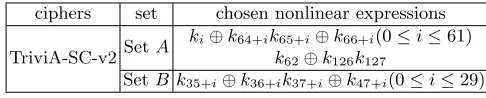
Since TriviA-SC-v2 is the newer version of TriviA-SC, we perform experiments on it with our new framework. According to the internal state of TriviA-SC-v2 after 96 initialization rounds, we choose the following two sets of quadratic expressions in Table 5.
Table 5.The nonlinear expressions chosen for of TriviA-SC-v2
ciphers set chosen nonlinear expressions
TriviA-SC-v2SetA
ki⊕k64+ik65+i⊕k66+i(0≤i≤61)
k62⊕k126k127
SetB k35+i⊕k36+ik37+i⊕k47+i(0≤i≤29)
a higher number of initialization rounds with our new framework. As a result, we find several linear superpolies and quadratic superpolies for the 864-round TriviA-SC-v2 and the 992-round simplified TriviA-SC-v2, see Table 8 in the Appendix.
5 Conclusion
In this paper, we study experimental cube attacks against Trivium-like stream ciphers, and propose a new framework to find nonlinear su-perpolies. The key idea is doing linearity tests on superpolies about a set of fixed nonlinear key expressions. The complexity of finding nonlinear superpolies in our framework is almost the same as that of finding linear superpolies. Besides, experimental results show that the probability of find nonlinear superpolies using our framework is twice as large as that of finding linear superpolies for Kreyvium and as large as that of finding linear superpolies for Trivium. In fact, we further perform experiments on the 740-round Trivium by choosing 100 cubes of size 30 randomly, and the quadratic superpolies found are twice as many as linear super-polies. Hence, our new framework for finding nonlinear superpolies shall definitely be helpful for cube attacks against Kreyvium and Trivium. Al-though we only did experiments on quadratic superpolies for Trivium-like stream ciphers, cubic superpolies and superpolies with degree larger than three are also applicable. In such cases, more careful analysis is needed to choose useful key expressions. This will be one subject of our future work. We hope that by gradually increasing the degree of superpolies, the dimension of cubes could be reduced, which is a very important factor of experimental cube attacks. In the future, it is also worthy of working on its applications to other NFSR-based ciphers.
References
1. Christophe De Canni`ere and Bart Preneel. Trivium. In Matthew J. B. Robshaw and Olivier Billet, editors,New Stream Cipher Designs - The eSTREAM Finalists, volume 4986 ofLecture Notes in Computer Science, pages 244–266. Springer, 2008. 2. Itai Dinur and Adi Shamir. Cube attacks on tweakable black box polynomials. In Antoine Joux, editor,Advances in Cryptology - EUROCRYPT 2009, 28th Annual International Conference on the Theory and Applications of Cryptographic Tech-niques, Cologne, Germany, April 26-30, 2009. Proceedings, volume 5479 ofLecture Notes in Computer Science, pages 278–299. Springer, 2009.
4. Pierre-Alain Fouque and Thomas Vannet. Improving key recovery to 784 and 799 rounds of trivium using optimized cube attacks. In Shiho Moriai, editor, Fast Software Encryption - 20th International Workshop, FSE 2013, Singapore, March 11-13, 2013. Revised Selected Papers, volume 8424 ofLecture Notes in Computer Science, pages 502–517. Springer, 2013.
5. Yosuke Todo, Takanori Isobe, Yonglin Hao, and Willi Meier. Cube attacks on non-blackbox polynomials based on division property. In Katz and Shacham [22], pages 250–279.
6. Qingju Wang, Yonglin Hao, Yosuke Todo, Chaoyun Li, Takanori Isobe, and Willi Meier. Improved division property based cube attacks exploiting low de-gree property of superpoly. Cryptology ePrint Archive, Report 2017/1063, 2017.
https://eprint.iacr.org/2017/1063.
7. Meicheng Liu, Dongdai Lin, and Wenhao Wang. Searching cubes for testing boolean functions and its application to trivium. In IEEE International Sym-posium on Information Theory, ISIT 2015, Hong Kong, China, June 14-19, 2015, pages 496–500. IEEE, 2015.
8. Santanu Sarkar, Subhamoy Maitra, and Anubhab Baksi. Observing biases in the state: case studies with trivium and trivia-sc. Des. Codes Cryptography, 82(1-2):351–375, 2017.
9. Ali Vardasbi, Mahmoud Salmasizadeh, and Javad Mohajeri. Superpoly algebraic normal form monomial test on trivium. IET Information Security, 7(3):230–238, 2013.
10. Meicheng Liu. Degree evaluation of nfsr-based cryptosystems. In Katz and Shacham [22], pages 227–249.
11. Yonglin Hao Willi Meier Yosuke Todo, Takanori Isobe. Cube attacks on non-blackbox polynomials based on division property (full version). Cryptology ePrint Archive, Report 2017/306, 2017. https://eprint.iacr.org/2017/306.
12. Simon Knellwolf, Willi Meier, and Mar´ıa Naya-Plasencia. Conditional differential cryptanalysis of trivium and KATAN. In Ali Miri and Serge Vaudenay, editors,
Selected Areas in Cryptography - 18th International Workshop, SAC 2011, Toronto, ON, Canada, August 11-12, 2011, Revised Selected Papers, volume 7118 ofLecture Notes in Computer Science, pages 200–212. Springer, 2011.
13. Alexander Maximov and Alex Biryukov. Two trivial attacks on trivium. In Carlisle M. Adams, Ali Miri, and Michael J. Wiener, editors, Selected Areas in Cryptography, 14th International Workshop, SAC 2007, Ottawa, Canada, August 16-17, 2007, Revised Selected Papers, volume 4876 ofLecture Notes in Computer Science, pages 36–55. Springer, 2007.
14. Anne Canteaut, Sergiu Carpov, Caroline Fontaine, Tancr`ede Lepoint, Mar´ıa Naya-Plasencia, Pascal Paillier, and Renaud Sirdey. Stream ciphers: A practical solution for efficient homomorphic-ciphertext compression. In Thomas Peyrin, editor,Fast Software Encryption - 23rd International Conference, FSE 2016, Bochum, Ger-many, March 20-23, 2016, Revised Selected Papers, volume 9783 ofLecture Notes in Computer Science, pages 313–333. Springer, 2016.
16. Avik Chakraborti and Mridul Nandi. Trivia-ck-v2. http://competitions.cr.yp.to/round2/triviackv2.pdf (2015).
17. Yuhei Watanabe, Takanori Isobe, and Masakatu Morii. Conditional differential cryptanalysis for kreyvium. In Josef Pieprzyk and Suriadi Suriadi, editors, Infor-mation Security and Privacy - 22nd Australasian Conference, ACISP 2017, Auck-land, New ZeaAuck-land, July 3-5, 2017, Proceedings, Part I, volume 10342 ofLecture Notes in Computer Science, pages 421–434. Springer, 2017.
18. Chao Xu, Bin Zhang, and Dengguo Feng. Linear cryptanalysis of FASER128/256 and trivia-ck. In Willi Meier and Debdeep Mukhopadhyay, editors, Progress in Cryptology - INDOCRYPT 2014 - 15th International Conference on Cryptology in India, New Delhi, India, December 14-17, 2014, Proceedings, volume 8885 of
Lecture Notes in Computer Science, pages 237–254. Springer, 2014.
19. Manuel Blum, Michael Luby, and Ronitt Rubinfeld. Self-testing/correcting with applications to numerical problems. J. Comput. Syst. Sci., 47(3):549–595, 1993. 20. Noga Alon, Tali Kaufman, Michael Krivelevich, Simon Litsyn, and Dana Ron.
Test-ing low-degree polynomials over GF(2). In Sanjeev Arora, Klaus Jansen, Jos´e D. P. Rolim, and Amit Sahai, editors,Approximation, Randomization, and Combinato-rial Optimization: Algorithms and Techniques, 6th International Workshop on Ap-proximation Algorithms for Combinatorial Optimization Problems, APPROX 2003 and 7th International Workshop on Randomization and Approximation Techniques in Computer Science, RANDOM 2003, Princeton, NJ, USA, August 24-26, 2003, Proceedings, volume 2764 ofLecture Notes in Computer Science, pages 188–199. Springer, 2003.
21. Mate Soos. Cryptominisat-2.9.5. http://www.msoos.org/cryptominisat2/. 22. Jonathan Katz and Hovav Shacham, editors. Advances in Cryptology - CRYPTO
2017 - 37th Annual International Cryptology Conference, Santa Barbara, CA, US-A, August 20-24, 2017, Proceedings, Part III, volume 10403 of Lecture Notes in Computer Science. Springer, 2017.
Appendix
Table 6.New superpolies of round-reduced Trivium variants
# of rounds superpolies cube index
784
k63k64⊕k65⊕k38
2,4,6,8,10,12,13,15,19,22,24,28,29,32,34,37,38, 40,41,44,47,49,51,53,55,57,65,68,70,73,74,76,78 k71k72⊕k73⊕k46
2,4,6,8,10,12,13,15,19,24,28,29,32,34,37,40,41, 44,47,49,51,53,55,57,59,62,65,70,72,73,74,76,78 k73k74⊕k75⊕k48 41,44,47,49,51,53,55,57,59,68,70,72,73,74,76,782,4,6,8,10,12,13,15,19,24,28,29,32,34,37,38,40,
799
k71k72⊕k73⊕k46 0,2,4,5,6,7,9,11,13,14,15,18,20,22,24,26,32,35,37,39,42,44,48,52,53,55,57,61,62,68,70,74,79
k27x28⊕k29⊕k2 0,2,4,5,6,7,9,11,13,15,18,20,22,24,26,30,32,35,37,39,42,44,46,52,53,57,62,68,70,72,74,79
802
k47 2,3,4,6,8,10,11,12,15,17,19,21,23,25,29,30,32,34,36,39,41,43,45,48,50,54,57,58,65,67,69,76,49,59,73,79
k55 5,7,9,11,13,16,18,20,22,24,26,28,30,31,33,35,37,40,42,44,46,47,49,51,53,56,60,62,64,66,68,70,74,76,79
k56 2,4,6,8,10,11,15,17,19,21,23,25,29,30,32,34,36,39,41,43,45,50,52,54,57,58,67,69,76,49,59,71,73,79
k57 5,7,9,11,13,16,18,20,22,24,26,28,30,31,33,35,37,40,42,44,46,49,51,53,55,60,62,64,66,68,70,74,76,79
k59 5,7,9,11,13,16,18,20,22,24,26,28,30,31,33,35,37,38,40,42,44,49,51,55,56,60,62,64,66,68,72,74,76,79
k61 5,7,9,11,13,16,18,20,22,24,26,28,30,31,33,35,37,38,40,42,46,49,51,53,55,56,60,62,64,66,68,72,74,76,79
k38k39⊕k13⊕k40 0,5,7,9,11,13,16,18,20,22,24,26,28,30,31,33,35,37,40,42,44,46,47,49,51,53,60,62,64,66,72,74,76,79
k61k62+k36+k63 39,41,43,45,50,52,54,57,58,65,67,69,76,49,59,73,791,2,3,4,6,8,10,12,15,17,19,21,23,25,29,30,32,34,36,
Table 7.Superpolies of the 776-round Kreyvium
superpolies cube index
k4⊕k29k30⊕k31 2,5,7,9,13,17,19,22,24,28,30,37,39,41,43,45,52,54,58,64,69,71,73,77,81,83,87,92,97,103,106,109,117,121
k5⊕k30k31⊕k32 0,2,5,7,9,13,19,22,24,28,30,37,39,41,43,45,52,54,58,66,69,71,73,77,81,83,87,92,97,103,106,109,117,121,127
k6⊕k31k32⊕k33 0,2,5,7,9,13,17,19,22,24,28,30,37,39,41,43,45,49,52,54,64,66,69,71,73,77,81,83,97,103,106,117,121,127
k26⊕k51k52⊕k53 2,5,7,9,13,17,19,22,24,28,30,37,39,41,43,45,49,52,64,66,69,71,73,77,81,83,87,92,97,103,106,109,117,121
k38⊕k63k64⊕k65 54,64,66,69,71,73,77,81,83,87,92,97,103,106,117,1270,2,5,7,9,13,17,19,22,24,28,30,37,39,41,43,45,49,52,
k39⊕k64k65⊕k66 64,66,71,73,77,81,83,87,92,97,103,106,109,117,121,1270,2,5,7,13,17,19,22,24,28,30,37,41,43,45,49,52,54,58,
k46⊕k71k72⊕k73 64,66,69,71,73,77,81,83,87,92,97,103,106,109,117,1270,2,5,7,9,13,17,19,22,24,28,30,37,39,41,43,45,52,54,
k58⊕k83k84⊕k85
Table 8.Superpolies of round-reduce TriviA-SC-v2 variants
ciphers # of rounds superpolies cube indexes
TriviA-v2 864
k1 0,2,8,12,15,18,22,25,30,33,40,47,50,69,72,86,89,92,95,98,104,111,115,120,127
k20 0,2,8,12,18,22,25,30,33,40,55,60,66,69,72,86,89,98, 100,104,111,115,120,127
k21 0,2,8,15,18,22,25,30,33,40,47,55,66,69,72,86,92,95,98,100,111,115,120,127
k22⊕1 0,2,8,12,18,22,25,30,33,47,50,55,66,69,72,86,89,92,95,98,104,111,115,120,127
k35 0,2,8,15,18,22,25,27,30,33,47,55,60,66,69,72,86,89,95,100,104,111,115,120,127
k37 0,8,12,15,18,22,27,30,33,47,50,55,66,69,72,86,89,92,98,100,104,111,115,120,127
k46 0,2,8,12,15,18,22,30,33,40,44,47,55,60,66,69,72,86,89,92,98,100,104,111,115,127
k50 0,2,8,12,15,18,22,25,30,33,40,47,50,60,69,86,89,92,98,100,104,111,115,120,127
k52⊕1 0,2,8,12,18,22,25,30,33,44,47,50,66,69,72,86,89,92,98,100, 104,111,115,120,127
k54 0,2,8,12,15,18,22,25,30,33,40,50,60,66,69,72,86,89,92,98,100,104,115,120,127
k56 0,2,8,12,15,18,22,25,30,33,40,55,66,69,72,86,89,92,100,104,111,115,120,127
k64 0,2,8,12,15,18,22,25,30,33,40,50,55,69,72,86,92,95,98,100,104,111,115,120,127
k32⊕k96k97⊕k98 0,2,8,15,22,22,25,30,33,40,44,55,60,66,69,72,86,89,92,100,111,115,120,127
k47⊕k111k112⊕k113 0,2,12,15,18,22,25,30,33,40,47,55,60,69,72,86,89,92,95,98,100,104,111,115,120,127
k61⊕k125k126⊕k127 0,2,8,12,15,22,25,30,33,47,50,55,66,69,72,86,89,92,98,100,111,115,120
TriviA-v2(simplified) 992
k2 0,2,5,10,13,16,23,29,34,40,45,49,51,59,66,78,88,90,98,104,108,110,114,117,119,121,123,125,127
k25 0,2,5,10,13,19,23,29,34,40,45,49,55,59,66,71,78,85,88,90,94,98,104,110,112,114,119,121,123,125,
k26 0,2,5,10,13,16,19,23,29,34,40,45,49,55,59,66,71,78,85,88,90,94,104,110,112,114,119,121,123,125
k27 0,2,5,10,13,16,19,23,29,34,40,45,49,55,59,62,71,78,85,90,94,98,104,108,110,112,114,117,119,121,123,125,
k41 0,2,10,13,16,19,23,29,40,45,49,55,59,66,71,78,85,88,90,94,98,104,108,110,112,114,117,121,123,125
k41+k63 0,2,10,13,16,19,23,29,40,45,49,51,55,59,71,78,85,88,90,94,98,104,108,110,112,114,119,121,123,125
k48 0,2,5,10,13,16,23,29,40,45,49,51,55,59,66,71,78,88,90,94,98,104,110,114,117,119,121,123,125
k50 0,2,5,10,13,16,19,23,29,40,45,49,55,59,66,71,78,85,88,90,98,104,110,112,114,119,121,123,125,127
k53⊕1 0,2,5,10,13,16,19,23,29,34,40,45,49,55,59,66,71,78,85,88,90,94,98,104,110,112,114,119,121,123
k56 0,5,10,13,16,19,23,29,40,45,49,55,59,66,71,78,85,88,90,94,98,104,110,117,119,121,125,127
k57 2,5,10,13,16,19,23,29,34,40,45,49,55,59,66,71,78,85,88,90,94,98,104,110,112,114,117,119,121,123,125
k59 0,2,5,10,13,16,19,23,29,40,45,49,51,55,59,62,66,71,78,85,94,104,110,112,114,117,119,121,123
k61 0,2,5,10,13,16,19,23,29,34,40,45,51,55,59,66,71,78,85,90,94,98,104,108,110,112,114,117,119,121,125
k72 0,5,10,13,16,19,23,29,40,45,55,59,62,66,71,78,85,90,94,98,104,110,112,114,117,121,123,125,127
k33⊕k97k98⊕k99 0,2,5,10,13,19,23,29,40,45,49,51,55,59,66,71,78,85,88,90,98,104,108,110,117,119,121,127