A variational mean-field study of clusterization in a zero-temperature system
of soft-core bosons
SantiPrestipino1,∗,AlessandroSergi1,EzioBruno2, andPaolo V.Giaquinta1
1Università degli Studi di Messina, Dipartimento di Scenze Matematiche e Informatiche, Scienze Fisiche e Scienze della Terra, viale F.
Stagno d’Alcontres 31, 98166 Messina, Italy
2Università degli Studi di Messina, Dipartimento di Ingegneria, c.da Di Dio, 98166 S. Agata, Messina, Italy
Abstract. We work out the ground-state diagram of weakly-repulsive penetrable bosons, using mean-field theory with a Gaussian ansatz on the single-particle wave function. Upon compression, the fluid transforms into a cluster supersolid, whose structure is characterized for various choices of the embedding space. In Euclidean space, the stable crystals are those with the most compact structure, i.e., triangular and fcc in two and three dimensions, respectively. For particles confined in a spherical surface, as the sphere radius increases we observe a sequence of transitions between different cluster phases, all having a regular or semiregular polyhedron as
supporting frame for the clusters. The present results are relevant for the behavior of ultracold bosons weakly coupled to a Rydberg state.
1 Introduction
The ground state of a collection ofNnon-interacting iden-tical bosons is a product of single-particle states, all equal to the ground state of one particle only. We say that the system state is aperfect condensate. The condensate is a phase-coherent state, since the wave function of an indi-vidual particle is in phase with the wave function of other particles. Upon heating, phase coherence is reduced and eventually destroyed by thermal fluctuations, as first pre-dicted by Einstein for an ideal gas of bosons almost a cen-tury ago.
The concept of condensate can be extended to interact-ing many-body systems, if the highest eigenvalue of the one-body density matrix is a macroscopic number; then, there is a single-particle wave function that is occupied in a macroscopic way (a property equivalent to off-diagonal
long-range order) [1]. For example, in simple models of bosons on a lattice, when the tunneling/hopping term
dom-inates the interaction term in the Hamiltonian, then the system has a ground state consisting of every particle in the same state spread across the entire lattice.
We hereby focus on the behavior at zero tempera-ture (T = 0), where many condensed quantum systems
may still undergo (quantum) phase transitions driven by a non-thermal control parameter, such as pressure, mag-netic field, or chemical composition. A simple example is the freezing of an ultracold fluid of soft-core bosons, as could be realized in bosonic atoms dressed with Rydberg states [2, 3]. In purely classical terms, an interaction that is everywhere finite can stabilize cluster crystals at low tem-perature and high density (see, e.g., [4]). Indeed, it may be energetically more convenient to form isolated blobs of
∗Corresponding author:[email protected]
particles than having them distributed homogeneously in space [5, 6]. Clusterization also occurs in quantum sys-tems, as first shown theoretically by Pomeau and Rica in 1994 [7].
In theweak-interactionlimit, an effective approach to
the physics of ultracold bosons is mean-field theory (MF), which assumes that the many-body state is a perfect con-densate. The “best” single-particle state ψ (that is, the one of minimum energy) obeys the Gross-Pitaevskii (GP) equation [1],
−2m2∇2ψ(x)+N
ddx|ψ(x)|2u(x−x)ψ(x)=λψ(x),
(1) where u is the pair potential and λ is the
La-grange multiplier enforcing the normalization condition
Vddx|ψ(x)|2 =1 (ind dimensions, denotingV the sys-tem volume). For the penetrable-sphere model (PSM) po-tential,
u(r)=
, r< σ
0, r> σ , (2)
Kunimi and Kato [8] have solved the GP equation in two dimensions, showing that the high-density phase is a trian-gular cluster crystal. Macrì and coworkers [9] have tested MF results against Monte Carlo simulation of a weakly-interacting PSM system, finding that the exact freezing point lies indeed extremely close to the theoretical esti-mate.
However, solving the GP equation for a three-dimensional (3D) crystal is not as easy as in two dimen-sions, since the computational effort is much greater. This
is a severe problem when many different crystalline
con-densate wave function, dependent on parameters, and op-timize its shape by minimizing the MF energy functional. We have checked in a few two-dimensional (2D) cases that the best variational state reproduces the GP wave function and energy very accurately [10]. Then, by examining a wide spectrum of 3D lattices, we have identified stable and metastable solid phases and characterized their melting be-havior.
2 Three- and two-dimensional systems
The MF energy functional reads:
E[ψ;ρ] = Ekin+Epot, with
Ekin = −
2
2m
ddrψ∗∇2ψ;
Epot = N2
ddrddr|ψ(r)|2u(r−r)|ψ(r)|2, (3) representing the sum of zero-point kinetic energy and po-tential energy per unit particle. When the density is low, energy is minimized by spreading the wave function ψ
over the system volume, and the stable phase is then fluid. On the contrary, for very high densities the energy is lower for a strongly inhomogeneousψpeaked at the sites of a
crystalline lattice (at least provided that the bounded po-tentialuis “fatter” than Gaussian).
Within the variational method, we write the conden-sate wave function as a sum of Gaussians:
ψ(x)=Cα√1 V
R
e−α(x−aR)2, (4)
where theR’s are direct-lattice vectors, whileαandaare
adjustable parameters. Clearly,α =0 corresponds to the
fluid phase. The normalization constant in (4) is given by [10]
Cα =
v0 ad
2α
πI(α)2/d
d/4
with I(α)=
R e−α
2a2R2,
(5) wherev0is the volume of the primitive cell. To allow for the possibility of cluster crystals, the lattice constantaand the number densityρare taken as independent variables.
DenotingNcthe number of lattice cells, the number of par-ticles per cell is on averageN/Nc = (N/V)(V/Nc) =ρv0. If in equilibriumρv0 >1, then the solid phase is a cluster crystal.
On the other hand,ψcan also be written as a Fourier series,
ψ(x)= √1
V
G
ψGeiG·x, (6)
where theG’s are reciprocal-lattice vectors. The Fourier coefficients ofψare given by [10]
ψG=Cαe−G24αa2 with C
α=
ad
v0
2π αI(α)2/d
d/4
. (7)
Unlessαis exceptionally large, the Fourier series is better
suited for the computations than the originalψexpression.
The main advantage of the Gaussian ansatz is an an-alytic simplification of the energy functional, allowing a considerable speed up in the numerical calculations [10]. Indeed, the kinetic energy admits a closed-form expres-sion:
Ekin =e0d2ασ 2
a2
1+2
dα I(α)
I(α)
, (8)
wheree0 =2/(mσ2) is a natural energy unit. At variance withEkin, the formula of the potential energy is explicitly lattice-dependent. For the triangular lattice, we find:
Epot=12ρ
(e,e)
u(G)e−G2a2 4α +
J(α) I(α)
2
¬(e,e)
u(G)e−G2a2 4α
,
(9) whereu(k) is the real-valued Fourier transform ofu. In the first sum, only even-even combinations of reciprocal-lattice basis vectorsb1 andb2do occur; the otherG’s are exclusively involved in the second sum. Finally,
I(α)=2πa
2
αv0
G e−G2a2
2α and J(α)=2πa
2
αv0
G
e−(G+b1/2)2a2 2α .
(10) An expression similar to (9) holds for any Bravais or non-Bravais lattice, both in two and in three dimensions. Choosing the pressurePas the control parameter, the most stable phase atT =0 is the one with the lowest enthalpy.
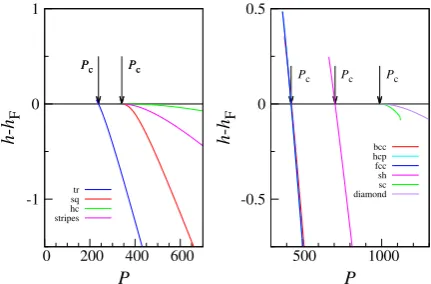
We confirm that, in two dimensions, the fluid freezes into a triangular cluster crystal (the coexistence densities areρf =12.315 andρtr =13.131, withρtrv0 =25.8 [10]). In three dimensions, the only relevant zero-temperature PSM phases besides the fluid are the compact cubic tals (fcc, bcc, and hcp), see Fig. 1. Loosely packed crys-tals, such as the simple-cubic crystal and the diamond crystal, melt continuously at a common pressure Pcthat
-1 0 1
0 200 400 600
Pc Pc
h-hF
P tr sq hc stripes
-0.5 0 0.5
500 1000
Pc Pc
Pc Pc Pc
h-hF
P bcc hcp fcc sh sc diamond
Figure 1. Enthalpyh(units ofe0) for each solid phase, see
leg-end, plotted as a function of P(units ofe2
0−1σ−d), taking the
densate wave function, dependent on parameters, and op-timize its shape by minimizing the MF energy functional. We have checked in a few two-dimensional (2D) cases that the best variational state reproduces the GP wave function and energy very accurately [10]. Then, by examining a wide spectrum of 3D lattices, we have identified stable and metastable solid phases and characterized their melting be-havior.
2 Three- and two-dimensional systems
The MF energy functional reads:
E[ψ;ρ] = Ekin+Epot, with
Ekin = −
2
2m
ddrψ∗∇2ψ;
Epot = N2
ddrddr|ψ(r)|2u(r−r)|ψ(r)|2, (3) representing the sum of zero-point kinetic energy and po-tential energy per unit particle. When the density is low, energy is minimized by spreading the wave function ψ
over the system volume, and the stable phase is then fluid. On the contrary, for very high densities the energy is lower for a strongly inhomogeneousψpeaked at the sites of a
crystalline lattice (at least provided that the bounded po-tentialuis “fatter” than Gaussian).
Within the variational method, we write the conden-sate wave function as a sum of Gaussians:
ψ(x)=Cα√1 V
R
e−α(x−aR)2, (4)
where theR’s are direct-lattice vectors, whileαandaare
adjustable parameters. Clearly,α =0 corresponds to the
fluid phase. The normalization constant in (4) is given by [10]
Cα =
v0 ad
2α
πI(α)2/d
d/4
with I(α)=
R e−α
2a2R2,
(5) wherev0is the volume of the primitive cell. To allow for the possibility of cluster crystals, the lattice constantaand the number densityρare taken as independent variables.
DenotingNcthe number of lattice cells, the number of par-ticles per cell is on average N/Nc = (N/V)(V/Nc) =ρv0. If in equilibriumρv0 >1, then the solid phase is a cluster crystal.
On the other hand,ψcan also be written as a Fourier series,
ψ(x)= √1
V
G
ψGeiG·x, (6)
where theG’s are reciprocal-lattice vectors. The Fourier coefficients ofψare given by [10]
ψG=Cαe−G24αa2 with C
α= ad v0 2π αI(α)2/d
d/4
. (7)
Unlessαis exceptionally large, the Fourier series is better
suited for the computations than the originalψexpression.
The main advantage of the Gaussian ansatz is an an-alytic simplification of the energy functional, allowing a considerable speed up in the numerical calculations [10]. Indeed, the kinetic energy admits a closed-form expres-sion:
Ekin =e0d2ασ 2
a2
1+2
dα I(α)
I(α)
, (8)
wheree0 =2/(mσ2) is a natural energy unit. At variance withEkin, the formula of the potential energy is explicitly lattice-dependent. For the triangular lattice, we find:
Epot= 12ρ
(e,e)
u(G)e−G2a2 4α +
J(α) I(α)
2
¬(e,e)
u(G)e−G2a2 4α
,
(9) whereu(k) is the real-valued Fourier transform ofu. In the first sum, only even-even combinations of reciprocal-lattice basis vectorsb1andb2do occur; the otherG’s are exclusively involved in the second sum. Finally,
I(α)=2πa
2
αv0
G e−G2a2
2α and J(α)=2πa
2
αv0
G
e−(G+b1/2)2a2 2α .
(10) An expression similar to (9) holds for any Bravais or non-Bravais lattice, both in two and in three dimensions. Choosing the pressurePas the control parameter, the most stable phase atT =0 is the one with the lowest enthalpy.
We confirm that, in two dimensions, the fluid freezes into a triangular cluster crystal (the coexistence densities areρf =12.315 andρtr =13.131, withρtrv0 =25.8 [10]). In three dimensions, the only relevant zero-temperature PSM phases besides the fluid are the compact cubic tals (fcc, bcc, and hcp), see Fig. 1. Loosely packed crys-tals, such as the simple-cubic crystal and the diamond crystal, melt continuously at a common pressure Pc that
-1 0 1
0 200 400 600
Pc Pc
h-hF P tr sq hc stripes -0.5 0 0.5
500 1000
Pc Pc
Pc Pc Pc
h-hF P bcc hcp fcc sh sc diamond
Figure 1. Enthalpyh(units ofe0) for each solid phase, see
leg-end, plotted as a function of P(units ofe2
0−1σ−d), taking the
fluid as reference. Left: 2D case. The arrows mark the transition into the triangular crystal (left) and into the square crystal (right). The transition pressure for the honeycomb and striped crystals is the same as for the square crystal [10]. Right: 3D case. The ar-rows mark the transition into the fcc crystal (left), the sh crystal (middle), and the sc crystal (right). The transition pressure for the diamond crystal is the same as for the sc crystal [10].
is much larger than, say, the fcc melting pressure. The fluid freezes into a fcc crystal (ρfσ3/e0 = 14.294 and
ρfccσ3/e0=16.599 are the density values at coexistence, withρfccv0 =36.7 [10]), but the difference in enthalpy
be-tween fcc and hcp is very small. As the pressure increases, the hcp crystal eventually prevails, and a fcc-to-hcp transi-tion then takes place.
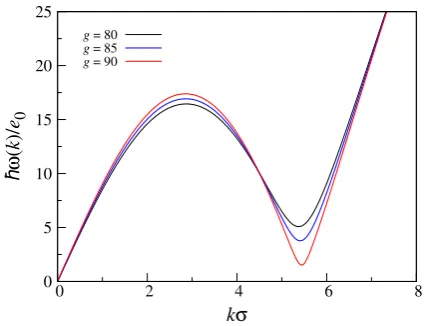
The MF spectrum of fluid excitations can be obtained by solving, in the amplitude-phase representation, the time-dependent GP equation for a condensate wave func-tion that deviates only slightly from homogeneity. It turns out (see e.g. [10]) that the perturbation has the form of plane waves with a dispersion relation of Bogoliubov type,
ω(k)=
2k2 2m
2k2
2m +2ρu(k)
. (11)
In particular, ifu(k) is negative in a range ofkvalues then
the fluid phase exhibits superfluid behavior (by Landau’s argument). For the 3D PSM fluid,ω(k) shows a roton
min-imum for high enough densities (see Fig. 2). The roton minimum becomes unstable exactly at the transition den-sity for continuous freezing, which will thus coincide with the upper stability threshold of the fluid.
A further outcome of our theory is the supersolid char-acter of the crystalline phases. A supersolid phase accom-modates both diagonal and off-diagonal long-range order,
meaning that particles are arranged in a crystalline struc-ture but, at the same time, can flow without dissipation. Like a superfluid, also a supersolid can be characterized by the nature of its response to uniform axial rotations. Un-der a slow rotation, a fraction of the supersolid stands still, as witnessed by the value of its moment of inertiaI be-ing smaller than the valueI0expected classically [11]. We have shown [10] that in MF theory the superfluid fraction 1−I/I0has a characteristic lower bound,ψ2min/ψ2max, where
ψmin andψmax are the minimum and maximum value of
ψin a cell. In our variational theory this lower bound is
0 5 10 15 20 25
0 2 4 6 8
¯h ω (k )/ e0 kσ
g = 80 g = 85 g = 90
Figure 2. Dispersion relation of collective excitations for the PSM fluid, plotted for three values ofg≡ρu(0)/e0(see legend).
The r.h.s. of Eq. (11) is positive up tog=90.9542. . ., which cor-responds to the same reduced density (21.7137. . .) where contin-uous freezing takes place in three dimensions.
strictly positive, implying that the crystal issupersolidat every pressure. In fact, above a certain pressure the value ofψin the interstitial region is so small that phase coher-ence will be destroyed by quantum fluctuations, and the system then enters a “normal” solid phase (see, e.g., [12]).
3 One-dimensional system
In the one-dimensional (1D) case, which we treated in Ref. [13], the analytic simplifications introduced by the Gaussian ansatz are even stronger than in higher dimen-sions. The only problem with MF theory is that a rig-orous result by Pitaevskii and Stringari rules out, at zero temperature, any form of long-range order (including off
-diagonal long-range order) in 1D bosonic systems with continuous group symmetries [14]. However, if we add a trapping potential in the axial direction, both the ampli-tude and phase fluctuations are suppressed at low T and one has a true condensate in one dimension, at least pro-vided thatNis large enough [15].
Another issue concerns the range of validity of the MF approximation. A hand-waving argument goes as follows: MF theory is expected to hold when the healing length /mρu(0) (withu(0) ≈ σd), fixing the length scale above which collective physics dominates over single-particle physics, is much larger than the average inter-particle separation ρ−1/d. In equivalent terms, one might say that MF theory is valid whenever the kinetic energy per unit particle due to localization,2ρ2/d/(2m), is much larger than the interaction energyu(0)ρ. In three
dimen-sions, this leads toρσ3/e0(e0/)2, which corresponds
to a density range that is wider the weaker the interaction strength. However, in one dimension the MF regime is ratherρσ/e0(/e0)2, and the approximation improves withincreasingdensity.
4 Soft-core bosons on a sphere
Finally, we have extended our theory to the case of parti-cles embedded in a spherical surface. The systems which more closely conform to this setting are ultracold bosons trapped in a thin spherical shell, which will be the sub-ject of upcoming experiments under microgravity condi-tions [16].
also clusterize at high density, becoming solid-like inho-mogeneous. As for the classical system, numerous struc-tures would compete for stability, and the natural candi-dates for the dense phases are highly symmetric packings of clusters. Considering that for the 2D PSM the edge of the triangular lattice is about 1.51σat the melting point, it is likely that the supporting frame of the clusters for a givenRwill be found among the regular or quasi-regular polyhedra with edge≈1.51σ. For instance, since the ra-dius of the sphere circumscribing the regular icosahedron equals
R=
4
10+2√5, (12)
an icosahedral cluster phase is most likely to occur forR
1.44σ.
Expanding the condensate wave function in spherical harmonics,
ψ(Ω)=
∞
l=0 l
m=−l clmYm
l (Ω) with
lm
|clm|2=1, (13)
the specific energyE is again written as the sum of two terms [22],
Ekin =
2 2mR2
lm
l(l+1)|clm|2 (14)
and
Epot= N−1
2
lm
2π
1
−1dx u(x)Pl(x)
|dlm|2, (15)
where Pl(x) are Legendre polynomials and dlm are the Fourier coefficients of|ψ|2. In practice, thelsum must be truncated, i.e.,l≤lmax, wherelmaxis chosen in accordance with the spatial resolution adopted for the description [23]. We have first provided an analytic proof of clusteriza-tion forR=1.45σ, i.e., where we expect that the
symme-try of the stable phase is icosahedral. We employ a vari-ational wave function that is a weighted sum of the two simplest icosahedral harmonics [24],
ψ=Cβ(T00+βT0 6)
with Cβ= 1 1+β2
, (16)
withβa parameter to optimize. For thisψthe calculation
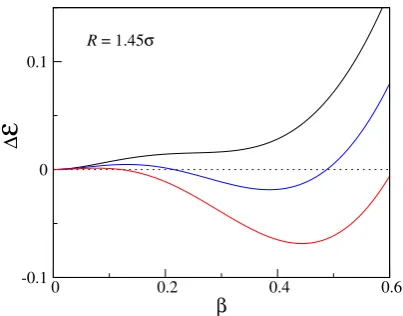
of (14) and (15) is an analytictour de force[22], and a graphical demonstration of the existence of the transition for the PSM fluid is provided in Fig. 3.
Clearly, choosing the icosahedron as scaffolding for
the clusters is just one possibility; as Rincreasingly de-parts from 1.45σ, other polyhedra will be better suited than the icosahedron for matching the condition ≈
1.51σ. We have considered ten circumscribable polyhedra (see Table 1), and for each of them computed the grand potential as a function ofR(for fixed radius and chemical potential, the stable phase is the one with the lowest grand potential). A one-parameterψ adequate to represent the
high-density patterns is a sum of Gaussians centered at the verticesRk(k=1, . . . ,n) of the given polyhedron:
ψ(ˆr)=Cα n
k=1
exp
−α
Rrˆ−Rk
2
. (17)
-0.1 0 0.1
0 0.2 0.4 0.6
ε
R = 1.45σ
∆
β
Figure 3. Energy (units ofe0) of the PSM solid relative to the
fluid, plotted as a function ofβforR=1.45σand three densities ρ(units ofσ.2e0/): from top to bottom,ρ = 14.5 (black), 15
(blue), and 15.5 (red).
The fluid ground state (ψ=1/√4π) is recovered as a limit-ing case, that is forα=0. We have followed two different
but equivalent routes to compute the grand potential [22]: either i) a direct Monte Carlo estimate of the integrals orig-inally definingEkinandEpot; or ii) the calculation of a large number of Fourier coefficients forψandψ2.
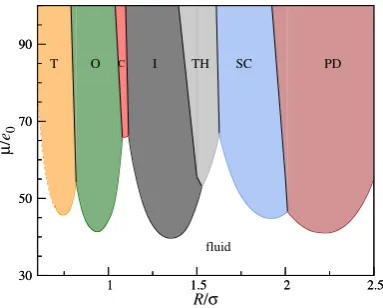
The resulting ground-state diagram of the PSM fluid, plotted in Fig. 4, includes as many as seven supersolid cluster phases in theRrange from 0.6σto 2.5σ. All transi-tion lines are first-order, except for a portransi-tion of the melting line for the tetrahedral phase (marked as dashed in Fig. 4) which is second-order. Each cluster phase spans a certain
Table 1.Edge lengthin units of the circumscribed radiusRfor the polyhedra analyzed in this work (the five regular solids, three Archimedean solids, and two Catalan solids). For the snub-cube case, 3t=1+ 3
19−3√33+ 3
19+3√33 and
γ3=26+6√33. In the last two lines, the quoted/Rrefers to the biscribed form of the polyhedron, and in this case
represents the short edge.
polyhedron /R
tetrahedron 2√2/3=1.632. . .
cube 2√3/3=1.154. . .
octahedron √2=1.414. . .
dodecahedron 4/√3+ √15=0.713. . .
icosahedron 4/
10+2√5=1.051. . .
cuboctahedron 1
rombicuboctahedron 2/
5+2√2=0.714. . .
snub cube √2(2√−8/γ+γ)/3
t2+t−2+1 =0.744. . . tetrakis
hexahedron
63−√3/3=0.919. . .
pentakis dodecahedron
3015−155+2√5
also clusterize at high density, becoming solid-like inho-mogeneous. As for the classical system, numerous struc-tures would compete for stability, and the natural candi-dates for the dense phases are highly symmetric packings of clusters. Considering that for the 2D PSM the edge of the triangular lattice is about 1.51σat the melting point, it is likely that the supporting frame of the clusters for a givenRwill be found among the regular or quasi-regular polyhedra with edge≈1.51σ. For instance, since the ra-dius of the sphere circumscribing the regular icosahedron equals
R=
4
10+2√5, (12)
an icosahedral cluster phase is most likely to occur forR
1.44σ.
Expanding the condensate wave function in spherical harmonics,
ψ(Ω)=
∞
l=0 l
m=−l clmYm
l (Ω) with
lm
|clm|2=1, (13)
the specific energyE is again written as the sum of two terms [22],
Ekin =
2 2mR2
lm
l(l+1)|clm|2 (14)
and
Epot= N−1
2
lm
2π
1
−1dx u(x)Pl(x)
|dlm|2, (15)
where Pl(x) are Legendre polynomials and dlm are the Fourier coefficients of|ψ|2. In practice, thelsum must be truncated, i.e.,l≤lmax, wherelmaxis chosen in accordance with the spatial resolution adopted for the description [23]. We have first provided an analytic proof of clusteriza-tion forR=1.45σ, i.e., where we expect that the
symme-try of the stable phase is icosahedral. We employ a vari-ational wave function that is a weighted sum of the two simplest icosahedral harmonics [24],
ψ=Cβ(T00+βT60)
with Cβ= 1 1+β2
, (16)
withβa parameter to optimize. For thisψthe calculation
of (14) and (15) is an analytictour de force [22], and a graphical demonstration of the existence of the transition for the PSM fluid is provided in Fig. 3.
Clearly, choosing the icosahedron as scaffolding for
the clusters is just one possibility; as Rincreasingly de-parts from 1.45σ, other polyhedra will be better suited than the icosahedron for matching the condition ≈
1.51σ. We have considered ten circumscribable polyhedra (see Table 1), and for each of them computed the grand potential as a function ofR(for fixed radius and chemical potential, the stable phase is the one with the lowest grand potential). A one-parameterψ adequate to represent the
high-density patterns is a sum of Gaussians centered at the verticesRk(k=1, . . . ,n) of the given polyhedron:
ψ(ˆr)=Cα n
k=1
exp
−α
Rrˆ−Rk
2
. (17)
-0.1 0 0.1
0 0.2 0.4 0.6
ε
R = 1.45σ
∆
β
Figure 3. Energy (units ofe0) of the PSM solid relative to the
fluid, plotted as a function ofβforR=1.45σand three densities ρ(units ofσ.2e0/): from top to bottom,ρ= 14.5 (black), 15
(blue), and 15.5 (red).
The fluid ground state (ψ=1/√4π) is recovered as a limit-ing case, that is forα=0. We have followed two different
but equivalent routes to compute the grand potential [22]: either i) a direct Monte Carlo estimate of the integrals orig-inally definingEkinandEpot; or ii) the calculation of a large number of Fourier coefficients forψandψ2.
The resulting ground-state diagram of the PSM fluid, plotted in Fig. 4, includes as many as seven supersolid cluster phases in theRrange from 0.6σto 2.5σ. All transi-tion lines are first-order, except for a portransi-tion of the melting line for the tetrahedral phase (marked as dashed in Fig. 4) which is second-order. Each cluster phase spans a certain
Table 1.Edge lengthin units of the circumscribed radiusRfor the polyhedra analyzed in this work (the five regular solids, three Archimedean solids, and two Catalan solids). For the snub-cube case, 3t=1+ 3
19−3√33+ 3
19+3√33 and
γ3=26+6√33. In the last two lines, the quoted/Rrefers to the biscribed form of the polyhedron, and in this case
represents the short edge.
polyhedron /R
tetrahedron 2√2/3=1.632. . .
cube 2√3/3=1.154. . .
octahedron √2=1.414. . .
dodecahedron 4/√3+ √15=0.713. . .
icosahedron 4/
10+2√5=1.051. . .
cuboctahedron 1
rombicuboctahedron 2/
5+2√2=0.714. . .
snub cube √2(2√−8/γ+γ)/3
t2+t−2+1 =0.744. . . tetrakis
hexahedron
63−√3/3=0.919. . .
pentakis dodecahedron
3015−155+2√5
15 =0.640. . .
30 50 70 90
1 1.5 2 2.5
µ
/e
0
R/σ
30 50 70 90
1 1.5 2 2.5
fluid
T O C I TH SC PD
Figure 4. PSM bosons on a sphere: T =0 phase diagram
ac-cording to our theory, choosing the radiusRand the chemical potentialµ as control parameters. AsR increases, the cluster phase changes accordingly, successively assuming the symmetry of a tetrahedron (T), octahedron (O), cube (C), icosahedron (I), tetrakis hexahedron (TH), snub cube (SC), and pentakis dodeca-hedron (PD).
interval ofR; when more phases compete for stability, the phase with the lowest value of grand potential turns out to be the one providing the most efficient occupation of the
surface, or, equivalently, the highest coordination number.
5 Conclusions
We have used the variational method to evaluate, within MF theory and a Gaussian ansatz for the condensate wave function, the average quantum energy of a collection of fully penetrable bosons in spaces of various dimensional-ity. Using this information, we have identified the zero-temperature phases of the PSM system and clarified the nature of the pressure-induced freezing transition. In the dense phase particles are invariably gathered in clusters centered at the sites of a crystalline lattice. For the special case of particles embedded in a spherical surface, clus-ters instead fall at the vertices of a regular or semi-regular polyhedron inscribed in the sphere. Within our MF de-scription, the dense phases are all supersolid, i.e., they are characterized by non-classical rotational inertia.
References
[1] L. Pitaevskii and S. Stringari,Bose-Einstein Conden-sation and Superfluidity(Oxford University Press, New York, 2016)
[2] N. Henkel, R. Nath, and T. Pohl, Phys. Rev. Lett.104, 195302 (2010)
[3] S. Saccani, S. Moroni, and M. Boninsegni, Phys. Rev. B83, 092506 (2011)
[4] K. Zhang and P. Charbonneau, J. Chem. Phys. 136, 214106 (2012)
[5] C. N. Likos, A. Lang, M. Watzlawek, and H. Löwen, Phys. Rev. E63, 031206 (2001)
[6] B. M. Mladek, P. Charbonneau, C. N. Likos, D. Frenkel, and G. Kahl, J. Phys.: Condens. Matter20, 494245 (2008)
[7] Y. Pomeau and S. Rica, Phys. Rev. Lett. 72, 2426-2429 (1994)
[8] M. Kunimi and Y. Kato, Phys. Rev. B86, 060510(R) (2012)
[9] T. Macrì, F. Maucher, F. Cinti, and T. Pohl, Phys. Rev. A87, 061602(R) (2013)
[10] S. Prestipino, A. Sergi, and E. Bruno, Phys. Rev. B 98, 104104 (2018)
[11] A. J. Leggett, J. Stat. Phys.93, 927-941 (1998) [12] F. Cinti, T. Macrì, W. Lechner, G. Pupillo, and T.
Pohl, Nat. Commun.5, 3235 (2014)
[13] S. Prestipino, A. Sergi, and E. Bruno, J. Phys. A52, 015002 (2019)
[14] L. Pitaevskii and S. Stringari, J. Low Temp. Phys.85, 377-388 (1991)
[15] D. S. Petrov, G. V. Shlyapnikov, and J. T. M. Wal-raven, Phys. Rev. Lett.85, 3745-3749 (2000)
[16] N. Lundblad, R. A. Carollo, C. Lannert, M. J. Gold, X. Jiang, D. Paseltiner, N. Sergay, and D. C. Aveline, arXiv:1906.05885
[17] S. Prestipino Giarritta, M. Ferrario, and P. V. Gi-aquinta, Physica A187, 456-474 (1992)
[18] S. Prestipino Giarritta, M. Ferrario, and P. V. Gi-aquinta, Physica A201, 649-665 (1993)
[19] S. Prestipino, C. Speranza, and P. V. Giaquinta, Soft Matter8, 11708-11713 (2012)
[20] J.-P. Vest, G. Tarjus, and P. Viot, J. Chem. Phys.148, 164501 (2018)
[21] S. Franzini, L. Reatto, and D. Pini, Soft Matter14, 8724-8739 (2018)
[22] S. Prestipino and P. V. Giaquinta, Phys. Rev. A99, 063619 (2019)
[23] S. Prestipino, A. Laio, and E. Tosatti, J. Chem. Phys. 138, 064508 (2013)