82 |
P a g e
www.ijarse.com
DECISION MAKING IN RECRUITMENT PROCESS
WITH AHP AND ANP
Kartik Singh¹, Rahul Sindhwani², Punj L Singh³
¹
,2Department of Mechanical and Automation Engineering, Amity University, 201301, Noida, (India)
³Department of Civil Engineering, Amity University, 201301, Noida, (India)
ABSTRACT
With the booming of IT sector everywhere and thousands of newly trained professionals and hundreds of
colleges providing peak level of excellence in education and Increase in number of trained professionals, the
Recruitment process is getting very hard. To find stability in the various traits of a recruit during a recruitment
process and a good relationship between the recruiter and recruit is a very complex condition. To solve this
problem we analyse AHP and ANP approach on a case study done in various industries by questionnaire based
survey and literature based survey. The various opinions were taken from the HR recruiters in the form of
questionnaire based survey from the respected companies and the data was fed in the AHP and ANP
formulation process to find the various priority levels in the traits of a professional during recruitment process.
The objective of this paper is to present the results of the application of AHP and ANP processes to help in the
recruitment process done in various industries considering various stages and traits of a student.
Keywords
:
Analytical Hierarchy Process, Analytical Network Process, Recruitment, Human
Resource Managers
I INTRODUCTION
This paper is based on the very fact that when undergoing through any procedure in any respected field a certain number of data or traits are required in an organised manner so to carry out the procedure effectively and efficiently. The whole system of organising certain traits and characteristics that acts as the spine of a procedure and on which the whole process is based yields effective result if the system is well organised. Here we try to work through one such complex procedure i.e. Recruitment process which is a much neglected topic yet one of the essential elements an individual have to face in his life. As the process is very complex which have to consider certain parameters and traits of a particular recruit which have to be carefully examined so as to compete and fulfil the very basic requirement the firm is hiring for.
83 |
P a g e
www.ijarse.com
processed to give the priority levels for the various alternatives provided. Many problems cannot be processed in hierarchy because they involve the interdependency of higher level element in a hierarchy on lower level elements. A network has cluster of elements and each element in a cluster is dependent on other element of the same cluster i.e. inner dependence of elements as well as the elements in one cluster is linked with the elements of other cluster i.e. outer dependence. Hence ANP is represented by a network and not a hierarchy. These can be best understood form figure 1.
Figure 1
II LITERATURE SURVEY ON RECRUITMENT PROCESS AND PERSONNEL
SELECTION
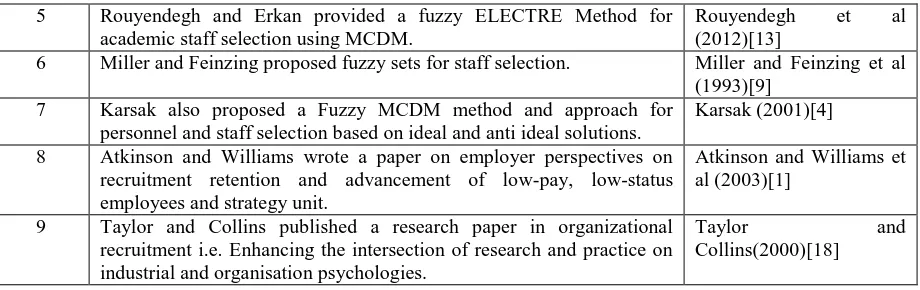
A lot of scientists and researchers early conducted surveys and research on Personnel selection and Recruitment process. Liang and wang et al. Conducted a multi criterion decision making methods by using a fuzzy approach on personnel selection. Grungor et al. also contributed in personnel selection using fuzzy AHP by quantitative and qualitative criterion. Askunois conducted a TOPSIS method on recruitment process or personnel selection. Barber conducted his research on personnel selection in both individual and organizational perspective. Rouyendegh and Erkan worked on Fuzzy ELECTRE method while Miller and his Feinzing on fuzzy sets for personnel selection. Karsak worked on fuzzy MCDM (multi criterion method) by using ideal and anti ideal situations. Atkinson and Williams worked his research on an employer and various perspectives attached to it. Taylor and Collins worked on a research paper in organisational recruitment.
1 Liang and Wang et al. carried out MCDM (Multi criterion decision making) methods that use a fuzzy MCDM method approach for personnel selection.
Liang and Wang et al (1994)[7]
2 Gungor et al. submittted a fuzzy AHP(Multi criterion decision making method )for personnel selection using quantitative and qualitative criterion.
Güngör et al (2009)[3]
3 Askounis provided a TOPSIS method for recruitment process or personnel selection.
Kelemenis and Askounis et al (2010)[6]
4 Barber gave a significant contribution in recruiting employees. Individual and organizational perspective
84 |
P a g e
www.ijarse.com
5 Rouyendegh and Erkan provided a fuzzy ELECTRE Method for academic staff selection using MCDM.
Rouyendegh et al (2012)[13]
6 Miller and Feinzing proposed fuzzy sets for staff selection. Miller and Feinzing et al (1993)[9]
7 Karsak also proposed a Fuzzy MCDM method and approach for personnel and staff selection based on ideal and anti ideal solutions.
Karsak (2001)[4]
8 Atkinson and Williams wrote a paper on employer perspectives on recruitment retention and advancement of low-pay, low-status employees and strategy unit.
Atkinson and Williams et al (2003)[1]
9 Taylor and Collins published a research paper in organizational recruitment i.e. Enhancing the intersection of research and practice on industrial and organisation psychologies.
Taylor and Collins(2000)[18]
TABLE 2.1
Several scientists and researchers have carried out extended literature view on personnel selection or Recruitment process. To evaluate the recruitment process we are using literature view and questionnaire based survey to find various characteristics that are essentially required or need to be possessed by an individual are studied to yield following given results.
III ATTRIBUTES REQUIRED IN PERSONNEL SELECTION
3.1 Academic Factors
Academic factors are defined as those factors that somehow influence the academic criterion of an individual. Academic factors are very important in recruitment of fresher’s specially. (Rouyendegh and Babak Daneshvar et al.(2012)[12]) Various academic factors can be subdivided into :-
3.1.1 Experience
Experience is one of the major criteria considered during the recruitment process as experience consists of knowledge of some particular skill gained through exposure. Experience is rated one of the major criteria for recruitment process (WERS-(2004)[19]).
3.1.2 Qualifications
Qualification is somewhat defined as a quality or a particular title gained in the field of education which can be anything for ex:- engineering , doctorate and so on (WERS-(2004)[19]).
3.1.3 Team Working
Team work is defined as "work done by several associates with each doing a part but all subordinating personal prominence to the efficiency of the whole” according to "Teamwork". Merriam-Webster Dictionary online. Retrieved April 26, 2012.” It is put up as one of the major criteria for recruitment process in (Rouyendegh and
85 |
P a g e
www.ijarse.com
3.2. Individual Factors
Individual factors are those factors that are responsible for defining who an individual is and what an individual does. It is one of the three factors that is considered for recruitment process (Rouyendegh and Babak Daneshvar et al.(2012)[12]) The various sub points in Individual factors are as follows:-
3.2.1. Skills
A skill is a learned ability that is used to perform a task which results are predetermined. After experience Skills is second most important factor for recruitment process (WERS-(2004)[19]).
3.2.2. Motivation
Motivation is a defined something as a force that derives the flux from desire to will in life. Motivation in Industries surprisingly was rated one of the major important factor in recruitment process (WERS-(2004)[19]). Motivation is one of the essential elements in leadership qualities which are required by an individual to perform well in an industry.
3.2.3. Age
Ageing is defined as defined as the effect of time on the attributes of an individual. Ageing is a low priority in recruitment process but it is still to be considered while hiring an individual (WERS-(2004)[19]).
3.3. Work Factor
Work factor is defined as the amount of work or job done by an individual. Work factor relates with those factors that somehow affect the working power of an individual or it can be defined as the attributes which affect the job carrying capacity of an individual. Work factor is considered one of the major factor during recruitment process (Rouyendegh and Babak Daneshvar et al.(2012)[12]).It consist of various sub points that are as follows:-
3.3.1. Confidence
Confidence is defined as a state of being certain of result for any outcome or prediction. Self confidence is defined as having confidence in oneself. Confidence is one of the major criteria for recruitment process (Rouyendegh and Babak Daneshvar et al.(2012)[12])
3.3.2. Availability
Availability is also considered as reliability. According (WERS-(2004)[19]) it was introduced as one of the essential skills in recruitment process..
3.3.3. References
References include professional connections that can attest or verify to your qualifications for the job that is written in your resume. It is also one of the major criterions nowadays for personnel (WERS-(2004)[19]). All the factors that are taken consideration according to their importance can be seen in table 3.1
86 |
P a g e
www.ijarse.com
Table 3.1: Important factors
in recruiting (
Ewart Keep
et al. (2010)[11])
IV METHODOLOGY
4.1. AHP Process
The Analytic Hierarchy Process (AHP) for decision-making is a theory of relative measurement based on paired comparisons used to derive normalized absolute scales of numbers whose elements are then used as priorities [T.L. Saaty(1980) Pittsburgh(1990, 1996[14,15,16])].
AHP process is a MCDM(multi criterion decision making process) used for Decision making in various traits. AHP consists of a hierarchy network. A hierarchy consists of a Goal, various stages of elements, These so called elements are our deciding factors in the process and are interdependent on each other and Alternatives. Alternatives are the final results on which our whole process is based. The alternatives are processed using various criteria or elements. The importance of criteria is the factor of selection of alternatives as well as the importance of alternatives themselves is a depending factor of importance of elements.
IMPLEMENTATION
PROCESS
Step 1: Forming the network
The first major step includes formation of network. The network as stated earlier consists of a Goal, Elements and alternatives. These alternatives can be divided into sub-alternatives. The last thing of the network consists of Alternatives. These alternatives are the final results of which priority levels are synthesised. Various elements and sub elements importance are the major deciding factor of our Alternatives.
Step 2: Pair-wise comparison matrix and obtaining priority level
Pair wise comparison matrix is formed in the various elements and sub elements in the hierarchy process. Pair wise comparison matrix is formed using the Importance weight of factors. This importance weight of factors scale is given in Table 3. After formation of pair wise comparison matrix their respected priority vectors are obtained or synthesised which can be given in Unweighted super matrix.
1 Equal importance
3 Moderate importance
5 Essential or strong importance
Experience 86%
Skills 83%
Motivation 80%
References 71%
Qualifications 54%
Availability 47%
Recommendations 40%
87 |
P a g e
www.ijarse.com
7 Very strong importance
9 Extreme importance
2,4,6,8 Intermediate value between the scale values
Table 4.1(Intensity of importance)
Step 3: Obtaining results in form of Super matrix
For obtaining the results AHP or comparing matrices on their weight of importance it uses the principal eigenvector of comparison matrix. After putting the input of all the weights of importance the super matrix is synthesised. The super matrix represents the relationship between two components of a system.
Step 4: Selecting the best alternative
The various weight of importance of alternatives, factors and sub factors can be determined from the super matrix. The alternative with the highest weight of importance is selected.
4.2. ANP Process
ANP or Analytical Network Process is a MCDM(Multi Criterion Decision Making) originally invented by Prof. ThomasL. Saaty[14] ANP is actually a generalised form of AHP. Many decision making problems cannot be solved using AHP because Hierarchy involve the interdependence and interaction of higher level elements on lower level elements. The network contains multiple clusters. Each cluster has its own elements and the elements of one cluster are dependent on elements of another cluster which is called Outer dependence or is dependent on elements of its own cluster which is called Inter dependence. ANP consists of clusters, elements and Interrelationship between elements.
IMPLEMENTATION
PROCESS:-
Step 1: Forming the
network:-The problem should be stated clearly and then divided into a rational system. Here the complete structure is formed through the questionnaire based survey submitted to the various HR managers of respective companies and obtaining results from them. While forming an ANP network we first define elements, sub-elements and then alternatives are defined in last. After that clusters of elements are defined. The network is formed on relationship among clustersand the elements subdivided into these clusters.
Step 2: Pair-wise comparison matrix and obtaining priority level:-
Pair wise comparison matrix is formed on the elements in the cluster as they are dependent by other clusters of the network and also on those elements that influence them. . Pair wise comparison matrix is formed using the Importance weight of factors just like in the case of AHP and this importance weight of factors scale is given in Table 2. In pair-wise comparison, decision makers compare two elements. Then, they determine the contribution of factors to the result as given by Thomal L. Saaty. After this the super decision software is implemented and the dependencies of the various elements and the affecting clusters are calculated.
Step 3: Obtaining results in form of Super matrix:-
88 |
P a g e
www.ijarse.com
between two components of a network. For obtaining the global priorities the priority vectors are fed into the matrix which is after then collectively converted into super matrix.
Step 4: Selecting the best alternative:-
Just like the case of AHP even in ANP the various weight of importance of alternatives, factors and sub factors can be determined from the super matrix. The alternative with the highest weight of importance is selected.
V PROCESSING
5.1 AHP Process
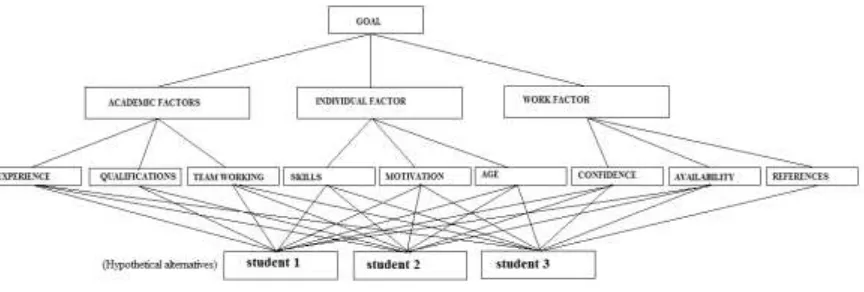
The network is first created in the AHP process as mention above in the implementation. Here for our given problem of personnel selection or recruitment process the constructed network is given in Figure 5.1.
FIGURE 5.1
The goal, elements and sub elements are defined and for our final result selection 3 hypothetical alternatives are taken as Student 1, Student 2 and Student 3. Their particular priority vectors are rated by the help of questionnaire based survey to the respective HR managers where each candidate excel in some attributes than the other two candidates while is deficit in some attributes as compared to the other two candidates.
The data is then fed into the Super decision making software and the pair wise comparison matrix is obtained. The unweighted super matrix is the matrix containing the priorities from pair wise comparisons which is given in figure 5.2.
ACADEMIC FACTORS ALTERNATIVES CRITERIA GOAL INDIVIDUAL FACTORS WORK FACTORS
EXPERIENCE QUALIFICATION TEAM WORKING STUDENT 1 STUDENT 2 STUDENT 3 ACADEMIC INDIVIDUAL WORK GOAL AGE MOTIVATION SKILLS AVAILABILITY CONFIDENCE REFRENCES
ACADEMIC FACTORS EXPERIENCE 0 0 0 0 0 0 0.379259 0 0 0 0 0 0 0 0 0
QUALIFICATION 0 0 0 0 0 0 0.331313 0 0 0 0 0 0 0 0 0
TEAM WORKING 0 0 0 0 0 0 0.289428 0 0 0 0 0 0 0 0 0
ALTERNATIVES STUDENT 1 0.289428 0.310814 0.289428 0 0 0 0 0 0 0 0.5 0.493386 0.5 0.1958 0.310814 0.376668
STUDENT 2 0.331313 0.493386 0.379259 0 0 0 0 0 0 0 0.25 0.1958 0.25 0.493386 0.1958 0.261167
STUDENT 3 0.379259 0.1958 0.331313 0 0 0 0 0 0 0 0.25 0.310814 0.25 0.310814 0.493386 0.362166
CRITERIA ACADEMIC 0 0 0 0 0 0 0 0 0 0.333333 0 0 0 0 0 0
INDIVIDUAL 0 0 0 0 0 0 0 0 0 0.333333 0 0 0 0 0 0
WORK 0 0 0 0 0 0 0 0 0 0.333333 0 0 0 0 0 0
GOAL GOAL 0 0 0 0 0 0 0 0 0 0 0 0 0 0 0 0
INDIVIDUAL FACTORS AGE 0 0 0 0 0 0 0 0.13501 0 0 0 0 0 0 0 0
MOTIVATION 0 0 0 0 0 0 0 0.280833 0 0 0 0 0 0 0 0
SKILLS 0 0 0 0 0 0 0 0.584156 0 0 0 0 0 0 0 0
WORK FACTORS AVAILABILITY 0 0 0 0 0 0 0 0 0.310814 0 0 0 0 0 0 0
CONFIDENCE 0 0 0 0 0 0 0 0 0.493386 0 0 0 0 0 0 0
89 |
P a g e
www.ijarse.com
Figure 5.2
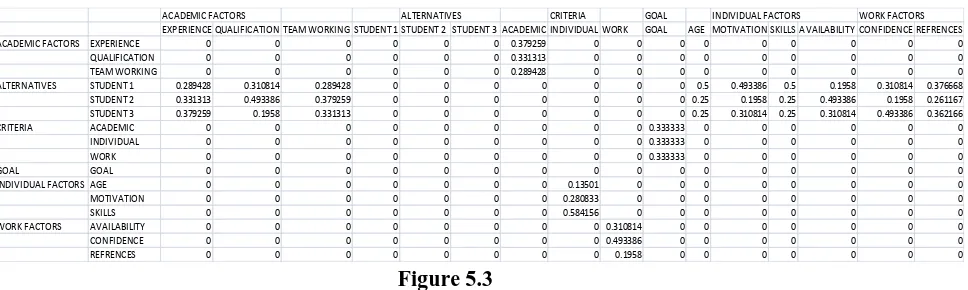
After formation of the unweighted supermatrix the given unweighted super matrix components have been multiplied by cluster weights and weighted supermatrix is obtained. The supermatrix of the following AHP structure is given in figure 5.3
ACADEMIC FACTORS ALTERNATIVES CRITERIA GOAL INDIVIDUAL FACTORS WORK FACTORS
EXPERIENCE QUALIFICATION TEAM WORKING STUDENT 1 STUDENT 2 STUDENT 3 ACADEMIC INDIVIDUAL WORK GOAL AGE MOTIVATION SKILLS AVAILABILITY CONFIDENCE REFRENCES
ACADEMIC FACTORS EXPERIENCE 0 0 0 0 0 0 0.379259 0 0 0 0 0 0 0 0 0
QUALIFICATION 0 0 0 0 0 0 0.331313 0 0 0 0 0 0 0 0 0
TEAM WORKING 0 0 0 0 0 0 0.289428 0 0 0 0 0 0 0 0 0
ALTERNATIVES STUDENT 1 0.289428 0.310814 0.289428 0 0 0 0 0 0 0 0.5 0.493386 0.5 0.1958 0.310814 0.376668
STUDENT 2 0.331313 0.493386 0.379259 0 0 0 0 0 0 0 0.25 0.1958 0.25 0.493386 0.1958 0.261167
STUDENT 3 0.379259 0.1958 0.331313 0 0 0 0 0 0 0 0.25 0.310814 0.25 0.310814 0.493386 0.362166
CRITERIA ACADEMIC 0 0 0 0 0 0 0 0 0 0.333333 0 0 0 0 0 0
INDIVIDUAL 0 0 0 0 0 0 0 0 0 0.333333 0 0 0 0 0 0
WORK 0 0 0 0 0 0 0 0 0 0.333333 0 0 0 0 0 0
GOAL GOAL 0 0 0 0 0 0 0 0 0 0 0 0 0 0 0 0
INDIVIDUAL FACTORS AGE 0 0 0 0 0 0 0 0.13501 0 0 0 0 0 0 0 0
MOTIVATION 0 0 0 0 0 0 0 0.280833 0 0 0 0 0 0 0 0
SKILLS 0 0 0 0 0 0 0 0.584156 0 0 0 0 0 0 0 0
WORK FACTORS AVAILABILITY 0 0 0 0 0 0 0 0 0.310814 0 0 0 0 0 0 0
CONFIDENCE 0 0 0 0 0 0 0 0 0.493386 0 0 0 0 0 0 0
REFRENCES 0 0 0 0 0 0 0 0 0.1958 0 0 0 0 0 0 0
Figure 5.3
It can be clearly seen that the unweighted super matrix and the weighted supermatrix of the given structure is same, it is because in the case of AHP and ANP the weighted and unweighted supermatirx is always same because in a hierarchy there are no cluster weights.
After the formation of the weighted supermatrix in the AHP this weighted supermatrix is raised to powers until it converges to give the final answer which is given in the form of limit Supermatrix which is given in Figure 5.4.
ACADEMIC FACTORS ALTERNATIVES CRITERIA GOAL INDIVIDUAL FACTORS WORK FACTORS
EXPERIENCE QUALIFICATION TEAM WORKING STUDENT 1 STUDENT 2 STUDENT 3 ACADEMIC INDIVIDUAL WORK GOAL AGE MOTIVATION SKILLS AVAILABILITY CONFIDENCE REFRENCES
ACADEMIC FACTORS EXPERIENCE 0 0 0 0 0 0 0.189629 0 0 0.04214 0 0 0 0 0 0
QUALIFICATION 0 0 0 0 0 0 0.165656 0 0 0.036813 0 0 0 0 0 0
TEAM WORKING 0 0 0 0 0 0 0.144714 0 0 0.032159 0 0 0 0 0 0
ALTERNATIVES STUDENT 1 0.289428 0.310814 0.289428 0 0 0 0.148257 0.249071 0.14398 0.120291 0.5 0.493386 0.5 0.1958 0.310814 0.376668 STUDENT 2 0.331313 0.493386 0.379259 0 0 0 0.199443 0.117389 0.150546 0.103862 0.25 0.1958 0.25 0.493386 0.1958 0.261167 STUDENT 3 0.379259 0.1958 0.331313 0 0 0 0.1523 0.133539 0.205474 0.109181 0.25 0.310814 0.25 0.310814 0.493386 0.362166
CRITERIA ACADEMIC 0 0 0 0 0 0 0 0 0 0.111111 0 0 0 0 0 0
INDIVIDUAL 0 0 0 0 0 0 0 0 0 0.111111 0 0 0 0 0 0
WORK 0 0 0 0 0 0 0 0 0 0.111111 0 0 0 0 0 0
GOAL GOAL 0 0 0 0 0 0 0 0 0 0 0 0 0 0 0 0
INDIVIDUAL FACTORS AGE 0 0 0 0 0 0 0 0.067505 0 0.015001 0 0 0 0 0 0
MOTIVATION 0 0 0 0 0 0 0 0.140417 0 0.031204 0 0 0 0 0 0
SKILLS 0 0 0 0 0 0 0 0.292078 0 0.064906 0 0 0 0 0 0
WORK FACTORS AVAILABILITY 0 0 0 0 0 0 0 0 0.155407 0.034535 0 0 0 0 0 0
CONFIDENCE 0 0 0 0 0 0 0 0 0.246693 0.054821 0 0 0 0 0 0
REFRENCES 0 0 0 0 0 0 0 0 0.0979 0.021756 0 0 0 0 0 0
Figure 5.4
After formation of limit supermatrix the whole model is synthesised to give the final results which is given in
Figure 5.5.
90 |
P a g e
www.ijarse.com
In figure 5.5 the raw values came directly from the limit supermatrix as given in Figure 5.4. The Normals or Normalized values are obtained from them by summing and dividing each value by sum and the ideals are obtained by dividing the raw values with the largest raw value.
5.2. ANP Process
The ANP was proposed in (Saaty(1996)[15]),Saaty and Vargas(1998)[16]) to beat the issue of reliance and input between criteria or choices. The ANP is the general type of the diagnostic chain of command procedure (AHP) (Saaty(1980)[14]) which has been utilized within multicriteria choice making (MCDM) to discharge the confinement of progressive structure, and has been connected to extend determination (Meade and Presley{2002)[8].Item arranging, key choice (Sarkis(2003)[17],Karsak et al.(2002)[5]), ideal planning (Momoh and Zhu(2003)[10]). Basically ANP is generalisation of AHP. The interdependence of various criteria and subcriteria are given in table 5.2.1
AFFECTED SUBCRITERIA AFFECTING SUB CRITERIA
Experience Qualification,Age,Confidence,Refrences Qualification Skills
Skills Experience,Qualification,Age Motivation Team working
Age Experience,Refrences Confidence Experience,skills,Motivation Availability Age
Refrences Experience,qualification,age
TABLE 5.2.1
As you can see in Table 5.6 various elements are having interdependence within their own structure or criteria and as well as outer dependence affecting sub criteria of other elements.
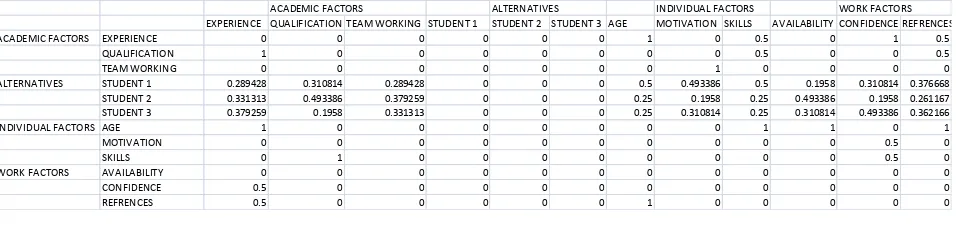
After formation of the inner and outer dependence table the unweighted matrix, weighted supermatrix and limit supermatrix is generated. In the case of ANP the unweighted and weighted supermatrix won’t be equal because
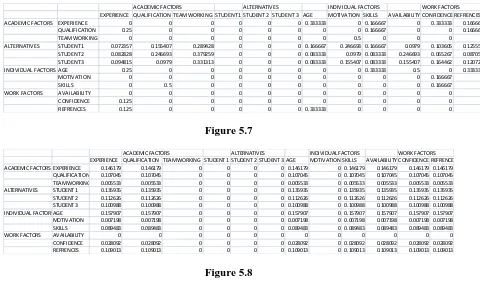
in ANP there are cluster weights. The unweighted matrix is given in figure 5.6, weighted matrix is given in figure 5.7 and limit matrix is given in figure 5.8.
ACADEMIC FACTORS ALTERNATIVES INDIVIDUAL FACTORS WORK FACTORS
EXPERIENCE QUALIFICATION TEAM WORKING STUDENT 1 STUDENT 2 STUDENT 3 AGE MOTIVATION SKILLS AVAILABILITY CONFIDENCE REFRENCES
ACADEMIC FACTORS EXPERIENCE 0 0 0 0 0 0 1 0 0.5 0 1 0.5
QUALIFICATION 1 0 0 0 0 0 0 0 0.5 0 0 0.5
TEAM WORKING 0 0 0 0 0 0 0 1 0 0 0 0
ALTERNATIVES STUDENT 1 0.289428 0.310814 0.289428 0 0 0 0.5 0.493386 0.5 0.1958 0.310814 0.376668
STUDENT 2 0.331313 0.493386 0.379259 0 0 0 0.25 0.1958 0.25 0.493386 0.1958 0.261167
STUDENT 3 0.379259 0.1958 0.331313 0 0 0 0.25 0.310814 0.25 0.310814 0.493386 0.362166
INDIVIDUAL FACTORS AGE 1 0 0 0 0 0 0 0 1 1 0 1
MOTIVATION 0 0 0 0 0 0 0 0 0 0 0.5 0
SKILLS 0 1 0 0 0 0 0 0 0 0 0.5 0
WORK FACTORS AVAILABILITY 0 0 0 0 0 0 0 0 0 0 0 0
CONFIDENCE 0.5 0 0 0 0 0 0 0 0 0 0 0
REFRENCES 0.5 0 0 0 0 0 1 0 0 0 0 0
Figure 5.6
91 |
P a g e
www.ijarse.com
ACADEMIC FACTORS ALTERNATIVES INDIVIDUAL FACTORS WORK FACTORS
EXPERIENCE QUALIFICATION TEAM WORKING STUDENT 1 STUDENT 2 STUDENT 3 AGE MOTIVATION SKILLS AVAILABILITY CONFIDENCE REFRENCES
ACADEMIC FACTORS EXPERIENCE 0 0 0 0 0 0 0.333333 0 0.166667 0 0.333333 0.166667
QUALIFICATION 0.25 0 0 0 0 0 0 0 0.166667 0 0 0.166667
TEAM WORKING 0 0 0 0 0 0 0 0.5 0 0 0 0
ALTERNATIVES STUDENT 1 0.072357 0.155407 0.289428 0 0 0 0.166667 0.246693 0.166667 0.0979 0.103605 0.125556
STUDENT 2 0.082828 0.246693 0.379259 0 0 0 0.083333 0.0979 0.083333 0.246693 0.065267 0.087056
STUDENT 3 0.094815 0.0979 0.331313 0 0 0 0.083333 0.155407 0.083333 0.155407 0.164462 0.120722
INDIVIDUAL FACTORS AGE 0.25 0 0 0 0 0 0 0 0.333333 0.5 0 0.333333
MOTIVATION 0 0 0 0 0 0 0 0 0 0 0.166667 0
SKILLS 0 0.5 0 0 0 0 0 0 0 0 0.166667 0
WORK FACTORS AVAILABILITY 0 0 0 0 0 0 0 0 0 0 0 0
CONFIDENCE 0.125 0 0 0 0 0 0 0 0 0 0 0
REFRENCES 0.125 0 0 0 0 0 0.333333 0 0 0 0 0
Figure 5.7
ACADEMIC FACTORS ALTERNATIVES INDIVIDUAL FACTORS WORK FACTORS
EXPERIENCE QUALIFICATION TEAM WORKING STUDENT 1 STUDENT 2 STUDENT 3 AGE MOTIVATION SKILLS AVAILABILITY CONFIDENCE REFRENCES
ACADEMIC FACTORS EXPERIENCE 0.146179 0.146179 0 0 0 0 0.146179 0 0.146179 0.146179 0.146179 0.146179
QUALIFICATION 0.107045 0.107045 0 0 0 0 0.107045 0 0.107045 0.107045 0.107045 0.107045
TEAM WORKING 0.005533 0.005533 0 0 0 0 0.005533 0 0.005533 0.005533 0.005533 0.005533
ALTERNATIVES STUDENT 1 0.135935 0.135935 0 0 0 0 0.135935 0 0.135935 0.135935 0.135935 0.135935
STUDENT 2 0.112626 0.112626 0 0 0 0 0.112626 0 0.112626 0.112626 0.112626 0.112626
STUDENT 3 0.100988 0.100988 0 0 0 0 0.100988 0 0.100988 0.100988 0.100988 0.100988
INDIVIDUAL FACTORSAGE 0.157907 0.157907 0 0 0 0 0.157907 0 0.157907 0.157907 0.157907 0.157907
MOTIVATION 0.007198 0.007198 0 0 0 0 0.007198 0 0.007198 0.007198 0.007198 0.007198
SKILLS 0.089483 0.089483 0 0 0 0 0.089483 0 0.089483 0.089483 0.089483 0.089483
WORK FACTORS AVAILABILITY 0 0 0 0 0 0 0 0 0 0 0 0
CONFIDENCE 0.028092 0.028092 0 0 0 0 0.028092 0 0.028092 0.028092 0.028092 0.028092
REFRENCES 0.109013 0.109013 0 0 0 0 0.109013 0 0.109013 0.109013 0.109013 0.109013
Figure 5.8
After the formation of weighted, unweighted and limit matrix the final results are synthesised which are given in figure 5.9
Figure 5.9
VI RESULTS
92 |
P a g e
www.ijarse.com
VII CONCLUSION
AHP is an essential technique for the structure of determination. As it is connected to this issue, it might be connected to different sorts of choice issues. Nonetheless, AHP has two inadequacies: one of them is not genuine, however the other one must be taken care of to get more correct comes about inside the choice of best Student. The main deficiency of AHP is that it doesn't permit the chief to settle on choices in a nature; case in point, some of the time the leader conceives that one choice component is feebly more paramount than another (spoke to by number "3" in AHP scale); however in the meantime the chief may imagine that the said choice component is some way or another similarly critical and some way or another pitifully more essential regarding the other one (spoke to by number "2" in the AHP scale). In short, the chief may be uncertain whether to speak to the consequence of pair-wise examination with the number 2 or 3. There is looseness in the circumstances. Sadly, as per the AHP, the person must select one and only number from the pair-wise correlation scale; he can't display his/her choice with 2 numbers. In such cases, AHP does not permit the person to settle on choices in a nature's turf. This may not be considered as a critical weakness, as the leader ought to be upheld to choose one of the numbers in the scale, 2 or 3 and the result won't be altogether different. Anyway with a specific end goal to kill the leaders' hesitant way in such circumstances ANP procedure might be utilized. The second deficiency of AHP is identified with its structure. AHP considers the issue inside a progression and a choice component in any level of the order is influenced just by the components one level beneath of that component (the options at the base of the chain of importance are just influenced from one level upper components). What is expressed here is that in AHP communications inside the same level of order and among irregular levels of chain of command are not permitted. Case in point, when the pecking order for choice of the best Student issue is inspected deliberately, the sub-criteria may influence some other sub-criteria and this cannot be done in AHP. To assess such extra collaborations inside choice components, ANP ought to be utilized. The AHP and ANP both yield the same outcome that student 1 is the best option yet changed in their second result.
REFRENCES
1 Atkinson, J., and Williams, M. (2003), “Employer perspectives on the recruitment, retention and advancement of low-pay, low-status employees”, Strategy Unit Occasional Paper Series No. 2, London: Cabinet Office.
2 Barber, A. E. Recruiting employees. Thousand Oaks. CA: Sage Publications,1998
3 Güngör, Z.;Serhadlıoğlu, G.;Kesen, (2009) S. E. A Fuzzy AHP approach to staff selection problem. // Applied Soft Computing, 9, pp. 641–646
4 Karsak,(2001) E. E. gStaff selecting using a fuzzy MCDM approach based on ideal and anti-ideal solutions. Multiple Criteria Decision Making in the New Millennium, Springer, Berlin
5 Karsak, E.E., Sozer, S., Alptekin, S.E. (2002), “Product planning in quality function deployment using
a combined analytic network process and goal programming approach”, Computers & Industrial
93 |
P a g e
www.ijarse.com
6 Kelemenis, A.; Askounis,(2010) D. A new TOPSIS based multi-criteria approach to personnel selection. Expert Systems with Applications, 37, pp. 4999-5008
7 Liang, S.; Wang, (1994), M. J. J. Personnel selection using fuzzy MCDM algorithm, European Journal of Operational Research, 78,pp. 22–33
8 Meade, L.M., Presley, A. (2002), “R&D project selection using the analytic network process”, IEEE
Transactions on Engineering Management, 49(1), 59–66.
9 Miller, G. M.; Feinzing,(1993) S. L. Fuzzy sets and staff selection: discussion and application. // Journal of Occupational and Organizational Psychology, 66, pp. 163–169.
10 Momoh, J.A., Zhu, J. (2003), “Optimal generation scheduling based on AHP/ANP”, IEEE Transaction
on Systems Man and Cybernetics Part B- Cybernetics, 33 (3), 531–535.
11 Recruitment and Selection – the Great Neglected Topic SKOPE Research Paper No. 88 February 2010 Ewart Keep et al
12 Rouyendegh, Babak Daneshvar; Erkan, Turan Erman ehnicki vjesnik (Oct-Dec2012)/ Technical Gazette, Vol. 19 Issue 4, p923)
13 Rouyendegh, B. D.; Erkan (2012) T. E. An Application of the Fuzzy ELECTRE Method for Academic Staff Selection. //Human Factors and Ergonomics in Manufacturing & Service Industries, DOI: 10.1002/hfm.20301
14 Saaty TL (1980). The Analytic Hierarchy Process: Planning, Priority Setting, Resource Allocation. New York: McGraw-Hill.
15 Saaty TL (1996). Decision Making with Dependence and Feedback: The Analytic Network Process. Pennsylvania: RWS Publications.
16 Saaty TL (2008). Decision making with the analytic hierarchy process. Intl. J. Service.s SciencesSci., 1 (1): 83-98
17 Sarkis, J. (2003), “A strategic decision framework for Green supply chain management”, J. Cleaner
Production, 11 (4), 397–409.
18 Taylor, M. S. & Collins, C. J. (2000). Organizational recruitment: Enhancing the intersection of research and practice. In C. L. Cooper & E. A. Locke (Eds.) Industrial and Organizational Psychology (pp. 304-334)