Clinical Interventions in Aging
Effects of circuit-based exercise programs
on the body composition of elderly obese women
Danilo Sales Bocalini1 Lucas S Lima3
Socrates de Andrade4 Angelo Madureira4 Roberta L Rica4,5 Rodrigo Nolasco dos Santos4
Andrey Jorge Serra1,2 Jose Antonio Silva Jr2 Daniel Rodriguez6 Aylton Figueira Jr6
Francisco Luciano Pontes Jr3 1Departamenteo de Educação
Física e, 2Ciências da Reabilitação
da Universidade Nove de Julho (UNINOVE), São Paulo, SP, Brazil;
3Curso de Gerontologia, Escola de
Artes, Ciências e Humanidades da Universidade de São Paulo (EACH), São Paulo, SP, Brazil; 4Universidade
Gama Filho (UGF), Rio de Janeiro, RJ, Brazil; 5Departamento de Educação
Física, Colegio Arbos, São Bernardo do Campo, SP, Brazil; 6Departamento
de Educação Física. Universidade São Judas Tadeu (USJT), São Paulo, SP, Brazil
Correspondence: Danilo Sales Bocalini Rua Ary Barroso, 68, apto 105, torre 1 CEP: 09790-000, Ferrazópolis, São Bernardo do Campo, SP, Brazil Email [email protected]
Aim: The aim of this study was to investigate the impact of circuit-based exercise on the body composition in obese older women by focusing on physical exercise and body weight (BW) gain control in older people.
Methods: Seventy older women (.60 years old) voluntarily took part in the study. Participants were randomized into six different groups according to body mass index (BMI): appropriate weight (AW) control (AWC) and trained (AWT) groups, overweight (OW) control (OWC) and trained (OWT) groups, and obesity (O) control (OC) and trained (OT) groups. The exercise program consisted of 50 minutes of exercise three times per week for 12 weeks. The exercises were alternated between upper and lower body using rest between sets for 40 seconds with intensity controlled by heart rate (70% of work). The contraction time established was 5 seconds to eccentric and concentric muscular action phase. The following anthropometric parameters were evaluated: height (m), body weight (BW, kg), body fat (BF, %), fat mass (FM, kg), lean mass (LM, kg), and BMI (kg/m2).
Results: The values (mean ± standard deviation [SD]) of relative changes to BW (−8.0% ± 0.8%), BF (−21.4% ± 2.1%), LM (3.0% ± 0.3%), and FM (−31.2% ± 3.0%) to the OT group were higher (P, 0.05) than in the AWT (BW: −2.0% ± 1.1%; BF: −4.6% ± 1.8%; FM: −7.0% ± 2.8%; LM: 0.2% ± 1.1%) and OWT (BW: −4.5% ± 1.0%; BF: −11.0% ± 2.2%; FM: −16.1% ± 3.2%; LM: −0.2% ± 1.0%) groups; additionally, no differences were found for C groups. While reduc-tion (P , 0.03) in BMI according to absolute values was observed for all trained groups (AWT: 22 ± 1 versus 21 ± 1; OWT: 27 ± 1 versus 25 ± 1, OT: 34 ± 1 versus 30 ± 1) after training, no differences were found for C groups.
Conclusion: In summary, circuit-based exercise is an effective method for promoting reduction in anthropometrics parameters in obese older women.
Keywords: anthropometric parameters, body fat, obesity, older women, physical exercise
Introduction
In older adults, age-related changes contribute to alterations in body composition such as increases in fat mass (FM) and decreases in lean mass (LM) and loss of height caused
by compression of vertebral bodies and kyphosis.1 Additionally, the prevalence of
obesity (O) has increased among older adults and will likely continue to increase.2
Therefore, weight gain worsens age-related impairment of physical function and often leads to frailty and is frequently associated to sarcopenia. These changes in body composition, low muscle mass, and/or low muscle strength may coexist in the same person, a condition defined as sarcopenic O. This condition may induce a decrease in the level of physical activity, reducing the most important trophic effect on muscle mass
Dove
press
O R I G I N A L R E S E A R C H
open access to scientific and medical research
Open Access Full Text Article
Clinical Interventions in Aging downloaded from https://www.dovepress.com/ by 118.70.13.36 on 20-Aug-2020
For personal use only.
Number of times this article has been viewed
This article was published in the following Dove Press journal: Clinical Interventions in Aging
as well as predisposing adults to positive energy balance and FM gain. Moreover, excess adiposity is a strong contributing
factor for cardiovascular disease risk.3
Exercise training (ET) has been shown to be an effective non-pharmacological method to reduce body weight (BW) and physical disability in obese older people; moreover, ET has been considered a primary strategy for reducing cardiovas-cular disease risk and inducing weight loss through reduced
daily energy intake and moderate endurance exercise.4
It is well-established that ET improves the physical
capacity of obese people,5,6 and therefore, physical activity
should be increased among this group. Obese people are a challenging group for physical activity promotion as they have more comorbidities and physical impairments and they report an increased number of diseases compared to their non-obese age peers, such as diabetes, cardiovascular diseases, and osteoarthritis, smaller muscle strength relative
to body mass, pain, and tiredness.7 Basic exercise guidelines
recommended by the American College of Sports Medicine for healthy adults and elderly people emphasize that training programs should consist of resistance, strength, aerobic, and flexibility exercises.
However, the shortage or interruption in body composi-tion changes in exercise programs may be determinants of withdrawal, so in order to structure weight loss programs more effectively it is important to develop methods of physical training that effectively awaken changes in body composition. Among the most varied methods, resistance training has been applied in the form of circuit training (CT). Using this exercise protocol to change the body composi-tion in overweight (OW) adults, Fett et al8 demonstrated that training caused decreases in BW and FM; however, no
effects were demonstrated by Dias et al9 on anthropometric
parameters after CT.
There is no information available to describe the effect of CT in obese older women. Therefore, the aim of this study is to investigate the impacts of circuit-based exercise on body composition in obese older women.
Materials and methods
Subjects
After receiving approval from the Healthy Institute (015-2010) ethics committee, 90 healthy older women were recruited from the regional community adult day care facilities focusing around the School of Arts, Sciences, and Humanities of the University of São Paulo, São Paulo, Brazil. All participants voluntarily took part in the study, received medical examinations, and filled in questionnaires regarding
their medical history. All procedures in this study conformed to the 196/96 resolution of the Brazilian Ministry of Health and the Helsinki Human Rights Declaration (http://www. wma.net/en/30publications/10policies/b3/). Only those who gave written informed consent were included in the research.
Inclusion criteria to this study were being $60 years of
age, healthy, and physically independent. Exclusion criteria were as follows: participation in current or previous regular exercise training in the last 6 months, recent hospitalization, symptomatic cardiorespiratory disease, severe hypertension, metabolic syndrome, and renal or hepatic disease, cogni-tive impairment or progressive and debilitating conditions, marked O with inability to exercise, recent bone fractures, or any other medical contraindications to training.
The classification of O was established according to the body mass index (BMI) by the World Health Oganiza-tion10 and is of use in the Brazilian population.11 Thus three levels were determined: appropriate weight (AW; 18.5–24.9
kg/m2); overweight (OW; 25.0–29.9 kg/m2), and obese
(O; >30.0 kg/m2).
According to the exclusion criteria, 12 women were excluded and 78 women were randomized into six groups, including AW control (AWC, n: 9) and trained (AWT, n: 20) groups, OW control (OWC, n: 10) and OW trained (OWT, n: 14) groups, and O control (OC, n: 9) and trained (OT, n: 16) groups. Subjects that could not frequent the training sessions on the program days were considered as
the control group. Participation in ,90% of the stipulated
exercise program was also considered as an exclusion criteria. All groups maintained their usual daily activities. All subjects were instructed to keep their previously controlled normal dietary intake, to inform the study directors of any new pre-scribed medication, and to not take part in any other type of physical exercise.
Body composition
Height was measured to the nearest 0.1 cm using a Cardiomed stadiometer (WCS model, Cardiomed, Curitiba, Brazil). Body mass was measured to the nearest 0.1 kg using a Filizola scale (Personal Line 150 model, Filizola, São Paulo, Brazil).
BMI (kg/m2) was calculated as follows: BMI = weight/
height2. Body composition was determined using
anthropo-metric measures.11 Each skinfold was measured three times
to the nearest 0.1 cm using a Lange skinfold caliper (Sanny Scientific Skinfold Caliper, São Paulo, Brazil) and the mean value was used for calculations. Body fat (BF) percentage was derived with skinfolds as was done previously by our
Dovepress
Bocalini et al
Clinical Interventions in Aging downloaded from https://www.dovepress.com/ by 118.70.13.36 on 20-Aug-2020
group.12 The following parameters were evaluated: BW, BF, LM, FM, and BMI.
Circuit-based exercise program
The exercise program consisted of 50-minute exercise sessions three times per week on nonconsecutive days for 12 weeks. After 5 minutes of aerobic warm-up performed on a treadmill, the following isotonic exercises were per-formed in a circuit: knee flexion, arm raise, shoulder abduc-tion, shoulder adducabduc-tion, shoulder rotaabduc-tion, squat, biceps curl, triceps extensions, calves raise, push-up, abdominal crunch, and hip extension. All participants were encouraged to accomplish the exercise movement within 45 seconds. Weight resistance was performed using elastic bands and free weights; contraction time was 5 seconds for eccentric and concentric phases followed by rest for 40 seconds. In order to allow a proper familiarization with the exercises with the correct and safe technique of execution and breathing, training intensity was lower during the first three sessions. After this period, the exercise intensity (70%) was controlled based on the individual preprogrammed target heart rate previously calculated using the Karvonem equation: % of work × (maximal heart rate − baseline heart rate) + baseline heart rate, corrected for resting heart rate on the day of the exercise and monitored in all participants during training sessions by Polar-HR monitors (S150; São Paulo, Brazil). To minimize fatigue, the exercise was alternated between upper and lower body exercises. Rest was used between sets of 40 seconds, but there were no pauses between repetitions. Each session was guided by trained fitness instructors and supervised by the researchers.
Statistics
All statistical analyses were performed using SPSS for Windows software (version 12.0, SPSS Inc, Chicago, IL,
USA). All data are expressed as mean ± standard deviation.
The D’Agostino–Pearson test was applied for Gaussian distribution analysis. Analysis of comparisons between groups along the time periods were performed using two-way analysis of variance with repeated measures, followed by Kruskal–Wallis or Bonferroni’s post hoc tests when appropriated. Comparisons between groups concerning rela-tive changes in variables after training were performed by one-way analysis of variance followed by Kruskal–Wallis or Bonferroni’s post hoc tests when appropriate. Statistical
significance was established at P, 0.05.
Results
During the research period, no one left the study; however, two and seven women in the AWT and OT groups,
respec-tively, participated in ,90% of the physical activity program.
Therefore, our data are based on 69 subjects: (AWC, n = 9)
and (AWT, n = 18) groups, (OWC, n = 10) and (OWT, n = 14)
groups and (OC, n = 9) and (OT, n = 9) groups.
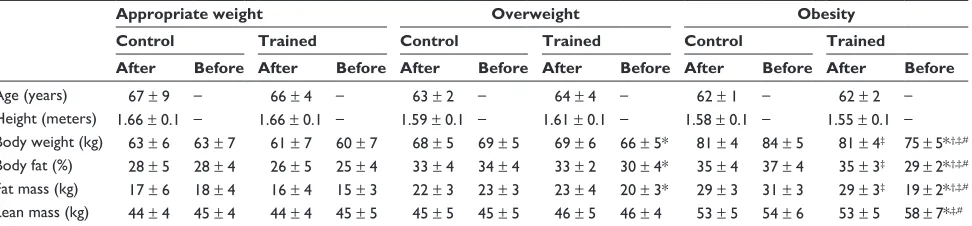
During and after training, no participants suffered inju-ries as a result of the training programs. Table 1 shows the anthropometrics parameters of all groups. At baseline, the values of BW, BF, FM, LM, and BMI of the O groups did not differ; however, the values were higher than in the AW and OW groups. Additionally, no differences were found between the respective control to AWT and OWT groups.
For all analyzed parameters in the AWT group, there was no significant difference in the values before versus after training and AWC; however, in the OWT and OT groups, the values of BW, BF, FM, and BMI were lower than the baseline values and respective controls. However, only the OT group showed an increase in LM after training (Table 1).
The relative changes are showed in Figure 1. Changes
of values in BW (−8.0% ± 0.8%), BF (−21.4% ± 2.1%), LM
(8.0% ± 2%), and FM (−31.2% ± 3.0%) in the OT group were
Table 1 Anthropometrics measures
Appropriate weight Overweight Obesity
Control Trained Control Trained Control Trained
After Before After Before After Before After Before After Before After Before Age (years) 67 ± 9 – 66 ± 4 – 63 ± 2 – 64 ± 4 – 62 ± 1 – 62 ± 2 – Height (meters) 1.66 ± 0.1 – 1.66 ± 0.1 – 1.59 ± 0.1 – 1.61 ± 0.1 – 1.58 ± 0.1 – 1.55 ± 0.1 – Body weight (kg) 63 ± 6 63 ± 7 61 ± 7 60 ± 7 68 ± 5 69 ± 5 69 ± 6 66 ± 5* 81 ± 4 84 ± 5 81 ± 4‡ 75 ± 5*,†,‡,#
Body fat (%) 28 ± 5 28 ± 4 26 ± 5 25 ± 4 33 ± 4 34 ± 4 33 ± 2 30 ± 4* 35 ± 4 37 ± 4 35 ± 3‡ 29 ± 2*,†,‡,#
Fat mass (kg) 17 ± 6 18 ± 4 16 ± 4 15 ± 3 22 ± 3 23 ± 3 23 ± 4 20 ± 3* 29 ± 3 31 ± 3 29 ± 3‡ 19 ± 2*,†,‡,#
Lean mass (kg) 44 ± 4 45 ± 4 44 ± 4 45 ± 5 45 ± 5 45 ± 5 46 ± 5 46 ± 4 53 ± 5 54 ± 6 53 ± 5 58 ± 7*,‡,# Notes: Values are presented as mean ± error deviation of appropriate weight, overweight, and obesity groups. Two-way analysis of variance with repeated measures was used, followed by Bonferroni’s post hoc tests; *P, 0.05 before versus after; †P, 0.05 versus respective control; ‡P, 0.05 appropriate and overweight versus obesity trained
group; #P, 0.05 indicated interaction.
Dovepress Circuit-based exercise and obese women
Clinical Interventions in Aging downloaded from https://www.dovepress.com/ by 118.70.13.36 on 20-Aug-2020
higher (P, 0.05) than in the AWC (BW: 2.0% ± 0.4%; BF:
1.6% ± 1.5%; LM: 0.6% ± 0.6%; FM: 2.0% ± 1.5%), AWT
(BW: −2.0% ± 1.1%; BF: −4.6% ± 1.8%; LM: 0.2% ± 1.1%;
FM: −7.0% ± 2.8%), OWC (BW: 1.5% ± 0.3%; BF:
2.5% ± 0.3%; LM: 0.3% ± 0.4%; FM: 4.0% ± 0.4%),
OWT (BW: −4.5% ± 1.0%; BF: −11.0% ± 2.2%;
LM: −0.2% ± 1.0%; FM: −16.1% ± 3.2%), and OC (BW:
3.0% ± 0.5%; BF: 6.0% ± 1.0%; LM: 1.3% ± 0.7%; FM:
9.0% ± 0.8%) groups. No differences were found among
other groups.
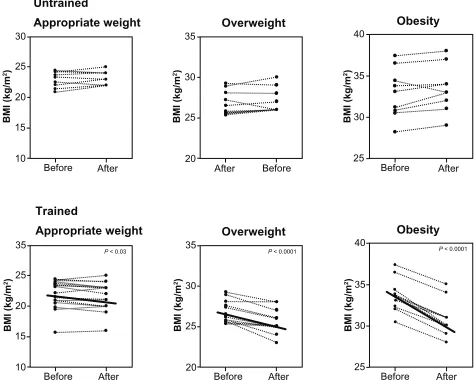
Although a significant (P , 0.03) reduction in BMI
(Figure 2) was found in all trained groups (AWT: 22 ± 1 versus 21 ± 1, kg/m2; OWT: 27 ± 1 versus 25 ± 1, kg/m2; OT: 34 ± 1 versus 30 ± 1, kg/m2) after training (Figure 2),
no differences were found in control groups (AWC: 23 ± 5
versus 23 ± 4, kg/m2; OWC: 26 ± 1 versus 27 ± 1, kg/m2; OC: 33 ± 1 versus 33 ± 1, kg/m2). Additionally, the relative
change in BMI (Figure 1) in trained groups (AWT: −5% ± 2%;
OWT: −1% ± 3%; OT: −22% ± 2%) was higher than in control
groups (AWC: 1% ± 1%; OWC: 2% ± 1%; OC: 2% ± 1%).
Furthermore, the decrease in values of the OT group was
statistically (P, 0.05) stronger than other groups.
Discussion
This is the first study to assess the effects of 12 weeks of circuit-based exercise on obese older women. According to our results, circuit-based exercise is effective for promoting reductions in anthropometrics parameters, particularly the increase in LM.
The prevalence of OW people is a serious public health concern, and is a risk factor for developing cardiovascular and metabolic disorders.13,14 Thus, there is a need to identify effective therapeutic practices for regulating BW and improv-ing quality of life.
An appropriate level of physical activity has direct effects
on the maintenance of lean body mass in adults.14 Therefore,
treatment strategies for O, which maximize the BF loss and
increase LM, carry significant benefits to obese people.15–17
The ET plays an important role in weight control and is often associated with other types of interventions such as diet. However, several studies18–22 showed similar results presented in this paper without dietary control to modify body composition, particularly free FM. In addition, the weight loss achieved with moderate physical activity can be easily reversed by a small compensatory increase in food intake.23
Additionally, aging often leads to a loss of functional fitness in older people, reducing their ability to perform daily tasks.19–21,24 Moreover, fall-related injuries are seri-ous problems in old age, as they often lead to prolonged, or even permanent, disability. Therefore, maintenance of LM is frequently considered an important strategy for
Lean mass Fat mass Fat body Body weight Untrained Trained BMI
AW OW O AW OW O AW OW O AW OW O
AW OW O
(Relative change %) (Relative change %) (Relative change %) (Relative change %) (Relative change %)
* * * * 12 10 8 6 4 2 0 * 10 0 –10 10 0 –10 –20 –30 –20 –30 –40 5 0 −5 −10 5 0 −5 −10 −15 −20 −25 −30
Figure 1 Repercussion (means ± standard error) of appropriate weight (AW), overweight (OW), and obesity (O) groups from baseline in body weight, body fat, lean mass, fat mass, and body mass index (BMI).
Notes: Positiveor negative values result from 12 weeks of circuit-based exercise program. *P , 0.05 versus all groups.
Obesity
P < 0.0001
After Before 25 30 35 40 BMI (kg/ m 2) Overweight
P < 0.0001
After Before 20 25 30 35 BMI (kg/ m 2) Trained Appropriate weight
P < 0.03
After Before 10 15 35 BMI (kg/ m
2) 25
20 Obesity After Before 25 30 35 40 BMI (kg/ m 2) Overweight After Before 20 25 30 35 BMI (kg/ m 2) Untrained Appropriate weight After Before 10 15 30 BMI (kg/ m
2) 25
20
Figure 2 Repercussion (means ± standard error) of body mass index (BMI) before and after 12 weeks of circuit-based exercise program in appropriate weight, overweight and obesity groups.
Dovepress
Bocalini et al
Clinical Interventions in Aging downloaded from https://www.dovepress.com/ by 118.70.13.36 on 20-Aug-2020
improving functional fitness, preventing BW gain,
reduc-ing disability,25 improving the quality of life, and reducing
the costs of health care. Moreover, a review of randomized controlled trials has demonstrated that exercise reduces the risk of falls in elderly people, and reduction in the incidence of fall-related injuries is related to lower health care costs.26 The preservation of functional capacity, muscle strength and BW, prevention of injuries that reduce disability, improve-ment of quality of life, and reduction of costs of health care should be the most relevant features of exercise programs. The contribution of ET in general for the weight loss process is due to the increase in daily caloric expenditure promoted by the fat-free mass, as found in our study. Additionally, the ET energy expenditure may also stimulate elevation of basal metabolic rate due to increased muscle mass. It is believed that the tendencies of people to gain weight with age are due largely to a reduced basal metabolic rate by
progressive LM loss.27
Not surprisingly, strength exercises can substantially modify the body composition and capacity of power
gen-eration in different populations.28 In relationship to CT, the
effectiveness is unclear, with studies showing positive8,29
and discordant results9,30 in adults and old people. However,
clinically, our results are important for future research, spe-cifically for sarcopenic subjects. The loss of muscle mass reduces targets available to insulin-responses, promoting insulin resistance, in turn promoting metabolic syndrome
and O.31–35 Moreover, increasing FM promotes production of
tumor necrosis factor-α, interleukin-6, and other adipokines
that further promote insulin resistance as well as potentially having a direct catabolic effect on muscle reducing the muscle strength. Villareal et al36 suggest that sarcopenic O is a major public health problem; in this perspective, circuit-based exercise is considered cheaper and a reliable method for preventing sarcopenic status.
Additionally, it is known that one factor contributing to the failure of the treatment of O is maintaining a
low-calorie diet intake for long periods, causing demotivation.37
An important feature of ET is that it allows the possibility of a large number of people taking part in exercise sessions. This fact corresponds to the wide variety of exercise as well as the increased possibility of intrapersonal relationships with exercise practice, leading to higher level of motivation during training.
There were some limitations to this study. This was a relatively small sample study, and it was not designed to examine possible biochemical mechanisms of bone adapta-tion to exercise programs.
In conclusion, we demonstrated the positive effects of circuit strength training on body composition parameters, and relevant importance should be given to improve LM in obese older women. For future therapeutic considerations, the present work may support the safety and utility of this exercise modality for larger trials, as well as for education and physical training in this population.
Acknowledgment
The authors are grateful to Fárlley Rodrigues for assistance with language correction and layout of this article.
Disclosure
The authors report no conflicts of interest in this work.
References
1. Sorkin JD, Muller DC, Andres R. Longitudinal change in height of men and women: implications for interpretation of the body mass index: the Baltimore Longitudinal Study of Aging. Am J Epidemiol. 1999;150(9):969–977.
2. Arterburn DE, Crane PK, Sullivan SD. The coming epidemic of obesity in elderly Americans. J Am Geriatr Soc. 2004;52(11):1907–1912. 3. Villareal DT, Apovian CM, Kushner RF, et al. Obesity in older adults:
technical review and position tatement of the American Society for Nutrition and NAASO, The Obesity Society. Am J Clin Nutr. 2005; 82(5):923–934.
4. Kaplan NM. The deadly quartet. Upper-body obesity, glucose intol-erance, hypertriglyceridemia, and hypertension. Arch Intern Med. 1989;149(7):1514–1520.
5. Koster A, Penninx BW, Newman AB, et al. Lifestyle factors and incident mobility limitation in obese and non-obese older adults. Obesity (Silver Spring). 2007;15(12):3122–3132.
6. Lang IA, Guralnik JM, Melzer D. Physical activity in middle-aged adults reduces risks of functional impairment independent of its effect on weight. J Am Geriatr Soc. 2007;55(11):1836–1841.
7. Baumgartner RN, Wayne SJ, Waters DL, et al. Sarcopenic obesity predicts instrumental activities of daily living disability in the elderly.
Obes Res. 2004;12(12):1995–2004.
8. Fett CA, Fett WCR, Oyama SR, Marchini JS. Body composition and somatotype in overweight and obese women pre- and post-circuit train-ing or joggtrain-ing. Rev Bras Med Esporte. 2006;12(1):45–50.
9. Dias R, Prestes J, Manzatto R, et al. Effects of different exercise pro-grams in clinic and functional status of overweight women. Brazilian J Kinanthrom Human Performance. 2006;8(3):58–65.
10. World Health Organization. Obesity: preventing and managing the global epidemic. Report of a WHO consultation. World Health Organ Tech Rep Ser. 2000;894:i–xii, 1–253.
11. Taveres EL, Anjos LA. Anthropometric profile of the elderly Brazilian population: results of the National Health and Nutrition Survey, 1989. 1999;15(4):759–768.
12. Bocalini DS, Serra AJ, dos Santos L, Murad N, Levy RF. Strength training preserves mineral bone density in postmenopausal women without use of hormone replacement therapy. J Aging Health. 2009;21(3):519–527. 13. Kumanyika SK, Obarzaneck E, Stettler N, et al. Population-based
prevention of obesity. Circulation. 2008;118:428–464.
14. Clinical Guidelines on the Identification, Evaluation, and Treatment of Overweight and Obesity in Adults. The Evidence Report. National Institutes of Health. Obes Res. 1998;6 Suppl 2:51S–209S.
15. Briner RW, Ullrich IH, Saures J, et al. Effects of aerobic vs resistance training combined with an 800 calorie liquid diet on lean body mass and resting metabolic rate. J Am Col Nutr. 1999;18(2):115–121.
Dovepress Circuit-based exercise and obese women
Clinical Interventions in Aging downloaded from https://www.dovepress.com/ by 118.70.13.36 on 20-Aug-2020
Clinical Interventions in Aging
Publish your work in this journal
Submit your manuscript here: http://www.dovepress.com/clinical-interventions-in-aging-journal
Clinical Interventions in Aging is an international, peer-reviewed journal focusing on evidence-based reports on the value or lack thereof of treat-ments intended to prevent or delay the onset of maladaptive correlates of aging in human beings. This journal is indexed on PubMed Central, MedLine, the American Chemical Society’s ‘Chemical Abstracts
Ser-vice’ (CAS), Scopus and the Elsevier Bibliographic databases. The manuscript management system is completely online and includes a very quick and fair peer-review system, which is all easy to use. Visit http://www.dovepress.com/testimonials.php to read real quotes from published authors.
16. Jakicic JM, Otto AD. Physical activity considerations for the treat-ment and prevention of obesity. Am J Clin Nutr. 2005;82(Suppl 1): 226S–229S.
17. Stiegler P, Cunliffe A. The role of diet and exercise for maintenance of fat free mass and rest metabolic rate during weight loss. Sports Med. 2006;36(3):239–262.
18. Deibert P, König D, Vitolins MZ, et al. Effect of a weight loss interven-tion on anthropometric measures and metabolic risk factors in pre-versus postmenopausal women. Nutr J. 2007;6:31–37.
19. Hill JO, Schlundt DG, Sbrocco T, et al. Evaluation of an alternating-calorie diet with an without exercise in the treatment of obesity. Am J Clin Nutr. 1989;50(2):248–254.
20. Saris WHM. Exercise with or without dietary restriction and obesity treatment. Int J Obes. 1995;19 Suppl 4:781–787.
21. Kraemer WJ, Volek JS, Clark KL, et al. Physiological adaptations to a weight loss dietary regimen and exercise programs in women. J Appl Physiol. 1997;83(1):270–279.
22. Ross R, Pedwell H, Rissanen J. Effects of energy restriction and exercise on skeletal muscle and adipose tissue in women as measured by mag-netic resonance imaging. Am J Clin Nutr. 1995;61(6):1179–1185. 23. Ballor DL, Poehlman ET. Exercise-training enhances lean mass
pres-ervation during diet-induced weight loss: a meta-analytical finding. Int J Obes Relat Metab Disord. 1994;18(1):35–40.
24. Grundy SM, Blackburn G, Higgins M, Lauer R, Perri MG, Ryan D. Physical activity in the prevention and treatment of obesity and its comorbities. Med Sci Sports Exerc. 1999;31(Suppl 11):S502–S508. 25. Garrow JS, Summerbell CD. Meta-analysis: effect of exercise, with or
without dieting, on the body composition of overweight subjects. Eur J Clin Nutr. 1995;49(1):1–10.
26. Broadwin J, Goodman-Gruen D, Slymen D. Ability of fat and lean mass percentages to predict functional disability in older men and women. J Am Geriatric Soc. 2001;49(12):1641–1645.
27. Gardner MM, Robertson MC, Campbell AJ. Exercise in preventing falls and fall related injuries in older people: a review of randomized controlled trials. Br J Sports Med. 2000;34(1):7–17.
28. Hallal PC, Victora CG, Wells JC, Lima RC. Physical inactivity: prevalence and associated variables in Brazilian adults. Med Sci Sports Exerc. 2003;35(11):1894–1900.
29. Maiorana A, O’Driscoll G, Dembo L, Goodman C, Taylor R, Green D. Exercise training, vascular function, and functional capacity in middle-aged subjects. Med Sci Sports Exerc. 2001;33(12):2022–2028. 30. Garcia JMS, Sánchez EDLC, García ADS, González YE, Piles ST.
Influence of a circuit-training programme on health-related fitness and quality of life in sedentary women above 70 years old. Fit Perf. 2007;6(1):14–19.
31. Winett RA, Carpinelli ED. Potential health-related benefits of resistance training. Prev Med. 2001;33(5):503–513.
32. Allison DB, Gallagher D, Heo M, Pi-Sunyer FX, Heymsfield SB. Body mass index and all-cause mortality among people age 70 and over: the Longitudinal Study of Aging. Int J Obes Relat Metab Disord. 1997;21(6):424–431.
33. Walker RF. Editor’s choice: sarcopenia or loss of muscle mass. Clin Interv Aging. 2012;7:139–141.
34. Heber D, Ingles S, Ashley JM, Maxwell MH, Lyons RF, Elasho RM. Clinical detection of sarcopenic obesity by bioelectrical impedance analysis. Am J Clin Nutr. 1996;64(Suppl 3):S472–S477.
35. Reaven GM. Banting lecture 1988. Role of insulin resistance in human disease. Diabetes. 1988;37(12):1595–1597.
36. Villareal D, Banks M, Sienerc C, Sinacore D, Klein S. Physical frailty and body composition in obese elderly men and women. Obes Res. 2004;12(6):912–919.
37. Bronstein MD. Obesity and physical exercise. Rev SOCESP. 1996;6(1): 111–115.
Dovepress
Dove
press
Bocalini et al
Clinical Interventions in Aging downloaded from https://www.dovepress.com/ by 118.70.13.36 on 20-Aug-2020