COMPARATIVE STUDY AND ANALYSIS FOR
GESTURE RECOGNITION METHODOLOGIES
Rafiqul Z. Khan
1, Noor A. Ibraheem
21
Department of Computer Science, A.M.U. Aligarh, India
2
Department of Computer Science, College of Women, Baghdad University, Iraq
ABSTRACT
The diverse applications of hand gesture recognition system accepted it great attention especially in the past few
years, besides the recognition system ability to interact with machine naturally and efficiently through human
computer interaction. Hand gestures recognition system has different applications on different domains including
virtual environments, graphic editor systems, sign language translation, games, and robot control. In this paper a
survey of some recent hand gesture recognition systems is presented. Application areas are explained with the
system challenges as well. Description of hand gesture recognition system phases which are segmentation, feature
detection and extraction, and classification. A review of hand gesture systems are discussed and summary of these
systems are given with comparisons on different evaluations criteria such as recognition rates, database used,
invariant factor, and different methods used for hand gesture recognition systems phases. And finally advantages
and disadvantages of these systems are explained.
Keywords:
Gesture Recognition System, Feature Extraction, Segmentation, Classifications, Hand
Posture.
I.
INTRODUCTION
Making the hand gesture understood by the computer considered as a problem in human computer interaction (HCI)
[1], where the gesture used to control a robot system or translate meaning information [1]. Hand gesture recognition
system has a great attention especially with human computer interaction vision area where the interaction is easy and
friendly to control machine such as robot [2]. Complex background, changing lights conditions, and the articulated
nature of the hand considered the most challenges of hand gesture recognition system [2]. Sine posture is a certain
pose, and the gesture is a sequence of postures in real time systems where time factor is important [2] [3], posture
can be defined as a static gesture [3].
Acquiring data for hand gesture systems are depending on the system application, some systems use hand vision and
skin color detection method to extract the hand gesture data [4], other systems used instrumented devices data glove
shape using colors in the glove [4]. Generally former method considered more natural and less cost comparing with
the last two methods [4].
Some of the recent reviews that discussed hand gesture recognition system and applications especially human
computer Interaction HCI, games, and robot control are available in [5][7]. This paper demonstrates the advantages
of hand gesture recognition system, and it is up to date, with explanations and comparisons in different gesture
recognition systems.
This paper organized as follows: the following subsection explained application areas on hand gesture recognition
system. Section 2 explained hand gesture challenges. Section 3 demonstrates system methodology of hand gesture
recognition. A review of gesture recognition methods are described in section 4. Summary of research results and
conclusion are shown in section 5.
II.
APPLICATION AREAS ON HAND GESTURE RECOGNITION SYSTEM
Gesture recognition system applications have been various and numerous with its spread on different application
domains [3][11] which include sign language translation, virtual environments, editing graphical systems, etc. some
of these applications are included bellow :
Sign Language Recognition.
Robot Control.
Graphic Editor Control.
Virtual Environments (VEs).
Numbers Recognition.
Television Control.
Lie detection.
Manipulating in virtual environments.
Communicating in video conferencing.
Distance learning assistance.
Defining aids for the hearing impaired.
III.
HAND GESTURE RECOGNITION: SYSTEM METHODOLOGY
The main steps for gesture recognition system can be summarized into four stages as explained in Figure 1, these
stages are: acquired hand gesture, segmentation which represents the main step for extracting hand gesture, hand
features extraction and identification of the input gesture. In the following subsections an explanation of these stages
Figure 1: General steps for gesture recognition system
.
3.1
Acquired hand gesture
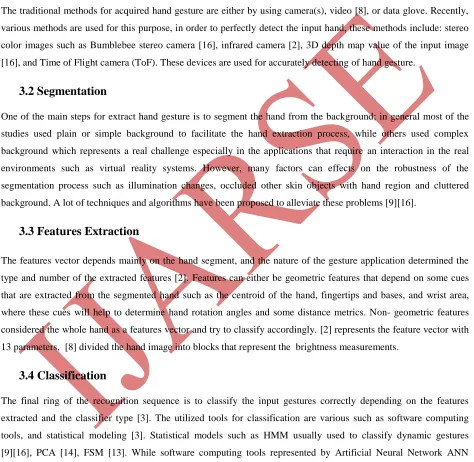
The traditional methods for acquired hand gesture are either by using camera(s), video [8], or data glove. Recently,
various methods are used for this purpose, in order to perfectly detect the input hand, these methods include: stereo
color images such as Bumblebee stereo camera [16], infrared camera [2], 3D depth map value of the input image
[16], and Time of Flight camera (ToF). These devices are used for accurately detecting of hand gesture.
3.2
Segmentation
One of the main steps for extract hand gesture is to segment the hand from the background; in general most of the
studies used plain or simple background to facilitate the hand extraction process, while others used complex
background which represents a real challenge especially in the applications that require an interaction in the real
environments such as virtual reality systems. However, many factors can effects on the robustness of the
segmentation process such as illumination changes, occluded other skin objects with hand region and cluttered
background. A lot of techniques and algorithms have been proposed to alleviate these problems [9][16].
3.3
Features Extraction
The features vector depends mainly on the hand segment, and the nature of the gesture application determined the
type and number of the extracted features [2]. Features can either be geometric features that depend on some cues
that are extracted from the segmented hand such as the centroid of the hand, fingertips and bases, and wrist area,
where these cues will help to determine hand rotation angles and some distance metrics. Non- geometric features
considered the whole hand as a features vector and try to classify accordingly. [2] represents the feature vector with
13 parameters, [8] divided the hand image into blocks that represent the brightness measurements.
3.4
Classification
The final ring of the recognition sequence is to classify the input gestures correctly depending on the features
extracted and the classifier type [3]. The utilized tools for classification are various such as software computing
tools, and statistical modeling [3]. Statistical models such as HMM usually used to classify dynamic gestures
[9][16], PCA [14], FSM [13]. While software computing tools represented by Artificial Neural Network ANN
[10][12], fuzzy set [2], Genetic Algorithms GAs [15], etc.
Aquired hand
Gesture Segmentation
Features
IV.
AN OVERVIEW OF GESTURE RECOGNITION SYSTEMS
Trigo [10] analyzed three different geometric shape descriptors used for gesture recognition systems which are;
invariant moments, k-curvature, and template matching. The input image segmented manually and different tests
have been applied to examine the robustness of each of the selected method. MLP artificial neural network used as a
classifier for these methods.
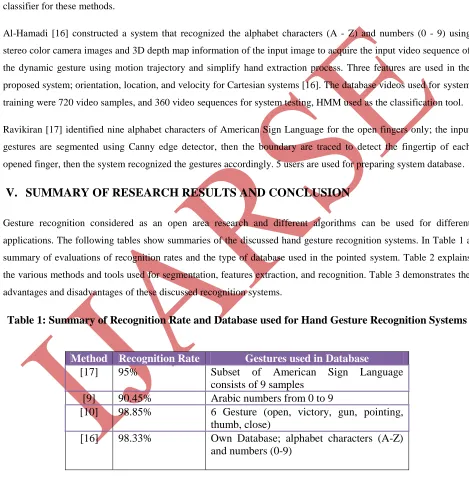
Al-Hamadi [16] constructed a system that recognized the alphabet characters (A - Z) and numbers (0 - 9) using
stereo color camera images and 3D depth map information of the input image to acquire the input video sequence of
the dynamic gesture using motion trajectory and simplify hand extraction process. Three features are used in the
proposed system; orientation, location, and velocity for Cartesian systems [16]. The database videos used for system
training were 720 video samples, and 360 video sequences for system testing, HMM used as the classification tool.
Ravikiran [17] identified nine alphabet characters of American Sign Language for the open fingers only; the input
gestures are segmented using Canny edge detector, then the boundary are traced to detect the fingertip of each
opened finger, then the system recognized the gestures accordingly. 5 users are used for preparing system database.
V.
SUMMARY OF RESEARCH RESULTS AND CONCLUSION
Gesture recognition considered as an open area research and different algorithms can be used for different
applications. The following tables show summaries of the discussed hand gesture recognition systems. In Table 1 a
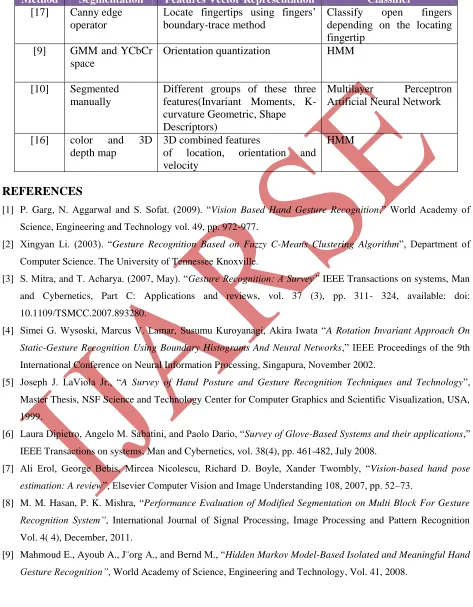
summary of evaluations of recognition rates and the type of database used in the pointed system. Table 2 explains
the various methods and tools used for segmentation, features extraction, and recognition. Table 3 demonstrates the
advantages and disadvantages of these discussed recognition systems.
Table 1: Summary of Recognition Rate and Database used for Hand Gesture Recognition Systems
Method
Recognition Rate
Gestures used in Database
[17]
95%
Subset of American Sign Language
consists of 9 samples
[9]
90.45%
Arabic numbers from 0 to 9
[10]
98.85%
6 Gesture (open, victory, gun, pointing,
thumb, close)
[
16
]
98.33%
Own Database; alphabet characters (A-Z)
Table 2: Summary of Segmentation, Features Vector Representation, and Recognition of Gesture
Recognition Systems
Method
Segmentation
Features Vector Representation
Classifier
[17]
Canny edge
operator
Locate fingertips using fingers’
boundary-trace method
Classify
open
fingers
depending on the locating
fingertip
[9]
GMM and YCbCr
space
Orientation quantization
HMM
[10]
Segmented
manually
Different groups of these three
features(Invariant Moments,
K-curvature Geometric, Shape
Descriptors)
Multilayer
Perceptron
Artificial Neural Network
[16]
color
and
3D
depth map
3D combined features
of
location,
orientation
and
velocity
HMM
REFERENCES
[1] P. Garg, N. Aggarwal and S. Sofat. (2009). “Vision Based Hand Gesture Recognition,” World Academy of
Science, Engineering and Technology vol. 49, pp. 972-977.
[2] Xingyan Li. (2003). “Gesture Recognition Based on Fuzzy C-Means Clustering Algorithm”, Department of
Computer Science. The University of Tennessee Knoxville.
[3] S. Mitra, and T. Acharya. (2007, May). “Gesture Recognition: A Survey” IEEE Transactions on systems, Man
and Cybernetics, Part C: Applications and reviews, vol. 37 (3), pp. 311- 324, available: doi:
10.1109/TSMCC.2007.893280.
[4] Simei G. Wysoski, Marcus V. Lamar, Susumu Kuroyanagi, Akira Iwata “A Rotation Invariant Approach On
Static-Gesture Recognition Using Boundary Histograms And Neural Networks,” IEEE Proceedings of the 9th
International Conference on Neural Information Processing, Singapura, November 2002.
[5] Joseph J. LaViola Jr., “A Survey of Hand Posture and Gesture Recognition Techniques and Technology”,
Master Thesis, NSF Science and Technology Center for Computer Graphics and Scientific Visualization, USA,
1999.
[6] Laura Dipietro, Angelo M. Sabatini, and Paolo Dario, “Survey of Glove-Based Systems and their applications,”
IEEE Transactions on systems, Man and Cybernetics, vol. 38(4), pp. 461-482, July 2008.
[7] Ali Erol, George Bebis, Mircea Nicolescu, Richard D. Boyle, Xander Twombly, “Vision-based hand pose
estimation: A review”, Elsevier Computer Vision and Image Understanding 108, 2007, pp. 52–73.
[8] M. M. Hasan, P. K. Mishra, “Performance Evaluation of Modified Segmentation on Multi Block For Gesture
Recognition System”, International Journal of Signal Processing, Image Processing and Pattern Recognition
Vol. 4( 4), December, 2011.
[9] Mahmoud E., Ayoub A., J¨org A., and Bernd M., “Hidden Markov Model-Based Isolated and Meaningful Hand
[10] T. R. Trigo, S. R. M. Pellegrino, “An Analysis of Features for Hand-Gesture Classification”, 17th International
Conference on Systems, Signals and Image Processing (IWSSIP 2010), 2010.
[11] W. T. Freeman and Michal R., “Orientation Histograms for Hand Gesture Recognition”, IEEE International
Workshop on Automatic Face and Gesture Recognition, Zurich, June, 1995.
[12] N. A. Ibraheem., R. Z. Khan, “Vision Based Gesture Recognition Using Neural Networks Approaches: A
Review”, International Journal of Human Computer Interaction (IJHCI) Malaysia, Vol. 3(1), 2012.
[13] Verma, R., Dev A., “Vision based hand gesture recognition using finite state machines and fuzzy logic”. IEEE
International Conference on Ultra Modern Telecommunications & Workshops, 2009. ICUMT '09, pp. 1-6,
2009, doi: 10.1109/ICUMT.2009.5345425
[14] Minghai Y., Xinyu Q., Qinlong G., Taotao R., Zhongwang L., “Online PCA with Adaptive Subspace Method
for Real-Time Hand Gesture Learning and Recognition”, vol. 9(6), 2010.
[15] Cheng-Chang L. and Chung-Lin H., “The Model-Based Dynamic Hand Posture Identification Using Genetic
Algorithm”, Springer-Verlag, Machine Vision and Applications Vol. 11, 1999.
[16] Ayoub Al-Hamadi, Mahmoud Elmezain, and Bernd Michaelis, “Hand Gesture Recognition Based on
Combined Features Extraction”, International Journal of Information and Mathematical Sciences, Vol. 6 (1),
2010
[17] Ravikiran J, Kavi Mahesh, Suhas Mahishi, Dheeraj R, Sudheender S, Nitin V Pujari, “Finger Detection for
Sign Language Recognition”, Proceedings of the International Multi Conference of Engineers and Computer