
Available Online at www.ijcsmc.com
International Journal of Computer Science and Mobile Computing
A Monthly Journal of Computer Science and Information Technology
ISSN 2320–088X
IJCSMC, Vol. 4, Issue. 12, December 2015, pg.177 – 184
Qualitative and Quantitative Based
Comparison of Proactive and Reactive
Routing Approaches in MANET
Nawneet Raj
1, Priyanka Bharti
2, Sanjeev Thakur
31Department of Computer Science and Engineering, Amity University, India
²Department of Computer Science and Engineering, Siddaganga Institute of Technology, India
3Department of Computer Science and Engineering, Amity University, India 1 [email protected], 2 [email protected], 3 [email protected]
Abstract- In recent years, a broad research has been done in the domain of Mobile Ad-hoc Networks (MANETs). Due to the bounded resources in MANETs, to develop a reliable and efficient routing approach is still a threat or issues. There are distinct aspects appropriate for research like synchronization, power consumption, routing, bandwidth consideration, etc. This paper concentrates on routing approach which is the major challenging concern due to the change in topology of ad-hoc networks. Under a number of network scheme, such as network topology and size, it is difficult to figure out which routing protocol may perform well. In this paper we contribute an outline of broad range of the current routing approaches, with a special focus on their functionality and characteristics. Also based on the routing information and methodologies the comparison is provided, which can be use to make decisions of routing. Performance of all the routing protocols are considered as well. Further this consideration will benefit the researcher to get an outline of the existing protocols and advice which protocols may have better performance with respect to changing network scenario.
Keywords- MANETs, Routing Protocol, Dynamic Topology, Synchronization, Performance
I. INTRODUCTION
Figure 1: Wireless Network Categories
A. INFRASTRUCTURE NETWORKS:
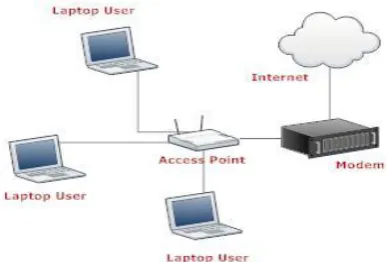
In this type of network an Access Points (AP) act as a central organizer for every node. Through AP any node can join the network. The association between Basic Set Services (BSSs) is organized by AP so that the path is accessible when it is demanded. The major disadvantage of infrastructure network is that we have to always maintain the routing table. Figure 2 illustrates an infrastructure network.
Figure 2: Infrastructure Network
B. AD-HOC NETWORKS:
Wireless Ad-Hoc network is a distributed variety of wireless network. The network does not commit on a foregoing infrastructure, so it is called as ad-hoc network. This type network does not have a central coordination point or a certain topology. So, forwarding and collecting packets are also difficult as compared to infrastructure networks. With the extensive success in wireless network application like tablets, handheld computers, cell phones and PDAs, scientists are inspired to raise the performance and network task. Supporting mobility in MANETs is one of the major designing challenges for wireless Ad-hoc network. The node’s mobility in MANETs raises degree of connection flexibility and complications of routing protocols. Yet, the flexibleness of nodes to leave, join and transmission of data to network increase security challenges. A MANET is the group of distinct mobile nodes which are linked together in a wireless medium having dynamic topology [16]. Each node has constrained sources such as memory, processing power, battery and. MANET can be easily used in battlefields, natural disasters etc., where it is very difficult to use wired network. Figure 3 illustrates a Mobile Ad-Hoc Network.
II. ROUTING APPROACHES IN MANET
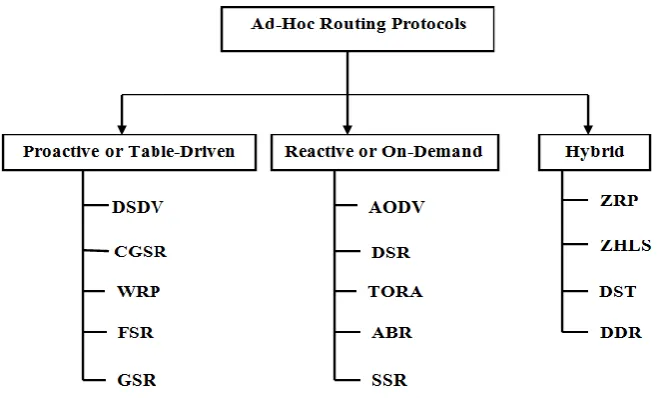
Routing approaches for MANETs can be divided into three classes on the basis of routing information update technique. They could be Proactive (Table-driven), Reactive (On-demand) and Hybrid. Figure 4 shows the three classes of routing approaches in MANET. Proactive routing technique maintains an updated topological map of the whole network. In this approaches all the paths are maintained all the times so routes can be found anytime. The main properties of proactive approaches are that it uses the low latency in discovering the new path. It uses the more bandwidth to update routing knowledge. Reactive approach does not initiate for finding the paths. By flooding a query it establishes routes on demand. When finding a route it uses bandwidth only when there is a need for discovering the routes. So, its latency is high. In this approach due to flooding there is a network overhead for query for finding the routes. Hybrid approach merges the advantages of above two approaches [5], [11].
Figure 4: Classification of Routing Protocols
III. PROACTIVE ROUTING PROTOCOLS
Proactive routing protocols are also known as the Table Driven routing protocols. In this routing protocol each node keeps routing knowledge about every other node. Routing information is generally stored in routing tables and is generally refreshed as the changes in network occur. So, routes are always available in this type of protocols. These protocols have less latency but use more bandwidth. The protocols under this class maintain various numbers of tables. Moreover, they are not suitable for large networks. DSDV, CGSR, WRP, FSR, GSR etc. are various proactive routing protocols [8].
A. DESTINATION SEQUENCED DISTANCE VECTOR (DSDV):
DSDV is based on Bellman-Ford routing approach. In DSDV, packets relay between mobile nodes with the help of routing tables which are saved at mobile node. The routing table has the directory of all useful terminal nodes and the number of hops required to reach every terminal node. Terminal nodes create the sequence number (SN) which is appended in the table entry.
Advantages:
Routing loop issue is solved
Count to infinity issue is minimised
It doesn’t maintain the multiple path to every destination node, it maintains only best path
Disadvantages:
DSDV always updates it’s routing table, if network is in idle state then also it uses bandwidth and small amount of battery power
SN is necessary whenever the topology of network changes.
DSDV is not relevant for highly topological change in networks.
B. CLUSTER GATEWAY SWITCH ROUTING PROTOCOL (CGSR):
CGSR is based on the concept of cluster head (CH). Its structure is hierarchical. It uses a distributed cluster-head selection approach to select the cluster-cluster-head. In this approach, CH performs the important role. Every node send the messages to the CH, then CH send it with the help of gateway node to the other cluster then to CH of other cluster and so on, until the target CH is reached.
Advantages:
Better bandwidth utilization
Routing is performed only over cluster-head so; it reduces the size of distance vector table. Disadvantages:
Higher time is spent in selection of gateways and cluster-heads
Change in cluster-heads may result in multiple path breaks
C. WIRELESS ROUTING PROTOCOL (WRP):
Every node keeps four tables: routing table, link-cost table, distance table and message retransmission list table (MRL). Whenever, an updated message is communicated to neighbor nodes then WRP updates routing tables. SN of the update message and retransmission counter is kept in the MRL. Node transmit updated message after identifying a change in the link or after processing updates from their neighbors.
Advantages:
Count to infinity is solved Disadvantages:
More memory is required to maintain the four table
Extra bandwidth and power is consumed due to periodic HELLO message
D. FISHEYE STATE ROUTING (FSR):
FSR is an absolute hierarchical routing approach. It is a proactive link-state routing protocol. Like link-sate, it keeps a complete topology map at every node. In this protocol, there is a regular transfer of HELLO packets and topology tables within the local neighbor only (instead of flooding entire network). As the distance to destination decreases, the topology table update frequency also decreases. Updates for close destination are propagated generally more than updates for a remote destination. Every node holds: Distance Table, Neighbor list, Next Hop Table and Topology Table.
Advantages:
Maintain accurate routing information for immediate neighbours
As the distance between data packets and destination node decreases accuracy increases
Disadvantages:
Progressively limited details as distance increases
Routing table size grows linearly with network size
E. GLOBAL STATE ROUTING (GSR):
protocol regularly exchange collected link-state information with its neighbors. Sometime this is identical to STAR when optimal paths are required. To ensure the link-state table is up to date it uses sequence numbers. Entries with earlier sequence numbers are replaced with updated sequence number.
Advantages:
GSR can provide optimal and loop free paths
It can be used to support Quality of Service
Disadvantage:
Reliability of Link layer is still required
TABLE 2 shows the comparison of some of existing proactive routing protocols [1]-[10].
TABLE 2: Comparison of Proactive Routing Protocols
IV. REACTIVE ROUTING PROTOCOLS
This protocol is known as on-demand routing protocol. Reactive approach does not initiate for finding the paths. By flooding a query it establishes routes on demand. When finding a route it uses bandwidth only when there is a need for discovering the routes. So, its latency is high. Following are the numerous well known reactive routing protocols: AODV, DSR, TORA, ABR and SSR [12]. The reactive routing approaches have mainly two phases [14].
Route Discovery: It is the early phase for routing. This phase is focus on finding the route from source node to destination node. For this purpose, source node considers its route cache for the feasible route. Source node adds the addresses of all intermediary nodes and destination node. Intermediary nodes perform the important role to find the path from source to destination node.
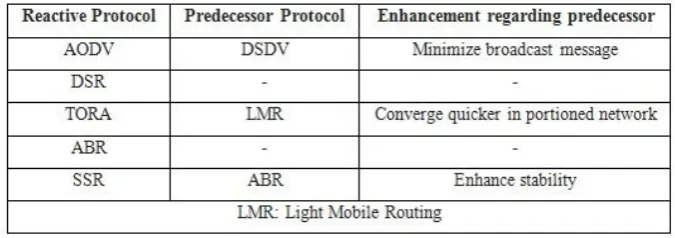
TABLE 3: Reactive Protocols
A. AD-HOC ON DEMAND DISTANCE VECTOR ROUTING (AODV):
AODV is fundamentally an enhancement of DSDV. It reduces the number of transmission, by creating paths based requirement, which is different from DSDV. A route request (RREQ) is broadcasted when a node want to transmit a data packet to destination node. To ensure the loop free path RREQ uses the SN and reply consist of updated information only.
Advantages:
Less delay in connection setup
Route are established on demand and latest route to destination is searched by destination sequence number
Disadvantages:
If the source SN is very old then intermediary node can lead to inconsistent routes
Unnecessary bandwidth consumption due to periodic beaconing
B. DYNAMIC SOURCE ROUTING (DSR):
DSR is an efficient and simple routing approach, which performs uniquely in multi-hop MANETs. With the use of DSR, the network is perfectly self-configuring and self-organizing, requires no existent network administration or infrastructure. This approach consists of mainly two phases: Route Discovery and Route Maintenance.
Advantages:
To reduce the control overhead intermediary nodes take advantage of route cache information
Routes are established on demand
Disadvantages:
Higher connection setup delay
Routing traffic is directly proportional to the length of path
C. TEMPORALLY ORDERED ROUTING ALGORITHM (TORA):
It is an efficient, more adaptive and extensible distributed routing protocol, which is based on the approach of link reversal. This protocol is recommended for multi-hop and highly changeable wireless networks. This approach is source-initiated and on requirement routing approach and it finds various paths from sender node to terminal node. This approach consists of mainly three phases: Route creation, Route maintenance and Route deletion. QUERY and UPDATE packet is used to route creation. To erase invalid routes a clear packet (CLR) is broadcasted through the network.
Advantages:
Good in dense networks
Multiple paths created
Disadvantages:
With increase in mobility, performance degradesD. ASSOCIATIVELY BASED ROUTING (ABR):
Advantages:
Each node setup a beacon to represent its existence
Route is stable
Disadvantages:
Scalability issue
High overhead
E. SINGLE STABILITY ROUTING (SSR):
This protocol selects a path on the basis of strength of signal between nodes and position establishment of nodes. SSR is composed of two cooperative approaches: Static Routing Protocol (SRP) and Dynamic Routing Protocol (DRP). The DRP keeps the Routing Table (RT) and Stability Table (SST). Strength of signal of neighbor nodes at SST is attaining by periodic beacon. Strength of signal is listed either as strong or weak. All communications are accepted by DRP and then processed.
TABLE 4 shows the comparison of some of existing reactive routing protocols [1], [11]-[15].
TABLE 4: Comparison Table for Reactive Routing Protocol
V. CONCLUSION
REFERENCES
[1]. Mbarushimana C, Shahrabi A, “Comparative Study of Reactive and Proactive Routing Protocols Performance in Mobile Ad Hoc Networks”, 21 st International Conference on Advanced Information Networking and Applications Workshops, IEEE, 2007, Volume-2, May 2007, pp. 679-684.
[2]. Javaid N, Bibi A, Javaid A, Malik S A, “Modeling routing overhead generated by wireless proactive routing protocols” GLOBECOM Workshops (GC Wkshps), IEEE, Dec 2011, pp. 1072-1076.
[3]. Mahmood D, Javaid N, Qasim U, Khan Z A, “ Routing Load of Route Calculation and Route Maintenance in Wireless Proactive Routing Protocols”, 7th International Conference on Broadband, Wireless Computing,
Communication and Application (BWCCA),IEEE, November 2012, pp. 149-155.
[4]. Pan-long Yang, Chang Tian, Yong Yu, “ Analysis on optimization model for proactive ad hoc Routing protocol” Military Communication Conference (MILCOM), IEEE, Volume-5, Oct. 2005, pp. 2960-2966. [5]. Garnepudi P, Damarla T, Gaddipati J, Veeraiah D, “ Proactive, reactive, hybrid multicast routing protocols
for Wireless Mess Networks”, International Conference on Computational Intelligence and Computing Research (ICCIC), IEEE, Dec. 2013, pp. 1-7.
[6]. Vanthana S, Prakash V S J, “ Comperative Study of Proactive and Reactive AdHoc Routing Protocols Using NS2”, IEEE Conference on Computing and Communication Technologies (WCCCT), March 2014, pp. 275-279.
[7]. Rohankar R, Bhatia R, shrivastava V, Sharma D K, “Performance analysis of various routing protocols (proactive and reactive) for random mobility models of Adhoc networks”,1st International conference on
Recent Advances in information Technology (RAIT), IEEE, March 2012, pp. 331-335.
[8]. Shenbagapriya R, Kumar N, “ A survey on proactive routing protocols in MANETs”, International Conference on Science Engineering and Management Research (ICSEMR), Nov. 2014, pp. 1-7.
[9]. Sholander P, Yankopolus A, Coccoli P, Tabrizi S S, “ Experimental comparison of hybrid and proactive MANET routing protocols”,IEEE Conference on Military Communication, Volume 1, Oct. 2002, pp. 513-518.
[10]. Samar P, Haas Z J, “ Strategies for broadcasting updates by proactive routing protocols in mobile ad hoc networks”, IEEE Conference on Military Communication , volume 2, Oct. 2002, pp. 873-878.
[11]. Rahman M A, Anwar F, Naeem J, Abedin M S M, “ A simulation based performance comparison of routing protocol on Mobile Ad-hoc Network (proactive, reactive, hybrid)”, IEEE International Conference on Computer and Communication Engineering (ICCCE), May 2010, pp. 1-5.
[12]. Patel D N, Patel S B, Kothadiya H R, Jethwa P D, Jhaveri R H, “ A survey of reactive routing protocols in MANETs”, International Conference on Information Communication and Embedded Systems (ICICES), Feb. 2014, pp. 1-6.
[13]. Rajput M, Khatri P, Shastri A, Solanki K. “ Comparison of Ad-hoc reactive routing protocols using OPNET modeler”, International Conference on Computer Information System and Industrial Management Applications (CISIM), Oct. 2010, pp. 530-534.
[14]. Naserian M, Tape K E, Tarique M, “ Routing overhead analysis for reactive routing protocols in wireless ad hoc networks”, IEEE International Conference on Wireless And Mobile Computing, Networking and Communications (WiMob), Volume-3, Aug. 2005, pp. 87-92.
[15]. Michalareas T, Sacks L, “ Reactive network Management architectures and routing”, International Symposium on Integrated Network Management, May 2001, pp. 811-824.
![TABLE 2 shows the comparison of some of existing proactive routing protocols [1]-[10]](https://thumb-us.123doks.com/thumbv2/123dok_us/1936376.1254406/5.595.76.537.200.467/table-shows-comparison-existing-proactive-routing-protocols.webp)
![TABLE 4 shows the comparison of some of existing reactive routing protocols [1], [11]-[15]](https://thumb-us.123doks.com/thumbv2/123dok_us/1936376.1254406/7.595.78.525.248.610/table-shows-comparison-existing-reactive-routing-protocols.webp)
