Searchable encryption with decryption in the standard model
Dennis Hofheinz∗ Enav Weinreb†
Abstract
Asearchable public key encryption (PEKS) schemeallows to generate, for any given message W, a trapdoorTW, such thatTW allows to check whether a given ciphertext is an encryption ofW or
not. Of course,TW should not reveal any additional information about the plaintext. PEKS schemes
have interesting applications: for instance, consider an email gateway that wants to prioritize or filter encrypted emails based on keywords contained in the message text. The email recipient can then enable the gateway to do so by releasing the trapdoors for the corresponding keywords. This way, the gateway can check emails for these keywords, but it learns nothing more about the email contents.
PEKS schemes have first been formalized and constructed by Boneh et al.. But with one ex-ception, no known construction of a PEKS scheme supports the decryption of ciphertexts. That is, known constructions allow totestfor a certain message, but they do not allow toretrievethe message, even when having the full secret key. Besides being somewhat unnatural for an encryp-tion scheme, this “no-decrypencryp-tion”-property also limits the applicability of a PEKS scheme. The one exception, a PEKS scheme with decryption due to Fuhr and Paillier, is formulated in the random oracle model, and inherently relies on the statistical properties of the random oracle. In fact, Fuhr and Paillier leave it as an open problem to construct a PEKS scheme with decryption in the standard model.
In this paper, we construct the first PEKS scheme with decryption (PEKSD scheme) in the stan-dard model. Our sole assumption is an anonymous IBE scheme. We explain the technical difficulties that arise with previous attempts to build a PEKS scheme with decryption and how we overcome these difficulties. Technically, we isolate a vital additional property of IBE schemes (a property we callwell-addressednessand which states that a ciphertext is tied to an identity and will be rejected when trying to decrypt with respect to any other identity) and show how to generically achieve it.
Our construction of a PEKSD scheme from an anonymous IBE scheme provides a natural ex-ample of a non-shieldingconstruction (in which the decryption algorithm queries the encryption algorithm). Gertner et al. have shown that an IND-CCA secure public key encryption scheme can-not be constructed and proven from an IND-CPA secure scheme in a black-box andshieldingway. However, our results give evidence that encryption queries in the decryption algorithm may well prove useful in a security reduction.
∗
CWI, Amsterdam, The Netherlands. E-mail: [email protected] †
1
Introduction
Motivation. Consider an email gatewayGthat stores the email for a number of users. Suppose each email message is encrypted and tagged with a number of keywords (such as “meeting” or “price offer” or similar). We assume that the keywords are also encrypted for privacy reasons. Now imagine that a user U wants to retrieve all messages tagged with the keyword “meeting”. Since U does not want to download all messages,U needs to delegate toGthe capability to recognize and then filter emails tagged with keyword “meeting”.
Searchable public key encryption (PEKS). This can be done with asearchable public key encryption (PEKS) scheme(as defined by Boneh et al. [3]). Basically, a PEKS scheme is a public key encryption (PKE) scheme, in which, instead of decryption, the secret key allows to generate trapdoors TW for
arbitrary messagesW. UsingTW, it is possible to check whether an arbitrary given ciphertext cis an
encryption ofW or not. However, ifcis not an encryption ofW, the trapdoorTW should not give any
information about the true encrypted messageW0 (besidesW0 6= W of course). A PEKS scheme can be used in the above example to encrypt the keywords of an email. The userU can then delegate the capability of checking whether an email is tagged with a keywordW =“meeting” simply by handing the trapdoorT“meeting”to the gatewayG.
Searchable public key encryption with decryption (PEKSD). However, a PEKS scheme does not allow the userU todecryptthe encrypted keywords, and thusU cannot, say, sort her emails according to the keywords, or even just see the full list of keywords attached to a message. It might seem natural to then encrypt the keyword not only by a PEKS scheme, but additionally use a traditional PKE scheme. The user U could then retrieve the keyword by a PKE decryption. However, this solution does not ensure that the PEKS encryption and the PKE encryption are really consistent (i.e., referring to the same keyword). This can become problematic ifU relies on the gateway’s actions (which only depend on the PEKS encryptions) during local computations (which then only depend on the PKE encryptions). This leads to a definition of asearchable public key encryption scheme with decryption (PEKSD scheme). A PEKSD scheme is identical to a PEKS scheme, only that the secret key allows to also decrypt ciphertexts (in the usual PKE sense).
Related literature. The definition of a PEKS scheme was first formalized by Boneh et al. [3], who also noticed a connection between identity-based encryption (IBE) schemes and PEKS schemes. This connection appears natural: in an IBE scheme, the master secret key can be used to generate user secret keys which allow to decrypt a certain subset of ciphertexts; this seems a natural starting point for trapdoors in the PEKS sense. The construction from [3] starts from a specific IBE scheme (specifically, the Boneh-Franklin IBE scheme [2]). A more general connection to (anonymous) IBE schemes was given by Abdalla et al. [1]; in particular, combining the results of [1] with the anonymous IBE scheme from Boyen and Waters [5] yields a PEKS construction without random oracles. Abdalla et al. also generalized the notion of PEKS consistency1, and corrected a flaw concerning consistency from [3].
However, Abdalla et al. leave open the question to construct aperfectlyconsistent PEKS scheme. Zhang and Imai [12] consider a “hybrid” of a PEKS and a PKE scheme, in which PKE encryptions are tagged with a PEKS encryption. While their solution provides decryption of the PKE part of the ciphertext, it does not allow to retrieve the PEKS keyword. Hence, while the solution of [12] allows to “tie together” a PEKS keyword and a PKE message, it does not guarantee any relation between message and keyword. (In particular, their construction does not imply a PEKSD scheme, as required for our purposes.)
Possibly closest to our work is the work of Fuhr and Paillier [8]: they construct a PEKSD scheme in the random oracle model. As we will argue below, the proof of their construction hinges on the statistical properties of the random oracle and cannot be easily transported to the standard model. This
1
is also noticed by Fuhr and Paillier who specifically mention designing a solution in the standard model as an open problem.
Our contribution. We construct the first PEKSD scheme in the standard model (i.e., without random oracles). Our construction is surprisingly simple and, similar to previous PEKS constructions, only assumes an anonymous identity-based encryption (IBE) scheme as a basis.2 We stress that anonymous IBE schemes can indeed be implemented from standard bilinear complexity assumptions, cf. Boyen and Waters [5]. For our construction, we isolate and define a useful property of the underlying IBE scheme we call well-addressedness. Informally, a well-addressed IBE scheme has ciphertexts which only decrypt correctly under at most one identity (i.e., a ciphertext is tied to an identity). We show how to turn any anonymous IBE scheme into an anonymousandwell-addressed IBE scheme.3 In the following, we will motivate and explain our construction in detail.
A first attempt. As a first attempt towards constructing a PEKSD scheme, assume an IBE scheme IBE = (IBG,IBT,IBE,IBD). (For formal definitions of IBE and PKE schemes, see Section 2.) It seems natural to start from an IBE scheme, since an IBE master secret key allows to produce user secret keysTid that allow to decrypt a certain class of ciphertexts (namely, those ciphertexts associated with an
identityid). Hence, we might try to identify IBE identities with PEKS messages. Concretely, we could try to construct a PEKS encryption ofW as
PEKSPK(W) = IBEPK,W(F),
i.e., as an IBE encryption under identityW of an arbitrary (for simplicity fixed) IBE plaintextF. The trapdoor for testing if a given ciphertextcis an encryption ofW would be the IBE user secret keyTW
for identityW. Accordingly, one can then test whethercis an encryption ofW by checking ifcdecrypts toF underTW.
Observe that secrecy of this naive PEKS scheme now requires anonymity from the IBE scheme (this was also noticed by Abdalla et al. [1], who consider a related but more complex generic construction for a PEKS scheme without decryption). Namely, given an IBE ciphertext, it should not be possible to determine under which identity this ciphertext was encrypted. Observe also that there are two problems with this naive scheme: first, it is unclear how to decrypt. Second, the usual security requirements on IBE schemes (including anonymity) give no guarantees what happens if a ciphertext is decrypted under an identitydifferentfrom the one under which it was encrypted. Concretely, for all we know aboutIBE, we might have that
IBDTW0,W0(IBEPK,W(F)) =F
for a cleverly chosenW0 6=W. (This would violate PEKS consistency, since now the PEKS test returns thatPEKSPK(W) = IBEPK,W(F)is an encryption ofW06=W.)
Adding decryption. To solve the first problem of our naive scheme (i.e., the lack of decryption), we might add a PKE encryption of the PEKS messageW to the ciphertext. (Also the scheme from Fuhr and Paillier [8] follows this path, see below for more information on their approach.) So assume a PKE schemePKE = (PKG,PKE,PKD), and consider the construction:
PEKSPK(W) =c= (c1, c2) = (IBEPK1,W(F),PKEPK2(W)). (1)
This obviously ensures decryptability (assuming that the PEKS secret key contains the PKE secret key
SK2), but it creates two new problems. First, combining two ciphertexts often invites malleability-style attacks on the (IND-CCA) security of an encryption scheme (cf. Zhang et al. [13], Dodis and Katz [7]).
2
For our construction, we actually use awell-addressedanonymous IBE schemeanda PKE scheme. However, we show in Section 4 how to construct well-addressed anonymous IBE schemes from anonymous IBE schemes; also, it is known how to construct PKE schemes from IBE schemes (Canetti et al. [6]).
3
The mutual dependency problem. However, a much graver problem is that now PEKS consis-tencyis at stake, in the following sense. For consistency, we require that the PEKS testing algorithm (which tests whetherc1is encrypted under a given identityW) yields results which are consistent with the actual PEKS decryption algorithm. That is, we want thatTestPK(c, TW) = “yes” if and only if
PEKSDMK(c) = W. Now the holder of the PEKS secret key MK can first extractW from the PKE
partc2 = PKEPK2(W)of the ciphertext and then check if the IBE partc1 is consistent withW.
How-ever, there is no guarantee for the holder of a trapdoorTW that the PKE partc2is indeed an encryption ofW. In fact, more generally, the values ofc1andc2depend on each other, since the results of testing and decryption must be “synchronized”.
The approach of Fuhr and Paillier. Fuhr and Paillier [8] approach this “synchronization” problem as follows: essentially, they also encrypt therandomnessused during both IBE and PKE encryptions. Concretely, their IBE ciphertext part is an encryption of the randomness used in the PKE encryption, and the PKE ciphertext part contains the actual PEKS message andthe randomness used in the IBE encryption.4 In particular, they create a cyclic dependency as follows:
PKE decryption −→ IBE randomness, PEKS message
↑ ↓
PKE randomness ←− IBE decryption
where an arrowX →Y means thatXallows todeterministicallyobtainY, given the full ciphertext of Fuhr and Paillier’s scheme. The holder of the full PEKS secret key can “jump into” that cycle at the upper left corner (the PKE decryption) and check for consistency by following the arrows deterministically in a full circle. On the other hand, the holder of the trapdoor for a PEKS messageW can “jump into” the cycle at the lower right corner (the IBE decryption) and check for consistency similarly.
While elegant from a conceptual point of view, this approach has the disadvantage that neither the randomness used in the IBE encryption nor that used in the PKE encryption is completely hidden; instead, all random coins are additionally encrypted. That implies that a straightforward reduction to IBE or PKE security is not possible. The reason why [8] still can prove security follows from their use of a random oracle: they first prove that the encryption randomness is statistically hidden, from which point on a “usual” reduction can be conducted.
Our approach. We solve the consistency problem in a different way. To see how, reconsider the construction from (1). The problem with this construction was that the holder of a PEKS trapdoorTW
cannot check that the PKE ciphertext c2 is really an encryption ofW. But now suppose thatc1 is an encryption of therandomnessused in the PKE encryptionc2:
PEKSPK(W) =c= (c1, c2) = (IBEPK1,W(R),PKEPK2(W;R)).
Then, decryptingc1yields the randomness forc2, which allows to check whetherc2 is an encryption of W. This is exactly the information that the holder ofTW needs to decide whether the whole ciphertext
is consistent. On the other hand, the holder of the PEKS secret key can first decrypt c2 to obtain a “candidate message”W, generate an IBE trapdoorTW forc1, and then proceed as the holder ofTW.
IND-CCA attacks and well-addressed IBE schemes. This simple construction thus ensures (perfect) consistency; however, we still might get into trouble if we strive for encryption security against chosen-ciphertext attacks (IND-CCA security). Indeed, suppose that an IND-CCA adversaryAgets a challenge ciphertext
c∗ = (c∗1, c∗2) = (IBEPK1,W∗(R),PKEPK2(W
∗;R)),
andA’s goal is to determine whetherW∗ =W0orW∗ =W1 (for adversarially chosen messagesW0
andW1). Now suppose further that the IBE scheme has the property thatIBDTW0,W0(IBEPK1,W(R)) =
4
0for allRandW0 6= W. (This property does not violate anonymity or security of the IBE scheme.) Then,Acan use its CCA oracle and request a decryption of
c= (c1, c2) = (c1∗,PKEPK2(W0; 0)),
wherePKEPK2(W0; 0)denotes a PKE encryption ofW0with randomness0. Technically,c6=c
∗ with
high probability, so A gets the correct decryption W ofc. By definition, PEKSDwill first decrypt c2 (which yields W0) and then decrypt c1 = c∗1 under identity W0. If W∗ = W0, then decrypting c∗1 will yield the randomness R used to encrypt c∗2, which is6= 0 with high probability. After this,
PEKSDwill checkc2 ?
= PKEPK2(W0;R), which is most likely not the case, soPEKSDwill reject
the ciphertext c. Conversely, if W∗ = W1, then PEKSDwill decrypt c∗1 under identity W0, which by our assumption onIBE yields0. Then,PEKSDwill successfully verify thatPKEPK2(W0; 0)and
outputW0. Summarizing, A can break the IND-CCA security of the PEKSD scheme with only one CCA query.
For the described attack, it is crucial that the IBE scheme does not reject ciphertexts when trying to decrypt under a “wrong” identity. In fact, we can show that when the IBE scheme iswell-addressed
(which means that the decryption algorithm rejects ciphertexts when trying to decrypt under the wrong identity), we can prove the described PEKSD scheme IND-CCA secure. As hinted, IBE schemes may or may not be well-addressed. However, we give a construction that turns any IND-CCA secure and anony-mous IBE scheme into a well-addressed scheme, while preserving IND-CCA security and anonymity. (For more details on our construction, see Section 4.)
Perfect consistency. We stress that our PEKSD construction enjoysperfectconsistency (i.e., the test performed by a holder of a trapdoor TW will always be consistent with the output of the decryption
algorithm). While already the PEKSD scheme of Fuhr and Paillier [8] achieves perfect consistency, our scheme is the first scheme that does so in the standard model.
Privacy preserving trapdoors. As a side remark, we informally introduce PEKS schemes with pri-vacy preserving trapdoors, which allow to hide the keyword even from the server holding the trapdoor, assuming sufficient entropy in the message space. We discuss a construction in the RO model to compile a PEKS scheme (with or without decryption) into a scheme with privacy preserving trapdoors.
Importance of non-shielding constructions. Our PEKSD scheme constitutes a natural example of anon-shieldingconstruction (that is, a construction of an encryption scheme from another encryption scheme, in which the constructed decryption algorithm queries the encryption algorithm of the under-lying scheme). Gertner et al. have been shown that an IND-CCA secure public key encryption scheme cannot be constructed and proven from an IND-CPA secure scheme in a black-box andshieldingway. Their work in fact raises the question whether non-shielding reductions are of importantance at all. Our results give evidence that the answer to that question might be “yes”: encryption queries in the decryp-tion algorithm may well prove useful in a security reducdecryp-tion. (We should mendecryp-tion that, independently, Rosen and Segev [11] gave another example of a non-shielding construction of an IND-CCA secure encryption scheme.)
2
Preliminaries
A probabilistic polynomial-time (PPT) algorithmAis a randomized algorithm which runs in time poly-nomial in the length of its input. Sometimes we will want to make explicit the random coins that A uses; we writeA(x;r)to express thatAshould be run on inputxand with random coinsr. A function f : N → R is negligible iff it vanishes faster than any polynomial, i.e., iff ∀c > 0∃k0∀k > k0 :
|f(k)|< k−c. IfSis a set, thenx← S$ denotes the process of assigningxa value fromSuniformly at random.
The definitions for families of pairwise independent hash functions, public-key encryption schemes, and identity-based encryption schemes have been outsourced into Appendix A due to space constraints.
3
Searchable public key encryption
We start with a definition of PEKS as it appears in [3].
Definition 3.1(PEKS [3]). A non interactive public key encryption with keyword search (PEKS) scheme consists of the following polynomial time randomized algorithms:
1. KeyGen(1k): Takes a security parameter1kand generates a public/secret key pair(PK,MK). 2. PEKSPK(W): For a public keyPK and a wordW, produces a searchable encryption ofW. 3. TrapdoorMK(W): For a secret keyMK and a wordW, produces a trapdoorTW.
4. TestPK(S, TW): Given a public keyPK, a searchable encryptionS = PEKS(PK, W0), and a
trapdoorTW = TrapdoorMK(W), outputs ‘yes’ ifW =W0and ’no’ otherwise.
We continue to the definition of security against an active attacker as it appears in [3].
Definition 3.2(PEKS security [3]). A PEKS schemePEKS = (KeyGen,Trapdoor,PEKS,Test)is calledindistinguishable under chosen-trapdoor attacks (IBE-IND-CTA secure)iff for every pair of PPT adversariesA= (A1, A2), the function
AdvpeksPEKS-ind,A-cta(k) :=Pr
h
ExppeksPEKS-ind,A-cta(k) = 1 i
−1/2
is negligible ink, whereExppeksPEKS-ind,A-cta(k)is the following experiment: ExperimentExppeksPEKS-ind,A-cta(k)
(MK,PK)←KeyGen(1k) (m0, m1,st)←ATrapdoorMK(·)
1 (PK)
b← {$ 0,1}
c∗←PEKSPK(mb)
b0←ATrapdoorMK(·)
2 (st, c
∗) Return 1 iffb=b0
To avoid trivialities, we require thatA1always returnsm0, m1with|m0|=|m1|, thatA1never returns a valuemion whichTrapdoor(MK,·)has been queried, and thatA2never queriesTrapdoorMK(m0) andTrapdoorMK(m1).
We consider enhanced PEKS schemes which enable the holder of the secret key to decrypt.
Definition 3.3(PEKS with decryption (PEKSD)). A PEKS scheme with decryption (PEKSD scheme) is a PEKS scheme with the following extra polynomial time randomized algorithm:
1. PEKSDMK(S): Given a secret keyMK and a searchable encryptionS= PEKSPK(W)outputs
We requirecorrectnessin the sense that for(MK,PK)in the range ofKeyGen(1k)and all messages
W ∈ M, we havePEKSDMK(PEKSPK(W)) =W always.
We also requireconsistencyofPEKSDMK withTest, even for inconsistent ciphertexts, in the follow-ing sense. We require that for all keypairs(MK,PK)in the range ofKeyGen(1k), for all syntactically possible encryptionsSand wordsW, and all trapdoorsTW in the range ofTrapdoorMK(W), we have that
TestPK(S, TW) = yesif and only ifPEKSDMK(S) =W.
Definition 3.4(PEKSD security). A PEKSD schemePEKSD = (KeyGen,Trapdoor,PEKS,Test,
PEKSD)is calledindistinguishable under chosen-ciphertext attacks (IBE-IND-CCA secure)iff for ev-ery pair of PPT adversariesA= (A1, A2), the function
AdvPEKSDpeksd-ind,A-cca(k) :=PrhExpPEKSDpeksd-ind,A-cca(k) = 1i−1/2
is negligible ink, whereExppeksdPEKSD-ind,A-cca(k)is the following experiment: ExperimentExppeksdPEKSD-ind,A-cca(k)
(MK,PK)←KeyGen(1k)
(m0, m1,st)←APEKSDMK(·),TrapdoorMK(·)
1 (PK)
b← {$ 0,1}
c∗←PEKSPK(mb)
b0←APEKSDMK(·),TrapdoorMK(·)
2 (st, c∗)
Return 1 iffb=b0
To avoid trivialities, we require thatA1always returnsm0, m1with|m0|=|m1|, thatA1never returns
a valuemion whichTrapdoorMK(·)has been queried, and thatA2never queriesTrapdoorMK(m0), TrapdoorMK(m1), andPEKSDMK(c∗).
4
Well-addressed IBE schemes
The security definition. Informally, an IBE scheme is well-addressed if it is not feasible, given an encryption of a random message under an adversarially chosen identity, to find another identity under which the given ciphertext is not rejected, i.e., decrypts to an (arbitrary) message from the message space. For our results, we need that this property holds even if the adversary gets the master IBE key:
Definition 4.1(Well-addressed IBE scheme). An IBE schemeIBE = (IBG,IBT,IBE,IBD)is called
well-addressediff for every PPT adversaryA= (A1, A2), the function
AdvibeIBE-wa,A(k) :=Pr
h
ExpibeIBE-wa,A(k) = 1
i −1/2
is negligible ink, whereExpibeIBE-wa,A(k)is the following experiment: ExperimentExpibeIBE-wa,A(k)
(MK,PK)←IBG(1k) (id,st)←A1(MK,PK)
m← {$ 0,1}k
c←IBEPK,id(m)
id0←A2(st, m, c)
m0 ←IBDMK,id0(c)
How to construct a well-adressed IBE scheme. Not every IBE scheme is well-addressed. For instance, a scheme might decrypt invalid ciphertexts to, say,0, instead of rejecting them with⊥. Hence, formally, no ciphertext at all is rejected. This does not contradict security or anonymity, but obviously breaks well-addressedness. There is a trivial way to turn any IBE scheme into a well-addressed one: append the identity to every ciphertext and check that identity during decryption. It is easy to see that this transformation achieves Definition 4.1 and preserves IBE-IND-CCA security, butbreaks anonymity. However, our purposes require an IBE scheme which is anonymous, IBE-IND-CCA secure,and well-addressed.
A seemingly better idea (that preserves anonymity) would be to encrypt the identityid alongwith the messagem (so actually the tuple(id, m)is encrypted). Upon decryption, the identity can then be extracted from the message and checked. But with this idea, a particularly “uncooperative” IBE scheme might decrypt messages under a “wrong” identityid0 6=id to(id0,0); such ciphertexts are then accepted as valid, which breaks well-addressedness. Similar to the initial example above, this does not contradict anonymity or secrecy, since no information about the message is leaked. Note that in this example, we can view the IBE scheme that is used as a basis in fact as part of the adversary: it tries to lure the decryption construction around it into accepting the ciphertext as valid.
So we need a slightly more sophisticated way to achieve well-addressedness. Concretely, similar to the previous example, our approach is to hide the identity as part of the encrypted message, so that anonymity is preserved. But to avoid the attack on well-addressedness above, we will equip the identity with an “authentication tag” which is hard to guess from the basic IBE scheme’s perspective.
Construction 4.2 (Well-addressed IBE scheme). Let IBE0 = (IBG0,IBT0,IBE0,IBD0) be an IBE scheme with identity space{0,1}kand message space{0,1}`for a polynomially bounded`=`(k)>
3k. LetH = (Hk)k∈N be a family of pairwise independent hash functions mapping from{0,1}k to
{0,1}3k. In this situation, define an IBE schemeIBE = (IBG,IBT,IBE,IBD), with message space
{0,1}`−3kand identity space{0,1}k, as follows:
• IBG(1k)uniformly samplesh← H$ k, runs(MK0,PK0)←IBG0(1k), and returns(MK,PK) :=
((MK0, h),(PK0, h)).
• IBT(MK,id)parsesMK = (MK0, h)and returnsT = (IBT0(MK0,id), h). • IBEPK,id(m)parsesPK = (PK0, h)and returnsc:= IBE0PK0,id(h(id), m).
• IBDT,id(c) parses T = (T0, h), computes m0 ← IBD0T0,id(c), then parses m0 = (Y, m), and finally returnsmifY =h(id), and⊥otherwise.
So roughly speaking, Construction 4.2 encryptsh(id)along withm. We will now formally prove that this modification does not damage the secrecy and the anonymity of the underlying IBE scheme, and we will prove that this modification achieves well-addressedness.
Lemma 4.3(Construction 4.2 preserves IBE-IND-CCA). In the situation of Construction 4.2, ifIBE0
is IBE-IND-CCA secure, then so isIBE.
Proof. This can be shown using a merely syntactic reduction and will be given in Appendix B.
Lemma 4.4(Construction 4.2 preserves IBE-ANO-CCA). In the situation of Construction 4.2, ifIBE0
is IBE-IND-CCA secure and IBE-ANO-CCA secure, thenIBEis IBE-ANO-CCA secure.
Proof. The reduction used in this proof is slightly more complex than the one from Lemma 4.3, since the challenge messagemin the IBE-ANO-CCA experiment withIBE corresponds to a challenge message m0 = (h(idb), m)in the IBE-ANO-CCA experiment withIBE0whichdepends on the used identityidb.
We hence provide a game-based proof for clarity.
Assume an adversaryAonIBE’s IBE-ANO-CCA property, and letGame 1 be the original IBE-ANO-CCA experimentExpibeIBE-ano,A-cca. Letout1denote the experiment’s output bit, so that
by definition.
In Game 2, we modify the generation of the challenge ciphertext c∗. Recall that in the original experimentExpibeIBE-ano,A-cca, we havec∗ ←IBEPK,idb(m). If we writePK = (PK
0, h), this is equivalent
toc∗ ← IBE0PK0,id
b(h(idb), m). In Game 2, we now construct c
∗ asc∗ ← IBE0
PK0,idb(0
3k, m). A
straightforward reduction toIBE0’s IBE-IND-CCA security shows that
Pr[out2= 1]−Pr[out1 = 1]
=Pr
h
ExpibeIBE-ind0,A-cca∗ (k) = 1|b= 1 i
−Pr
h
ExpibeIBE-ind0,A-cca∗ (k) = 1|b= 0 i
= 2AdvibeIBE-ind0,A-cca∗ (k)
is negligible, whereA∗ is a suitable IBE-IND-CCA adversary onIBE0 that choosesm0 = (h(idb), m)
andm1 = (03k, m), andout2denotes the experiment output in Game 2.
Now note that in Game 2, the message (03k, m) encrypted in c∗ does no longer depend on the identityidb used for that encryption. Hence, we can now reduce toIBE0’s IBE-ANO-CCA security.
Namely, we can construct an adversaryA0 onIBE0’s IBE-ANO-CCA security, such thatA0 simulates A, but translatesA’s oracle calls like in the proof of Lemma 4.3. A0constructs its challenge message as m0 = (03k, m), wheremisA’s challenge message. This perfectly simulates Game 2, so that
Pr[out2 = 1]−1/2 =Pr h
ExpibeIBE-ano0,A-0cca(k) = 1 i
−1/2 =AdvibeIBE-ano0,A-0cca(k)
is negligible. Summing up, alsoAdvibeIBE-ano,A-cca(k)must be negligible, which shows the claim.
Lemma 4.5(Construction 4.2 achieves well-addressedness). In the situation of Construction 4.2,IBE
is well-adressed.
Proof. Note that the claim is unconditional, so we will not rely on any computational assumptions, but only on the fact thatHis a family of pairwise independent hash functions.
Consider the well-addressedness experiment ExpibeIBE-wa,A with an arbitrary adversary A. Let rIBE and rIBD denote the respective random coins used by the experiment for the computations of c ←
IBEPK,id(m)andm0 ←IBDMK,id0(c). Denote byrAthe random coins thatA1andA2are run with.
Recall thatPK = (PK0, h) andMK = (MK0, h). Now fix arbitrary valuesPK0, MK0,m, and r := (rIBE, rIBD, rA)(but noth). Then, any pair of identitiesid,id0 ∈ {0,1}kand a valuey =h(id)
deterministically induces a ciphertext
c= IBEPK,id(m) = IBE0PK0,id(h(id), m;rIBE) and thus a decryption
(y0,m˜0) = ˜m= IBDMK0,id0(c;rIBD). (2) By the universal property ofh, we hence have for any fixed tuple(PK0,MK0, m, r,id,id0)withid 6=
id0:
Pr
h
y0 =h(id0)
= 2−3k,
wherey0is defined through (2). A union bound over all values ofid,id0∈ {0,1}kwithid 6=id0
yields
Pr
h
h
∃id,id0∈ {0,1}k : y0 =h(id0)i≤2−k. (3)
5
The Construction
We show how to construct a PEKSD scheme from an IBE scheme and a PKE scheme.
Construction 5.1(PEKSD scheme from IBE and PKE). LetIBE = (IBG,IBT,IBE,IBD)be an IBE scheme, and letPKE = (PKG,PKE,PKD)be a PKE scheme, such that:
• IBE is anonymous, well-addressed5, IBE-IND-CCA secure, and has identity and message space
{0,1}k,
• PKEis IND-CCA secure, has message space{0,1}k, and the encryption algorithmPKEalways
uses at mostkbits of randomness6.
Consider the following construction of a PEKSD scheme:
• KeyGen(k): Executes key generation algorithms of both the IBE and the PKE. The public (secret) key is a concatenation of the two corresponding public (secret, respectively) keys. That isPK = (PK1,PK2) andMK = (MK1,SK2) where (MK1,PK1) ← IBG(k) and(SK2,PK2) ←
PKG(k).
• PEKS((PK1,PK2), W): Given a wordW, the encryption algorithm works as follows: 1. Choose two random stringsr1, r2∈ {0,1}k.
2. Computec1 = IBEPK1,W(r1;r2)andc2 = PKEPK2(W;r1).
3. Output(c1, c2).
• Trapdoor(MK1,SK2)(W): Given a wordW, to generate a trapdoor, execute the trapdoor algorithm TW = IBT(MK1, W)and output the resulting user secret ket(TW, W).
• Test(PK1,PK2)(S,(TW, W)): Given a public key(PK1,PK2)and a searchable encryptionS =
(c1, c2), as well as an IBE trapdoor TW = Trapdoor((MK1,SK2), W) along with a wordW, do the following:
1. Compute r01 = IBDTW,W(c1), using the decryption algorithm of the IBE scheme and the
user secret key associated with the identityW. 2. Compute c02 = PKEPK2(W;r
0
1), using the encryption algorithm of the PKE scheme with r10 as the random string.
3. ifc2 =c02output ‘yes’, and otherwise output ‘no’.
• PEKSD(MK1,SK2)(S), given a secret key(MK1,SK2)and a searchable encryptionS= (c1, c2)
do the following:
1. ComputeW0= PKDSK2(c2), using the secret key of the PKE scheme.
2. ComputeTW0 = IBT(MK1, W0)using the exatraction algorithm of the IBE scheme. 3. Computer10 = IBDTW0,W0(c1)using the decryption algorithm of the IBE scheme. 4. Compute c02 = PKEPK2(W
0;r0
1)using the encryption algorithm of the PKE scheme, with r10 as a random string.
5. ifc2 =c02outputW0, and otherwise output⊥.
We remark that for efficiency, an identity-based key encapsulation mechanism (instead of a full IBE scheme) can be used, similar to [8].
Correctness and consistency. The correctness of our construction is immediate. To see that also the consistency requirement of Definition 3.3 is met, consider an arbitrary PEKSD keypair(MK,PK) = ((MK1,SK2),(PK1,PK2))(as produced by KeyGen), S = (c1, c2), W. Let (TW, W) denote the
unique trapdoor produced byTrapdoorMK(W).7 Then, by definition,PEKSDMK(S) =W means
W = PKDSK2(c2)andc2= PKEPK2(W;r1)wherer1 = IBDTW,W(c1).
By the perfect correctness ofPKE, this is equivalent to
c2= PKEPK2(W;r1)forr1= IBDTW,W(c1).
5
Recall that the assumption of well-addressedness is without loss of generality, considering Construction 4.2.
6
The assumption about PKE’s use of random coins is without loss of generality, since one can always use a pseudorandom number generator to stretchkbits of randomness suitably.
7
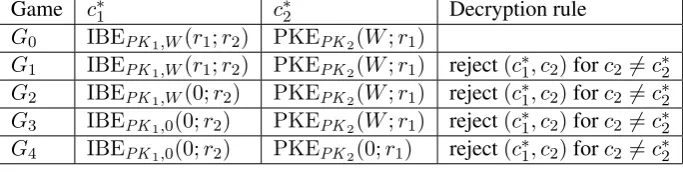
Game c∗1 c∗2 Decryption rule G0 IBEPK1,W(r1;r2) PKEPK2(W;r1)
G1 IBEPK1,W(r1;r2) PKEPK2(W;r1) reject(c
∗
1, c2)forc2 6=c∗2 G2 IBEPK1,W(0;r2) PKEPK2(W;r1) reject(c
∗
1, c2)forc2 6=c∗2 G3 IBEPK1,0(0;r2) PKEPK2(W;r1) reject(c
∗
1, c2)forc2 6=c∗2 G4 IBEPK1,0(0;r2) PKEPK2(0;r1) reject(c
∗
1, c2)forc2 6=c∗2 Table 1: Games in the security proof of the PEKSD construction.
But this is equivalent toTest(PK1,PK2)(S,(TW, W)) = yes.
Privacy against the server. In case of Construction 5.1, trapdoors are of the form(TW, W)and thus
contain the word W being tested for in plain. This is crucial for our construction, since we want to enableTestto decrypt an IBE ciphertext with respect to the “right” identityW. But obviously, this way the holder of the trapdoor(TW, W)learns the wordW which the trapdoor allows to test for. To a certain
degree, this property of the trapdoor is unavoidable in general: if the trapdoor holder suspects that the trapdoor is associated with a wordW, he can always encryptW and see if the trapdoor recognizesW.
In our example from the introduction, an email gateway uses trapdoors to test incoming user emails for a keywordW. With our scheme (in which trapdoors are of the form(TW, W)), the server hence
knows all relevant keywordsW, and what messages contains which keywords. However, an email user might be interested innotletting the server know the keywordW itself, butonlyproviding the server with a trapdoor test (which in itself does not leak the keyword, but only accepts or rejects). In other words, we might want that, given a trapdoor for a randomly chosen keywordW, one cannot efficiently find W. (As outlined above, we cannot expect indistinguishability, but only one-wayness here.) We informally say that PEKS schemes with this property haveprivacy-preserving trapdoors.
We briefly sketch how to construct PEKS (and PEKSD) schemes with privacy-preserving trapdoors. As a basis, we assume a PEKS schemePEKS. As a first attempt, we can usePEKSnot with messages W, but instead with messagesf(W)for a one-way permutationf. (That is, we construct a new PEKS schemePEKS0in whichPEKS0PK(W) = PEKSPK(f(W)), etc.) This way, trapdoors are constructed
for messagesf(W), and hence findingW from a trapdoor for (uniform)W requires breaking the one-way property off. With a similar construction, one obtains a PEKSD scheme with privacy-preserving trapdoors from any PEKSD scheme and atrapdoorone-way permutation.
Of course, this first attempt has the drawback that privacy holds only for a uniform message W, where one might hope even for privacy as soon as the message comes from a distribution with significant min-entropy. And indeed, truly random permutation is one-way as soon as the input distribution has significant min-entropy. Since (almost) truly random permutations can be constructed in the random oracle model (cf. [10]), we obtain a PEKS (but not a PEKSD) scheme with privacy-preserving trapdoors in the random oracle model.
6
Security Proof
We prove the security of the PEKSD scheme presented in Construction 5.1 using a series of games. The first game is the IND-CCA-PEKSD security game, while in the last game the adversary has information theoretically no chance of winning. We prove that every two adjacent games are indistinguishable to a polynomial time adversary, relying on the different properties of the IBE and the PKE schemes. The games differ in the way challenge messages are encrypted and in the way the decryption queries are being answered. The games are depicted in Table 6. For simplicity of notation, we denote byGi(A)
the probability thatAdvpeksPEKS-ind,A-cta(k) = 1while adapting theAdvpeksPEKS-ind,A-cta experiment to the changes described inGi.
asserts that since the IBE scheme is well-addressed these two games are indistinguishable.
Claim 6.1. If the IBE scheme in Construction 5.1 is well-addressed then gamesG0andG1are indistin-guishable.
Proof. Suppose there exists an adversaryA = (A1, A2)such thatG0(A)−G1(A) = f(k) is a non-negligible function of the security parameter. We construct an adversaryBfor theExpibeIBE-wa,B(k) experi-ment that succeeds with probabilityf(k). The adversaryB is described as follows:
1. Get the parameters(MK,PK)of the IBE from the experimentExpIBEibe-wa,B(k).
2. Generate public and private parameters for the PKE scheme.
3. HandAthe public parameters for the PEKSD scheme as described in the construction.
4. Answer PEKSDandTrapdoorqueries by following the description in Construction 5.1. PKE operations can be done sinceB holds the secret key for the PKE system. IBE operations can be done sinceBhas the master secret key of the IBE scheme.
5. Get(m00, m01)fromA1. 6. Pickb← {$ 0,1}andr1← M.$
7. Handm0bto the experimentExpibeIBE-wa,B(k)to obtain a ciphertextc∗1= IBEPK.m0
b(r1)and a message
r1.
8. Give(c∗1, c∗2)toA2, wherec∗2 = PKEPK2(m
0
b;r1).
9. Handling decryption queries: given a query of the type (c1, c2), where c1 6= c∗1, answer exactly as in step4. On queries of the form(c∗1, c2)withc2 6=c∗2, decryptc2to obtain an identityid0. If
id0 = mb, then reject. (Sincec2 6= c∗2 butc1 = c∗1, this ciphertext would have been rejected in bothG0andG1.) Forid0 6=mb, check ifIBDPK,id0(c∗1) =⊥. If yes, reject (again, this ciphertext would have been rejected inG0andG1). If not, we have found an identity useful for attacking the well-addressedness ofIBE, so we can returnid0to the experimentExpibeIBE-wa,B(k).
It is clear that in order to detect a difference betweenG0 andG1,A has to submit a decryption query
(c∗1, c2)such thatIBDPK,id0(c∗1)6=⊥forid
0being the decryption ofc
2. But these queries,B manages to extractid0 fromB’s query and can use it to breakIBE’s well-addressedness. We have
|G0(A)−G1(A)| ≤AdvibeIBE-wa,B
which proves the claim.
Next, game G2 differs from G1 in the fact that the message encrypted by the IBE scheme is no longer related to the random string used in the PKE encryption. The indistinguishability of these games in based on the secrecy property of the IBE scheme.
Claim 6.2. If the IBE scheme in Construction 5.1 is IBE-IND-CCA secure, then gamesG1andG2 are
indistinguishable.
Proof. Suppose there exists an adversaryA = (A1, A2)such thatG1(A)−G2(A) = f(k) is a non-negligible function of the security parameter. We construct an adversaryB to theExpibeIBE-ind,B-cca
experi-ment that gets advantagef(k)/4. The adversaryBis described as follows:
1. Get public parameters for the IBE scheme from theExpibeIBE-ind,B-ccaexperiment. 2. Generate public and private parameters to the PKE scheme.
3. HandA1the public parameters for the PEKSD scheme as described in Construction 5.1.
4. Answer PEKSDandTrapdoorqueries ofA1by following the algorithms as described in Con-struction 5.1. PKE operations can be done sinceB holds the secret key for the PKE system. IBE operations are done by using oracle calls to theIBDandIBTalgorithms, which are allowed in theExpibeIBE-ind,B-cca experiment.
5. Get(m00, m01)fromA1. 6. Pickb← {$ 0,1}andr1
$
← M.
7. Hand theExpibeIBE-ind,B-ccathe following values: id
∗
8. Getc∗fromExpIBEibe-ind,B-cca and give(c∗1, c∗2)toA2, wherec∗1=c∗andc∗2= PKEPK2(m
0
b;r1). 9. AnswerPEKSDandTrapdoorqueries ofA2as follows: if the query is of the form(c∗1, c2), then
reject the query. Otherwise, answer exactly as in step (4). The key point is that sincec1 6=c∗1, the adversaryB can still use oracle calls to theIBDandIBTalgorithms.
10. Get the outputb0fromA2. 11. Pickb1, b2
$
← {0,1}. Ifb1 = 0, outputb∗ =b0, else, outputb∗ =b2.
Note that in case the experiment ExpibeIBE-ind,B-cca chose to encrypt the message m0 = r1, then the
experiment is distributed identically to the gameG1 while if it chose to encrypt the messagem1 = 0, then the experiment is distributed identically to the gameG2.
Pr[ExpibeIBE-ind,B-cca(k) = 1] =
= 1/2 Pr[ExpibeIBE-ind,B-cca(k) = 1|b1= 0] + 1/2 Pr[ExpibeIBE-ind,B-cca(k) = 1|b1= 1] = = 1/2 Pr[ExpIBEibe-ind,B-cca(k) = 1|b1= 0] + 1/4 =
= 1/2(1/2 Pr[ExpIBEibe-ind,B-cca(k) = 1|b1= 0andm0 =r1was encrypted]+
+1/2 Pr[ExpibeIBE-ind,B-cca(k) = 1|b1 = 0andm1= 0was encrypted]) + 1/4 =
= 1/2(1/2(1−G1(A)) + 1/2G2(A)) + 1/4 =
= 1/2(1/2−1/2(G1(A)−G2(A))) + 1/4 =
= 1/4−1/4f(k) + 1/4 = 1/2−1/4f(k)
Therefore,AdvibeIBE-ind,B-cca(k) =−f(k)/4is non-negligible.
The difference between gameG3andG2 is that the identity used to encrypt a message in gameG3 is now replaced to be the zero identity. The games are proved indistinguishable based on the anonymity property of the IBE scheme.
Claim 6.3. If the IBE scheme in Construction 5.1 is anonymous then gamesG2 andG3 are indistin-guishable.
Proof. Suppose there exists an adversaryA = (A1, A2)such thatG2(A)−G3(A) = f(k) is a non-negligible function of the security parameter. We construct an adversaryBfor theExpibeIBE-ano,B-cca experi-ment that gets advantagef(k)/4. The adversaryBis described as follows:
1. Get public parameters for the IBE scheme from theExpibeIBE-ind,B-ccaexperiment.
2. Generate public and private parameters to the PKE scheme.
3. Hand toA1the public parameters for the PEKSD scheme as described in Construction 5.1. 4. Answer PEKSD andTrapdoor queries of A by following the algorithms as described in the
PEKSD construction. PKE operations can be done since B holds the secret key for the PKE system. IBE operations are done by using oracle calls to theIBDandIBTalgorithms, which are allowed in theExpibeIBE-ano,B-ccaexperiment.
5. Get(m00, m01)fromA1. 6. Pickb← {$ 0,1}andr1← M.$
7. Hand toExpibeIBE-ano,B-ccathe following values:id0 =m0b,id1 = 0, andm= 0.
8. Getc∗fromExpibeIBE-ano,B-ccaand give(c∗1, c2∗)toA2, wherec∗1=c∗andc∗2= PKEPK2(m
0
b;r1).
9. Answer PEKSD andTrapdoor queries as follows: if the query is of the form(c1, c2), where c1 =c∗1, then reject the query. Otherwise, answer exactly as in step (4). The key point is that since c1 6=c∗1, the adversaryBcan still use oracle calls to theIBDandIBTalgorithms.
10. Get the outputb0fromA2. 11. Pickb1, b2
$
Note that in case the experiment ExpibeIBE-ind,B-cca chose to encrypt under the identity id0 = mb, then
the experiment is distributed identically to the gameG2 while if it chose to encrypt under the identity
id1 = 0, then the experiment distributes identically to the gameG3. The analysis of the advantage ofB is identical to the analysis from Claim 6.2.
Finally, game G4 differs from G3 in that the message encrypted by the PKE scheme no longer depends on the messageW. This makes the encryption challenge information theoretically independent of the message, and thus the adversary has no advantage in guessing which ofW0andW1was encrypted. The games are proven indistiguishable using the secrecy property of the PKE scheme.
Claim 6.4. If the PKE scheme in Construction 5.1 is IND-CCA secure, then gamesG3 and G4 are indistinguishable.
Proof. Suppose there exists an adversaryA = (A1, A2)such thatG3(A)−G4(A) = f(k) is a non-negligible function of the security parameter. We construct an adversaryB to theExppkePKE-ind,B-cca experi-ment that gets advantagef(k)/4. The adversaryBis described as follows:
1. Get public parameters for the PKE scheme from theExppkePKE-ind,B-ccaexperiment. 2. Generate public and private parameters to the IBE scheme.
3. HandAthe public parameters for the PEKSD scheme as described in Construction 5.1.
4. AnswerPEKSDandTrapdoorqueries by following the algorithms as described in the Construc-tion 5.1. IBE operaConstruc-tions can be done sinceB holds the master secret key for the IBE scheme. PKE operations are done by using oracle calls to thePKDalgorithm, which are allowed in the
ExppkePKE-ind,B-ccaexperiment. 5. Get(m00, m01)fromA1.
6. Pickb← {$ 0,1}andr1, r2← M.$
7. Hand theExppkePKE-ind,B-cca the following values:m0 =m0bandm1 = 0.
8. Getc∗fromExppkePKE-ind,B-ccaand give(c∗1, c∗2)toA2, wherec∗1 = IBE0(0)andc∗2=c∗.
9. Answer PEKSD andTrapdoor queries as follows: if the query is of the form(c1, c2), where c1 = c∗1, then reject the query. Otherwise, if c2 6= c∗2, answer exactly as in Step 4. Finally, ifc2 = c∗2 answer as follows (here we show how to answer a decryption query; a test query is answered similarly):
(a) ComputeT0= IBT(MK1,0)using the extraction algorithm of the IBE scheme. (b) Computer10 = IBDT0,0(c1)using the decryption algorithm of the IBE scheme.
(c) Computec02 = PKEPK2(0;r
0
1)using the encryption algorithm of the PKE scheme, withr01 as a random string. Ifc02=c∗2answer0. otherwise continue.
(d) ComputeTmb = IBT(MK1, mb)using the extraction algorithm of the IBE scheme.
(e) Computer100= IBDTmb,mb(c1)using the decryption algorithm of the IBE scheme.
(f) Computec002 = PKEPK2(mb;r
00
1)using the encryption algorithm of the PKE scheme, with r100as a random string. Ifc002 =c∗2answermb. otherwise reject the query.
10. Get the outputb0fromA2.
11. Pickb1, b2← {$ 0,1}. Ifb1 = 0, outputb∗ =b0, else, outputb∗ =b2.
Note that in case the experiment ExppkePKE-ind,B-cca chose to encrypt the message m0 = m0b, then the experiment is distributed identically to the game G3 while if it chose to encrypt the message m1 =
0, then the experiment distributes identically to the game G4. The analysis of the advantage ofB is identical to the analysis from Claim 6.2.
Acknowledgements
References
[1] Michel Abdalla, Mihir Bellare, Dario Catalano, Eike Kiltz, Tadayoshi Kohno, Tanja Lange, John Malone-Lee, Gregory Neven, Pascal Paillier, and Haixia Shi. Searchable encryption revisited: Consistency properties, relation to anonymous IBE, and extensions. In Victor Shoup, editor,
CRYPTO 2005, volume 3621 ofLNCS, pages 205–222, Santa Barbara, CA, USA, August 14–18, 2005. Springer-Verlag, Berlin, Germany.
[2] Dan Boneh and Matthew K. Franklin. Identity-based encryption from the Weil pairing. In Joe Kilian, editor,CRYPTO 2001, volume 2139 ofLNCS, pages 213–229, Santa Barbara, CA, USA, August 19–23, 2001. Springer-Verlag, Berlin, Germany.
[3] Dan Boneh, Giovanni Di Crescenzo, Rafail Ostrovsky, and Giuseppe Persiano. Public key encryp-tion with keyword search. In Christian Cachin and Jan Camenisch, editors,EUROCRYPT 2004, volume 3027 ofLNCS, pages 506–522, Interlaken, Switzerland, May 2–6, 2004. Springer-Verlag, Berlin, Germany.
[4] Dan Boneh, Ran Canetti, Shai Halevi, and Jonathan Katz. Chosen-ciphertext security from identity-based encryption. SIAM Journal on Computing, 36(5):915–942, 2006.
[5] Xavier Boyen and Brent Waters. Anonymous hierarchical identity-based encryption (without ran-dom oracles). In Cynthia Dwork, editor,CRYPTO 2006, volume 4117 ofLNCS, pages 290–307, Santa Barbara, CA, USA, August 20–24, 2006. Springer-Verlag, Berlin, Germany.
[6] Ran Canetti, Shai Halevi, and Jonathan Katz. Chosciphertext security from identity-based en-cryption. In Christian Cachin and Jan Camenisch, editors, EUROCRYPT 2004, volume 3027 of
LNCS, pages 207–222, Interlaken, Switzerland, May 2–6, 2004. Springer-Verlag, Berlin, Germany.
[7] Yevgeniy Dodis and Jonathan Katz. Chosen-ciphertext security of multiple encryption. In Joe Kilian, editor,TCC 2005, volume 3378 ofLNCS, pages 188–209, Cambridge, MA, USA, Febru-ary 10–12, 2005. Springer-Verlag, Berlin, Germany.
[8] Thomas Fuhr and Pascal Paillier. Decryptable searchable encryption. In Willy Susilo, Joseph K. Liu, and Yi Mu, editors,Provable Security, First International Conference, ProvSec 2007, volume 4784 of LNCS, pages 228–236, Wollongong, Australia, November 1–2, 2007. Springer-Verlag, Berlin, Germany.
[9] Yael Gertner, Tal Malkin, and Steven Myers. Towards a separation of semantic and CCA security for public key encryption. In Salil P. Vadhan, editor, TCC 2007, volume 4392 ofLNCS, pages 434–455, Amsterdam, The Netherlands, February 21–24, 2007. Springer-Verlag, Berlin, Germany.
[10] Michael Luby and Charles Rackoff. How to construct random permutations from pseudo-random functions (abstract). In Hugh C. Williams, editor,CRYPTO’85, volume 218 ofLNCS, page 447, Santa Barbara, CA, USA, August 18–22, 1986. Springer-Verlag, Berlin, Germany.
[11] Alon Rosen and Gil Segev. Chosen-ciphertext security via correlated products. Cryptology ePrint Archive, Report 2008/116, 2008. http://eprint.iacr.org/2008/116.
[12] Rui Zhang and Hideki Imai. Generic combination of public key encryption with keyword search and public key encryption. In Feng Bao, San Ling, Tatsuaki Okamoto, Huaxiong Wang, and Chaop-ing XChaop-ing, editors, CANS 07, volume 4856 ofLNCS, pages 159–174, Singapore, December 8–10, 2007. Springer-Verlag, Berlin, Germany.
A
Standard definitions
A.1 Universal hashing
Definition A.1(Family of pairwise independent hash functions). LetH = (Hk)k∈Nand` :N → N withh :{0,1}k → {0,1}`(k)for allkandh ∈ H
k. ThenHis afamily of pairwise independent hash
functionsiff for allk, for allX, X0 ∈ {0,1}kwithX=6 X0, and for allY, Y0 ∈ {0,1}`(k)
Pr
h
h(X) =Y andh(X0) =Y0= 2−2`(k),
where the probability is over a uniform choice ofh∈ Hk.
A.2 Public key encryption
Definition A.2(PKE scheme). Apublic key encryption (PKE) schemePKE = (PKG,PKE,PKD) withmessage spaceMconsists of three PPT algorithms with the following syntactics:
Key generation: (PK,SK) ← PKG(1k)samples a keypair(PK,SK)consisting of a public keyPK
along with a secret keySK.
Encryption: c←PKEPK(m)encrypts a messagem∈ Mand produces a ciphertextc.
Decryption: m←PKDSK(c)decrypts a ciphertextcto a messagem.
We require thatPKDSK(PKEPK(m)) = m always, for allm ∈ M and all possible(PK,SK) ← PKG(1k).
Definition A.3(IND-CCA secure PKE scheme). A PKE schemePKE = (PKG,PKE,PKD)is called
indistinguishable under chosen-ciphertext attacks (IND-CCA secure) iff for every pair of PPT adver-sariesA= (A1, A2), the function
AdvPKEpke-ind,A-cca(k) :=PrhExpPKEpke-ind,A-cca(k) = 1i−1/2
is negligible ink, whereExppkePKE-ind,A-cca(k)is the following experiment: ExperimentExppkePKE-ind,A-cca(k)
(SK,PK)←PKG(1k) (m0, m1,st)←APKDSK(
·)
1 (PK)
b← {$ 0,1}
c∗ ←PKEPK(mb)
b0 ←APKDSK(·)
2 (st, c∗)
Return 1 iffb=b0
To avoid trivialities, we require thatA1 always returnsm0, m1 ∈ Mwith|m0| = |m1|, and that A2
never queriesPKDSK(c∗).
A.3 Identity based encryption
Definition A.4(IBE scheme). An identity-based encryption (IBE) schemeIBE = (IBG,IBT,IBE,
IBD) withidentity space ID ⊆ {0,1}∗ andmessage space M ⊆ {0,1}∗ is comprised of four PPT algorithms with the following syntactics:
Key generation: (MK,PK)←IBG(1k)returns amaster secret keyMK along with apublic keyPK.
Trapdoor generation: T ←IBT(MK,id)returns auser secret keyMK for an identityid ∈ ID.
Encryption: c ← IBEPK,id(m)encrypts a messagem ∈ Munder public keyPK and identityid ∈
ID.
Occasionally, we will writec ← IBDMK,id(c)as a shorthand for executing firstT ← IBT(MK,id) and then c ← IBDT,id(c). We require that for all id ∈ ID and m ∈ M, we always have m ← IBDMK,id(IBEPK,id(m))for all possible(MK,PK) ← IBG(1k). As a technicality, we also require that algorithmIBTis deterministic (this is without loss of generality, cf. Boneh et al. [4]).
Definition A.5 (IND-CCA secure IBE scheme). An IBE scheme IBE = (IBG,IBT,IBE,IBD) is called indistinguishable under chosen-ciphertext attacks (IBE-IND-CCA secure) iff for every pair of PPT adversariesA= (A1, A2), the function
AdvIBEibe-ind,A-cca(k) :=PrhExpIBEibe-ind,A-cca(k) = 1i−1/2
is negligible ink, whereExpibeIBE-ind,A-cca(k)is the following experiment:
ExperimentExpibeIBE-ind,A-cca(k) (MK,PK)←IBG(1k) (id∗, m0, m1,st)←A
IBT(MK,·),IBDMK,·(·)
1 (PK)
b← {$ 0,1}
c∗ ←IBEPK,id∗(mb)
b0 ←AIBT(MK,·),IBDMK,·(·)
2 (st, c
∗) Return 1 iffb=b0
To avoid trivialities, we require thatA1 always returnsm0, m1 ∈ Mwith|m0|=|m1|, thatA1 never returns anid∗on whichIBT(MK,·)has been queried, and thatA2 never queriesIBT(MK,id∗)and IBDMK,id∗(c∗).
Definition A.6(Anonymous IBE scheme). An IBE scheme IBE = (IBG,IBT,IBE,IBD) is called
anonymous (IBE-ANO-CCA secure)iff for every pair of PPT adversariesA= (A1, A2), the function
AdvIBEibe-ano,A-cca(k) :=PrhExpIBEibe-ano,A-cca(k) = 1i−1/2
is negligible ink, whereExpibeIBE-ano,A-cca(k)is the following experiment:
ExperimentExpibeIBE-ano,A-cca(k) (MK,PK)←IBG(1k) (id0,id1, m,st)←A
IBT(MK,·),IBDMK,·(·)
1 (PK)
b← {$ 0,1}
c∗ ←IBEPK,idb(m)
b0 ←A2(st, c∗) Return 1 iffb=b0
To avoid trivialities, we require thatA1always returnsid0,id1with|id0|=|id1|, thatA1never returns
anid0or anid1on whichIBT(MK,·)has been queried, and thatA2never queriesIBT(MK,idi)and
IBDMK,idi(c
∗)fori∈ {0,1}.
B
Postponed proofs
Proof of Lemma 4.3. Given an arbitrary IBE-IND-CCA adversaryA= (A1, A2)onIBE, we construct
an IBE-IND-CCA adversaryA0 = (A01, A20)onIBE0.A0IBT
0(MK0,·),IBD0
MK0,·(·)
1 (PK0)samplesh
$
← Hk,
setsPK := (PK0, h), and runs(id∗, m0, m1,st)←A
IBT(MK,·),IBDMK,·(·)
as follows: run m0 ← IBD0MK0,id(c), parsem0 = (Y, m), and returnm ifh(id) = Y (and⊥ other-wise). Next,A01returns(id∗, m00, m01,st), wherem0i = (h(id∗), mi)fori∈ {0,1}. Finally,A02runsA2 with oraclesIBTandIBDimplemented as above, and outputsA2’s output. This perfectly emulates the IBE-IND-CCA experiment withIBEforA, and we have