Privacy-Preserving Distributed Set Intersection
Qingsong Ye, Huaxiong Wang and Christophe Tartary Department of Computing, Macquarie University, Australia {qingsong,hwang,ctartary}@ics.mq.edu.au
Abstract. With the growing demand of databases outsourcing and its security concerns, we investigate privacy-preserving set intersection in a distributed sce-nario. We propose a one-round protocol for privacy-preserving set intersection based on a combination of secret sharing scheme and homomorphic encryption. We then show that, with an extra permutation performed by each of contacted servers, the cardinality of set intersection can be computed efficiently. All proto-cols constructed in this paper are provably secure against a semi-honest adversary under the Decisional Diffie-Hellman assumption.
Keywords: privacy-preserving set intersection, homomorphic encryption
1
Introduction
Privacy-Preserving Set Intersection (PPSI) protocols [7] are cryptographic techniques allowing two or more parties, each holding a set of inputs, to jointly calculate set op-erations of their inputs without leaking any information to each other. Consider that two companies C1 andC2 want to discover the consumption pattern of their shared
customers. That is, they want to determine the likelihood that a customer buying the productP1fromC1is also buying the productP2fromC2. To obtain this information,
they would like to perform a set intersection operation on their private datasets. In or-der to preserve confidentiality of the companies business and to protect the customers’ privacy, the purchase details of customers must not be revealed. There are many other examples of PPSI applications such as when two hospitals conduct a study where they wish to analyze patients records anonymously.
With the growing demand of databases outsourcing and security requirements im-posed on its applications, we investigate PPSI in a distributed environment. We call this Privacy-Preserving Distributed Set Intersection (PPDSI). To illustrate the security problem, we consider the following scenario. Assume that a provider owning a dataset wishes to outsource it to commercial servers and make it available to his clients. If he outsources his dataset to a single server then he has to fully trust that server and risk the privacy of his data. Alternatively, he can encrypt his dataset before sending it to the server but querying and evaluating on such encrypted data are very inefficient.
scheme. As such, anyt−1or less servers should not able to find out the original data. Now, assume that a client holding her private dataset, wishes to compute a specific set operation for the two sets held by the provider and herself. In order to do this success-fully, the client interacts witht or more servers. In our settings, we require that this interaction is done with minimum possible disclosure of information, that is, the client learns nothing except the final result of the set operation.
In general, PPSI can be implemented using secure multi-party computation cols [3, 23]. However, such solutions are generally inefficient. More specialized proto-cols on PPSI are needed to improve its efficiency.
Related Work. A specialized private set intersection protocol recently developed by Freedman, Nissim and Pinkas (FNP) [7] is based on the representation of datasets as roots of a polynomial. To briefly describe Freedman et al.’s construction, suppose CS = (K, Epk, Dsk) is a semantically secure public-key homomorphic encryption
scheme. Assume that Alice has the datasetA={a1, . . . , an}and Bob owns the dataset
B={b1, . . . , bm}.
To evaluateA∩B, Alice constructs the polynomialf(x) = Q
ai∈A
(x−ai) = n
P
i=0
αixi.
Then, she encrypts each coefficient asEpk(αi)with the homomorphic cryptosystem
CSsuch as Paillier’s [18] and the standard variant of the ElGamal encryption scheme (see [4]). Note that an homomorphic cryptosystem allows a party knowingEpk(x)and
Epk(y)to computeEpk(x+y) =Epk(x)·Epk(y)andEpk(x·c) =Epk(x)c wherec
is any constant. The reader is referred to Sect. 2.1 for a formal definition. Note that we only use the standard variant of the ElGamal encryption scheme in our protocols due to our distributed setting.
Thus, given encrypted coefficients, Bob can obliviously evaluate Epk(f(bi))for
each elementbi ∈ B. Note that ifbi ∈ Athenf(bi) = 0. Since Bob does not want
to reveal any other information whenbi ∈/ A, he randomizes all his oblivious
evalua-tions by a random nonzero valuerasEpk(f(bi))r =Epk(r·f(bi)). Consequently, if
f(bi) = 0then the encryption ofEpk(r·f(bi)) =Epk(0). Otherwise,Epk(r·f(bi))
is some random value. This hides any information about elements in B which are not in A. To enable Alice to check whetherbi also belongs to her dataset, Bob sends all
the cryptogramsEpk(r·f(bi) +bi)’s to her. She decrypts them and tests whether any
of the resulting plaintexts are inAasDsk(Epk(r·f(bi)+bi)) =biif and only ifbi∈A.
Inspired by FNP, Kessner and Song (KS) [12] propose a solution to various privacy-preserving set operations such as set union, set intersection, the cardinality of set in-tersection and multiplicity testing. Based on a threshold homomorphic cryptosystem, Sang et al. gave protocols for the set intersection and set matching problems with an improved computation and communication complexity in [20].
equality of two datasets is a special case of the private disjointness problem, where each party has a single element in the database. Such protocols were considered in [6, 16, 14].
Our Results. Our approach is based on homomorphic encryption and secret sharing. This paper builds on recently developed private set operation protocols FNP and KS and offers a new construction in two-party private set operations where one dataset is distributed.
Contrary to the previous two-party PPSI protocols based on the one client-one server setting, we deal with the distributed case relying on secret sharing described ear-lier. Our construction may be of great value where the privacy of unencrypted dataset outsourced in single server is a great concern.
We first compute thewshares of the datasetDP of the providerPby constructing a
bivariate polynomial and evaluating it atwpoints to get the shares. This approach is to make the share construction more efficient. Our construction only needs to use Shamir’s secret scheme [21] a single time to compute the shares of the whole dataset.
In our set intersection protocol, we will use our observation that
t
P
j=1
bj(µj−µ) = 0
where thebj’s are Lagrange interpolation coefficients,µis a value and theµj’s are the
shares ofµ. Using this relation, one can obliviously check that an elementcis equal toµ by collectingtvalues(µj−c)rwhereris a randomizer common to all participants. As
a consequence, if the clientCinteracts in parallel withtservers with her whole dataset DC, she is able to computeDP∩ DC.
We then extend our PPDSI solution to a one-round protocol evaluating|DC∩ DP|.
To prevent the client from learning the intersectionDC∩ DP, each server will permute
the cryptograms it has evaluated obliviously before sending them back to the clientC. Thus, after decryption and computation, the client only learns|DC∩ DP|.
Our protocols are secure against an honest-but-curious (semi-honest) adversary. By definition, such an adversary follows the steps of the protocol execution but tries to learn extra information from the messages received during its execution. Our homomorphic encryption is based on the ElGamal cryptosystem [5] which is semantically secure pro-vided the Decisional Diffie-Hellman (DDH) assumption holds [22]. The security of this building block will imply the security of our protocols. Note that, as in [7, 10], our pro-tocols reveal the size of the datasets of both the client and the provider. As suggested in [10], "dummy" elements can be used for dataset padding in order to hide the size of the original dataset. But, in this case, the protocols reveal an upper bound on the number of elements in the sets.
The complexity of the communication cost for each of these two constructions is O(t|DP| |DC| × log2p) bits. The computation cost complexity is
ef-ficient considering our distributed setting.
Our paper is organized as follows. In Sect. 2, we introduce the cryptographic prim-itive used in our protocols, describe the distributed environment in which our protocols are run, and give the adversary model. In Sect. 3, we present our two protocols for the set intersection problem and the cardinality of set intersection problem. The security and efficiency of these two schemes are analyzed in that section as well. Finally, in Sect. 4, we give concluding remarks and discuss possible future work.
2
Preliminaries
2.1 Additive Homomorphic Encryption
We will utilize an additive homomorphic public key cryptosystem. Following Adida and Wikstrom [1], we use the following definition.
Definition 1 ([1]). A cryptosystem with key generator K, encryption algorithm Epk
and decryption algorithm Dsk is said to be homomorphic if for every key pair (pk, sk)∈K(1l):
1. The message spaceMis a subset of an abelian groupG(M)written additively. 2. The randomizer spaceRis an abelian group written additively.
3. The ciphertext spaceCis an abelian group written multiplicatively.
4. The group operations can be computed in polynomial time given pk. For every
m, m0 ∈ Mandr, r0 ∈ R, we haveEpk(m, r)Epk(m0, r0) =Epk(m+m0, r+r0).
5. The cryptosystem is said to be additive if the message space Mis the additive modular groupZnfor some integern >1.
When such operations are performed, we require that the resulting ciphertexts be re-randomized for security. During such a process, the ciphertextcof the plaintextmis transformed intoc0such thatc0is still a valid cryptogram for the messagembut relying
on a different random string fromc’s.
In our protocols, the computations are carried out overZpwherepis prime. We
as-sume thatp= 2q+ 1whereqis also prime. We note that all our protocols can be based on the standard variant of the ElGamal encryption scheme (see [4]) which recently was used for constructing privacy-preserving set operation protocols in [10, 2, 14].
Letg, handf be three random generators of orderqinZ∗p,m1, m2, m∈ Zqand
correspondingr1, r2, r R
←Zq. We denotethe multiplication overZp×Zpdefined as
follows.
Epk(r1, m1)Epk(r2, m2) := gr1+r2, hr1+r2fm1+m2=Epk(r1+r2, m1+m2)
If we repeat this operationctimes for a single encryption, then we have Epk(r, m)c =Epk(r, m)Epk(r, m). . .Epk(r, m)
| {z }
c times
For simplicity, we useEpk(m)to representEpk(r, m)in the rest of the presentation as
we assume that there is always a correspondingr←R Zq.
2.2 Distributed Environment
The players are a clientC, a providerP, andwserversS1, S2, . . . , Sw. We assume that
the provider holds a datasetDP ={µ0, µ1, . . . , µn−1}which is distributed towservers
using(t, w)-Shamir’s secret sharing scheme.
The providerP does not directly interact withC for the set operations. Instead,C contacts at least t servers to perform the requested set operation. Note that this dis-tributed setting was first proposed by Naor and Pinkas [17].
Our homomorphic encryption system is based on a variant of ElGamal cryptosystem in which the message space is overZqwhereq≥n. For simplicity, we omit modulusq
within the computation of shares construction in this section.
Initialization and Share Distribution Phase.P constructs a polynomialF(y)whose coefficients represent his datasetDP, i.e.:
F(y) =
n−1
X
i=0
µiyi
Then,P generates a random masking bivariate polynomialH(x, y)as:
H(x, y) =
t−1
X
j=1 n−1
X
i=0
aj,ixjyi whereaj,i R
←Zq
Note that we have H(0, y) = 0for anyy. Using the polynomialH(x, y),P defines another bivariate polynomial Q(x, y) = F(y) + H(x, y). Note that we get ∀y Q(0, y) := F(y). For 1 ≤ ` ≤ w, P sends Q(`, y) :=
n−1
P
i=0
µi,`yi to server
S` where ∀i ∈ {0, . . . , t−1} µi,` = µi +bi,` with bi,` = t−1
P
j=1
aj,i`j. The server
S` receives a set of shared coefficients {µ0,`, . . . , µn−1,`} of the polynomial F(y)
(see [15]).
Secret Reconstruction Phase. We now show how anyt-subset of servers can recover F(y). DenoteS`1, . . . , S`tthetservers contacted by the client. Using Lagrange
following system: V−1
Q(`1, y)
Q(`2, y)
.. . Q(`t, y)
=
F(y)
t−1
X
j=1
aj,0yi
.. .
t−1
X
j=1
aj,n−1yi
(1)
whereV is thet×tVandermonde matrix:V :=`jij=0,...,t−1
i=1,...,t . Since we are only
inter-ested in the reconstruction ofF(y), we simply need to know the first row(v1,1 · · ·v1,t)
ofV−1as we have:
t
X
j=1
v1,jQ(`j, y) =F(y)
As a consequence, we obtain:
∀i∈ {0, . . . , n−1}
t
X
j=1
v1,jµi,`j =µi (2)
Lemma 1 shows how to construct the first row ofV−1 whose proof can be found in
Appendix A. Lemma 1. We have:
∀j∈ {1, . . . , t} v1,j = Y
1≤k≤t k6=j
`k
`k−`j
and t X j=1
v1,j = 1
From the previous lemma, we deduce:
∀i∈ {1, . . . , n−1} µi= t X j=1 Y 1≤k≤t k6=j `k
`k−`j
µi,`j
Note that our reconstruction technique can be seen as a particular case of Lagrange interpolation. Notice that we use the variant of ElGamal that is defined overZp. Further
in our paper, the computations are being done modulopand we simplify the notation by skipping the modulus in the congruences. If we use different modulus, the congruence will be written in full to avoid confusion.
2.3 Adversary Model
In this model, there is no direct interaction betweenCandP. Instead the clientC andw servers are assumed to follow the steps defined in the protocol. The security definition is straightforward that only the clientClearns the result of the protocol. Definition 2. (t-secure). A set operation protocol is said to be t-secure if the clientC, colluding with at mostt−1out ofwservers learns no information about the provider’s dataset and the set operation result.
Following [16, 17] our model should meet the following requirements:
Correctness. A protocol is correct if the client C is able to compute the valid result from shares obtained fromtservers assuming that each server and the client honestly follow the protocol.
Client’s security. The protocol should guarantee the client privacy, i.e. the servers learn nothing about either the client inputs or its corresponding computed output. In other words, a server is not able to distinguish the client inputs from uniform random vari-ables.
Provider’s security. The protocol should not give out to the client any information about the function held by the provider apart from the output of the function assuming that no server colludes with the client. Also, the provider privacy is t-secure.
3
Protocols for PPDSI
In this section, we address the problem of designing protocols for PPDSI related is-sues. Those targeted in this paper are the privacy preserving set intersection prob-lem and the cardinality of set intersection probprob-lem. The provider P holds a dataset DP ={µ0, . . . , µn−1}which is distributed towserversS1, . . . , Swas in Sect. 2.2. The
datasetDCof the clientCis{c0, . . . , cm−1}. Note that it is assumed that|DC|=mand
|DP|=nare publicly known. We assume that the providerPbroadcastsλ R
←Zq−{0}
to thewservers.
3.1 Determination of the Set Intersection
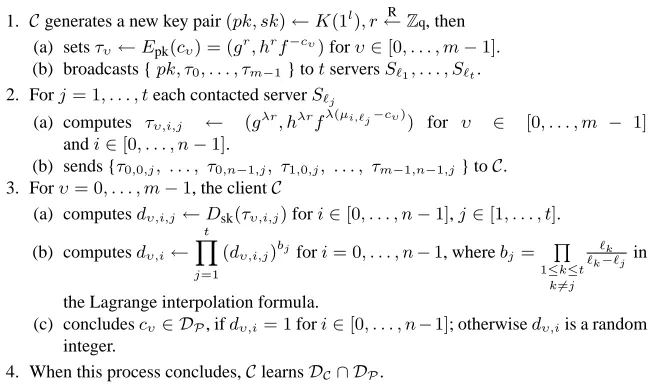
Figure 1 represents a protocol which enables the clientCto compute the intersection DP∩ DCby contacting anyt-subset of serversS`1, . . . , S`t.
Correctness of the Protocol. In order to prove the soundness of our construction, we need the following lemma.
Lemma 2. Let bj = Q 1≤k≤t
k6=j `k
`k−`j be the coefficient constructed at Step 3.b of Fig. 1.
Then:
t
X
j=1
Input: The clientChas a set of dataDC. Each serverS`(1≤`≤w)knows the random valueλand the shared coefficients {µ0,`, . . . , µn−1,`}of the polynomial F(y) (whose coefficients are the elements of the provider’s datasetDP).
Output: The clientClearnsDC∩ DP.
1. Cgenerates a new key pair(pk, sk)←K(1l)
, r←R Zq, then (a) setsτυ←Epk(cυ) = (gr, hrf−cυ)forυ∈[0, . . . , m−1]. (b) broadcasts {pk, τ0, . . . , τm−1} totserversS`1, . . . , S`t.
2. Forj= 1, . . . , teach contacted serverS`j
(a) computes τυ,i,j ← (gλr, hλrfλ(µi,`j
−cυ))
for υ ∈ [0, . . . , m − 1]
andi∈[0, . . . , n−1].
(b) sends {τ0,0,j, . . . , τ0,n−1,j, τ1,0,j, . . . , τm−1,n−1,j} toC. 3. Forυ= 0, . . . , m−1, the clientC
(a) computesdυ,i,j←Dsk(τυ,i,j)fori∈[0, . . . , n−1],j∈[1, . . . , t].
(b) computesdυ,i← t
Y
j=1
(dυ,i,j)bj fori= 0, . . . , n−1, wherebj= Q 1≤k≤t
k6=j `k
`k−`j in
the Lagrange interpolation formula.
(c) concludescυ∈ DP, ifdυ,i= 1fori∈[0, . . . , n−1]; otherwisedυ,iis a random integer.
4. When this process concludes,ClearnsDC∩ DP.
Fig. 1. Privacy-preserving set intersection protocol
Proof. Note that our coefficientbj corresponds to thejthcoefficient of the first row of
the matrixV−1denotedv
1,j in Sect. 2.2. From Lemma 1, we get that t
P
j=1
bj = 1. Thus,
(2) provides our result. ut
In the above protocol, the clientCfirst encrypts each elementcυof her dataset by
using her public key as Epk(f−cυ)for υ ∈ [0, . . . , m−1]and broadcasts all these
encrypted elements tot servers. For each encrypted element Epk(f−cυ), the servers
S`j(1 ≤ j ≤ t)computeEpk(f
λ(µi,`j−cυ))for i ∈ [0, . . . , n−1], and send all the
Epk(fλ(µi,`j−cυ))’s back to C. The client C then decrypts those Epk(fλ(µi,`j−cυ))’s
and computesfλ
t
P
j=1
bj(µi,`j−cυ)
for eachi = 0, . . . , n−1. Note that ifcυ = µithen t
P
j=1
bj(µi,`j −cυ) = 0. Therefore, the client C learns that cυ ∈ DP if there exists
i ∈[0, . . . , n−1]such thatfλ
t
P
j=1
bj(µi,`j−cυ)
= 1. When all the steps are finished,C learnsDC∩ DP.
Theorem 1. Given the set intersection protocol described in Fig. 1 and assuming that
the underlying homomorphic encryption is semantically secure, then each of the con-tacted servers cannot distinguish inputs generated by the clientCfrom random integers with a non-negligible probability.
Theorem 2. Assuming that the discrete logarithm problem is hard, the clientCcannot compute any information about shared coefficients{µ0,`, . . . , µn−1,`} (1 ≤ ` ≤ w)
distributed by the providerP. In addition,P’s privacy is t-secure.
3.2 Computation of the Cardinality of Set-Intersection
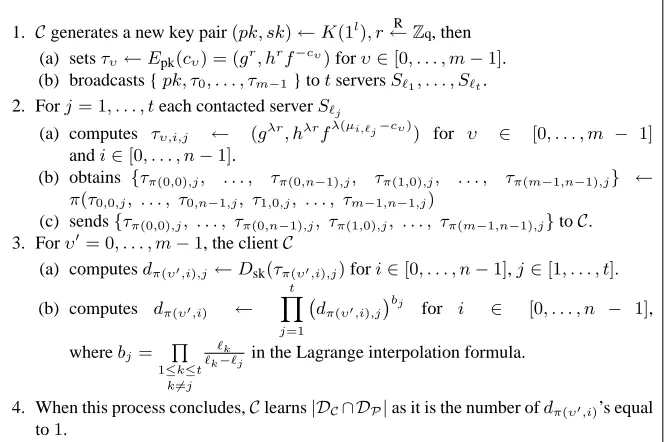
By introducing a permutation into our PPDSI protocol, we develop an algorithm com-puting the cardinality of the datasets’ intersection|DC∩ DP|. DenotePm nthe set of
all permutations of{1, . . . , m n}. Assume thatPhas a private permutation functionπ, chosen uniformly at random fromPm n, which is given to thewservers. This scheme
is represented as Fig. 2.
Input: The clientChas a set of dataDC. Each serverS`(1≤`≤w)knows the random valueλ, the permutation functionπand the shared coefficients{µ0,`, . . . , µn−1,`}of the polynomialF(y)(whose coefficients are the elements of the provider’s datasetDP).
Output: The clientClearns|DC∩ DP|.
1. Cgenerates a new key pair(pk, sk)←K(1l), r←R
Zq, then (a) setsτυ←Epk(cυ) = (gr, hrf−cυ)forυ∈[0, . . . , m−1]. (b) broadcasts {pk, τ0, . . . , τm−1} totserversS`1, . . . , S`t.
2. Forj= 1, . . . , teach contacted serverS`j
(a) computes τυ,i,j ← (gλr, hλrf
λ(µi,`j−cυ))
for υ ∈ [0, . . . , m − 1]
andi∈[0, . . . , n−1].
(b) obtains {τπ(0,0),j, . . . , τπ(0,n−1),j, τπ(1,0),j, . . . , τπ(m−1,n−1),j} ←
π(τ0,0,j, . . . , τ0,n−1,j, τ1,0,j, . . . , τm−1,n−1,j)
(c) sends{τπ(0,0),j, . . . , τπ(0,n−1),j, τπ(1,0),j, . . . , τπ(m−1,n−1),j}toC. 3. Forυ0= 0, . . . , m−1
, the clientC
(a) computesdπ(υ0,i),j←Dsk(τπ(υ0,i),j)fori∈[0, . . . , n−1],j∈[1, . . . , t].
(b) computes dπ(υ0,i) ← t
Y
j=1
` dπ(υ0,i),j
´bj
for i ∈ [0, . . . , n − 1],
wherebj= Q 1≤k≤t
k6=j `k
`k−`j in the Lagrange interpolation formula.
4. When this process concludes,Clearns|DC∩ DP|as it is the number ofdπ(υ0,i)’s equal to1.
Fig. 2. Privacy-preserving cardinality of set-intersection protocol
πon their computed cryptograms. This is to prevent the clientCfrom learning the set intersectionDC∩ DP.
Security of the Construction. The security model as well as the proof for this protocol are similar to what was done for our set-intersection protocol presented in Sect. 3.1 as the permutationπwas chosen uniformly at random fromPm n.
3.3 Efficiency of our Protocols
In this part, we study the communication and computation cost of our two constructions. Communication Cost. For both protocols,Cbroadcasts a set ofmencrypted values to tservers while each contacted serverS`j responds withm nmessages. Thus, the
com-plexity of the communication cost for both constructions areO(t m n×log2p)bits. Computation Cost. It should be noticed that operations inZpcan be done inO(log22p)
bit operations.
For our first protocol,Cneedsm+ 2modular exponentiations andmmodular mul-tiplications to encrypt her dataset, t m ndecryptions, t m n modular exponentiations andm n(t−1)modular multiplications for Lagrange interpolation. Note that each de-cryption represents one modular multiplication and one modular exponentiation. Each serverS`j executesm nmodular exponentiations and multiplications when processing
its shares. So, this protocol usesO(t m n×log2p)modular multiplications considering
that a single modular exponentiation takes at mostblog2(p−1)cmodular
multiplica-tions using the Fast Exponentiation algorithm presented in [19].
The cost of our second protocol is the same as the first one’s plustexecutions of the permutationπ. Assuming that πis represented by its binary permutation matrix Mπ,
each of thesetqueries has a negligible cost sinceπis a simple reordering of its inputs (Mπhas a single coefficient equal to1per row).
Therefore, the complexity of computation cost of these two constructions is O(t m n×log32p)bits.
4
Conclusion and Future Work
In this paper, we have proposed a protocol for the privacy-preserving set intersection computation in a distributed environment. Our construction was based on Shamir’s se-cret sharing scheme and homomorphic encryption scheme. With our construction, each server only held the shares of the original provider dataset, and consequently the pri-vacy of that dataset was protected. Moreover, we have shown that, using a permutation π, we could efficiently compute the cardinality of the set intersection.
References
[1] B. Adida and D. Wikstrom. How to shuffle in public. In 4th Theory of Cryptography Conference (TCC ’07),, volume accepted of LNCS. Springer-Verlag, 2007.
[2] B. Aiello, Y. Ishai, and O. Reingold. Priced oblivious transfer: How to sell digital goods. In B. Pfitzmann, editor, Advances in Cryptology - Eurocrypt ’01, volume 2045 of LNCS, pages 119–135. Springer-Verlag Berlin Heidelberg, 2001.
[3] M. Ben-Or, S. Goldwasser, and A. Wigderson. Completeness theorems for non-cryptographic fault-tolerant distributed computation. In 20th Annual ACM Symposium on Theory of Computing, pages 1–10. ACM Press, 1988.
[4] R. Cramer, R. Gennaro, and B. Schoenmakers. A secure and optimally efficient multi-authority election scheme. In Advances in Cryptology - Eurocrypt’97, volume 1233 of LNCS, pages 103 – 118. Springer - Verlag, 1997.
[5] T. El Gamal. A public key cryptosystem and a signature scheme based on discrete log-arithms. In G. R. Blakley and D. Chaum, editors, Advances in Cryptology - Crypto ’84, volume 196, pages 19–22. Springer-Verlag, August 1984.
[6] R. Fagin, M. Naor, and P. Winkler. Comparing information without leaking it. Communi-cations of the ACM, 39(5):77–85, 1996.
[7] M. J. Freedman, K. Nissim, and B. Pinkas. Efficient private matching and set intersection. In C. Cachin and J. Camenisch, editors, Advances in Cryptology - Eurocrypt ’04, volume 3024 of LNCS, pages 1–9. Springer-Verlag Berlin Heidelberg, 2004.
[8] O. Goldreich. The Foundations of Cryptography, volume 2. Cambridge University Press, 2004.
[9] S. Hohenberger and S. A. Weis. Honest-verifier private disjointness testing without random oracles. In 6th Workshop on Privacy Enhancing Technologies (PET’06), volume 4258 of LNCS, pages 277–294. Springer-Verlag Berlin Heidelberg, 2006.
[10] A. Kiayias and A. Mitrofanova. Testing disjointness and private datasets. In A. S. Patrick and M. Yung, editors, Finanicial Cryptography (FC’05), volume 3570, pages 109–124. Springer-Verlag Berlin Heidelberg, 2005.
[11] A. Kiayias and A. Mitrofanova. Syntax-driven private evaluation of quantified membership queries. In 4th International Conference on Applied Cryptography and Network Security (ACNS’06), volume 3989 of LNCS, pages 470–485. Springer-Verlag, 2006.
[12] L. Kissner and D. Song. Privacy-preserving set operaitons. In V. Shoup, editor, Advances in Cryptology - Crypto ’05, volume 3621 of LNCS, pages 241–257. Springer-Verlag Berlin Heidelberg, 2005.
[13] S. Laur, H. Lipmaa, and T. Mielikainen. Private itemset support counting. In 7th Interna-tional Conference on Information and Communications Security, volume 3783 of LNCS, pages 97–111. Springer-Verlag, 2005.
[14] H. Lipmaa. Verifiable homomorphic oblivious transfer and private equality test. In C. S. Laih, editor, Advances in Cryptology - Asiacrypt ’03, volume 2894, pages 416–433. Springer-Verlag Berlin Heidelberg, 2003.
[15] P. Mohassel and M. Franklin. Efficient polynomial operations in the shared-coefficients setting. In M. Yung, editor, Public Key Cryptography (PKC’06), volume 3958 of LNCS, pages 44–57. Springer-Verlag, 2006.
[16] M. Naor and B. Pinkas. Oblivious transfer and polynomial evaluation. In 31st annual ACM Symposium on Theory of Computing (STOC ’99), pages 245–254, Atlanta, Georgia, May 1999.
[18] P. Paillier. Public-key cryptosystems based on composite degree residuosity classes. In Advances in Cryptology - Eurocrypt ’99, volume 1592 of LNCS, pages 223–238. Springer-Verlag, 1999.
[19] J. Pieprzyk, T. Hardjono, and J. Seberry. Fundamentals of Computer Security. Springer, 2003.
[20] Y. Sang, H. Shen, Y. Tan, and N. Xiong. Efficient protocols for privacy preserving matching against distributed datasets. In 8th International Conference of Information and Commu-nications Security (ICICS’06), volume 4307 of LNCS, pages 210–227. Springer - Verlag, 2006.
[21] A. Shamir. How to share a secret. Communications of the ACM, 22:612–613, 1979. [22] Y. Tsiounis and M. Yung. On the security of elgamal based encryption. In Public Key
Cryptography (PKC’98), volume 1431 of LNCS, pages 117–134. Springer-Verlag, 1998. [23] A. C. Yao. Protocols for secure computations. In 23rd Symposium on Foundations of
Computer Science (FOCS), pages 160–164. IEEE, 1982.
A
Proof of Lemma 1
We havetparticipants and each of them has a share. Corresponding to thetpoints, the Vandermonde matrixV is constructed as follows:
V =
1xi1. . . xt−1i1
..
. ... . .. ... 1xit . . . x
t−1 it
.
Since the points are pairwise distinct,V is invertible. LetV−1= (v
i,j)1≤i,j≤t. By
tak-ing first row ofV−1and first column ofV, we obtain Pt j=1
v1,j = 1asV−1×V =Idt
where Idtdenotes thet×tidentity matrix.
Thet polynomialsP1(x), . . . , Pt(x)are defined asPj(x) := Q 1≤k≤t
k6=j x−xik
xik−xij for
any1≤j≤t. Note that these polynomials have a nice property, namely
∀j∈[1, . . . , t], Pj(xie) =
1 ifj=e 0 otherwise.
Those polynomials also can be rewritten as:∀j ∈ [1, . . . , t] Pj(x) = t
P
k=1
aj,k xk−1
where eachaj,k∈Zp.
We now build at×tmatrix:
D=
a1,1a2,1· · · at,1
..
. ... . .. ... a1,t a2,t· · · at,t
Thejthcolumn ofDrepresents the coefficients ofP
j(x). We claim that:V−1=D. It
is sufficient to prove thatV ×Dis a identity matrix. LetV ×D=W = (wς,η)1≤ς≤t
1≤η≤t
. We fixς, η∈[1, . . . , t]the coefficientwς,ηis
obtained by using the ςth row of V along with the ηth column of D as
wς,η = t
P
m=1
xm−1iς aη,m. Notice thatwς,η = Pη(xiς). Using the previous property of
the polynomial, we obtain
wς,η =
1 ifη=ς 0 otherwise.
This property demonstrates thatWis a identity matrix, which proves thatV−1=Das
the inverse is unique.
Since the sum of the coefficients of the first row of V−1 is 1, we get t
P
j=1
v1,j = t
P
j=1
aj,1 = 1. Notice that aj,1 is the constant coefficient of Pj(x),
so∀j ∈ [1, . . . , t], aj,1 =Pj(0) = Q 1≤k≤t
k6=j xik
xik−xij.Combining the previous two
find-ings, we can conclude that:
t
X
j=1
Y
1≤k≤t k6=j
xik
xik−xij
= 1.
B
Proof of Theorem 1
Denotehgi, the subgroup ofZ∗p generated byg. By definition, the order ofhgiisq.
The client C sends the group of t servers the encrypted values Epk(c0), . . . ,
Epk(cm−1)where:
∀i∈ {0, . . . , m−1} Epk(ci) = (gr, hrf−ci)
Thus, the group oftservers obtains:
gr, hrf−c0, . . . , hrf−cm−1
The elementsgandhare two generators of the multiplicative grouphgi. Asris chosen uniformly at random overhgi,grandhrare two elements uniformly distributed over
As theci’s are all distinct, we get:f−ci6≡f−cj modpwheni6=j. Ifhr6≡1modp
then each elementhrf−cimodpis uniformly distributed overhgiand we have:
Pr(hr6≡1modp) =Pr(r6≡0modq) = 1−1
q
So, we deduce thathrf−c0, . . . , hrf−cm−1arempairwise distinct elements uniformly
distributed overhgiwith probability1−1q as the same valueris used for each of these elements.
As the discrete logarithm problem is assumed to be hard overZp(DDH assumption),
the group of t servers cannot computer fromgr with non-negligible probability in
polynomial time as a function of the bit size ofp. Therefore, given the above analysis, we deduce that thetservers cannot distinguish themelementshrf−c0, . . . , hrf−cm−1
frommdistinct elements ofhgidrawn uniformly.
C
Proof of Theorem 2
We first consider thatCcontactstservers. At the end of Step3.b, we have:
∀υ∈ {0, . . . , m−1} ∀i∈ {0, . . . , n−1} dυ,i=f λ
t
P
j=1
bj(µi,`j−cυ)
Using the proof of Lemma 2, we get:
∀υ∈ {0, . . . , m−1} ∀i∈ {0, . . . , n−1} dυ,i=f λ
t
P
j=1 bjµi,`j
! −cυ
!
Using that lemma, we deduce that, for eachcυfromDC, we have:
cυ∈ DP ⇐⇒ ∃i0∈ {0, . . . , n−1}
t
X
j=1
bjµi0,`j
−cυ= 0
Now, assume thatcυis not an element ofDP. We have:
∀i∈ {0, . . . , n−1}
t
X
j=1
bjµi,`j
−cυ6≡0modq
Sinceλhas been chosen uniformly at random fromZq− {0}, we deduce that the
ele-mentλ
t
P
j=1
bjµi,`j
!
−cυ
!
is uniformly distributed overZq− {0}as well. As the
discrete logarithm problem is assumed to be hard overZp(DDH assumption), this
ex-ponent is not computable in polynomial time with non-negligible probability byCand thus the coefficientsdυ,0, . . . , dυ,n−1appeared to be uniformly drawn fromhgito the
We now assume thatConly contactedt−1serversS`1, . . . , S`t−1. In this
situa-tion, the polynomialF(y)representing the provider datasetDPcannot be reconstructed
uniquely identically to the secret polynomial of a(t, w)-Shamir secret sharing scheme when onlyt−1participants work together. As a consequence, the missing participant involves thatF(y)can takepequally probable values where a single one is correct. Thus,C cannot recoverDC ∩ DP even if he colludes witht−1servers as he cannot