Time-Specific Encryption
?Kenneth G. Paterson and Elizabeth A. Quaglia
Information Security Group, Royal Holloway, University of London,
[email protected], [email protected]
Abstract. This paper introduces and explores the new concept of Time-Specific Encryption (TSE). In (Plain) TSE, a Time Server broadcasts a key at the beginning of each time unit, a Time Instant Key (TIK). The sender of a message can specify any time interval during the encryption process; the receiver can decrypt to recover the message only if it has a TIK that corresponds to a time in that interval. We extend Plain TSE to the public-key and identity-based settings, where receivers are additionally equipped with private keys and either public keys or identities, and where decryption now requires the use of the private key as well as an appropriate TIK. We introduce security models for the plain, public-key and identity-based settings. We also provide constructions for schemes in the different settings, showing how to obtain Plain TSE using identity-based techniques, how to combine Plain TSE with public-key and identity-based encryption schemes, and how to build schemes that are chosen-ciphertext secure from schemes that are chosen-plaintext secure. Finally, we suggest applications for our new primitive, and discuss its relationships with existing primitives, such as Timed-Release Encryption and Broadcast Encryption.
?
1 Introduction
Time has always played an important role in communication. Information can become useless after a certain point, sensitive data may not be released before a particular time, or we may wish to enable access to information for only a limited period of time. In this context, being able to specify during what time interval a ciphertext can be decrypted by a receiver is a useful and interesting property. In this paper, we introduce and develop a new cryptographic primitive called Time-Specific Encryption (TSE) which addresses this problem.
More specifically, we consider a setting in which we have a (semi-)trusted Time Server (T S). T S
broadcasts a Time Instant Key (TIK)ktat each time unit or “tick” of its clock,t, where 0≤t≤T−1. This TIK is available to all users, and we implicitly assume that it contains a description oft. A sender can specify any interval [t0, t1], where t0 ≤t1, when encrypting a plaintext m to form a ciphertext c. In Plain TSE, we wish to achieve the property that c can only be decrypted by a receiver to recover
m if the receiver is in possession of a TIKkt for somet witht∈[t0, t1]. Notice that we cannot enforce the property that the receiver can only decrypt during the decryption time interval (DTI) [t0, t1], since a receiver can always obtain an appropriate TIK and then use it at any time later on. Achieving this stronger notion could be done using trusted hardware, for example. Yet, as we discuss below, TSE has several intriguing applications exploiting its defining property that a receiver must obtain a suitable TIK before being able to decrypt.
We extend Plain TSE to the public-key and identity-based settings, where receivers are additionally equipped with private keys and either public keys or identities, and where decryption now requires the use of the relevant private key as well as an appropriate TIK. This provides protection against a curious Time Server, as well as ensuring that a ciphertext is decryptable only by a specified party. We introduce security models for the plain, public-key and identity-based settings, considering both chosen-plaintext and chosen-ciphertext adversaries.
We also provide constructions for schemes in the different settings. Firstly, we build Plain TSE schemes by adapting ideas of [25,27] which themselves employ identity-based and tree techniques. Secondly, we show how to combine Plain TSE with public-key and identity-based encryption schemes to obtain chosen-plaintext secure TSE schemes in the public-key and identity-based settings. Thirdly, we show how to adapt the CHK transform [8] to the TSE setting, obtaining a generic construction for a chosen-ciphertext secure TSE scheme in the public-key setting from a chosen-plaintext secure, identity-based TSE scheme. Our focus is on providing generic constructions that are secure in the standard model. Naturally, more efficient constructions and concrete schemes can be obtained by working in the Random Oracle Model (ROM), and we sketch such constructions where appropriate. In our closing section, we discuss possible extensions of our ideas and areas for future work.
1.1 Applications of TSE
TSE generalises Timed-Release Encryption (TRE), a concept first introduced in [23]. In TRE, a user can only decrypt after a specified release time. Existing approaches [9,10,20,15,12] to achieving TRE also make use of a trusted Time Server broadcasting time-specific keys, but suffer from the limitation that some back-up mechanism must be provided in case the receiver misses a key broadcast by the server. In this sense, TRE represents the special case of TSE in which the sender can specify only intervals of the form [t, t]. Typically in the literature, it is assumed that the Time Server (or some other agency) will make old keys available on a public server. Clearly this may be inconvenient and would require additional infrastructure on top of the broadcast capability. TSE provides an elegant solution to this problem: if the sender specifies an interval of the form [t, T−1] (whereT−1 is the maximum time supported by the scheme) then a receiver can decrypt usinganyTIKkt0 broadcast by the Time Server at timet0 ≥t. We note that the use of tree techniques to achieve this capability was sketched in [9,12], but without any formal security analysis. TSE, then, provides a useful extension of TRE that can be exploited in any of the many applications that have already been proposed for TRE in the literature, including electronic auctions, key escrow, on-line gaming, timed release of information such as press releases, and so on.
ciphertext as soon as it is received and a TIK has been obtained, but only up to timet. After this time, TIKs issued by the time server will not help in decryption. Yet, a user might obtain a useful TIK from some other user in the system, so this application of TSE only makes sense in situations where users have a vested interest in not sharing TIKs with one another, such as in situations where users are in competition with one another. For example, the ciphertext may encrypt a ticket for accessing a service that is valid up to timet. More generally, TSE can be used to support any application in which a user benefits from accessing plaintext in a timely manner, and where the utility of a TIK becomes limited shortly after its broadcast time. We sketch an example of such an application in the domain of entity authentication next.
Consider a typical time-stamp based network authentication protocol, in which entities A and B
share a symmetric key K and in which A sends B messages of the form MACK(T||B) where T is the current time (at A) and MACK denotes a secure MAC algorithm using the key K. Such a protocol requires roughly synchronised clocks, andB needs to allow a “window of acceptance” for values T in
A’s messages, to cater for any loss of accuracy in synchronisation and network delay. In turn, this means that B needs to keep a log of recently received messages to prevent replays by an attacker during the window. How can TSE help? Suppose B generates a nonce N, encrypts it using a TSE scheme with an interval [t0, t1], where t1 −t0 is equal to the width of a suitable window of acceptance (to cater for network delay and clock drift betweenA andB), and broadcasts the resulting ciphertext. Now A’s ability to send a message of the form MACK(N||B) to B before time t1 is a proof that A obtained a TIKkt during the interval [t0, t1] and decrypted to obtain the nonce N. ThusB obtains a proof of liveness ofAwithin a certain window of acceptance, so authenticatingA toB. This basic protocol can be extended in a number of ways. For example, B’s ciphertexts can be pre-distributed to A, giving
A a set of tokens which she can use to authenticate to B during specified time intervals. We can also adapt the basic scheme to use pseudo-randomly generated nonces, so saving state atB. We can modify it to provide key transport, by replacing the MAC with an authenticated encryption primitive and including a session key in A’s message. We can also add mutual authentication in obvious ways. But what is notable about the protocol design is that we no longer require synchronised clocks, and we have a window of acceptance for responses by design. These features arise from the use of TSE.
1.2 Further Related Work
Range queries over encrypted data and related ideas: Shiet al. [25] proposed schemes enabling multi-dimensional range queries over encrypted data (MRQED). In the one-multi-dimensional version of this prim-itive, data is associated with a single value and is encrypted with respect to that value, while users are equipped with keys enabling them to decrypt data whose values are in a given range. In contrast, in TSE, encryption is performed with respect to a range, while the Time Server makes available keys specific to a particular time value. Thus, our notion of Plain TSE is precisely equivalent to the notion of dual MRQED, introduced but not formalised by Shiet al.[25]. We note that [25] gives a construction which builds a dual MRQED scheme from a normal MRQED scheme, but this seems to involve a dou-bling of dimension and, therefore, a significant loss of efficiency, a problem from which our constructions do not suffer. In addition, in our work, we give constructions achieving non-selective security against chosen-ciphertext attackers, whereas [25] only considers selective security notions and chosen-plaintext attackers in any detail (and then in the MRQED setting rather than its dual). Moreover, we consider plain, public-key and identity-based settings, whereas [25] only handles what amounts to the plain setting. In work related to that of Shi et al., Srivatsa et al. introduced [27] Trust-and-Identity Based Encryption (TIBE). Replacing “trust” with time in TIBE, and ignoring the identity-based aspects, we recover a special case of MRQED of dimension 1, but handling only intervals of the form [t, T −1]. Another related idea is sketched in [4], where it is shown how to transform a hierarchical identity-based encryption scheme into an encryption system that can send messages into the future. Translated into the language of this paper, this yields a Plain TSE scheme that can only support intervals of the form [t, T −1]. Unfortunately, because of specific details of the construction used, this approach does not seem capable of being extended to support more general intervals.
which express interval membership and attributes which express specific times, and with the Time Server playing the role of Attribute Authority. We note that most work on ABE and PE to date, with the exception of [22], is limited to the “selective-attribute” case. In the context of TSE, converting to a non-selective security model would incur a cost of roughly O(T12) in the tightness of the security reduction. However, our constructions for TSE already achieve fully adaptive security in the standard model with atight reduction to the security of the IBE scheme used in the specific instantiation.
Broadcast Encryption: Broadcast Encryption (BE) is a cryptographic primitive designed to address the issue of broadcasting a message to an arbitrary subset drawn from a universe of users. Although conceptually opposites (in TSE the keys are broadcast while the message is sent beforehand), it can be shown that a BE scheme can be used to construct a Plain TSE scheme: assume the users in the BE scheme can be labeled with elements from [0, T −1], consider a DTI as the target subset of addressed users in the BE encryption algorithm, and broadcast the private key for user with labeltat timet. The functionality of the algorithms and the security of the schemes are preserved in this transformation (see Appendix B). There are however some caveats to this approach. First of all, to meet our TSE security requirement, we need the BE scheme to be fully collusion resistant. This condition immediately rules out many of the existing schemes. Furthermore, deploying BE schemes, as they are described generically in [6] and [18], requires the specification of the target set (in our case, the DTI) as an input to the decryption algorithm, inherently preventing the resulting Plain TSE scheme from having the DTI confidentiality property. Finally, the advantages and shortcomings of BE over our approach to the realisation of Plain TSE, as developed in Section 4.1, can be cast in a framework of trade-offs between the sizes of public parameters, private keys and ciphertexts, together with computational costs and strength of security achieved. We give a flavour of the possible trade-offs below.
For the purpose of our discussion, we consider the construction of Plain TSE schemes supportingT
time instants from BE schemes. We focus on schemes that are provably secure in the standard model. In particular, the BE scheme of Boneh et al. in [6], proved only statically secure, results in a Plain TSE scheme with constant size private keys, public parameters and ciphertexts of sizeO(√T). In [18] Gentry and Waters introduce the new notion of semi-static security and provide a BE scheme achieving this notion which can be used to construct a Plain TSE scheme with constant size private keys and ciphertexts but public parameters whose size is linear in T. They also give a fully adaptive secure BE scheme with constant size private keys, but with public parameters and ciphertexts of sizeO(√T). The resulting Plain TSE scheme inherits these sizes. On the other hand, our solution results in schemes which are fully secure, with constant size public parameters, and private keys and ciphertexts of size
O(logT). This brief comparison illustrates the value of a dedicated approach when realising Plain TSE.
Temporal access control: Significant related work in the symmetric key setting exists in the area of cryptographically-enabled “temporal access control”, see for example [14] and the references therein. In this line of work, a key is associated with each time “point”, and a key assignment scheme is used to ensure that an authorized user is able to derive keys for all the points contained in a designated interval. Such schemes generally require the publication of rather large amounts of information in order to achieve the desired functionality, but do allow efficient derivation of keys associated with time points. In contrast, we use public-key techniques, achieving small public parameters and greater flexibility in operation, at the cost of increased computation.
2 Preliminaries
3 Definitions and Security Notions
3.1 Plain TSE
We start by providing the definition and the security models for the basic form of Time-Specific En-cryption, namely Plain TSE.
Definition 1. A Plain TSE scheme is defined by four algorithms and has associated message space MSP = {0,1}l, ciphertext space CSP and time space T = [0, T −1]. The parties involved in the
scheme are the Time Server (T S), the sender (S) and a user (U). The four algorithms are as follows:
Plain.Setup. Run by T S, this algorithm takes as input the security parameter κ and T and outputs the master public key TS-MPK and the master secret key TS-MSK.
Plain.TIK-Ext. Run byT S, this algorithm takes as input TS-MPK, TS-MSK, t∈ T and outputs the Time Instant Key (TIK) kt. This is broadcast by T S at time t.
Plain.Enc.Run byS, this algorithm takes as input TS-MPK, a message m∈ MSP and a Decryption Time Interval (DTI)[t0, t1]⊆ T and outputs a ciphertext c, broadcast by S to all users.
Plain.Dec.Run by U, this algorithm takes as input TS-MPK, a ciphertextc∈ CSP and a key kt and
outputs either a message m or a failure symbol ⊥.
The correctness property requires that if c = Plain.Enc(TS-MPK, m,[t0, t1]) and kt is output by Plain.TIK-Ext on input t ∈[t0, t1], then Plain.Dec(TS-MPK, c, kt) =m, and also that if t /∈ [t0, t1]
then the decryption algorithm returns ⊥.
We define a model for IND-CPA security of a Plain TSE scheme.
Definition 2. Consider the following game.
Setup. The challenger C runs Plain.Setup(κ,T) to generate master public key TS-MPK and master secret key TS-MSK and gives TS-MPK to the adversary A.
Phase 1. A can adaptively issue TIK extraction queries to an oracle for any time t∈ T. The oracle will respond to each query with kt.
Challenge. A selects two messages m0 and m1 ∈ MSP and a time interval [t0, t1] ⊆ T with the
restriction thatt /∈[t0, t1]for all of the queries t in Phase 1. Apasses m0, m1,[t0, t1]to C. C chooses a
random bitb and computes c∗ =Plain.Enc(TS-MPK,mb,[t0, t1]). c∗ is passed toA.
Phase 2.Acontinues to make queries to the TIK extraction oracle with the same restriction as in the Challenge phase.
Guess. The adversary outputs its guess b0 for b.
A’s advantage in the above game is defined asAdvA(κ) =Pr[b0 =b]−1 2 .
Definition 3. We say that a Plain TSE scheme is IND-CPA secureif all polynomial-time adversaries have at most negligible advantage in the above game.
We can extend this definition to address IND-CCA security by considering, in addition, a Decrypt oracle that acts as follows. On input the pair (c, t), where c is a ciphertext and t ∈ T, it passes
t to the TIK extraction oracle, which will respond with kt. The Decrypt oracle will then compute
Plain.Dec(TS-MPK, c, kt) and return either a message m or a failure symbol ⊥ to the adversary. The Decrypt oracle can be adaptively issued queries (c, t) in both Phase 1 and Phase 2, but in the latter phase with the restriction that if c∗ and [t0, t1] are the challenge ciphertext and time interval, respectively, then the adversary cannot make a decryption query (c, t) where c = c∗ and t ∈ [t0, t1]. This restriction prevents the adversary from winning the game trivially.
3.2 Public-Key TSE
Definition 4. A PK-TSE scheme is defined by five algorithms and has associated message space MSP = {0,1}l, ciphertext space CSP and time space T = [0, T −1]. The parties involved in the
scheme are the Time Server (T S), the sender (S) and the receiver (R). The five algorithms are as follows:
PK.Setup. Run by T S, this algorithm takes as input the security parameter κ and T and outputs the master public key TS-MPK and the master secret key TS-MSK.
PK.TIK-Ext.Run by T S, this algorithm takes as input TS-MPK, TS-MSK,t∈ T and outputskt. This
is broadcast by T S at time t.
PK.KeyGen. Run by R, this algorithm takes as input the security parameter κ and outputs a key-pair
(pk, sk).
PK.Enc. Run by S, this algorithm takes as input TS-MPK, a message m ∈ MSP, a time interval
[t0, t1]⊆ T and a public key pk and outputs a ciphertext c∈ CSP.
PK.Dec.Run byR, this algorithm takes as input TS-MPK, a ciphertextc∈ CSP, a keyktand a private
key sk and outputs either a message m or a failure symbol ⊥.
The correctness property requires that if c=PK.Enc(TS-MPK, m,[t0, t1], pk) where (pk, sk) is
out-put byPK.KeyGenandktis output byPK.TIK-Exton inputt∈[t0, t1], thenPK.Dec(TS-MPK, c, kt, sk) =
m, and also that if t /∈[t0, t1] then the decryption algorithm returns ⊥.
To model the security of a PK-TSE scheme, we consider (as in [15]) the following kinds of adversaries:
– A curiousT S who holds TS-MSK and wishes to break the confidentiality of the message.
– An intended but curious receiver who wishes to decrypt the message outside of the appropriate decryption time interval.
We observe that security against an outside adversary (who is not the intended recipient and does not know TS-MSK) trivially follows from security against either type of adversary considered above.
Remark 1. In Plain TSE there is only one type of adversary, i.e. the curious user, since there is no specific receiver and T S can trivially decrypt any message.
In defining the security models for PK-TSE we consider a single-user setting. We first define IND-CPA security against a curiousT S.
Definition 5. Consider the following game, which we call GamePK-TS.
Setup.The challengerC runsPK.Setup(κ,T) to generate TS-MPK, TS-MSK, and runsPK.KeyGen(κ)
to get a pair (pk, sk). C gives (TS-MPK,TS-MSK, pk) to the adversary A.
Challenge. A selects two messages m0 and m1 ∈ MSP and a time interval [t0, t1] ⊆ T. A passes
m0, m1,[t0, t1] to C. C chooses a random bit b and computes c∗ =PK.Enc(TS-MPK, mb,[t0, t1], pk). c∗
is passed toA.
Guess. The adversary outputs its guess b0 for b.
We can extend this definition to address IND-CCA security by considering, in addition, a Decrypt oracle that on input the pair (c, t), where c is a ciphertext and t ∈ T, returns either a message m or failure symbol⊥to the adversary. The Decrypt oracle can be adaptively issued queries (c, t) before and after the challenge phase, but with the obvious restriction that the adversary cannot make queries of the form (c, t) wherec=c∗ and t∈[t0, t1] after the challenge phase.
We now address IND-CPA security against a curious receiver.
Definition 6. Consider the following game, which we call GamePK-CR.
Setup.The challengerC runsPK.Setup(κ,T) to generate TS-MPK, TS-MSK, and runsPK.KeyGen(κ)
to get a pair (pk, sk). C gives (TS-MPK, pk, sk) to the adversary A.
Phase 1.Acan adaptively issue TIK extraction queries for any timet∈ T. The challenger will respond to each query withkt=KP.TIK-Ext(TS-MPK,TS-MSK, t).
Challenge. A selects two messages m0 and m1 ∈ MSP and a time interval [t0, t1] ⊆ T with the
restriction thatt /∈[t0, t1]for all of the queries t in Phase 1. Apasses m0, m1,[t0, t1]to C. C chooses a
random bitb and computes c∗ =PK.Enc(TS-MPK, mb,[t0, t1], pk). c∗ is passed to A.
Phase 2. A continues to make TIK extraction queries with the same restriction as in the Challenge phase.
A’s advantage in the above games is defined asAdvA(κ) =Pr[b0 =b]−1 2 .
We observe that this chosen-plaintext notion of security is sufficient to capture all realistic attacks that can be mounted by a curious receiver, so that a chosen-ciphertext notion of security is not required for curious receivers. Indeed such a receiver would be the only entity in possession of its private key, and so would be the only entity that could implement a general decryption oracle in practice. We show next that such an oracle would either allow the receiver to win trivially or would not provide any advantage over just having access to the TIK extraction oracle in the chosen-plaintext setting. More precisely, supposec∗is the challenge ciphertext and [t0, t1] the challenge interval. To handle decryption queries of the form (c, t) wherec6=c∗ andt∈[t0, t1], the receiver would need to use its private key in combination with a key kt obtained from T S. But then having such a key kt would also allow the curious receiver to decrypt c∗ and so win the security game trivially. For any other decryption query (c, t), where now
t /∈[t0, t1], the curious receiver would be able to obtain the key kt by making a TIK extraction query, and then usekt together with its private keysk to decryptc. So, in this situation, the curious receiver would gain no advantage from having access to a decryption oracle.
Definition 7. We say that a PK-TSE scheme is IND-CPAT Ssecureif all polynomial-time adversaries
have at most negligible advantage in GamePK-TS.
Definition 8. We say that a PK-TSE scheme is IND-CPACR secureif all polynomial-time adversaries
have at most negligible advantage in GamePK-CR.
Definition 9. We say that a PK-TSE scheme is IND-CPA secure if it is both is IND-CPAT S and
IND-CPACR secure.
3.3 Identity-Based TSE
We finally consider an ID-based version of TSE, called ID-TSE, in which the sender encrypts a message
munder theidentity of a particular receiver. The messagemhas an associated decryption time interval [t0, t1] specified by the sender. The receiver can decrypt if he holds the private key associated with his identity (as issued by a (semi-)trusted authority T A) and a Time Instant Key (TIK) issued by T S
between timet0 and timet1. We now provide a more formal definition of ID-TSE.
Definition 10. An ID-TSE scheme is defined by six algorithms and has associated message space MSP ={0,1}l, ciphertext spaceCSP, identity space IDSP and time spaceT = [0, T−1]. The parties
involved in the scheme are the Time Server (T S), a trusted authority (T A), the sender (S) and the receiver (R). The six algorithms are as follows:
TS-Setup. Run by T S, this algorithm takes as input the security parameter κ and T and outputs the master public key TS-MPK and the master secret key TS-MSK.
ID-Setup. Run by T A, this algorithm takes as input the security parameter κ and outputs the master public key ID-MPK and the master secret key ID-MSK.
ID.TIK-Ext.Run by T S, this algorithm takes as input TS-MPK, TS-MSK,t∈ T and outputskt. This
is broadcast by T S at time t.
ID.Key-Ext.Run by T A, this algorithm takes as input ID-MPK, ID-MSK, anid∈ IDSP and outputs the private key skid corresponding to id.
ID.Enc. Run by S, this algorithm takes as input TS-MPK, ID-MPK, a message m ∈ MSP, a time interval [t0, t1]⊆ T and an identity id∈ IDSP and outputs a ciphertext c∈ CSP.
ID.Dec. Run by R, this algorithm takes as input TS-MPK, ID-MPK, a ciphertext c ∈ CSP, a key kt
and a private key skid and outputs either a message m or a failure symbol ⊥.
The correctness property requires that if c=ID.Enc(TS-MPK,ID-MPK, m,[t0, t1], id), where skid
is output by ID.Key-Exton input id, andkt is output by PK.TIK-Ext on input t∈[t0, t1], then ID.Dec(TS-MPK,ID-MPK, c, kt, skid) = m, and also that if t /∈ [t0, t1] then the decryption algorithm
returns⊥.
– A curious T S who holds TS-MSK, and hence can derive TIKs for any time t, and wishes to break the confidentiality of the message.
– A curiousT Awho holds ID-MSK, and hence can derive private keys for any identityid, and wishes to break the confidentiality of the message.
We note that the latter adversary is more powerful than the natural analogue of the curious receiver in the ID setting.
We first define IND-CPA security against a curious T S.
Definition 11. Consider the following game, which we call GameID-TS.
Setup. The challenger C runs TS-Setup(κ,T) to generate TS-MPK, TS-MSK, and runs ID-Setup(κ)
to generate ID-MPK and ID-MSK. C gives (TS-MPK,TS-MSK,ID-MPK) to the adversary A.
Phase 1. A can adaptively issue queries to a private key extraction oracle to get the private keys corresponding to identitiesidof its choice.Cwill respond withskid=ID.Key-Ext(ID-MPK,ID-MSK, id). Challenge. A selects two messages m0 and m1 ∈ MSP and a time interval [t0, t1] ⊆ T and id∗ ∈
IDSP with the restriction that id∗ was not queried to the private key extraction oracle in Phase 1. A passes m0, m1,[t0, t1], id∗ to C. C computes c∗ =ID.Enc(TS-MPK,ID-MPK, mb,[t0, t1], id∗) where b is
a random bit.c∗ is passed to A.
Phase 2. A continues to make private key extraction queries with the same restriction as in the Challenge phase.
Guess. The adversary outputs its guess b0 for b.
We can easily modify this game to obtain a selective-id security notion, by requiring that at the beginning of the game, before the Setup phase, the adversary will output the identity id∗ on which it wishes to be challenged.
We now define IND-CPA security against a curious T A.
Definition 12. Consider the following game, which we call GameID-TA.
Setup. The challenger C runs TS-Setup(κ,T) to generate TS-MPK, TS-MSK, and runs ID-Setup(κ)
to generate ID-MPK and ID-MSK. C gives (TS-MPK,ID-MPK,ID-MSK) to the adversary A.
Phase 1.Acan adaptively issue TIK extraction queries for any timet∈ T. The challenger will respond to each query withkt=ID.TIK-Ext(TS-MPK,TS-MSK, t).
Challenge.Aselects two messagesm0andm1∈ MSP, a time interval[t0, t1]⊆ T, with the restriction
that t /∈ [t0, t1] for all of the the queries t made in Phase 1, and an identity id∗ ∈ IDSP. A passes
m0, m1,[t0, t1], id∗ to C. C chooses a random bit b. c∗ =ID.Enc(TS-MPK,ID-MPK, mb,[t0, t1], id∗) is
computed and passed toA.
Phase 2. A continues to make TIK extraction queries with the same restriction as in the Challenge phase.
Guess. The adversary outputs its guess b0 for b.
A’s advantage in the above games is defined as AdvA(κ) =Pr[b0 =b]−1 2 .
Definition 13. We say that an ID-TSE scheme is IND-CPAT S secure if all polynomial-time
adver-saries have at most negligible advantage in GameID-TS.
Definition 14. We say that an ID-TSE scheme is IND-CPAT A secure if all polynomial-time
adver-saries have at most negligible advantage in GameID-TA.
Definition 15. We say that an ID-TSE scheme is IND-CPA secure if it is both IND-CPAT S and
IND-CPAT A secure.
∅
0
00
000 001
01
010 011
1
10
100 101
11
110 111
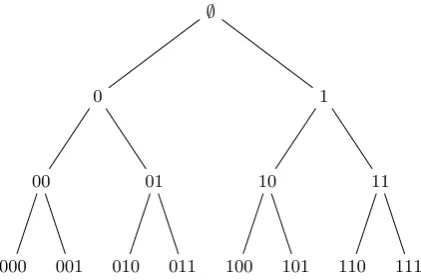
Fig. 1.Example of binary tree of depthd= 3 used in our construction.
4 Constructions for TSE Schemes
4.1 Plain TSE
Our first step towards building TSE schemes is to focus on how to achieve Plain TSE. We have to find a way to express time so that the Time Server can extract Time Instant Keys (TIKs) and the sender can specify a decryption time interval. Our approach will make use of a binary tree of depth d, where we denote withparent(x) and child(x) the standard notions of parent and child of a node x in a tree. The input T toPlain.Setup, which represents the number of allowed time units, will be of the form
T = 2d. The root node of the tree is labelled with ∅ and the non-root nodes are labelled with binary strings of lengths between 1 and d, as illustrated for the case d= 3 in Figure 1. Hence each node is associated with a binary string t0t1...tl−1 of length l ≤d. In particular we will have that the leaves of the tree are binary strings of lengthdlabelled from 0...0 (on the left) to 1...1 (on the right). Each leaf will represent a time instantt=Σi=0d−1ti2d−1−i between 0 andT −1.
We now define two particular sets of nodes.
– Path Pt to t. Given a time instant t = Σi=0d−1ti2d−1−i we construct the following path Pt in the tree, where the last node is the leaf corresponding to t:
∅, t0, t0t1, ..., t0...td−1.
– Set S[t0,t1] covering the interval [t0, t1]. S[t0,t1]is the minimal set of roots of subtrees that cover leaves representing time instants in [t0, t1]. We will call this the cover set for [t0, t1]. Such a set is unique and of size at most 2d. We can compute the labels of the nodes in S[t0,t1] in a particular order by running Algorithm 1 on input [t0, t1].
It is easy to see that Pt and S[t0,t1] intersect in a unique node if and only if t ∈ [t0, t1]. This property will ensure that the correctness requirement holds for the Plain TSE scheme that we will construct. The key idea, then, is to view the nodes of the tree as identities and make use of identity-based encryption techniques to instantiate a Plain TSE scheme. Informally, the sender will encrypt under the nodes in the cover set for the Decryption Time Interval (DTI), and the TIK for timetwill be the set of private keys associated to the nodes on the pathPt tot. More formally, we use an Identity-based Encryption (IBE) schemeI = (Setup,Key-Ext,Enc,Dec) with message spaceMSP ={0,1}l to constructX = (Plain.Setup,Plain.TIK-Ext,Plain.Enc,Plain.Dec), a Plain TSE scheme with the same message space, in the following way:
– Plain.Setup(κ, T). Run Setup on input κ to obtain TS-MPK and the master secret key TS-MSK. We set T = 2d, wheredis the depth of the tree used in our construction.
Algorithm 1 Compute S[t0,t1].
LetLbe the binary expansion oft0.
LetR be the binary expansion oft1.
LetS =∅. whileL < Rdo
if L≡0 mod 2then
L=parent(L)
else
S =S ∪ {L}
L=parent(L) + 1
end if
if R≡0 mod 2then S =S ∪ {R}
R=parent(R)−1
else
R=parent(R)
end if end while if L=Rthen
S=S ∪ {L} end if
return S
–Plain.Enc(TS-MPK, m,[t0, t1]). Run Algorithm 1 on input [t0, t1] to compute a list of nodes S[t0,t1]. For eachs∈ S[t0,t1]runEnc(TS-MPK, m, s) to obtain a list of ciphertexts CT[t0,t1]={cp :p∈ S[t0,t1]}. OutputC= (CT[t0,t1],[t0, t1]).
– Plain.Dec(TS-MPK, C,Dt). Here C = (CT,[t0, t1]) denotes a list of ciphertexts for the scheme I together with a time interval. Ift /∈[t0, t1] return⊥. Otherwise run Algorithm 1 to generate an ordered list of nodesS[t0,t1]and generate the setPt; the intersection of these sets is a unique nodep. Obtain the key dp corresponding to p from Dt. Run Dec(TS-MPK, cp, dp), where cp ∈ CT is in the same position in the listCT asp is inS[t0,t1], to obtain either a message m or a failure symbol⊥. Output the result.
For the above construction, the following result holds.
Theorem 1. Let I be an IND-CPA secure IBE scheme. Then the Plain TSE scheme X constructed fromI as above is IND-CPA secure in the sense of Definition 3, and is correct.
Proof sketch: The proof of IND-CPA security works in two steps. In the first step, we show that for any IND-CPA attackerA with non-negligible advantage against the Plain TSE scheme, there is a modified IND-CPA adversaryBhaving non-negligible advantage against the IBE scheme. This modified adversary specifies in its challenge phase a list ofdidentities, none of which are allowed to be queried to the ID-based private key extraction oracle at any point in the game, along with a pair of messages
m0, m1. In return, B receives from its challenger the encryption of mb under each of the identities in its list. As usual B’s task is to find b. This reduction is straightforward, relying on the fact that the restrictiont /∈[t0, t1] imposed on the TIKs kt that the Plain TSE adversaryAcan obtain from its TIK extraction oracle means thatBcan handleA’s queries to its TIK extraction oracle by passing them to its ID-based private key extraction oracle. In the second step, we use a standard hybrid argument to reduce the IND-CPA security of the IBE scheme against modified adversaries to its IND-CPA security against normal adversaries (who specify just one identity in the challenge phase). The proof of correctness is straightforward, relying on the fact thatPt does not intersectS[t0,t1] ift /∈[t0, t1].
We provide a small example to illustrate our construction. Considerd= 3 as in Figure 1.
Example: Suppose we wish to decrypt a message that was encrypted using time interval [2,6]. In the tree, these endpoints will correspond to nodes with labels 010 and 110, respectively. We compute
S[2,6]={01,10,110}. Suppose we obtain the TIK broadcast byT Sat time 4 (corresponding to the leaf node labelled 100). This means that we obtain a list of private keys for nodes on the pathP4 from the root to 100. In particular, we have the key corresponding to node 10, the unique intersection ofP4 and
In general, ciphertexts in the Plain TSE scheme X consist of up to 2d ciphertexts from the IBE schemeI, while private keys consist of at most dprivate keys fromI. The public parameters ofX are the same size as those of I. The cost of encryption for the scheme X is up to 2d times greater than its cost for the schemeI, while decryption forX costs the same as for I. This compares well with the naive solution of encrypting with a single private key to every time instant in the interval, as it allows for shorter ciphertexts.
A variety of IBE schemes can be used to instantiate the above construction, including Waters’ [28] and Gentry’s [17] schemes in the standard model, and the Boneh-Franklin scheme [5] and the Sakai-Kasahara scheme (as analysed in [11]) in the ROM. Each of them has various advantages and disadvantages in terms of efficiency and the sizes of public parameters and ciphertexts. For exam-ple, Waters’ scheme has relatively large public parameters, compact ciphertexts, and depends for its security on the Bilinear Diffie-Hellman Problem, while Gentry’s scheme has small public parameters and ciphertexts, but its security depends on a non-standard hardness assumption, the q-Truncated Decisional Augmented Bilinear Diffie-Hellman Exponent (q-TDABDHE) problem.
A potentially more efficient approach would be to use a multi-recipient, single key, ID-based KEM (MR-SK-IBKEM), as defined in [1], which would allow encapsulation of the same key for multiple recipients id1, ..., idn in an efficient and secure manner. Using an approach similar to that in [27], we can combine an MR-SK-IBKEM with a (symmetric) Data Encapsulation Mechanism (DEM) to produce an multi-recipient IBE scheme in a standard way [2]; if the underlying KEM and DEM satisfy appropriate security notions (IND-CPA and FG-CPA security, respectively), then the resulting multi-recipient IBE scheme will be IND-CPA secure [2]. This primitive perfectly matches our requirement to be able to encrypt the same message to all nodes in a cover set simultaneously, and it is easy to see how to obtain IND-CPA secure Plain TSE from such a primitive. However, current instantiations for IND-CPA secure MR-SK-IBKEMs are only known in the ROM (see for example [1]). To the best of our knowledge, it remains an open problem to find efficient instantiations that are secure in the standard model. We recall that the scheme in [27] actually solves thedual of our problem and can only handle intervals of the type [t, T−1].
4.2 IND-CPA Security
We now wish to address the problem of instantiating IND-CPA secure PK-TSE and ID-TSE schemes. We begin with the PK-TSE case.
Let Π = (Gen,E,D) be a public-key encryption (PKE) scheme with message
space {0,1}l. We will construct a PK-TSE scheme from a Plain TSE scheme X =
(Plain.Setup,Plain.TIK-Ext,Plain.Enc,Plain.Dec) with MSP = {0,1}l and Π in the
fol-lowing way:
– PK.Setup(κ, T). Run Plain.Setupon the same input to obtain TS-MPK and the master secret key TS-MSK.
– PK.TIK-Ext(TS-MPK,TS-MSK, t). Run Plain.TIK-Ext(TS-MPK,TS-MSK,t) to obtain kt,
broadcast by TS at timet.
– PK.KeyGen(κ). RunGen(κ), which will output a key-pair (pk, sk).
– PK.Enc(TS-MPK, m,[t0, t1], pk). Pick a random r ∈ {0,1}l and set m0 = m⊕r. Then run the algorithm Plain.Enc(TS-MPK, r,[t0, t1]) to obtain c0 and E(pk, m0) to get c1. The ciphertext will be (c0, c1).
– PK.Dec(TS-MPK,(c0, c1), kt, sk). Parse c0 and c1. Run Plain.Dec(TS-MPK, c0, kt) which will output either a messager or a failure symbol⊥. Run D(sk, c1) which will output either a messagem0 or a failure symbol⊥. If either of the decryption algorithms returns ⊥, then output⊥; otherwise output
m=r⊕m0.
Lemma 1. Let Π be an IND-CPA secure PKE scheme. Then the PK-TSE scheme, constructed as above, is IND-CPAT S secure.
Setup.The challengerC runsGen(κ) to obtain a pair (pk, sk). It gives pktoB.B runsPK.Setup(κ,T) to generate (TS-MPK,TS-MSK) and gives (TS-MPK,TS-MSK, pk) to the adversaryA.
Challenge. A outputs two messages m0 and m1 ∈ MSP and a time interval [t0, t1] ⊆ T. A passes
m0, m1,[t0, t1] to B. B picks a random r ∈ {0,1}l and passes m0 ⊕r, m1 ⊕r to C. C picks a random bit b and computes c00 =E(pk, mb⊕r). B runs Plain.Enc(TS-MPK, r,[t0, t1]) = c0. Finally, B passes
c∗ = (c0, c00) to A.
Guess.The adversary outputs its guess b0 forband B outputs the same guess.
B perfectly simulates the IND-CPAT S game for A. Hence A’s advantage is as it would be in the
real game and by construction Bwins whenever Adoes.
We can prove the following result in an analogous way.
Lemma 2. Let X be an IND-CPA secure Plain TSE scheme. Then the PK-TSE scheme, constructed as above, is IND-CPACR secure. Moreover, if X is correct, then so is the resulting PK-TSE scheme.
Hence, the following theorem holds.
Theorem 2. Let X be an IND-CPA secure Plain TSE scheme and Π be an IND-CPA secure PKE scheme. Then the PK-TSE scheme, constructed as above, is IND-CPA secure. Moreover, ifXis correct, then so is the resulting PK-TSE scheme.
To achieve IND-CPA security in the ID-TSE setting we can adopt an approach similar to the one used above to build a PK-TSE scheme, where instead of a PKE scheme we employ an IBE scheme
I = (Setup,Key-Ext,Enc,Dec) in the obvious manner. In this setting we obtain an analogous result:
Theorem 3. Let X be an IND-CPA secure Plain TSE scheme and I be an IND-CPA secure IBE scheme. Then the ID-TSE scheme, constructed analogously to the construction of the PK-TSE scheme above, is IND-CPA secure. Moreover, if X is correct, then so is the resulting ID-TSE scheme.
In particular, we observe that if I is a selective-id IND-CPA secure IBE scheme, then it can be shown that the resulting ID-TSE scheme is also secure in the selective sense.
4.3 IND-CCA Security
We will now address the problem of building IND-CCAT S secure PK-TSE schemes, using an approach similar to that of [8].
Suppose we have a selective-id IND-CPAT S secure ID-TSE scheme I = (TS-Setup,ID-Setup,
ID.TIK-Ext,ID.Key-Ext,ID.Enc,ID.Dec), with MSP ={0,1}l and IDSP = {0,1}n. We construct an IND-CCAT S secure PK-TSE scheme Γ = (PK.Setup,PK.TIK-Ext,PK.KeyGen,PK.Enc,PK.Dec). In the construction, we use a signature scheme Σ= (G,Sign,Ver), whose generation algorithm Goutputs verification keys of lengthn. We construct the algorithms ofΓ as follows:
– PK.Setup(κ, T). Run TS-Setup(κ, T) to get TS-MPK,TS-MSK.
– PK.TIK-Ext(TS-MPK,TS-MSK, t). RunID.TIK-Ext(TS-MPK,TS-MSK, t) to obtain TIK kt. – PK.KeyGen(κ). RunID-Setup(κ) to get (ID-MPK, ID-MSK), a key-pair.
– PK.Enc(TS-MPK, m,[t0, t1],ID-MPK). RunG(κ) and obtain (vk, sigk). Computec=
ID.Enc(TS-MPK,ID-MPK, m,[t0, t1], vk). Produce σ =Sign(sigk, c). The final ciphertext will be C= (vk, c, σ).
– PK.Dec(TS-MPK, C, kt,ID-MSK). ParseC as (vk, c, σ). Check ifVer(vk, c, σ) = 1. If not, output
⊥. Otherwise, runID.Key-Ext(ID-MPK,ID-MSK, vk) to obtainskvk and decryptcby running ID.Dec with inputskt,skvk.
Theorem 4. Let I be a correct, selective-id IND-CPAT S secure ID-TSE scheme and Σ a strongly
unforgeable one-time signature scheme. Then Γ, as constructed above, is an IND-CCAT S secure
PK-TSE scheme.
Theorem 5. Let I be a selective-id IND-CPAT A secure ID-TSE scheme andΣ a strongly unforgeable
one-time signature scheme. Then Γ, as constructed above, is an IND-CPACR secure PK-TSE scheme.
We can also use a variant of the more complex Boneh-Katz transform [7] to construct PK-TSE schemes that are IND-CCA secure in the standard model. The resulting schemes generally have im-proved efficiency. Details are omitted.
We discuss the problem of obtaining IND-CCA secure ID-TSE schemes in the following section, where we discuss future work.
5 Extensions and Future Work
Various extensions of our TSE concept are possible. For example, we could consider TSE schemes (in all three settings) that have the property of hiding the decryption time interval of ciphertexts from adversaries. Our current constructions do not offer this. We call such a property DTIC (Decryption Time Interval Confidentiality). We can model the DTIC-IND-CPA/CCA security of a TSE scheme by allowing the adversary to select two messages and two time intervals in the challenge phase and requiring him to guess which message was encrypted under which interval. We distinguish between the plain setting, where the decryption time interval is hidden from all users, making successful decryption a kind ofproof of work(since every user will need to attempt decryption under possibly many keys), and the public-key and identity-based settings, where the decryption time interval is hidden from everyone except the intended recipient. It will be interesting to explore these properties in conjunction with extensions of key-privacy/recipient-anonymity in the public-key and identity-based settings, to obtain enhanced security properties for TSE.
Another relevant problem is that of constructing TSE schemes allowing the capability of opening
the message outside of the decryption time interval, a useful feature supportingbreak the glass policies. This extension has already been considered in the setting of TRE [20,15]. It would also be interesting to find schemes in which the maximum time value T can be dynamically extended without resetting the parameters of the Time Server, and schemes in which the granularity of times can be adjusted by users (such a consideration was made in [27] for TIBE).
Our focus in this paper has been on achieving IND-CCA security of PK-TSE in the standard model. This leaves the problem of constructing IND-CCA secure ID-TSE schemes, in either the standard model or the ROM. The former, we believe, should be achievable by introducing hierarchical ID-TSE notions and further extending the CHK-style transform to this setting. The latter can be achieved by developing Fujisaki-Okamoto style transforms for the TSE setting. In this paper, we have constructed PK-TSE/ID-TSE schemes in the IND-CPA setting by combining Plain PK-TSE/ID-TSE schemes and PKE/IBE schemes. We have then used the CHK technique to obtain CCA security for PK-TSE. It might be worth investigating an alternative approach in which one first obtains an IND-CCA secure Plain TSE scheme, and then applies a Dodis-Katz style construction [16] to combine this with IND-CCA secure PKE/IBE schemes. This may lead to efficiency gains as compared to our CHK-based constructions. It would also be useful to solve the open problem of constructing MR-SK-IBKEMs that are provably secure in the standard model, in order to improve the efficiency of our Plain TSE constructions.
Thinking more broadly, one can envisage the development of the wider concept of Time-Specific Cryptography. This could include, for example, time-specific signatures (where signatures can only be created within certain time intervals). We believe there is much interesting work still to be done in this area.
Acknowledgement
We are grateful to Jason Crampton for suggesting the application of TSE to authentication protocols.
References
2. Kamel Bentahar, Pooya Farshim, John Malone-Lee, and Nigel P. Smart. Generic constructions of identity-based and certificateless KEMs. J. Cryptology, 21(2):178–199, 2008.
3. John Bethencourt, Amit Sahai, and Brent Waters. Ciphertext-policy attribute-based encryption. In Pfitzmann and McDaniel [24], pages 321–334.
4. Dan Boneh, Xavier Boyen, and Eu-Jin Goh. Hierarchical identity based encryption with constant size ciphertext. In Cramer [13], pages 440–456.
5. Dan Boneh and Matthew K. Franklin. Identity-based encryption from the Weil Pairing. In Joe Kilian, editor, CRYPTO 2001, volume 2139 ofLecture Notes in Computer Science, pages 213–229. Springer, 2001.
6. Dan Boneh, Craig Gentry, and Brent Waters. Collusion resistant broadcast encryption with short ciphertexts and private keys. In Victor Shoup, editor, CRYPTO 2005, volume 3621 of Lecture Notes in Computer Science, pages 258–275. Springer, 2005.
7. Dan Boneh and Jonathan Katz. Improved efficiency for CCA-secure cryptosystems built using identity-based encryp-tion. In Alfred Menezes, editor, CT-RSA 2005, volume 3376 of Lecture Notes in Computer Science, pages 87–103. Springer, 2005.
8. Ran Canetti, Shai Halevi, and Jonathan Katz. Chosen-ciphertext security from identity-based encryption. In Christian Cachin and Jan Camenisch, editors,EUROCRYPT 2004, volume 3027 ofLecture Notes in Computer Science, pages 207–222. Springer, 2004.
9. Julien Cathalo, Benoˆıt Libert, and Jean-Jacques Quisquater. Efficient and non-interactive timed-release encryption. In Sihan Qing, Wenbo Mao, Javier Lopez, and Guilin Wang, editors,ICICS 2005, volume 3783 ofLecture Notes in Computer Science, pages 291–303. Springer, 2005.
10. Aldar C.-F. Chan and Ian F. Blake. Scalable, server-passive, user-anonymous timed release cryptography. InICDCS 2005, pages 504–513. IEEE Computer Society, 2005.
11. Liqun Chen and Zhaohui Cheng. Security proof of Sakai-Kasahara’s identity-based encryption scheme. In Smart [26], pages 442–459.
12. Sherman S. M. Chow, Volker Roth, and Eleanor G. Rieffel. General certificateless encryption and timed-release encryption. In Rafail Ostrovsky, Roberto De Prisco, and Ivan Visconti, editors,SCN 2008, volume 5229 of Lecture Notes in Computer Science, pages 126–143. Springer, 2008.
13. Ronald Cramer, editor.Advances in Cryptology - EUROCRYPT 2005, 24th Annual International Conference on the Theory and Applications of Cryptographic Techniques, Aarhus, Denmark, May 22-26, 2005, Proceedings, volume 3494 ofLecture Notes in Computer Science. Springer, 2005.
14. Jason Crampton. Trade-offs in cryptographic implementations of temporal access control. In Audun Jøsang, Torleiv Maseng, and Svein J. Knapskog, editors,NordSec 2009, volume 5838 ofLecture Notes in Computer Science, pages 72–87. Springer, 2009.
15. Alexander W. Dent and Qiang Tang. Revisiting the security model for timed-release encryption with pre-open capability. In Juan A. Garay, Arjen K. Lenstra, Masahiro Mambo, and Ren´e Peralta, editors,ISC 2007, volume 4779 ofLecture Notes in Computer Science, pages 158–174. Springer, 2007.
16. Yevgeniy Dodis and Jonathan Katz. Chosen-ciphertext security of multiple encryption. In Joe Kilian, editor,TCC 2005, volume 3378 ofLecture Notes in Computer Science, pages 188–209. Springer, 2005.
17. Craig Gentry. Practical identity-based encryption without random oracles. In Serge Vaudenay, editor,EUROCRYPT 2006, volume 4004 ofLecture Notes in Computer Science, pages 445–464. Springer, 2006.
18. Craig Gentry and Brent Waters. Adaptive security in broadcast encryption systems (with short ciphertexts). In An-toine Joux, editor,EUROCRYPT 2009, volume 5479 ofLecture Notes in Computer Science, pages 171–188. Springer, 2009.
19. Vipul Goyal, Omkant Pandey, Amit Sahai, and Brent Waters. Attribute-based encryption for fine-grained access control of encrypted data. In Ari Juels, Rebecca N. Wright, and Sabrina De Capitani di Vimercati, editors,ACM Conference on Computer and Communications Security 2006, pages 89–98. ACM, 2006.
20. Yong Ho Hwang, Dae Hyun Yum, and Pil Joong Lee. Timed-release encryption with pre-open capability and its application to certified e-mail system. In Jianying Zhou, Javier Lopez, Robert H. Deng, and Feng Bao, editors,ISC 2005, volume 3650 ofLecture Notes in Computer Science, pages 344–358. Springer, 2005.
21. Jonathan Katz, Amit Sahai, and Brent Waters. Predicate encryption supporting disjunctions, polynomial equations, and inner products. In Nigel P. Smart, editor,EUROCRYPT 2008, volume 4965 ofLecture Notes in Computer Science, pages 146–162. Springer, 2008.
22. Allison Lewko, Tatsuaki Okamoto, Amit Sahai, Katsuyuki Takashima, and Brent Waters. Fully secure functional encryption: Attribute-based encryption and (hierarchical) inner product encryption. Cryptology ePrint Archive, Report 2010/110, 2010. http://eprint.iacr.org/.
23. Timothy C. May. Time-release crypto, 1993. manuscript.
24. Birgit Pfitzmann and Patrick McDaniel, editors. IEEE Symposium on Security and Privacy (S&P 2007), 20-23 May 2007, Oakland, California, USA. IEEE Computer Society, 2007.
25. Elaine Shi, John Bethencourt, Hubert T.-H. Chan, Dawn Xiaodong Song, and Adrian Perrig. Multi-dimensional range query over encrypted data. In Pfitzmann and McDaniel [24], pages 350–364.
26. Nigel P. Smart, editor. Cryptography and Coding, 10th IMA International Conference, Cirencester, UK, December 19-21, 2005, Proceedings, volume 3796 ofLecture Notes in Computer Science. Springer, 2005.
27. Mudhakar Srivatsa, Shane Balfe, Kenneth G. Paterson, and Pankaj Rohatgi. Trust management for secure information flows. In Peng Ning, Paul F. Syverson, and Somesh Jha, editors,ACM Conference on Computer and Communications Security 2008, pages 175–188. ACM, 2008.
A Additional Definitions and Security Models
Definition 16. A Public Key Encryption (PKE) scheme Π is defined by three algorithms and has associated message space MSP and ciphertext space CSP. The three algorithms are as follows.
Gen. This algorithm takes as input the security parameter κ and outputs a key-pair (pk, sk).
E.This algorithm takes as input a public key pkand a messagem∈ MSP and outputs a ciphertext c.
D. This algorithm takes as input a private key sk and a ciphertext c ∈ CSP and outputs either a messagem or a failure symbol ⊥.
The correctness property requires that ifc=E(pk, m) andsk is the private key corresponding to pk thenD(sk, c) =m.
We define a model for IND-CPA security of a PKE scheme.
Definition 17. Consider the following game.
Setup. The challengerC runsGen(κ) to generate a key-pair (pk, sk) and gives pk to the adversary A.
Challenge.A selects two messagesm0 and m1 ∈ MSP and passes them toC.C chooses a random bit
b and computes c∗=E(pk, mb). c∗ is passed toA. Guess. The adversary outputs its guess b0 for b.
A’s advantage in the above game is defined asAdvA(κ) =Pr[b0 =b]−12 .
Definition 18. We say that a PKE scheme is IND-CPA secureif all polynomial-time adversaries have at most negligible advantage in the above game.
Definition 19. An Identity-Based Encryption (IBE) scheme I is defined by four algorithms and has associated message space MSP, ciphertext space CSP and identity space IDSP. The four algorithms are as follows.
Setup. This algorithm takes as input the security parameter κ and outputs a master public key ID-MPK and a master secret key ID-MSK.
Key-Ext. This algorithm takes as input ID-MPK, ID-MSK and an id ∈ IDSP and outputs the private key skid corresponding to id.
Enc. This algorithm takes as input ID-MPK, a message m ∈ MSP and an identity id ∈ IDSP and outputs a ciphertext c∈ CSP.
Dec. This algorithm takes as input a private key skid and a ciphertext c∈ CSP and outputs either
a message m or a failure symbol ⊥.
The correctness propertyrequires that if c=Enc(ID-MPK, m, id) andskid is the private key
corre-sponding toid then D(skid, c) =m.
We define a model for IND-CPA security of an IBE scheme.
Definition 20. Consider the following game.
Setup. The challengerC runsSetup(κ) to generate master public key ID-MPK and master secret key ID-MSK and gives ID-MPK to the adversary A.
Phase 1.Acan adaptively issue private key extraction queries to an oracle for any identityid∈ IDSP. The oracle will respond to each query withskid.
Challenge. A selects two messagesm0 andm1∈ MSP and an id∗∈ IDSP with the restriction that
for none of the queries in Phase 1 we have thatid=id∗.Apasses m0, m1, id∗ toC.Cchooses a random
bit b and computesc∗ =Enc(ID-MPK,mb, id∗). c∗ is passed toA.
Phase 2. A continues to make queries to the private key extraction oracle with the same restriction we have in the Challenge phase.
Guess. The adversary outputs its guess b0 for b.
Definition 21. We say that an IBE scheme is IND-CPA secure if all polynomial-time adversaries have at most negligible advantage in the above game.
Definition 22. Asignature scheme Σ is defined by three algorithms and has associated message space MSP and signature space SSP. The three algorithms are as follows.
G. This algorithm takes as input the security parameter κ and outputs a signing-verification key pair (sigk,vk).
Sign. This algorithm takes as input a signing key sigk and a message m ∈ MSP and outputs a signatureσ ∈ SSP.
Ver. This algorithm takes as input a verification key vk, a message m ∈ MSP and a signature σ∈ SSP and outputs a bitv∈ {0,1}, where v= 1 means acceptance and v= 0 means rejection.
The correctness property requires that for every (sigk, vk) output by Gand for every message m∈ MSP it holds that Ver(vk, m,Sig(sigk, m)) = 1.
We define the notion of strong unforgeability under a one-time message attack (SUF-1CMA) for a signature schemeΣ as follows.
Definition 23. Consider the following game.
Setup. The challengerC runsG(κ) to generate a signing-verification key pair (sigk,vk) and gives vk to the adversaryA.
Signing Query. A selects a message m∈ MSP and gives it to C. C computes σ =Sign(sigk, m). σ is passed toA.
Forgery. A outputs a pair(m∗, σ∗).
A’s advantage in the above game is defined asAdvA(κ) = Pr[Ver(vk, m∗, σ∗) = 1∧(m∗, σ∗)6= (m, σ)].
Definition 24. We say that a signature scheme isSUF-1CMA secureif all polynomial-time adversaries have at most negligible advantage in the above game.
B Plain TSE from BE
We will show how a Plain TSE scheme can be built from a Broadcast Encryption (BE) scheme in a straightforward way. We begin by giving a formal definition of a public-key broadcast encryption system and a security notion for it, similar to the ones given in [18].
Definition 25. A broadcast encryption (BE) scheme is defined by four algorithms and has associated message space MSP and ciphertext space CSP. The four algorithms are as follows.
BE.Setup. This algorithm takes as input the security parameter κ, the number of users of the system nand the maximal size l≤nof a broadcast target group. It outputs a master public key BE-MPK and a master secret key BE-MSK.
BE.Key-Gen.This algorithm takes as input BE-MPK, BE-MSK and an indexi∈ {1, ..., n}and outputs the private key ski for user i.
BE.Enc. This algorithm takes as input BE-MPK, a message m ∈ MSP and a subset S ⊆ {1, ..., n}, the broadcast target set. If |S| ≤l, it outputs a ciphertext c∈ CSP.
BE.Dec. This algorithm takes as input BE-MPK, a subset S ⊆ {1, ..., n}, an index i ∈ {1, ..., n}, a private key ski and a ciphertextc∈ CSP. It outputs either a messagem or a failure symbol ⊥.
The correctness propertyrequires that if c=BE.Enc(BE-MPK, m, S) andski is the private key for
i∈S then BE.Dec(BE-MPK, S, i, ski, c) =m.
Remark 2. We observe that the standard definition of a BE scheme (as per [6,18]) requires the specifi-cation of the broadcast target setS as an input to the decryption algorithm.
Definition 26. Consider the following game.
Setup. The challenger C runs BE.Setup(κ,n,l) to generate master public key BE-MPK and master secret key BE-MSK and gives BE-MPK to the adversary A.
Phase 1.A can adaptively issue queries to a private key extraction oracle for any index i∈ {1, ..., n}. This oracle will respond by returning ski=BE.Key-Gen(BE-MPK,BE-MSK, i).
Challenge. Aselects two messages m0 andm1∈ MSP and a challenge set S∗ ⊆ {1, ..., n}, such that
i /∈ S∗ for all queries i made in Phase 1. A passes m0, m1, S∗ to C. C chooses a random bit b and
computes c∗ =BE.Enc(BE-MPK,mb, S∗). c∗ is passed to A.
Phase 2. A continues to make queries to the private key extraction oracle with the same restriction as in the Challenge phase.
Guess. The adversary outputs its guess b0 for b.
A’s advantage in the above game is defined asAdvA(κ, n, l) =Pr[b0=b]−12 .
Definition 27. We say that a BE scheme is adaptively secureif all polynomial-time adversaries have at most negligible advantage in the above game.
We now show how to construct a Plain TSE scheme from a BE scheme. We note that by Remark 2 the resulting Plain TSE scheme is inherently prevented from having the DTI confidentiality property. This is because this interval will need to be specified as an input to the decryption algorithm in the Plain TSE scheme, a feature that arises from the construction of this algorithm from the corresponding algorithm of the BE scheme.
Consider a BE scheme B = (BE.Setup,BE.Key-Gen,BE.Enc,BE.Dec) with message space MSP. We will useB to construct X= (Plain.Setup,Plain.TIK-Ext,Plain.Enc,Plain.Dec), a Plain TSE scheme with the same message space, in the following way:
– Plain.Setup(κ, T). Run BE.Setup on input κ, n = T and l = T to obtain outputs BE-MPK,
BE-MSK. Set TS-MPK = BE-MPK and TS-MSK = BE-MSK.
–Plain.TIK-Ext(TS-MPK,TS-MSK, t). RunBE.Key-Genon the same inputs to obtain the TIKkt for
t.
– Plain.Enc(TS-MPK, m,[t0, t1]). RunBE.Enc(TS-MPK, m, S), where S is set to the interval [t0, t1], to obtain a ciphertextc.c must contain an explicit description ofS.
– Plain.Dec(TS-MPK, c, kt). Run BE.Dec(TS-MPK, S, t, kt, c) where S is extracted from c and t is extracted fromkt, to obtain either a message mor a failure symbol ⊥.
We observe that in addition to not having the DTI confidentiality property, the Plain-TSE scheme constructed from a BE scheme as above also implicitly requires the TIKkt to contain a description of
t. For the above construction, the following result holds.
Theorem 6. Let B be a fully collusion resistant, adaptively secure BE scheme. Then the Plain TSE schemeX constructed from B as above is IND-CPA secure in the sense of Definition 3, and is correct.
Proof. Suppose we have an adversaryAagainst the Plain TSE schemeX with advantage(κ). We will construct an adversaryBthat will interact withAto break the BE schemeB used in the construction. The game proceeds as follows.
Setup. The challenger C runs BE.SetupGen(κ, T, T) to obtain a pair (BE-MPK,BE-MSK). It gives BE-MPK toB, who passes it on toA.
Phase 1.Acan adaptively issue TIK extraction queries for any time t∈T. Such a query is passed on toB, who gives it to C as private key query for user t.C will respond to each query with the private keyskt, which is passed toB, who then forwards it to A as the TIK for timet.
Challenge.Aselects two messagesm0 andm1∈ MSP and a challenge interval [t0, t1]⊆T, such that
t /∈[t0, t1] for any of the queries t in made in Phase 1. Apasses m0, m1,[t0, t1] to B, who passes them toC.C chooses a random bitband computesc∗=BE.Enc(BE-MPK,mb,[t0, t1]).c∗ is passed toB, who in turn passes it toA.
Phase 2. A continues to issue TIK extraction queries with the same restriction as in the Challenge phase. These queries are dealt with by Bas in Phase 1.
B perfectly simulates the IND-CPA game for A. Hence A’s advantage is as it would be in the real
game and by constructionB wins wheneverAdoes.
C Proof of Theorem 4
We recall the statement of Theorem 4:
Theorem 4. Let I be a correct, selective-id IND-CPAT S secure ID-TSE scheme and Σ a strongly
unforgeable one-time signature scheme. ThenΓ, as constructed in section 4.3, is an IND-CCAT S secure
PK-TSE scheme.
Proof. Our proof follows closely the proof of [8], with suitable modifications. Given an IND-CCAT S adversaryA againstΓ we construct an adversaryB that will interact withA to break the selective-id IND-CPAT S security ofI. Before presenting the game, we note the following important considerations. We start by saying that a ciphertextC = (vk, c, σ) is valid if Ver(vk, c, σ) = 1. Let C∗ = (vk∗, c∗, σ∗) denote the challenge ciphertext received by A during the game, and letForge denote the event that in this game A submits a valid ciphertext C = (vk∗, c, σ) to its decryption oracle. It can be shown that A can be used to break the underlying one-time signature scheme Σ with probability exactly PrA,Γ[Forge]. SinceΣ is a strongly unforgeable one-time signature (as defined in Appendix A), we can assume that PrA,Γ[Forge] is negligible in the security parameterκ.
We now describe the simulation.
Init. B runsG(κ) to get (vk∗, sigk∗). The stringvk∗ will be the target identity used by B.
Setup. C runs TS-Setup, ID-Setup to get (TS-MPK,TS-MSK,ID-MPK,ID-MSK). It gives B
(TS-MPK,TS-MSK,ID-MPK).B passes the same information toA.
Phase 1. A can issue queries of the form (C, t) to its Decrypt oracle, where C is of the form (vk, c, σ). Bresponds as follows:
– if Ver(vk, c, σ)6= 1 thenB returns ⊥;
– if Ver(vk, c, σ)= 1 and vk = vk∗ then B aborts and outputs a random bit (event Forge just occurred);
– if Ver(vk, c, σ)= 1 and vk 6= vk∗ then B makes a query vk to its private key extraction oracle to obtainskvk.Bcan compute the TIKktas it obtained TS-MSK from its challenger.Bthen computes
ID.Dec(TS-MPK,ID-MPK, kt, skvk) and obtains either a message m or failure symbol⊥, which is passed toA.
Challenge. A outputs m0, m1 and [t0, t1] and passes the tuple (m0, m1,[t0, t1]) to B, who then sends (m0, m1,[t0, t1], vk∗) to C as its challenge query. C picks a random bit b and computes c∗ =
ID.Enc(TS-MPK,ID-MPK, mb,[t0, t1], vk∗). C gives c∗ to B, who computes σ∗ = Sign(sigk∗, c∗) and returnsC∗ = (vk∗, c∗, σ∗) to A.
Phase 2.Acan continue issuing queries of the form (C, t), whereC= (vk, c, σ), with the restriction that (C, t)6= (C∗, t0), wheret0 ∈[t0, t1]. If Ver(vk, c, σ)6= 1 thenBreturns⊥. Otherwise,Bwill respond as described in the following two cases:
– Case 1: C6=C∗.
• ifc6=c∗ and vk=vk∗ then Baborts and outputs a random bit (event Forgejust occurred);
• ifc=c∗ and vk=vk∗ then Baborts and outputs a random bit (event Forgejust occurred);
• ifc=c∗ andvk6=vk∗ thenBpasses the oracle queryvkto its challenger to obtainskvk.Bthen computes the TIKktusing TS-MSK.Bthen computesID.Dec(TS-MPK,ID-MPK, kt, skvk) and obtains either a messagem or failure symbol⊥, which it passes to A.
– Case 2: C=C∗ andt0 ∈/ [t0, t1].
In this case, the correctness of the scheme I implies that decryption algorithm ID.Dec applied to
c∗ with key kt and identityvk∗ should output ⊥, soBreturns ⊥.
Guess. Aoutputsb0 as its guess for b.Boutputs the same bit.
We note that Bprovides a perfect simulation forAas well as a legal strategy for attacking scheme
In particularBnever queries its challenger for the private key corresponding to the target identityvk∗. We hence have thatBwins ifA does, and this can only happen when the eventForgedoes not occur. In that case,B is forced to abort and outputs a random bit. We therefore have
|PrB,I[Succ]−12|=|PrA,Γ[Succ∧ ¬Forge] + 12PrA,Γ[Forge]−12|.
We observe that the right-hand side of the above equation is negligible since bothPrB,I[Succ]− 12 and PrA,Γ[Forge] are negligible, assuming the security of schemesI andΣ. Finally we have:
|PrA,Γ[Succ]−12|
=|PrA,Γ[Succ∧Forge] + PrA,Γ[Succ∧ ¬Forge]− 21PrA,Γ[Forge] + 12PrA,Γ[Forge]−12|
≤ |PrA,Γ[Succ∧Forge]− 12PrA,Γ[Forge]|+|PrA,Γ[Succ∧ ¬Forge] +12PrA,Γ[Forge]− 12|
≤1
2PrA,Γ[Forge] +|PrA,Γ[Succ∧ ¬Forge] + 1
2PrA,Γ[Forge]− 1 2|,
where on the right-hand side we have two negligible quantities. We have hence proved thatA’s advantage