© 2015, IJCSMC All Rights Reserved
521
Available Online atwww.ijcsmc.com
International Journal of Computer Science and Mobile Computing
A Monthly Journal of Computer Science and Information Technology
ISSN 2320–088X
IJCSMC, Vol. 4, Issue. 6, June 2015, pg.521 – 525
RESEARCH ARTICLE
A Study on Different Challenges in Facial
Recognition Methods
Madhu Madhan
Student, M.Tech (CSE), R.N. College of Engineering and Management, Rohtak
Pooja Ahlawat
Asstt. Prof, CSE Deptt., R.N. College of Engineering and Management, Rohtak
Abstract:Face recognition is one of the major biometric recognition process adapted by online and offline applications. But easy availability of face capturing increased the complexities. There is no standard device or constraint to capture these faces. Lack of standardization has increased the challenges in recognition model. In this paper, some of these challenges are discussed and presented. These challenges are required to resolve to improve the integrity of recognition process model. These challenges include environmental constraints, device specific constraints and the facial feature constraints. The paper has explored some of these associated challenges.
Keywords: Face Recognition, Biometric, Challenges, Environmental
I. INTRODUCTION
© 2015, IJCSMC All Rights Reserved
522
Figure 1 : Face Recognition Model
The figure here shows the standard model adapted by any of the recognition system. According to this model as the image is collected from the raw source for recognition, it goes through number of process stages. The first stage is to transform the image to the normalized form so that that the image will be mapped to the database image. After this transformation, the actual facial object is mapped over the image. This object location identification is called localization stage. After obtaining the facial object, the facial features are extracted. Now this featured image is mapped to the database images. The facial database is also present in the form of facial images. Once the featured dataset and the featured input image are obtained, the next work is to perform the recognition. The recognition is performed using algorithmic model such as PCA, LDA, Neural network, SVM etc. The maximum mapped image is identified over the database based which the recognition is verified. In this paper main focus on the challenges of the recognition process. The foremost challenge is the database adaption. The database adaptive challenges are given in this sub section.
A) DB Challenges
The accuracy of the biometric/facial recognition system depends on the maintained dataset. The dataset is defined as the set of images that are captured from real scenario. The input image can be a database image or not. The reliability of the system how effectively a recognition system can recognize a non-database image. This recognition process is adaptively depends on the algorithmic model to extract the facial feature. To improve the recognition rate, there is the requirement to define a database from real time images that also covers the real time challenges. The features that are required while forming a database are given here in figure 2.
Figure 2 : DB Features Facial DB
Generation
Features
Real Time Images
Number of Instances
Gender Specifications
Variations in pose/contrast/illu
mination
Resolution
© 2015, IJCSMC All Rights Reserved
523
Here figure 2 is showing the set of database feature that are required to define significantly while maintaining the facial database. The first requirement is to collect the images in real time. It means, the database must be collected from different camera devices in different situation such as different backdrop or different dress types etc. Another associated property is the number of ins tances collected for each facial image. More the instances, more chances of the recognition. Each instance must be defined with some variation. These variations are another constraint for the database management. Different facial instances must different in terms of pose, contrast, illumination, brightness etc. More the variations in the images, more adaptive features can be extracted from the facial image. The facial database must be defined with mix gender so that the robust recognition will be obtained. Another consideration for database generation includes the technical specification. These considerations include the camera device specification and the resolution independent. It means the images must be captured from different devices and of different resolutions.
In this paper, a study of different challenges faced in the facial recognition. The paper has identified the work in light of facial recognition model. In this section, a description the biometric recognition system is provided. The section also defined the work model of facial recognition system. The section also identified the DB associated challenges to improve the facial recognition. In section II, the work defined by earlier researchers is discussed. In section III, the challenges associated with facial recognition system are presented. In section IV, the conclusion obtained from the work is presented.
II. EXISTING WORK
Facial recognition system and biometric information processing system are one of the favorite research area. The work defined by the earlier researchers on facial recognition is discussed in this section.
Zixuan Wang[1] has presented a work on facial recognition based on the location adaptive robustness. Author defined the system for mobile devices so that the real time authentication will be obtained from the work. Author provided the location adaptive recognition system so that the overall work accuracy will be improved. Lijun Yan[2] defined an improved facial recognition using adaptive PCA approach. In this recognition model, the feature selection is done based on the direction adaptive mapping. Once the features are obtained the eigen face adaptive mapping is provided to achieve the high recognition rate. Author provided the distance based mapping to provide the recognition of facial image. This metric level analysis model is applied to obtain the high recognition rate. Jun-Bao Li[3] provided a work on non parametric analyses to extract the discriminant features from the facial image. Once these adaptive dynamic features are extracted, the recognition is performed under distance adaptive facial mapping. This work is applied on YALE and FERET datasets. The work provided the high recognition rate on different test sets.
Yong Ma[4] presented a work to provide the facial recognition system to provide the estimation of person age. This presented model or the framework is based on the ranking method applied to improve the effectiveness of recognition process. This process model is defined to obtain the person age and relatively a program is defined for age estimation. Author applied the experimentation to derive the actual identification information and based on this information the facial feature adaptation based recognition is performed. The model is tested on different real time experiments. Che-Hua Yeh[5] provided home photo adaptive recognition model. Author captured the image from the low resolution cameras and provided the adaptive recognition and classification model under pattern adaptive mapping. The presented work model is adaptively applied on real time image sets a high recognition rate is obtained from the work.
Yang Zhang[6] presented a LBP feature adaptive recognition model to provide the recognition based on the featured integration so that the relatively effective recognition set will be obtained. Author analyzed the work under different facial challenges and provided the feature adaptive recognition. Author obtained the high recognition rate so that the more dynamic and robust recognition system is obtained.
© 2015, IJCSMC All Rights Reserved
524
mapping is performed to recognize the face. Naveen N. Murthy[10] has used the DWT based feature generation and decomposition model under gradient masking. The recognition is here applied by analyzing the facial variation and later on the maximum mapped image is selected as the recognized image over the dataset. This recognition model used the distance based mapping to perform the real time recognition of facial image.
III. CHALLENGES
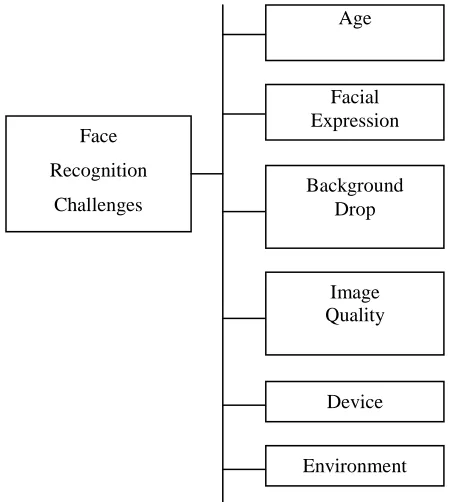
The face recognition systems are defined to provide the authentication as well as some other biometric adaptive answers based on application specification such as gender identification, complexion identification, age identification etc. But as the number of associated operations and relative application becomes complex it requires more adaptive images and more vast imageset. The accuracy of the recognition system on different associated vectors. In this paper, some of these common problems associated with facial recognition system are described. These associated challenges are shown in figure 3.
Figure 3 : Face Recognition Challenges
A) Aging :-
One of the core challenge for facial recognition is the change is person face according to age. It means, the database image that provided the true recognition today may be not provide the same recognition rate after 5 years or 10 years. Because of this, it is required to cover the aging vector in the authentication system. To cover this, there is the requirement to update the dataset regularly. There also exist some robust recognition system that can perform the age estimation as well as provide the recognition along with age variation. The aging problem is critical and based on the probabilistic estimation so that the system which are not age adaptive cannot provide the accurate results.
B) Image Quality:-
Another associated with facial recognition and that affects the face recognition rate is the quality of image itself. The poor quality image can hide some of the adaptive facial features. The poor quality images are not effective to provide the effective results. The quality of image depends on different vectors such as resolution, image size, colors etc. The quality of the image also applied to handle the image problems such as contrast difference, illumination problem, correlation analysis, distortion etc. Lesser the quality of image more difficult will be to perform the recognition. The effectiveness of the recognition system depends on the image quality. In some of the facial recognition system, the image quality improvement is added as the pre processing stage. These image quality adjustments transform the raw image to the normalized image. Another issue associated with quality of image is the noise.
Face
Recognition
Challenges
Age
Facial Expression
Background Drop
Image Quality
Device
© 2015, IJCSMC All Rights Reserved
525
There are number of additive and multiplicative noise vectors that disrupts the image contents so that the recognition rate affects. The noise can occur to the image because of device or the environmental or technological fault[11][12][13].
C) Face Expression:
Another challenge to the facial recognition is the expression robust recognition. The facial expression identification is another application of facial recognition. But if the expression of database image and the input image are different then it becomes difficult to perform the recognition. The expression independent facial recognition requires a robust and probabilistic model to provide the recognition.
IV. Conclusion
In this paper, some of the issues or challenges associated with facial recognition system are discussed. The paper has discussed the face recognition model as well as identified the challenges associated to the face recognition. These challenges include the device specific, feature specific and the environment specific. The paper is effective to take the early decision about the associated processes by observing these challenges.
REFERENCES
[1] Zixuan Wang," Who is Here: Location Aware Face Recognition", PhoneSense’12, November 6, 2012, Toronto, ON, Canada. ACM 978-1-4503-1778-8
[2] Lijun Yan," DIRECTIONAL TWO-DIMENSIONAL PRINCIPAL COMPONENT ANALYSIS FOR FACE RECOGNITION", ICUIMC’10, Jannuary 14–15, 2010, SKKU, Suwon, Korea. ACM 978-1-60558-893-3
[3] Jun-Bao Li," Dimensionality Reduction Based on Nonparametric Discriminant Analysis with Kernels for Feature Extraction and Recognition", 978-1-60558-893-3
[4] Yong Ma," Person-specific Age Estimation under Ranking Framework", ICMR ’11, April 17-20, Trento, Italy ACM 978-1-4503-0336-1/11/04
[5] Che-Hua Yeh," Face Recognition and Clustering for Home Photos", SIGGRAPH Asia 2011, Hong Kong, China, December 12 – 15, 2011. ISBN 978-1-4503-0807-6/11/0012
[6] Yang Zhang," Local Binary Patterns for Face Recognition Under Varying Variations", CSIIRW '10, April 21-23, Oak Ridge, Tennessee, USA ACM 978-1-4503-0017-9
[7] Weisheng Li," Face Recognition Method Based on Dynamic Threshold Local Binary Pattern", ICIMCS’12, September 9-11, 2012, Wuhan, China. ACM 978-1-4503-1600-2/12/09
[8] Seiji TAKEDA," Implicit Context Awareness by Face Recognition", MoMM2011, 5-7 December, 2011, Ho Chi Minh City, Vietnam.ACM 978-1-4503-0785-7/11/12
[9] Kanchan Singh," An Improved Algorithm for Face Recognition using Wavelet and Facial Parameters", IITM’10, December 28–30, 2010, Allahabad, Uttar Pradesh, India. ACM 978-1-4503-0408-5/10/12
[10] Naveen N. Murthy," Face Recognition Using DWT Thresholding based Feature Extraction With Laplacian-Gradient Masking As a Pre-processing Technique", CUBE 2012, September 3–5, 2012, Pune, Maharashtra, India. ACM 978-1-4503-1185-4/12/09
[11] Hua Yu, Jie Yang, "A Direct LDAAlgorithm for High-Dimensional Data with Application to Face Recognition", Pattern Recognition Letters, pp 1-3, 2004
[12] Li-Fen Chen, Hong-Yuan Mark Liao, Ming-Tat Ko,Ja-Chen Lin, Gwo-Jong Yu, "A new LDA-based face recognition system which can solve the small sample size problem", Pattern Recognition, pp 1713-1726, 2000