THE EFFICIENT ANALYSIS OF ELECTROMAGNETIC SCATTERING FROM COMPOSITE STRUCTURES USING HYBRID CFIE-IEFIE
Z. H. Fan, D. Z. Ding, and R. S. Chen
Department of Communication Engineering Nanjing University of Science and Technology Nanjing 210094, China
Abstract—The efficient algorithm is presented for the analysis of electromagnetic scattering from composite structures with coexisting open and closed conductors. A hybrid combined-field integral equation-the improved electric-field integral equation (CFIE-IEFIE) formulation with the incomplete LU factorization (ILU) preconditioner is proposed. Numerical results are given to demonstrate that the efficiency of our algorithm can be significantly improved when compared with the conventional EFIE formulation and the hybrid CFIE-EFIE formulation.
1. INTRODUCTION
solvers, especially when the problem size becomes large. In [12], the hybrid CFIE-EFIE formulation for composite geometries is presented to significantly improve the efficiency of the solutions. In this formulation, the EFIE is adopted for thin conductors that are modeled with open surfaces and the CFIE is taken with the closed parts in order to improve the efficiency of the iterative solutions.
To solve discretized surface integral equations, which give rise to large, dense, complex systems, direct methods based on the Gaussian elimination are prohibited due to their O(n2) memory and O(n3) computational complexity for n unknowns. On the other hand, by making use of the multilevel fast multipole algorithm (MLFMA) [13– 16], the dense matrix-vector products required in each step of the iterative solvers can be performed in O(nlogn) time and O(nlogn) memory, rendering these solvers very attractive for large problems. However, the iterative solver may not converge, or convergence may require too many iterations for the hybrid CFIE-EFIE formulation when the number of unknowns of the EFIE parts becomes large. In this paper, we propose a novel technique denoted as the hybrid CFIE-IEFIE to accelerate the convergence rate, which replaces the EFIE part in the hybrid CFIE-EFIE techniques with the improved electric field integral equation (IEFIE) [17]. To further accelerate the solution, the incomplete LU preconditioning technique in [18, 19] is proposed to solve the hybrid CFIE-IEFIE.
2. THE HYBRID CFIE-IEFIE FORMULATION
For the analysis of electromagnetic scattering from the composite conductors S involving both closed and open surfaces, the hybrid CFIE-EFIE shows a higher efficiency than the traditional EFIE [12]. In the hybrid CFIE-EFIE technique, the linear system withN unknowns is written as:
N
n=1
ZmnCEIn=vmCE, m= 1,2, . . . N (1)
The corresponding elements of the hybrid CFIE-EFIE are linearly combined as
ZmnCE = αmZmnE + (1−αm)·η·ZmnM (2) vCEm = αmvEm+η(1−αm)vmM (3)
where η is the wave impendence and αm a variable combination parameter with its value between 0 and 1. αm is set to be 1 when Λm locates on the open surface parts, and 0 < αm < 1 when Λm resides in the closed surface parts. αm is customarily taken as 0.2–0.3 for the closed surface to achieve the fast convergence rate and remove the inner resonance phenomenon. Inis the unknown coefficient of thenth basis function. The EFIE and the MFIE impedance matrix elements are calculated by:
ZmnE = jk0η
S Λm·
S ¯
G0·ΛndSdS (4)
ZmnM = 1 2
S
Λm·ΛndS−
S0
Λm·nˆ× ∇ ×
S
G0ΛndSdS(5)
wherej is the imaginary unit, Λm, Λnthe Rao-Wilton-Glisson (RWG) test and basis functions [20], ¯G0 the three dimensional free space dyad
Green’s function,k0 the wavenumber of the incident wave, ˆn the unit
outward normal vector of the closed parts of the surfaces. The right-hand side vectors of the EFIE and the MFIE are
vEm =
S
Λm·EincdS (6)
vMm =
S
Λm·nˆ×HincdS (7)
The EFIE parts are replaced with the IEFIE in [17] to further speed up the solution. In this case, the hybrid CFIE-IEFIE solution utilizes an updated process fori= 1,2, . . . ,Nstep to solve
N
n=1
ZmnCIIni =vCEm +αmβm N
n=1
˜
ZmnM ·Ini−1 (8)
whereβm is the IEFIE combination factor, and it is set to be 0 when Λm locates on the closed surface parts and 0 < βm < 1 for the open surface parts. Nstep is the number of iteration steps that has the neighbor approximations satisfying
INstep−INstep−12
INstep2 ≤
ε (9)
where .2 denotes the 2-norm of a vector and ε is a given small
positive real number. The matrix elements in the hybrid CFIE-IEFIE formulation are
ZmnCI =ZmnCE+αmβm·Z˜mnM (10)
where ˜ZM is the principle value terms of the MFIE and with the elements
˜
ZmnM = 1 2
S0
Λm·ΛndS (11)
Since ˜ZM is a sparse symmetric matrix with a maximum five elements for each row, the cost for building ˜ZM is very little.
3. ILU PRECONDITIONER
Equation (8) can be written in the following form:
ZCIIi =Vi and i= 1,2, . . . , Nstep (12)
whereVi
m=vCEm +αmβm N n=1
˜ ZM
mn·Ini−1. Instead of solving the original linear system in (9), one may solve a left preconditioned system
M−1ZCIIi =M−1Vi (13)
via the two steps
which are equivalent to solving the original system so long as the preconditioner matrixMis nonsingular. The preconditioner matrixM
often approximatesZCI, thus the product matrixM−1ZCI has a much better condition number. As a consequence, the number of iterations is greatly reduced. Since the operatorM−1has to be applied at each step of the iterative linear solver, its computation should be high efficient in order to reduce the cost (computing time) of applying the M−1
operation. Incomplete factorization methods start from a factorization method such asLUor Cholesky decomposition that factorizes a matrix into a lower triangular matrix L and an upper triangular matrix U. AndLUfactorization is modified into its incomplete version to reduce the construction cost and memory requirement for the sparse matrix. Usually let ¯LU¯ ≈LU=M, where ¯L≈L, ¯U≈U. The basic idea to construct ¯Land ¯Uis to keep the factors artificially sparse, for instance by dropping some elements in the prescribed non-diagonal positions during the standard Gaussian elimination algorithm. Then the final preconditioning matrix isM = ¯LU¯ and the preconditioning operation
z = (M)−1y is computed by solving the linear system ¯LUz¯ = y, which can be performed in two distinct steps: solve ¯Lw = y and
¯
Uz=wsuccessively and they are much easier to solve than the original preconditioning operation z=M−1y.
The key step to build an ILU preconditioner is the selection of the non-zero pattern of triangular factors since the triangular factors
L andU can often be fairly dense, even when the matrix is sparse. A simple way is to take the non-zero pattern of factors ( ¯L and ¯U) to be the same as the sparsified matrix ofZ, which is called ILU factorization with no fill-ins and denoted by ILU(0) [21, 22]. Since ILU(0) prescribes the non-zero pattern in advance, its constructing cost is quite small. Therefore, the preconditioning matrix for the IEFIE can be constructed as
M=αm·Z˜EN+ (1−αm)βm·η·Z˜MN+αmβm·Z˜M (15)
where ˜ZEN, ˜ZMN are the near-field matrices of EFIE and MFIE in the context of MLFMA as in [13]. To reduce the both computational cost and memory requirement, the preconditioner M is further sparsified by maintaining only the entries with the largest 100 moduli for each row.
4. NUMERICAL EXPERIMENTS
x y z
r
h
a a
O k Ei
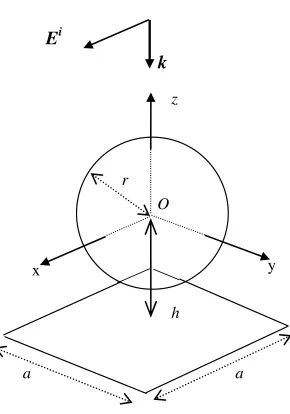
Figure 1. The geometry of examples 1–3: A sphere above a square patch with an incident plane wave Ei= ˆxexp(jk0z).
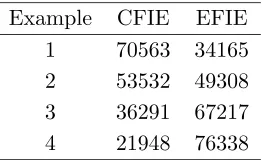
containing both close and open surfaces. As shown in Fig. 1, examples 1–3 are involved in a closed geometry of perfectly conducting sphere and an open geometry of square patch. The geometries are solved at various dimensions and the different meshes and numbers of unknowns are required for the closed surfaces and the open surfaces. How the number of the unknowns in the EFIE parts is demonstrated to have the influence on the ILU(0) preconditioner for the hybrid CFIE-EFIE formulation and the CFIE-IEFIE formulation, respectively.
Example 1 involves a sphere of radius r = 5 m and a rectangular patch of edge length a= 10 m. The patch is located below the center of the sphere with a distance ofh= 7 m.
Example 2 is with the sphere of radiusr = 4 m and the rectangular patch of edge length a = 12 m. The patch is located at a distance of h= 6 m from the center of the sphere.
Example 3 has the sphere of radius 3 m and the rectangular patch of edge lengtha= 14 m. The patch is located at a distance ofh= 5 m below the center of the sphere.
L H a. b
d.
c L
H
Figure 2. The geometry of example 4: China’s lunar orbiter Chang’E1 with an incident plane wave Ei= ˆxexp(jk0z).
length L = 10 m and H = 2 m, and the distance between the rectangular patch and the cuboid d= 0.8 m. The cuboid is built as a cuboid centering at the coordinate origin with edges length 1.7 m, 2 m, 2.2 m along thex-, y-, z-direction respectively, then rotate 45 degrees around the xaxis.
Table 1. The number of unknowns of CFIE parts and EFIE parts in the hybrid CFIE-EFIE formulation for the examples 1–4.
Example CFIE EFIE 1 70563 34165 2 53532 49308 3 36291 67217 4 21948 76338
In the analysis, the incident electric field isEi = ˆxexp(jk0z) and
-10 0 10 20 30 40 50 60
0 20 40 60 80 100 120 140 160 180
θ(degree)
RCS
(d
B)
EFIE
CFIE+EFIE CFIE+IEFIE
Figure 3. Bistatic RCS in example 1 by EFIE, hybrid CFIE-EFIE, hybrid CFIE-IEFIE. The incident wave is Ei = ˆxexp(jkz) with frequency 300 MHz.
-10 0 10 20 30 40 50 60
0 20 40 60 80 100 120 140 160 180
θ(degree)
RCS
(d
B)
EFIE CFIE+EFIE CFIE+IEFIE
Figure 4. Bistatic RCS in example 2 by EFIE, hybrid CFIE-EFIE, hybrid CFIE-IEFIE. The incident wave is Ei = ˆxexp(jkz) with frequency 300 MHz.
steps. The solver terminates if the normalized backward error is less than 10−3 or the number of iterations reaches 10000. The parameter ε in eq. (9) is taken to be 10−3. All experiments are performed on a Core-2 6300 with 1.86 GHz CPU and 2 GB RAM in single precision. As shown in Figs. 3–6, the curves of bistatic RCS of the four examples are given for the EFIE, the hybrid EFIE and the hybrid CFIE-IEFIE formulations, respectively. It can be found that there is a good agreement between them.
0 10 20 30 40 50 60
0 20 40 60 80 100 120 140 160 180
θ (degree)
RCS
(d
B)
EFIE CFIE+EFIE
CFIE+IEFIE
Figure 5. Bistatic RCS in example 3 by EFIE, hybrid CFIE-EFIE, and hybrid CFIE-IEFIE. The incident wave is Ei = ˆxexp(jkz) with frequency 300 MHz.
-30 -20 -10 0 10 20 30 40 50
0 20 40 60 80 100 120 140 160 180
θ (degree)
RCS
(d
Bs
m
)
EFIE
CFIE+EFIE CFIE+IEFIE
Figure 6. Bistatic RCS in examples 4 by EFIE, hybrid CFIE-EFIE, and hybrid CFIE-IEFIE. The incident wave is Ei= ˆxexp(−jkz) with frequency 550 MHz.
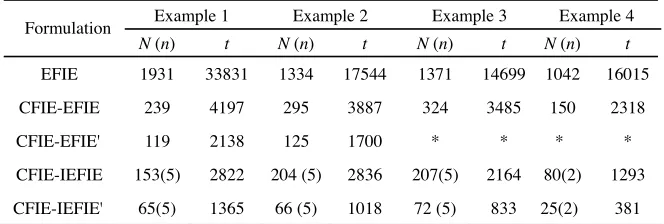
solution-time, and the update step Nsteps are listed in Table 2 and the comparison is made among EFIE, hybrid CFIE-EFIE and hybrid CFIE-IEFIE without/with ILU(0) for our four examples. The total iteration number of GMRES denotes the summation of the number of iterations of every update step. It can be observed for example 1 that the ILU(0) preconditioned hybrid CFIE-EFIE and hybrid CFIE-IEFIE reduce the solution time by a factor of about 15.8 and 24.8 respectively when compared with the traditional EFIE solution.
Table 2. Comparison of the total number of iterations of GMRES (denoted as N), update steps of the hybrid CFIE-IEFIE formulation (denoted as n) and the sol-time (denotes as t in seconds) in various schemes for three examples, * denotes no convergence achieved in 10000 iterations. Superscript ’ stands for the case with ILU(0) preconditioner.
Example 1 Example 2 Example 3 Example 4
Formulation
N (n) t N (n) t N (n) t N (n) t
EFIE 1931 33831 1334 17544 1371 14699 1042 16015
CFIE-EFIE 239 4197 295 3887 324 3485 150 2318
CFIE-EFIE' 119 2138 125 1700 * * * *
CFIE-IEFIE 153(5) 2822 204 (5) 2836 207(5) 2164 80(2) 1293
CFIE-IEFIE' 65(5) 1365 66 (5) 1018 72 (5) 833 25(2) 381
solution time by a factor of 10.3 and 17.2 respectively when compared with the EFIE. They reduce the solution time by a factor of 2.3 and 2.8 respectively when compared with the hybrid CFIE-EFIE and the hybrid CFIE-IEFIE without the preconditioning technique.
For examples 3 and 4, it can be observed that the ILU(0) preconditioned hybrid CFIE-EFIE does not reach the convergence over 10000 iterations since the number of unknowns of open parts becomes so large that ILU(0) produces highly unstable and hence useless factorizations for the EFIE part. However, the ILU(0) preconditioned hybrid CFIE-IEFIE reaches the convergence with a reduction of the solution time by a factor of 17.6 for example 3 and 42.0 for example 4 when compared to the traditional EFIE and a factor of 4.2 for example 3 and 6.1 for example 4 when compared to the hybrid CFIE-EFIE.
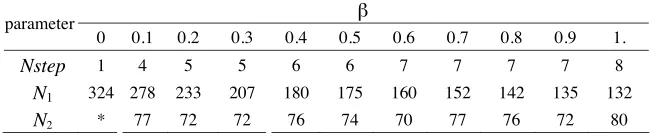
Table 3 shows the influence of the IEFIE combination factorβ on the convergence of the hybrid CFIE-IEFIE formulation in example 3. It can be found that the total number of iterations decreases as βm increases for open surface parts without ILU(0) preconditioner. However, the total number of iterations is almost constant after the ILU(0) preconditioner is used.
Table 3. The influence of the IEFIE combination factorβfor the open surface parts on the total number of iterations and update stepsNstep
in example 3. N1 andN2 stand for the total number of iterations of the
CFIE-IEFIE formulation and the ILU(0) preconditioned CFIE-IEFIE formulation, respectively.
β
parameter
0 0.1 0.2 0.3 0.4 0.5 0.6 0.7 0.8 0.9 1.
Nstep 1 4 5 5 6 6 7 7 7 7 8
N1 324 278 233 207 180 175 160 152 142 135 132
N2 * 77 72 72 76 74 70 77 76 72 80
unknowns for the open surface parts increases as in examples 3 and 4. But this phenomenon is not true for the ILU(0) preconditioned CFIE-IEFIE and it is stable and highly efficient.
5. CONCLUSIONS
In this paper, the ILU(0) preconditioned hybrid CFIE-IEFIE is presented to efficiently solve the electromagnetic scattering from composite objects involving both open and closed conducting surfaces. The instability of the incomplete LU factorization is avoided for the EFIE part of the hybrid CFIE-IEFIE. The significant reductions for both the number of iterations and solution time are obtained without compromising the accuracy.
ACKNOWLEDGMENT
The authors would like to thank the assistance and support of Natural Science Foundation of China under Contract Number 60701003, 60701005, 60431010 and Excellent Youth Natural Science Foundation of China under Contract Number 60325103.
REFERENCES
1. Xu, L., Y.-C. Guo, and X.-W. Shi, “Dielectric half space model for the analysis of scattering from objects on ocean surface,”Journal
of Electromagnetic Waves and Applications, Vol. 21, No. 15, 2287–
2. Strifors, H. C. and G. C. Gaunaurd, “Bistatic scattering by bare and coated perfectly conducting targets of simple shape,”Journal
of Electromagnetic Waves and Applications, Vol. 20, No. 8, 037–
1050, 2006.
3. Li, Y. L., J. Y. Huang, and M. J. Wang, “Scattering cross section for airborne and its application,” Journal of Electromagnetic
Waves and Applications, Vol. 21, No. 15, 2341–2349, 2007.
4. Collard, B., B. Fares, and B. Souny, “A new formulation for scattering by impedant 3D bodies,” Journal of Electromagnetic
Waves and Applications, Vol. 20, No. 10, 1291–1298, 2006.
5. Illahi, A., M. Afzaal, and Q. A. Naqvi, “Scattering of dipole field by a perfect electromagnetic conductor cylinder,” Progress
In Electromagnetics Research Letters, Vol. 4, 43–53, 2008.
6. Carpentieri, B., “Fast large RCS calculation using the boundary element method,” Journal of Electromagnetic Waves and
Applications, Vol. 20, No. 14, 1959–1968, 2007.
7. Huang, E. X. and A. K. Fung, “An application of sampling theorem to moment method simulation in surface scattering,”
Journal of Electromagnetic Waves and Applications, Vol. 20, No.
4, 531–546, 2006.
8. Varmazyar, S. H. and M. N. Moghadasi, “An integral equation modeling of electromagnetic scattering from the surfaces of arbitrary resistance distribution,” Progress In Electromagnetics
Research B, Vol. 3, 157–172, 2008.
9. Mittra, R. and K. Du, “Characteristic basis function method for iteration-free solution of large method of moments problems,”
Progress In Electromagnetics Research B, Vol. 6, 307–336, 2008.
10. Hatamzadeh-Varmazyar, S., M. Naser-Moghadasi, and Z. Ma-souri, “A moment method simulation of electromagnetic scatter-ing from conductscatter-ing bodies,” Progress In Electromagnetics
Re-search, PIER 81, 99–119, 2008.
11. Mautz, J. R. and R. F. Harrington, “H-field, E-field, and combined field solutions for conducting bodies of revolution,”AE ¨U, Vol. 32, 157–164, 1978.
12. Ergul, O. and L. Gurel, “Hybrid CFIE-EFIE solution of composite geometries with coexisting open and closed surfaces,” IEEE
Transactions on Electromagnetic Compatibility, Vol. 5, 289–292,
2005.
13. Chew, W. C., J. M. Jin, E. Midielssen, and J. M. Song, Fast and
Efficient Algorithms in Computational Electromagnetics Boston,
14. Pan, X.-M. and X.-Q. Sheng, “A highly efficient parallel approach of multi-level fast multipole algorithm,” Journal of
Electromagnetic Waves and Applications, Vol. 20, No. 8, 1081–
1092, 2006.
15. Li, L. and Y.-J. Xie, “Efficient algorithm for analyzing microstrip antennas using fast-multipole algorithm combined with fixed real-image simulated method,”Journal of Electromagnetic Waves and
Applications, Vol. 20, No. 15, 2177–2188, 2006.
16. Wang, P. and Y.-J. Xie, “Scattering and radiation problem of surface/surface junction structure with multilevel fast multipole algorithm,” Journal of Electromagnetic Waves and Applications, Vol. 20, No. 15, 2189–2200, 2006.
17. Hu, J. and Z. Nie, “Improved electric field integral equation (IEFIE) for analysis of scattering from 3-D conducting struc-tures,” IEEE Transactions on Electromagnetic Compatibility, Vol. 49, 644–648, 2007.
18. Saad, Y., Iterative Methods for Sparse Linear Systems, PWS Publishing Company, 1996.
19. Malas, T. and L. Gurel, “Incomplete LU preconditioner with multilevel fast multipole algorithm for electromagnetic scattering,”SIAM Journal of Scientific Computing, Vol. 29, 1476– 1494, 2007.
20. Rao, S. M., D. R. Wilton, and A. W. Glisson, “Electromagnetic scattering by surfaces of arbitrary shape,”IEEE Trans. Antennas
Propagat., Vol. 30, 409–418, 1982.
21. Sertel, K. and J. L. Volakis, “Incomplete LU preconditioner for FMM implementation,” Microwave Opt. Technol. Lett., Vol. 26, 265–267, 2000.
22. Rui, P. L., R. S. Chen, Z. H. Fan, J. Hu, and Z. P. Nie, “Perturbed incomplete ILU preconditioner for efficient solution of electric field integral equations,”IET Microwave Antennas Propagation, Vol. 1, 1059–1063, 2007.