Cryptanalysis of the Light-Weight Cipher A2U2
First Draft version
Mohamed Ahmed Abdelraheem, Julia Borghoff, Erik Zenner
Technical University of Denmark, DK-2800 Kgs. Lyngby, Denmark {M.A.Abdelraheem,J.Borghoff,E.Zenner}@mat.dtu.dk
1
Introduction
At IEEE RFID 2011, David et al. proposed a new cryptographic primitive for use with RFID [2]. The design is a stream cipher called A2U2. Shortly afterwards, an attack was published on IACR Eprint by Chai et al. [1], claiming to break the ci-pher in a chosen-plaintext attack using extremely little computational resources. Regrettably, this attack is wrong since it works with an erroneous description of the cipher. In this paper, we show why the attack is wrong and how it can be repaired (Section 4).
Furthermore, in Section 5 we describe a guess-and-determine attack which applies in a known plaintext scenario.
A special design feature of A2U2 is that the number of initialization rounds varies and depends on an internal counter. The number of rounds varies from 9 to 126. In Section 6 we proposed a differential style attack which first enables us to find the counter value determining the number of initialization rounds. Moreover we present an attack that recovers the masterkey in the case that only 9 initialization rounds are used.
2
Description of the Cipher
The cipher’s inner state consists of a counter LFSR C (7 bit), two non-linear feedback shift registers A and B (NFSRs, 17 and 9 bit), and a key registerK
(56 bit). Thus, the total inner state size is 89 bit. Note that we use a different notation than in the original paper, our being more suitable for cryptanalysis.
Updating the counter: In the following, we denote the state of the counter LFSR at time tbyCt= (C
t, Ct−1, . . . , Ct−6), fort= 0,1, . . .. The starting state after initialisation is C0 = (1,1, . . . ,1), see below under “Initialisation”. The LFSR then uses the feedback recurrence
Ct=Ct−7+Ct−4
Updating the NFSRs We denote the state of the NFSRs byAt= (A
t, . . . , At−16) and by Bt= (B
t, . . . , Bt−8). The update uses an auxiliary variableht (defined
below under “Updating the key register”) and the following non-linear feedback recurrences:
Bt=At−17+At−15At−14+A12+At−10Ct−7+At−7At−6At−5+At−4At−2
At=Bt−9+Bt−8Bt−7+Bt−6+Bt−3+ht+ 1,
again fort≥1.
Updating the key register The key register is a rotation register, i.e. the state in time t is a rotated version of the initial state. If we denote the key bits by (k0, . . . , k55), then each state of the key register is defined as
Kt= (k5t, k5t+1, . . . , k5t+55),
where all indices are computed modulo 56.
For each round, the first five bits of the register are stored in a buffer
St = (St
0, . . . , S4t) = (k5t, . . . , k5t+4), and they are used to compute the
aux-iliary variableht as follows:
ht= MUXCt−5(S
t
0, S1t)·MUXCt−1(S
t
4, At−2) + MUXCt−3(S
t
2, S3t) + 1, where MUXz(x, y) is the multiplexer function that selects x if z = 0 and y
otherwise.
Initialisation: The A2U2 cipher has a 61-bit key split into two parts: A 5-bit “counter key” and a 56-bit “register key”. In addition, the cipher receives a 32-bit random number. Key and random number are written into the registers as follows:
– Counter register: The 5 least significant key and random bits are xored.
The resulting 5-bit vector is written into the 5 least significant bits of the counter LFSR (using the above notation). The second MSB is set to 1, the MSB is set to 0.
– NFSRs: The next 26 key and random bits are xored and written into the
NFSR cells.
– Key register:The 56 register key bits (to some extend the same that were
used for NFSR initialisation) are stored in the key register.
Now the cipher is clocked until the counter register reaches the all-one state. This happens after 9-126 clockings. The resulting state is called the initial state.
Output generation: The cipher deploys a form for irregular output mechanism; it outputs either encrypted plaintext bits or pseudo-random bits depending on the content of NFSR cell At. Plaintext bits have to “wait” untilAt= 1 before
being encrypted. If we denote the plaintext string byP = (P0, P1, . . .) and if we define σ(t) =Pt−1
i=0At withσ(0) = 0, then the output of the cipher in roundt
is:
3
Cryptanalysis
3.1 Useful Properties
In the following, we point out some properties of the cipher that will be used by our attacks.
Known counter: Since the counter has the all-one state after initialisation, the attacker can compute all successive counter states and does know the bitCtfor
anyt≥0. This simplifies significantly some of the algebraic equations described above.
Chosen randomisation vector: Instead of using a nonce that is chosen solely by the encrypting party as is common practice with stream ciphers, the random vector used for initialisation is generated in collaboration between sender and receiver. According to [2], both sender and receiver each choose a 32-bit random number which is then sent over the communication channel. Both inputs are then combined by xor into the actual randomisation vector. Note that this procedure enables an active attacker to choose the randomisation vector: He waits for the legitimate party’s input and chooses his own such that the xor sum will be the desired number. In particular, he can introduce arbitrary differences between randomisation vectors and even force the encryption device to use the same randomisation vector twice, thus violating an important design principle for stream ciphers.
Chosen plaintext: Due to the unusual output generation, a chosen plaintext attack is more powerful than a known plaintext attack. This is another difference to traditional stream cipher designs, where no extra information is gained if the attacker is allowed to choose the plaintext himself.
4
A Chosen Plaintext Attack
4.1 Disproving the Chai/Fan/Gong Attack
In [1], a very efficient chosen plaintext attack against A2U2 is proposed. However, as we are going to show in this section, the attack contains a flaw that makes it unapplicable against the real A2U2 cipher.
Attack Idea: If the attacker could freely choose one plaintext bit for each clock, then he can write the output equation as follows:
ct= MUXAt(Bt+Ct, Bt+pt) = MUXAt(Ct, pt) +Bt.
If the attacker can choose the plaintext, he can start by encrypting a plain-text that is identical to the counter sequence. In this case, the above equation simplifies to
ct= MUXAt(Ct, p) +Bt =p+Bt,
meaning that the attacker can learn the whole sequence (Bt)t≥0.
Next, he encrypts a plaintext that is the bitwise inverse of the counter se-quence. This allows him to distinguish for every ciphertext bit whetherCtorp
was encrypted, providing the attacker with the full sequence (At)t≥0.
Now he has the sequences produced by the LFSR and by both NFSRs. All that remains is to test for each round which key bit gives the correct NFSR update. This can be done in unit time, yielding an extremely efficient attack.
The Catch: However, the initial assumption of the above attack is wrong, in-validating the whole cryptanalysis. The problem is that plaintext is not used at a rate of 1 bit per round. It is not possible to choose a plaintext bit for each round, because (1) some plaintext bits are used in several rounds and (2) with-out knowledge of the sequence (At)t≥0, it is impossible to say in which rounds
a plaintext bit will be used.
4.2 A Leak in the Output Function
However, as it turns out, this attack can be repaired. In the following, we will demonstrate a leak in the output function that can even be used for general known-plaintext attacks and will then expand this weakness into a chosen plain-text attack that reminds of the one described above but is actually functional.
Known plaintext: Assume that the inner sequences At and Bt are statistically
close to random. Then in particular, Pr(At = 0) = 1/2 for all t. We can now
consider two cases for the output function:
– If At = 0, then Yt = Bt+Ct. Since we know Ct, we can rewrite this as
Bt=Yt+Ct. ForAt= 0, this is always true.
– IfAt= 1, we haveYt=Bt+Pσ(t), with Pσ(t) unknown. If we assume that
Pσ(t)=Ctwith probability 1/2, then the equationBt=Yt+Ctis also true
with probability 1/2.
In total, the equationBt=Yt+Ctis thus met with probability 1/2 + (1/2)2=
3/4, i.e. by observing the keystream and knowing the behaviour of the counter LFSR, we can predict the inner stream (B0, B1. . .) with probability 3/4 per bit.
Chosen plaintext: Note that when we can choose the plaintext, we can increase the probability of Pσ(t) = Ct and thus the probability of the equation Bt =
As an example, consider the first 5 output bits of the LFSR, which are (1,0,0,0,0). Thus, if we choose a plaintext (1,0,0,0,0), thenPσ(t)=Ctis true
with probability 1 for the first bit, 1−1/2 for the second, 1−1/4 for the third, 1−1/8 for the fourth, and 1−1/16 for the fifth bit. Thus, we can predict the inner state bits (B0, . . . , B4) with probabilities (1,3/4,7/8,15/16,31/32).
The most useful plaintexts for this kind of analysis seem to be (0,0, ...) and (1,1, ...), since for them, the attacker knows exactly the bitPσ(t) for every time slot t. Let us start with the all-zero sequence. The attacker knows that the plaintext sequence (Pσ(t))t≥0 consists only of zeros. He now looks at all time slots twith Ct= 0. For those time slots, it holds that Bt=Yt, independent of
the choice ofAt. Thus, he learns about half of the bits of the sequenceB.
The remaining bits can be learned using the all-one sequence. In this case, in all positions whereCt= 1, the attacker learnsBt=Yt+ 1, also independent
ofAt. Thus, he has fully reconstructed the sequenceB.
What is more, he can also use this new information to learn the sequenceA
as well. For every time slot, he either picks the ciphertext bit Yt corresponding
to the plaintext bit Pσ(t) 6= Ct. If it holds that Bt = Yt+Ct, then At = 0,
otherwiseAt= 1.
After this step, the attacker knows the sequences generated by all three reg-isters A, B, and C. The remaining attack proceeds as follows. Knowing the sequencesA,B andC the attacker can determine the valueshtbecause
ht=Bt−9+Bt−8Bt−7+Bt−6+Bt−3+At+ 1.
Furthermore, it holds that
ht= MUXCt−5(S
t
0, S
t
1)·MUXCt−1(S
t
4, At−2) + MUXCt−3(S
t
2, S
t
3) + 1,
whereCt−ifori= 1,3,5 andAt−2are known. This equation is at most quadratic and in about half of the cases (whenCt−1= 1) it is linear. Determining 56 values ofhtyields a fully determined quadratic Boolean equation system, which can be
solved by e.g., using Gr¨obner basis techniques. As about half of the equation are linear, a linear equation system can be obtained after determining 112 values of ht. After 11 clockings of the algorithm the key register is rotated once and
the key bits are reused, thus it can happen that the same equation is generated twice. However, experiments showed that this does not happen frequently, thus we expect that observing around 120 values ofhtis sufficient to generate a fully
determined linear equation systems in 56 unknowns.
5
Guess-and-Determine attack
In this section a we discuss known plaintext attack which is in general a more likely scenario than a chosen plaintext attack. When we know but are not allowed to choose the plaintext we cannot use the same trick as in Section 4 to deter-mine the sequence (Bt)t≥0. We cannot simply calculate this sequence for a given
plaintext/ciphertext pair because we do not know which bits of the ciphertext correspond to the plaintext bits. This is controlled by registerA. The idea of this attack is to guess the sequence of (At)t≥0, meaning we guess at which positions
of the ciphertext a plaintext bit was used. These guesses are used to determine additional bits of registerB and then later on the value ofht. As we know the
value of the counter at any time during the encryption process, given ht and
At−2 we obtain a Boolean equation in the key bits which is at most quadratic and contains at most three variables. If we are able to collect sufficiently many of those equations we will be able to recover the key bits by solving the equation system.
We denote byA0 the content of the last cell of the first NFSR at the time when the ciphertext generation starts.The attack is divided into three parts of guessing bits.
In the first part we guess the value At for t = 0, . . . ,8 for 8 consecutive
clockings of the algorithms. Depending on our guess we know if the counter bit or a plaintext bit was used to generate the corresponding ciphertext bit and we can determine the value ofBtfort= 0, . . . ,8. After guessing 9 bits we know the
full second NFSR and about the lower half of the first NFSR.
In the next part we continue guessing the value ofAt fort = 9, . . . ,16 and
determine the value of Bt for t = 9, . . . ,16. Additionally, we obtain the value
of ht for t = 9, . . . ,16 and the corresponding Boolean equation in the key bits
because it holds that
ht:=At+Bt−9+Bt−8Bt−7+Bt−6+Bt−3+ 1, (1)
the full register B is known and we guessed the value of At. After the second
part of the attack both registers are known and we have already obtained 8 equations.
In the third part we want to determine the value ofht for further clockings
of the cipher. The full registerAis known and in order to update registerBonly bits of registerAare used. This means we can update registerB and know the value which was use to encrypt next ciphertext bit (bit 17, 18 etc). Furthermore, we know the counter value Ct and the plaintext bit p that might have been
used (according to our guess). As mentioned before we want to determine the value ofhtand obtain the corresponding equation. Using equation (1) we need
to determineAtin order to obtainht. This can be done in two ways. Either we
have to guess At as we did before, or we can simply calculate the value of At.
This can be done whenCt6=Pσ(t)because it holds that
Effort: We need to collect at least 56 equations to determine a unique solution in 56 key variables. In the first two parts of the attack we guess 17 bits and obtain 8 equations. We expect that we have to guess every second value forAtin the
third part of the attack. Thus, we expect that we have to guess 24 further bits in the third part of the attack in order to obtain a fully determined equation system. This leads to a complexity of 241.
This equation system is non-linear and therefore it might not have a unique solution even though is is fully determined. However, it is often sufficient to add a few extra equations to get a unique solution. This will slightly raise the complexity of the attack.
However, in order to give an more precise estimate of the complexity an implementation is necessary (work in progress) because of the fact that the key register is rotate once after 11 clockings of the algorithm and thus key bits are reused. This property will on the one hand increase the complexity of the attack for the correct guess but on the other hand enable us to discard wrong guesses in an early stage. After producing 11 ciphertext bits the key register has been rotated once, that means the key bits will be reused when generating more equations. This leads to rounds where we guess or determine the value of At
but do not get a new equation, thus do not gain extra information about the key. This is especially true for the correct guess and means that it is necessary to guess extra bit in order to obtain a fully determined system. For a wrong guess however this might be to our advantage because it is very likely that when the same polynomial is generated the RHS differs. Thus, we get contradicting equations and can abort the guess.
In general, for a wrong guess the equation system will not have a solution. The inconsistency might be very obvious as mentioned above, but it might also be necessary to solve a non-linear Boolean equation system. Therefore, we have to make a trade-off how often we want to check if the system is still solvable.
Experiments to estimate the actual attack complexity are currently carried out and the paper will be updated as soon as we ran a sufficient number of tests.
6
Targeting the low number of initialization rounds
6.1 Recovering the last five key bits
A2U2 has a secret number of initialization rounds. There are 32 possible choices for the number of initialization rounds that varies from 9 to 126 where each choice is specified by the 5 LSBs of the tag’s random number and the reader’s random number. The attack requires for each of the possible 32 initialization 29 state pairs with a good difference (sparse characteristic). Under these states we encrypt a single bit of plaintext which is equal to the first bit of the counter,
Experiments show that Pr(∆(B0) = 0)>0.7 for 9 initialization rounds when the differences ∆(A) = 10000000000000000 in A and ∆(B) = 100000100 in B
are used. The bias is smaller when more initialization rounds are applied. We observe the strong bias inB0for 9 rounds because in only 9 rounds the difference cannot propagate through state and does not spread out sufficiently. After having distinguished the 29 state pairs corresponding to 9 rounds of initialization, we can consequently find the five last secret key bits.
6.2 Recovering subkey bits and master key bits
The following attack targets plaintext/ciphertext generated using 9 rounds of initialization and exploits the key scheduling used to generate the subkey bits,
ht. The attacker starts by guessing the 26 master key bits used in initializing
registers A and B and then at each round he guesses one subkey bits ifCt−1= 0, or two master key bits ifCt−1= 1 (since At−2will then be used to generateht)
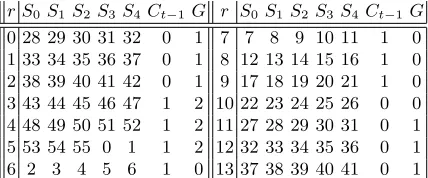
or no bits when all the key bits involved in the generation of the round subkey bit are from the 26 master key bits used in initializing registersA andB. The cipher is initialized using 9 rounds and then a 5-bit plaintext is encrypted, so in total the cipher runs for 14 rounds. Without loss of generality we assume that the starting key position is 2, so the key bits at positions 2 to 27 are used in initializing registers A and B. Table 1 shows the key bits positions used from round 0 to round 13, the value of Ct−1 and the number of guessed subkey/key bits. The table also shows that we have to guess 12 subkey/key bits plus the 26 master key bits used in initializing the registers. So in total we have a time complexity equal to 238to recover 32 master key bits and 6 subkey bits and when using plaintexts of length 5-bit we need onlyb38
5c= 7 plaintext/ciphertext pairs to find the right key guess. The remaining master key bits can be recover using a brute force search. In order for the above attack to work we need to find only 7 plaintext/ciphertext pairs whose initial state pairs are initialized with position 2 as a starting key position and are generated using 9 initialization rounds which we can easily find using the last five secret key bits recovered in the previous attack.
r S0 S1S2S3S4Ct−1G r S0S1 S2 S3 S4Ct−1 G
0 28 29 30 31 32 0 1 7 7 8 9 10 11 1 0 1 33 34 35 36 37 0 1 8 12 13 14 15 16 1 0 2 38 39 40 41 42 0 1 9 17 18 19 20 21 1 0 3 43 44 45 46 47 1 2 10 22 23 24 25 26 0 0 4 48 49 50 51 52 1 2 11 27 28 29 30 31 0 1 5 53 54 55 0 1 1 2 12 32 33 34 35 36 0 1 6 2 3 4 5 6 1 0 13 37 38 39 40 41 0 1
References
1. Q. Chai, X. Fan, and G. Gong. An ultra-efficient key recovery attack on the lightweight stream cipher A2U2. http://eprint.iacr.org/2011/247, 2011. Version published: 20110518:133751 (posted 18-May-2011 13:37:51 UTC).