Distributed Oblivious RAM for Secure Two-Party Computation
∗Steve Lu† Rafail Ostrovsky‡
Abstract
Secure two-party computation protocol allows two players, Alice with secret inputxand Bob with secret inputy, to jointly execute an arbitrary programπ(x, y)such that only the output of the program is revealed to one or both players. In the two player setting, under computational assumptions most approaches require to first “unroll”πinto a circuit, and then execute this circuit in a private manner. Without unrolling the circuit, an alternative method was proposed by Ostrovsky and Shoup (in STOC 1997) [28] with both players simulating the CPU of an oblivious RAM machine using “off-the-shelf” secure two-party computation to perform CPU simulation with atomic instructions implemented by circuits and relying on one of the players to implement en-crypted memory. The simulation of the CPU must be done through circuit-based secure two-party computation, thus CPU “memory” in the Oblivious RAM simulation must be minimized, as otherwise it impacts simulation of each step of the computation. Luckily, there are multiple Oblivious RAM solutions that requireO(1)CPU memory in the security parameter. The Ostrovsky-Shoup compiler suffers from two drawbacks:
• The best running time of Oblivious RAM simulation withO(1)memory is still prohibitive and requires
O(log2t/log logt) overhead for running programs of length t by Kushilevitz, Lu, and Ostrovsky (in SODA 2012) [23].
• The most problematic part of this approach is that all Oblivious RAM simulations, starting with Goldre-ich and Ostrovsky (in JACM 1996) [14] require “Oblivious Sorting” that introduce a huge constant into Oblivious RAM simulation that essentially kills all practicality.
In this paper, we observe that in the secure two-party computation, Alice and Bob can simulate two non-communicating databases. We show how to extend the Ostrovsky-Shoup compiler so that two non-non-communicating servers can eliminate all the drawbacks stated above. More specifically, we design a new Oblivious RAM proto-col where a client interacts with two non-communicating servers, that supportsnreads and writes, and requires
O(n)memory for the servers,O(1)memory for the client, andO(logn)amortized read/write overhead for data access. The constants in the big-O notation are tiny, and we show that the storage and data access overhead of our solution concretely compares favorably to the state-of-the-art single-server schemes. As alluded to above, our protocol enjoys an important feature from a practical perspective as well. At the heart of almost all previous single-server Oblivious RAM solutions, a crucial but inefficient process known as oblivious sorting was required. In our two-server model, we describe a novel technique to bypass oblivious sorting, and show how this can be carefully blended with existing techniques to attain a more practical Oblivious RAM protocol in comparison to all prior work.
This new protocol leads to a novel application in the realm of secure two-party RAM program computation. We show that our multi-server Oblivious RAM construction can be composed with an extended version of the Ostrovsky-Shoup compiler to obtain a new method for secure two-party RAM computation with lower overhead than (implicitly) existing constructions by a factor ofO(logn/log logn)of Gordon et al. [18].
Keywords: Oblivious RAM, Cloud Computing, Multi-Server Model, Software Protection, Secure Computa-tion.
∗
This work expands on and is protected by patent application [25].
†
Stealth Software Technologies, Inc. E-mail: [email protected]
‡
1
Introduction
The concept of outsourcing data storage or computation is widespread in practice. This raises the issue of what happens to the privacy of the data when the outsourcing service is only semi-trusted or untrusted. Encryption can be employed to protect thecontentof the data, but it is apparent that information might be revealed based on how the data is accessed. Simply put, encryption by itself alone does not entirely address the issue of data privacy at hand.
The sequence of reads and writes a client makes to the remotely stored data is known as the access pattern. Even if the content of the data is protected by encryption, the server storing the data can deduce information about the encrypted data just by observing and analyzing the access pattern. For instance, the server can correlate this pattern with public information about the client’s behavior, such as the purchase or sale of stock. Over time, the server may learn enough information to predict the behavior of the client or the underlying semantics of the data, thereby defeating the purpose of encrypting it in the first place.
A trivial solution would be for the client to access the entire stored database every single read or write. This clearly hides the access pattern, but the per-access overhead is linear in the size of stored data. The question remains:
Is it possible to hide the access pattern with less than linear overhead?
In the model where the client is a Random Access Machine (i.e. RAM model), Goldreich and Ostrovsky [11, 27, 26, 14] introduced the concept of hiding the access pattern in the context of software protection. A small protected CPU would run on a machine with large unprotected RAM. The goal was to obliviously simulate access to RAM, so that the set of instructions ran by the CPU would be protected against an outsider monitoring the RAM. In this manner, an adversary observing the RAM would learn nothing about what instructions were executed except the total number of instructions. The work of [11] featured two solutions using constant client memory: a “square-root” solution and a “recursive square-“square-root” solution. The amortized time overhead of executing a program in the former scheme wasO(√n), andO(2
√
lognlog logn)in the latter. Ostrovsky [27, 26] then discovered what is known
as the “hierarchical solution” which had amortized overheadO(min
(log3n); (log3t) ), wheretis running time. The subsequent work of Goldreich and Ostrovsky [14] contains the merged results of [27, 26, 11] and featured a simpler method of reshuffling. The work described a way of simulating oblivious RAM withO(log3n)amortized overhead per access forndata items, using constant client storage1andO(nlogn)server storage.
While the asymptotic behavior ofO(log3n)overhead might seem efficient, this only gives a practical advantage over the trivial solution whenn >log3n(without even considering the constants hidden in theO). A database of sizen= 220results in an overhead factor of roughly8000, and such a large overhead would seem to cast oblivious RAM as outside the realm of practicality. Making oblivious RAM practical would be of great impact, as it can be applied to software protection and several other important problems such as cloud computing, preventing cache attacks, etc. as we discuss later.
A highly interesting and powerful application of Oblivious RAM is in the problem of efficient, secure two-party
programcomputation. While there are many ways to model computation, such as with Turing Machines, (Boolean) Circuits, Branching Programs, or Random Access Machines, one representation might be more natural than another, depending on the program. Nearly all secure two-party computation protocols require the program to be specified as a circuit between the two parties. Due to a classic result by Pippenger and Fischer [32], any Turing machine running in timeT can be transformed into a circuit with only O(logT)blowup, but it is not known in the RAM model of computation whether there exists such an efficient transformation to circuits. Therefore, even using the most efficient secure two-party protocols for circuits (e.g. IKOS [19] or IPS [20] protocols), there is no clear path on how to apply these to efficiently perform secure RAM computation. We consider the question:
How can one efficiently perform secure two-party computation in the natural RAM model?
RELATEDWORK. Subsequent to Goldreich and Ostrovsky [27, 26, 11, 14], works on Oblivious RAM [33, 34, 31,
16, 17] looked at improving the concrete and asymptotic parameters of oblivious RAM. We give a full summary of
1
these schemes in Section 2. The major practical bottleneck of all these works on Oblivious RAMs is a primitive calledoblivious sortingthat is being called upon as a sub-protocol. Although the methods for oblivious sorting have improved, it still remains as both the critical step and the primary stumbling block of all these schemes. Even if new methods for oblivious RAM are discovered, there is aninherent limitto how much these schemes can be improved. It was shown in the original work of Goldreich and Ostrovsky [14] that there is a lower bound for oblivious RAM in this model.
([14], Theorem 6): To obliviously perform nqueries using onlyO(1) client memory, there is a lower bound of
O(logn)amortized overhead per access.
We mention several results that are similar to Oblivious RAM but work in slightly different models. The works of Ajtai [1] and Damg˚ard et al. [10] show how to construct oblivious RAM with information-theoretic security with poly-logarithmic overhead in the restricted model where the Adversary can not read memory contents. That is, these results work in a model where an adversary only sees the sequence of accesses and not the data. The work of Boneh, Mazieres and Popa [7] suggests ways to improve the efficiency of the “square-root” solution [11, 14] when memory contents are divided into larger blocks.
Finally, the notion ofPrivate Information Storageintroduced by Ostrovsky and Shoup [28] allows for private storage and retrieval of data. The work was primarily concentrated in the information theoretic setting. This model differs from Oblivious RAM in the sense that, while the communication complexity of the scheme is sub-linear, the server performs a linearamount of work on the database. The work of Ostrovsky and Shoup [28] gives a multi-server solution to this problem in both the computational and the information-theoretic setting and introduces the Ostrovsky-Shoup compiler of transforming Oblivious RAM into secure two-party computation. Quoting directly from their STOC 1997 [28] paper (with citations cross-referenced):
Both databases keep shares of the state of the CPU, and additionally one of the databases also keeps the contents of the Oblivious RAM memory. The main reason why we can allow one of the constituent databases to keep both the “share” of the CPU and the Oblivious RAM memory and still show that the view of this constituent database is computationally indistinguishable for all executions is that the Oblivious RAM memory component is kept in an encrypted (and tamper-resistant) form (see [14]), according to a distributed (between both databases) private-key stored in the CPU. For every step of the CPU computation, both databases execute secure two-party function evaluation of [35, 13] which can be implemented based on any one-way trapdoor permutation family (again communicating through the user) in order to both update their shares and output re-encrypted value stored in a tamper-resistant way in Oblivious RAM memory component.
The current work can be viewed as a generalization of the [28] model where servers must also perform sublinear work. The notion of single-server “PIR Writing” was subsequently formalized in Boneh, Kushilevitz, Ostrovsky and Skeith [6] where they provide a single-server solution. The case of amortized “PIR Writing” of multiple reads and writes was considered in [8].
Also along the lines of oblivious simulation of execution, the result of Pippenger and Fischer [32] shows that a single-tape Turing machine can be obliviously simulated by a two-tape Turing machine with logarithmic overhead. With regard to secure computation for RAM programs, the implications of the Ostrovsky-Shoup compiler was explored in the work of Naor and Nissim [24] which shows how to convert RAM programs into so-called circuits with “lookup tables” (LUT). This transformation incurs a poly-logarithmic blowup, or more precisely, for a RAM running in timeT using spaceS, there is a family of LUT circuits of size T ·polylog(S)that performs the same computation. The work then describes a specific protocol that securely evaluates circuits with lookup tables. [24] also applies to the related model of securely computing branching programs.
there is a secure two-party protocol computingf in timeO(T)·polylog(S)with the client usingO(logS)space and the server usingO(S·polylog(S))space.
OUR RESULTS. In this paper, we introduce a new model for oblivious RAM in which we can achieve far better parameters than existing single-server schemes. We mention that our model, like most existing schemes, focuses on computational rather than information-theoretic security, and we only make the mild assumption that one-way functions exist. Instead of having a single server to store our data, we consider using multiple2servers to store our data. These servers are assumed to not communicate or collude with each other, but only communicate with the client. From a theoretical point of view, this model has been used in the past to much success such as in the seminal works in the areas of multi-prover Interactive Proof Systems [4] and multi-server Private Information Retrieval [9]. This model is also directly applicable to the Ostrovsky-Shoup compiler for the construction of secure two-party RAM computation protocols.
In our two-server model, we introduce a new approach for oblivious RAMthat completely bypasses oblivious sorting, which was the inhibiting factor of practicality in most previous schemes (we give a comparison in Sec-tion 2.3). To perform a sequence ofnreads or writes, our solution achievesO(logn)amortized overhead per access,
O(n)storage for the servers, and constant client memory. This matches the lower bound in the single-server model, and thusnosingle-server solution that uses constant client memory can asymptotically outperform our solution. We have:
Theorem 1 (Informal). Assume one-way functions exist. Then there exists an Oblivious RAM simulation in the
two-servermodel withO(logn)overhead.
As mentioned above, this new Oblivious RAM protocol leads to a novel and interesting application to se-cure programcomputation. We then show how to perform secure two-party RAM computation by adapting our multi-server Oblivious RAM solution to fit the Ostrovsky-Shoup compiler [28]. This allows us (under certain as-sumptions) to achieve the most efficient secure RAM computation using only logarithmic overhead as opposed to thepoly-logarithmicoverhead of all prior schemes [28, 24, 18].
Theorem 2(Informal). Given any secure circuit computation protocol with constant overhead, there exists a two-party secure RAM computation protocol withO(logn)overhead.
1.1 Applications
SECURETWO-PARTY ANDMULTIPARTY COMPUTATION. In the case of MPC, we can apply oblivious RAM by letting the participants jointly simulate the client, and have the contents of the server be stored in a secret-shared manner. This application was originally described by Ostrovsky and Shoup [28] in the case of secure two-party computation. As described above, several other subsequent works [24, 10, 18] also investigated the application of Oblivious RAM to the area of secure computation. This can be beneficial in cases where the program we want to securely compute is more suitable to be modeled by a RAM program than a circuit. In particular, we demonstrate in this paper how our two-server ORAM construction can be applied to the case of secure two-party RAM program computation in the semi-honest model to obtain more efficient protocols for this purpose.
SOFTWAREPROTECTION. Original works of Goldreich [11] and Ostrovsky [27] envisioned protecting software using oblivious RAM. A small tamper-resistant CPU could be incorporated in a system with a large amount of unprotected RAM. A program could be run on this CPU by using oblivious RAM to access the large memory. Because this RAM could be monitored by an adversary, the benefit of oblivious RAM is that it hides the access pattern of the program that is running, thus revealing only the running time of the program to the adversary. CLOUD COMPUTING. With the growing popularity of storing data remotely in the cloud, we want a way to do so privately when the data is sensitive. As mentioned before, simply encrypting all the data is insufficient, and by
implementing oblivious RAM in the cloud, a client can privately store and access sensitive data on an untrusted server.
PREVENTINGSIDE-CHANNELATTACKS. There are certain side-channel attacks that are based on measuring the RAM accesses that can be prevented by using oblivious RAM. For example, an adversary can mount a cache attack by observing the memory cache of a CPU. This poses a real threat as it can be used for cryptanalysis and has even been observed in practice in the work of Osvik-Shamir-Tromer [29].
PRIVATE DATASTRUCTURES. Rather than protecting an entire program, we can consider the middle ground of data structures. Data structures typically fit neatly into the RAM model, where each read or write is a sequence of accesses to memory. Performing these operations will leak information about the data, and we can use oblivious RAM to mitigate such issues. For example, commercial databases typically offer encryption to protect the data, but to protect the access pattern we can replace the data structures with oblivious ones.
2
Background
2.1 Model
We work in the RAM model, where there is a tiny machine that can run a program performs a sequence of reads or writes to memory locations stored on a large memory. This machine, which we will refer to as the client, can be viewed as a stateful processor with a special data registervthat can run a programΠ. From a given stateΣof the client and the most recently read elementx,Π(Σ, x)acts as the next instruction function and outputs a read or write query and an updated stateΣ0.
Because we wish to hide the type of access performed by the client, we unify both types of accesses into a operation known as aquery. A sequence ofnqueries can be viewed as a list of (memory location, data) pairs
(v1, x1), . . . ,(vn, xn), along with a sequence of operationsop1, . . . , opn, whereopiis a READor WRITEoperation.
In the case of READoperations, the correspondingxvalue is ignored. The sequence of queries, including both the memory location and the data, performed by a client is known as theaccess pattern.
In our model, we wish to obliviously simulate the RAM machine with a client, which can be viewed as having limited storage, that has access to multiple servers with large storage that do not communicate with one another. However, the servers are untrusted and assumed to only be, in the best case,semi-honest, i.e. each server follows the protocol but attempts to learn additional information by reviewing the transcript of execution. For our model, we assume that the servers can do slightly more than just I/O, in that they can do computations locally, such as shuffle arrays, as well as perform hashing and basic arithmetic and comparison operations. We mention that there are some standard ways to deal with maliciousservers, similar to a single-server case [27, 14]. However, due to the fact that the servers in our model are assigned some computational tasks, guarding against malicious servers requires additional techniques (described in the full version) to ensure security.
An oblivious RAM issecureif for any two access patterns in the ideal RAM, the corresponding views in the execution of those access patterns of any individual server are computationally indistinguishable. Another way of putting it is that the view of a server can be simulated in a way that is indistinguishable from the view of the server during a real execution.
We also briefly state the model of secure two-party RAM computation which we work in (see, e.g. [12], for a more in-depth treatment of general models of secure computation). Letf(A, B)be a function that can be efficiently computed by a RAM machine, that is to say, there exists a programΠthat a client can execute starting withAand
B stored in the appropriate input memory locations and halting with the resultf(A, B)in the appropriate output memory location on the server. We usually denote the running timeT(n)and the space usedS(n)which depend on the size of the inputn.
We use an ideal/real simulation-based definition of security and also work in the setting of semi-honest adver-saries. There are two parties, Alice and Bob that receive inputsA andB respectively and they wish to compute
and sends the output to Alice and Bob. In the real world, we can think of the Alice and Bob executing a protocol
πf that computesf(A, B). Roughly speaking, we say thatπf securely realizesthe functionalityFf if there exists
an efficient simulator S playing the role of the corrupted party in the ideal world can produce an output that is computationally indistinguishable from the view of the corrupted party in the real world.
2.2 Tools
HASHING. In our scheme and in previous schemes, hashing is a central tool in storing the records. For our purposes, the hash functions used for hashing will be viewed as either a random function or a keyed pseudo-random function familyFk. Recall the standard hashing with buckets data structure: there is a table ofmbuckets, each of sizeb, and
a hash functionh:V → {1. . . m}. A record(v, x)is stored in bucketh(v).
CUCKOO HASHING. A variant of standard hashing known as Cuckoo Hashing was introduced by Pagh and
Rodler [30]. In this variant, the hash table does not have buckets, but now two hash functions h1, h2 are used.
Each record(v, x)can only reside in one of two locationsh1(v)orh2(v), and it is always inserted intoh1(v). If
there was a previous record stored in that location, the previous record is kicked out and sent to its other location, possibly resulting in a chain of kicks. If the chain grows too long or there is a cycle, new hash functions are chosen, and it was shown that this results in an amortizedO(1)insertion time. A version of cuckoo hashing with a stash was introduced by Kirsch et al. [21] where it was shown that the probability of having to reset drops exponentially in the size of the stash.
OBLIVIOUS SORTING. A key ingredient in most previous schemes is the notion of oblivious sorting. This is a sorting algorithm such that the sequence of comparisons it makes is independent of the data. For example, the schemes of Batcher [3] and Ajtai et al. [2] are based on sorting networks, and recently a randomized shell sort was introduced by Goodrich [15].
2.3 Comparison to Prior Work
We briefly overview the relevant key techniques used in previous schemes. We summarize all of these in Table 1 SQUAREROOTSOLUTION. In the work of Goldreich [11] and subsequently Goldreich-Ostrovsky [14], a “square root” solution (ORAMGO1) was introduced for oblivious RAM. This solution was not hierarchical in nature, and
instead had a permutation of the entire memory stored in a single array along with a cache of size√nwhich was scanned in its entirety during every query. After every√nqueries, the entire array was obliviously sorted and a new permutation was chosen. This results in an amortized overhead ofO(√nlogn)per access.
HIERARCHICALSOLUTION. In the work of Ostrovsky [27] and subsequently [14], a hierarchical solution was given for oblivious RAM. In this solution, the server holds a hierarchy of bucketed hash tables, growing geometrically in size. New records would be inserted at the smallest level, and as the levels fill up, they would be reshuffled down and re-hashed by using oblivious sorting. A query forvwould scan buckethi(v)in the hash table on leveli. By using
the oblivious sorting of Batcher [3], the scheme achieves anO(log4n)amortized query overhead (ORAMGO2), and
with AKS [2], anO(log3n)query overhead is achieved (ORAMGO3).
BUCKET SORTING. In the work of Williams-Sion [33], the client was givenO(√n)working memory instead of
O(1). By doing so, it was possible to achieve a more efficient oblivious sorting algorithm by sorting the data locally in chunks of size√nand then sending it back to the server. This resulted in a solution (ORAMW S) withO(log2n)
query overhead. This idea of using the client to sort was continued in the work of Williams et al. [34] in which a Bloom filter [5] was introduced to check whether or not an element was stored in a level before querying upon it. This solution (ORAMW SC) was suggested to haveO(lognlog logn)overhead, but the a more careful analysis of
[31] shows that this depends on the number of hash functions used in the Bloom filter.
Scheme Comp. Overhead Client Storage Server Storage # of Servers Dist. Prob.3
[14]ORAMGO1 O(
√
nlogn) O(1) O(n+√n) 1 negl
[14]ORAMGO2 O(log4n) O(1) O(nlogn) 1 negl
[14]ORAMGO3 O(log3n) O(1) O(nlogn) 1 negl
[33]ORAMW S O(log2n) O(
√
n) O(nlogn) 1 negl
[34]ORAMW SC O(lognlog logn) O(√n) O(n) 1 poly
[31]ORAMP R O(log2n) O(1) O(n) 1 poly
[16]ORAMGM1 O(log2n) O(1) O(n) 1 negl
[16]ORAMGM2 O(logn) O(nν) O(n) 1 negl
[17]ORAMGM OT O(logn) O(nν) O(n) 1 negl
[23]ORAMKLO O(log2n/log logn) O(1) O(n) 1 negl
Our Scheme O(logn) O(1) O(n) 2 negl
Table 1: Comparison of oblivious RAM schemes.
resulted in a scheme (ORAMP R) that only used constant client memory,O(n)server storage, and onlyO(log2n)
query overhead where the constant was empirically shown to be as small as 150. The work of Goodrich and Mitzenmacher [16] also made use of cuckoo hashing, although the stashed variant of cuckoo hashing was used for their scheme (ORAMGM1), which resulted in similar parameters. They also suggested a solution (ORAMGM2)
where the client has O(nν) memory, in which case they are able to achieve O(logn) query overhead. A state-less version of this scheme is featured in [17] with similar asymptotics. The best known overhead for schemes with constant client memory come from the work of Kushilevitz, Lu, and Ostrovsky [23] (full version appears on ePrint [22]), where they introduce a new balancing technique for their scheme (ORAMKLO) to achieve an overhead
ofO(log2n/log logn).
3
Our Scheme
3.1 Overview
Our new scheme uses the hierarchical format of Ostrovsky [27]. The general principle behind protocols using this technique can be stated as: the data is encrypted (under semantically secure encryption) and stored in hierarchical levels that reshuffle and move into larger levels as they fill up. To keep track of the movement, for each level we logically divide different time periods intoepochs, based on how many queries the client has already performed. All parties involved are aware of a countertthat indicates the number of queries performed by the client.
In hierarchical schemes, the reshuffling process is the main bottleneck in efficiency, specifically the need to perform “oblivious sorting” several times. We identify the purposes that oblivious sorting serves during reshuffling and describe methods on how to replace oblivious sorting in our two-server model.
The first purpose of oblivious sorting is to separate real items from “dummy” items. Dummy items are records stored in the levels to help the client hide the fact that it may have already found what it was looking for prior to reaching that level. For example, if the client was searching for virtual memory location v, and it was found on level 3, the client still needs to “go through the motions” and search on the remaining levels to hide the fact thatv
had already been found. On all subsequent levels in this example, the client would search for“dummy”◦tinstead ofv.
3
The second purpose of oblivious sorting is to identify old records being merged with new records. New records are always inserted at the topmost level, and as the levels are reshuffled down, there is the possibility that an old record will run into a new one on some lower level. Because they both have the same virtual memory locationv, a collision will occur. To resolve this, when records are being reshuffled, an oblivious sort is performed to place old records next to new ones so that the old records can be effectively erased (re-encrypted as a dummy record).
Finally, oblivious sorting is used to apply a pseudo-random permutation to the records as they are being reshuf-fled. A permutation is necessary to prevent the server from being able to track entries as they get reshuffled into lower levels.
The key ingredient to our new techniques is the idea of “tagging” the records and letting the two servers do most of the work for the client. A typical record looks like(v, x)wherevis the index of the record (virtual memory location), and x is the data stored at that index. In most previous schemes, a hash function was applied tov to determine where the record would be stored in the data structure. Because the client cannot revealvto the servers, and yet we wish for the servers to do most of the work, the client needs to apply tags to the records. Later, when the client needs to retrieve index locationv, the client first computes the tag and then looks up the tag instead ofv
in the data structure located on the servers.
Note that this tagging must be performed carefully. We want the client to use onlyO(1)working memory, so it cannot simply keep a list of all the tags it has generated in the past. Instead, the tags must be deterministic so that the client is able to re-create the tag at a future point in time when needed. However, if the tags depend only onv, a server can immediately identify when two encrypted records have the same index locationv.
To resolve the apparent tension between these two requirements, we use a pseudo-random function (PRF) applied to v, the level it is stored on, as well as the period of time which it is stored at that level, known as the
epoch. We describe this in greater detail in our construction.
To begin, we first present a warm-up construction to demonstrate the utility of tagging and using two servers. For a sequence of client queries of lengthn, thisinsecurestrawman construction will have the servers storingO(n)
data, the client havingO(1)working memory, and the amortized overhead of queries beingO(logn).
3.2 Warm-up Construction
Recall that in our model, there is a client and two servers that only communicate with the client. The client wants to perform a sequence ofndata queries, where thet-th query is of the form(READ, vt, xt)or(WRITE, vt, xt). The
client keeps a counter fort. The client makes use of a semantically secure encryption scheme to encrypt all the data being stored on the servers. Whenever the client reads a record from the server, it is implied that the client needs to decrypt it.
In our construction, we use the hierarchical structure of [14] combined with Cuckoo Hashing (similar to [31, 16]) and tagging to store the data. The two servers, S0 andS1, store alternating levels of the hierarchical data
structure. We allow the data structure to grow in levels as we insert more records. Typically, if there arenrecords in the data structure, then there will beO(logn)levels among the two servers. We letN denote the total number of levels.
The top level, level 1, of the hierarchical data structure is an array that holds a small number, c, of records. While some of these may be “dummy” records, from the point of view of the servers each query will always insert a single record at the top level. Leveliconsists of a table of sizec·2i. This acts as storage for a cuckoo hash table that stores up toc·2i−1 real records atα = 0.5hash table utilization. We call a levelfullif thatc·2i−1 (real or dummy) records are stored at that level, andhalf fullifc·2i−2records are stored at that level. Note that we do not think ofcnecessarily as a constant, and in our main constructioncwill be on the order oflogn.
Aftercqueries, the top level becomes full and will need to be reshuffled into the second level in some oblivious manner. In general, after everyc·2i−1 queries leveliis reshuffled to leveli+ 1. In our construction, we make use of an optimization4by means of a simple observation. By algebra, we see that whenever a multiple ofc·2i−1
4
queries have been performed, it will also the case that a multiple ofc·2i−j queries have been performed as well, for all j = 2. . . i. With this observation, we can avoid performing obsolete reshuffling at higher levels. Instead, after thet-th query, we first computei∗, the largest value such thatc·2i∗−1dividest, and then reshuffle all levels from1toi∗into leveli∗+ 1.
Every time a level has records reshuffled into or out of it, we call that a new epoch for the level. Thus, for level
i, everyc·2i−2accesses by the client will be the start of a new epoch. We denoteei =bt/(c·2i−2)cas the epoch
for leveli.
Each leveliwill have two hash functions,hi,0andhi,1, associated with it for the purpose of cuckoo hashing.
As mentioned previously, these can be modeled as PRFs parameterized by the level and the epoch.
For the purpose of tagging, the client will have a PRFF and a secret seedskept private from the two servers. All levels on both servers are initialized to be empty. To perform a readvquery or write(v, y)query on index locationv, the client performs the steps in Figure 1.
1. The client allocates temporary storagem, large enough to hold a single record, initialized to a dummya value“dummy”.
2. Read each entry of the entire top level one at a time. Ifvis found as some entry(v, x)then storexinm.
3. For subsequent levelsi= 2. . . N, perform the following with the server holding leveli:
(a) Ifvhas not already been found, compute the tag forvat this level asz=Fs(i, ei, v). Else, set z=Fs(i, ei,“dummy”◦t).
(b) Fetch into local memory the records(v0, x0)and(v1, x1)from locationsh0(z)andh1(z).
(c) Ifvis found at one of these locations, i.e.v=vbfor someb= 0,1, then replacevb with “dummy”◦tand storexbinm.
(d) Re-encrypt the fetched records and store them back to their original locations, releasing them from local client memory.
4. In the case of a write query, here we overwritem=y.
5. Read each entry of the entire top level one at a time, and re-encrypt each record with the following exception: If the record is of the form(v, x), then overwrite it with(v, m)before re-encrypting it.
6. If(v, x)was not overwritten at the top level, write(v, m)in the first available empty spot (even ifmis
“dummy”), otherwise write a dummy value(“dummy”◦t,“dummy”).
7. The client increments the local query countert. Iftis a multiple ofc, then a reshuffle step is performed as described below.
aDummy records have been used in slightly different manners in various previous works. To be clear, in this work we treat dummy
values more as padding records to be treated as real records.
1. Saallocates a temporary array and inserts every (encrypted) record it holds between levels1andi.Sa
applies a random permutation to this temporary array and sends its contents one by one to the client.
2. The client re-encrypts each record and sends it toSb. In this step, both empty and dummy records are treated as real records.
3. Sb allocates a temporary array and inserts every record it holds between levels1andias well as the
records it received from the client in the previous step. Sbapplies a random permutation to this temporary array and sends its contents one by one to the client.
4. The client re-encrypts each record and sends it toSa, announcing that it is empty if the record is empty,
and tagging non-empty records(v, x)with the output of the PRFFs(i+ 1, ei+1, v), whereei+1is the
newepoch of leveli+ 1. Note thatvmay be a virtual memory address or a dummy location. In this step, dummy records are treated as real records and we are only concerned with eliminating empty records.
5. Sanow holdsc·2i−1tagged records. It allocates a temporary table of sizec·2i+1and it usesh0andh1
for leveli+ 1and epochei+1to hash these records into this temporary table. If the insertion fails, new
hash functions are selected. Sasends the temporary table one record at a time to the client.
6. The client re-encrypts each record where empty records are encrypted as(“empty”,“empty”)so thatSb
does not know it is empty, and sends it toSb.Sbthen stores these records in leveli+ 1in the order in which they were received.
Figure 2: Warm-up Construction: Reshuffle
After everycqueries, the top level becomes full and needs to be reshuffled down. This reshuffle may cause a cascade as previously indicated, and we now describe the reshuffling process that takes place at leveli. Recall that we require the reshuffling to be done at the deepest level possible, i.e. iis the largest value such thatc·2i−1|t. We first prove a lemma describing the state of the levels prior to the reshuffle.
Lemma 1. Lettbe a multiple ofcand letibe the largest integer such thatc·2i−1|t. Then, prior to reshuffling, the top level is full, levels2. . . iare half full, and leveli+ 1is empty. After reshuffling, levels1. . . iare empty and leveli+ 1is half full.
Proof. Each query inserts exactly one record at the top level, and thus after everycqueries the top level becomes full and is reshuffled down to a lower level. Sincetis a multiple ofc, the top level is full prior to reshuffling.
Next, we show that leveli+ 1is empty. Writet=kc·2i−1for some integerk. By the maximality ofi,kmust be odd. Ifk= 1, then this is the first time we are reshuffling into leveli+ 1, which is initialized to be empty. If
k >1, then during the previous queryt0= (k−1)c·2i−1it is the case that there is somei0 > isuch thatc·2i0−1|t, and thus leveli+ 1was reshuffled and emptied into a lower level. Since the state of leveli+ 1does not change between queriest0 andt, it remains empty before reshuffling.
Indeed, observe that for any levelj, the state of levelj only changes everyc·2j−2 queries. For any positive integerk, on querykc·2j−2, it is the case that lower levels are shuffled into leveljwhen kis odd, and leveljis shuffled into a lower level whenkis even. Sincetis a multiple ofc·2i−1, we can writet =kjc·2j−2 for some
evenkj for every level2 ≤j ≤i. Thus just prior to queryt, every level2 ≤j ≤ ihad records reshuffled into it
and is non-empty.
records. After reshuffling, all the records are placed in leveli+ 1, and there will bec+Pi
j=2c·2j
−2 =c·2i−1
records. This is exactly half ofc·2i, which is the capacity of leveli+ 1.
To reshuffle levels1. . . iinto leveli+ 1, supposeSb holds leveli+ 1and letSa =S1−b be the other server.
The steps in Figure 2 are performed.
3.3 Analysis of Warm-up Construction
We now turn our attention to analyzing the storage and communication overhead.
Claim 1. For a sequence ofnqueries, with a top level buffer of size cand a total of N levels, the construction described in Section 3.2 usesO(n)memory for each server, O(1)working memory for the client, andO(c+N)
amortized overhead for queries. Ifcis a constant, this results inO(logn)amortized overhead for queries.
Proof. Aside from the top level, each leveliis of sizec·2i and can store up toc·2i−1records. Recall thatN, the number of levels, is chosen so thatc·2N isO(n). The total amount of storage used by the two servers combined is
c+PN
j=2c·2j =c·2N+1, which isO(n).
As in previous schemes, we don’t count the private keys nor the countertof the client as storage because these are typically small relative to the size of a record. Instead, we measure the working memory of the client as the number of records it needs to simultaneously store and process. In the query portion of the scheme, the client will simultaneously hold at most 2 records: the record matching its query, and the record pulled from the hash table. During reshuffling, the client accesses the records one at a time, so only the size of a single record needs to be allocated in the working memory of the client in this case. All in all, the client usesO(1)working memory.
Finally, during a read or write operation, the client scans the entire top buffer, which containscelements, and 2 elements from each of theN remaining levels. This isO(c+N), but we also need to incorporate the amortized cost of reshuffling. Everyc·2i−1queries, the contents of leveliare caught in the reshuffle step, being passed through the client 3 times. This gives a total amortized overhead ofPN
i=1 3c
·2i
c·2i−1 = 6N, which is alsoO(c+N).
3.4 Full Construction
A recent result [23] points out that hash overflows leads to an adversary distinguishing different access patterns. Plain cuckoo hashing and the variant of cuckoo hashing with a constant stash [16] yield a polynomial chance of this event occurring. The work of Goodrich-Mitzenmacher [16] shows that cuckoo hashing with logarithmic
size stash yields a superpolynomially small chance (in n) of overflow, under the assumption that the size of the table is Ω(log7n). Thus, as a starting point, we use the level layout of [16], where smaller levels are standard hash tables with buckets and larger levels are cuckoo hash tables with a stash of size O(logn). Furthermore, we use a version of the “shared stash” idea introduced by [17] and subsequently used in [16, 23]. We emphasize that this is where the similarities end with existing schemes and that significant modifications must be diligently balanced to yield a scheme with our desired parameters. Before we begin describing our full construction, we take a quick glance at the balancing dynamics involved in choosing the right parameters for our scheme. Our goal is to achieveO(logn)amortized overhead per query, while maintaining that the hash tables do not overflow with all but negligible probability.
levels andO(log2n)for the larger levels. We now summarize the series of modifications that need to be made to the structure of the scheme:
Reduce Bucket Size. The standard hash tables will now use buckets of size3 logn/log logn. This causes the total amount of reads for the small levels to drop down toO(logn). This produces a negative side effect: a bucket will now overflow with n12 probability.
Standard Hash with Stash. We introduce a stash of sizelognto the standard hash tables to hold the overflows from the now reduced bucket sizes. We prove in Section 3.5 that the probability of overflowing the stash is negligible. This produces a negative side effect: each stash must be read at the smaller levels, bringing us back toO(lognlog logn)reads for the smaller levels.
Cache the Stash.[17, 16, 23] For both the smaller levels and larger levels, the stash of sizelognwill not be stored at that level, but the entire stash is instead re-inserted into the hierarchy. In fact, by choosing the top level to be of size O(logn), we can fit the entire stash into the top level. We show how this step is done during a reshuffle. Now, because there is no longer a stash at any level, the total amount read from all the levels combined will beO(logn). This will cause the levels to be reshuffled more often, but we show that it is at most by a constant factor.
We now give the full details of our scheme.
Letc= 2 logn, wherecis taken to be the size of the top level (i= 1) as in the warm-up scheme. We split the top level in half so that each server holds half of the top level, and for subsequent levels, serverSi mod 2holds level
i. Let`cuckoobe the level such thatc·2`cuckoo−1isΩ(log7n), e.g. 7 log logn. For levelsi= 2, . . . , `cuckoo−1, level iwill be a standard hash table consisting ofc·2i−1buckets, each of size3 logn/log logn, along with a “mental”5 stash of sizelogn. For levelsi = `cuckoo, . . . , N, leveliwill be a cuckoo hash table that can hold up toc·2i−1
elements, which is of sizec·2i, along with a “mental” stash of sizelogn.
The client keeps a local countertof how many queries have been performed so far, as well as a countersto indicate how many dummy stash elements were created. We describe how a query is performed in Figure 3. To reshuffle levels1. . . iinto leveli+ 1, supposeSbholds leveli+ 1and letSa=S1−bbe the other server. The steps
in Figure 4 are performed.
3.5 Standard Hash with Stash
Letm=polylog(n),b= 3 logn/log lognands= log(n). We show that in the case of hashingmvalues into a standard hash table of sizemwith buckets of sizeband a stash of sizes, the probability of overflow is negligible in
n. Recall that whenever a bucket overflows, the element is inserted into the stash and is not considered an overflow. We take a look at a standard balls and bins argument, and we start by calculating the probability that more thanb
balls end up in any bin when we throwmballs intombins. The probability that there are exactlyiballs in any bin can be bounded as:
Pr[Bin hasiballs] =
m i
1 mi
1− 1
m
m−i
≤me
i
i 1
mi
Taking the probability over alli= b, . . . , mwe getP r[Bin has at leastbballs] ≤ ebb 1
1−e/b. We denote this
event byEa,i, i.e. the event that binahas more thaniballs.
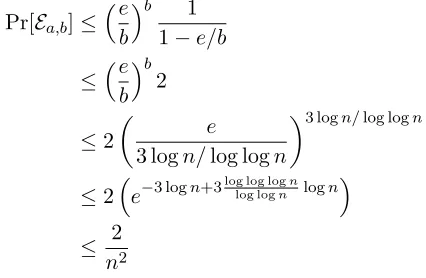
Plugging inb= 3 logn/log logn, we get the classic result (iflog logn >3 log log logn):
5
1. The client allocates temporary storagem, large enough to hold a single record, initialized to a dummy value“dummy”.
2. Read each entry of the entire top level from both servers one at a time. Ifvis found as some entry(v, x)
then storexinm.
3. For small levelsi= 2. . . `cuckoo−1, perform the following with the server holding leveli:
(a) Ifvhas not already been found, compute the tag forvat this level asz=Fs(i, ei, v). Else, set z=Fs(i, ei,“dummy”◦t).
(b) Fetch into local memory the bucket corresponding toh(z)one element at a time, i.e. fetch(vj, xj)
forj= 1, . . . ,3 logn/log lognfrom bucketh(z)one element at a time.
(c) Ifvis found in some record(vi, xi), then replaceviwith“dummy”◦tand storexiinm.
(d) Re-encrypt the fetched records and store them back to their original locations, releasing them from local client memory.
4. For large levelsi=`cuckoo. . . N, perform the following with the server holding leveli:
(a) Ifvhas not already been found, compute the tag forvat this level asz=Fs(i, ei, v). Else, set
z=Fs(i, ei,“dummy”◦t).
(b) Fetch into local memory the records(v0, x0)and(v1, x1)from locationsh0(z)andh1(z).
(c) Ifvis found at one of these locations, i.e.v=vbfor someb= 0,1, then replacevb with
“dummy”◦tand storexbinm.
(d) Re-encrypt the fetched records and store them back to their original locations, releasing them from local client memory.
5. In the case of a write query, here we overwritem=y.
6. Read each entry of the entire top level one at a time, and re-encrypt each record with the following exception: If the record is of the form(v, x), then overwrite it with(v, m)before re-encrypting it.
7. If(v, x)was not overwritten at the top level, write(v, m)in the first available empty spot (even ifmis
“dummy”), otherwise write a dummy value(“dummy”◦t,“dummy”).
8. The client increments the local query countert. Iftis a multiple ofc/2, then a reshuffle step is performed as described below.
Figure 3: Main Construction: Query
Pr[Ea,b]≤e
b
b 1
1−e/b
≤e
b
b
2
≤2
e
3 logn/log logn
3 logn/log logn
≤2e−3 logn+3log log loglog lognnlogn
≤ 2
1. Saallocates a temporary array and inserts every (encrypted) record it holds between levels1andi.Sa
applies a random permutation to this temporary array and sends its contents one by one to the client.
2. The client re-encrypts each record and sends it toSb. In this step, both empty and dummy records are treated as real records.
3. Sb allocates a temporary array and inserts every record it holds between levels1andias well as the
records it received from the client in the previous step. Sbapplies a random permutation to this temporary array and sends its contents one by one to the client.
4. The client re-encrypts each record and sends it toSa, announcing that it is empty if the record is empty,
and tagging remaining records(v, x)with the output of the PRFFs(i+ 1, ei+1, v), whereei+1is thenew
epoch of leveli+ 1. Note thatvmay be a virtual memory address, a dummy value, or a stash dummy value. In this step, dummy records are treated as real records and we are only concerned with eliminating empty records.
5. Sanow holdsc·2i−1tagged records. It allocates a temporary hash table (standard or cuckoo, depending
on the level), with a stash of sizelognand it uses the hash functions corresponding to leveli+ 1and epochei+1to hash these records into this temporary table. If the insertion fails, new hash functions are
selected (we will show this happens with negligible probability). Sathen informs the client the number
of elements inside the stash,σ, then sends both the temporary table and the stash one record at a time to the client.
6. As the client receives records fromSaone at a time, it re-encrypts each record and sends them toSb
without modifying the contents except:
(a) The firstσempty records in the table the client receives fromSaare encrypted as
(“stashdummy”◦s,“empty”), incrementingseach time. Note that a table is always more than half empty, and therefore we can always findσempty slots.
(b) Subsequent empty records from the table are encrypted as(“empty”,“empty”).
(c) Every empty record in the stash is re-encrypted as(“stashdummy”◦s,“empty”), incrementings
each time.
7. Sb stores the table records in leveli+ 1in the order in which they were received, and stores the stash records at the top level.
Figure 4: Main Construction: Reshuffle
Although the probabilities of overflow of each bin are not independent, we can calculate the probability that at least c = log log lognof them overflow (more than b balls) as if they were independent. This is because the probability that a bin overflows reduces the chance that another bin overflows, and thus treating them independently gives an upper bound. The probability that exactlyjbins (independently) overflow can be calculated as:
Pr[jbins overflow]≤
m j
2 n2
j
1− 2
n2 m−j
≤
me j
j
1 n2j ≤
e j
j
1 nj
Taking the probability over allj = c, . . . , mwe get P r[at leastcbins overflow] ≤ 1
nc ec
c 1
1−e/c, which is
dominated by n1c and hence negligible inn.
3(log log logn−log log log logn)):
Pr[Ea,c]≤e
d
d 1
1−e/d
≤e
d
d
2
≤2
e
3 log log lognlogn/log logn
3 log log log logn/log logn
≤2e−3 log log lognlogn+3log log logn
−log log log logn
log logn log log lognlogn
≤2
e−2 log log lognlogn
≤ 2
n2 log log logn
Taking the Union Bound, the probability that all bins contain fewer than delements is n2 log log log2m n which is
negligible inn.
Finally, we have to calculate the probability that there are more thanselements in the stash. Observe that if all bins have fewer thandelements, and if at mostcbins overflow, then there will be at most
cd = (log log logn)2logn/log lognelements in the stash, which (asymptotically) is less thans. The probability that each of these conditions fail is negligible, and by the Union Bound, the probability that either of them fail is still negligible.
3.6 Analysis of Main Construction
Theorem 3. For a sequence ofnqueries, the main construction usesO(n)memory for each server,O(1)working memory for the client, andO(logn)amortized overhead for queries.
Proof. Computing the sizes of the levels, level 1 is of size c = 2 logn, split between the servers, levels i = 2, . . . , `cuckoo−1 are of size c·2i−1 ·3 logn/log logneach, giving a total of O(log9n) size, since `cuckoo = 7 log logn. Levelsi=`cuckoo, . . . , Nare of sizec·2ieach, wherec·2N =n, hence there is a total ofO(n)size. Note that the additional elements added in by the stash dummy elements can be counted as follows: everyc/2steps, we insert anotherlognstash dummy records into the hierarchy. Therefore, afternsteps, at most2nlogn/c =n
stash dummy records have been inserted, and we can simply accommodate this by adding one extra level at the bottom.
Clearly, the client uses constant working memory as it only transmits records one at a time.
When the client performs the read operation, it reads 2 logn records from the top level, 3 logn/log logn
elements from each level i = 2, . . . , `cuckoo −1, and 2 elements from each level i = `cuckoo, . . . , N. Since `cuckoo= 7 log lognandN = logn−log logn−1, this gives a total of roughly25 lognelements read.
Because we re-insert the stash (which is half the size of the top level), we need to reshuffle twice as often. Following the warm-up analysis, recall that each reshuffle only moves an element in the level at most 3 times. We sketch the analysis of the amortized overhead:
• For levels2, . . . , `cuckoo−1, each level containsc·2i−13 logn/log lognelements and needs to be reshuffled
everyc·2i−1/2steps. This incurs an amortized overhead of:
3
7 log logn−1 X
i=2
c·2i−13 logn/log logn
with a constant of roughly125.
• For levels`cuckoo, . . . , N, each level containsc·2ielements and needs to be reshuffled everyc·2i−1/2steps.
This incurs an amortized overhead of:
3
logn−log logn−1 X
i=7 log logn
c·2i
c·2i−2 =O(logn)
with a constant of roughly10.
Before we prove the security of our construction, we state a few important lemmas.
Lemma 2. At all times during the execution of the scheme, any record of the form(v,∗)will appear at most once in the hierarchy unlessv= “empty”.
Proof. An indexvmust be either a virtual memory location, a dummy element, a stash dummy element, or empty. Virtual memory locations are only introduced into the hierarchy either from a read query that foundvat a lower level and moved it to the top, or from a write query that did not findvin the hierarchy. A dummy element“dummy00◦t
can only be introduced during queryt, and it can be introduced at most once. Similarly, stash dummy elements can only be introduced once assis incremented after every such entry.
Lemma 3. The samevwill not be queried upon twice between reshuffles at any level.
Proof. Oncevis queried upon at a level,i, either it is a“dummy”◦tvalue (in which case it will trivially never be queried again, astis incremented at the next query), or it is some virtual memory location. In the latter case,vwill be written to the top level after the query, and subsequent queries tovwill findvbefore it reaches leveli, and the only wayvcan reach a deeper level is ifiis reshuffled.
Lemma 4. Every level except the top will always be empty or half-full (a half-full standard hash contains a number of records equal to half the number of buckets) and this state depends only ont.
Proof. This lemma is similar to Lemma 1, except now we have to take into account stashing. However, whenever we stash an element, our reshuffling algorithm also introduces a stash dummy element inside the table. This causes the amount of elements to be shuffled into any level to always be the same.
Lemma 5. Any time a leveliis reshuffled, its stash is included in the shuffle.
Proof. Similar to the proof of Lemma 1, we observe that the only way a level is shuffled is if all previous levels are shuffled as well and become empty. Because the stash of leveliwas stored in the hierarchy above leveli, no elements of the stash will fall below leveliunless caused by a reshuffle, in which case it will be shuffled with level
i.
Theorem 4. Under the assumption that one-way functions exists, the main construction is a secure two-server oblivious RAM.
Proof. One-way functions allow private-key encryption and authentication. We use method of [26] to prevent tampering and thus must only show how to protect the access pattern.
We show how to simulate the view of a server’s access pattern during the execution of the protocol upon any sequence of queries q1, . . . , qn knowing only the length n. We begin by first making the observation that every
we can assume that all these data contents are computationally indistinguishable from the encryption of any other contents. We also replace both the hash functions (which are modeled as PRFs) and the tagging PRF by random functions.
We first consider the view of each server during a reshuffle. If the server is playing the role ofSa, after its initial
message out, it sees a random sequence of encrypted records (real or dummy) with tags, and announced empty records. By Lemma 2, all the hidden records will contain elements with uniquev’s, and hence their tags will also be unique with overwhelming probability. The tags came from a random function that had not been previously used, and so the tags that the server sees are independent from its view. Furthermore, because of Lemmas 4 and 5, the number of empty records revealed will be deterministic and will not reveal any additional information. Thus, we can simulate this view by calculating the number of pre-determined items of each type, and use encryptions of 0 for all of them and tagging the appropriate records with completely random tags.
If the server is playing the role ofSb during a reshuffle, it will receive a sequence of encrypted records which reveals no information. Next, after it shuffles these records and sends them out, it receives back another sequence of encrypted records which also reveals no information. This view can be trivially simulated.
Finally, we argue that the sequence of reads can also be simulated. By the above arguments, we see that what each server holds at leveliis nearly independent of its view, except for the fact that the tags of the records stored at that level are consistent with the hash function used at that level. By Lemma 3, between two reshuffles, the sequence of queries made to leveliwill all be distinct, but they may arbitrarily intersect the elements contained in leveli. However, because only a negligible fraction of hash functions do not agree with the records in leveli(i.e. would cause an overflow), the distribution of the outputs of the hash function applied to any sequence of distinct queries is statistically close to uniform6. Thus, we can simulate the probes to levelibetween reshuffles by a random sequence
of probes.
4
Application to Secure Two-Party RAM Computation
In this section, we describe how our multi-party Oblivious RAM simulation can be applied to the setting of secure two-party computation on RAM programs. The idea of using Oblivious RAM for the purpose of secure computation has been suggested in the literature [24, 10, 18] and we outline the high-level idea of its use.
Consider the setting of two (semi-honest) parties, Alice and Bob, who wish to securely compute some function
f (computed as some RAM programΠthat runs in timeT =T(n)and usesS=S(n)space) on their inputsAand
B. Observe that in an Oblivious RAM, the view of the server can be simulated, so the idea is to let Alice or Bob play the role of the server (or in the case of our construction, two servers). However, in the case of Oblivious RAM, the privacy of the data is not protected from the client, so in order to securely runΠ, we need to somehow simulate the client as well. In order to do so, we let the state of the client besharedbetween Alice and Bob so that neither party learns what is going on until the end of the computation when their outputs are revealed. In order to compute on this shared state, eachfixed instructionofΠis encoded as a circuit. We emphasize that rather than unrolling the entire program into a circuit, which may be quite inefficient, we are only representing each atomic instruction as a circuit.
Because the joint state secure computation occurs at each step in the program, we want to minimize the amount of computation and communication overhead incurred by this step. In particular, in order for Alice and Bob to jointly compute Πsimulate the state of the client efficiently, the client state should be as small as possible. This means that even if an ORAM solutions is efficient in terms of computation or communication overhead, we cannot use it if the footprint of the client is too large. In particular, works that require the memory of the client to beO(√n)
(e.g. [33, 34]) orO(nν)(e.g. [16, 17]) will incur too much overhead per step of the program. The currently most
6
efficient (single-server) ORAM protocol that is suitable for this purpose comes from the work of [23].
We point out that when modeling the client, we can either treat it as operating on bits or on “words”. By this we mean the client may need, for example, pointers ofO(logS)bits so that it can index into memory. The notion of a client having constant memory can implicitly mean that we are operating on words and these can each hold sufficiently many bits to perform the necessary instructions. However, when simulating the client steps using a circuit, we need to operate on bits rather than words.
Because of this, the client state may in fact be larger than a constant number of bits despite having only a constant number of words. In order not to accrue any additional overhead when performing the simulation of the client state, we need to use an efficient MPC that has onlyconstant overhead. For example, the protocols of IKOS [19] or IPS [20] suit this situation.
By using our two-server ORAM solution in the Ostrovsky-Shoup compiler, we are able to achieve lower over-head for secure RAM computation than any known single-server ORAM solution. We have:
Theorem 5. Suppose there exists a symmetric-key encryption scheme and a hash function modeled as a random function or an efficient PRF (e.g. the constant-overhead PRF of IKOS [19] under the existence of one-way functions or the PRF suggested in [18] under the DDH assumption in the OT-hybrid model). Suppose there exists a two-party secure circuit computation protocol (that is based on secret sharing) with constant overhead, e.g. [19, 20]. Then to securely compute a RAM program that runs inT(n)time and usesS(n)space, there exists a two-party secure RAM computation protocol in the semi-honest model withO(logT(n))multiplicative overhead in the security parameter. If the client computes on bits instead of words, there is an additional implicitO(logS)multiplicative overhead.
Proof Sketch.We give a construction of such a scheme and argue that it is secure.
We follow the construction of the Ostrovsky-Shoup [28] compiler and let Alice and Bob hold inputsAandB
respectively, and letΠbe the program they wish to securely compute. Initialize the two-server ORAM as follows: let Alice play the role of one server and let Bob play the role of the other server. They jointly simulate the state of the client in our two-server ORAM protocol initialized to the secret sharing of the initial state. The parties then proceed by secret sharingAandB with each other. The two parties run the MPC protocol on the instructions that tells the client to obliviously insert (via ORAM)AandBinto the locations inside the RAM where the programΠ
expects to read them as input. At the end of this process, Alice and Bob hold their respective encrypted server data as well as the shared state of the client.
Then, Alice and Bob begin to jointly execute the instructions ofΠ. Namely, they start with a shared stateΣand a shared value xand they perform the secure two-party computation on the circuit representing the step Π(Σ, x)
to receive a new shared state Σ0 and a read or write operation op. The operation is converted into a sequence of oblivious instructions op01, . . . , op0` by running the MPC on the two-server ORAM protocol steps. When the operation involves reading or writing from the server Alice is holding, Bob sends Alice his share of that instruction and Alice reconstructs the instruction and executes it on her server before re-sharing the result. Similarly, Alice reveals her share to Bob when the operation involves reading or writing from his server. At the end of execution of
Π, Alice and Bob recombine shares to retrieve the output.
We follow the (standard) proof technique of composition of simulation of CPU and simulation of Oblivious RAM in which we invoke the simulatability of both the underlying MPC and ORAM (see also [18]). To simulate the view of one party, say Alice, we begin by generating a uniformly random share of the initial state for her view. As her input and Bob’s input are being stored on the servers obliviously, we simulate the intermediate state shares
Finally, when the output is about to be reconstructed, the simulator (which knows the result via interaction with the ideal functionality) sets the revealed share to ber⊕f(A, B)whereris the random share of the data for Alice during this final step.
Remark. We describe new techniques (to be expanded upon in the full version) on how to extend two-server ORAM simulation to be secure againstfully maliciousadversaries. This allows us, when combined with constant-overhead MPC secure against malicious adversaries (e.g. the IPS compiler [20]), to construct secure two-party RAM computation secure against malicious adversaries.
To ensure security against malicious adversaries, we first apply the methods of [27, 14] where each encrypted value stored on the server is also given a label about the address and epoch, then authenticated with a secure Message Authentication Code (MAC). Whenever the client retrieves data from the server, it decrypts and then verifies the MAC. To maintain efficiency, one can use the constant-overhead MACs constructed in [19]. Note that if the word size is larger than the security parameter, then any this does not incur any additional overhead as it can factored in to the word size overhead.
However, due to the fact that our two-server solution now offloads the duty of sorting to the servers, there needs to be an additional step in verifying the correctness of the sort. The client does not have enough memory to hold this entire array, so in order to verify the sort, the client queries adjacent positionsiandi+ 1 on the server and verifies that they are in the right order. Note that the server cannot fake these locations because the MAC of the label ensures that the data is in the correct location. Such a check is only performed during a reshuffle step, so it does not impact the overall amortized overhead of the scheme itself.
Finally, to apply this to maliciously secure two-party RAM computation, we must simulate the internal atomic instructions of the CPU using an MPC that is also secure against malicious adversaries. In order to do this efficiently, we use the IPS compiler [20] to obtain constant-overhead MPC (for circuits) secure against malicious adversaries in the OT-hybrid model.
5
Conclusion and Open Problems
In this paper, we introduced a new multi-server model for oblivious RAM and constructed a two-server scheme in this model. The scheme is secure against semi-honest servers, and with additional checks (described in the full version) is secure against malicious servers. The parameters of the scheme – O(1) client memory, O(n)
server memory, andO(logn)overhead – match the lower bound of single-server oblivious RAM. The natural open problem to ask is whether or not the same lower bound holds, or if a better scheme can be constructed in this new model.
Our scheme was constructed under the assumption of the existence of one-way functions. We ask the open question of whether or not information-theoretic multi-server oblivious RAM can be constructed with similar pa-rameters. One naive way of doing so would be to duplicate each server and use information-theoretic secret sharing between each server and its duplicate in order to replace encryption. The interesting question is to ask whether one can do so with fewer servers or perhaps better performance.
As an application of our two-server ORAM protocol, we also showed how to construct a two-party secure RAM computation protocol that is more efficient than existing constructions [28, 24, 18].
References
[1] Mikl´os Ajtai. Oblivious RAMs without cryptogrpahic assumptions. InSTOC, pages 181–190, 2010.
[2] Mikl´os Ajtai, J´anos Koml´os, and Endre Szemer´edi. An o(n log n) sorting network. InSTOC, pages 1–9, 1983.
[4] Michael Ben-Or, Shafi Goldwasser, Joe Kilian, and Avi Wigderson. Multi-prover interactive proofs: How to remove intractability assumptions. InSTOC, pages 113–131, 1988.
[5] Burton H. Bloom. Space/time trade-offs in hash coding with allowable errors.Commun. ACM, 13(7):422–426, 1970.
[6] Dan Boneh, Eyal Kushilevitz, Rafail Ostrovsky, and William E. Skeith III. Public key encryption that allows pir queries. InCRYPTO, pages 50–67, 2007.
[7] Dan Boneh, David Mazieres, and Raluca Ada Popa. Remote oblivious storage: Making oblivious ram practi-cal. CSAIL Technical Report, MIT-CSAIL-TR-2011-018, 2011.
[8] Nishanth Chandran, Rafail Ostrovsky, and William E. Skeith III. Public-key encryption with efficient amor-tized updates. InSCN, pages 17–35, 2010.
[9] Benny Chor, Oded Goldreich, Eyal Kushilevitz, and Madhu Sudan. Private information retrieval. InFOCS, pages 41–50, 1995.
[10] Ivan Damg˚ard, Sigurd Meldgaard, and Jesper Buus Nielsen. Perfectly secure oblivious ram without random oracles. InTCC, pages 144–163, 2011.
[11] Oded Goldreich. Towards a theory of software protection and simulation by oblivious RAMs. InSTOC, pages 182–194, 1987.
[12] Oded Goldreich. Foundations of Cryptography: Basic Tools. Cambridge University Press, Cambridge, UK, 2001.
[13] Oded Goldreich, Silvio Micali, and Avi Wigderson. How to play any mental game or a completeness theorem for protocols with honest majority. InSTOC, pages 218–229, 1987.
[14] Oded Goldreich and Rafail Ostrovsky. Software protection and simulation on oblivious RAMs. J. ACM, 43(3):431–473, 1996.
[15] Michael T. Goodrich. Randomized shellsort: A simple oblivious sorting algorithm. In SODA, pages 1262– 1277, 2010.
[16] Michael T. Goodrich and Michael Mitzenmacher. Privacy-preserving access of outsourced data via oblivious ram simulation. InICALP, pages 576–587, 2011.
[17] Michael T. Goodrich, Michael Mitzenmacher, Olga Ohrimenko, and Roberto Tamassia. Privacy-preserving group data access via stateless oblivious ram simulation.CoRR, abs/1105.4125v1, May 2011.
[18] Dov Gordon, Jonathan Katz, Vladimir Kolesnikov, Tal Malkin, Mariana Raykova, and Yevgeniy Vahlis. Se-cure computation with sublinear amortized work. Cryptology ePrint Archive, Report 2011/482, 2011.
[19] Yuval Ishai, Eyal Kushilevitz, Rafail Ostrovsky, and Amit Sahai. Cryptography with constant computational overhead. InSTOC, pages 433–442, 2008.
[20] Yuval Ishai, Manoj Prabhakaran, and Amit Sahai. Founding cryptography on oblivious transfer - efficiently. InCRYPTO, pages 572–591, 2008.
[22] Eyal Kushilevitz, Steve Lu, and Rafail Ostrovsky. On the (in)security of hash-based oblivious ram and a new balancing scheme. Cryptology ePrint Archive, Report 2011/327, 2011.
[23] Eyal Kushilevitz, Steve Lu, and Rafail Ostrovsky. On the (in)security of hash-based oblivious ram and a new balancing scheme. InSODA, 2012. To appear. See full version on ePrint [22].
[24] Moni Naor and Kobbi Nissim. Communication preserving protocols for secure function evaluation. InSTOC, pages 590–599, 2001.
[25] Rafail Ostrovsky. Apparatus system and method to efficiently search and modify information stored on remote servers, while hiding the access pattern. U.S. Patent Application No. 12,768,617. April 27, 2010.
[26] Rafail Ostrovsky. Software protection and simulation on oblivious RAMs.PhD thesis, Massachusetts Institute of Technology.
[27] Rafail Ostrovsky. Efficient computation on oblivious rams. InSTOC, pages 514–523, 1990.
[28] Rafail Ostrovsky and Victor Shoup. Private information storage (extended abstract). InSTOC, pages 294–303, 1997.
[29] Dag Arne Osvik, Adi Shamir, and Eran Tromer. Cache attacks and countermeasures: The case of AES. In
CT-RSA, pages 1–20, 2006.
[30] Rasmus Pagh and Flemming Friche Rodler. Cuckoo hashing. InESA, pages 121–133, 2001.
[31] Benny Pinkas and Tzachy Reinman. Oblivious ram revisited. InCRYPTO, pages 502–519, 2010.
[32] Nicholas Pippenger and Michael J. Fischer. Relations among complexity measures. J. ACM, 26(2):361–381, 1979.
[33] Peter Williams and Radu Sion. Usable PIR. InNDSS, 2008.
[34] Peter Williams, Radu Sion, and Bogdan Carbunar. Building castles out of mud: practical access pattern privacy and correctness on untrusted storage. InACM Conference on Computer and Communications Security, pages 139–148, 2008.