Available Online atwww.ijcsmc.com
International Journal of Computer Science and Mobile Computing
A Monthly Journal of Computer Science and Information Technology
ISSN 2320–088X
IMPACT FACTOR: 5.258IJCSMC, Vol. 5, Issue. 3, March 2016, pg.17 – 26
Implement Adaptive Modulation
Technique to Reduce Bit Error Rate
in Wireless Sensor Network
Amandeep Kaur
1, Mohit Srivastava
2M.Tech1, Professor2
Department of ECE, Chandigarh Engineering College, Campus Landran, Mohali, Punjab
Abstract: Wireless sensor network consists of large number of nodes and it is increasing in today’s
environment because of cost, coverage and system deployment. They are used in civil applications and in most scenario it depends on bit error rate i.e. no. of bits transferred to the node. More number of bits are transferred, more is the no. of dead nodes which decreases the network’s lifetime. When more number of bits are transferred, some may be damaged in their routing path which results in their energy loss. Some bits may take more time to reach their destination. So the problem of delay occurs. So, the main objective of our proposed adaptive modulation approach is minimize bit error rate by consuming less energy and delay and the bits which are transferred not gets wasted in their path. When bit gets wasted, it would affects the Reliability of network. So, we focus our study on the performance analysis of four factors i.e. Reliability, Delay, Energy and Packet overhead and comparison of these parameters with existing approach. Simulation results which are shown in the command window of MATLAB shows that Reliability in 2000 rounds is 98 in existing approach and with adaptive modulation it is 200. Delay is 79 with existing approach and with adaptive modulation it is 39. Energy is 75 joules in 2500 rounds with existing approach and 46 joules with adaptive modulation. Packet overhead is 70 packets in 3000 rounds and with adaptive modulation it is 35 packets.
Keywords: Wireless sensor network, Adaptive modulation, Bit error rate, LEACH protocol.
Introduction
The WSN is built of “nodes”- from a few to several hundreds or even thousand, where each node is connected to one (or sometimes several) sensors. Each such sensor network has typically several parts- a radio transceiver with an internal antenna or connection to an external antenna, a microcontroller, an electronic circuit for interfacing with the sensors and an energy source, usually a battery or an embedded form of energy harvesting. The cost of sensor nodes is similarly variable ranging from a few to hundreds of dollars, depending on the complexity of individual sensor nodes. Size and cost constraints on sensor nodes result in corresponding constraints on resources such as energy, memory computational speed and communications bandwidth. The topologyof the WSN are of flat grid type in which each node in the network is connected with two neighbors along one or more dimensions. As in the wireless sensor networks there are too much nodes and it will be difficult to select cluster head (CH) in these networks. So to overcome this problem LEACH protocol is going to be used in this paper. Some modifications are also going to be done in multilevel fault tolerant routing protocol. As in wireless sensor networks when data is transferred from sensor node to cluster head and from cluster head to base station or (sink) there is an error in the number of bits transmitted per unit time which is called the bit error rate (BER). So a novel technique which is called the adaptive modulation technique is going to be used in this paper to reduce bit error rate.
Literature Survey
In [1], A mathematical model is proposed to analyze the impact of adaptive modulation on the overall energy consumption, end to end delivery latency, packet loss and bit error rate. A centralized optimal management mechanism is developed based on the model, which adaptively adjusts the modulation levels to minimize energy consumption and reduces bit error rate. Results shows that there exist some ranges on packet loss, which have significant impact on energy consumption and bit error rate.
In [2], The author compare adaptive modulation (AM) over flat fading channels with data rate and transmit power being varied according to channel conditions. Adaptive modulation with Idle mode(AMI) and a new adaptive sleep with adaptive modulation (ASAM) which dynamically adjusts the transmission and sleep modes. Simulation results shows that a notable reduction in energy consumption and bit error rate can be achieved by jointly adapting the data rate and the transmit power in WSN’s.
adaptive modulation was proposed and remarkable results were obtained. Results shows that when the start up time increases, the adaptive modulation becomes more efficient. The higher the number of bits/symbol is used, lower the bandwidth efficiency.
In[4], The author considers the problem of minimizing transmission energy and bit error rate in wireless sensor networks by considering that every sensor may have a different bit rate and reliability according to a particular condition. The author proposes a cross layer approach to tackle such a minimization in wireless sensor networks for total transmission energy. In the physical layer, for each sensor, sink adaptively selects a modulation scheme. In the MAC layer, each sensor is correspondingly assigned a time slots. Results shows that bit error rate and energy consumption has been reduced by using M-QAM i.e. quadrature amplitude modulation as an adaptive modulation scheme. The choice of MQAM as the modulation scheme is chosen because of its higher energy efficiency.
In[5], An adaptive modulation scheme is proposed to save the energy of the lowest residual energy’s node by consuming the energy of the other node that have high residual energy. The simulation results shows that proposed adaptive modulation approach gives 44.44% better results.
In[6], A game theoretical model in which a game is formulated to maximize distributed power by considering the residual energy of the nodes along with adaptive modulation. The game approach considered adapts to changes in channel condition and selects the appropriate modulation to reduce bit error rate. Results shows that when the channel condition is poor, the system adapts to QPSK i.e. quadrature phase shift keying modulation and shifts to higher order modulation to reduce bit error rate.
In[7], The author proposed an error control coding (ECC) which is a type of adaptive modulation. Critical distance is another term which is used by the author with ECC. In their work, author proposes three different critical distance values against different coding gain. If distance lies below critical distance, then particular encoders are selected with respect to their particular coding gains. Coding gains are used for critical distance approximation. An adaptive encoder with respect to their coding gain significantly reduces the bit error rate and enhances wireless sensor network’s lifetime.
In[8], The author considers three aspects of system design from silicon to applications that have affected the power consumption. The different energy efficient transmission techniques across time, frequency and spatial domains are introduced to develop an energy efficient reduced bit rate wireless sensor network. Results shows that using the proposed mechanism adaptively selects a specific modulation technique which results in minimization of bit error rate. This also reduces the number of retransmissions of the data frames. The high accuracy of bit error rate is achieved by fuzzy controller.
Problem Formulation
The solution adopted by LovedeepSingh[5], which relied on minimizing the bit error rate by saving the energy of the lowest energy’s node and consuming the energy of the higher energy’s node is not optimal, because there is a probability that some other node in the wireless sensor network may have same energy and with this node’s residual energy and energy of the other node is not saved by this approach which results in the reduction of bit error rate. The question is that how author knows about high residual energy of the node ? By this approach, author was not giving any steps or ideas involved in the selection of high residual energy of the node in the wireless sensor network because there are so many nodes in the network and there must be any routing protocol to select the highest energy of the node so that data can be transferred from node to higher energy node which is having highest energy and to base station or sink. Our approach gives an efficient routing protocol to determine the highest energy of the node i.e LEACH protocol and effective adaptive modulation technique to reduce bit error rate.
The solution adopted by various authors as stated above is based on the optimal management mechanism in which a node’s lowest energy is saved and node’s highest energy is consumed. No author is able to describe the steps involved in the cluster head selection. How they select the node’s highest energy. Moreover, they select the node which have the higher energy but there is a probability that some other nodes in the wireless sensor network may have the same energy level then what about those nodes. It clearly defines that energy of single
node is only consumed and node’s 2nd
from other transmitter, the sensitivity of the receiver, the available transmitter power margin. etc). Adaptive modulation systems improves rate of transmission, and /or bit error rates, by exploiting the channel information i.e. present at the transmitter. Especially over fading channels which models wireless propagation environments, adaptive modulation systems exhibit great performance enhancements as compared to systems that do not exploit channel knowledge at the transmitter.
Proposed Methodology
Steps
1. Deploy network randomly.
2. Apply LEACH protocol to select cluster head (CH) in wireless sensor network.
3. Apply adaptive modulation technique to reduce bit error rate. Bit error rate is number of bits transmitted per second.
Flowchart
No
Yes
START
Deploy wireless sensor networks with finite number of sensor nodes
Apply location based clustering to cluster sensor nodes and select cluster head in each cluster
Select cluster head in each cluster on the basis of energy and distance
Establish shortest and secure path from cluster head to cluster head for sensed information
Frequency of sensed information is above threshold
Transmit data on selected path STOP
LEACH Protocol
Low Energy Adaptive Clustering Hierarchy (“LEACH”) is a TDMA based MAC protocol which is integrated with clustering and a simple routing protocol in wireless sensor networks. The goal of LEACH is to lower the energy consumption required to create and maintain clusters in order to improve the lifetime and reduce bit error rate of wireless sensor network. LEACH is a hierarchial protocol in which most nodes transmit to cluster heads, and the cluster heads aggregate and compress the data and forward it to the base station (sink). Each node uses a stochastic algorithm at each round to determine whether it will become a cluster head in this round. LEACH assumes that each node has a radio powerful enough to directly reach the base station or the nearest cluster head, but that using this radio at full power at the time would waste energy. Nodes that have been cluster heads cannot become cluster heads again for P rounds, where P is the probability of becoming a cluster head in each round. At the end of each round, each node that is not a cluster head selects the closest cluster head and joins that cluster. The cluster head then creates a schedule for each node in its cluster to transmit its data. All nodes that are not cluster heads only communicate with other nodes according to the schedule created by the cluster head.
Experimental Results
All results are shown in the command window of MATLAB as follows:
Input Parameters
Area 800*800
No. of nodes 100
Initial energy 100 joules
Energy consumption
during transmission
0.1 joule
Antenna type Omni-directional
MAC type 802.11
Network topology Flat grid
Reliability: The ability of a system or component to perform its required functions under stated conditions for a
specific period of time.
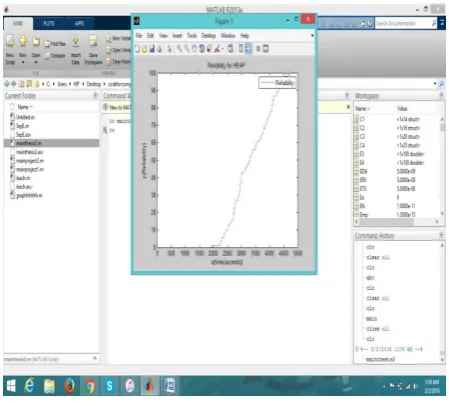
Reliability graph:
Fig 1
Above graph illustrates that reliability of the network is 90 in 2000sec of time.
Delay: Delay is defined as a measurement of the time for a signal to reach its destination in wireless sensor
Delay graph:
Fig 2
Above figure represents that delay is 89 in 2500 seconds. Clearly, delay is more in this case.
Energy: Energy in wireless sensor network is defined as how much energy is consumed when data is
transferred from one node to another node.
Energy graph:
Fig 3
In the above figure x axis represents time and y axis represents energy. Energy is 90 joules in 2300 seconds. It can be observed that energy consumption is more.
Packet overhead: The time it takes to transmit data on a packet switched network. Each packet requires extra
Packet overhead graph:
Figure 4
In the above graph, x axis represents time and y axis represents packet overhead. Packet overhead is 75pkts/sec in 2800 sec. It is observed that packet overhead is more in particular time.
Results without adaptive modulation:
Snapshot of implementation
In this figure, there are number of sensor nodes in the network. Dark blue nodes donate data that are currently communicated with other nodes. In above, dead nodes are maximum and degrade the performance of the wireless sensor network.
Solution implementation with adaptive modulation technique:
This is a snapshot of implementation with adaptive modulation, in this scenario dead nodes are less as compared to before which in turn reduces the bit error rate and increases the network’s lifetime.
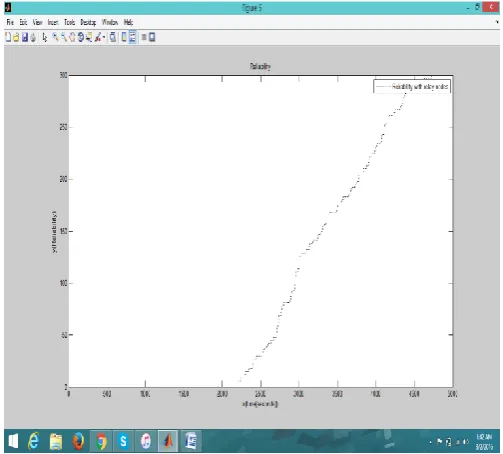
New Reliability graph:
In this figure, Reliability increases as compared to old scenario. A straight line graph represents better reliability. As the number of rounds increases, reliability increases.
New Delay graph:
Fig 4
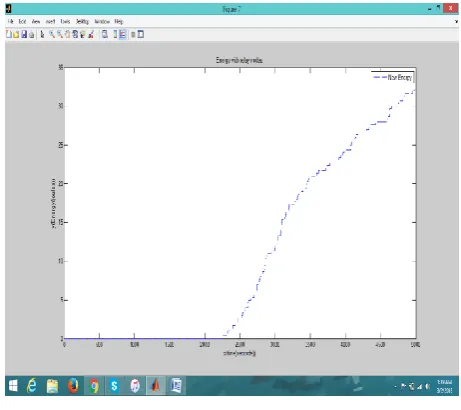
New Energy Graph:
Fig 5
In the above graph energy consumption is less as compared to old scenario.
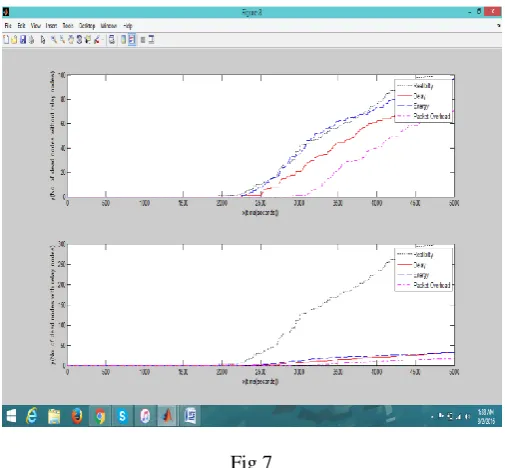
Comparison of graph:
Fig 7
Tabulate the outputs:
Parameter Old algorithm New algorithm
Reliability 2000 rounds, 98 2000 rounds, 200
Delay 79 39
Energy 2500 rounds, 75 joules 2500 rounds, 46 joules
Packet overhead 3000 rounds, 70 pkts. 3000 rounds, 35 packets.
Conclusion:
It considered the problem of Bit error rate reduction using adaptive modulation. Initially, deploy wireless sensor network randomly in heterogeneous environment and then compare adaptive modulation approach with existing approach in the sense that with adaptive modulation dead nodes are less in wireless sensor network and with existing approach dead nodes are more. And then LEACH protocol is applied for cluster head selection. Compare four parameters ie Reliability, Delay, Energy, Packet overhead with existing approach. Reliability in 2000 rounds is 98 in existing approach and with adaptive modulation it is 200. Delay is 79 with existing approach and with adaptive modulation it is 39. Energy is 75 joules in 2500 rounds with existing approach and 46 joules with adaptive modulation. Packet overhead is 70 pkts in 3000 rounds and with adaptive modulation it is 35 pkts. In proposed approach, we optimized the Bit error rate in 4 parameters and also consumes less energy as compared to existing approach. Therefore, we can say that proposed approach decreases bit error rate and also increases the network’s lifetime.
References
1. Yong Yuan, Zong Kai Yang and Jianhue He. “An adaptive modulation scaling scheme for quality of
service ensurance in wireless sensor networks”. American journal of applied sciences, Science publications, 2005.
2. Xiao Zhao, FlyesBdira, Mohammed IbnKahla. “Joint adaptive modulation and adaptive MAC
protocols for wireless sensor networks”. International journal of computer applications. Volume-85-No 19, January 2014.
3. George Bravos and Athanasios G. Kanatas. “Wireless sensor networks: An adaptive modulation
scheme”. Proc. Of SPIE vol. 5611.
4. J. Joaquin Escudero Garzas, Carlos BousonoCalzon, and Ana Garcia Armada. “An energy efficient Adaptive modulation suitable for wireless sensor network with SER and throughput constraints”. EURASIP journal on wireless communications and networking volume 2007.
5. Lovedeepsingh.Lifetime improvement using adaptive modulation in wireless sensor network”.
IJRACST- International journal of computer networks and wireless communications (IJCNWC)
6. R. VALLI, P. DANANJAYAN. “Adaptive modulation and coding for lifetime enhancement
of wireless sensor network using Game theoretic approach”. WSEAS transactions on communications.
7. Z. Abbas, N. Javaid, A. Javaid, Z. A. khan, U. Qasim. “EAPESS: An adaptive transmission scheme in
wireless sensor networks”.
8. Yashaswim C.S. “Adaptive modulation for Energy efficiency in wireless communication”.