B
production in pPb at 5.02 TeV from CMS
Kisoo Lee (for the CMS collaboration)1
1Korea University, Seoul 136-701, Republic of Korea
Abstract.Hadrons with heavy quarks are promising probes to investigate the detailed properties of hot and dense medium generated by heavy-ion collisions at collider ener-gies. Since heavy quarks are sensitive to the transport properties of the medium, the energy-loss pattern of them is expected to be quite different from that of light quarks in a strongly-interacting matter. On the other hand, in order to elicit the actual effects caused by the hot and dense medium, it is necessary to understand the cold nuclear matter effect in pA collisions. For example, the pPb data is expected to provide a baseline for the study of the b-quark energy loss in medium produced by PbPb collisions. Therefore, the CMS Collaboration at the Large Hadron Collider (LHC) has analyzed the production cross sec-tions ofB+,B0,B0
s mesons in pPb collisions as a function of rapidity and the transverse momentum at the nucleon-nucleon center-of-mass energy of 5.02 TeV. In addition, the nuclear modification factors of theBmesons have been constructed using the theoretical pp reference spectra estimated by the perturbative Quantum ChromoDynamics (pQCD) model. Finally CMS collected pp and PbPb collisions at the center-of-mass energy of 5.02 TeV at the LHC in the end of 2015. Analysis ofBproduction in pp and PbPb is ongoing.
1 Introduction
In the heavy-ion collisions, heavy quarks are useful probe to study hot and dense QCD medium because they are produced in the early stage of collision and interact with medium. Besides, there may be effects due to nuclear modifications to the parton distributions, known as the cold nuclear matter effect, such as nuclear modifications to the parton distributions. The pPb collisions are considered as a useful system to study the cold nuclear matter effect because they are not expected to form an extended hot medium. With large cross section of b quark production at the LHC, the CMS collaboration has measured production cross section of b quarks. The CMS collaboration studied the b-hadron production in PbPb collisions at √sNN=2.76 TeV by using inclusive non-promptJ/ψin the
2010 and 2011 data sets [1]. For the first time, CMS collaboration reconstructed exclusiveBmesons via the combination of charged particle tracks to the reconstructedJ/ψin the pPb collisions at √sNN =5.02 TeV recorded in 2013.
TheBmeson species analyzed for this study areB+,B0,B0
sthat consist of u (or ¯u), d (or ¯d), and s
B+→J/ψ+K±→μ++μ−+K± B0→J/ψ+K∗
0(892)→μ++μ−+K++π− B0
s →J/ψ+φ→μ++μ−+K++K−
(1)
As this analysis does not separate corresponding antiparticle,B+andB−,B0andB¯0,B0
sandB¯0sare
denoted byB+,B0,B0
s. For the final cross section values, the combined results are divided by two to
obtain an average.
The CMS detector has highly efficient muon detection system and the high-resolution silicon tracker which is crucial to reconstructB meson decays. The muon detector system, consisting of Cathode Strip Chambers (CSC), Drift Tubes (DT) and Resistive Plate chambers (RPC), is dedicated to identify and track the muons. The silicon tracker is located in the 3.8 T magnetic field generated by the superconducting solenoid, and consists of 1440 silicon pixel and 15148 silicon strip detector modules with a typical momentum resolution of 1.5 % inpT for nonisolated particles of 1<pT <10
GeV/c and|η| <1.4, whereηis the pseudo-rapidity in the laboratory frame. The detailed description of the CMS detector elements are given in Ref. [2].
For the pPb run lead nuclei of 1.58 TeV per nucleon collide with protons of 4 TeV. The center of mass energy is √sNN =5.02 TeV. Because of the asymmetric beam energies, all produced particles
from the collisions are detected with rapidity shift of 0.465 towards the proton-going side in the labo-ratory frame. The data sample used in this analysis corresponds to an integrated recorded luminosity of (34.6±1.2) nb−1.
2 Analysis
The events used in this analysis are collected with a singe-muon trigger that requires at least one muon withpT >3 GeV/c. The electromagnetic and beam-gas collision events are triggered by
meth-ods described in Ref.[3] TheBreconstruction starts with the muons that are reconstructed from the inner tracker system and the outer muon system. The muons must satisfy the muon selection criteria including the kinematic limits imposed by the geometry of the detectors: pT >3.3 GeV/cfor |η| <
1.3, p>2.9 GeV/cfor 1.3< |η| <2.2 andpT >0.8 GeV/cfor 2.2< |η| <2.4. The opposite-signed
muon pairs used for this analysis are within±300 MeV/c2from its nominalJ/ψmass found in the Particle Data Group[4]. The charged hadrons are reconstructed by the inner tracker system within|η|
<2.4 in the laboratory frame. To reconstructB+, the kaon mass is assigned to each charged particle and, then, the invariant-mass distribution ofJ/ψplus kaon candidates are produced. TheB0andB0 s
analyses are more complicated than the chargedB’s as they decay into the intermediate states which can be reconstructed by the two charged hadrons. Therefore, for the reconstructions ofB0andB0
s, the
pion and kaon masses are assigned to any pair of the charged particles.
In order to maximize the statistical significance of theBmeson signals, selection is optimized for each meson species using a multivariate technique. Theχ2 of the secondary vertex fit, the distance
between the primary and the secondary vertices (normalized by its uncertainty) and the cosine of the angle between the momentum vector ofBand the position vector of the secondary vertex measured from the primary vertex in the transverse plane, etc. For theB0 andB0
s reconstructions, additional
constraints on the respective proper mass window of the invariant mass for the intermediate meson states are re-imposed. In the case of multipleBmesons being reconstructed in one event, the candidate with the bestχ2of the secondary vertex is chosen to prevent the possible double counting.(especially,
)
2
(GeV/c
B
m
5 5.2 5.4 5.6 5.8 6
)
2
Entries / (20 MeV/c
0 50 100 150 200 Data Fit Signal Combinatorial X ψ J/ → B
(pPb 5.02 TeV) 34.6 nb CMS -+B + B
< 15 GeV/c T
10 < p
| < 2.4 lab |y ) 2 (GeV/c B m
5 5.2 5.4 5.6 5.8 6
)
2
Entries / (30 MeV/c
0 10 20 30 40 50 60 70 Data Fit Signal Combinatorial X ψ J/ → B
(pPb 5.02 TeV) 34.6 nb CMS 0 B + 0 B
< 15 GeV/c T
10 < p
| < 2.4 lab |y ) 2 (GeV/c B m
5 5.2 5.4 5.6 5.8 6
)
2
Entries / (40 MeV/c
0 10 20 30 40 50 60 70 Data Fit Signal Combinatorial (pPb 5.02 TeV) 34.6 nb CMS 0 s B + 0 s B
< 60 GeV/c T
10 < p
| < 2.4 lab |y
Figure 1.Invariant-mass distributions ofB++B−(left),B0+B¯0(center), andB0
s+B¯0s(right) candidates in the trans-verse momentum ranges of 10-15, 10-15 and 10-60 GeV/crespectively. The orange-dotted area represent the fittedBsignal distributions and the green-hatched areas represent the peaking backgrounds from otherBmeson species. The blue-dotted lines represent the combinatorial backgrounds.
3 Results
AllBcandidates are reconstructed in 10<pT<60 GeV/c and|yCM| <1.93 whereyCMis the rapidity in
center-of-mass frame. Fig. 1 shows the invariant-mass distribution ofB+,B0andB0
s in their respective
lowestpT bin. The raw yields ofB+,B0andB0s are extracted using a binned maximum likelihood fit
to theBmeson invariant-mass distributions in the mass range 5<mB<6 GeV/c2. The combinatorial
backgrounds, fitted by first or second order polynomial functions, are dominated by inclusiveJ/ψ’s and charged hadrons associated with different mother particles. The so-called peaking background, shown by the green hatched areas in Fig. 1, is caused by the mis-reconstructedBmesons. In order to understand the signal and background distribution, Monte Carlo simulations have been performed. The particles in the Monte Carlo samples are generated by the PYTHIA event generator [5] and decayed by the EvtGen particle decay simulation package [6]. The initial and final state radiations are controlled by the PHOTOS package [7]. Furthermore, the signal particles are embedded in the HIJING minimum-bias events for pPb collisions to mimic more realistic environment [8]. After the proper background subtraction, several functions are tried to fit the signal peak shapes for each channel. Finally, sum of two Gaussian functions with same mean is chosen as the signal function.
The differential cross section for eachBspecies has been obtained by
dσB dpT
|y
CM|<1.93 = 1
2 1
ΔpT NB
|yCM|<1.93
(α× )·BR· L (2)
whereσBis cross-section ofB,ΔpTis the width of thepTbin,NBis number ofB,αis the geometrical
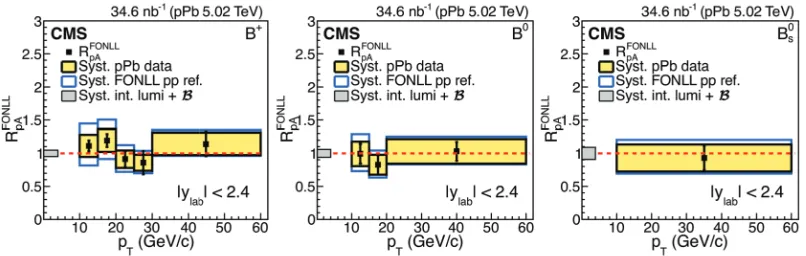
Figure 2. The nuclear modification factors RFONLL
pA (pT) ofB+(left),B0(center),B0s(right) measured in pPb
col-lisions at √sNN=5.02 TeV. The statistical and systematic uncertainties on the pPb data are shown as bars and
yellow boxes around the data points respectively. The systematic uncertainties from the FONLL predictions are plotted separately as open blue boxes. The global systematic uncertainties are shown as full grey boxes at unity, and are not included in the data points.
cross section data and the FONLL calculations, the nuclear modification factors are calculated by
RFONLLpA (pT)=
(dσ/dpT)pPb A×(dσ/dpT)pp
(3)
where A is the number of nucleons in Pb. The results on RFONLL
pA forB+,B0andB0sare shown in Fig. 2.
Within the systematic and statistical uncertainties, RFONLLpA of all three particle species are consistent with unity and, thus, significant cold nuclear matter effects are not observed. The nuclear modification factor as a function of rapidity in the center-of-mass frame is calculated only for theB+which has the best statistical precision among the three analyzed particle species. In the Fig. 3 the left panel is differential cross section and right panel is nuclear modification factor of theB+. Although the most backward data point toward the Pb-going side is higher than the others, the experimental uncertainties are large and no rapidity dependence can be claimed.
4 Conclusions
For the first time, theB+,B0, andB0
smesons are exclusively reconstructed for 10<pT<60 GeV/c and
|yCM| <1.93 in pPb collisions at √sNN =5.02 TeV by the CMS Collaboration at the LHC. The range
of transverse momentum covered is 10 to 60 GeV/c, for the rapidity range (evaluated in the center-of-mass frame) of|yCM| <1.93. Statistically significant peaks are observed for all threeB-meson species
in the invariant-mass distributions. The nuclear modification factors for all threeB-meson species are estimated using FONLL calculations as pp references. The nuclear modification factors are consistent with unity within the uncertainties. Presently, the CMS Collaboration is analyzing the data recorded in 2015 with the 5.02 TeV PbPb collision. The present results will be baseline for theB-meson RAA.
References
CM
y
-3 -2 -1 0 1 2
b)
μ
(
CM
/ dy
σ
d
0 100 200 300 400 500 600
pPb
Scaled FONLL pp ref. FONLL pp ref. uncert.
CMS
(pPb 5.02 TeV) 34.6 nb
+
B
< 60 GeV/cT
10 < p
Global uncert. 4.7%
CM
y
-3 -2 -1 0 1 2
)
+
(B
pA
FONLL
R
0 0.5 1 1.5 2 2.5 3 3.5 4
pA FONLL R
Syst. pPb data Syst. FONLL pp ref.
Syst. int. lumi + B
CMS
(pPb 5.02 TeV) 34.6 nb
+
B
< 60 GeV/c T10 < p
Figure 3.(left) TheyCM-differential production cross section ofB+measured in pPb collisions at √sNN=5.02 TeV. Vertical bars (the boxes) correspond to statistical (systematic) uncertainties The listed global systematic uncertainty is not included in the data points. The result is not included in the data points. The result is compared to a FONLL calculation represented by a continuous histogram. The dashed histograms represent the theoretical uncertainties for the FONLL reference. (right) The nuclear modification factor RFONLL
pA (yCM) ofB+as a function ofyCM. The statistical and systematic uncertainties on the pPb data are shown as bars and yellow boxes around the data points, respectively. The systematic uncertainty from the FONLL reference is plotted separately as open blue boxes. The global systematic uncertainty is shown as a full grey box at unity, and is not included in the data points.
[2] CMS Collaboration, J Instruments. 3 (2008) S08004. [3] CMS Collaboration, Eur. Phys. J. C 74 (2014) 2951.
[4] Particle Data Group Collaboration, Phys. Rev. D 86 (2012) 010001. [5] T. Sj¨ostrand, S. Mrenna, P. Skands, J. High Energy Phys. 05 (2006) 026.
[6] D.J. Lange, Nucl. Instrum. Methods Phys. Res., Sect. A, Accel. Spectrom. Detect. Assoc. Equip. 462 (2001) 152.
[7] E. Barberio, B. van Eijk, Z. Was, Comput. Phys. Commun. 66 (1991) 115. [8] X.-N. Wang, M. Gyulassy, Phys. Rev. D 44 (1991) 3501.
[9] M. Cacciari, S. Frixione, P. Nason, J. High Energy Phys. 0103 (2001) 006. [10] M. Cacciari, M. Greco, P. Nason, J. High Energy Phys. 9805 (1998) 007. [11] CDF Collaboration, Phys. Rev. D 75 (2007) 012010.