Example-based Machine Translation Based on Syntactic Transfer
with Statistical Models
Kenji Imamura, Hideo Okuma, Taro Watanabe, and Eiichiro Sumita ATR Spoken Language Translation Research Laboratories
2-2-2 Hikaridai, “Keihanna Science City” Kyoto, 619-0288, Japan
{kenji.imamura,hideo.okuma,taro.watanabe,eiichiro.sumita}@atr.jp
Abstract
This paper presents example-based machine translation (MT) based on syntactic trans-fer, which selects the best translation by us-ing models of statistical machine translation. Example-based MT sometimes generates in-valid translations because it selects similar ex-amples to the input sentence based only on source language similarity. The method pro-posed in this paper selects the best transla-tion by using a language model and a trans-lation model in the same manner as statisti-cal MT, and it can improve MT quality over that of ‘pure’ example-based MT. A feature of this method is that the statistical models are applied after word re-ordering is achieved by syntactic transfer. This implies that MT quality is maintained even when we only ap-ply a lexicon model as the translation model. In addition, translation speed is improved by bottom-up generation, which utilizes the tree structure that is output from the syntactic transfer.
1 Introduction
In response to the ongoing expansion of bilingual corpora, many machine translation (MT) meth-ods have been proposed that automatically ac-quire their knowledge or models from the cor-pora. Recently, two major approaches to such ma-chine translation have emerged: example-based machine translation and statistical machine trans-lation.
Example-based MT (Nagao, 1984) regards a bilingual corpus as a database and retrieves exam-ples that are similar to an input sentence. Then, a translation is generated by modifying the tar-get part of the examples while referring to trans-lation dictionaries. Most example-based MT sys-tems employ phrases or sentences as the unit for examples, so they can translate while consider-ing case relations or idiomatic expressions. How-ever, when some examples conflict during
re-E =
J = A =
NULL0 show1 me2 the3 one4 in5 the6 window7
uindo1 no2 shinamono3 o4 mise5 telidasai6
7 0 4 0 1 1
( )
Figure 1: Example of Word Alignment between English and Japanese (Watanabe and Sumita, 2003)
trieval, example-based MT selects the best exam-ple scored by the similarity between the input and the source part of the example. This implies that example-based MT does not check whether the translation of the given input sentence is correct or not.
On the other hand, statistical MT employing IBM models (Brown et al., 1993) translates an in-put sentence by the combination of word transfer and word re-ordering. Therefore, when it is ap-plied to a language pair in which the word order is quite different (e.g., English and Japanese, Figure 1), it becomes difficult to find a globally optimal solution due to the enormous search space (Watan-abe and Sumita, 2003).
Statistical MT could generate high-quality translations if it succeeded in finding a globally optimal solution. Therefore, the models employed by statistical MT are superior indicators of the quality of machine translation. Using this feature, Akiba et al. (2002) achieved selection of the best translation among those output by multiple MT engines.
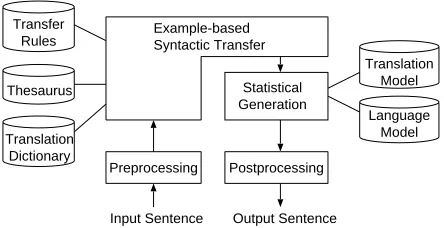
Input Sentence Output Sentence Example-based
Syntactic Transfer
Thesaurus
Preprocessing Postprocessing Statistical Generation Translation
Dictionary Transfer
Rules
Translation Model Language
Model
Figure 2: Structure of Proposed Method
tree structures of the target language by parsing and mapping the input sentence while referring to transfer rules. The other is a statistical generation module, which selects the best word sequence of the target language in the same manner as statis-tical MT. Therefore, this method is sequentially combined example-based and statistical MT.
The proposed method has the following advan-tages.
• From the viewpoint of example-based MT, the quality of machine translation improves by se-lecting the best translation not only from the similarity judgment between the input sen-tence and the source part of the examples but also from the scoring of translation correctness represented by the word transfer and word con-nection.
• From the viewpoint of statistical MT, an ap-propriate translation can be obtained even if we use simple models because a global search is applied after word re-ordering by syntac-tic transfer. In addition, the search space becomes smaller because the example-based transfer generates syntactically correct candi-dates for the most appropriate translation.
The rest of this paper is organized as follows: Section 2 describes the example-based syntactic transfer, Section 3 describes the statistical gen-eration, Section 4 evaluates an experimental sys-tem that uses this method, and Section 5 compares other hybrid methods of example-based and statis-tical MT.
2 Example-based Syntactic Transfer The example-based syntactic transfer used in this paper is a revised version of the Hierarchical
Phrase Alignment-based Translator (HPAT, re-fer to (Imamura, 2002)). This section gives an overview with an example of Japanese-to-English machine translation.
2.1 Transfer Rules
Transfer rules are automatically acquired from bilingual corpora by using hierarchical phrase alignment (HPA; (Imamura, 2001)). HPA parses bilingual sentences and acquires corresponding syntactic nodes of the source and target sentences. The transfer rules are created from their node cor-respondences. Figure 3 shows an example of the transfer rules. Variables, such as X and Y in Fig-ure 3, denote non-terminal symbols that corre-spond between source and target grammar. The set of transfer rules is regarded as synchronized context-free grammar.
The difference between this approach and con-ventional synchronized context-free grammar is that source examples are added to each transfer rule. The source example is an instance (i.e., a headword) of the variables that appeared in the training corpora. For example, the source exam-ple of Rule 1 in Figure 3 is obtained from a phrase pair of the Japanese verb phrase “furaito (flight)
wo yoyaku-suru (reserve)” and the English verb
phrase “make a reservation for the flight.”
2.2 Syntactic Transfer Process
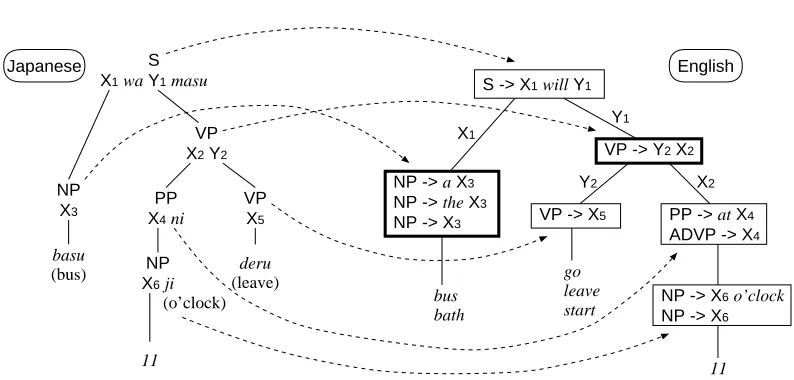
When an input sentence is given, the target tree structure is constructed in the following three steps.
1. The input sentence is parsed by using the source grammar of the transfer rules.
2. The nodes in the source tree are mapped to the target nodes by using transfer rules.
3. If non-terminal symbols remain in the leaves of the target tree, candidates of translated words are inserted by referring to the translation dic-tionary.
An example of the syntactic transfer process is shown in Figure 4 for the input sentence “basu
wa 11 ji ni de masu (The bus will leave at 11
No. Source Grammar Target Grammar Source Example
1 VP→XPPYVP ⇒ VP→YVPXPP ((furaito (flight), yoyaku-suru (reserve)) ..) 2 VP→YVPXADVP ((soko (there), yuku (go)) ..)
3 VP→YBEVPXNP ((hashi (bridge), aru (be)) ..) 4 S→XNPwa YVPmasu ⇒ S→XNPYVP ((kare (he), enso-suru (play)) ..) 5 S→XNPwill YVP ((basu (bus), tomaru (stop)) ..)
Figure 3: Example of Transfer Rules
bus bath
go leave start
11
NP -> a X3
NP -> the X3
NP -> X3
VP -> Y2 X2
VP -> X5 PP -> at X4
ADVP -> X4
NP -> X6o’clock
NP -> X6 basu
(bus)
11
deru (leave)
NP X3
NP X6ji (o’clock)
PP X4ni
VP X5
VP X2 Y2
S X1wa Y1masu
X1
Y1
Y2 X2
Japanese English
S -> X1will Y1
Figure 4: Example of Syntactic Transfer Process (Bold frames are syntactic nodes mentioned in text)
that do not correspond between the source and tar-get sentences (e.g., the determiner ‘a’ or ‘the’) are automatically inserted or eliminated by the tar-get grammar (cf. NPnode represented by a bold frame). Namely, transfer rules work in a manner similar to the functions of distortion, fertility, and NULL in IBM models.
2.3 Usage of Source Examples
Example-based transfer utilizes the source exam-ples for disambiguation of mapping and parsing. Specifically, the semantic distance (Sumita and Iida, 1991) is calculated between the source exam-ples and the headwords of the input sentence, and the transfer rules that contain the nearest exam-ple are used to construct the target tree structure. The semantic distance between words is defined as the distance from the leaf node to the most spe-cific common abstraction (MSCA) in a thesaurus (Ohno and Hamanishi, 1984).
For example, if the input phrase “ie (home) ni
kaeru (return)” is given, Rules 1 to 3 in Figure 3
are used for the syntactic transfer, and three target
nodes are generated without any disambiguation. However, when we compare the source examples with the headword of the variablesX (ie)andY (kaeru), only Rule 2 is used for the transfer be-cause the semantic distance of the example (soko (there), yuku (go)) is the nearest. In the current implementation, all rules that contain examples of the same distance are used.
Consequently, example-based transfer achieves translation while considering case relations or id-iomatic expressions based on the semantic dis-tance from the source examples.
3 Statistical Generation
3.1 Translation Model and Language Model
respectively, the output word sequenceEˆthat sat-isfies the following equation is searched for.
ˆ
E = argmax
E P(E|F) = argmax
E P(E)P(F|E). (1) We only utilize the lexicon model as the trans-lation model in this paper, similar to the models proposed by Vogel et al. (2003). Namely, whenf andedenote the channel target and channel source word, respectively, the translation probability is computed by the following equation.
P(F|E) = j
i
t(fj|ei). (2)
The IBM models include other models, such as fertility, NULL, and distortion models. As we described in Section 2.2, the quality of machine translation is maintained using only the lexicon model because syntactical correctness is already preserved by example-based transfer.
For the language model, we utilize a standard word n-gram model.
3.2 Bottom-up Generation
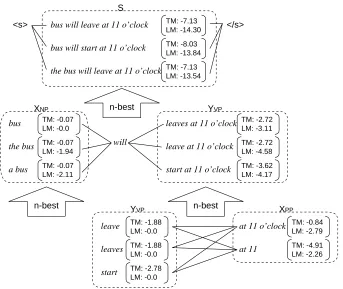
We can construct word graphs by serializing the target tree structure, which allows us to select the best word sequence from the graphs. However, the tree structure already shares nodes transferred from the same input sub-sequence. The cost of calculating probabilities is equivalent if we cal-culate the probabilities while serializing the tree structure. We call this method bottom-up genera-tion in this paper.
Figure 5 shows a partial example of bottom-up generation when the target tree in Figure 4 is given. For each node, word sub-sequences and their probabilities (language and translation) are obtained from child nodes. Then, the new probabilities of the word sequence combination are calculated, and the n-best sequences are se-lected. These n-best sequences and their prob-abilities are reused to calculate the probprob-abilities of parent nodes. When the translation probabil-ity is calculated, the source word sub-sequence is obtained by tracing transfer mapping, and the ap-plied translation model is restricted to the source sub-sequence. In other words, the translation probability is locally calculated between the cor-responding phrases.
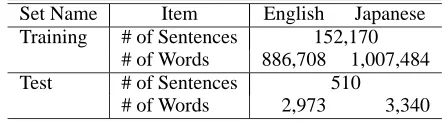
Set Name Item English Japanese Training # of Sentences 152,170
# of Words 886,708 1,007,484 Test # of Sentences 510
# of Words 2,973 3,340
Table 1: Corpus Size
When the generation reaches the top node, the language probability is re-calculated with marks for start-of-sentence and end-of-sentence, and the n-best list is re-sorted. As a result, the translation “The bus will leave at 11 o’clock” is obtained from the tree of Figure 4.
Bottom-up generation calculates the probabili-ties of shared nodes only once, so it effectively uses tree information.
4 Evaluation
In order to evaluate the effect when models of sta-tistical MT are integrated into example-based MT, we compared various methods that changed the statistical generation module.
4.1 Experimental Setting
Bilingual Corpus The corpus used in the fol-lowing experiments is the Basic Travel Expression Corpus (Takezawa et al., 2002; Kikui et al., 2003). This is a collection of Japanese sentences and their English translations based on expressions that are usually found in phrasebooks for foreign tourists. We divided it into subsets for training and testing as shown in Table 1.
Transfer Rules Transfer rules were acquired from the training set using hierarchical phrase alignment, and low-frequency rules that appeared less than twice were removed. The number of rules was 24,310.
Translation Model and Language Model We
used a lexicon model of IBM Model 4 learned by GIZA++ (Och and Ney, 2003) and word bigram and trigram models learned by CMU-Cambridge Statistical Language Modeling Toolkit (Clarkson and Rosenfeld, 1997).
Compared Methods We compared the
follow-ing four methods.
• Baseline (Example-based Transfer only)
the bus TM: -0.07
LM: -1.94
bus TM: -0.07
LM: -0.0
XNP n-best
n-best n-best
will
YVP
leave at 11 o’clock TM: -2.72
LM: -4.58
start at 11 o’clock TM: -3.62
LM: -4.17
leaves at 11 o’clock TM: -2.72
LM: -3.11
YVP
leave TM: -1.88
LM: -0.0
start TM: -2.78
LM: -0.0
leaves TM: -1.88
LM: -0.0
XPP
at 11 o’clock TM: -0.84
LM: -2.79
at 11 TM: -4.91
LM: -2.26
a bus TM: -0.07
LM: -2.11
S
bus will start at 11 o’clock
the bus will leave at 11 o’clock
bus will leave at 11 o’clock TM: -7.13
LM: -14.30 TM: -8.03 LM: -13.84 TM: -7.13 LM: -13.54
<s> </s>
Figure 5: Example of Bottom-up Generation
(TM and LM denote log probabilities of the translation and language models, respectively)
tree that was output from the example-based transfer module. The translation words were selected in advance as those having the highest frequency in the training corpus. This is the baseline for translating a sentence when using only the example-based transfer.
• Bottom-up
The bottom-up generation selects the best translation from the outputs of the example-based transfer. We used a 100-best criterion in this experiment.
• All Search
For all combinations that can be generated from the outputs of the example-based trans-fer, we calculated the translation and language probabilities and selected the best translation. Namely, a globally optimal solution was se-lected when the search space was restricted by the example-based transfer.
• LM Only
In the same way as All Search, the best trans-lation was searched for, but only the language
model was used for calculating probabilities. The purpose of this experiment is to measure the influence of the translation model.
Evaluation Metrics From the test set, 510 sen-tences were evaluated by the following automatic and subjective evaluation metrics. The number of reference translations for automatic evaluation was 16 per sentence.
BLEU: Automatic evaluation by BLEU score
(Papineni et al., 2002).
NIST: Automatic evaluation by NIST score
(Doddington, 2002).
mWER: The mean rate by calculating the word
error rates between the MT results and all ref-erence translations, where the lowest rate is se-lected.
Subjective Evaluation: Subjective evaluation
Automatic Evaluation Subjective Evaluation Translation Speed
Method BLEU NIST mWER A A+B A+B+C Mean Worst
(sec./sent.) (sec.)
Baseline 0.410 9.06 0.423 51.6% 64.3% 70.4% 0.180 10.82
Bottom-up 0.491 9.99 0.366 62.2% 72.5% 80.4% 0.211 5.03
All Search 0.498 10.04 0.353 62.9% 73.1% 80.8% 1.23 171.31
LM Only 0.491 9.11 0.385 57.6% 66.9% 72.0% 1.624 220.69
Table 2: MT Quality and Translation Speed vs. Generation Methods
4.2 Results
Table 2 shows the results of the MT quality and translation speed among each method.
First, comparing the baseline with the statisti-cal generations (Bottom-up and All Search), the MT quality of statistical generation improved in all evaluation metrics. Accordingly, the models of statistical MT are effective for improving the MT quality of example-based MT.
Next, comparing Bottom-up with All Search, the MT quality of bottom-up generation was slightly low. Bottom-up generation locally applies the translation model to a partial tree. In other words, the probability is calculated without word alignment linked to the outside of the tree. This re-sult indicates that the rere-sults of bottom-up genera-tion are not equal to the global optimal solugenera-tion.
Comparing LM Only with the statistical gener-ations, the MT quality of ranks A+B+C by subjec-tive evaluation significantly decreased. This is be-cause the n-gram language model used here does not consider output length, and shorter translations are preferred. Although the language model was effective to some degree, it could not evaluate the equivalence of the translation and the input sen-tence. Therefore, we concluded that the transla-tion model is necessary for improving MT quality. Finally, focusing on translation speed, the worst time for Bottom-up generation was dramatically faster than that for All Search. Bottom-up gen-eration effectively uses shared nodes of the target tree, so it can improve translation speed. There-fore, bottom-up generation is suitable for tasks that require real-time processing, such as spoken dialogue translation.
5 Discussion
We incorporated example-based MT in models of statistical MT. However, some methods to ob-tain initial solutions of statistical MT by
example-based MT have already been proposed. For example, Marcu (2001) proposed a method in which initial translations are constructed by com-bining bilingual phrases from translation mem-ory, which is followed by modifying the transla-tions by greedy decoding (Germann et al., 2001). Watanabe and Sumita (2003) proposed a decoding algorithm in which translations that are similar to the input sentence are retrieved from bilingual cor-pora and then modified by greedy decoding.
The difference between our method and these methods involves whether modification is applied. Our approach simply selects the best translation from candidates that are output from example-based MT. Even though example-example-based MT can output appropriate translations to some degree, our method assumes that the candidates contain a globally optimal solution. This means that the upper bound of MT quality is limited by the example-based transfer, so we have to improve this stage in order to further improve MT quality. For instance, example-based MT can be improved by applying an optimization algorithm that uses an automatic evaluation of MT quality (Imamura et al., 2003).
6 Conclusions
This paper demonstrated that example-based MT can be improved by incorporating it in models of statistical MT. The example-based MT used in this paper is based on syntactic transfer, so word re-ordering is achieved in the transfer module. Us-ing this feature, the best translation was selected by using only a lexicon model and an n-gram lan-guage model. In addition, bottom-up generation achieved faster translation speed by using the tree structure of the target sentence.
Acknowledgements
Ruigo-shin-jiten.
The research reported here is supported in part by a contract with the Telecommunications Ad-vancement Organization of Japan entitled, “A study of speech dialogue translation technology based on a large corpus.”
References
Yasuhiro Akiba, Taro Watanabe, and Eiichiro Sumita. 2002. Using language and transla-tion models to select the best among outputs from multiple MT systems. In Proceedings of
COLING-2002, pages 8–14.
Peter F. Brown, Stephen A. Della Pietra, Vincent J. Della Pietra, and Robert L. Mercer. 1993. The mathematics of machine translation: Pa-rameter estimation. Computational Linguistics, 19(2):263–311.
Philip Clarkson and Ronald Rosenfeld. 1997. Statistical language modeling using the CMU-Cambridge toolkit. In Proceedings of
Eu-roSpeech 97, pages 2707–2710.
George Doddington. 2002. Automatic evaluation of machine translation quality using n-gram co-occurrence statistics. In Proceedings of the
HLT Conference, San Diego, California.
Ulrich Germann, Michael Jahr, Kevin Knight, Daniel Marcu, and Kenji Yamada. 2001. Fast decoding and optimal decoding for machine translation. In Proceedings of 39th Annual
Meeting of the Association for Computational Linguistics, pages 228–235.
Kenji Imamura, Eiichiro Sumita, and Yuji Mat-sumoto. 2003. Feedback cleaning of machine translation rules using automatic evaluation. In
Proceedings of the 41st Annual Meeting of the Association for Computational Linguistics (ACL 2003), pages 447–454.
Kenji Imamura. 2001. Hierarchical phrase align-ment harmonized with parsing. In
Proceed-ings of the 6th Natural Language Processing Pacific Rim Symposium (NLPRS 2001), pages
377–384.
Kenji Imamura. 2002. Application of transla-tion knowledge acquired by hierarchical phrase alignment for pattern-based MT. In
Proceed-ings of the 9th Conference on Theoretical and Methodological Issues in Machine Translation (TMI-2002), pages 74–84.
Genichiro Kikui, Eiichiro Sumita, Toshiyuki Takezawa, and Seiichi Yamamoto. 2003.
Cre-ating corpora for speech-to-speech translation. In Proceedings of EuroSpeech 2003, pages 381–384.
Daniel Marcu. 2001. Towards a unified approach to memory- and statistical-based machine trans-lation. In Proceedings of 39th Annual Meeting
of the Association for Computational Linguis-tics, pages 386–393.
Makoto Nagao. 1984. A framework of mechani-cal translation between Japanese and English by analogy principle. In Artificial and Human
In-telligence, pages 173–180, Amsterdam:
North-Holland.
Franz Josef Och and Hermann Ney. 2003. A systematic comparison of various statistical alignment models. Computational Linguistics, 29(1):19–51.
Susumu Ohno and Masato Hamanishi. 1984.
Ruigo-Shin-Jiten. Kadokawa, Tokyo. in Japanese.
Kishore Papineni, Salim Roukos, Todd Ward, and Wei-Jing Zhu. 2002. BLEU: a method for au-tomatic evaluation of machine translation. In
Proceedings of the 40th Annual Meeting of the Association for Computational Linguistics (ACL), pages 311–318.
Eiichiro Sumita and Hitoshi Iida. 1991. Experi-ments and prospects of example-based machine translation. In Proceedings of the 29th ACL, pages 185–192.
Toshiyuki Takezawa, Eiichiro Sumita, Fumiaki Sugaya, Hirofumi Yamamoto, and Seiichi Ya-mamoto. 2002. Toward a broad-coverage bilin-gual corpus for speech translation of travel con-versations in the real world. In Proceedings
of the Third International Conference on Lan-guage Resources and Evaluation (LREC 2002),
pages 147–152.
Stephan Vogel, Ying Zhang, Fei Huang, Alicia Tribble, Ashish Venugopal, Bing Zhao, and Alex Waibel. 2003. The CMU statistical ma-chine translation system. In Proceedings of the
9th Machine Translation Summit (MT Summit IX), pages 402–409.
Taro Watanabe and Eiichiro Sumita. 2003. Example-based decoding for statistical machine translation. In Proceedings of Machine