A Fluid Knowledge Representation for Understanding and Generating
Creative Metaphors
Tony Veale
School of Computer Science University College Dublin
Ireland
Yanfen Hao
School of Computer Science University College Dublin
Ireland
Abstract
Creative metaphor is a phenomenon that stretches and bends the conventions of se-mantic description, often to humorous and poetic extremes. The computational mod-eling of metaphor thus requires a knowl-edge representation that is just as stretch-able and semantically accommodating. We present here a flexible knowledge repre-sentation for metaphor interpretation and generation, calledTalking Points, and de-scribe how talking points can be acquired on a large scale from WordNet (Fellbaum, 1998) and from the web. We show how talking points can be fluidly connected to form a slipnet, and demonstrate that talk-ing points provide an especially concise representation for concepts in general. 1 Introduction
Metaphor serves two important roles in language. The first of these is to make the unfamiliar and the strange seem more familiar and understandable (Indurkhya, 1992). For instance, one might describe a burqa (a full body covering for Muslim women) as a suit of armor, as a shield against prying eyes or, depending on one’s communi-cation goal, as a wearable cage. The other role of metaphor is most often associated with the poetic and fanciful use of language, but is no less important: to make the familiar and mundane seem strange and unfamiliar. In this latter guise, metaphor allows us to view a commonplace idea from a new and revealing category perspective
c
°2008. Licensed under the Creative Commons Attribution-Noncommercial-Share Alike 3.0 Unported li-cense (http://creativecommons.org/licenses/by-nc-sa/3.0/). Some rights reserved.
(Camac and Glucksberg, 1984). For instance, one might describe makeup as “the Western burqa”, to communicate not just the idea that each involves a covering of the female form, but that each reflects a society-imposed expectation on the public presentation of women. Each of these roles is a manifestation of the same underlying mechanism for combining concepts, for under-standing how they interact (Black, 1962) and for determining how they are connected (Fauconnier and Turner, 1998), even if those connections are tenuous, hidden or not always obvious (Collins and Loftus, 1975). For example, consider the connections needed to make and understand the above metaphors:
Burqa⇒
≡for concealing a Muslim woman ≈for protecting a Muslim woman ≈protecting a woman
≈for protecting a person
Armor⇐
Make-up⇒
≡typically worn by women ≈expected to be worn by women ≈must be worn by women
≈must be worn by Muslim women
Burqa⇐
In each case we see how metaphor draws out and highlights, in a modified or exaggerated form, an existing aspect of each target concept. In other words, metaphor does not indiscriminately transplant arbitrary aspects of a source concept onto a target, but accommodates a selective graft of the most salient aspects of this source concept onto those aspects of the target that can
be highlighted by the comparison (Ortony, 1979). This connection between concepts requires a flexible knowledge representation, one that allows the connections between non-identical source and target aspects to be recognized, reconciled and even compressed (Fauconnier and Turner, 1998). This fluid representation (Hofstadter et al., 1995) defines the search space in which the processes of metaphor generation and metaphor understanding are cognitively situated (Veale and O’Donoghue, 2000): for generation, fluid connectivity allows a system to search outwards from a given target to find those potential source concepts that offer a new yet appropriate perspective; for understanding purposes, connectivity allows an agent to focus on those key aspects of a source concept that are most apt for a target because they can be linked to that target.
In this paper we describe the construction of a fluid knowledge representation for creative metaphor processing, one that is acquired automat-ically from WordNet (Fellbaum, 1998) and from the texts of the web. In section 2 we summarize related work in the field of metaphor as it pertains to flexible knowledge representation. In section 3 we describe two complementary means of acquir-ing the basic elements of this representation, from WordNet and from the web, before describing how these elements can be placed into a fluid network of connections - what Hofstadter (ibid) calls a slip-net - in section 4. We then present in section 5 some empirical evaluation of the acquired repre-sentation on an objective test of term categoriza-tion, before concluding with some consideration of future work in section 6.
2 Related Work
Since metaphor can be viewed as a stretching of linguistic conventions to cover new conceptual ground, the interpretation of metaphor crucially hinges on a systems ability to recognize these con-ventions and accommodate the exceptional mean-ing conveyed by each figurative expression. In-deed, most computational approaches embody a sense of what it means to be literal, and accom-modate metaphoric meanings within this conven-tional scheme through a form of relaxation, map-ping or translation. Wilks (1978) advocates that the typically hard constraints that define a literal semantics should instead be modeled assoft pref-erences that can accommodate the violations that
To take a linguistic example, word choice in natu-ral language generation is more susceptible to slip-page (as influenced by synonym availability) than the concepts underlying the meaning of a sentence. Slippage can be seen as a lossy form of con-ceptual re-representation: the greater the slippage, the more dramatic the re-representation and the greater the potential for loss of accuracy. For instance, a recent magazine cover proclaims the governor of California, Arnold Schwarzenegger, as “president of 12% of the United States”. This conceptualization can be viewed as an interme-diate stage in a slippage path from Governor to President as follows:
Governor of California⇒
≈governor of 12% of the United States ≈leader of 12% of the United States ≈president of 12% of the United States ≈president of 100% of the United States
President of the U.S.⇐
This labeling is creative enough to grace a magazine cover because it involves an ambitious level of re-conceptualization, at least from a computational perspective. The pivotal insight comes from California = 12% of the United States, an ad-hoc synonym that one is unlikely to find in a dictionary or general-purpose resource like WordNet. While ultimately aiming for this kind of creative transformation, our goal in this paper is more modest: to build a slippage network of concepts that are connected via their most salient features, one that combines the principled flexibility of a Hofstadter-style slipnet with the comprehensive scale of a resource like WordNet.
3 Acquiring ConceptualTalking Points
We refer to the knowledge elements connected by this slipnet as conceptual talking points. We first describe the form of these talking points and how they are acquired, before describing in section 4 how slippage operates between these talking points. We discuss two complementary kinds of talking point here: objective descriptions, extracted from WordNet glosses, and informal, stereotypical descriptions, harvested from the text of the web via a search engine like Google.
3.1 Objective Talking Points
Objective talking points are aspects of conceptual description that contribute to the consensus defini-tional view of a concept. Though WordNet does not provide explicit semantic criteria for the defi-nition of each lexical concept, many of these cri-teria can be gleaned from a shallow parse of the pithy dictionary gloss it associates with each (e.g., see Ahlswede and Evans, 1988). Thus, whenever the head phrase of a concept’s gloss has the form “ADJ+NOUN” where NOUN can denote a
hyper-nym of the concept, we can associate the talking pointis ADJ:NOUNwith that concept. For exam-ple, the gloss of {Hamas} is “a militant Islamic fundamentalist political movement that ...”, which yields the talking points is militant:movement, is islamic:movement,is fundamentalist:movement and is political:movement for Hamas. When a WordNet concept has a hypernym of the form {ADJ NOUN}, where NOUN can denote a hy-pernym of this concept, we likewise associate the talking point is ADJ:NOUN with that con-cept. For example, {Taliban, Taleban} has {religious movement} as a hypernym, which yieldsis religious:movementas a talking point for Taliban.
Objective talking points can also be gleaned from the subject-verb-object structure of a Word-Net gloss. For instance, the gloss for synset {conductor, music director} is “the person who leads a musical group”, which yields the talking point leads:musical group. The hypernym of this concept, {musician}, has the gloss “artist who composes or conducts music ...”, which yields the talking pointscomposes:musicand con-ducts:musicthat are then inherited by{conductor, ...} and other sub-types of musician in WordNet. A shallow parse will generally not lead to a complete understanding of a concept, but will typically produce some interesting talking points of the predicate:object variety that can be used to relate a concept to others that are analogically or metaphorically similar. Using WordNet’s noun and verb taxonomies, we can identify the following slippage paths between talking points:
In all, we extract talking points of the form is adj:noun for over 40,000 WordNet concepts, and talking points of the formverb:nounfor over 50,000 concepts. However, the real power of talking points emerges when they are connected to form a slipnet, as we discuss in section 4.
3.2 Stereotypical Talking Points
The talking points we harvest from the web do not have the authoritative, definitional character we find in hand-crafted resources like WordNet, but they do reflect how people typically speak of (and, perhaps, actually think of) the world. Veale and Hao (2007) argue that similes present the clear-est window into the stereotypical talking points that underpin everyday conversations, and collect from the web instances of the pattern “as ADJ as a *” for thousands of WordNet adjectives. Though the simile frame is somewhat leaky in English, and prone to subversion by irony, Veale and Hao construct a comprehensive database of more than 12,000 highly stereotypical adjective:noun asso-ciations, such as precise:surgeon, straight:arrow, balanced:pyramid and sharp:knife. We use their data here, as the basis of an additional web harvest-ing process to gather stereotypical talkharvest-ing points of the form has ADJ:facet. For every stereotypi-cal association ADJ:NOUN in their database, we send the query “the ADJ * of a|an|the NOUN” to Google and collect noun values for the wildcard * from the first 200 hits returned for each query.
This pattern allows us to determine the con-ceptual attributes that are implicit in each stereo-typicaladjective:nounpairing. For instance, “the delicate hands of a surgeon” and “the inspiring voice of a preacher” reveal that hand is a salient attribute of surgeons while voice is a salient at-tribute of preachers. The frequency with which we find these attributes on the web also allows us to build a textured representation for each con-cept. So while these expanded web patterns also reveal that surgeons have a thorough eye and steadynerves, “the hands of a surgeon” are men-tioned far more frequently and are thus far more salient to our understanding of surgeons. To avoid noise, the set of allowable attribute nouns, such ashands,soul, heart, voice, etc., is limited to the nouns in WordNet that denote a kind of trait, body part, quality, activity, ability or faculty. This al-lows us to acquire meaningful talking points like has magical:skillfor Wizard,has brave:spiritfor
Lion andhas enduring:beautyfor Diamond, while avoiding dubious or misleading talking points like has proud:ownerfor Peacock that lack either rep-resentational value or insight. In all, this pro-cess acquires 18,794 stereotypical talking points for 2032 different WordNet noun senses, for an av-erage of 9 facet:feature pairs per sense. Specific senses are identified automatically, by exploiting WordNet’s network of hypernymy and synonymy relations to connect talking points that describe variations of the same concept.
4 Building a Slipnet of Talking Points To construct a slipnet in the style of Hofstadter and Mitchell (1994), but on the scale of WordNet, we need to connect those talking points that ex-press similar but different meanings, and to quan-tify the difference between these meanings. Is-sues of scale mean that we need only connect talking points that are close in meaning, since greater slippage can be achieved by following longer paths through the slipnet. This slippage can be based on semanticorpragmatic criteria. Thus, the talking pointshas sacred:authority(for Pope) andhas sacred:power(for God) are semantically similar since the potency sense of “authority” is a specialization of the control sense of “power” in WordNet. Likewise, writes:speech and com-poses:speech are similar because “compose” and “write” are synonymous in the context of literary creation, and it is this particular linkage that sup-ports a slippage pathway fromcomposes:musicto writes:poetry. In contrast, is political:movement (for Hamas) and is religious:movement (for Tal-iban) are pragmatically similar since movements that are religious often have a political agenda also. We can use WordNet to construct the semantic links of the slipnet, but pragmatic links like these require not just word senses but a sense of the world, of a kind we can distil from the text of the web.
Two talking points is ADJ1:OBJ1 and
is ADJ2:OBJ2 should be connected in the
slipnet if: OBJ1 and OBJ2 are semantically close
(i.e., synonymous, or semantic siblings in Word-Net); and ADJ1 and ADJ2 are synonymous, or
ADJ1frequently implies ADJ2or ADJ2frequently
implies ADJ1. These implications are
mutually reinforce each other in web comparisons. This search reveals that “religious” reinforces “superstitious” (5 times), “moral” (4), “political” (3), “conservative” (3), “intolerant” (2) and “irrational” (1). These slippage connections link is religious:movement to is political:movement (pragmatic) to is political:campaign (semantic) to is military:campaign (pragmatic), thereby connecting Taliban (is religious:movement) to Crusade (is military:campaign).
4.1 The Slipnet in Action
Slippage is a phenomenon best explained with an example, so consider again the task of creating metaphors for the concept Pope. We have ready seen that slippage among talking points al-lows Pope to be linked to the concept God via Pope → has sacred:authority → has sacred:power ← God. Pope can also be linked to Rabbi via the path Pope→has sacred:words→has wise:words ←Rabbi and to Judge by extending this pathway: Pope→ has sacred:words → has wise:words→ has solemn:words ← Judge. Black (1962) saw metaphor as an interaction between concepts, in which the interpretation of a particular source con-cept depends crucially on how it is able to inter-act with a specific target concept. This concept-sensitive interplay is clearly on display here. The Pope can be metaphorically viewed as a warrior not by considering what it means for a generic person to be a warrior, but by considering how the concept Pope actually interacts with the con-cept Warrior, e.g., Pope→has infallible:voice→ has powerful:voice←Warrior.
Consider the potential for slippage between ob-jective talking points from WordNet:
Pope⇒
≡leads:Roman Catholic Church ≈leads:congregation
≈leads:flock ≈leads:mob
≈leads:organized crime
Don (Crime Father)⇐
Pope⇒
≡leads:Roman Catholic Church ≈leads:congregation
≈leads:political movement ≈leads:gang
≈leads:military force
Warlord (Military Leader)⇐
One can typically terminate a slippage path at any point, to produce different metaphors with varying semantic similarity to the starting con-cept. Thus, atleads:flockone can reach Shepherd, and from leads:political movement, one can reach Civil rights leader.
A lexicon alone, like WordNet, is generally in-sufficient for metaphor processing, but such a re-source can still reveal useful lexical resonances that may enrich an interpretation. In the exam-ple above, we see a resonance between the Pope, which WordNet also lexicalizes as “holy father”, and a mafia Don, which WordNet also lexicalizes as “father”. Indeed, since WordNet conceptualizes Roman Catholic Church as a specialization of Or-ganized religion, the metaphor establishes a par-allelism between crime and religion as organized activities.
5 Empirical Evaluation
To understand whether talking points are suffi-ciently descriptive of the concepts they are ac-quired for, we replicate here the clustering ex-periments of Almuhareb and Poesio (2004, 2005) which are designed to measure the effectiveness of web-acquired conceptual descriptions. Since Al-muhareb and Poesio use WordNet as a semantic gold-standard, we consider here the effectiveness of stereotypical talking points alone; it would be circular to consider objective talking points, since these are extracted from WordNet.
Table 1: Experiment 1, accuracy for 214 nouns Approach Values Attr’s All
only only (V + A) Almu. + Poesio 71.96% 64.02% 85.51% (51045 (8934 (59979 vals) attr) v+a)
Talking Points 70.2% 78.7% 90.2% (2209 (4974 (7183 vals) attr) v+a)
an accuracy of 85.5% using both together (59979 features).
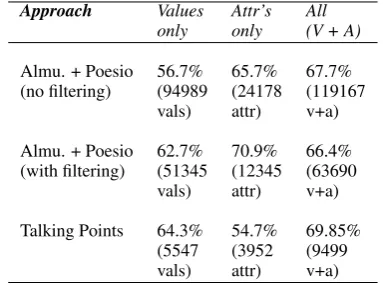
In a second, larger experiment, Almuhareb and Poesio select 402 nouns from 21 different seman-tic classes in WordNet, and proceed to harvest 94,989 property values (again mostly adjectives) and 24,178 attribute nouns from the web using the same retrieval patterns. They then applied therepeated bisections clusteringalgorithm to this larger data set, and report an initial cluster purity measure of 56.7% using only property values like hot, 65.7% using only attributes liketemperature, and 67.7% using both together. Suspecting that noisy features contribute to the perceived drop in performance, those authors then applied a variety of noise filters to reduce the value set to just 51,345 values and the attribute set to just 12,345 attributes, for a size reduction of about 50% in each case. This in turn leads to an improved cluster purity measure of 62.7% using property values only and 70.9% using attributes only. Surprisingly, filtering actually appears to reduce the clustering perfor-mance of both data-sets used together, to 66.4%.
We replicate here both of these experiments us-ing the same data-sets of 214 and 402 nouns re-spectively. For fairness, we collect raw descrip-tions for each of these nouns directly from the web, and use no filtering (manual or otherwise) to re-move poor or ill-formed descriptions. We thus use the pattern “as * as a|an|the C” to collect 2209 raw adjectival values for the 214 nouns of experiment 1, and 5547 raw adjectival values for the 402 nouns of experiment 2. We then use the pattern “the ADJ * of a|an|the C” to collect 4974 attributes for the 214 nouns of experiment 1, and 3952 for the 402 nouns of experiment 2; in each case, ADJ is bound to the raw adjectival values that were acquired us-ing “as * as a|an|the C”. A comparison of cluster-ing results is given in Tables 1 and 2. These tables illustrate that clustering is most effective when it
Table 2: Experiment 2, accuracy for 402 nouns Approach Values Attr’s All
only only (V + A) Almu. + Poesio 56.7% 65.7% 67.7% (no filtering) (94989 (24178 (119167
vals) attr) v+a)
Almu. + Poesio 62.7% 70.9% 66.4% (with filtering) (51345 (12345 (63690
vals) attr) v+a)
Talking Points 64.3% 54.7% 69.85% (5547 (3952 (9499 vals) attr) v+a)
is performed on the basis of both values and at-tributes (yielding the highest scores, 90.2% and 69.85%, in each experiment respectively). These results thus support the combination of conceptual attributes with specific adjectival values into inte-grated talking points which reflect how people ac-tually talk about the concepts concerned.
6 Conclusions
Metaphor is a knowledge-hungry phenomenon, so any computational treatment of metaphor will only be as good as the knowledge representation that supports it. Moreover, from a computational per-spective, any theory of metaphor – cognitive, lin-guistic, or otherwise – is only as good as the al-gorithmic and representational insights that it pro-vides, and the scale of the implementation that it ultimately allows us to realize. In this paper we have given computational form to some of the key insights in the metaphor literature, from the in-teraction theory of Black (1962) to the salience imbalance theory of Ortony (1979) to the theory of conceptual blending of Fauconnier and Turner (1998). We also employ a key insight from the work of Hofstadter and his fluid analogies group (1995), that robust reasoning on a conceptual level requires a degree of slippage that must be sup-ported by the underlying knowledge representa-tion.
slip-page means that non-identical talking points can be treated as equivalent for purposes of robust processing, which in turn extends the halo of talking points that surrounds each concept in the knowledge-base (Hofstadter et al., 1995). The experiments of section 5 also indicate that, in a pinch, new talking points for a previously under-represented concept can be acquired dynamically from the web with reasonable accuracy. As it currently stands, the talking points approach to metaphor is robust enough and scalable enough to generate simple but imaginative metaphors on de-mand for a wide range of user inputs.
But what does it mean to state, at a knowledge-representation level, that lions and knights both have a brave heart, that wolvesand tyrants both have a cruel face, or that eagles and warriors have a fierce expression? Stereotypical talking points such as these can be poetic or metaphor-ical, and may express a viewpoint that is overly simplistic, subjective or even technically inaccu-rate. Nonetheless, our experiments suggest that the linguistic insights we acquire from non-literal descriptions strongly reflect our ontological intu-itions about concepts and are more than mere lin-guistic decorations. Most significantly, we see from these experiments that stereotypical talking points yield an especially concise representation, since with no filtering of any kind, this approach achieves comparable clustering results with feature sets that are many times smaller than those used in previous work. We anticipate therefore that stereo-typical descriptions will be a key growth area for the development of the talking points knowledge-base.
The Pope examples of section 4.1. exem-plify the competence of the system as it is cur-rently implemented, while the Burqa and Gover-nor/President examples of sections 1 and 2 mark out our future directions. The Burqa examples demonstrate the need for a more complex repre-sentation of talking points that can accommodate nested propositions, while the Governor example demonstrates the need for more radical and ad-hoc slippage patterns in creative metaphors. Rather than add special rules to handle such individual cases (which are creative because of their one-off disposal nature), our ambition is to develop a general corpus-grounded mechanism for explain-ing all metaphor-related slippage. We remain a considerable distance from this goal, yet believe
it is best attained using the kind of robust and scal-able approach described here.
References
Almuhareb, A. and M. Poesio. 2004. Attribute-Based and Value-Attribute-Based Clustering: An Evaluation In proceedings of EMNLP, the Conference on Em-pirical Methods on Natural Language Processing. Barcelona.
Almuhareb, A. and M. Poesio. 2005. Concept Learn-ing and Categorization from the Web. In proceed-ings of the annual meeting of the Cognitive Science society. Italy.
Ahlswede, T. and M. Evans. 1998. Parsing vs. Text Processing in the analysis of dictionary definitions. Inproceedings of the 26th Annual Meeting of the As-sociation for Computational Linguistics, 217–224. Barnden, J. A. and M. G. Lee. 2002. An Artificial
Intelligence Approach to Metaphor Understanding. Theoria et Historia Scientiarum, 6(1):399–412. Black, M. 1962. Models and Metaphor: studies in
language and philosophy. Ithaca, NY: Cornell Uni-versity Press.
Camac, K. and S. Glucksberg. 1984. Metaphors do not use associations between concepts, they are used to create them.Journal of Psycholinguistic Re-search,13(6).
Collins, A. and E. F. Loftus. 1975. A Spreading-Activation Theory of Semantic Processing. Psycho-logical Review82, 407–428.
Fauconnier, G. and M. Turner. 1998. Conceptual In-tegration Networks. Cognitive Science, 22(2):133– 187.
Fellbaum, C. (ed.). 1998. WordNet: An electronic lex-ical database. The MIT Press. 1985 A comprehen-sive grammar of the English.
Hofstadter, D. R. and M. Mitchell. 1994. The Copy-cat Project: A model of mental fluidity and analogy-making. In Holyoak, K.J. & Barnden, J. A. (Eds.) Advances in Connectionist and Neural Computation Theory, Vol. 2. Norwood, NJ: Ablex.
Hofstadter, D. R. and the Fluid Analogy Research Group. 1995. Fluid Concepts and Creative Analo-gies: Computer Models of the Fundamental Mecha-nisms of Thought. NY: Basic Books.
Fass, D. 1991. Met*: a method for discriminating metonymy and metaphor by computer. Computa-tional Linguistics, 17(1):49–90.
Martin, J. H. 1990. A Computational Model of Metaphor Interpretation. NY: Academic Press. Ortony, A. 1979. Beyond literal similarity.
Psycholog-ical Review, 86, 161–180.
Veale, T. and Y. Hao. 2007. Making WordNet Func-tional and Context-Sensitive. In proceedings of the 45th Annual Meeting of the Association for Compu-tational Linguistics. Czech Republic.
Veale, T. and O’Donoghue. 2000. Computation and Blending.Cognitive Linguistics, 11(3–4), special is-sue on Conceptual Blending.
Way, E. C. 1991. Knowledge Representation and Metaphor. Studies in Cognitive systems. Holland: Kluwer.