Head-modifier Relation based Non-lexical Reordering Model
for Phrase-Based Translation
Shui Liu
1, Sheng Li
1, Tiejun Zhao
1, Min Zhang
2, Pengyuan Liu
31
School of Computer Science and Technology, Habin Institute of Technology
{liushui,lisheng,tjzhao}@mtlab.hit.edu.cn
2
Institute for Infocomm Research
[email protected]
3
Institute of Computational Linguistics, Peking Unive rsity
[email protected]
Abstract
Phrase-based statistical MT (SMT) is a milestone in MT. However, the transla-tion model in the phrase based SMT is structure free which greatly limits its reordering capacity. To address this is-sue, we propose a non-lexical head-modifier based reordering model on word level by utilizing constituent based parse tree in source side. Our experi-mental results on the NIST Chinese-English benchmarking data show that, with a very small size model, our me-thod significantly outperforms the base-line by 1.48% bleu score.
1
Introduction
Syntax has been successfully applied to SMT to improve translation performance. Research in applying syntax information to SMT has been carried out in two aspects. On the one hand, the syntax knowledge is employed by directly inte-grating the syntactic structure into the transla-tion rules i.e. syntactic translatransla-tion rules. On this perspective, the word order of the target transla-tion is modeled by the syntax structure explicit-ly. Chiang (2005), Wu (1997) and Xiong (2006) learn the syntax rules using the formal gram-mars. While more research is conducted to learn syntax rules with the help of linguistic analysis (Yamada and Knight, 2001; Graehl and Knight, 2004). However, there are some challenges to these models. Firstly, the linguistic analysis is far from perfect. Most of these methods require an off-the-shelf parser to generate syntactic structure, which makes the translation results sensitive to the parsing errors to some extent.
To tackle this problem, n-best parse trees and parsing forest (Mi and Huang, 2008; Zhang, 2009) are proposed to relieve the error propaga-tion brought by linguistic analysis. Secondly, some phrases which violate the boundary of linguistic analysis are also useful in these mod-els ( DeNeefe et al., 2007; Cowan et al. 2006). Thus, a tradeoff needs to be found between lin-guistic sense and formal sense.
On the other hand, instead of using syntactic translation rules, some previous work attempts to learn the syntax knowledge separately and then integrated those knowledge to the original constraint. Marton and Resnik (2008) utilize the language linguistic analysis that is derived from parse tree to constrain the translation in a soft way. By doing so, this approach addresses the challenges brought by linguistic analysis through the log-linear model in a soft way.
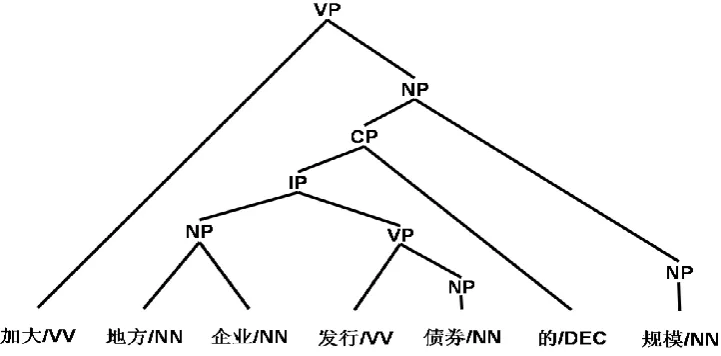
Fig 1. An Constituent based Parse Tree
2
Baseline
Moses, a state-of-the-art phrase based SMT sys-tem is used as our baseline syssys-tem. In Moses, given the source language f and target language
e, the decoder is to find:
ebest = argmaxe p ( e | f ) pLM ( e ) ω length(e)
(1)
where p(e|f) can be computed using phrase translation model, distortion model and lexical reordering model. pLM(e) can be computed us-ing the language model. ωlength(e) is word penalty model.
Among the above models, there are three reordering-related components: language model, lexical reordering model and distortion model. The language model can reorder the local target words within a fixed window in an implied way. The lexical reordering model and distortion reordering model tackle the reordering problem between adjacent phrase on lexical level and alignment level. Besides these reordering model, the decoder induces distortion pruning con-straints to encourage the decoder translate the leftmost uncovered word in the source side firstly and to limit the reordering within a cer-tain range.
3
Model
In this paper, we utilize the constituent parse tree of source language to enhance the reorder-
ing capacity of the translation model. Instead of directly employing the parse tree fragments (Bod, 1992; Johnson, 1998) in reordering rules (Huang and Knight, 2006; Liu 2006; Zhang and Jiang 2008), we make a mapping from trees to sets of head-modifier dependency relations (Collins 1996 ) which can be obtained from the constituent based parse tree with the help of head rules ( Bikel, 2004 ).
3.1
Head-modifier Relation
According to Klein and Manning (2003) and Collins (1999), there are two shortcomings in n-ary Treebank grammar. Firstly, the grammar is too coarse for parsing. The rules in different context always have different distributions. Se-condly, the rules learned from training corpus cannot cover the rules in testing set.
Fig. 2. Head-modifier Relationships with Aligned Translation
Moreover, there are several reasons for which we adopt the head-modifier structured tree as the main frame of our reordering model. Firstly, the dependency relationships can reflect some underlying binary long distance dependency relations in the source side. Thus, binary depen-dency structure will suffer less from the long distance reordering constraint. Secondly, in head-modifier relation, we not only can utilize the context of dependency relation in reordering model, but also can utilize some well-known and proved helpful context (Johnson, 1998) of constituent base parse tree in reordering model. Finally, head-modifier relationship is mature and widely adopted method in full parsing.
3.2 Head-modifier Relation Based
Reor-dering Model
Before elaborating the model, we define some notions further easy understanding. S=<f1, f
2…fn> is the source sentence; T=<e1,e2,…,em> is the target sentence; AS={as(i) | 1≤ as(i) ≤ n } where as(i) represents that the ith word in source
sentence aligned to the as(i)th word in target
sentence; AT={aT(i) | 1≤ aT (i) ≤ n } where aT(i)
represents that the ith word in target sentence aligned to the aT(i)th word in source sentence;
D= {( d(i), r(i) )| 0≤ d(i) ≤n} is the head-modifier relation set of the words in S where
d(i)represents that the ith word in source sen-tence is the modifier of d(i)th word in source sentence under relationship r(i); O= < o1, o2,…, om > is the sequence of the reordering type of every word in target language. The reordering model probability is P(O| S, T, D, A).
Relationship: in this paper, we not only use the
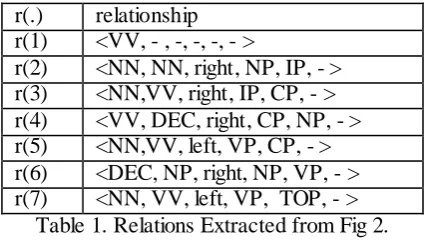
label of the constituent label as Collins (1996), but also use some well-known context in pars-ing to define the head-modifier relationship r(.), including the POS of the modifier m, the POS of the head h, the dependency direction d, the parent label of the dependency label l, the grandfather label of the dependency relation p, the POS of adjacent siblings of the modif ier s. Thus, the head-modifier relationship can be represented as a 6-tuple <m, h, d, l, p, s>.
r(.) relationship r(1) <VV, - , -, -, -, - >
r(2) <NN, NN, right, NP, IP, - > r(3) <NN,VV, right, IP, CP, - > r(4) <VV, DEC, right, CP, NP, - > r(5) <NN,VV, left, VP, CP, - > r(6) <DEC, NP, right, NP, VP, - > r(7) <NN, VV, left, VP, TOP, - >
Table 1. Relations Extracted from Fig 2.
In Table 1, there are 7 relationships extracted from the source head-modifier based dependen-cy tree as shown in Fig.2. Please notice that, in this paper, each source word has a correspond-ing relation.
Reordering type : there are 4 reordering types
for target words with linked word in the source side in our model: R= {rm1, rm2, rm3, rm4}. The reordering type of target word as(i) is defined as follows:
as(d(i)) (as(i) < as(d(i)) ) in target lan-guage;
rm2: if the position number of the ith word’s head is less than i ( d(i) < i ) in source language, while the position num-ber of the word aligned to i is larger than as(d(i)) (as(i) > as(d(i)) ) in target lan-guage.
rm3: if the position number of the ith word’s head is larger than i ( d(i) > i ) in source language, while the position num-ber of the word aligned to i is larger than as(d(i)) (as(i) > as(d(i))) in target language. rm4: if the position number of the ith
word’s head is larger than i ( d(i) > i) in source language, while the position num-ber of the word aligned to i is less than as(d(i)) (as(i) < as(d(i)) ) in target lan-guage.
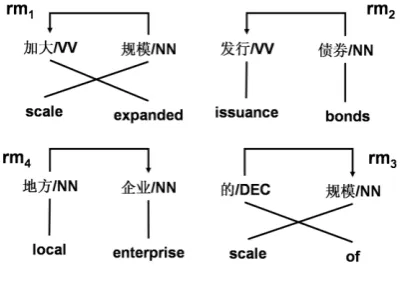
Fig. 3. An example of the reordering types in Fig. 2.
Fig. 3 shows examples of all the reordering types. In Fig. 3, the reordering type is labeled at the target word aligned to the modifier: for ex-ample, the reordering type of rm1 belongs to the target word “scale”. Please note that, in general,
these four types of reordering can be divided into 2 categories: the target words order of rm2 and rm4 is identical with source word order, while rm1 and rm3 is the swapped order of source. In practice, there are some special cases that can’t be classified into any of the defined reordering type into rm4.
Probability estimation: we adopt maximum
likelihood (ML) based estimation in this paper. In ML estimation, in order to avoid the data sparse problem brought by lexicalization, we discard the lexical information in source and
where oi∈{rm1,rm2,rm3,rm4} is the reorder-ing type of ith word in target language.
To get a non-zero probability, additive smooth ing( Chen and Goodman, 1998) is used:
where F(.) is the frequency of the statistic event in training corpus. For a given set of dependen-cy relationships mapping from constituent tree, the reordering type of ith word is confined to two types: it is whether one of rm1 and rm2 or rm3 and rm4. Therefore, |O|=2 instead of |O|=4 in (2). The parameter α is an additive factor to prevent zero probability. It is computed as: where c is a constant parameter(c=5 in this pa-per).
In above, the additive parameter α is an adap-tive parameter decreasing with the size of the statistic space. By doing this, the data sparse problem can be relieved.
4
Apply the Model to Decoder
words in decoding procedure is fixed. That is, once a hypothesis is generated, the order of tar-get words cannot be changed in the future. Tak-ing advantage of this feature, instead of compu-ting a totally new reordering score for a newly generated hypothesis, we merely calculate the reordering score of newly extended part of the hypothesis in decoding. Thus, in decoding, to compute the reordering score, the reordering types of each target word in the newly extended phrase need to be identified.
The method to identify the reordering types in decoding is proposed in Fig.4. According to the definition of reordering, the reordering type of the target word is identified by the direction of head-modifier dependency on the source side, the alignment between the source side and tar-get side, and the relative translated order of word pair under the head-modifier relationship. The direction of dependency and the alignment can be obtained in input sentence and phrase table. While the relative translation order needs to record during decoding. A word index is em-ployed to record the order. The index is con-structed in the form of true/false array: the index of the source word is set with true when the word has been translated. With the help of this index, reordering type of every word in the phrase can be identified.
1: Input: alignment array AT; the Start is the
start position of the phrase in the source side; head-modifier relation d(.); source word in-dex C, where C[i]=true indicates that the
ith word in source has been translated.
2: Output: reordering type array O which
re-serves the reordering types of each word in the target phrase
3: for i = 1, |AT| do 4: P ← aT(i) + Start 5: if (d (P)<P) then
6: if C [d(p)] = false then
7: O[i] ← rm1
8: else
9: O[i] ← rm2 10: end if 11: else
12: if C[d(p)] = true then
13: O[i] ← rm3 14: else
15: O[i] ← rm4
16: end if
17: end if
18: C[p] ←true //update word index
19: end for
Fig. 4. Identify the Reordering Types of Newly Extended Phrase
After all the reordering types in the newly ex-tended phrase are identified, the reordering scores of the phrase can be computed by using equation (3).
5
Preprocess the Alignme nt
In Fig. 4, the word index is to identify the reor-dering type of the target translated words. Ac-tually, in order to use the word index without ambiguity, the alignment in the proposed algo-rithm needs to satisfy some constraints.
Firstly, every word in the source must have alignment word in the target side. Because, in the decoding procedure, if the head word is not covered by the word index, the algorithm cannot distinguish between the head word will not be translated in the future and the head word is not translated yet. Furthermore, in decoding, as shown in Fig.4, the index of source would be set with true only when there is word in target linked to it. Thus, the index of the source word without alignment in target is never set with true.
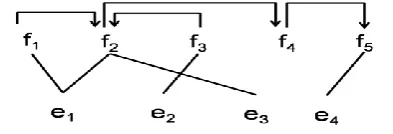
Fig. 5. A complicated Example of Alignment in Head-modifier based Reordering Model
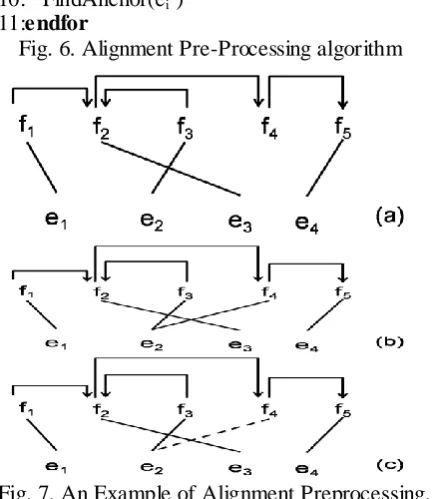
Secondly, if the head word has more than one alignment words in target, different alignment possibly result in different reordering type. For example, in Fig. 5, the reordering type of e2 is different when f2 select to link word e1 and e3 in the source side.
To solve this problem, we modify the align-ment to satisfy following conditions: a) each word in source just has only one alignment word in target, and b) each word in target has at most one word aligned in source as its anchor word which decides the reordering type of the target word.
order to explain the alignment preprocessing, the following notions are defined: if there is a link between the source word fj and target word ei, let l(ei ,fj) = 1 , otherwise l(ei ,fj) = 0; the source word fj∈F1-to-N , iff ∑i l(ei,fj) >1, such as the source word f2 in Fig. 5; the source word fj∈FNULL, iff ∑i l(ei,fj) = 0, such as the source word f4 in Fig. 5; the target word ei∈E1-to-N , iff
∑j l(ei,fj) > 1, such as the target word e1 in Fig. 5.
In preprocessing, there are 3 types of opera-tion, including DiscardLink(fj) , BorrowLink( fj )
and FindAnchor(ei ) :
DiscardLink( fj ) : if the word fj in source with
more than one words aligned in target, i.e. fj∈ F1-to-N ; We set the target word en with l(en, fj) = 1, where en= argmaxi p(ei |fj) and p(ei |fj) is estimated by ( Koehn e.t. al, 2003), while set rest of words linked to fj with l (en, fj) = 0.
BorrowLink( fj ): if the word fj in source
with-out a alignment word in target, i.e. fj∈FNULL ; let l(ei,fj)=1 where ei aligned to the word fj , which is the nearest word to fj in the source side; when there are two words nearest to fj with alignment words in the target side at the same time, we select the alignment of the left word firstly .
FindAnchor( ): for the word ei in target with
more than one words aligned in source , i.e. ei
∈E1-to-N ; we select the word fm aligned to ei as
its anchor word to decide the reordering type of
ei , where fm= argmaxj p(ei |fj) and p(fj | ei) is estimated by ( Koehn et al, 2003); For the rest of words aligned to ei , we would set their word
indexes with true in the update procedure of decoding in the 18th line of Fig.4.
With these operations, the required alignment can be obtained by preprocessing the origin alignment as shown in Fig. 6.
1: Input: set of alignment A between target
lan-guage e and source language f
2: Output: the 1-to-1 alignment required by the
model
3: foreach fi∈F1-to-N do
4: DiscardLink( fi )
5: end for
6: foreach fi ∈FNULL do
7: BorrowLink( fi )
8: end for
9: foreach ei∈E1-to-Ndo
10: FindAnchor(ei )
11:endfor
Fig. 6. Alignment Pre-Processing algorithm
Fig. 7. An Example of Alignment Preprocessing.
An example of the preprocess the alignment in Fig. 5 is shown in Fig. 7 : firstly,
Discar-dLink(f2) operation discards the link between f2
and e1 in (a); then the link between f4 and e3 is established by operation BorrowLink(f4 ) in (b);
at last, FindAnchor(e3)select f2 as the anchor word of e3 in source in (c). After the prepro-cessing, the reordering type of e3 can be identi-fied. Furthermore, in decoding, when the de-coder scans over e2, the word index sets the word index of f3 and f4 with true. In this way, the never-true word indexes in decoding are avoided.
6
Training the Reordering Model
Before training, we get the required alignment by alignment preprocessing as indicated above. Then we train the reordering model with this alignment: from the first word to the last word in the target side, the reordering type of each word is identified. In this procedure, we skip the words without alignment in source. Finally, all the statistic events required in equation (3) are added to the model.
In our model, there are 20,338 kinds of rela-tions with reordering probabilities which are much smaller than most phrase level reordering models on the training corpus FBIS.
Type of Reordering Percentage %
rm1 rm2 rm3
3.69 27.61 20.94
rm4 47.75
Table 1: Percentage of different reordering types in model
From Table 1, we can conclude that the reor-dering type rm2 and rm4 are preferable in reor-dering which take over nearly 3/4 of total num-ber of reordering type and are identical with word order of the source. The statistic data indi-cate that most of the words order doesn’t change in our head-modifier reordering view. This maybe can explain why the models (Wu, 1997; Xiong, 2006; Koehn, et., 2003) with limited capacity of reordering can reach certain perfor-mance.
7
Experime nt and Discussion
7.1
Experiment SettingsWe perform Chinese-to-English translation task on NIST MT-05 test set, and use NIST MT-02 as our tuning set. FBIS corpus is selected as our training corpus, which contains 7.06M Chinese words and 9.15M English words. We use GI-ZA++(Och and Ney, 2000) to make the corpus aligned. A 4-gram language model is trained using Xinhua portion of the English Gigaword corpus (181M words). All models are tuned on BLEU, and evaluated on both BLEU and NIST score.
To map from the constituent trees to sets of head-modifier relationships, firstly we use the Stanford parser (Klein, 2003) to parse the source of corpus FBIS, then we use the head-finding rules in (Bikel, 2004) to get the head-modifier dependency sets.
In our system, there are 7 groups of features. They are:
1. Language model score (1 feature) 2. word penalty score (1 feature) 3. phrase model scores (5 features) 4. distortion score (1 feature) 5. lexical RM scores (6 features)
6. Number of each reordering type (4 fea-tures)
7. Scores of each reordering type (4 fea-tures, computed by equation (3))
In these feature groups, the top 5 groups of features are the baseline model, the left two group scores are related with our model.
In decoding, we drop all the OOV words and use default setting in Moses: set the distortion limitation with 6, beam-width with 1/100000, stack size with 200 and max number of phrases for each span with 50.
7.2 Results and Discussion
We take the replicated Moses system as our baseline. Table 2 shows the results of our model. In the table, Baseline modelis the model includ-ing feature group 1, 2, 3 and 4. Baseliner m mod-el is the Basmod-eline modmod-el with feature group 5. H-M model is the Baseline model with feature group 6 and 7. H-Mrm model is the Baseliner m model with feature group 6 and 7.
Model BLEU% NIST
Baseline 27.06 7.7898
Baseliner m 27.58 7.8477
H-M 28.47 8.1491
H-Mrm 29.06 8.0875
Table 2: Performance of the Systems on NIST-05(bleu4 case-insensitive).
From table 2, we can conclude that our reor-dering model is very effective. After adding feature group 6 and 7, the performance is im-proved by 1.41% and 1.48% in bleu score sepa-rately. Our reordering model is more effective than the lexical reordering model in Moses: 1.41% in bleu score is improved by adding our reordering model to Baseline model, while 0.48 is improved by adding the lexical reordering to Baseline model.
threshold KOR BLEU NIST
≥1 20,338 29.06 8.0875
≥2 13,447 28.83 8.3658
≥3 10,885 28.64 8.0350
≥4 9,518 28.94 8.1002
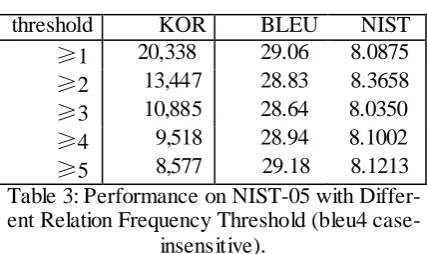
≥5 8,577 29.18 8.1213 Table 3: Performance on NIST-05 with Differ-ent Relation Frequency Threshold (bleu4
case-insensitive).
the frequency of the relationships in our model, and expertise our H-Mfull model with different frequency threshold.
In Table 3, when the frequency of relation is not less than the threshold, the relation is added into the reordering model; KOR is the number of relation type in the reordering model.
Table 3 shows that, in our model, many rela-tions occur only once. However, these low-frequency relations can improve the perfor-mance of the model according to the experimen-tal results. Although low frequency statistic events always do harm to the parameter estima-tion in ML, the model can estimate more events in the test corpus with the help of low frequency event. These two factors affect the experiment results on opposite directions: we consider that is the reason the result don’t increase or de-crease with the increasing of frequency thre-shold in the model. According to the results, the model without frequency threshold achieves the highest bleu score. Then, the performance drops quickly, when the frequency threshold is set with 2. It is because there are many events can’t be estimated by the smaller model. Although, in the model without frequency threshold, there are some probabilities overestimated by these events which occur only once, the size of the model affects the performance to a larger extent. When the frequency threshold increases above 3, the size of model reduces slowly which makes the overestimating problem become the impor-tant factor affecting performance. From these results, we can see the potential ability of our mode l: if our model suffer less from data spars problem, the performance should be further im-proved, which is to be verified in the future.
8
Related Work and Motivation
There are several researches on adding linguis-tic analysis to MT in a “soft constraint” way. Most of them are based on constituents in parse tree. Chiang(2005), Marton and Resnik(2008) explored the constituent match/violation in hie-ro; Xiong (2009 a) added constituent parse tree based linguistic analysis into BTG model; Xiong (2009 b) added source dependency struc-ture to BTG; Zhang(2009) added tree-kernel to BTG model. All these studies show promising results. Making soft constrain is an easy and
efficient way in adding linguistic analysis into formal sense SMT model.
In modeling the reordering, most of previous studies are on phrase level. In Moses, the lexical reordering is modeled on adjacent phrases. In (Wu, 1996; Xiong, 2006), the reordering is also modeled on adjacent translated phrases. In hiero, the reordering is modeled on the segments of the unmotivated translation rules. The tree-to-string mode ls (Yamada et al. 2001; Liu et al.2006) are model on phrases with syntax re-presentations. All these studies show excellent performance, while there are few studies on word level model in recent years. It is because, we consider, the alignment in word level model is complex which limits the reordering capacity of word level models.
However, our work exploits a new direction in reordering that, by utilizing the decomposed dependency relations mapped from parse tree as a soft constraint, we proposed a novel head-modifier relation based word level reordering model. The word level reordering model is based on a phrase based SMT framework. Thus, the task to find the proper position of translated words converts to score the reordering of the translated words, which relax the tension be-tween complex alignment and word level reor-dering in MT.
9
Conclusion and Future Work
Experimental results show our head-modifier relationship base model is effective to the base-line (enhance by 1.48% bleu score), even with limited size of model and simple parameter es-timation. In the future, we will try more compli-cated smooth methods or use maximum entropy based reordering model. We will study the per-formance with larger distortion constraint, such as the performances of the distortion constraint over 15, or even the performance without distor-tion model.
10
Acknowledge ment
References
Deka i Wu. 1997. Stochastic inversion transduction grammars and bilingual parsing of parallel corpo-ra. Computational Lingustics,23(3):377-403.
David Ch iang. 2005. A hie rarchica l phrase-based model for SMT. ACL-05.263-270.
David Chiang. 2007. Hiera rchical phrase-based translation. Computational Linguistics, 33(2):201-228.
Kenji Ya mada and K. Knight. 2001. A syntax-based statistical translation model. ACL-01.523-530.
Yuva l Marton and Philip Resnik. 2008. Soft syntac-tic Constraints for Hie rarchica l Phrased-based Translation. ACL-08. 1003-1011.
Libin shen, Jin xi Xu and Ra lph Weischedel. 2008. A New String-to-Dependency Machine Translation Algorith m with a Target Dependency Language Model. ACL-08. 577-585.
J. Graehl and K. Kn ight.2004.Train ing Tree trans-ducers. In proceedings of the 2004 Human Lan-guage Technology Conference of the North Amer-ican Chapter of the Association for Computatio n-al Linguistics.
Deka i Wu. 1996. A Polyno mia l-Time Algorithm for Statistical Machine Translation. In proceedings of
ACL-1996
Deyi Xiong, Qun Liu, and Shou xun Lin. 2006. Ma x-imu m Entropy Based Phrase Reordering Model for Statistical Machine Translation. In proceed-ings of COLIN G-ACL 2006
Deyi Xiong, Min Zhang, Aiti AW and Haizhou Li. 2009a. A Syntax-Driven Bracket Model for Phrase-Based Translation. ACL-09.315-323.
Deyi Xiong, Min Zhang, Aiti AW and Haizhou Li. 2009b. A Source Dependency Model for Statistic Machine translation. MT-Summit 2009.
Och, F.J. and Ney, H. 2000. Imp roved statistical align ment models. In Proceedings of ACL 38.
Philipp Koehn, et al. Moses: Open Source Toolkit for Statistical Machine Translation, A CL 2007.
Philipp Koehn, Fran z Joseph Och, and Daniel Mar-cu.2003. Statistical Phrase-based Translation. In Proceedings of HLT-NAACL.
Philipp Koehn. 2004. A Bea m Sea rch Decoder for Phrase-Based Translation model. In : Proceeding
of AMTA-2004,Washington
Rens Bod. 1992. Data oriented Pa rsing( DOP ). In Proceedings of COLIN G-92.
Mark Johnson. 1998. PCFG models of linguistic tree representations. Computational Linguistics, 24:613-632.
Liang Huang, Kevin Knight, and Aravind Joshi. Sta-tistical Syntax-Directed Translation with Ex-tended Domain of Locality. 2006. In Proceedings of the 7th AMTA.
Yang Liu, Qun Liu, and Shou xun Lin. Tree-to-String Align ment Temp late for Statistica l Machine Translation. 2006.In Proceedings of the ACL 2006.
Min Zhang, Hongfei Jiang, Ai Ti Aw, Ha izhou Li, Chew Lim Tan and Sheng Li. 2008. A Tree Se-quence Alignment-based Tree-to-Tree Translation Model. ACL-HLT-08. 559-567.
Dan Kle in, Christopher D. Manning. Accurate Un-le xica lized Parsing. 2003. In Proceedings of
ACL-03. 423-430.
M. Collins. 1996. A new statistical parser based on bigra m le xical dependencies. In Proceedings of
ACL-96. 184-191.
M. Co llins. 1999. Head-Driven Statistical Models for Natural Language Parsing. Ph.D. thesis, Univ. of Pennsylvania.
Andreas Zollmann. 2005. A Consistent and Effic ient Estimator for the Data-Oriented Parsing Model. Journal of Automata, Languages and Co mbinator-ics. 2005(10):367-388
Mark Johnson. 2002. The DOP estimation method is biased and inconsistent. Computational Linguis-tics 28, 71-76.
Danie l M. Bikel. 2004. On the Para meter Space of Generative Le xica lized Statistical Parsing Models. Ph.D. thesis. Univ. of Pennsylvania.
S. F. Chen, J. Good man. An Empirica l Study of Smoothing Techniques for Language Modeling. In Proceedings of the 34th annual meeting on
As-sociation for Computational Linguistics,
1996.310-318.
Haitao M i and Liang Huang. 2008. Forest-based translation Rule Extract ion. ENMLP-08. 2006-214.
Hui Zhang, Min Zhang , Haizhou Li, A iti A w and Chew Lim Tan. Forest-based Tree Sequence to String Translation Model. ACL-09: 172-180
S DeNeefe , K. Kn ight, W. Wang, and D. Marcu. 2007. What can syntax-based MT learn fro m phrase-based MT ? In Proc. EMN LP-CoNULL.