
102
Weight Pattern Based Cuckoo Search for Unit
Commitment Problem
Dr. Sudhir Sharma
1, Mrs. Shivani Mehta
2Tamanna Verma
3,
Department Electrical Engineering, D.A.V.I.E.T., Jalandhar, Punjab, India1, 2, 3 Associate Professor, [email protected]1
Assistant Professor, [email protected]2 Student, Master of Technology, [email protected]3
Abstract: In this paper weight pattern based cuckoo search with Levy Flight algorithm is used for solving unit commitment problem. The basic idea behind this method is that a few cuckoo species rely on other species to raise their eggs in merge with Levy Flight behaviour of a few birds. The weight pattern is used to change the scale to get the more precise and better results for the system. The success of the projected method is analysed on two systems comprising of three and six generating units without and with losses. The comparative analysis of the proposed method is done with some other methods.
Key Words: Unit Commitment, Cuckoo Search, Levy Flight, Weight Pattern.
1. INTRODUCTION
In today’s era, the stability of the power system load is very much affected varying from peak value to low value depending on the demand. Unit Commitment (UC) plays a very important role in generation resource management. Its purpose is to turn on and off the generating units over a scheduling sphere so that the related to production of power is minimized depending on the load demand while fulfilling the procedure constraints.
Unit Commitment is the problem of determining the optimal scheduling of electricity generation units within a power system subject to operating constraints. The optimal scheduling guarantees a feasible system operation at minimum operational system cost. The principle method of solving the scheduling problem of generator is to try all the possible combination and the choosing the best solution out of them giving the least operating cost. But this is quite time consuming and it gets difficult with complex large systems, so is applied for simplest cases. Various new optimization techniques are nowadays applied to solve the UC problem like Genetic Algorithm, Particle Swarm Optimization etc.
Nowadays cuckoo search technique has attracted more attention and has been applied in almost
every area more precisely in engineering
optimization.
2. NOTATION
ai ,bi ,ci cost coefficients for ith unit
F (Pgi ) the total cost of generation
Pgi generation of i th
plant PD the load demand
the power loss
Abbreviation
UC Unit Commitment
HGA Hybrid genetic algorithm
EP Evolutionary programming
SGA Simple genetic algorithm
GA Genetic algorithm
GA-PS Hybrid GA and PS
SADE Self-adaptive differential evolution
ABC Artificial Bee Colony
3. PROBLEM FORMULATION
103
At a particular hour for a particular set of units for generation, the total cost of power production is minimized by cost-efficiently dispatching the units scheduled in focus to particular constraints given below as:
1. The total power generation have to be equal to the load demand.
∑ = …(1)
With losses
∑ = + … (2)
2. The power generated by the units must lie
between the particular boundary limit
(minimum and maximum capacity).
≤ ≤ …(3)
The fuel cost function at any time interval of generated power output is
= + + …(4)
4. CUCKOO SEARCH AND ITS
ALGORITHM
(i). Cuckoo search
In 2009 Xin-she Yang and Suash Deb introduced a new practice of optimization called Cuckoo search inspired by a process by which some of the varieties of cuckoo lay their eggs in other bird nests of other species as a host. The other species birds comes into direct quarrel with the cuckoos if a host bird finds that the eggs in their nests do not belong to them and it will either dispose of its nest or throw unfamiliar eggs away and build a new nest at new place.
Cuckoo Search follows the following three idealized regulations [6]:
1. The egg laid by Cuckoo should be one at a time and dumps its egg in aimlessly chosen nest.
2. The high and good quality eggs will be carried by the best nest to the next generation.
3. The host nests availability is fixed in numbers and the discovery rate of the cuckoo eggs by host bird lies between probability 0 and 1. In this case host birds throw away the cuckoo eggs or abandon their nest and build their new nest.
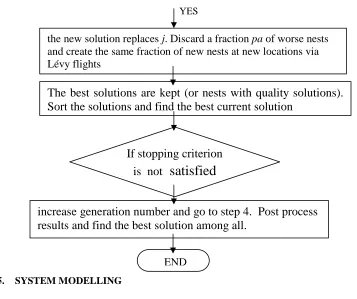
(ii). Flow chart of Cuckoo Search with Weight pattern Algorithm
NO
Start
Define the Fitness function f(x), x = (x1, ..., xd)T.
Set
n
,
pa
and
Max Generations
parameters
Move a cuckoo randomly by Lévy flights with weight pattern. Set
w1 to change the scale and direction of flight in search space& Set
w2 to change the step-size of flight on nests
Evaluate the fitness (Fi ) i.e Total cost
choose a nest Randomly (Fj) among n available nests
104
YES
5. SYSTEM MODELLING
WITHOUT LOSSES (i). Test system 1
Table 1 Data [18] for Cost Coefficients and power limits of three units
Table 2 Data [18] showing load pattern for three units
Hour [h] Load [MW] Hour [h] Load [MW]
1 1200 13 500
2 1200 14 500
3 1150 15 600
4 1100 16 800
5 1000 17 850
6 900 18 900
7 800 19 950
8 600 20 1000
9 550 21 1050
10 500 22 1100
11 500 23 1200
12 500 24 1200
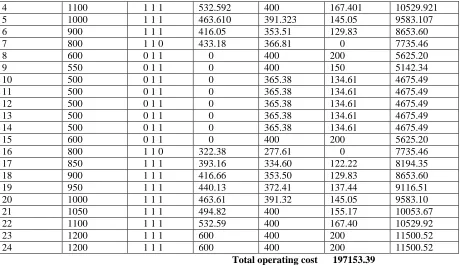
Table 3 Unit Commitment using Weight pattern based cuckoo search of three units HOUR LOAD UC PI P2 P3 TOTAL COST(Rs/hr) 1 1200 1 1 1 600 400 200 11500.523 2 1200 1 1 1 600 400 200 11500.523 3 1150 1 1 1 570.356 400 179.642 11012.062 Unit Min(MW) Max(MW) a b c 1 100 600 0.001562 7.92 561
2 100 400 0.001940 7.85 310
3 50 200 0.004820 7.97 78
the new solution replaces j. Discard a fraction pa of worse nests
and create the same fraction of new nests at new locations via
Lévy flights
The best solutions are kept (or nests with quality solutions).
Sort the solutions and find the best current solution
If stopping criterion
is not
satisfied
increase generation number and go to step 4. Post process
results and find the best solution among all.
105
4 1100 1 1 1 532.592 400 167.401 10529.921
5 1000 1 1 1 463.610 391.323 145.05 9583.107
6 900 1 1 1 416.05 353.51 129.83 8653.60
7 800 1 1 0 433.18 366.81 0 7735.46
8 600 0 1 1 0 400 200 5625.20
9 550 0 1 1 0 400 150 5142.34
10 500 0 1 1 0 365.38 134.61 4675.49
11 500 0 1 1 0 365.38 134.61 4675.49
12 500 0 1 1 0 365.38 134.61 4675.49
13 500 0 1 1 0 365.38 134.61 4675.49
14 500 0 1 1 0 365.38 134.61 4675.49
15 600 0 1 1 0 400 200 5625.20
16 800 1 1 0 322.38 277.61 0 7735.46
17 850 1 1 1 393.16 334.60 122.22 8194.35
18 900 1 1 1 416.66 353.50 129.83 8653.60
19 950 1 1 1 440.13 372.41 137.44 9116.51
20 1000 1 1 1 463.61 391.32 145.05 9583.10
21 1050 1 1 1 494.82 400 155.17 10053.67
22 1100 1 1 1 532.59 400 167.40 10529.92
23 1200 1 1 1 600 400 200 11500.52
24 1200 1 1 1 600 400 200 11500.52
Total operating cost 197153.39
Table 4 Comparison of simulation result of three methods for three units
METHOD Total Operating Cost (Rs)
Particle Swarm Optimization [18] 197397.5459
Dynamic Programming [18] 199097.7838
Proposed Method 197153.39
Three units are considered serving a load pattern of 24-h in above system. The data for the three units system and its load pattern [18] is given in table 1 and 2.
Table 3 represents the simulation result for unit commitment problem via weight pattern based cuckoo search algorithm method. Hour is represented by the first column, second column represents the load pattern for each hour, the third
column represents the combination of the units in table 3. The fourth column represents the load shared among the units and the last column represents the total cost obtained by committing the units. Table 4 shows comparison of proposed method with other two methods and it is shown that the total cost of operation obtained using Weight pattern based Cuckoo search method is minimum in comparison to other two methods.
(ii). Test System 2
Table 5 Data [18] for Cost Coefficients and power limits of six units
Unit Min(MW) Max(MW) a b c
1 50 200 0.0037 2.0000 0
2 20 80 0.0175 1.7500 0
3 15 50 0.0625 1.0000 0
4 10 35 0.0083 3.2500 0
5 10 30 0.0250 3.0000 0
106
Table 6 Unit Commitment result of six units in comparison with two methodsMETHOD UC
SCHEDULE
P1 P2 P3 P4 P5 P6 TOTAL
COST(Rs/hr)
Particle Swarm Optimization [18]
1 1 1 1 0 0 196.19 50.20 19.02 17.90 0 0 769.5164
Dynamic Programming [18]
1 1 1 0 0 0 186.76 46.63 50 0 0 0 828.511
Proposed Method
1 1 1 1 1 1 159.78 41.58 50 10 10 12 689.5147
An IEEE standard 30-bus system comprising of six units is taken [18]. In this results are obtained for 1 hour taking a load of 283.4MW. The data for six unit system is shown in table 5. The results by committing the six unit system is shown in table 6 in comparison with the other two methods. The first column indicates the method used to solve unit commitment problem, second column represents
the scheduling of the units , third column represents the allocation of load among various units. The fourth column indicates the total cost attained by committing the units which showing the total operating cost obtained by Weight pattern based Cuckoo search method is minimum in comparison to other two methods.
WITH LOSSES
(iii). Test system 3
Table 7 Data [20] for Cost Coefficients and power limits of three units
Unit Min(MW) Max(MW) a b c
1 10 85 0.008 7 200
2 10 80 0.009 6.3 180
3 10 70 0.007 6.8 140
The transmission loss coefficient matrix B for three unit system [20] is specified as
!= "
0.000218 0.000093 0.000028 0.000093 0.000228 0.000017
0.000028 0.000017 0.000179)
*= +0.0003 0.0032
**= 0.030523
Table 8 Results for the best simulations with three generating units system.
POWER OUTPUTS
CUCKOO SEARCH [20]
ABC [20] FIREFLY
ALGORITHM [20]
PROPOSED METHOD
UNIT 1(MW) 33.490 33.049 32.729 82.73
UNIT 2(MW) 64.116 61.764 63.843 0
UNIT 3(MW) 55.126 57.872 56.151 70
Power Loss(MW) 2.73 2.70 2.72 2.73
Power Demand(MW
150 150 150 150
107
Generation(MW)
Cost(Rs/hr) 1600.46 1600.51 1600.47 1484.16
The three unit system data is given in table 7 and table 8 represents results for the best simulations
with three generating units system [20]. In this case the load demand expected is 150 MW.
(iv). Test System 4
Table 9 Data [13] for Cost Coefficients and power limits of six units
Unit Min(MW) Max(MW) a b c
1 50 200 0.00375 2 0
2 20 80 0.01750 1.75 0
3 15 50 0.06250 1 0
4 10 35 0.00834 3.25 0
5 10 30 0.02500 3 0
6 12 40 0.02500 3 0
Table 10 Data [13] showing Load pattern of six units Hour [h] Load [MW] Hour [h] Load [MW] 1 166 13 170
2 196 14 185
3 229 15 208
4 267 16 232
5 283.4 17 246
6 272 18 241
7 246 19 236
8 213 20 225
9 192 21 204
10 161 22 182
11 147 23 161
12 160 24 131
The transmission loss coefficient matrix B for six unit [20] system is specified as
=
. / / / /
0 0.000218 0.000103 0.000009 − 0.000010 0.000002 0.0000270.000103 0.000181 0.000004 − 0.000015 0.000002 0.000030 0.000009 0.000004 0.000417 − 0.000131 − .000153 − .000107
−.000140 − .000015 − .000131 0.0000221 0.000094 0.000050 0.000002 0.000002 0.000153 0.000094 0.000243 0.000000
0.000027 0.000030 − .000107 0.000050 0.000000 0.000358 34
4 4 4 5
Table 11 Combination of units using Weight pattern based cuckoo search of six units
HOUR LOAD P1 P2 P3 P4 P5 P6
1 166 1 1 1 0 0 0
2 196 1 1 1 0 0 0
3 229 1 1 1 0 1 0
4 267 1 1 1 1 1 1
108
6 272 1 1 1 1 1 1
7 246 1 1 1 0 1 0
8 213 1 1 1 0 1 0
9 192 1 1 1 0 0 0
10 161 1 1 1 0 0 0
11 147 1 1 1 0 0 0
12 160 1 1 1 0 0 0
13 170 1 1 1 0 0 0
14 185 1 1 1 0 0 0
15 208 1 1 1 0 0 0
16 232 1 1 1 0 1 01
17 246 1 1 1 0 1 0
18 241 1 1 1 0 0 0
19 236 1 1 1 0 0 0
20 225 1 1 1 0 0 0
21 204 1 1 1 0 0 0
22 182 1 1 1 0 0 0
23 161 1 1 1 0 0 0
24 131 1 1 1 0 0 0
Table 12 Unit Commitment using Weight pattern based cuckoo search of six units
HOUR P1 P2 P3 P4 P5 P6 Total Cost
(Rs/hr)
1 119.92 32,84 15.19 0 0 0 399.7511
2 144.82 38.17 16.68 0 0 0 494.7128
3 163.83 42.25 17.83 0 10 0 603.7186
4 177.07 45.10 18.59 10 10 12 731.6289
5 189.78 47.78 19.41 10.98 10 12 789.8940
6 180.84 45.90 18.80 10 10 12 747.8024
7 176.92 45.05 18.61 0 10 0 658.3603
8 150.33 39.35 17.01 0 10 0 549.0228
9 141.77 37.52 16.50 0 0 0 482.7521
10 117.95 32.41 15.07 0 0 0 392.4921
11 105.87 29.83 15 0 0 0 350.6366
12 117.16 32.25 15.03 0 0 0 389.6104
13 125.50 34.03 15.53 0 0 0 420.5148
14 138.06 36.72 16.28 0 0 0 468.3589
15 157.48 40.88 17.44 0 0 0 545.2585
16 168.24 43.19 18.09 0 10 0 621.9248
17 178.83 45.46 18.73 0 10 0 666.4955
18 175.20 44.68 18.51 0 10 0 651.1217
19 170.34 43.64 18.22 0 10 0 630.6876
20 169.25 43.41 18.15 0 0 0 593.6374
21 151.73 39.65 17.10 0 0 0 522.1305
22 133.75 35.80 16.02 0 0 0 451.7527
23 116.67 32.14 15 0 0 0 387.7979
24 91.88 26.83 15 0 0 0 304.0565
Table 13 Comparison of simulation results of six unit with other mehods
TECHNIQUE FUEL COST TOTAL POWER (MW) POWER LOSS
HGA [13] 802.465 292.9150 9.5105
EP [13] 802.404 292.8791 9.4791
109
losses. The data for the six units system and its load pattern [13] is given in table 9 and 10.Table 11 represents the combination of the units via weight pattern based cuckoo search algorithm method for six units. The first, second, third column in table 11 represents the hour, the load corresponding particular hour, the combination of six units In table 12 simulation results is represented representing the first column as hour, second column as the allocation of load among six units and the last column as the total cost obtained by committing six units. In table 13 comparison of proposed method is done with other methods
6. CONCLUSION competitive to other techniques for solving large-scale unit commitment problems.
REFERENCES
[1] Weerakorn Ongsakul and Nit Petcharaks,” Unit
Commitment by Enhanced Adaptive
Lagrangain Relaxation,” IEEE Trans. Power Syst., vol.19, pp. 620-628, No.1, Feb 2004. [2] Sayeed Salam,” Unit Commitment Solution
Methods,” World Academy of Science, Engg.and Tech., 2007.
[3] V.S.Pappala and I.Erlich,” A New Approach for solving the Unit Commitment problem by Adaptive Particle Swarm Optimization,” IEEE Trans. Power and Energy, pp.1-6, july 2008.
[4] S.Chitra Selvi, R.P.Kumudini Devi and
C.Christober Asir Rajan,” Hybrid
Evolutionary Programming Approach to Multi-Area Unit Commitment with Import and Export Constraints,” International Journal of Recent Trends in Engg., vol.1, pp.223-228, No.3, May 2009
[5] T.W.Lau, C.Y.Chung, K.P.Wong, T.S.Chung and S.L.Ho,” Quantum-Inspired Evolutionary Algorithm Approach for Unit Commitment,”
IEEE Trans. on Power Systems, vol.24, pp.1503-1512, No.3, Aug 2009.
[6] Xin-She Yang and Suash Deb,” Cuckoo Search via Levy Flights,” Proc. of world congress on nature and biologically inspired computing, 2009.
[7] A.Safari, H.A.Shayanfar and R.Jahani,” Optimal Unit Commitment of Power System using Fast Messy Genetic Algorithm,” International Journal on Tech. and Physical Problems of Engg., vol.2, pp.22-27, No.2, June 2010.
[8] Yun-Won Jeong, Jong-Bae Park, Se-Hwan Jang and Kwang Y.Lee,” A New Quantum-Inspired Binary PSO:Application to Unit Commitment Problems for Power Systems,” IEEE Trans. on Power Systems, vol.25, pp.1486-1495, No.3, Aug 2010.
[9] M.Y.EI-Sharkh, N.S.Sisworahardjo, A.A.EI-Keib and Rahman,” Fuzzy Unit Commitment using the Ant Colony Search Algorithm,” IEEE Trans. Electric Power and Energy, pp.1-6, Aug 2010.
[10] S.Najafi and Y.Pourjamal,” A New Heuristic Algorithm for Unit Commitment Problem,” ELSEVIER, 2011.
[11] Po-Hung Chen,” Two-Level Hierarchical Approach to Unit Commitment using Expert System and Elite PSO,” IEEE Trans. on Power Systems, vol.27, pp.780-789, No.2, May 2012.
[12] SureshKumar.C, SelvaKumar.K and
SantoshKumar.G,” Unit Commitment
Problem Solved using Ant Colony Search Algorithm,” IJAIR, 2012.
[13] SurekhaP and DR.S.Sumathi,” Unit
Commitment and Economic Load Dispatch using Self Adaptive Differential Evolution,” WSEAS Trans. on Power Systems, vol.7, pp.159-171, Oct 2012.
[14] Prof.Vikrant Sharma, Navpreet Singh Tung, Arsh Batish and Harmandeep Singh,” Single Area Unit Commitment Optimization using Pattern Search,” International Journal of Advanced Research in Comp. Science and Software Engg., vol.3, pp.896-903, Oct 2013. [15] Provas Kumar Roy,” Solution of Unit
Commitment Problem using Gravitational Search Algorithm,” ELSEVIER, pp.85-94, 2013.
[16] Nimain Charan Nayak and Dr.C.Christober Asir Rajan,: A Novel Approach for solving
Unit Commitment Problem using
110
of Applied Research, vol-3, pp.45-48, Jan 2013.
[17]S.Shobana and R.Janani” Optimization of Unit
Commitment problem and Constrained
Emission using Genetic Algorithm,”
International Journal of Emerging Tech. and Advanced Engg., vol-3, pp.367-371, May 2013.
[18] S.Usha Rani and C.H.Padmanabha Raju,” A Solution to Unit Commitment Problem via Dynamic Programming and Particle Swarm
optimization,” International Journal of
Current Engg. and Tech., pp.1495-1503, 2013.
[19]German Morales-Espana, Jesus M.Latorre and Andres Romas,” Tight and Compact MILP
Formulation for the Thermal Unit
Commitment Problem,” IEEE Trans. on Power Systems, 2013.
[20] Adriane B.S. Serapiao,”Cuckoo search for solving Economis Dispatch Load Problem,” Scientific Research, Intelligent Control and Automation, pp.385-390, 2013.
[21] Ali Ahmadian, Mahdi Sedghi and Masoud Aliakbar Golkar,” Solving Multiobjective Unit Commitment Problem to Minimize Operation Cost and Emission using HBMO Algorithm,” ICMLEME, pp.49-54, Jan 2014. [22] Majid Alizadeh Moghadam and Hasan
Keshavarz Ziyarani,” Optimal Unit
Commitment with Ant Colony Algorithm,” Computation Research, vol.5, pp.69-76, 2014. [23] S. Patra, S. K. Goswami, B.Goswami, “Fuzzy
![Table 7 Data [20] for Cost Coefficients and power limits of three units](https://thumb-us.123doks.com/thumbv2/123dok_us/744470.1084966/5.595.66.532.607.764/table-data-cost-coefficients-power-limits-units.webp)
