Verb subcategorization kernels for automatic semantic labeling
Alessandro Moschitti and Roberto Basili
Department of Computer Science University of Rome ”Tor Vergata”
Rome, Italy
{moschitti,basili}@info.uniroma2.it
Abstract
Recently, many researches in natural lan-guage learning have considered the repre-sentation of complex linguistic phenom-ena by means of structural kernels. In particular, tree kernels have been used to represent verbal subcategorization frame (SCF) information for predicate argument classification. As the SCF is a relevant clue to learn the relation between syn-tax and semantic, the classification algo-rithm accuracy was remarkable enhanced. In this article, we extend such work by studying the impact of the SCF tree kernel on both PropBank and FrameNet seman-tic roles. The experiments with Support Vector Machines (SVMs) confirm a strong link between the SCF and the semantics of the verbal predicates as well as the bene-fit of using kernels in diverse and complex test conditions, e.g. classification of un-seen verbs.
1 Introduction
Some theories of verb meaning are based on syn-tactic properties, e.g. the alternations of verb argu-ments (Levin, 1993). In turn, Verb Subcategoriza-tion Frame (SCF) characterizes different syntactic alternations, thus, it plays a central role in the link-ing theory between verb semantics and their syntac-tic structures.
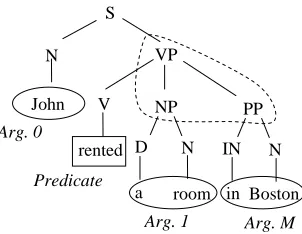
Figure 1 shows the parse tree for the sentence "John rented a room in Boston" along
Predicate Arg. 0
Arg. M S
N
NP
D N VP
V John
in rented
a room PP
IN N
[image:1.612.350.501.235.352.2]Boston Arg. 1
Figure 1: A predicate argument structure in a parse-tree rep-resentation.
with the semantic shallow information embodied by the verbal predicate to rent and its three arguments: Arg0, Arg1 and ArgM. The SCF of such verb, i.e. NP-PP, provides a synthesis of the predicate argu-ment structure.
Currently, the systems which aim to derive se-mantic shallow information from texts recognize the SCF of a target verb and represent it as a flat feature (e.g. (Xue and Palmer, 2004; Pradhan et al., 2004)) in the learning algorithm. To achieve this goal, a lex-icon which describes the SCFs for each verb, is re-quired. Such a resource is difficult to find especially for specific domains, thus, several methods to auto-matically extract SCF have been proposed (Korho-nen, 2003). In (Moschitti, 2004), an alternative to the SCF extraction was proposed, i.e. the SCF ker-nel (SK). The subcategorization frame of verbs was implicitly represented by means of the syntactic sub-trees which include the predicate with its arguments. The similarity between such syntactic structures was evaluated by means of convolution kernels.
Convolution kernels are machine learning ap-proaches which aim to describe structured data in
terms of its substructures. The similarity between two structures is carried out by kernel functions which determine the number of common substruc-tures without evaluating the overall substructure space. Thus, if we associate two SCFs with two subtrees, we can measure their similarity with such functions applied to the two trees. This approach determines a more syntactically motivated verb par-tition than the traditional method based on flat SCF representations (e.g. theNP-PP of Figure 1). The subtrees associated with SCF group the verbs which have similar syntactic realizations, in turn, accord-ing to Levin’s theories, this would suggest that they are semantically related.
A preliminary study on the benefit of such ker-nels was measured on the classification accuracy of semantic arguments in (Moschitti, 2004). In such work, the improvement on the PropBank arguments (Kingsbury and Palmer, 2002) classification sug-gests that SK adds information to the prediction of semantic structures. On the contrary, the perfor-mance decrease on the FrameNet data classification shows the limit of such approach, i.e. when the syn-tactic structures are shared among several semantic rolesSKseems to be useless.
In this article, we use Support Vector Machines (SVMs) to deeply analyze the role ofSKin the au-tomatic predicate argument classification. The ma-jor novelty of the article relates to the extensive ex-perimentation carried out on the PropBank (Kings-bury and Palmer, 2002) and FrameNet (Fillmore, 1982) corpora with diverse levels of task complex-ity, e.g. test instances of unseen predicates (typi-cal of free-text processing). The results show that: (1) once a structural representation of a linguistic object, e.g. SCF, is available we can use convolu-tion kernels to study its connecconvolu-tions with another linguistic phenomenon, e.g. the semantic predicate arguments. (2) The tree kernels automatically derive the features (structures) which support also a sort of back-off estimation in case of unseen verbs. (3) The structural features are in general robust in all testing conditions.
The remainder of this article is organized as fol-lows: Section 2 defines the Predicate Argument Ex-traction problem and the standard solution to solve it. In Section 3 we present our kernels whereas in Section 4 we show comparative results among
SVMs using standard features and the proposed ker-nels. Finally, Section 5 summarizes the conclusions.
2 Parsing of Semantic Roles and Semantic Arguments
There are two main resources that relate to predicate argument structures: PropBank (PB) and FrameNet (FN). PB is a 300,000 word corpus annotated with predicative information on top of the Penn Treebank 2 Wall Street Journal texts. For any given pred-icate, the expected arguments are labeled sequen-tially from Arg 0 to Arg 9, ArgA and ArgM. The Figure 1 shows an example of the PB predicate an-notation. Predicates in PB are only embodied by verbs whereas most of the times Arg 0 is the subject, Arg 1 is the direct object and ArgM may indicate lo-cations, as in our example.
FrameNet also describes predicate/argument structures but for this purpose it uses richer se-mantic structures called frames. These latter are schematic representations of situations involving various participants, properties and roles, in which a word may be typically used. Frame elements or semantic roles are arguments of target words that can be verbs or nouns or adjectives. In FrameNet, the argument names are local to the target frames. For example, assuming that attach is the target word and Attaching is the target frame, a typical sentence annotation is the following.
[Agent They] attachT gt [Item themselves] [Connector with their mouthparts] and then release a digestive enzyme secretion which eats into the skin.
Several machine learning approaches for argu-ment identification and classification have been de-veloped, e.g. (Gildea and Jurasfky, 2002; Gildea and Palmer, ; Gildea and Hockenmaier, 2003; Pradhan et al., 2004). Their common characteristic is the adop-tion of feature spaces that model predicate-argument structures in a flat feature representation. In the next section we present the common parse tree-based ap-proach to this problem.
2.1 Predicate Argument Extraction
along with their arguments. This problem can be divided into two subtasks: (a) the detection of the target argument boundaries, i.e. all its compound-ing words, and (b) the classification of the argument type, e.g. Arg0 or ArgM in PropBank or Agent and Goal in FrameNet.
The standard approach to learn both the detection and the classification of predicate arguments is sum-marized by the following steps:
1. Given a sentence from the training-set, gener-ate a full syntactic parse-tree;
2. let P and A be the set of predicates and the set of parse-tree nodes (i.e. the potential argu-ments), respectively;
3. for each pair<p, a>∈ P × A:
• extract the feature representation set,Fp,a;
• if the subtree rooted in a covers exactly the words of one argument of p, putFp,a
in T+ (positive examples), otherwise put it inT−(negative examples).
For instance, in Figure 1, for each combination of the predicate rent with the nodes N, S, VP, V,NP, PP,DorINthe instancesFrent,a are generated. In
case the nodeaexactly covers ”Paul”, ”a room” or ”in Boston”, it will be a positive instance otherwise it will be a negative one, e.g.Frent,IN.
TheT+andT−sets can be re-organized as posi-tiveTargi+ and negativeTargi− examples for each argu-menti. In this way, an individual ONE-vs-ALL clas-sifier for each argumentican be trained. We adopted this solution as it is simple and effective (Pradhan et al., 2004). In the classification phase, given a sen-tence of the test-set, all its Fp,a are generated and
classified by each individual classifierCi. As a final
decision, we select the argument associated with the maximum value among the scores provided by the individual classifiers.
2.2 Standard feature space
The discovery of relevant features is, as usual, a complex task, nevertheless, there is a common con-sensus on the basic features that should be adopted. These standard features, firstly proposed in (Gildea and Jurasfky, 2002), refer to a flat information de-rived from parse trees, i.e. Phrase Type, Predicate
Word, Head Word, Governing Category, Position and Voice. For example, the Phrase Type indicates the syntactic type of the phrase labeled as a predi-cate argument, e.g. NP forArg1 in Figure 1. The Parse Tree Path contains the path in the parse tree between the predicate and the argument phrase, ex-pressed as a sequence of non-terminal labels linked by direction (up or down) symbols, e.g. V ↑ VP↓ NPforArg1 in Figure 1. The Predicate Word is the surface form of the verbal predicate, e.g. rent for all arguments.
In the next section we describe the SVM approach and the basic kernel theory for the predicate argu-ment classification.
2.3 Learning with Support Vector Machines
Given a vector space in<nand a set of positive and negative points, SVMs classify vectors according to a separating hyperplane,H(~x) = w~ ×~x+b = 0, wherew~ ∈ <nandb ∈ <are learned by applying the Structural Risk Minimization principle (Vapnik, 1995).
To apply the SVM algorithm to Predicate Argu-ment Classification, we need a functionφ:F → <n to map our features spaceF ={f1, .., f|F|}and our
predicate/argument pair representation,Fp,a = Fz,
into<n, such that:
Fz→φ(Fz) = (φ1(Fz), .., φn(Fz))
From the kernel theory we have that:
H(~x) =³ X
i=1..l αi~xi
´
·~x+b=
X
i=1..l
αi~xi·~x+b=
X
i=1..l
αiφ(Fi)·φ(Fz) +b.
where, Fi ∀i ∈ {1, .., l} are the training instances
and the product KT(Fi, Fz) =<φ(Fi)·φ(Fz)>is
the kernel function associated with the mappingφ. The simplest mapping that we can apply is
φ(Fz) =~z = (z1, ..., zn)wherezi = 1if fi ∈ Fz
andzi = 0otherwise, i.e. the characteristic vector
of the setFz with respect to F. If we choose the
scalar product as a kernel function we obtain the lin-ear kernelKL(Fx, Fz) =~x·~z.
S
NP VP
VP CC VP
VB NP
took DT NN
the book
and VB NP
read PRP$ NN
its title PRP
John
S
NP VP
VP
VB NP
took
S
NP VP
VP
VB NP
read
Arg. 0 Arg. 0
Arg. 1 Arg. 1
[image:4.612.74.300.62.175.2]Sentence Parse-Tree Ftook Fread
Figure 2:Subcategorization frame structure for two predicate argument structures.
S
NP VP
VP
VB NP
took S
NP VP VP
VB NP
took VP
VB NP
S
NP VP
VP
VB NP S
NP VP
VP VB
took
VP
VP
VB NP
took VP
VP
VB NP
VP
VP
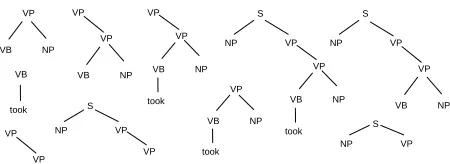
Figure 3: All 10 valid fragments of the SCFS associated with the arguments ofFtookof Figure 2.
KP oly(Fx, Fz) = (c+~x·~z)d, wherecis a constant
anddis the degree of the polynom.
The interesting property is that we do not need to evaluate theφfunction to compute the above vector; only the K(~x, ~z) values are required. This allows us to define efficient classifiers in a huge (possible infinite) feature set, provided that the kernel is pro-cessed in an efficient way. In the next section, we introduce the convolution kernel that we used to rep-resent subcategorization structures.
3 Subcategorization Frame Kernel (SK)
The convolution kernel that we have experimented was devised in (Moschitti, 2004) and is character-ized by two aspects: the semantic space of the sub-categorization structures and the kernel function that measure their similarities.
3.1 Subcategorization Frame Structure (SCFS)
We consider the predicate argument structures an-notated in PropBank or FrameNet as our semantic space. As we assume that semantic structures are correlated to syntactic structures, we used a ker-nel that selects semantic information according to the syntactic structure of a predicate. The subparse tree which describes the subcategorization frame of
the target verbal predicate defines the target Sub-categorization Frame Structure (SCFS). For exam-ple, Figure 2 shows the parse tree of the sentence "John took the book and read its title" to-gether with two SCFS structures, Ftook andFread
associated with the two predicates took and read, re-spectively. Note that SCFS includes also the external argument (i.e. the subject) although some linguistic theories do not consider it being part of the SCFs.
Once the semantic representation is defined, we need to design a tree kernel function to estimate the similarity between our objects.
3.2 The tree kernel function
The main idea of tree kernels is to model a
K(T1, T2)function which computes the number of the common substructures between two treesT1and
T2. For example, Figure 3 shows all the fragments of the argument structureFtook(see Figure 2) which
will be matched against the fragment of another SCFS.
Given the set of fragments {f1, f2, ..} = F ex-tracted from all SCFSs of the training set, we define the indicator function Ii(n) which is equal 1 if the
targetfi is rooted at nodenand 0 otherwise. It
fol-lows that:
K(T1, T2) = X
n1∈NT1
X
n2∈NT2
∆(n1, n2) (1)
where NT1 and NT2 are the sets of the T1’s and T2’s nodes, respectively and ∆(n1, n2) =
P|F|
i=1Ii(n1)Ii(n2). This latter is equal to the num-ber of common fragments rooted in then1 andn2 nodes. We can compute∆as follows:
1. if the productions at n1 and n2 are different then∆(n1, n2) = 0;
2. if the productions atn1 and n2 are the same, andn1andn2have only leaf children (i.e. they are pre-terminals symbols) then ∆(n1, n2) = 1;
3. if the productions atn1 and n2 are the same, andn1andn2are not pre-terminals then
∆(n1, n2) =
ncY(n1)
j=1
(1 + ∆(cjn1, cjn2)) (2)
[image:4.612.73.298.219.301.2]Note that, as the productions are the samenc(n1) =
nc(n2).
The above kernel has the drawback of assigning higher weights to larger structures1. To overcome this problem we can scale the relative importance of the tree fragments using a parameter λin the con-ditions 2 and 3 as follows: ∆(nx, nz) = λ and
∆(nx, nz) =λ
Qnc(nx)
j=1 (σ+ ∆(cjn1, cjn2)).
The set of fragments that belongs to SCFs are derived by human annotators according to seman-tic considerations, thus they generate a semanseman-tic subcategorization frame kernel (SK). We also note that SK estimates the similarity between two SCFSs by counting the number of fragments that are in common. For example, in Figure 2,
KT(φ(Ftook), φ(Fread))is quite high (i.e. 6 out 10 substructures) as the two verbs have the same syn-tactic realization.
In other words the fragments encode semantic in-formation which is measured bySK. This provides the argument classifiers with important clues about the possible set of arguments suited for a target ver-bal predicate. To support this hypothesis the next section presents the experiments on the predicate ar-gument type of FrameNet and ProbBank.
4 The Experiments
A clustering algorithm which usesSKwould group together verbs that show a similar syntactic struc-ture. To study the properties of such clusters we ex-perimentedSK in combination with the traditional kernel used for the predicate argument classification. As the polynomial kernel with degree3was shown to be the most accurate for the argument classifica-tion (Pradhan et al., 2004; Moschitti, 2004) we use it to build two kernel combinations:
• P oly+SK: |KP olyKP oly|+γ|KTKT|, i.e. the sum be-tween the normalized polynomial kernel (see Section 2.3) and the normalizedSK2.
• P oly × SK: |KP olyKP oly|×|×KTKT|, i.e. the normal-ized product between the polynomial kernel
1With a similar aim and to have a similarity score between 0 and 1, we also apply the normalization in the kernel space, i.e.
K0(T
1, T2) =√ K(T1,T2) K(T1,T1)×K(T2,T2).
2To normalize a kernel K(~x, ~z) we can divide it by
p
K(~x, ~x)×K(~z, ~z).
andSK.
For the experiments we adopted two corpora PropBank (PB) and FrameNet (FN). PB, avail-able at www.cis.upenn.edu/∼ace, is used along with the Penn TreeBank 2 (www.cis.upenn.edu /∼treebank) (Marcus et al., 1993). This corpus contains about 53,700 sentences and a fixed split be-tween training and testing which has been used in other researches, e.g. (Pradhan et al., 2004; Gildea and Palmer, ). In this split, Sections from 02 to 21 are used for training, section 23 for testing and sec-tions 1 and 22 as development set. We considered all 12 arguments from Arg0 to Arg9, ArgA and ArgM for a total of 123,918 and 7,426 arguments in the train-ing and test sets, respectively. It is worth nottrain-ing that in the experiments we used the gold standard parsing from the Penn TreeBank, thus our kernel structures are derived with high precision.
The second corpus was obtained by extract-ing from FrameNet (www.icsi.berkeley.edu/ ∼framenet/) all 24,558 sentences from 40 frames of the Senseval 3 (http://www.senseval.org) Au-tomatic Labeling of Semantic Role task. We con-sidered 18 of the most frequent roles for a total of 37,948 arguments3. Only verbs are selected to be
predicates in our evaluations. Moreover, as there is no fixed split between training and testing, we ran-domly selected 30% of the sentences for testing and 30% for validation-set, respectively. Both training and testing sentences were processed using Collins’ parser (Collins, 1997) to generate parse-tree auto-matically. This means that our shallow semantic parser for FrameNet is fully automated.
4.1 The Classification set-up
The evaluations were carried out with the SVM-light-TK software (Moschitti, 2004) available at http://ai-nlp.info.uniroma2.it/moschitti/ which encodes the tree kernels in the SVM-light software (Joachims, 1999).
The classification performance was measured us-ing the F1 measure4 for the individual arguments and the accuracy for the final multi-class classifier. This latter choice allows us to compare the results
3
We mapped together roles having the same name 4F
with previous literature works, e.g. (Gildea and Jurasfky, 2002; Pradhan et al., 2004; Gildea and Palmer, ).
For the evaluation of SVMs, we used the default regularization parameter (e.g., C = 1 for normal-ized kernels) and we tried a few cost-factor values (i.e., j ∈ {1,2,3,5,7,10,100}) to adjust the rate between Precision and Recall. We chose the pa-rameters by evaluating the SVMs using the KP oly
kernel (degree = 3) over the validation-set. Bothλ
(see Section 3.2) and γ parameters were evaluated in a similar way by maximizing the performance of SVM using Poly+SK. We found that the best values were 0.4 and 0.3, respectively.
4.2 Comparative results
To study the impact of the subcategorization frame kernel we experimented the three models P oly,
P oly+SK and P oly×SK on different training conditions.
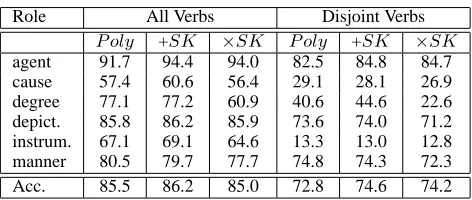
First, we run the above models using all the verbal predicates available in the training and test sets. Ta-bles 1 and 2 report theF1 measure and the global accuracy for PB and FN, respectively. Column 2 shows the accuracy ofP oly(90.5%) which is sub-stantially equal to the accuracy obtained in (Prad-han et al., 2004) on the same training and test sets with the same SVM model. Columns 3 and 4 show that the kernel combinationsP oly+SK and
P oly × SK remarkably improve P oly accuracy, i.e. 2.7% (93.2% vs. 90.5%) whereas on FN only
P oly+SKproduces a small accuracy increase, i.e. 0.7% (86.2% vs. 85.5%).
This outcome is lower since the FN classification requires dealing with a higher variability of its se-mantic roles. For example, in ProbBank most of the time, the PB Arg0 and Arg1 corresponds to the log-ical subject and loglog-ical direct object, respectively. On the contrary, the FN Cause and Agent roles are often both associated with the logical subject and share similar syntactic realizations, making SCFS less effective to distinguish between them. More-over, the training data available for FrameNet is smaller than that used for PropBank, thus, the tree kernel may not have enough examples to generalize, correctly.
Second, we carried out other experiments using a subset of the total verbs for training and another
Args All Verbs Disjoint Verbs
P oly +SK ×SK P oly +SK ×SK
Arg0 90.8 94.6 94.7 86.8 90.9 91.1 Arg1 91.1 92.9 94.1 81.7 86.8 88.3 Arg2 80.0 77.4 82.0 49.9 49.5 47.6 Arg3 57.9 56.2 56.4 20.3 22.9 20.6
Arg4 70.5 69.6 71.1 0 0 0
[image:6.612.312.543.58.160.2]ArgM 95.4 96.1 96.3 90.3 93.4 93.7 Acc. 90.5 92.4 93.2 82.1 86.3 86.9
Table 1:Kernel accuracies on PropBank.
Role All Verbs Disjoint Verbs
P oly +SK ×SK P oly +SK ×SK
agent 91.7 94.4 94.0 82.5 84.8 84.7 cause 57.4 60.6 56.4 29.1 28.1 26.9 degree 77.1 77.2 60.9 40.6 44.6 22.6 depict. 85.8 86.2 85.9 73.6 74.0 71.2 instrum. 67.1 69.1 64.6 13.3 13.0 12.8 manner 80.5 79.7 77.7 74.8 74.3 72.3 Acc. 85.5 86.2 85.0 72.8 74.6 74.2 Table 2:Kernel accuracies on 18 FrameNet semantic roles.
disjoint subset for testing. In these conditions, the impact ofSKis amplified: on PB,SK×P oly out-performs Poly by 4.8% (86.9% vs. 82.1%), whereas, on FN,SK increases Poly of about 2%, i.e. 74.6% vs. 72.8%. These results suggest that (a) when test-set verbs are not observed during training, the clas-sification task is harder, e.g. 82.1% vs. 90.5% on PB and (b) the syntactic structures of the verbs, i.e. the SCFSs, allow the SVMs to better generalize on unseen verbs.
[image:6.612.313.549.184.284.2](a) PropBank Multi-classifier 0.83 0.85 0.87 0.89 0.91 0.93 0.95 0.97
1-5 6-10 11-15 16-30 31-60 61-100 101-300 301-400 401-600 601-700 701-1000 >1000 Verb Frequency A c c u ra c y Poly Poly+SK
(b) Arg0 Classifier
0.85 0.87 0.89 0.91 0.93 0.95 0.97
1-5 6-10 11-15 16-30 31-60 61-100 101-300 301-400 401-600 601-700 701-1000 >1000 Verb Frequency F 1 Poly Poly+SK
(c) PropBank Multi-classifier
0.80 0.82 0.84 0.86 0.88 0.90 0.92 0.94
1 2-3 4-5 6-10 11-15 16-20 21-25 26-30 31-35 36-40 41-45 46-50 >50 # SCF Type
A c c u ra c y Poly Poly+SK
(d) Arg0 Classifier
0.80 0.82 0.84 0.86 0.88 0.90 0.92 0.94
1 2-3 4-5 6-10 11-15 16-20 21-25 26-30 31-35 36-40 41-45 46-50 >50 # SCF Type
F
1
Poly Poly+SK
(e) FrameNet Multi-classifier
0.60 0.65 0.70 0.75 0.80 0.85 0.90
1 2-3 4-5 6-10 11-15 16-20 21-2526-30 31-3536-40 41-4546-50 >50 # SCF Type
A c c u ra c y Poly Poly+SK
(f) Agent Classifier
0.65 0.70 0.75 0.80 0.85 0.90 0.95 1.00
1 2-3 4-5 6-10 11-15 16-20 21-25 26-30 31-35 36-40 41-45 46-50 >50 # SCF Type
F
1
[image:7.612.80.530.54.355.2]Poly Poly+SK
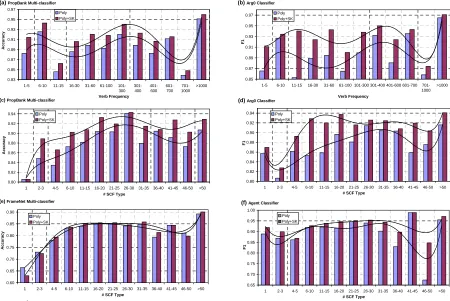
Figure 4: The impact of SCF on the classification accuracy of the semantic arguments and semantic roles according to the verb complexity.
of verb’s SCF types the more difficult is the classifi-cation of its arguments.
Figure 4.a, reports the accuracy along with the trend line plot of P oly andSK+P oly according to subsets of different verb frequency. For example, the label 1-5 refers to the class of verbal predicates whose frequency ranges from 1 to 5. The associated accuracy is evaluated on the portions of the training and test-sets which contain only the verbs in such class. We note thatSK improvesP olyfor any verb frequency. Such improvement decreases when the frequency becomes very high, i.e. when there are many training instances that can suggest the correct classification. A similar behavior is shown in Figure 4.b where theF1measure for Arg0 of PB is reported.
Figures 4.c and 4.d illustrate the accuracy and the
F1 measure for all arguments and Arg0 of PB ac-cording to the number of SCF types, respectively. We observe that the Semantic Kernel does not pro-duce any improvement on the verbs which are syn-tactically expressed by only one type of SCF. As the number of SCF types increases (> 1) P oly+SK
outperformsP oly for any verb class, i.e. when the
verb is enough complexSK always produces use-ful information independently of the number of the training set instances. On the one hand, a high num-ber of verb instances reduces the complexity of the classification task. On the other hand, as the num-ber of verb type increases the complexity of the task increases as well.
A similar behavior can be noted on the FN data (Figure 4.e) even if the not so strict correlation be-tween syntax and semantics preventsSKto produce high improvements. Figure 4.f shows the impact of
SKon the Agent role. We note that, theF1increases more than the global accuracy (Figure 4.e) as the Agent most of the time corresponds to Arg0. This is confirmed by the Table 2 which shows an improve-ment for the Agent of up to 2% when SK is used along with the polynomial kernel.
5 Conclusive Remarks
FrameNet corpora. To study the SK’s verb clas-sification properties we have combined it with the polynomial kernel on standard flat features.
We run the SVMs on diverse levels of task com-plexity. The results show that: (1) in general SK remarkably improves the classification accuracy. (2) When there are no training instances of the test-set verbs the improvement ofSK is almost double. This suggests that tree kernels automatically derive features which support also a sort of back-off esti-mation in case of unseen verbs. (3) In all complexity conditions the structural features are in general very robust, maintaining a high improvement over the ba-sic accuracy. (4) The semantic role classification in FrameNet is affected with more noisy data as it is based on the output of a statistical parser. As a con-sequence the improvement is lower. Anyway, the systematic superiority ofSK suggests that it is less sensible to parsing errors than other models. This opens promising direction for a more weakly super-vised application of the statistical semantic tagging supported bySK.
In summary, the extensive experimentation has shown that theSKprovides information robust with respect to the complexity of the task, i.e. verbs with richer syntactic structures and sparse training data.
An important observation on the use of tree ker-nels has been pointed out in (Cumby and Roth, 2003). Both computational efficiency and classifi-cation accuracy can often be superior if we select the most informative tree fragments and carry out the learning in the feature space. Nevertheless, the case studied in this paper is well suited for using ker-nels as: (1) it is difficult to guess which fragment from an SCF should be retained and which should be discarded, (2) it may be the case that all frag-ments are useful as SCFs are small structures and all theirs substructures may serve as different back-off levels and (3) small structures do not heavily penal-ize efficiency.
Future research may be addressed to (a) the use ofSKkernel to explicitly generate verb clusters and (b) the use of convolution kernels to study other lguistic phenomena: we can use tree kernels to in-vestigate which syntactic features are suited for an unknown phenomenon.
Acknowledgement
We would like to thank the anonymous reviewers for their competence and commitment showed in the re-view of this paper.
References
Michael Collins. 1997. Three generative, lexicalized models for statistical parsing. In Proceedings of the
ACL’97,Somerset, New Jersey.
Chad Cumby and Dan Roth. 2003. Kernel methods for relational learning. In Proceedings of ICML’03, Wash-ington, DC, USA.
Charles J. Fillmore. 1982. Frame semantics. In
Linguis-tics in the Morning Calm, pages 111–137.
Daniel Gildea and Julia Hockenmaier. 2003. Identifying semantic roles using combinatory categorial grammar. In Proceedings of EMNLP’03, Sapporo, Japan. Daniel Gildea and Daniel Jurasfky. 2002. Automatic
la-beling of semantic roles. Computational Linguistic, 28(3):496–530.
Daniel Gildea and Martha Palmer. The necessity of pars-ing for predicate argument recognition. In
Proceed-ings of ACL’02.
T. Joachims. 1999. Making large-scale SVM learning practical. In B. Scho¨lkopf, C. Burges, and A. Smola, editors, Advances in Kernel Methods - Support Vector
Learning.
Paul Kingsbury and Martha Palmer. 2002. From Tree-bank to PropBank. In Proceedings of LREC’02.
Anna Korhonen. 2003. Subcategorization Acquisi-tion. Ph.D. thesis, Techical Report
UCAM-CL-TR-530. Computer Laboratory, University of Cambridge.
Beth Levin. 1993. English Verb Classes and
Alterna-tions A Preliminary Investigation. Chicago:
Univer-sity of Chicago Press.
M. P. Marcus, B. Santorini, and M. A. Marcinkiewicz. 1993. Building a large annotated corpus of en-glish: The Penn Treebank. Computational Linguistics, 19:313–330.
Alessandro Moschitti. 2004. A study on convolution kernels for shallow semantic parsing. In proceedings
ACL’04, Barcelona, Spain.
Sameer Pradhan, Kadri Hacioglu, Valeri Krugler, Wayne Ward, James H. Martin, and Daniel Jurafsky. 2005. Support vector learning for semantic argument classi-fication. to appear in the Machine Learning Journal.
V. Vapnik. 1995. The Nature of Statistical Learning
The-ory. Springer.