Learnability-based Syntactic Annotation Design
Ro y Schwar tz Omri Abend Ari Rappopor t
Institute of Computer Science, Hebrew University of Jerusalem
{roys02|omria01|arir}@cs.huji.ac.il
Abstract
There is often more than one way to represent syntactic structures, even within a given formalism. Selecting one representation over another may affect parsing performance. Therefore, selecting between alternative syntactic representations (henceforth, syntactic selection) is an essential step in designing an annotation scheme. We present a methodology for syntactic selection and apply it to six central dependency structures. Our methodology compares pairs of annotation schemes that differ in the annotation of a single structure. It selects the more learnable scheme, namely the one that can be better learned using statistical parsers. We find that in three of the structures, one anno-tation is unequivocally better than the alternatives. Our results are consistent over various settings involving five parsers and two definitions of learnability. Furthermore, we show that the learnabil-ity gains incurred by our selections are both considerable (error reductions of up to 19.8%) and additive. The contribution of this work is in demonstrating that syntactic selection has a substantial and predictable effect on parsing performance, and showing that this effect can be effectively used in designing syntactic annotation schemes.
1
Introduction
The formal manner in which syntactic relations are represented is at the core of the study of gram-mar. Numerous representations have been proposed over the years for expressing similar syntactic relations. This diversity of representations is expressed in a variety of syntactic annotation schemes currently in use in NLP. Examples include, for constituency annotation, schemes by (Marcus et al. 1993; Sampson 1995; Nelson et al. 2002, inter alia) and for dependency annotation, schemes by (Collins 1999; Rambow et al. 2002; Yamada and Matsumoto 2003; Johansson and Nugues 2007, inter alia). Variation within the same formalism is expressed in structures that have several alterna-tive annotations (henceforth Varying Syntactic Structure or VSS).
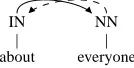
In this work we focus on dependency structures, where some of the most basic structures are VSS’s. One example is prepositional phrases, which consist of a preposition followed by a noun phrase (e.g., “about everyone”). While some schemes select the preposition to head the NP (Collins 1999), others select the NP as the head of the preposition (Johansson and Nugues 2007) (see Fig-ure 1). Other prominent VSS’s include coordination structFig-ures and verb group constructions (see Section 3). In fact, more than 40% of the tokens in the Penn Treebank (Marcus et al. 1993) partici-pate in at least one VSS (Schwartz et al. 2011).
IN
about
NN
[image:2.420.163.230.250.284.2]everyone
Figure 1: An example of a prepositional phrase – a Varying Syntactic Structure (VSS). Both annotation alternatives for this structure are plausible: either setting the preposition (“about” – solid line) as head, or the noun phrase (“everyone” – dashed line).
Despite the similar content represented by the alternative annotations to VSS’s, selecting one over the other (syntactic selection) may have significant empirical implications. Previous work showed that syntactic selection can affect the parsing performance of a specific parser (see Section 7). In this work, we are the first to show that in some VSS’s, syntactic selections improves parsing performance consistently across different parsers. As our findings are not parser-specific, they can be used to guide future syntactic annotation design.
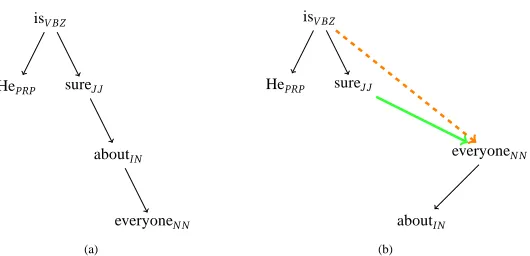
The empirical implications of syntactic selection stem from the inter-relations between the VSS’s and their surrounding structures. Figure 2 presents two alternative annotations for the sentence “he is sure about everyone”. The alternatives differ in whether the preposition (“about”) or the NP (“everyone”) is selected to head the PP (“about everyone”). The two annotations can be determin-istically derived from one another and express a similar syntactic relation, namely in both cases the PP is the complement of the adjective “sure”. However, selecting one of the alternatives (the preposition) and not the other (the NP) results in a more learnable scheme.
isV BZ
HePRP sureJ J
aboutIN
everyoneN N
(a)
isV BZ
HePRP sureJ J
everyoneN N
[image:3.420.67.332.63.191.2]aboutIN (b)
Figure 2:Exploring the effect of VSS annotation on neighboring structures. The sentence “He is sure about everyone”, annotated when prepositions head PPs (Figure 2(a)) and when NPs head PPs (Figure 2(b)). Thin solid black lines mark gold+parser edges, thick green solid edges markgold edges, and thick orange dashed lines markparser edges.
The implications of syntactic selection underscore the importance of taking empirical considera-tions into account when designing an annotation scheme. In this work, we propose learnability as an empirical criterion for syntactic selection. The notion that more learnable schemes are prefer-able is motivated both practically and theoretically. Practically, more learnprefer-able schemes result in more accurate parsers. Theoretically, learnability has been a major consideration in the design of phrase structure grammar (Chomsky 2006), and can also be seen as a measure of simplicity, a fundamental principle in many other scientific fields (see Section 7).
We present a learnability-based methodology for syntactic selection and apply it to six central VSS’s. We compare alternative annotations for each VSS, by examining pairs of schemes that differ only in their annotation of this VSS. For each pair, we pick the scheme that can be more easily learned using statistical parsers. We select an annotation for this VSS if we find that the schemes that use this annotation are consistently picked.
We experiment with five parsers of various types and using two different learnability measures. We obtain highly consistent results. Our experiments show that for three of the VSS’s there is one alternative that is more learnable over all settings. That is, training any of the five parsers on an annotation scheme that uses the more learnable alternative results in higher parsing performance. The differences are substantial in magnitude, yielding error reductions that range between 2.4%-19.8%. Moreover, this gain is additive – using all three of the more learnable alternatives results in an even more accurate parser.
To further establish learnability as a coherent empirical criterion for syntactic selection, we show that our results are consistent with a parser-independent measure based on information theoretic notions.
Section 2 describes our methodology. Section 3 discusses Varying Syntactic Structures (VSS). Experimental setup and results are described in Sections 4, 5. Section 6 discusses our methodol-ogy and presents further experiments that provide a wider context for understanding our findings. Section 7 surveys related work.
2
Methodology
We present a learnability-based methodology for selecting between alternative annotations for VSS’s.
2.1
Notation
In the following we give a formal definition of an annotation scheme. We then turn to describe the different settings in which our methodology conducts experiments.
Our methodology experiments with a setSof VSS’s. For eachs∈S, we examine a set of alternative annotations. For clarity of presentation we assume each VSS has exactly two alternatives and denote themαs,βs. Letkdenote the size ofS(k=6in our experiments).
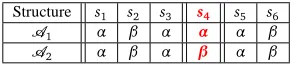
An annotation scheme is defined as a selection of an annotation for each of the structures in the language. It therefore includes a (fixed) annotation for non-VSS’s, as well as a selected annotation for each of the VSS’s. We can thus represent a schemeA as ak-tuple that selects one of the alternative annotations for each of the VSS’s inS(all in all,2k schemes). Table 1 shows an example of two annotation schemes that differ in the annotation of exactly one structure (s4).
Structure s1 s2 s3 s4 s5 s6
A1 α β α α α β
[image:4.420.130.277.291.324.2]A2 α β α β α β
Table 1:Applying our methodology to VSS’s(s1, . . . ,s6):A1,A2are annotation schemes that are identical in their annotation of all the VSS’s buts4(bold redcolumn).α,βare short forαsi,βsirespectively.
To obtain robust results, our methodology repeats each experiment in different settings, each deter-mined by a parser and a learnability measure. We useP(L) to refer to the set of parsers (learnability measures). We use|P|=5,|L|=2, all in all5×2=10settings.
2.2
Learnability Measures
We propose two straightforward definitions of learnability. They are both defined with respect to a parserpand an annotation schemeA (as defined above). Both measures assume a fixed corpus partitioned into a training set and a test set.
The first measure is “Accuracy-Learnability”. To compute it, we trainpon the training set an-notated according toA, parse the test set, and evaluate it against the annotation determined by A. We use attachment score for evaluation, which is the standard measure for dependency pars-ing evaluation. An annotation for whichpreceives a higher attachment score is considered more learnable.
evaluate the trained parser on our test data (annotated withA) and create a learning curve ofpand A. An annotation for whichpreachesβusing less training samples is considered more learnable.
2.3
Learnability-based Methodology
We turn to describing a methodology for selecting learnable annotations for VSS’s. The methodol-ogy runs a set of experiments, each using a parserp, a learnability measureland a schemeA. In each experiment, we compute the learnability ofAwith respect topandl.
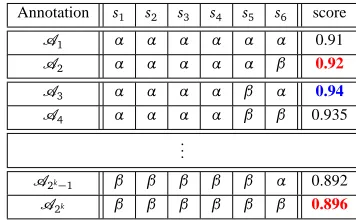
For everys∈Sand alternative annotationsαs,βs, there are2k/2pairs of schemes that differ only in their annotation ofs, one usingαs, and the other usingβs(see Table 1 for an example). Given a parserpand a learnability measurel, we compute the learnability of each pair of schemes and pick the more learnable scheme (see Table 2). We count the number of pairs in which the scheme using αsis picked and the number of pairs in which the scheme usingβsis picked. We thus receive two figures that sum up to2k/2(32 in our experiments).
Annotation s1 s2 s3 s4 s5 s6 score
A1 α α α α α α 0.91
A2 α α α α α β 0.92
A3 α α α α β α 0.94
A4 α α α α β β 0.935
.. .
A2k−1 β β β β β α 0.892
[image:5.420.126.304.215.326.2]A2k β β β β β β 0.896
Table 2: Applying our methodology for selecting a syntactic annotation for VSSs6, under parserpand learnability measurel: each row in the table is an experiment with annotation schemeAi. The experiment compares the learnability (last column) of pairs of annotation schemes that differ only in their annotation of
s6(where the annotations fors1, . . . ,s5are fixed). For each pair of annotation schemes, the more learnable annotation fors6is in boldface (blue forα, red forβ).
We then define a significance value1≥r≫0.5. If one annotation (sayαs) is more learnable than the other (with respect top,l) in a relative portionrof these pairs, we say thatpisr-biased towardsαswith respect tol.
If for somes∈S, it holds that for everyp∈P,l∈L,pisr-biased (r≫0.5) with respect tol to-wards the same annotation (say,αs), we say there is a unanimousr-bias towardsαs. Consequently, αsis the empirically preferred annotation ofs.
3
Varying Dependency Structures
Varying syntactic structures are prevalent in many syntactic formalisms (see Section 7). In this section we focus on dependency structures.
1. Hdetermines the syntactic category ofCand can often replaceC. 2. Hdetermines the semantic category ofC;Dgives semantic specification. 3. The form ofDdepends onH.
These definitions can often be applied to determine the identity of the head. For example, according to (1,2) a noun is the head of its modifying adjective (e.g., “cat” in “big cat”) and a verb is the head of its adverb (e.g., “eat” in “eat quickly”).
In VSS’s, these criteria are either inapplicable or conflicting. For example, in a sequence of proper nouns (e.g., “John Smith”), neither criterion is applicable. In a verb group construction (e.g., “can eat”), the main verb should be the head according to (2). On the other hand, the preceding modal restricts the main verb to be in infinitive form, and thus should be the head according to (3) (e.g., “he can eat” vs. “he eats”).
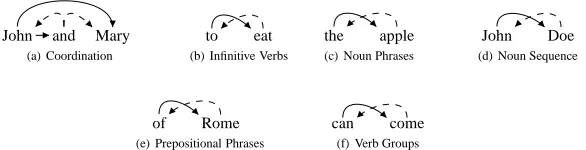
Such structures have led to the creation of several dependency schemes, each taking a different approach to annotating them (Collins 1999; Rambow et al. 2002; Yamada and Matsumoto 2003; Johansson and Nugues 2007, inter alia). We turn to describing the VSS’s that we experiment with and the alternatives annotations we consider for them. All of these annotations are in use in NLP. They are also plausible from a theoretical standpoint. Figure 3 shows a diagram for each of the structures, along with their possible annotations.
Coordination Structures are composed of two words, separated by a conjunction (e.g., “John and Mary”). It is not clear which token should be the head of this structure, if any (Nilsson et al. 2006). We consider two alternative annotations: (a) setting the conjunction as head, and both conjuncts as its dependents and (b) setting either of the conjuncts as head, selected according to the specific structure type (e.g., noun phrase, verb phrase).
Infinitive Verbs are verb phrases that contain the sequence “to” + infinitive verb (e.g., “to eat”). In (Yamada and Matsumoto 2003) the verb is the head, while in (Collins 1999) the “to” token is the head. We consider both annotations.
Noun Phrases that contain a determiner and a noun (e.g., “the apple” or “a dog”). Either the determiner (Bosco and Lombardo 2004) or the noun (Collins 1999) may serve as the head. We consider both annotations.
Noun Sequences are noun phrases that contain sequences of more than one noun (e.g., “John Doe”). Various alternative annotations for this structure include (Collins 1999), which takes the last noun as head, and BIO’s scheme which is somewhat more complex (Dredze et al. 2007). We consider either the rightmost or the leftmost noun as head, and mark all other nouns as its depen-dents.
Prepositional Phrases consist of a preposition and a noun phrase (e.g., “in a bag” or “of Rome”). Complement clauses that contain a subordinating conjunction (e.g., “after you go”) are also included1. Either the preposition/subordinating conjunction (Collins 1999) or the NP/clause
(Johansson and Nugues 2007) can be the head. We consider both alternatives.
Verb Groups are composed of a verb and a modal verb (e.g., “can come”). Some schemes select the modal as head (Collins 1999), others select the verb (Rambow et al. 2002). We consider both
John and Mary (a) Coordination
to eat (b) Infinitive Verbs
the apple (c) Noun Phrases
John Doe (d) Noun Sequence
of Rome (e) Prepositional Phrases
[image:7.420.73.366.66.141.2]can come (f) Verb Groups
Figure 3: The VSS’s with which we experiment. The possible annotations for each structure are marked using solid and dashed lines.
alternatives2.
4
Experimental Setup
4.1
The Parsers
In this work we experiment with five parsers of different types. We briefly describe them.
Dependency Model with Valence (DMV) (Klein and Manning 2004) is a generative parser that defines a probabilistic grammar for unlabeled dependency structures. This parser is widely used in the field of unsupervised dependency parsing, where the great majority of recent works are in fact elaborations of this model (e.g., (Cohen and Smith 2009; Headden III et al. 2009)). In our experiments we use a supervised version of this parser, by training it using maximum likelihood estimation (MLE). This approach was used in various previous works as an upper bound for the unsupervised model (Blunsom and Cohn 2010; Spitkovsky et al. 2011). Decoding is performed using the Viterbi algorithm3.
MST Parser (McDonald et al. 2005)4formulates dependency parsing as a search for a maximum spanning tree (MST). It uses online training and extends the Margin Infused Relaxed Algorithm (MIRA) (Crammer and Singer 2003) to learning with structured outputs.
Clear Parser (Choi and Nicolov 2009)5is a fast transition-based parser that uses the robust risk
minimization technique (Zhang et al. 2002). k-best ranking is used to prune the next state in de-coding.
Su Parser (Nivre 2009)6 is a transition-based parser and an extension of the MALT parser (Nivre et al. 2006). The parser starts by constructing arcs between adjacent words and then swaps the order of input words in order to learn more complex structures. It uses the stackeager algorithm, and is trained using various linear classifiers (including SVM).
NonDir Parser (Goldberg and Elhadad 2010)7is a non-directional, easy-first parser, which is
greedy and deterministic. It first attempts to induce a non-directional version of the easiest arcs in
2Some definitions of verb groups also include auxiliaries. We choose to exclude them from our definition since we use the PTB POS set, which distinguishes modals, but not auxiliaries, from other verbs.
3http://www.cs.columbia.edu/~scohen/parser.html
4http://www.seas.upenn.edu/~strctlrn/MSTParser/MSTParser.html 5http://code.google.com/p/clearparser/
6http://maltparser.org/
a dependency structure, and continues by iteratively selecting the best pair of neighbors to connect, until a complete dependency tree is created.
These parsers span the major approaches to statistical dependency parsing. The two main ap-proaches are (Kübler et al. 2009) (a) transition-based methods that use state machines to map sen-tences to dependency graphs, attempting to reach the optimal state; and (b) graph-based methods, which try to find the best scoring dependency graph in some graph space. Clear Parser and Su Parser are examples of (a), while MST Parser and DMV are examples of (b). NonDir takes a somewhat different parsing approach.
4.2
Technical Details
Following standard practice in English, used in the great majority of recent works, all the corpora are generated by converting constituency annotation to dependency using a set of head percolation rules8. Using these rules is also suitable here since they can easily be manipulated to create the
different corpora required for applying our methodology.
Parsers are trained on sections 2–21 of the Penn TreeBank (PTB) WSJ corpus (Marcus et al. 1993), and are tested on section 23. We use the default feature set for each of the parsers. Evaluation is done using unlabeled attachment score, a common evaluation measure for dependency parsing.
For the Rate-Learnability measure, we select a differentβvalue for each parser, due to their dif-ferent performance levels;βis set to be the attachment score of the least learnable annotation for that parser, as determined by our experiments with the Accuracy-Learnability measure. This is the highest value ofβthat all schemes would reach at some point along their learning curve.
5
Results
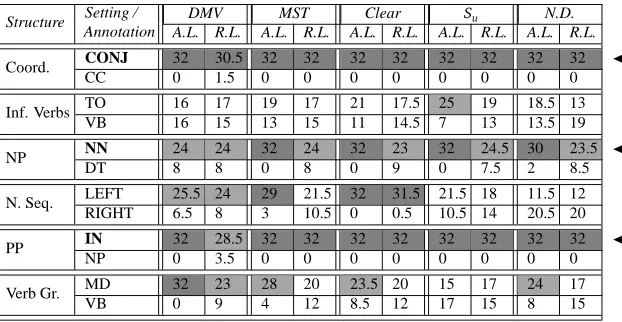
Table 3 shows our results. In three out of the six structures, a strong unanimous bias is found. A unanimous 0.9-bias is found towards (a) selecting the preposition as head of prepositional phrases, and (b) selecting either of the conjuncts as head of coordination structures. A unanimous 0.7-bias is found towards the noun in noun phrases. For these structures, one annotation is clearly more learnable than the other, independently of the selected annotations for the other structures. This gives an empirical motivation for using these annotations.
In two of the remaining structures (verb groups and noun sequences), we find a trend towards one of the annotations; in five of the settings a 0.7-bias is found towards one alternative (modal and leftmost noun, respectively). In the other five settings no strong bias is found towards either alternative. In these structures, it might be the case that certain modeling assumptions incorporated into the parsers affect whether one alternative is preferred or not. This calls for a more detailed investigation, which we defer to future work.
Finally, no considerable bias is found in the infinitive verb structures, as a 0.7-bias towards any alternative is found in only one setting. Thus, our experiments suggest no preference towards either alternative in this case.
8
Structure Setting / Annotation
DMV MST Clear Su N.D.
A.L. R.L. A.L. R.L. A.L. R.L. A.L. R.L. A.L. R.L.
Coord. CONJ 32 30.5 32 32 32 32 32 32 32 32
CC 0 1.5 0 0 0 0 0 0 0 0
Inf. Verbs TO 16 17 19 17 21 17.5 25 19 18.5 13
VB 16 15 13 15 11 14.5 7 13 13.5 19
NP NN 24 24 32 24 32 23 32 24.5 30 23.5
DT 8 8 0 8 0 9 0 7.5 2 8.5
N. Seq. LEFT 25.5 24 29 21.5 32 31.5 21.5 18 11.5 12
RIGHT 6.5 8 3 10.5 0 0.5 10.5 14 20.5 20
PP IN 32 28.5 32 32 32 32 32 32 32 32
NP 0 3.5 0 0 0 0 0 0 0 0
Verb Gr. MD 32 23 28 20 23.5 20 15 17 24 17
[image:9.420.63.374.70.231.2]VB 0 9 4 12 8.5 12 17 15 8 15
Table 3:Exploring the learnability of the different annotation schemes. Each row pair corresponds to a pair of annotations for a given VSS, and each column pair corresponds to a parser, under Accuracy-Learnability (A.L.) and Rate-Learnability (R.L.) (see Section 2). For a given VSS, learnability measure and parser, we show the number of times one annotation is more learnable than the alternative. There are 32 experiments with each such combination, each has a single winner, resulting in a pair of numbers that sums up to 32. Gray cells mark settings in which the annotation is substantially more learnable than the alternative (dark/light gray correspond tor=0.9/0.7respectively). Rows marked with an arrow () mark annotations that are unanimously biased. The annotations (see Section 3): Coordinations – headed by one of the conjuncts (CONJ) or by the conjunc-tion (CC) ; Infinitive Verbs – headed by “to” (TO) or by the Verb (VB) ; Noun Phrases – headed by the noun (Noun) or by the determiner (DT) ; Noun Sequences – headed by the left/rightmost noun (LEFT/RIGHT); Prepositional Phrases – headed by the preposition (IN) or by the noun phrase (NP) ; Verb Groups – headed by the modal (MD) or by the Verb (VB). The Parsers (see Section 4.1): DMV (Klein and Manning 2004) ; MST (McDonald et al. 2005) ; Clear (Choi and Nicolov 2009) ; Su(Nivre 2009) ; N.D. – NonDir
(Goldberg and Elhadad 2010).
5.1
Analysis
The empirically preferred annotations cannot be reduced to any simple, intuitive rule. For example, they do not match simple distinctions such as the one between closed and open classes: some of the more learnable annotations select closed class tags as heads (e.g., the preposition in prepositional phrases), while others select open class tags (e.g., the noun in noun phrases). Similarly, it is also not necessarily the rightmost or the leftmost word in the structure that is preferred.
Struct. DMV MST Clear Su N.D. Err. Red. Avg. Per.
Diff.
Coord. 1.3% 1.2% 2.1% 1.6% 0.9% 3.7-19.8% NP 1.6% 0.2% 0.3% 0.5% 0.2% 2.4-4.8% PP 2.6% 1.6% 1.1% 1.0% 0.9% 7.4-15.3% Best – Worst 8.3% 3.4% 4.2% 3.4% 2.5% 22.2-35.3%
[image:10.420.60.348.69.136.2]Avg. Per. 66.2% 90.1% 90.2% 89.2% 90.4% —
Table 4:The average performance gain incurred by selecting the empirically preferred annotations for the VSS’s for which a unanimous bias is found. The last column is the error reduction range. The last row shows the mean attachment score of each parser when averaging over all schemes. The row before shows the dif-ference between the lowest scoring and the highest scoring scheme for each parser. Annotation abbreviations (see Section 3): Coord. – Coordinations, NP – Noun Phrases, PP – Prepositional Phrases. Parser names are taken from Table 3.
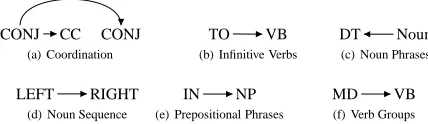
Another natural question to ask is whether there is a single scheme that receives the highest score in all settings. We find that in fact this is the case. Figure 4 shows this scheme. The obtained scheme does not exactly match any of the commonly used annotation schemes, although it closely resembles that of (Collins 1999), differing only in the annotation of noun sequences. We note that since we addressed a particular set of VSS’s, the winning scheme presented here is optimal only with respect to this selection.
CONJ CC CONJ (a) Coordination
TO VB
(b) Infinitive Verbs
DT Noun
(c) Noun Phrases
LEFT RIGHT (d) Noun Sequence
IN NP
(e) Prepositional Phrases
MD VB
(f) Verb Groups
Figure 4:The scheme that receives the highest score under all settings. Annotation abbreviations are taken from Table 3.
Correlation between Settings. We aim to show that our results are independent of the setting, and can therefore be seen as reflecting underlying phenomena. The parsers and the specific learn-ability measures can thus be seen as proxies by which these phenomena are observed.
In each setting (i.e., parser + learnability measure), we sort the different schemes according to their learnability (a total of2kvalues per ordering). The ten different settings (5 parsers×2 learnability measures) yield ten relative orderings. To assess their similarity we compute the Kendall rank correlation coefficient (Kendall 1938)9between each pair of relative orderings ( 10
2
=45pairs). The coefficient receives values in[−1, 1], where1indicates equality,0indicates no correlation, and−1indicates anticorrelation. We also compute a significancep-value, which is the probability for obtaining a given correlation at random (Abdi 2007).
Results show that the relative orderings obtained in the different settings are very much in concor-dance. The obtained Kendallτcorrelation coefficients range between (0.46, 0.88). Interestingly, when excluding DMV, results are even more significant (correlation in(0.64, 0.88)). This corre-sponds top-values smaller than10−7and smaller than10−13if we exclude DMV.
[image:10.420.91.305.272.334.2]Relation between Learnability Measures. In order to explore the relations between the two learnability measures, we focused on pairs of orderings that use the same parser, but different learnability measures (|P|=5pairs). The Kendallτvalues in this case range between (0.75, 0.82), which corresponds top-values<10−18.
Despite the high correlation between the measures, the biases discovered under the Accuracy-Learnability measure are stronger than the ones discovered under the Rate-Accuracy-Learnability measure. This demonstrates the somewhat different perspectives obtained by using different definitions of learnability.
6
Discussion
6.1
Syntactic Selection in a Wider Context
This paper presents a methodology for syntactic selection using learnability. The use of learnability is justified both for theoretical (see Section 7) and practical reasons, as it has direct implications on parsing technology. Namely, it is advantageous to train parsers on schemes that are inherently more learnable.
In the following we define a different, simplified empirical measure for syntactic selection and show that it correlates with learnability. The proposed measure is conceptually simpler than learnability and can therefore be used to partially explain the learnability results. However, it will be argued that learnability has several advantages over it as an empirical measure for syntactic selection.
We define the predictability of a scheme as minus the entropy of a parent given its child (unlike learnability, predictability is not defined with respect to a parser). We represent a word (x) as its POS tag, and a parent (Pa(x)) as the conjunction of its POS tag and the direction of the parent relative to the child (left or right). Concretely (Pdenotes the set of POS tags):
predictabilit y=−H(Pa(x)|x) = X
x∈P X
Pa(x)∈ P×{L,R}
P r(Pa(x)|x)·logP r(Pa(x)|x)
Intuitively, predictability measures how easy it is to predict a word’s head. On the face of it, higher predictability is likely to imply higher learnability. For example, if predictability is very high (i.e., the entropy is very low), words generally determine their parents, which facilitates learning. The opposite case, when predictability is very low, occurs when given a word, any other word is equally probable to serve as its parent. It is likely that such a scheme would be hard to learn.
We repeated the experiments described in Section 4, this time using predictability instead of learn-ability10. Results show that in the three structures where a unanimous learnability bias is found,
a strong predictability bias is also found. Predictability yields similar results to learnability in the infinitive verb structure as well, both showing no strong bias. However, in the two other structures results diverge. In noun sequences, predictability shows a strong bias towards the left noun, while learnability showed a weaker trend (with no unanimous bias). In verb groups, a strong predictabil-ity bias is found in the opposite direction to the non-unanimous one found with learnabilpredictabil-ity.
In addition, we derive a relative ordering of the different schemes (see Section 5.1). We com-pare this ordering to each of the orderings obtained in the learnability experiments. The obtained Kendallτvalues range between (0.38, 0.66), which corresponds top-values<10−4.
Predictability is a simple measure to understand and compute. The fact that it correlates with learnability can provide a partial explanation to the learnability results. However, it has several disadvantages compared to learnability. First, learnability relates directly to parsing technology, as parsers trained on more learnable schemes are likely to obtain higher results. Second, learnability is better motivated theoretically – it has been used extensively as a deciding factor in both linguistics and cognitive science (see Section 7). Third, predictability only quantifies a specific aspect of an annotation scheme (namely the POS tag and direction of the parent relative to its child), while parsers tend to take into account many other factors. These factors are captured by learnability.
Looking at our results, we observe that while correlations between predictability and learnability orderings are relatively high (mean Kendallτvalue 0.51), they are generally lower than the corre-lations between the different settings of our learnability experiments (mean Kendallτvalue 0.67). We conclude that predictability does give partial explanation to our results, but that further research is required in order to fully comprehend why exactly are some schemes more learnable than others.
6.2
The Methodology
Our methodology is designed for deciding between several alternatives, each having equal a-priori plausibility. It is therefore applicable for deciding between alternative annotations in VSS’s.
Although we compare performance against different test sets, we find the comparison meaningful. Presumably, had there been no preference to either of the annotations, the performance on all these data sets should have been equivalent. Our experiments show that this is usually not the case, and by this reveal a non-trivial property of both the parser and, in those cases where the bias is unanimous, of the structures in question.
The consistent results obtained across five parsers using two learnability measures, which are in turn consistent with the results of a parser-independent predictability experiment, demonstrate the robustness of our results. However, it is still possible that a future parser will exhibit different patterns. Such a parser would very likely be fundamentally different, in some way, from the set of parsers used in this work. Our methodology can thus be used to discover an interplay between parser families and their empirically preferred annotations, an interesting topic in its own right.
Finally, we remark that learnability cannot by itself be used as a criterion for the quality of a scheme. For example, consider the simple right-branching scheme, where each word receives the word to its right as its head. It is trivial to learn despite its inferiority as a dependency scheme. We address this issue by applying our methodology only to compare between annotations that aim to represent the same structure and that were proposed as valid dependency annotation schemes. All considered schemes are derived by combining annotations to VSS’s that were proposed in the literature (see Section 3). It is exactly because of the lack of consensus with regard to these structures that applying a complementary criterion, such as learnability, is required.
7
Related Work
7.1
Varying Syntactic Structures
The exact formal manner in which syntax should be represented has been the subject of endless debates. The diversity of approaches yielded a variety of annotation schemes for encoding similar structures.
1993), the British National Corpus (BNC) (Aston and Burnard 1998) and the SUSANNE corpus (Sampson 1995) all proposed different schemes for representing grammatical categories. Another example is the different annotation schemes used for noun compounds (Nastase and Szpakowicz 2003; Moldovan et al. 2004). In the field of constituency annotation, (Marcus et al. 1993; Sampson 1995; Kim et al. 2003) vary in the details of their representation of English syntax. Variation in de-pendency annotation, the focus of this paper, was discussed in (Ivanova et al. 2012) and is described in detail in Section 3. While these examples are all taken from English, variation is found in any language for which sufficient resources are available (Zeman et al. 2012).
Many previous works addressed the difficulties imposed by the lack of established standards for syntactic representation. Jiang and Liu (2009) adapted statistical tools trained with one annotation standard to another. Other works proposed to normalize the different representations into a stan-dard scheme (Ide and Bunt 2010; Zeman et al. 2012). Parsing evaluation is also highly affected by VSS’s. Schwartz et al. (2011) suggested Neutral Edge Direction (NED), an evaluation measure for unsupervised dependency parsing that accepts more than one plausible annotation for dependency VSS’s. Tsarfaty et al. (2011) suggested a new evaluation measure for supervised dependency pars-ing to address representational variation. The measure is based on tree edit distance. Tsarfaty et al. (2012) extended this measure for comparing between annotations from different formalisms.
The emphasis of all the above works was mainly to overcome the problems incurred by the lack of standard, and not to select the most advantageous annotation according to some empirical criterion. In contrast, other works addressed the advantages some schemes have over their alternatives, and selected a scheme which best suited their needs.
One of the motivations behind the LTH dependency scheme (Johansson and Nugues 2007) was to facilitate semantic-role-labeling (SRL). They showed that an SRL tool that used their scheme performed better than a tool that used an alternative dependency scheme. While their method provides empirical reasons for using the LTH scheme, our work has a few advantages: first, our methodology examines each VSS individually, while they only compared an annotation scheme as a whole; second, while they performed the comparison on a single (basic) SRL tool, we com-pared the schemes on five different parsers (four of them state-of-the-art) using two definitions of learnability. Stanford dependencies (de Marneffe et al. 2006) were also designed using empiri-cal considerations, namely to facilitate information extraction. However, they did not attempt to propose a methodology for syntactic selection.
Nilsson et al. (2006) modified the gold standard dependency annotations of two VSS’s in order to improve parsing accuracy. They were able to improve performance by training a parser on a transformed corpus, parsing, and re-transforming the induced parse. While their work evaluated against a fixed gold standard, our work provides a methodology for designing an optimal gold standard with respect to learnability considerations. Furthermore, while they experimented with a single parser11, our experiments use five parsers of different types and two learnability measures.
As a result, their findings may be parser-specific, while our consistent results reveal a property of the scheme itself. Therefore, our results are directly applicable to annotation design. Last, our work is more extensive in terms of the number of examined structures (six vs. two). Kübler (2005) and Maier (2006) conducted similar experiments in constituency parsing.
7.2
Learnability
The notion that simpler or more learnable structures should be preferred is a recurring theme, both in theoretical linguistics (Chomsky 2006; Clark 2010) and more generally in the discussion of representations in cognitive science (Chater and Vitányi 2003). In the context of language learning, learnability refers to the question of what biases are required in order to learn a language, and in particular its grammar (Pinker 1989). In formal linguistics, learnability using distributional methods has been used as an important consideration in designing the phrase structure formalism (Chomsky 2006).
In Machine Learning, the term learnability refers to the question of whether, under certain assump-tions, an underlying hypothesis may be learned given sufficient training samples (prominently, PAC-learnability (Valiant 1984)).
An empirical study by Perfors et al. (2011) used learnability considerations to decide between dif-ferent syntactic formalisms. This line of research bears resemblance to model selection techniques in statistics, which aim to find which model best explains a fixed data set. Our work takes a simi-lar direction. However, our methodology assumes the parsers are acceptable models for the given formalism, and tries to find the most suitable annotation from a set of a-priori equally likely alter-natives. To the best of our knowledge, no previous work has tackled a similar task.
Predictability. Previous works used information theoretic measures to quantify sentence com-plexity, taking into account its syntactic representation. Hale (2006) explored a similar measure to predictability in the context of context-free-grammar. Hale (2001) and Levy (2008) explored a dif-ferent measure (“surprisal”). These works demonstrated that their complexity measures correlate with human judgments on sentence comprehension difficulty.
Conclusion and Perspectives
In this paper we showed that selecting between alternative syntactic representations (syntactic se-lection) has a substantial and predictable effect on parsing performance. We presented a novel learnability-based methodology for syntactic selection and applied it to six central dependency structures that have several alternative annotations. Our methodology produced highly consistent results, and revealed a unanimity among all parsers in three of the structures. We showed that the gain from selecting the empirically preferred annotations is both substantial (error reduction of up to 19.8%) and additive. That is, selecting all three results in an even more accurate parser.
The higher learnability of the preferred annotations can be seen as an indication for their consis-tency with the rest of the scheme and has direct implications for parsing performance. We therefore suggest using the preferred annotations when designing future dependency schemes.
Future work will include applying our methodology to languages other than English, in order to assess whether the biases discovered in this work generalize cross-linguistically. We also plan to apply it to deciding between alternative annotations in other syntactic formalisms (such as con-stituency parsing) and in other NLP tasks such as POS tagging and noun-compound annotation.
Acknowledgments
References
Abdi, H. (2007). Kendall rank correlation. In Salkind, N. J., editor, Encyclopedia of Measurement and Statistics, pages 508–510. SAGE. 10
Aston, G. and Burnard, L. (1998). The BNC handbook. Exploring the British National Corpus with SARA. Edinburgh University Press. 13
Blunsom, P. and Cohn, T. (2010). Unsupervised induction of tree substitution grammars for dependency parsing. In Proc. of EMNLP. 7
Bosco, C. and Lombardo, V. (2004). Dependency and relational structure in treebank annotation. In Proc. of the Coling Workshop on Recent Advances in Dependency Grammar. 6
Brody, S. and Kantor, P. (2011). Automatic assessment of coverage quality in intelligence reports. In Proc. of ACL-HLT. 10
Chater, N. and Vitányi, P. (2003). Simplicity: a unifying principle in cognitive science. Trends in Cognitive Science, 7:19–22. 14
Choi, J. D. and Nicolov, N. (2009). K-best, locally pruned, transition-based dependency parsing using robust risk minimization. In Nicolov, N., Angelova, G., and Mitkov, R., editors, Recent Advances in Natural Language Processing V, volume 309 of Current Issues in Linguistic Theory, pages 205–216. John Benjamins, Amsterdam & Philadelphia. 7, 9
Chomsky, N. (2006). Language and Mind. Cambridge University Press, third edition. 3, 14
Clark, A. (2010). Three learnable models for the description of language. In LATA, pages 16–31. 14
Cohen, S. B. and Smith, N. A. (2009). Shared logistic normal distributions for soft parameter tying. In Proc. of HLT-NAACL. 7
Collins, M. J. (1999). Head-driven statistical models for natural language parsing. PhD thesis, University of Pennsylvania, Philadelphia. 2, 6, 10
Crammer, K. and Singer, Y. (2003). Ultraconservative online algorithms for multiclass problems. JMLR, 3:951–991. 7
de Marneffe, M. C., Maccartney, B., and Manning, C. D. (2006). Generating typed dependency parses from phrase structure parses. In Proc. of LREC. 13
Dredze, M., Blitzer, J., Talukdar, P. P., Ganchev, K., Graça, J. V., and Pereira, F. (2007). Frustrat-ingly hard domain adaptation for dependency parsing. In Proc. of the CoNLL 2007 Shared Task. EMNLP-CoNLL. 6
Francis, W. (1964). A standard sample of present-day English for use with digital computers. Brown University. 12
Goldberg, Y. and Elhadad, M. (2010). An efficient algorithm for easy-first non-directional depen-dency parsing. In Proc. of HLT-NAACL. 7, 9
Hale, J. (2006). Uncertainty about the rest of the sentence. Cognitive Science, 30:643–672. 14
Headden III, W. P., Johnson, M., and McClosky, D. (2009). Improving unsupervised dependency parsing with richer contexts and smoothing. In Proc. of HLT-NAACL. 7
Ide, N. and Bunt, H. (2010). Anatomy of annotation schemes: mapping to GrAF. In Proc. of the Fourth Linguistic Annotation Workshop (LAW). 13
Ivanova, A., Oepen, S., Øvrelid, L., and Flickinger, D. (2012). Who did what to whom? a contrastive study of syntacto-semantic dependencies. In Proc. of the Sixth Linguistic Annotation Workshop (LAW). 13
Jiang, W. and Liu, Q. (2009). Automatic adaptation of annotation standards for dependency parsing: using projected treebank as source corpus. In Proc. of IWPT. 13
Johansson, R. and Nugues, P. (2007). Extended constituent-to-dependency conversion for English. In Proc. of NODALIDA. 2, 6, 8, 13
Kendall, M. G. (1938). A new measure of rank correlation. Biometrika, 30:81–93. 10
Kim, J.-D., Ohta, T., Tateisi, Y., and ichi Tsujii, J. (2003). GENIA corpus – a semantically annotated corpus for bio-textmining. In ISMB (Supplement of Bioinformatics). 13
Klein, D. and Manning, C. (2004). Corpus-based induction of syntactic structure: Models of dependency and constituency. In Proc. of ACL. 7, 9
Kübler, S. (2005). How do treebank annotation schemes influence parsing results? or how not to compare apples and oranges. In Proc. of RANLP. 13
Kübler, S., McDonald, R., and Nivre, J. (2009). Dependency Parsing. Morgan And Claypool Publishers. 5, 8
Lapata, M. (2006). Automatic evaluation of information ordering: Kendall’s tau. Computational Linguistics, 32(4):471–484. 10
Levy, R. (2008). Expectation-based syntactic comprehension. Cognition, 106(3):1126–1177. 14
Maier, W. (2006). Annotation schemes and their influence on parsing results. In Proc. of the ACL Student Research Workshop. 13
Marcus, M., Santorini, B., and Marcinkiewicz, M. A. (1993). Building a large annotated corpus of English: The Penn Treebank. Computational Linguistics, 19:313–330. 2, 8, 12, 13
McDonald, R., Pereira, F., Ribarov, K., and Hajiˇc, J. (2005). Non-projective dependency parsing using spanning tree algorithms. In Proc. of HLT-EMNLP. 2, 7, 9
Moldovan, D., Badulescu, A., Tatu, M., Antohe, D., and Girju, R. (2004). Models for the semantic classification of noun phrases. In Proc. of the HLT-NAACL Workshop on Computational Lexical Semantics. 13
Nelson, G., Wallis, S., and Aarts, B. (2002). Exploring natural language: working with the British component of the international corpus of English. John Benjamins Pub. Co. 2
Nilsson, J., Nivre, J., and Hall, J. (2006). Graph transformations in data-driven dependency parsing. In Proc. of ACL. 6, 13
Nivre, J. (2009). Non-projective dependency parsing in expected linear time. In Proc. of ACL-IJCNLP. 7, 9
Nivre, J., Hall, J., and Nilsson, J. (2006). Maltparser: A data-driven parser-generator for depen-dency parsing. In Proc. of LREC. 7
Perfors, A., Tenenbaum, J. B., and Regier, T. (2011). The learnability of abstract syntactic princi-ples. Cognition, 118(3):306–338. 14
Pinker, S. (1989). Learnability and Cognition. MIT Press. 14
Rambow, O., Creswell, C., Szekely, R., Tauber, H., and Walker, M. (2002). A dependency tree-bank for English. In Proc. of LREC. 2, 6
Sampson, G. (1995). English for the Computer: The Susanne Corpus and Analytic Scheme. Clarendon Press. 2, 13
Schwartz, R., Abend, O., Reichart, R., and Rappoport, A. (2011). Neutralizing linguistically problematic annotations in unsupervised dependency parsing evaluation. In Proc. of ACL-HLT. 2, 13
Spitkovsky, V. I., Alshawi, H., and Jurafsky, D. (2011). Punctuation: Making a point in unsuper-vised dependency parsing. In Proc. of CoNLL. 7
Tsarfaty, R., Nivre, J., and Andersson, E. (2011). Evaluating dependency parsing: Robust and heuristics-free cross-annotation evaluation. In Proc. of EMNLP. 13
Tsarfaty, R., Nivre, J., and Andersson, E. (2012). Cross-framework evaluation for statistical parsing. In Proc. of EACL. 13
Valiant, L. G. (1984). A theory of the learnable. Communications of the ACM, 27(11):1134–1142. 14
Yamada, H. and Matsumoto, Y. (2003). Statistical dependency analysis with support vector ma-chines. In Proc. of IWPT. 2, 6
Zeman, D., Mareˇcek, D., Popel, M., Ramasamy, L., Štˇepánek, J., Žabokrtský, Z., and Hajiˇc, J. (2012). HamleDT: To parse or not to parse? In Proc. of LREC. 13