Robustness Issues in a Data-Driven Spoken Language Understanding
System
Yulan He and Steve Young
Cambridge University Engineering Department
Trumpington Street, Cambridge CB2 1PZ, England
{
yh213, sjy
}
@eng.cam.ac.uk
Abstract
Robustness is a key requirement in spoken lan-guage understanding (SLU) systems. Human speech is often ungrammatical and ill-formed, and there will frequently be a mismatch be-tween training and test data. This paper dis-cusses robustness and adaptation issues in a statistically-based SLU system which is en-tirely data-driven. To test robustness, the sys-tem has been tested on data from the Air Travel Information Service (ATIS) domain which has been artificially corrupted with varying levels of additive noise. Although the speech recog-nition performance degraded steadily, the sys-tem did not fail catastrophically. Indeed, the rate at which the end-to-end performance of the complete system degraded was significantly slower than that of the actual recognition com-ponent. In a second set of experiments, the ability to rapidly adapt the core understanding component of the system to a different appli-cation within the same broad domain has been tested. Using only a small amount of training data, experiments have shown that a semantic parser based on the Hidden Vector State (HVS) model originally trained on the ATIS corpus can be straightforwardly adapted to the some-what different DARPA Communicator task us-ing standard adaptation algorithms. The paper concludes by suggesting that the results pre-sented provide initial support to the claim that an SLU system which is statistically-based and trained entirely from data is intrinsically robust and can be readily adapted to new applications.
1
Introduction
Spoken language is highly variable as different people use different words and sentence structures to convey the same meaning. Also, many utterances are grammatically-incorrect or ill-formed. It thus remains an open issue as to how to provide robustness for large populations of non-expert users in spoken dialogue systems. The key compo-nent of a spoken language understanding (SLU) system is the semantic parser, which translates the users’ utterances into semantic representations. Traditionally, most seman-tic parser systems have been built using hand-crafted se-mantic grammar rules and so-called robust parsing (Ward and Issar, 1996; Seneff, 1992; Dowding et al., 1994) is used to handle the ill-formed user input in which word patterns corresponding to semantic tokens are used to fill slots in different semantic frames in parallel. The frame with the highest score then yields the selected semantic representation.
Formally speaking, the robustness of language (recog-nition, parsing, etc.) is a measure of the ability of hu-man speakers to communicate despite incomplete infor-mation, ambiguity, and the constant element of surprise (Briscoe, 1996). In this paper, two aspects of SLU sys-tem performance are investigated: noise robustness and adaptability to different applications. For the former, we expect that an SLU system should maintain acceptable performance when given noisy input speech data. This requires, the understanding components of the SLU sys-tem to be able to correctly interpret the meaning of an utterance even when faced with recognition errors. For the latter, the SLU system should be readily adaptable to a different application using a relatively small set (e.g. less than 100) of adaptation utterances.
applica-tions. Finally, section 5 concludes the paper.
2
System Overview
Spoken language understanding (SLU) aims to interpret the meanings of users’ utterances and respond reason-ably to what users have said. A typical architecture of an SLU system is given in Fig. 1, which consists of a speech recognizer, a semantic parser, and a dialog act de-coder. Within a statistical framework, the SLU problem can be factored into three stages. First the speech recog-nizer recognizes the underlying word stringWfrom each input acoustic signalA, i.e.
ˆ
W =argmax
W
P(W|A) =argmax
W
P(A|W)P(W) (1)
then the semantic parser maps the recognized word string
ˆ
W into a set of semantic conceptsC
ˆ
C=argmax
C
P(C|Wˆ) (2)
and finally the dialogue act decoder infers the user’s dia-log acts or goals by solving
ˆ
Gu=argmax Gu
P(Gu|Cˆ) (3)
Dialog Act Decoder Semantic
Parser Speech
Recognizer
Acoustic Signal Words Concepts User’s Dialog Acts PSfrag replacements
A W C Gu
Figure 1: Typical structure of a spoken language under-standing system.
The sequential decoding described above is suboptimal since the solution at each stage depends on an exact so-lution to the previous stage. To reduce the effect of this approximation, a word lattice orN-best word hypotheses can be retained instead of the single best stringWˆ as the output of the speech recognizer. The semantic parse re-sults may then be incorporated with the output from the speech recognizer to rescore theN-best list as below.
ˆ
C,Wˆ ≈ argmax
C,W∈LN
P(A|W)P(W)P(C|W)
≈ argmax
C,W∈LN
P(A|W)P(W)γP(C|W)α(4)
where P(A|W) is the acoustic probability from the first pass, P(W) is the language modelling likelihood,
P(C|W)is the semantic parse score,LN denotes theN
-best list, αis a semantic parse scale factor, andγ is a grammar scale factor.
In the system described in this paper, each of these stages is modelled separately. We use a standard HTK-based (HTK, 2004) Hidden Markov Model (HMM) rec-ognizer for recognition, the Hidden Vector State (HVS)
model for semantic parsing (He and Young, 2003b), and Tree-Augmented Naive Bayes networks (TAN) (Fried-man et al., 1997) for dialog act decoding.
The speech recognizer comprises 14 mixture Gaus-sian HMM state-clustered cross-word triphones aug-mented by using heteroscedastic linear discriminant anal-ysis (HLDA) (Kumar, 1997). Incremental speaker adap-tation based on the maximum likelihood linear regression (MLLR) method (Gales and Woodland, 1996) was per-formed during the test with updating being perper-formed in batches of five utterances per speaker.
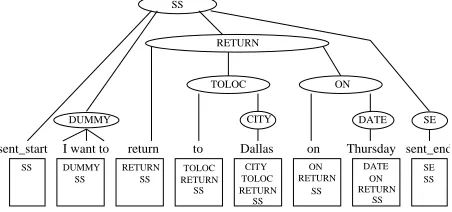
The Hidden Vector State (HVS) model (He and Young, 2003b) is a hierarchical semantic parser which associates each state of a push-down automata with the state of a HMM. State transitions are factored into separate stack pop and push operations and then constrained to give a tractable search space. The result is a model which is complex enough to capture hierarchical structure but which can be trained automatically from unannotated data.
CITY DATE
SS SE
TOLOC ON
RETURN SS
DUMMY
SS DUMMY
SS SS
Dallas sent_start I want to return to
RETURN
SS RETURN
TOLOC CITY
SS RETURN
TOLOC
RETURN RETURN
SS ON DATE Thursday sent_end
SE
[image:2.612.315.541.324.430.2]SS ON on
Figure 2: Example of a parse tree and its vector state equivalent.
Let each state at timetbe denoted by a vector ofDt
semantic concept labels (tags)ct= [ct[1], ct[2], ..ct[Dt]]
wherect[1]is the preterminal concept andct[Dt]is the
root concept (SS in Figure 2). Given a word sequence
W, concept vector sequenceC and a sequence of stack
pop operationsN, the joint probability ofP(W,C, N)
can be decomposed as
P(W,C, N) =
T
Y
t=1
P(nt|ct−1)·
P(ct[1]|ct[2· · ·Dt])·P(wt|ct) (5)
where ct at word positiont is a vector of Dt semantic
concept labels (tags),ntis the vector stack shift operation
and takes values in the range0,· · ·, Dt−1whereDt−1is the stack size at word positiont−1, andct[1] = cwt is
the new preterminal semantic tag assigned to wordwtat
word positiont.
1. popping semantic tags off the stack;
2. pushing a pre-terminal semantic tag onto the stack;
3. generating the next word.
The dialog act decoder was implemented using the Tree-Augmented Naive Bayes (TAN) algorithm (Fried-man et al., 1997), which is an extension of Naive Bayes Networks. One TAN was used for each dialogue act or goalGu, the semantic conceptsCi which serve as input
to its corresponding TAN were selected based on the mu-tual information (MI) between the goal and the concept. Naive Bayes networks assume all the concepts are con-ditionally independent given the value of the goal. TAN networks relax this independence assumption by adding dependencies between concepts based on the conditional mutual information (CMI) between concepts given the goal. The goal prior probabilityP(Gu)and the
condi-tional probability of each semantic conceptCigiven the
goalGu,P(Ci|Gu)are learned from the training data.
Dialogue act detection is done by picking the goal with the highest posterior probability ofGugiven the
particu-lar instance of conceptsC1· · ·Cn,P(Gu|C1· · ·Cn).
3
Noise Robustness
The ATIS corpus which contains air travel information data (Dahl et al., 1994) has been chosen for the SLU sys-tem development and evaluation. ATIS was developed in the DARPA sponsored spoken language understanding programme conducted from 1990 to 1995 and it provides a convenient and well-documented standard for measur-ing the end-to-end performance of an SLU system. How-ever, since the ATIS corpus contains only clean speech, corrupted test data has been generated by adding samples of background noise to the clean test data at the waveform level.
3.1 Experimental Setup
The experimental setup used to evaluate the SLU system was similar to that described in (He and Young, 2003a). As mentioned in section 2, the SLU system consists of three main components, a standard HTK-based HMM recognizer, the HVS semantic parser, and the TAN dia-logue act (DA) decoder. Each of the three major compo-nents are trained separately. The acoustic speech signal in the ATIS training data is modelled by extracting 39 features every 10ms: 12 cepstra, energy, and their first and second derivatives. This data is then used to train the speaker-independent, continuous speech recognizer. The HVS semantic parser is trained on the unannotated utter-ances using EM constrained by the domain-specific lex-ical class information and the dominance relations built into the abstract annotations (He and Young, 2003b). In
the case of ATIS, the lexical classes can be extracted au-tomatically from the relational database, whilst abstract semantic annotations for each utterance are automatically derived from the accompanying SQL queries of the train-ing utterances. The dialogue act decoder is trained ustrain-ing the main topics or goals and the key semantic concepts extracted automatically from the reference SQL queries
Performance is measured at both the component and the system level. For the former, the recognizer is eval-uated by word error rate, the parser by concept slot re-trieval rate using an F-measure metric (Goel and Byrne, 1999), and the dialog act decoder by detection rate. The overall system performance is measured using the stan-dard NIST “query answer” rate.
In the expriments reported here, car noise from the NOISEX-92 (Varga et al., 1992) database was added to the ATIS-3 NOV93 and DEC94 test sets. In order to ob-tain different SNRs, the noise was scaled accordingly be-fore adding to the speech signal.
3.2 Experimental Results
Robust spoken language understanding components should be able to compensate for the weakness of the speech recognizer. That is, ideally they should be capable of generating the correct meaning of an utterance even if it is recognized wrongly by a speech recognizer. At minimum, the performance of the understanding compo-nents should degrade gracefully as recognition accuracy degrades.
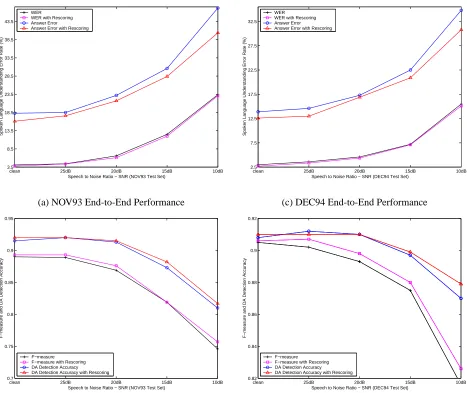
Figure 3 gives the system performance on the cor-rupted test data with additive noise ranging from 25dB to 10dB SNR. The label “clean” in the X-axis denotes the original clean speech data without additive noise. Note that the recognition results on the corrupted test data were obtained directly using the original clean speech HMM models without retraining for the noisy condi-tions. The upper portion of Figure 3 shows the end-to-end performance in terms of query answer error rate for the NOV93 and DEC94 test sets. For easy reference, WER is also shown. The individual component perfor-mance, F-measure for the HVS semantic parser and di-alogue act (DA) detection accuracy for the DA decoder, are illustrated in the lower portion of Figure 3. For each test set, the performance on the rescored word hypothe-ses is given as well. This incorporates the semantic parse scores into the acoustic and language modelling likeli-hoods to rescore the 25-best word lists from the speech recognizer.
the SNR to 15dB, the system performance degrades sig-nificantly. The WER increases by 3.1 times relative to clean but the query answer error rate increases by only 1.7 times. Similar figures were obtained for the DEC94 test set.
The above suggests that the end-to-end performance measured in terms of answer error rate degrades more slowly compared to the recognizer WER as the noise level increases. This demonstrates that the statistically-based understanding components of the SLU system, the semantic parser and the dialogue act decoder, are rela-tively robust to degrading recognition performance.
Regarding the individual component performance, the dialogue act detection accuracy appears to be less sensi-tive to decreasing SNR. This is probably a consequence of the fact that the Bayesian networks are set up to re-spond to only the presence or absence of semantic con-cepts or slots, regardless of the actual values assigned to them. In another words, the performance of the dialogue act decoder is not affected by the mis-recognition of indi-vidual words, but only by a failure to detect the presence of a semantic concept. It can also be observed from Fig-ure 3 that the F-measFig-ure needs to be better than 85% in order to achieve acceptable end-to-end performance.
4
Adaptation to New Applications
Statistical model adaptation techniques are widely used to reduce the mismatch between training and test or to adapt a well-trained model to a novel domain. Com-monly used techniques can be classified into two cat-egories, Bayesian adaptation which uses a maximum a
posteriori (MAP) probability criteria (Gauvain and Lee,
1994) and transformation-based approaches such as max-imum likelihood linear regression (MLLR) (Gales and Woodland, 1996), which uses a maximum likelihood (ML) criteria. In recent years, MAP adaptation has been successfully applied to n-gram language models (Bac-chiani and Roark, 2003) and lexicalized PCFG models (Roark and Bacchiani, 2003). Luo et al. have proposed transformation-based approaches based on the Markov transform (Luo et al., 1999) and the Householder trans-form (Luo, 2000), to adapt statistical parsers. However, the optimisation processes for the latter are complex and it is not clear how general they are.
Since MAP adaptation is straightforward and has been applied successfully to PCFG parsers, it has been selected for investigation in this paper. Since one of the special forms of MAP adaptation is interpolation between the in-domain and out-of-in-domain models, it is natural to also consider the use of non-linear interpolation and hence this has been studied as well1.
1
Experiments using linear interpolation have also been con-ducted but it was found that the results are worse than those
4.1 MAP Adaptation
Bayesian adaptation reestimates model parameters di-rectly using adaptation data. It can be implemented via maximum a posteriori (MAP) estimation. Assuming that model parameters are denoted byΘ, then given observa-tion samplesY, the MAP estimate is obtained as
ΘM AP = argmax
Θ
P(Θ|Y) = argmax
Θ
P(Y|Θ)P(Θ)
(6)
whereP(Y|Θ)is the likelihood of the adaptation dataY
and model parametersΘare random vectors described by their probabilistic mass function (pmf)P(Θ), also called the prior distribution.
In the case of HVS model adaptation, the objective is to estimate probabilities of discrete distributions over vector state stack shift operations and output word generation. Assuming that they can be modelled under the multino-mial distribution, for mathematical tractability, the con-jugate prior, the Dirichlet density, is normally used. As-sume a parser modelP(W, C)for a word sequence W
and semantic concept sequenceCexists withJ compo-nent distributionsPj each of dimension K, then given
some adaptation dataWl, the MAP estimate of thekth
component ofPj,Pˆj(k), is
ˆ
Pj(k) =
σj
σj+τ
˜
Pj(k) +
τ σj+τ
Pj(k) (7)
whereσj =
PK
k=1σj(k)in whichσj(k)is defined as the
total count of the events associated with thekth compo-nent ofPj summed across the decoding of all adaptation
utterancesWl,τ is the prior weighting parameter,Pj(k)
is the probability of the original unadapted model, and
˜
Pj(k)is the empirical distribution of the adaptation data,
which is defined as
˜
Pj(k) =
σj(k)
PK i=1σj(i)
(8)
As discussed in section 2, the HVS model consists of three types of probabilistic move. The MAP adaptation technique can be applied to the HVS model by adapting each of these three component distributions individually.
4.2 Log-Linear Interpolation
Log-linear interpolation has been applied to language model adaptation and has been shown to be equivalent to a constrained minimum Kullback-Leibler distance op-timisation problem(Klakow, 1998).
Following the notation introduced in section 4.1, where
Pj(k)is the probability of the original unadapted model,
andP˜j(k)is the empirical distribution of the adaptation
clean 25dB 20dB 15dB 10dB 3.5
8.5 13.5 18.5 23.5 28.5 33.5 38.5 43.5
Speech to Noise Ratio − SNR (NOV93 Test Set)
Spoken Language Understanding Error Rate (%)
WER WER with Rescoring Answer Error Answer Error with Rescoring
(a) NOV93 End-to-End Performance
clean 25dB 20dB 15dB 10dB 2.5
7.5 12.5 17.5 22.5 27.5 32.5
Speech to Noise Ratio − SNR (DEC94 Test Set)
Spoken Language Understanding Error Rate (%)
WER WER with Rescoring Answer Error Answer Error with Rescoring
(c) DEC94 End-to-End Performance
clean 25dB 20dB 15dB 10dB 0.7
0.75 0.8 0.85 0.9 0.95
Speech to Noise Ratio − SNR (NOV93 Test Set)
F−measure and DA Detection Accuracy
F−measure F−measure with Rescoring DA Detection Accuracy DA Detection Accuracy with Rescoring
(b) NOV93 Component Performance
clean 25dB 20dB 15dB 10dB 0.82
0.84 0.86 0.88 0.9 0.92
Speech to Noise Ratio − SNR (DEC94 Test Set)
F−measure and DA Detection Accuracy
F−measure F−measure with Rescoring DA Detection Accuracy DA Detection Accuracy with Rescoring
[image:5.612.73.540.142.535.2](d) DEC94 Component Performance
data, denote the final adapted model probability asPˆj(k).
It is assumed that the Kullback-Leibler distance of the adapted model to the unadapted and empirically deter-mined model is
D( ˆPj(k)kPj(k)) =d1 (9)
D( ˆPj(k)kP˜j(k)) =d2 (10)
Given an additional model probability P¯j(k) whose
distance toPˆj(k)should be kept small, and introducing
Lagrange multipliersλ01andλ
0
2to ensure that constraints 9 and 10 are satistifed, yields
D=D( ˆPj(k)kP¯j(k))+λ 0
1(D( ˆPj(k)kPj(k))−d1)
+λ02(D( ˆPj(k)kP˜j(k))−d2) (11)
MinimizingDwith respect toPˆj(k)yields the required
distribution.
With some manipulation and redefinition of the La-grange Multipliers, it can be shown that
ˆ
Pj(k) =
1
Zλ
Pj(k)λ1P˜j(k)λ2 (12)
whereP¯j(k)has been assumed to be a uniform
distribu-tion which is then absorbed into the normalizadistribu-tion term
Zλ.
The computation ofZλis very expensive and can
usu-ally be dropped without significant loss in performance (Martin et al., 2000). For the other parameters, λ1 and
λ2, the generalized iterative scaling algorithm or the sim-plex method can be employed to estimate their optimal settings.
4.3 Experiments
To test the portability of the statistical parser, the initial experiments reported here are focussed on assessing the adaptability of the HVS model when it is tested in a do-main which covers broadly similar concepts, but com-prises rather different speaking styles. To this end, the flight information subset of the DARPA Communicator Travel task has been used as the target domain (CUD-ata, 2004). By limiting the test in this way, we ensure that the dimensionalities of the HVS model parameters remain the same and no new semantic concepts are intro-duced by the adaptation training data.
The baseline HVS parser was trained on the ATIS corpus using 4978 utterances selected from the context-independent (Class A) training data in the ATIS-2 and ATIS-3 corpora. The vocabulary size of the ATIS training corpus is 611 and there are altogether 110 semantic con-cepts defined. The parser model was then adapted using utterances relating to flight reservation from the DARPA Communicator data. Although the latter bears similari-ties to the ATIS data, it contains utterances of a different
style and is often more complex. For example, Commu-nicator contains utterances on multiple flight legs, infor-mation which is not available in ATIS.
To compare the adapted ATIS parser with an in-domain Communicator parser, a HVS model was trained from scratch using 10682 Communicator training utterances. The vocabulary size of the in-domain Communicator training data is 505 and a total of 99 semantic concepts have been defined. For all tests, a set of 1017 Communi-cator test utterances was used.
Table 1 lists the recall, precision, and F-measure re-sults obtained when tested on the 1017 utterance DARPA Communicator test set. The baseline is the unadapted HVS parser trained on the ATIS corpus only. The in-domain results are obtained using the HVS parser trained solely on the 10682 DARPA training data. The other rows of the table give the parser performance using MAP and log-linear interpolation based adaptation of the baseline model using 50 randomly selected adaptation utterances.
System Recall Precision F-measure
Baseline 79.81% 87.14% 83.31%
In-domain 87.18% 91.89% 89.47%
MAP 86.74% 91.07% 88.85%
Log-Linear 86.25% 92.35% 89.20%
Table 1: Performance comparison of adaptation using MAP or log-linear interpolation.
Since we do not yet have a reference database for the DARPA Communicator task, it is not possible to conduct the end-to-end performance evaluation as in section 3. However, the experimental results in section 3.2 indi-cate that the F-measure needs to exceed 85% to give ac-ceptable end-to-end performance (see Figure 3). There-fore, it can be inferred from Table 1 that the unadapted ATIS parser model would perform very badly in the new Communicator application whereas the adapted models would give performance close to that of a fully trained in-domain model.
results to the in-domain Communicator model.
0 25 50 75 100 125 150 0.82
0.84 0.86 0.88 0.9
Adaptation Training Utterance Number
F−measure
[image:7.612.73.297.94.272.2]MAP Log−Linear
Figure 4: F-measure vs amount of adaptation training data.
5
Conclusions
The spoken language understanding (SLU) system dis-cussed in this paper is entirely statistically based. The recogniser uses a HMM-based acoustic model and ann -gram language model, the semantic parser uses a hid-den vector state model and the dialogue act decoder uses Bayesian networks. The system is trained entirely from data and there are no heuristic rules. One of the major claims motivating the design of this type of system is that its fully-statistical framework makes it intrinsically robust and readily adaptable to new applications. The aim of this paper has been to investigate this claim ex-perimentally via two sets of experiments using a system trained on the ATIS corpus.
In the first set of experiments, the acoustic test data was corrupted with varying levels of additive car noise. The end-to-end system performance was then measured along with the individual component performances. It was found that although the addition of noise had a sub-stantial effect on the word error rate, its relative influ-ence on both the semantic parser slot/value retrieval rate and the dialogue act detection accuracy was somewhat less. Overall, the end-to-end error rate degraded rela-tively more slowly than word error rate and perhaps most importantly of all, there was no catastrophic failure point at which the system effectively stops working, a situation not uncommon in current rule-based systems.
In the second set of experiments, the ability of the se-mantic decoder component to be adapted to another ap-plication was investigated. In order, to limit the issues to parameter mismatch problems, the new application cho-sen (Communicator) covered escho-sentially the same set of
concepts but was a rather different corpus with different user speaking styles and different syntactic forms. Over-all, we found that moving a system trained on ATIS to this new application resulted in a 6% absolute drop in F-measure on concept accuracy (i.e. a 62% relative increase in parser error) and by extrapolation with the results in the ATIS domain, we infer that this would make the non-adapted system essentially unusable in the new applica-tion. However, when adaptation was applied using only 50 adaptation sentences, the loss of concept accuracy was mostly restored. Specifically, using log-linear adapta-tion, the out-of-domain F-measure of 83.3% was restored to 89.2% which is close to the in-domain F-measure of 89.5%.
Although these tests are preliminary and are based on off-line corpora, the results do give positive support to the initial claim made for statistically-based spoken lan-guage systems, i.e. that they are robust and they are read-ily adaptable to new or changing applications.
Acknowledgements
The authors would like to thank Mark Gales for providing the software to generate the corrupted speech data with additive noise.
References
M. Bacchiani and B. Roark. 2003. Unsupervised lan-guage model adaptation. In Proc. of the IEEE Intl.
Conf. on Acoustics, Speech and Signal Processing,
Hong Kong, Apr.
T. Briscoe. 1996. Robust parsing. In R. Cole, J. Mariani, H. Uszkoreit, A. Zaenen, and V. Zue, editors, Survey
of the State of the Art of Human Language Technology,
chapter 3.7. Cambridge University Press, Cambridge, England.
CUData, 2004. DARPA Communicator Travel
Data. University of Colorado at Boulder.
http://communicator.colorado.edu/phoenix.
D.A. Dahl, M. Bates, M. Brown, K. Hunicke-Smith, D. Pallett, C. Pao, A. Rudnicky, and L. Shriberg. 1994. Expanding the scope of the ATIS task: the ATIS-3 corpus. In ARPA Human Language Technology
Work-shop, Princeton, NJ, Mar.
J. Dowding, R. Moore, F. Andry, and D. Moran. 1994. Interleaving syntax and semantics in an efficient bottom-up parser. In Proc. of the 32nd Annual
Meet-ing of the Association for Computational LMeet-inguistics,
pages 110–116, Las Cruces, New Maxico, June.
N. Friedman, D. Geiger, and M. Goldszmidt. 1997. Bayesian network classifiers. Machine Learning,
29(2):131–163.
M.J. Gales and P.C. Woodland. 1996. Mean and variance adaptation within the MLLR framework. Computer
J.L. Gauvain and C.-H. Lee. 1994. Maximum a poste-riori estimation for multivariate Gaussian mixture ob-servations of Markov chains. IEEE Trans. on Speech
and Audio Processing, 2(2):291–298.
V. Goel and W. Byrne. 1999. Task dependent loss functions in speech recognition: Application to named entity extraction. In ESCA ETRW Workshop on
Ac-cessing Information from Spoken Audio, pages 49–53,
Cambridge, UK.
Yulan He and Steve Young. 2003a. A data-driven spoken language understanding system. In IEEE Automatic
Speech Recognition and Understanding Workshop, St.
Thomas, U.S. Virgin Islands, Dec.
Yulan He and Steve Young. 2003b. Hidden vector state model for hierarchical semantic parsing. In Proc. of
the IEEE Intl. Conf. on Acoustics, Speech and Signal Processing, Hong Kong, Apr.
HTK, 2004. Hidden Markov Model Toolkit (HTK) 3.2. Cambridge University Engineering Department.
http://htk.eng.cam.ac.uk/.
D. Klakow. 1998. Log-linear interpolation of language models. In Proc. of Intl. Conf. on Spoken Language
Processing, Sydney, Australia, Nov.
N. Kumar. 1997. Investigation of Silicon Auditory
Mod-els and Generalization of Linear Discriminant analysis for Improved Speech Recognition. Ph.D. thesis, Johns
Hopkins University, Baltimore MD.
X. Luo, S. Roukos, and T. Ward. 1999. Unsupervised adaptation of statistical parsers based on Markov trans-form. In IEEE Automatic Speech Recognition and
Un-derstanding Workshop, Keystone, Colorado, Dec.
X. Luo. 2000. Parser adaptation via householder trans-form. In Proc. of the IEEE Intl. Conf. on Acoustics,
Speech and Signal Processing, Istanbul, Turkey, June.
S. Martin, A. Kellner, and T. Portele. 2000. Interpolation of stochastic grammar and word bigram models in nat-ural language understanding. In Proc. of Intl. Conf. on
Spoken Language Processing, Beijing, China, Oct.
B. Roark and M. Bacchiani. 2003. Supervised and unsu-pervised PCFG adaptation to novel domains. In
Pro-ceedings of the joint meeting of the North American Chapter of the Association for Computational Linguis-tics and the Human Language Technology Conference (HLT-NAACL 2003), Edmonton, Canada, May.
S. Seneff. 1992. Robust parsing for spoken language systems. In Proc. of the IEEE Intl. Conf. on Acoustics,
Speech and Signal Processing, San Francisco.
A.P. Varga, H.J.M. Steeneken, M. Tomlinson, and D. Jones. 1992. The NOISEX-92 study on the ef-fect of additive noise on automatic speech recognition. Technical report, DRA Speech Research Unit.
W. Ward and S. Issar. 1996. Recent improvements in the CMU spoken language understanding system. In Proc.
of the ARPA Human Language Technology Workshop,