Automatic Linguistic Analysis for Language Teachers:
The Case of Zeros
MITSUKO YAMURA-TAKEI Graduate School of Information Sciences
Hiroshima City University 3-4-1 Ozuka-higashi, Asaminami-ku,
Hiroshima, JAPAN 731-3194 [email protected]
MIHO FUJIWARA
Department of Japanese and Chinese Willamette University 900 State Street, Salem,
OR. USA 97301 [email protected]
MAKOTO YOSHIE
Graduate School of Information Sciences Hiroshima City University [email protected]
TERUAKI AIZAWA Faculty of Information Sciences
Hiroshima City University [email protected]
Abstract
This paper presents the Natural Language Processing-based linguistic analysis tool that we have developed for Japanese as a Second Language teachers. This program, Zero De-tector (ZD), aims to promote effective instruc-tion of zero anaphora, on the basis of a hy-pothesis about ideal conditions for second language acquisition, by making invisible zeros visible. ZD takes Japanese written narrative discourse as input and provides the zero-specified texts and their underlying structures as output. We evaluated ZD’s performance in terms of its zero detecting accuracy. We also present an experimental report of its validity for practical use. As a result, ZD has proven to be pedagogically feasible in terms of its accuracy and its impact on effective instruction.
Introduction
Natural Language Processing (NLP) is an emerging technology with a variety of real-world applications. Computer-Assisted Language Learning/Teaching (CALL/CALT) is one area that NLP techniques can contribute to. Such techniques range from indexing and concor-dancing to morphological processing with
on-demand dictionary look-ups and syntactic processing with diagnostic error analysis, to name a few. But little work has been done on discourse-level phenomena, including anaphora.
Zero anaphora or zero pronouns (henceforth zeros) are referential noun phrases (NPs) that are not overtly expressed in Japanese discourse. These NPs can be omitted if they are recoverable from a given context or relevant knowledge. The use of zeros is common in Japanese and this poses a challenge for Japanese as a Second Lan-guage (JSL) learners for their accurate compre-hension and natural-sounding production of Japanese discourse with zeros. Some learners fail to understand a passage correctly because of the difficulty of identifying zeros and/or their antecedents. Other learners produce grammati-cally correct but still unnatural-sounding Japa-nese due to overuse or underuse of zeros.
Analysis of zeros can be divided into three phases: zero identification, zero interpretation and zero production. This paper focuses on the first phase and proposes a method of systemati-cally identifying the presence of zeros in order that teachers might provide effective instruction of zeros, based on some pedagogical principles from relevant second language acquisition (SLA) theory. We regard teachers as primary users of the program and aim to help them enhance their instruction. We implemented the program and evaluated its potential benefits for language teachers.
In Sections 1 and 2 we discuss the peda-gogical assumptions from SLA theory that moti-vate our program design, and present the linguis-tic assumptions from which our heurislinguis-tics were drawn. Section 3 provides an overview of our system implementation. In Section 4, we pre-sent the results of evaluation from the viewpoints of both the accuracy and the empirical validity of the program. We conclude with a discussion of possible future work.
1 Pedagogical Assumptions
There have been many studies about how people learn foreign languages and what is responsible for successful language learning.
Recent SLA theory progresses beyond Krashen (e.g., 1982)’s emphasis on automatic processes of acquisition. Empirical research has shown that learners’ consciousness-raising through explicit instruction does contribute to successful second language learning (see Norris & Ortega, 2000 for comprehensive review).
Chapelle (1998) reviewed seven hypotheses about ideal SLA conditions that are relevant for CALL program design. At the top of her list is that “the linguistic characteristics of target lan-guage input need to be made salient” (p. 23). Effective input enhancement, by prompting learners to notice particular learning items, with highlighting for example, plays a significant role in facilitating acquisition. We conjecture that this salience effect can also be realized by mak-ing zeros visible.
2 Linguistic Assumptions
Japanese is a head-final language. A sentence or a clause is headed by a predicate, which takes a set of arguments and adjuncts. Predicates in
Japanese include verbs, adjectives, nominal ad-jectives and copula, and usually consist of a core predicate and some auxiliary elements. Argu-ments are classified into three types: Topic Phrase (TP), headed by a topic marker wa, Focus
We define zeros as unexpressed obligatory arguments of a core predicate. What is “obligatory” is the next question to arise. Obligatoriness is a controversial issue, and there is no set agreement among linguists on its definition. Somers (1984) proposed a six-level scale of valency binding that reflects the degree of closeness of an element to the predicate. The levels are (i) integral complements, (ii) obligatory complements, (iii) optional complements, (iv) middles, (v) adjuncts and (vi) extraperipherals. Ishiwata (1999) suggests that in Japanese group (i) is often treated as part of idioms and is not omissible, and Japanese nominative –ga and accusative –wo fall into the category (ii), while dative –ni belongs to (iii). In light of this, we assume that obligatory arguments that can be zero-pronominalized are phrases headed by nominative-case particle ga and accusative wo, and ni, excluding dative ni in an indirect object position.
3 Zero Detector
Zero Detector (henceforth ZD) is an automatic zero identifying tool, which takes Japanese writ-ten narrative texts as input and provides the zero-specified texts and their underlying struc-tures as output. This aims to draw learners’ and teachers’ attention to zeros, by making these invisible elements visible in effectively enhanced formats.
3.1 System Overview
ZD employs a rule-based approach, with theo-retically sound heuristics. Our heuristics are drawn from the linguistic assumptions described in Section 2.
capabilities for our purpose. Morphological analysis is done by ChaSen 2.2.8 (NAIST, Ma-tsumoto, Y. et al., 2001), and dependency struc-ture analysis by CaboCha 0.21 (NAIST, Kudo, K., 2001). The Goi-Taikei Valency Dictionary
(hereafter GTVD; Ikehara et al., 1997) serves as a source for valency pattern search.
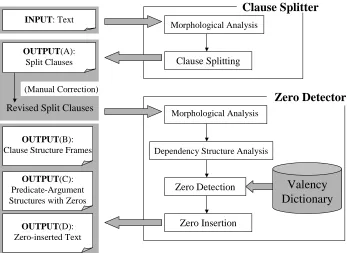
The flow of the system is illustrated in Fig-ure 1.
Clause Splitter
Morphological Analysis
Clause Splitting
(Manual Correction)
Revised Split Clauses
Zero Detector
Dependency Structure Analysis
Zero Detection
Valency
Dictionary
Zero Insertion
OUTPUT(B): Clause Structure Frames
OUTPUT(C): Predicate-Argument Structures with Zeros
OUTPUT(D): Zero-inserted Text
Morphological Analysis
OUTPUT(A): Split Clauses
INPUT: Text
Figure 1: Flow diagram of zero detecting processes
3.2 ZD Output
As shown in Figure 1, ZD produces four differ-ent types of output: (A) split clauses, (B) clause structure frames, (C) predicate-argument struc-tures with zeros, and (D) zero-inserted texts. We will show how these outputs are structured using the example text in Figure 2.
komatta Satsuki-wa sassoku in trouble Satsuki-TOP immediately
gennin-wo shirabe-sase-ta.
cause-ACC investigate-CAUSATIVE-PAST
“Satsuki, who was in trouble, immediately had (someone) investigate its cause.”
Figure 2: An example input text
komatta EC(RC)] Satsuki-wa sassoku
gennin-wo shirabe-sase-mashita. IC]
Figure 3: Split clauses1
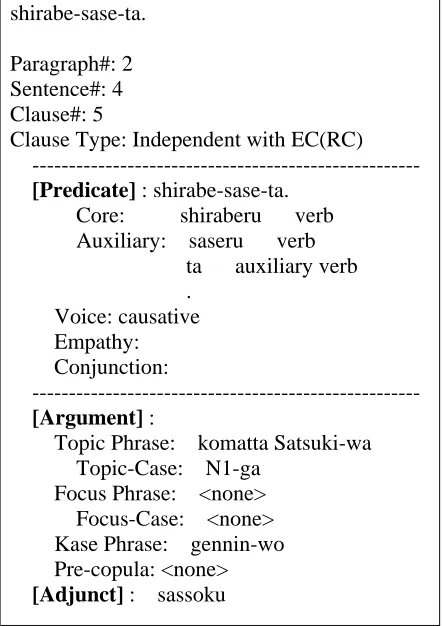
Once the text is split into clauses, each clause is analysed for its dependency structure and then converted into its clause structure frame. The noun phrases which depend on the predicate are extracted, and then classified into phrase types (TP, FP and KP) according to their accom-panying particles. An example of this frame, i.e., output (B), is given in Figure 4.
Input: komatta Satsuki-wa sassoku gennin-wo shirabe-sase-ta.
Paragraph#: 2 Sentence#: 4 Clause#: 5
Clause Type: Independent with EC(RC) --- [Predicate] : shirabe-sase-ta.
Core: shiraberu verb Auxiliary: saseru verb
ta auxiliary verb .
Voice: causative Empathy: Conjunction:
--- [Argument] :
Topic Phrase: komatta Satsuki-wa Topic-Case: N1-ga
Focus Phrase: <none> Focus-Case: <none> Kase Phrase: gennin-wo Pre-copula: <none> [Adjunct] : sassoku
Figure 4: A clause structure frame
This frame also includes the result of valency checking, as in Figure 5, and zero iden-tifying processes, as in Figure 6, at the bottom.
1 Here, we use the acronyms: IC for Independent
Clause, EC for Embedded Clause, and RC for Relative Clause.
Valency Selected: N1 ga N2 wo
Valency Obligatory: N1 ga N2 wo
Valency Changed: N1 ga N2 wo N3 ni
Figure 5: Valency checking
A core predicate is checked against GTVD to search for its syntactic valency pattern. GTVD is a semantic valency dictionary, origi-nally designed for transfer-based Japa-nese-to-English machine translation, so it in-cludes as many valency pattern entries for each predicate as are necessary for effective transfer. The entries are ordered according to expected frequency of occurrence. We took the naïve approach of selecting the first-ranking entry from the listing for each core predicate (i.e.,‘Valency Selected’ in Figure 5).
The next step is to apply the definition of ‘obligatoriness’ described in Section 2 to refine the selected valency pattern (‘Valency Obliga-tory’ in Figure 5). If non-ga, wo, or ni cases are within the first three case slots of the selected valency pattern, they are excluded. If a ni-case still remains in the third case slot, it is also de-leted. These operations leave us two valency patterns: (i) N1-ga N2-wo, and (ii) N1-ga N2-ni, in most cases.
Then, a valency changing operation is done in the case of causatives or passives. When an auxiliary verb is added to the core predicate in the causative or passive construction, the verb then requires three arguments. In the causative case, these are a ga-marked causer, a wo-marked object and a ni-marked causee. The valency changing operation adds the boxed valent, N3 ni, in Figure 5 (Valency Changed) because the voice slot is marked as causative in Figure 4.
Valency Selected: N1 ga N2 wo
Valency Obligatory: N1 ga N2 wo
Valency Changed: N1 ga N2 wo N3 ni
Zero: N3 ni
Now that the valency pattern for the given predicate is assigned, it is checked against overt arguments listed in the frame. The valent N2 is matched with the overt argument gennin-wo and removed from the zero candidates, as shown in Figure 6.
Case-less elements, such as TP and FP, also need to have their canonical case markers stored. This is done by assigning the first re-maining valent to TP and/or FP. This is based on the linguistic fact that subjects are more likely to be topicalized or focused than objects. In the example, TP, Satsuki-wa, is assigned ga case. The assigned case slot N1-ga is then matched with Satsuki-wa (ga) and is also deleted.
Finally, the remaining valent, if any, is as-sumed to be a zero (i.e., N3 ni in Figure 6).
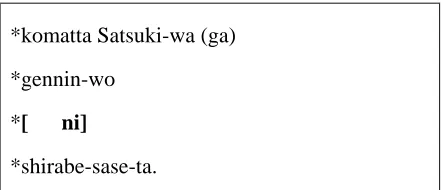
Once zeros are identified, ZD decides where to insert the identified zeros in the original text, by keeping canonical ordering as listed in the valency pattern. An example of the predicate- (obligatory) argument structure from Figure 6, with the identified zero, is presented in Figure 7. This is output (C). Here, the restored case marking particle is presented in parentheses.
*komatta Satsuki-wa (ga)
*gennin-wo
*[ ni]
*shirabe-sase-ta.
Figure 7: Predicate-argument structure with zeros
Finally, ZD outputs the original series of clauses with zeros inserted in the most plausible positions, along with adjuncts, output (D), as in Figure 8.
komatta Satsuki-wa sassoku gennin-wo [ ni]
shirabe-sase-ta.
Figure 8: Zero-specified text
These outputs can later be converted into the form of a slide presentation or hard-copy handouts, etc., depending on how they are used by teachers.
4 Evaluation
The purpose of the evaluation was to assess the validity of ZD output for practical use in a lan-guage learning/teaching setting. In the follow-ing subsections, we evaluate ZD’s performance in terms of its accuracy and then present an ex-perimental report of its validity for educational use.
4.1 Performance
First, we compared the ZD output with human judgements. The test corpus consisted of two reading selections from a JSL textbook and one student written narrative monologue, all of which were representative samples for lower intermedi-ate level Japanese. Five subjects (native speak-ers of Japanese and trained natural language re-searchers) served as our human zero detectors. They were asked to intuitively identify missing arguments in each clause. We used average human performance as a baseline against which to evaluate ZD output. Here, zeros detected by three or more, out of five, subjects were regarded as average human performance.
As Table 1 shows, ZD achieved a 73% per-clause matching rate with human output. That number represents the ratio of the number of exact matches between the two outputs over the total number of clauses.
Table 1: Per-clause matching rates
# of clauses # of matched
Reading (1) 30 22 (73%)
Reading (2) 25 18 (72%)
Writing 23 17 (74%)
Total 78 57 (73%)
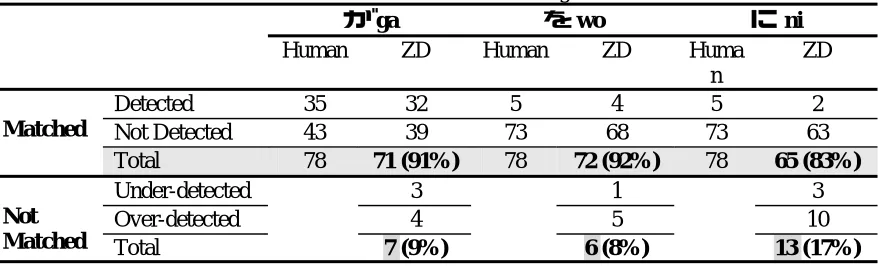
Table 2: Per-case element matching rates
ga wo ni
Human ZD Human ZD Huma n
ZD
Detected 35 32 5 4 5 2
Not Detected 43 39 73 68 73 63
Matched
Total 78 71 (91%) 78 72 (92%) 78 65 (83%)
Under-detected 3 1 3
Over-detected 4 5 10
Not
Matched Total 7 (9%) 6 (8%) 13 (17%)
Also, we analysed ‘not matched’ cases to improve future performance. There were 26 cases of both underproduction and overproduc-tion of zeros. Nearly half of them, 12 out of 26, were caused by our naïve valency selection algo-rithm, which selects the first entry from the GTVD valency pattern listing for each predicate. Three were caused by our canonical-case- marker-restoring heuristics, which assign a first available case marker from ga and wo in its preference order. They sometimes do not function properly when accusatives or adjuncts are topicalized (or focused). These are two major areas for future enhancement. Four cases were affected by morphological/sysntactic analyses. Also, our definition of obligatory arguments, which excludes dative –ni, produced three ‘not matched’ cases. This definition is also an issue for further consideration.
What should be noted here, on the other hand, is that there were six ZD produced zeros which did not match our human zero detectors’ decision but whose validity was later confirmed by a JSL teacher who carefully examined the result from an instructional point of view. This implies that human-recognized zeros and linguistically/pedagogically plausible zeros do not always match, and demonstrates the potential of ZD to fill this gap.
4.2 Experiment
In order to verify the pedagogical effectiveness of ZD, the output files were experimentally used in a university-level intermediate JSL classroom, through digital presentation. The aim of this lesson was to familiarize the students with zeros by making these invisible elements visible in texts and presenting their underlying structures.
In their post-lesson feedback, the students showed a positive reaction to this analytic in-struction. They described this approach as “in-novative”, “effective”, “clear” and “easy” for understanding zeros, in contrast to their past “just guessing or being lost” experiences.
The teacher who conducted this experimen-tal lesson also acknowledged the impact of ZD on effective instruction. She pointed out the following benefits for students:
(i) The valency checking segment of
output (B) helps students realize that each predicate has its own valency pattern, and as a consequence, clarifies when to use what particles,
(ii) the predicate-argument structures with zeros, output (C), help students realize that locating zeros is not a random op-eration, but a canonical designation, and
(iii) the clause-by-clause parallel arrange-ment in output (D) facilitates realizing zero distributions in discourse and tracking down antecedents for each zero.
These include positive side effects that we ini-tially did not foresee.
Conclusions and Future Work
We have developed an automatic zero detecting program that is intended mainly to serve as teacher support. The program has proven to be pedagogically feasible in terms of its accuracy and its impact on effective instruction. The great contribution of ZD is to introduce consis-tency and systematic analysis into an area where human intuitions play a dominant, but not always accurate and effective, role.
ZD is currently a purely syntactic-based tool that utilizes only surface-level heuristics, ex-cluding any semantic cues. As our error analy-sis in Section 4 indicates, more accuracy can be achieved in a semantically enhanced version, which in fact is our next project goal. Valency-pattern-selecting (from GTVD) and canonical-case-marker-restoring (from TP and FP) algorithms are two major areas to which semantic information can greatly contribute.
Also, ZD has been designed as a teaching aid in a teacher-controlled class instruction mode. To extend its use to a self-study mode, as some students suggested, clear guidance and a user-friendly interface will be required to replace teachers’ explanation.
ZD is a part of the CALL program for JSL learners, Zero Checker, which supports reading comprehension and writing revision process with a focus on zeros. Thus, ZD will also serve as a pre-processing module for the models of resolv-ing and generatresolv-ing zeros, created within the cen-tering framework (e.g., Grosz et al., 1995).
References
Chapelle, Carol A. (1998). Multimedia CALL: Lessons to be learned from research on instructed SLA. Language Learning and Technology, vol.2, no.1, pp.22-34.
Grosz, B. J., A. K. Joshi and S. Weinstein. (1995). Centering: A framework for modelling the local coherence of discourse. Computational Linguis-tics, 21/2, pp. 203-225.
Ikehara, S., M. Miyazaki, S. Shirai, A. Yokoo, H. Nakaiwa, K. Ogura and Y. Hayashi (1997).
Goi-Taikei – A Japanese Lexicon, 5 volumes,
Iwanami Shoten, Tokyo.
Krashen, S. (1982). Principles and Practice in
Second Language Acquisition. Pergamon,
Ox-ford.
NAIST, Kudo, K. (2001). CaboCha 0.21. http://cl.aist-nara.ac.jp/~taku-ku/software/caboch a/
NAIST, Matsumoto, Y. et al. (2001). ChaSen 2.2.8. http://chasen.aist-nara.ac.jp/
Ishiwata, T. (1999). Gendai GengoRiron to Kaku, Hituzi Shobo, Tokyo.
Norris, J. M. and L. Ortega (2000). Effectiveness of L2 instruction: A research synthesis and quantita-tive meta-analysis. Language Learning 50 (3), pp.417-528.