Abstract
This paper presents a model for synergistic inte-gration of multimodal speech and pen informa-tion. The model consists of an algorithm for matching and integrating interpretations of in-puts from different modalities, as well as of a grammar that constrains integration. Integration proper is achieved by unifying feature structures. The integrator is part of a general framework for multimodal information systems with dialogue capabilities. Those parts of this framework that are relevant and affects the design of the integra-tor are also presented.
1. Introduction
In recent years, a number of studies have shown that in-terfaces that allow interaction through more than a sin-gle modality (e.g., speech) can empower users in their day-to-day interaction with computers (for a good up-to-date review, consult Oviatt et al., 2000). Carefully de-signed multimodal interfaces promise to make human-computer interaction more flexible, efficient, habitable, and natural. This is of most importance when it comes to walk-up-and-use systems, such as information kiosks. These are systems with which users do not inter-act on an everyday basis and therefore need to be de-signed to allow an intuitive interaction. An instance of such a system is a time table information system for the local bus and train transportations in a city and its sur-roundings. This kind of system is currently being devel-oped at the Natural Language Laboratory (NLPLAB) at Linköping University.
The project aims to develop a publicly available time table information system capable of synergistic multi-modal speech and pen interaction. In parallel to the de-velopment of the specific application, a general framework for multimodal information systems with di-alogue capabilities, calledMALIN, is set up. MALINis an elaboration of an earlier architecture for unimodal typed natural language dialogue systems, and therefore this paper describes how the interpretation module has been expanded to handle multimodal speech and pen in-teraction. The primary focus of this paper is on how the problem of integrating, or fusing, the information re-ceived from the speech and pen modalities has been solved. This problem has previously been addressed by a number of researchers (cf. Neal et al. 1989; Wahlster,
1991; Koons, Sparrell, and Thorisson, 1993; Nigay and Coutaz, 1995; Johnston et al., 1997; Johnston, 1998; Johnston and Bangalore, 2000), but no single technique has become standard or even widely reused. This paper presents an approach to multimodal integration that falls somewhere between two of the earlier approaches, namely that of Johnston et al. (1997) and that of Johnston (1998). The integrator proposed consists of an algorithm for matching and integrating interpretations of input from different modalities, as well as an gram-mar formalism that constrains integration. The integra-tion proper is performed by unificaintegra-tion of feature structures.
2. MALIN
MALINis an acronym for Multimodal Application of LINLIN. LINLIN, in turn, is an acronym for Linköping Natural Language Interface and is a general architecture for natural language interfaces capable of entertaining a coherent dialogue (Jönsson, 1997). MALINis an exten-sion ofLINLIN and presents a general framework for multimodal dialogue applications. The framework con-sists of modules for interpreting and generating multi-modal input and output, dialogue management, domain knowledge management, and user interface manage-ment (Dahlbäck et al., 1999). In the present paper, the focus is on the multimodal interpretation module.
The interpretation module consists of five separate parts: a speech recognizer, a natural language interpret-er, a gesture recognizinterpret-er, a gesture interpretinterpret-er, and a mul-timodal integrator. The composition of these parts are illustrated in figure 1 below:
The architectural composition illustrated in figure 1 deviates very little from the typical multimodal
interpre-U
NDERSTANDING
M
ULTIMODAL
I
NTERACTION BY
E
XPLOITING
U
NIFICATION AND
I
NTEGRATION
R
ULES
Håkan Johansson
Department of Computer and Information Science Linköping University
Sweden
Speech recognition
Natural language interpreter
Multimodal integration
Gesture recognition
Gesture interpretation
tation architecture discussed in Oviatt et al. (2000, p. 275). The only discrepancy between the two architec-tures is that the one shown above does not regard the di-alogue context when integrating multimodal information. More specifically, integration, as proposed in the present paper, only occurs locally within a single interactional segment. References that remain unre-solved after multimodal integration (e.g., references to previous dialogue contributions) are solved by the dia-logue manager in theMALINframework.
2.1 Speech recognizer
The speech recognizer, which is currently not available, is assumed to be a standard continuous, speaker-inde-pendent recognizer for Swedish. However, it is essential that the recognizer can provide information on the tem-poral onset and offset of the individual tokens in a rec-ognized string. For example, if recognition results in the string ”depart from here”, the recognizer must provide temporal information about when ’depart’, ’from’, and ’here’ were uttered respectively. Currently, such speech recognizers exist for other languages than Swedish, and the lack of such a recognizer is a practical problem rather than a theoretical one.
2.2 Natural language interpreter
The natural language interpreter combines shallow and partial parsing (Strömbäck and Jönsson, 1998), which leads to a degree of flexibility suitable for spoken natural language. The interpreter is based on an extended PATR-IIformalism. It has been extended to allow the occurrence of unknown words within phrases in order to avoid analysis to break down in the face of words that are not present in the lexicon. Furthermore, the parser environment has been extended to allow the application developer to specify which of the inactive edges that constitute the parse result, i.e., the result is a set of partial parses. The representational format is directed acyclic graph (DAG) representations of feature structures.
The temporal information provided by the speech rec-ognizer is incorporated into the resulting partial parses. It is therefore required that the grammar is defined in such a way that all the information extracted from a sin-gle word or subphrase is represented within a sinsin-gle par-tial parse, rather than being distributed over several different partial parses. This is a limitation that has not been an issue in the current application, but could prove to be a problem in other applications. However, it is in many cases possible to construct the rules in the gram-mar such that this problem can be avoided.
2.3 Gesture recognizer
The gesture recognizer is triggered when the pen is pressed to the surface of the screen and terminates rec-ognition when the pen is released from the screen. The recognition result is represented as a feature structure containing information on the ”touched” coordinates, as well as the onset and offset of a number of consecutive pen gestures. The only task the gesture recognizer has is
to convert a continuous stream of information in a sym-bolic, non-interpreted, representation.
2.4 Gesture interpreter
The gesture interpreter further process the feature struc-ture received from the gesstruc-ture recognizer in that it re-ceives an interpretation according to a specification of a gesture language. Different interpretations are assigned depending on where in the interface the gesture was made. The output of the gesture interpreter is aDAG.
3. Multimodal Integrator
As can be inferred from the previous sections, the mul-timodal integrator receives as input two feature struc-tures, or more specifically, twoDAG:s. The integrator process theDAG:s and attempts to integrate them in or-der to construct a coherent interpretation of a user’s ac-tions.
3.1 Algorithm
The algorithm is quite straightforward. Informally, the algorithm maps every subDAGin one modality (i.e., the interpretation of input from one modality) to every subDAGin the other modality. In other words, the algo-rithm attempts to integrate every combination of subDAG:s. This means that the algorithm has to consid-er S * G combinations, whconsid-ere S is the numbconsid-er of subDAG:s of the interpreted speech, and G is the num-ber of subDAG:s in the interpreted gesture. In order for the combinations of subDAG:s to be integrated they have to match some rule in an ordered set of rules. These rules are ordered with regards to specificity, and there-fore this is a case of conflict resolution by specificity (cf. Jackson, 1999, p. 86).
A few other points are worth noticing. First, what is considered for integration is subDAG:s along with the feature (or attribute) of which they are a value. Since we are considering only proper subDAG:s, every subDAG is the value of some feature. However, in the current nat-ural language interpreter, cardinal numbers are used as features to iterate a number of similar structures. For in-stance, if the user specifies multiple locations, these are located by iteration under a feature locations. In the case where a subDAGis a value of a feature that is a cardinal number, the algorithm replaces this number with the fea-ture name at the next shallower level.
Another point worth noticing is that in the current im-plementation, speech is considered to be the primary modality. This means that if the algorithm receives non-empty DAG:s but is unable to integrate them, the speech-DAGis returned. However, if the speech-DAG is empty and the gesture-DAG is not, the latter is re-turned.
3.2 Integration rules
con-straints regard both the semantic and temporal informa-tion represented in theDAG:s.
3.3 Temporal constraints
When interacting with computers multimodally, users utilize a wide range of temporal integration patterns (cf. Oviatt et al., 1997). Therefore, the integration rules consists of constraints on these patterns. These con-straints are placed on∆tonsetand∆toffset.∆tonsetis calcu-lated by subtracting the onset of gesture from the onset of speech.∆toffsetis similarly calculated by subtracting the offset of gesture form the offset of speech. The con-straints are set by placing a maximum and a minimum value of∆tonsetand∆toffsetrespectively, i.e., by setting an interval within which the values must range.
3.4 Semantic constraints
The semantics of a subDAGis taken to be the attribute of which it is a value (henceforth referred to as parent attribute) along with the attributes within the subDAG. The semantic constraints differs from the temporal in that they are optional. If the semantic constraints are left out, the integration process will be driven entirely by temporal information. This can work for some cases, but the risk is that absurd integrations will take place. For in-stance, if the user points to a location in the map while uttering a timepoint this information might be integrat-ed.
The parent attribute is constrained by declaring which literal string it must be equal to. Constraints on the at-tributes contained within the subDAGon the other hand is more complex. These constraints can have the follow-ing three forms:
•<attribute> = w •<attribute> = [] •<attribute> =ε
The symbol w denotes some string, [] denotes an emp-ty dag, and
ε
denotes that no constraint is placed on the value (i.e., one only states that the attribute in question should be present).3.5 Summary of constraints
The list below summarizes the different constraints that can be placed on the subDAG:s being compared:
•constraints on the intervals within which∆tonsetand ∆toffsetmust fall,
•constraints on the parent attributes, and
•constraints on the attributes contained within the respective subDAG:s.
4. Example Integration
It is now useful to turn to a more concrete example in or-der to better unor-derstand the integrator’s functionality. The figures to which this section refers can be found on the last page of the paper.
The scenario is this: a user says ”Jag vill åka därifrån till Resecentrum”. The underlining means that the user simultaneously pointed somewhere in the map-part of
the interface. We will now step through the different parts of the integration process.
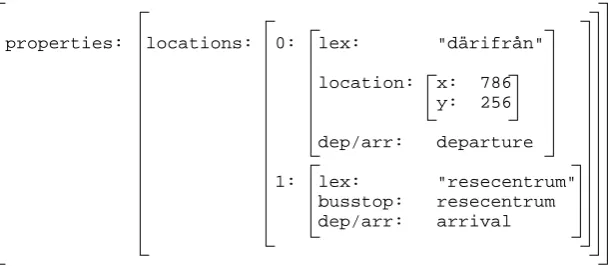
First the gesture is recognized and represented in the form seen in the left part of figure 2. This feature struc-ture simply contains information on when and at which coordinate in the interface the gesture was made. This structure is then passed to the gesture interpreter, which realizes that the coordinate corresponds to some loca-tion in the map-part of the interface. Based on this it as-sumes that the user intended to indicate some physical location. The gesture interpreter does however not inter-pret exactly which location the user indicated. This is later done in the domain knowledge manager in the MA-LIN framework. Hence, if the user utters the name of one location while pointing to another, this is not re-solved until the integrated result reaches the domain knowledge manager.
On the speech side, the utterance is first passed through the speech recognizer, which passes the string representation of the recognition result to the natural language interpreter. The parser outputs theDAGseen in figure 3.
The output of the gesture interpreter and the natural language interpreter is then passed to the integrator. Since neither of theDAG:s are empty initially, the algo-rithm proceeds to check all combinations of subDAG:s against the integration rules. The gesture-DAGcontains three subDAG:s, while the speech-DAGcontains seven. All in all, 21 combinations have to be checked for inte-gration. Assume that the grammar contains the follow-ing rule:
•(0.0≤ ∆tonset≤1.0)AND •(2.0≤ ∆toffset≤5.0)AND
•(parent_attributespeech= ”locations”)AND •(parent_attributegesture= ”locations)AND •(<location>speech= [])
The first and second constraints specify the intervals for∆tonsetand∆toffsetrespectively. The first constraint declares that gesture must have the same onset as, or pre-cede speech by up to most 1.0 time unit. The second con-straint declares that the pen must be lifted from the touch screen somewhere between 2.0 and 5.0 time units before speech ends. Constraints four and five declares that both speech and gesture should have received an interpreta-tion as being some form of locainterpreta-tion. Finally, constraint five declares that the speech-subDAGshould contain an attribute ’location’ that has an empty DAG as value, i.e., it should not have been interpreted as some specific location.
5. Discussion
This paper has presented a mechanism for integrating, or fusing, information received through different chan-nels (i.e., speech and pen). However, some issues re-main and deserve further elaboration. To some extent the four issues raised by Johnston et al. (1997) can serve as a useful ground for discussion.
First, the multimodal integrator has initially been de-signed to handle only simple deictic pointing gestures. However, this is not a fundamental limitation of the in-tegrator. The choice to limit the integrator in this sense has been made because there is currently no gesture rec-ognizer or gesture interpreter implemented. Therefore, minimal assumptions about these modules has been made.
Second, the integrator is to some extent speech-driv-en, i.e., in the presence of speech it tries to find elements in speech that can be integrated with gesture. However, the integration rules can be declared in such a way that the two modalities can stand on more equal ground. Fur-thermore, in the absence of speech, the interpreted ges-ture can constitute the entire interpretation.
Third, the multimodal integrator is based on a formal-ly well defined and understood meaning representation formalism, i.e., feature structures. This makes the inte-grator more readily integrable with other parsers than if it utilized some novel technique.
Finally, the integrator is semi-formally well defined even though it lacks a full formal specification.
References
Dahlbäck, N., Flycht-Eriksson, A., Jönsson, A. and Qvarfordt, P. (1999). An Architecture for Multi-Modal Natural Dialogue Systems. In Proceedings ofESCATutorial and Research Workshop (ETRW) on Interactive Dialogue in Multi-Modal Systems, Germany.
Jackson, P. (1999). Introduction to Expert Systems. Addison Wesley Longman Ltd.
Koons, D. B., Sparrell, C. J. and Thorisson, K. R. (1993). Integrating Simultaneous Input from Speech, Gaze, and Hand Gestures.
In M. T. Maybury (Ed.) Intelligent Multimedia Interfaces, pp. 243-261, Menlo Park,CA:AAAI/
MITPress.
Johnston, M. (1998). Unification-based Multimodal Parsing. In Proceedings of the 36th Annual Meeting of the Association for Computational Linguistics and the 17th International Conference on Computational Linguistics, pp. 624-630, Montreal, Quebec, Canada.
Johnston, M. and Bangalore, S. (2000). Finite-state Multimodal Parsing and Understanding. In Proceedings of the 18th International Conference on Computational Linguistics, Saarbrücken, Germany.
Johnston, M., Cohen, P. R., McGee, D., Oviatt, S. L., Pittman, J. A. and Smith, I. (1997). Unification-based Multimodal Integration. In Proceedings of the 35th Annual Meeting of the Association for Computational Linguistics, pp. 281-288, Madrid, Spain.
Jönsson, A. (1997). A Model for Habitable and Efficient Dialogue Management for Natural Language Interaction. Natural Language Engineering, 3(2/ 3), pp. 103-122.
Neal, J. G., Thielman, C. Y., Dobes, Z., Haller, S. M. and Shapiro, S. C. (1989). Natural Language with Integrated Deictic and Graphic Gestures.
In Proceedings of the 1989DARPAWorkshop on Speech and Natural Language, pp. 410-423.
Nigay, L. and Coutaz, J. (1995). A Generic Platform for Addressing the Multimodal Challenge.
In Proceedings of Conference on Human Factors in Computing Systems (CHI’95), pp. 98-105, Denver, Colorado.
Oviatt, S., Cohen, P., Wu, L., Vergo, J., Duncan, L., Suhm, B., Bers, J., Holzman, T., Winograd, T., Landay, J., Larson, J., and Ferro, D. (2000). Designing the User Interface for Multimodal Speech and Pen-based Gesture Applications: State-of-the-Art Systems and Future Research Directions. Human-Computer Interaction, 15(4), pp. 263-322.
Oviatt, S., DeAngeli, A., and Kuhn, K. (1997). Integration and Synchronization of Input Modes during Multimodal Human-Computer Interaction. In Proceedings of Conference on Human Factors in Computing Systems, pp. 415-422, Atlanta, Georgia.
Strömbäck, L. and Jönsson, A. (1998). Robust Interpretation for Spoken Dialogue Systems. In Proceedings of the International Conference on Spoken Language Processing, pp. 491-494, Sydney, Australia.
0: coord: x: 786 y: 256
time: begin: 10 end: 13
properties: locations: 0: lex: "därifrån"
location: x: 786 y: 256
dep/arr: departure
1: lex: "resecentrum" busstop: resecentrum dep/arr: arrival
Figure 2: To the left aDAGrepresenting a recognized gesture, and to the right its interpretation.
Figure 3: ADAGrepresenting the interpretation of the spoken utterance ”Jag vill åka därifrån till Resecentrum”.
Figure 4: ADAGrepresenting the result of integrating theDAGto the right in figure 2 and theDAGin figure 3.
dep/arr: departure
time: begin: 10 end: 17
1: lex: "resecentrum" busstop: resecentrum dep/arr: arrival
time: begin: 22 end: 32
time: begin: 10 end: 32 location: []
properties: locations: 0: lex: "därifrån"
0: locations: location: x: 786 y: 256