E v a l u a t i o n M e t r i c s for G e n e r a t i o n
S r i n i v a s B a n g a l o r e a n d O w e n R a m b o w a n d S t e v e W h i t t a k e r A T & T L a b s - R e s e a r c h
180 P a r k A v e , P O B o x 971 F l o r h a m P a r k , N J 0 7 9 3 2 - 0 9 7 1 , U S A
{srini,r~mbow, stevew}@reSearch, art tom
A b s t r a c t
Certain generation applications may profit from the use of stochastic methods. In developing stochastic methods, it is crucial to be able to quickly assess the relative merits of different approaches or mod- els. In this paper, we present several types of in- trinsic (system internal) metrics which we have used for baseline quantitative assessment. This quanti- tative assessment should then be augmented to a fuller evaluation that examines qualitative aspects. To this end, we describe an experiment t h a t tests correlation between the quantitative metrics and hu- man qualitative judgment. T h e experiment confirms that intrinsic metrics cannot replace human evalu- ation, but some correlate significantly with human judgments of quality and understandability and can
be used for evaluation during development.
1 I n t r o d u c t i o n
For m a n y applications in natural language genera- tion (NLG), the range of linguistic expressions t h a t must be generated is quite restricted, and a g r a m - m a r for a surface realization component can be fully specified by hand. Moreover, iLL inany cases it is very important not to deviate from very specific out- put in generation (e.g., m a r i t i m e weather reports), in which case hand-crafted g r a m m a r s give excellent control. In these cases, evaluations of the generator that rely on human j u d g m e n t s (Lester and Porter, I997) or on human annotation of the test c o r p o r a (Kukich, 1983) are quite sufficient . . . . However. in other NLG applications the variety of the output is much larger, and the demands on the quality of the output are solnewhat less strin- gent. A typical example is NLG in the context of (interlingua- or transfer-based) inachine translation. Another reason for relaxing the quality of the out- put m a y be that not enough time is available to de- velop a full gramnlar for a new target, language in NLG. ILL all these cases, stochastic methods provide an alternative to hand-crafted approaches to NLG. 1
To our knowledge, the first to use stochastic tech- niques in an NLG realization module were Langkilde and Knight (1998a) and (~998b) (see also (Langk- ilde, 2000)). As is the case for stochastic approaches in natural language understanding, the research a n d development itself requires an effective intrinsic m e t - ric in order to be able to evaluate progress.
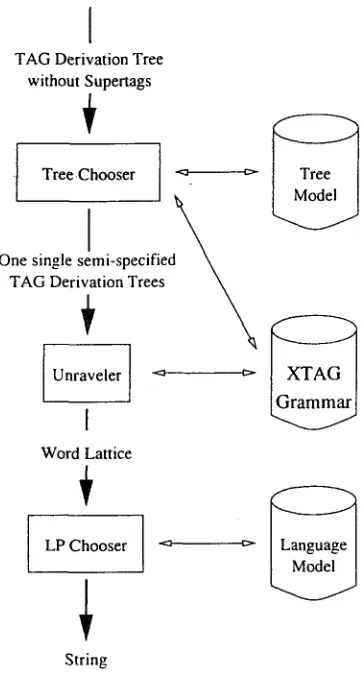
In this paper, we discuss several evaluation metrics that we are using during the development of FERGUS (Flexible Empiricist/Rationalist Generation Using Syntax). FERCUS, a realization module, follows Knight and Langkilde's seminal work in using an n-gram language model, but we augment it with a tree-based stochastic model and a lexicalized syntac- tic g r a m m a r . The metrics are useful to us as rela- tive quantitative assessments of different models we experiment with; however, we do not pretend t h a t these metrics in themselves have any validity. In- stead, we follow work done in dialog systems (Walker et al., 1997) and a t t e m p t to find metrics which on tim one hand can be computed easily but on the other hand correlate with empirically verified h u m a n judgments in qualitative categories such as readabil- ity.
The structure of the paper is as follows. In Section 2, we briefly describe the architecture of FEacUS, and some of the modules. In Section 3 we present four metrics and some results obtained with these met- rics. In Section 4 we discuss the for experimental validation of the metrics using human judgments, and present a new metric based on the results of these experiments. In Section 5 we discuss some of the 'many problematic issues related t o the u s e Of metrics and our metrics in particular, and discuss on-going work.
2 S y s t e m O v e r v i e w
a dependency tree as shown in Figure 2. t Note that the nodes are unordered and are labeled only with lexemes, not with any sort of syntactic annotations. 2 The Tree Chooser uses a stochastic tree model to choose syntactic properties (expressed as trees in a Tree Adjoining G r a m m a r ) for the nodes in the in- put structure. This step can be seen as analogous to "supertagging" -(Bangalore-und doshh 1:999);. except that now supertags (i.e., names of trees which en- code the syntactic properties of a lexical head) must be found for words in a tree rather than for words in a linear sequence. The Tree Chooser makes the siinplifying assumptions that the choice of a tree for a node depends only on its d a u g h t e r nodes, thus al- lowing for a top-down algorithm. T h e Tree Chooser draws on a tree model, which is a analysis in terms of syntactic dependency for 1,000,000 words of the Wall Street Journal (WSJ). 3
The supertagged tree which is o u t p u t from the Tree Chooser still does not fully determine the surface string, because there typically are different ways to attach a daughter node to her m o t h e r (for example, an adverb can be placed in different positions with respect to its verbal head). T h e Unraveler therefore uses the XTAG g r a m m a r of English ( X T A G - G r o u p , 1999) to produce a lattice of all possible lineariza- tions t h a t are compatible with the supertagged tree. Specifically, the daughter nodes are ordered with re- spect to the head at each level of the derivation tree. In cases where the XTAG g r a m m a r allows a daugh- ter node to be attached at more than one place in the m o t h e r supertag (as is the case in our exam- ple for was and for; generaUy, such underspecifica- tion occurs with adjuncts and with arguments if their syntactic role is not specified), a disjunction of all these positions is assigned to the daughter node. A b o t t o m - u p algorithm then constructs a lattice that encodes the strings represented by each level of the derivation tree. The lattice at the root of the deriva- tion tree is the result of the Unraveler.
Finally. the LP Chooser chooses the most likely traversal of this lattice, given a linear language 1The sentence generated by this tree is a p r e d i c a t i v e n o u n c o n s t r u c t i o n . The XTAG g r a m m a r analyzes these as being headed by the n o u n , r a t h e r - t h a n b y . t h e copula, and we fol- low the XTAG analysis. However, it would of course also be possible to use a g r a m i n a r t h a t allows for the copula-headed analysis.
21n the system that we used in the e x p e r i m e n t s described in Section 3. all words (including function words) need to be present in the input representation, fully inflected. Further- more, there is no indication of syntactic role at all. T h i s is of course unrealistic f~r applications see ,Section 5 for f u r t h e r renlarks.
:3This wa~s constructed from the Penn Tree Bank using some heuristics, sirice the. l)enn Tree Bank does not contain full head-dependerit information; as a result of the tlse of heuristics, the Tree Model is tint fully correct.
2
I
TAG Derivation Treewithout Supertags
i
One single s e m i - s p e c i f i e d ~ TAG Deri~tion Trees
[image:2.596.366.548.91.431.2]Word Lattice
i
[ cPc.oo=, ]
l
String
Figure 1: Architecture of FERGUS estimate
there was no cost for
I
phase
the second
Figure 2: Input to FERGUS
words WSJ training corpus. We pick the best path through the lattice resulting from the composition using the Viterbi algorithm, and this top ranking word sequence is the o u t p u t of the LP Chooser and the generator.
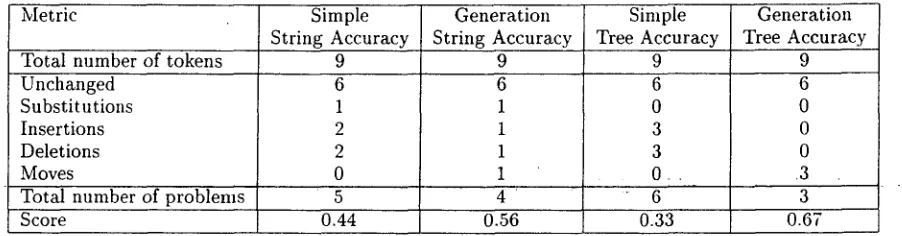
When we tally the results we obtain the score shown in the first column of Table 1.
Note that if there are insertions and deletions, the number of operations may be larger than the number of tokens involved for either one of the two strings. As a result, the simple string accuracy metric may 3 B a s e l i n e - Q u a _ n t i t m t i v e , M e t r i c s ...,:-~.--..~,-:..,be.:..~eg~i~ee (t:hoagk:it, As, nevel:-greater._than 1, of
We have used four different baseline quantitative metrics for evaluating our generator. The first two metrics are based entirely on the surface string. The next two metrics are based on a syntactic represen- tation of the sentence.
3.1 S t r i n g - B a s e d M e t r i c s
We employ two metrics that measure the accuracy of a generated string. The first metric, s i m p l e ac-
c u r a c y , is the same string distance metric used for
measuring speech recognition accuracy. This met- ric has also been used to measure accuracy of MT systems (Alshawi et al., 1998). It is based on string edit distance between the output of the generation system and the reference corpus string. Simple ac- curacy is the number of insertion (I), deletion (D) and substitutions (S) errors between the reference strings in the test corpus and the strings produced by the generation model. An alignment algorithm us- ing substitution, insertion and deletion of tokens as operations attempts to match the generated string with the reference string. Each of these operations is assigned a cost value such that a substitution op- eration is cheaper than the combined cost of a dele- tion and an insertion operation. The alignment al- gorithm attempts to find the set of operations that minimizes the cost of aligning the generated string to tile reference string. Tile metric is summarized in Equation (1). R is the number of tokens in the target string.
course).
The simple string accuracy metric penalizes a mis- placed token twice, as a deletion from its expected position and insertion at a different position. This is particularly worrisome in our case, since in our eval- uation scenario the generated sentence is a permuta- tion of the tokens in the reference string. We there- fore use a second metric, G e n e r a t i o n S t r i n g A c - c u r a c y , shown in Equation (3), which treats dele- tion of a token at one location in the string and the insertion of the same token at another location in the string as one single movement error (M). This is in addition to the remaining insertions ( I ' ) and deletions (D').
(3) G e n e r a t i o n S t r i n g A c c u r a c y =
( 1 -- M~-/~.P-~--~-~)
In our example sentence (2), we see that the inser- tion and deletion of no can be collapsed into one move. However, the wrong positions of cost and of phase are not analyzed as two moves, since one takes the place of the other, and these two tokens still re- sult in one deletion, one substitution, and one inser- tion. 5 Thus, the generation string accuracy depe- nalizes simple moves, but still treats complex moves (involving more than one token) harshly. Overall, the scores for the two metrics introduced so far are shown in the first two columns of Table 1.
3.2 T r e e - B a s e d M e t r i c s
(1) S i m p l e S t r i n g A c c u r a c y = (1 I+*)+s I¢ ) \Vhile tile string-b~u~ed metrics are very easy to ap- ply, they have the disadvantage that they do not reflect the intuition that all token moves are not Consider tile fifth)wing example. The target sentence
is on top, tile generated sentence below. Tile third equally "bad". Consider the subphrase estimate for line represents the operation needed to. transfor m .. phase the second of the sentence in (2). \Vhile this is one sentence into another: a period is used t.o indi- b a d ; i t seems better:tiara art alternative such as es- cate that no operation is needed. 4
(2)
There was no cost estimate for tile There was estimate for l)hase tiled (1 i
second phase
s e c o n d n o c o s t
i s
• I Note t h a t the metric is s y m m e t r i c ,
timate phase for tile second. Tile difference between the two strings is that the first scrambled string, but not tile s e c o n d , c a n be read off fl'om tile d e p e n d e n c y
tree for the sentence (as shown ill Figure 2) with- out violation of projectivity, i.e., without (roughly
STiffs shows the i m p o r t a n c e of the alignment algorithm in the definition of Ihese two metrics: had it. not, aligned p h a s e
and cost as a substitution ( b u t each with an e m p t y position
speaking) creating discontinuous constituents. It has long been observed (though informally) t h a t the dependency trees of a vast majority of sentences in the languages of the world are projective (see e.g. (Mel'euk, 1988)), so t h a t a violation of projectivity is p r e s u m a b l y a more severe error than a word order variation t h a t does not violate projectivity.
We designed t h e t r e e - b a s e d ' - a c e t t r u c y m e t r i c s in order to account for this effect. Instead of c o m p a r - ing two strings directly, we relate the two strings to a dependency tree of the reference string. For each treelet (i.e., non-leaf node with all of its daugh- ters) of the reference dependency tree, we construct strings of the head and its dependents in the order they a p p e a r in the reference string, and in the order they a p p e a r in the result string. We then calculate the n u m b e r of substitutions, deletions, and inser- tions as for the simple string accuracy, and the num- ber of substitutions, moves, and remaining deletions and insertions as for t h e generation string metrics, for all treelets that f o r m the dependency tree. We sum these scores, and then use the values obtained in the formulas given above for the two string-based metrics, yielding the S i m p l e T r e e A c c u r a c y and G e n e r a t i o n T r e e A c c u r a c y . The scores for our example sentence are shown in the last two columns of Table 1.
3.3 E v a l u a t i o n R e s u l t s
T h e simple accuracy, generation accuracy, simple tree accuracy and generation tree accuracy for the two experiments are tabulated in Table 2. The test corpus is a randomly chosen subset of 100 sentences from the Section 20 of WSJ. T h e dependency struc- tures for the test sentences were obtained automat- ically from converting the Penn TreeBank phrase s t r u c t u r e trees, in the s a m e way as was done to Create the training corpus. T h e average length of the test sentences is 16.7 words with a longest sen- tence being 24 words in length. As can be seen, the s u p e r t a g - b a s e d model improves over the baseline LR model on all four baseline quantitative metrics.
4 Q u a l i t a t i v e E v a l u a t i o n o f t h e Q u a n t i t a t i v e M e t r i c s
4.1 T h e E x p e r i m e n t s
We have presented four metrics which we can com- pute automatically. In order to determine whether the metrics correlate with independent notions un- derstandability or quality, we have performed eval- uation experiments with h u m a n subjects.
In the web-based experiment, we ask h u m a n sub- jects to read a short p a r a g r a p h from the WSJ. We present three or five variants of the last sentence of this p a r a g r a p h on the s a m e page, and a s k the sub- ject to judge them along two dimensions:
Here we summarize two experiments t h a t we have performed t h a t use different tree nmdels. (For a more detailed comparisons of different tree models, see (Bangalore and Rainbow, 2000).)
o For the baseline experiment, we impose a ran- d o m tree structure for each sentence of the cor- pus and build a Tree Model whose p a r a m e t e r s consist of whether a lexeme ld precedes or fol- lows her mother lexeme [ .... We call this the Baseline Left-Right (LR) Model. This model generates There w a s e s t i m a t e f o r p h a s e the sec- o n d n o c o s t . for o u r example input.
o In t h e second experiment w e use t h e - s y s t e m as described in Section 2. We employ the supertag-based tree model whose p a r a m e t e r s consist of whether a lexeme ld with s u p e r t a g sd is a dependent of lexeme 1,,, with s u p e r t a g s,,,. Furthermore we use the information pro- vided by the XTAG g r a m m a r to order the de- pendents. This model generates T h e r e w a s no cost e s t i m a t e for" t h e second phase . for our ex- a m p l e input, .which is indeed.the sentence found in the WS.I.
o U n d e r s t a n d a b i l i t y : How easy is this sentence to understand? Options range from "Extremely easy" ( = 7) to "Just barely possible" (=4) to "Impossible" (=1). (Intermediate numeric val- ues can also be chosen but have no description associated with them.)
o Q u a l i t y : How well-written is this sentence? Options range from "Extremely well-written'" ( = 7) to "Pretty bad" (=4) to "Horrible (=1). (Again. intermediate numeric values can also t)e chosen, but have no description associated with them.)
Metric Simple Generation Simple Generation String Accuracy String Accuracy Tree Accuracy Tree Accuracy
Total number of tokens 9 9 9 9
Unchanged Substitutions Insertions Deletions Moves
6 1
2 2
0
6 0 3 3 O . .
6
0 0 0 .3
Total number of problems 5 4 " 6 3
Score 0.44 0.56 0.33 0.67
Table 1: Scores for the sample sentence according to the four metrics
Tree Model Simple Generation Simple Generation
String Accuracy String Accuracy Tree Accuracy Tree Accuracy i
Baseline LR Model 0.41 0.56 0.41 0.63
. . . i
Supertag-based Model 0.58 0.72 0.65 0.76 I
Table 2: Performance results
tree measures being approximately equal. Ten sub- jects who were researchers from AT&T carried out the experiment. Each subject made a total of 24 judgments.
Given the variance between subjects we first nor- malized the data. We subtracted the mean score for each subject from each observed score and then divided this by standard deviation of the scores for that subject. As expected our data showed strong correlations between normalized understanding and quality judgments for each sentence variant (r(22) = 0.94, p < 0.0001).
Our main hypothesis is that the two tree-based met- rics correlate better with both understandability and quality than the string-based metrics. This was con- firmed. Correlations of the two string metrics with normalized understanding for each sentence variant were not significant (r(22) = 0.08 and rl.2.21 = 0.23, for simple accuracy and generation accuracy: for both p > 0.05). In contrast both of the tree metrics were significant (r(2.2) = 0.51 and r(22) = 0.48: for tree accuracy and generation tree accuracy, for both p < 0.05). Similar results were achieved--for t h e g o r - realized quality metric: (r(.2.21 = 0.16 and r(221 = 0,33: for simple accuracy and generation accuracy, for both p > 0.05), (r(ee) = 0.45 and r(.2.2) = 0.42, for tree accuracy and generation tree accuracy, for both p < 0.05).
A second aim of ()Lit" qualitative evaluation was to lest various models of the relationship between in- trinsic variables and qualitative user judgments. \Ve proposed a mmlber-of'models:in which various conL-
from the two tree models
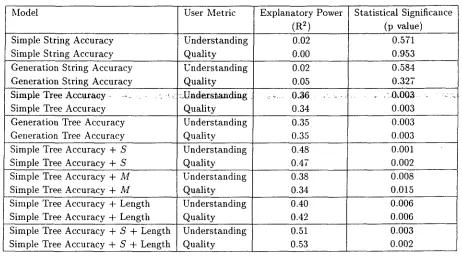
binations of intrinsic metrics were used to predict user judgments of understanding and quality. .We conducted a series of linear regressions with nor- malized judgments of understanding and quality as the dependent measures and as independent mea- sures different combinations of one of our four met- rics with sentence length, and with the "problem" variables that we used to define the string metrics (S, I, D, M, I ' , D' - see Section 3 for definitions). One sentence variant was excluded from the d a t a set, on the grounds that the severely "mangled" sentence happened to turn out well-formed and with nearly the same nleaning as the target sentence. The re- sults are shown in Table 3.
We first tested models using one of our metrics as a single intrinsic factor to explain the dependent vari- able. We then added the "problem" variables. 6 and could boost tile explanatory power while maintain- ing significance. In Table 3, we show only some con> binations, which show that tile best results were ob- tained by combining the simple tree accuracy with the number of Substitutions (S) and the sentence length. As we can see, the number of substitutions ... has an.important effecVon explanatory.power,, while that of sentence length is much more modest (but more important for quality than for understanding). Furthermore, the number of substitutions has more explanatory power than the number of moves (and in fact. than any of the other "problem" variables).
The two regressions for understanding and writing show very sinlilar results. Normalized understand-
[image:5.596.99.550.99.217.2]Model User Metric E x p l a n a t o r y Power Statistical Significance
(R 2) (p value)
Simple String Accuracy Understanding 0.02 0.571
Simple String Accuracy Quality 0.00 0.953
Generation String Accuracy Generation String Accuracy
S i m p l e T r e e Accuracy . . . . - ~ ,
Simple Tree Accuracy Generation Tree Accuracy Generation Tree Accuracy Simple Tree Accuracy + S Simple Tree Accuracy + S Simple Tree Accuracy + M Simple Tree Accuracy + M Simple Tree Accuracy + Length Simple Tree Accuracy + Length Simple Tree Accuracy + S + Length Simple Tree Accuracy + S + Length
Understanding Quality ::Unders~aatdiag
Quality Understanding Quality
0.02 0.05
: . , . . . . 0 . 3 6
0.34 0.35 0.35
0.584 0.327
. . • . . . ".0;003.. - . :
0.003 0.003 0.003
Understanding 0.48 0.001
Quality 0.47 0.002
Understanding 0.38 0.008
Quality 0.34 0.015
Understanding 0.40 0.006
Quality 0.42 0.006
0.51 0.53 Understanding
Quality
0.003 0.002
Table 3: Testing different models of user j u d g m e n t s (S is number of substitutions, M n u m b e r of moved elements)
ing was best modeled as:
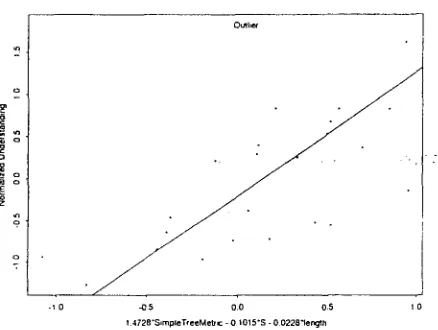
Normalized understanding = 1.4728*sim- ple tree accuracy - 0.1015*substitutions- 0.0228 * length - 0.2127.
This model was significant: F(3,1.9 ) = 6.62, p < 0.005. Tile model is plotted in Figure 3. with the d a t a point representing the removed outlier at the top of the diagram.
This model is also intuitively plausible. The simple tree metric was designed to measure the quality of a sentence and it has a positive coefficient. A substitu- tion represents a case in the string metrics in which not only a word is in the wrong place, but the word that should have been in t h a t place is somewhere else, Therefore, s u b s t i t u t i o n s , m o r e than moves or insertions or deletions, represent grave cases of word order anomalies. Thus, it is plausible to penalize them separately. (,Note that tile simple tree accuracy is bounded by 1, while the number of substitutions is l/ounded by the length of the sentence. I n practice, in our sentences S ranges between 0 and 10 with a mean of 1,583.) Finally, it is also plausible that longer sentem:es are more difficult to understand, so
that length has a (small) negative coefficient. We now turn to model for quality,
Normalized quality = 1.2134*simple tree a c c u r a c y - 0.0839*substitutions - 0.0280 * length - 0.0689.
This model was also significant: F(3A9) = 7.23, p < 0.005. The model is plotted in Figure 4, with the d a t a point representing the removed outlier at the top of the diagram. The quality model is plausible for the same reasons that the understanding model is.
L2
PP
j , 1 "
.i
/
. / /
/
/ /
• . , j -
-05 O0 05
I a728"SLmo~eTteeMel~ - 0 I015"S - 0 0228"lerN~h
[image:6.596.103.565.91.347.2] [image:6.596.346.562.546.714.2]o
Du~h~
- ( 0 - O 5 0.0 0 5 I 0
1 4728*S,mpleT~eeMetr ¢ - 0 I 0 1 5 " S - 0 0228"len~l~h
Figure 4: Regression for Quality (Well-Formedness)
4.2 T w o N e w M e t r i c s
A further goal of these experiments was to obtain one or two metrics which can be a u t o m a t i c a l l y com- puted, a n d which have been shown to significantly correlate with relevant h u m a n judgments• We use as a s t a r t i n g point the two linear models for normalized u n d e r s t a n d i n g and quality given above, but we make two changes. First, we observe t h a t while it is plau- sible to model h u m a n j u d g m e n t s by penalizing long sentences, this seems u n m o t i v a t e d in an accuracy metric: we do not want to give a perfectly generated longer sentence a lower score than a perfectly gener- ated s h o r t e r sentence. We therefore use models that just use the simple tree a c c u r a c y and the number of substitutions as independent variables• Second, we note t h a t once we have done so, a perfect sen- tence gets a score of 0.8689 (for understandability) or 0.6639 (for quality). We therefore divide by this score to assure that a perfect sentence gets a score of 1. (As for the previously introduced metrics, the scores m a y be less t h a n 0.)
\Ve o b t a i n the following new metrics:
(4) U n d e r s t a n d a b i l i t y • A c c u r a c y = (1.3147*simple tree a c c u r a c y 0.1039*sub- stitutions - 0.4458) / 0.8689 -
(5) Q u a l i t y A c c u r a c y = (1.0192*simple tree ac- c u r a c y - 0.0869*substitutions - 0.3553) / 0.6639
\ \ e reevahtated our s y s t e m and the baseline model using the new metrics, in order to veri(v whether the nloro motivated metrics we have developed still show that FER(;I:S improves l)erforniance over the baseline. This is indeed t h e case: the resuhs are Slllnm.arized ill T a b h ' - t .
Tree Model Understandability Quality A c c u r a c y A c c u r a c y
Baseline -0.08 -0.12
S u p e r t a g - b a s e d 0.44 0.42
. Table 4: P e r f o r m a n c e results from the .two tree m o d - ... els:using t h e : n e w metrics . . .
5 D i s c u s s i o n
We have devised the baseline quantitative metrics presented in this paper for internal use during re- search and development, in order to evaluate dif- ferent versions of FERGUS. However, the question also arises whether they c a n be used to c o m p a r e two completely different realization modules. In either case, there are two main issues facing the proposed corpus-based q u a n t i t a t i v e evaluation: does it gener- alize and is it fair?
T h e problem in generalization is this: can we use this m e t h o d to evaluate a n y t h i n g other than ver- sions of FERGUS which generate sentences from the W S J ? We claim that we can indeed use the quan- titative evaluation p r o c e d u r e to evaluate most real- ization modules generating sentences from any cor- pus of u n a n n o t a t e d English text. The fact t h a t the tree-based metrics require dependency parses of the corpus is not a major impediment. Using exist- ing s y n t a c t i c parsers plus ad-hoc postprocessors as needed, one can create the input representations to the g e n e r a t o r as well as the syntactic d e p e n d e n c y trees needed for the tree-based metrics. T h e fact t h a t the parsers introduce errors should not affect the way the scores are used, namely as relative scores (they have no real value absolutely). Which realiza- tion modules can be evaluated? First, it is clear that our approach can only evaluate single-sentence realization modules which may perform some sen- tence planning tasks, but cruciaUy not including sen- tence s c o p i n g / a g g r e g a t i o n . Second, this approach :only works for generators whose input representa- tion is fairly "syntactic". For example, it m a y be difficult to evaluate in this manner a generator that -uses semanzic roles in-its i n p n t r e p r e s e n t ~ i o n , since
we c u r r e n t l y cannot m a p large corpora of syntac- tic parses onto such semantic representations, and therefore c a n n o t create the input representation for the evaluation.
[image:7.596.108.327.112.277.2]stochastic model include lexical choice, introduction of function words and punctuation, and generation of morphology. (See (Langkilde and Knight, 1998a) for a relevant discussion. FERGUS currently can per- form punctuation and function word insertion, and morphology and lexical choice are under develop- ment.) T h e question arises whether our metrics will
. fairly m e a s u r e the:quality,~of,a, more comp!ete real~ ....
ization module (with s o m e sentence planning). Once the range of choices t h a t the generation component makes expands, one quickly runs into the problem that, while the gold s t a n d a r d may be a good way of communicating the input structure, there are usu- ally other good ways of doing so as well (using other words, other syntactic constructions, and so on). Our metrics will penalize such variation. However, in using stochastic m e t h o d s one is of course precisely interested in learning f r o m a corpus, so that the fact that there may be o t h e r ways of expressing an input is less relevant: the whole point of the stochastic ap- proach is precisely to express the input in a manner that resembles as much as possible the realizations found in the corpus (given its genre, register, id- iosyncratic choices, a n d so on). Assuming the test corpus is representative of the training corpus, we can then use our metrics to measure deviance from the corpus, whether it be merely in word order or in terms of more complex tasks such as lexical choice as well. Thus, as long as the goal of the realizer is to enmlate as closely as possible a given corpus (rather than provide a maximal range of paraphras- tic capability), then our approach can be used for evaluation, r
As in the case of machine translation, evaluation in generation is a complex issue. (For a discussion, see (Mellish and Dale, 1998).) Presumably, the qual- ity of most generation systems can only be assessed at a system level in a task-oriented setting (rather than by taking quantitative measures or by asking humans for quality assessments). Such evaluations are costly, and they cannot be the basis of work in stochastic generation, for which evaluation is a fre- quent step in research a n d development. An advan- tage of our approach is t h a t our quantitative metrics allow us to evaluate without human intervention, au- tomatically and objectively (objectively with respect to the defined m e t r i c , - t h a t is).- Independently, the use of the metrics has been validated using human subjects (as discussed in Section 4): once this has happened, the researcher can have increased confi- dence that choices nlade in research and develop- ment based on the quantitative metrics will in fact 7We could also assume a set of acceptable paraphrases for each sentence in the test corpus. Our metrics are run on all paraphrases, and the best score chosen. However. for many applications it will not be emsy to construct such paraphrase sets, be it by hand or automatically.
8
correlate with relevant subjective qualitative mea- sures.
R e f e r e n c e s
Hiyan Alshawi, Srinivas Bangalore, and Shona Dou- glas. 1998. Automatic acquisition of hierarchical ~traalsduatian.:models :for ~machine. tr:anslation, tn
Proceedings of the 36th Annual Meeting Association
for Computational Linguistics, Montreal, Canada.
Srinivas Bangalore and Aravind Joshi. 1999. Su- pertagging: An approach to almost parsing. Com-
putational Linguistics, 25(2).
Srinivas Bangalore and Owen Rambow. 2000. Ex- ploiting a probabilistic hierarchical model for gem eration. In Proceedings of the 18th International Conference on Computational Linguistics (COLING
2000), Saarbriicken, Germany.
K a r e n Kukich. 1983. Knowledge-Based Report Gen- eration: A Knowledge Engineering Approach to Nat-
ural Language Report Generation. Ph.D. thesis, Uni-
versity of Pittsuburgh.
Irene Langkilde and Kevin Knight. 1998a. Gener- ation t h a t exploits corpus-based statistical knowl- edge. In 36th Meeting of the Association for Com- putational Linguistics and 17th International Con- ference on Computational Linguistics (COLING-
ACL'98), pages 704-710, Montreal, Canada.
Irene Langkilde and Kevin Knight. 1998b. T h e practical value of n-grams in generation. In Proceed- ings of the Ninth International Natural Language
Generation Workshop (INLG'98), Niagara-on-the-
Lake, Ontario.
Irene Langkilde. 2000. Forest-based statistical sen- tence generation. In 6th Applied Natural Language
Processing Conference (ANLP'2000), pages 170-
177, Seattle, WA.
J a m e s C. Lester and Bruce W. Porter. 1997. De- veloping and empirically evaluating robust explana- tion generators: The KNIGHT experiments. Compu-
tational Linguistics. 23(1):65-102.
Igor A. Mel'~uk. 19S8. Dependency Syntax: Theory
and Practice. State University of New ~%rk Press.
New York.
Chris Mellish and Robert Dale. 1998. Evahlation in the context of natural language generation. Corn=
puter Speech and Language, 12:349-373.
M. A. Walker, D. Litman, C. A. K a m m . and A. Abella. 1997. PARADISE: A general framework for evahlating spoken dialogue agents. In Proceed- ings of the 35th Annual Meeting of the Association
of Computational Linguistics, A CL/EA CL 97. pages
271-280.
T h e X T A G - G r o u p . 1999. A lexicalized Tree Adjoin- ing G r a l n m a r for English. Technical report, Insti- - tu;te for 1Research in Cognitive Science, University of