Sarina Sulaiman1, Siti Mariyam Shamsuddin1, and Ajith Abraham2 1
Soft Computing Research Group, Faculty of Computer Science and Information System, Universiti Teknologi Malaysia, Johor, Malaysia
{sarina,mariyam}@utm.my
2
Centre for Quantifiable Quality of Service in Communication Systems, Norwegian University of Science and Technology, Trondheim, Norway
Summary. The demand for Internet content rose dramatically in recent years. Servers became more and more powerful and the bandwidth of end user connections and back-bones grew constantly during the last decade. Nevertheless users often experience poor performance when they access web sites or download files. Reasons for such problems are often performance problems, which occur directly on the servers (e.g. poor per-formance of server-side applications or during flash crowds) and problems concerning the network infrastructure (e.g. long geographical distances, network overloads, etc.). Web caching and prefetching have been recognized as the effective schemes to alleviate the service bottleneck and to minimize the user access latency and reduce the network traffic. In this chapter, we model the uncertainty in Web caching using the granularity of rough set (RS) and inductive learning. The proposed framework is illustrated using the trace-based experiments from Boston University Web trace data set.
1
Introduction
Good interactive response-time has long been known to be essential for user satisfaction and productivity [1, 2, 3]. This is also true for the Web [4, 5]. A widely-cited study from Zona Research [6] provides an evidence for the “eight second rule” in electronic commerce,“if a Web site takes more than eight seconds to load, the user is much more likely to become frustrated and leave the site”.
providers, delivery systems and applications including e-government, e-learning, e-shopping, e-marketing, e-banking, and e-logistics.
A surprising fact is that many people tend to access the same piece of informa-tion repeatedly [7, 8] in any ESI. This could be weather related data, news, stock quotes, baseball scores, course notes, technical papers, exchange rate informa-tion and so on. If too many people attempt to access a Web site simultaneously, then they may experience problems in getting connected to the Web site. This is due to slow responses from the server as well as incapability of Web site in coping with the load.
An alternative way to tackle these problems is an implementation of Web caching in enhancing Web access [9, 8]. Web caching is beneficial to broad users including those who are relied on slow dial-up links as well as on faster broadband connections. The word caching refers to the process of saving data for future use. In other words, Web caching is the process of saving copies of content from the Web closer to the end user for quicker access. Web caching is a fairly new technology whose history is linked to that of the Web [10].
At the same time, Web prefetching is another well-known technique for reduc-ing user web latency by preloadreduc-ing the web object that is not requested yet by the user [8, 9, 11, 12]. In other words, prefetching is a technique that downloads the probabilistic pages that are not requested by the user but could be requested again by the same user. Conventionally, there is some elapse time between two repeated requests by the same user. Prefetching usually performs the preloading operation within an elapse time and puts web objects into the local browser or proxy cache server to satisfy the next user’s requests from its local cache.
However, the Web caching and prefetching technologies are the most popular software based solutions [11, 12]. Caching and prefetching can work individually or combined. The blending of caching and prefetching (called as pre-caching) enables doubling the performance compared to single caching [13]. These two techniques are very useful tools to reduce congestion, delays and latency prob-lems. There are three most important features of web caching [14]:
• Caching that reduces network bandwidth usage • Caching that also reduces user-perceived delays • Caching that reduce loads on the original server
1.1 Problem in WWW Services
A key strategy for scaling the Internet to meet these increasing demands is to cache data near clients and thus improve access latency and reduce the network and server load [15, 16]. Mohamedet. al [17, 18, 19] has proposed an intelli-gent concept of Smart Web Caching with integrated modules of artificial neu-ral networks (ANN), environment analysis and conventional caching procedure. The results are convincing in reducing the internet traffic flow and enhancing performances. However, implementing this integrated analyzer in Web caching environment causes highly computational cost [20, 17, 21] due to the complexity of the integrated process generation.
Caching is a technique used to store popular documents closer to the user. It uses algorithms to predict user’s needs to specific documents and stores im-portant documents. According to Curran and Duffy [22], caching can occur any-where within a network, on the user’s computer or mobile devices, at a server, or at an Internet Service Provider (ISP). Many companies employ web proxy caches to display frequently accessed pages to their employees, as such to re-duce the bandwidth with lower costs [22, 23]. Web cache performance is directly proportional to the size of the client community [24, 22]. The bigger the client community, the greater the possibility of cached data being requested, hence, the better the cache’s performance [22].
Moreover, caching a document can also cause other problems. Most documents on the Internet change over time as they are updated. Static and Dynamic Caching are two different technologies that widely used to reduce download time and congestion [20].Static Caching stores the content of a web page which does not change. There is no need to request the same information repeatedly. This is an excellent approach to fight congestion.Dynamic Caching is slightly different. It determines whether the content of a page has been changed. If the contents have changed, it will store the updated version [23]. This unfortunately can lead to congestion and thus it is possibly not a very good approach as it does require verification on the source of the data prior to updating. If these two technologies are implemented simultaneously, then the latency and congestion can be diminished.
According to Davison [14] caching helps to bridge the performance gap be-tween local activity and remote content. Caching assists improvement of Web performance by reducing the cost and end-user latency for Web access within a short term. However, in the long term, even as bandwidth costs continue to drop and higher end-user speeds become available; caching will continue to ob-tain benefits for the following reasons:
Bandwidth will always have some cost. The cost of bandwidth will never reach zero, even though the competition is increasing, the market is growing, and the economies of scale will reduce end-user costs. The cost of bandwidth at the core has stayed relatively stable, requiring ISPs to implement methods such as caching to stay competitive and reduce core bandwidth usage so that edge bandwidth costs can be low.
will always be variations in bandwidth and latencies. Caching can help to smooth these effects.
Network distances are increasing. Firewalls, other proxies for security and pri-vacy, and virtual private networks for telecommuters have increased the num-ber of hops for contents delivery, hence slow Web response time.
Bandwidth demands continue to increase. The growth of user base, the popu-larity of high-bandwidth media, and user expectations of faster performance have guaranteed the exponential increase in demand for bandwidth. Hot spots in the Web will continue. Intelligent load balancing can alleviate
problems when high user demand for a site is predictable. However, a Web site’s popularity can also appear as a result of current events, desirable con-tent, or gossips. Distributed Web caching can help alleviate these “hot spots” resulting from flash traffic loads.
Communication costs exceed computational costs. Communication is likely to always be more expensive (to some extent) than computation. The use of memory caches are preferred because CPUs are much faster than main mem-ory. Likewise, the cache mechanisms will prolong as both computer systems and network connectivity become faster.
Furthermore, caching is the most relevant technique to improve storage sys-tem, network, and device performance. In mobile environments, caching can con-tribute to a greater reduction in the constraint of utilization resources such as network bandwidth, power, and allow disconnected operation [29]. A lot of stud-ies are focused on developing a better caching algorithm to improve the choice of item to replace, and simultaneously, building up techniques to model access be-havior and prefetch data. From 1990’s until today, researchers on caching have produced different caching policies to optimize a specific performance and to automate policy parameter tuning. Prior to this, administrator or programmer had to select a particular parameter to observe workload changes. However, an adaptive and self-optimizing caching algorithm offer another advantage when considered mobile environments, where users of mobile devices should not ex-pect to tune their devices to response the workload changes [29]. The workload depends on the current position of the mobile node in relation to other nodes and stations, and also depends on the current location and context of the mobile user.
replacement algorithms, applied to virtual caches, and their performance was estimated based on the observed performance of the virtual caches. The term expert refers to any mechanism for offering an answer to the question. For cache replacement, the answer they seek is the identity of the object in the cache with the least likelihood of subsequent future access.
Contrast to a single algorithm, there are not so many research works on inte-grated schemes. Aiming at integrating caching and prefetching, Yang and Zhang [26] employed a prediction model, whereas Tenget al.[31] presented a new cache replacement algorithm, considering the impact of prefetching engine located at Web server and a few cache parameters. Kobayashi and Yu [32] discussed the performance model for mobile Web caching and prefetching and provided the estimate of the total average latency, hit ratio, cache capacity and wireless band-width required.
Prefetching is an intelligent technique used to reduce perceived congestion, and to predict the subsequent page or document to be accessed [24, 12]. For example, if a user is on a page with many links, the prefetching algorithm will predict that the user may want to view associated links within that page. The prefetcher will then appeal the predicted pages, and stores them until the actual request is employed. This approach will display the page significantly faster compared to the page request without prefetching. The only drawback is that if the user does not request the pages, the prefetching algorithm will still implement the prediction of the subsequent pages, thus causes the network to be congested [25, 26, 27, 28].
In addition, Web prefetching method evolves from prefetching top-10 popular pages [33] or hyperlinks [34] into prefetching by user’s access patterns. Statistical prefetching algorithms [35] make use of Markov modeling, and establish a Markov graph based on user’s access histories and make prefetching predictions based on the graph which needs to be updated continuously while accessing Web. Prefetching strategies in [25, 36] used data mining technique, to decide whether to prefetch or not according to the probability of the pages accessed recently. But it is possible that the prefetched pages are far away from the current page sequence so that the cache hit ratio may not benefit from prefetching.
Hence, Web prefetching strategy need to achieve a balance between network loads and performance gains. Some research studies have found that too aggres-sive prefetching will increase Web access latency, since more prefetching will lead to replacement of more cache items even including the pages that will be accessed in near future. Under the wireless environment, Yin and Cao [37] proposed to dynamically adjust the number of prefetching according to power consumption for mobile data dissemination.
can really provide information that can be used to prefetch useful Internet con-tent for mobile users. While it is expected that such an approach cannot fulfill the whole of Internet content needs for a user, the work presented provided ev-idence to the extent to which a mobile cache can be populated with relevant documents that the user could find of interest. However, a foreseeable problem with the current system is that the current adaptation algorithm adjusts the sys-tem gradually, and not immediately, to the needs of a user. Thus, if a dramatic change of circumstances was to occur, or if a user was to require information from a very specific and known source, it is likely the system would fail to provide the necessary information.
2
Why Web Caching?
Web caching is the temporary storage of Web objects (such as HTML docu-ments) for later retrieval. There are three significant advantages to Web caching: reduced bandwidth consumption (fewer requests and responses that need to go over the network), reduced server load (fewer requests for a server to handle), and reduced latency (since responses for cached requests are available immedi-ately, and closer to the client being served). Together, they make the Web less expensive and better performing.
Caching can be performed by the client application, and is built in to most Web browsers. There are a number of products that extend or replace the built-in caches with systems that contabuilt-in larger storage, more features, or better performance. In any case, these systems cache net objects from many servers but all for a single user.
Caching can also be utilized in the middle, between the client and the server as part of a proxy. Proxy caches are often located near network gateways to reduce the bandwidth required over expensive dedicated Internet connections. These systems serve many users (clients) with cached objects from many servers. In fact, much of the usefulness (reportedly up to 80% for some installations) is in caching objects requested by one client for later retrieval by another client. For even greater performance, many proxy caches are part of cache hierarchies, in which a cache can inquire of neighboring caches for a requested document to reduce the need to fetch the object directly.
Finally, caches can be placed directly in front of a particular server, to reduce the number of requests that the server must handle. Most proxy caches can be used in this fashion, but this form has a different name (reverse cache, inverse cache, or sometimes httpd accelerator) to reflect the fact that it caches objects for many clients but from (usually) only one server [21].
2.1 How Web Caching Works?
Generally speaking, these are the most common rules that are followed for a particular request [21]:
1. If the object’s headers notify the cache not to keep the object, then it will do so. Simultaneously, if there is no validation, then most caches will mark that as uncacheable item.
2. If the object is authenticated or secured, then it will not be cached. 3. A cached object is consideredfresh(that is, able to be sent to a client without
checking with the origin server) if:
• It has an expiry time or other age-controlling directive set, and is still within the fresh period.
• If a browser cache has already seen the object, and has been set to check once a session.
• If a proxy cache has seen the object recently, and it was modified rel-atively long ago. Fresh documents are served directly from the cache, without checking with the origin server.
4. If an object is stale, the origin server will be executed tovalidate the object, or notify the cache whether the existing copy is still good.
Mutuallyfreshnessandvalidationare the most important mechanisms that make cache works with content. A fresh object will be available instantly from the cache, while a validated object will avoid sending the entire object all over again if it has not been changed.
3
Performance Measurement for Web Optimization
Performance measurement of Web caching is needed to establish the efficiency of a Web caching solution [9, 17, 32]. Some performance benchmarks or standards are required for a particular Web caching solution to be evaluated. Such bench-marks may assist in choosing the most suitable Web caching solution for the problem we encounter. In this situation, a possibility of a particular structure will beneficial for certain applications while other applications may require some other substitutes.
3.1 Parameters for Measuring Web Performance
Several metrics are commonly used when evaluating Web caching policies [41]. These include [42]:
1. Hit rate is generally a percentage ratio of documents obtained by using the caching mechanism and total documents requested. If measurement focuses on byte transfer efficiency, then weighted hit rate is a better performance measurement [43].
2. Bandwidth utilization is an efficiency metric measurement. The reduction bandwidth consumption shows that the cache is better.
3. Response time/access time –response time is the time taken for a user to get a document.
The are various parameters such as user access patterns, cache removal policy, cache size and document size that can significantly affect cache performance. Other common metrics that are used to quantify the performance of Web caching solutions proposed by Mohamed [17] include hit ratio, byte hit ratio, response time, bandwidth saved, script size and current CPU usage.
Performance of Web caching solutions may be quantified by measuring pa-rameters as follows [9]:
1. price
2. throughput (e.g. the number of HTTP requests per second generated by users, the rate at which a product delivers cache hits etc.)
3. cache hit ratio (the ratio of the number of requests met in the cache to the total number of requests)
4. byte hit ratio (the fraction of the number of bytes served by the cache divided by the total number of bytes sent to its clients)
5. the number of minutes until the first cache hit/miss after a breakdown 6. the cache age (the time after which the cache become full)
7. hit ratio/price (e.g. hits/second per thousand dollars)
8. downtime (e.g. time to recover from power outrages or cache failures) Techniques for measuring the efficiency and usefulness of Web caching solu-tions have been evolving slowly since this field is relatively a new discipline; the theory of Web Caching has advanced much faster than practice [9].
4
Uncertainty in Web Caching
Uncertainty, as well as evolution, is a part of nature. When humans describe com-plex environments, they use linguistic descriptors of cognized real-world circum-stances that are often not precise, but rather “fuzzy”. The theory of fuzzy sets [44] provides an effective method of describing the behavior of a system, which is too complex to be handling with the classical precise mathematical analysis. The theory of rough sets [61] emerged as another mathematical approach for dealing with uncertainty that arises from inexact, noisy or incomplete informa-tion. Fuzzy set theory assumes that the membership of the objects in some set is defined as a degree ranging over the interval [0,1]. Rough Set Theory (RST) focuses on the ambiguity caused by the limited distinction between objects in a given domain.
Uncertainty occurs in many real-life problems. It can cause the information used for problem solving being unavailable, incomplete, imprecise, unreliable, contradictory, and changing [46]. In computerized system, uncertainty is fre-quently managed by using quantitative approaches that are computationally intensive. For example, a binary that processes ‘TRUE or FALSE’, or ‘YES’ or ‘NO’ type of decisions, is likely to arrive at a conclusion or a solution faster than one that needs to handle uncertainty.
Organizing uncertainty is a big challenge for knowledge-processing systems [46]. In some problems, uncertainty can possibly be neglected, though at the risk of compromising the performance of a decision support system. However, in most cases, the management of uncertainty becomes necessary because of critical system requirements or more complete rules are needed. In these cases, elimi-nating inconsistent or incomplete information when extracting knowledge from an information system may introduce inaccurate or even false results, especially when the available source information is limited. Ordinarily, the nature of un-certainty comes from the following three sources: incomplete data, inconsistent data, and noisy data.
Thus, in a proxy cache, the superfluous of logs dataset with the huge number of records, the frequency of errors (incomplete data), and the diversity of log formats (inconsistent data) [10] will ground the practical challenges to analyze it either to cache or not cache objects in the popular documents. Table 1 depicts the sample of Web log data from Boston University Web Trace [47].
4.1 How Rough Sets Boost Up Web Caching Performance?
Another approach to represent uncertainty is using Rough Set (RS). RS are based on equivalence relations and set approximations, and the algorithms for computing RS properties are combinatorial in nature. The main advantages of RST are as follows [48]:
• It does not need any preliminary or additional information about data; • It is easy to handle mathematically;
Table 1.Sample Web log data
bugs 791131220 682449 “http://cs-www.bu.edu/” 2009 0.518815
bugs 791131221 620556 “http://cs-www.bu.edu/lib/pics/bu-logo.gif” 1805 0.320793
bugs 791131222 312837 “http://cs-www.bu.edu/lib/pics/bu-label.gif” 717 0.268006
bugs 791131266 55484 “http://cs-www.bu.edu/courses/Home.html” 3279 0.515020
bugs 791131266 676413 “http://cs-www.bu.edu/lib/pics/bu-logo.gif” 0 0.0 bugs 791131266 678045 “http://cs-www.bu.edu/lib/pics/bu-label.gif” 0 0.0 bugs 791131291 183914 “http://cs-www.bu.edu/students/grads/tahir/CS111/” 738 0.292915
bugs 791131303 477482 “http://cs-www.bu.edu/students/grads/tahir/CS111/ hw2.ps” 41374 0.319514
bugs 791131413 265831 “http://cs-www.bu.edu/students/grads/tahir/CS111/if-stat.ps” 10202 0.380549
bunsen 791477692 218136 “http://cs-www.bu.edu/” 2087 0.509628
bunsen 791477693 134805 “http://cs-www.bu.edu/lib/pics/bu-logo.gif” 1803 0.286981
bunsen 791477693 819743 “http://cs-www.bu.edu/lib/pics/bu-label.gif” 715 0.355871
bunsen 791477719 107934 “http://cs-www.bu.edu/techreports/Home.html” 960 0.335809
bunsen 791477719 518262 “http://cs-www.bu.edu/lib/pics/bu-logo.gif” 0 0.0 bunsen 791477719 520770 “http://cs-www.bu.edu/lib/pics/bu-label.gif” 0 0.0
Wakaki et al. [48] used the combination of the RS-aided feature selection method and the support vector machine with the linear kernel in classifying Web pages into multiple categories. The proposed method gave acceptable accu-racy and high dimensionality reduction without prior searching of better feature selection. Liang et al. [49] used RS and RS based inductive learning to assist students and instructors with WebCT learning. Decision rules were obtained using RS based inductive learning to give the reasons for the student failure. Consequently, RS based WebCT Learning improves the state-of-the-art of Web learning by providing virtual student/teacher feedback and making the WebCT system much more powerful.
collected from www.dusit.ac.th servers. In order to improve its prediction ration, the model includes a rough sets scheme in which search similarity measure to compute the similarity between two sequences using upper approximation.
In [52], the authors employed RS based learning program for predicting the web usage. In their approach, web usage patterns are represented as rules gener-ated by the inductive learning program, BLEM2. Inputs to BLEM2 are clusters generated by a hierarchical clustering algorithm that are applied to preprocess web log records. Their empirical results showed that the prediction accuracy of rules induced by the learning program is better than a centroid-based method, and the learning program can generate shorter cluster descriptions.
In general, the basic problems in data analysis that can be undertaken by using RS approach is as follows [46]:
• Characterization of a set of objects in terms of attribute values; • Finding the dependencies (total or partial) between attributes; • Reduction of superfluous attributes (data);
• Finding the most significant attributes; • Generation of decision rules.
4.2 A Framework of Rough Sets
The RClass system integrates RST with an ID3-like learning algorithm [46] as shown in Figure 1. It includes three main modules; a consistency analyzer, a rough classifier and an induction engine. The consistency analyzer analyses the training data and performs two tasks; elimination of redundant data items, and identifica-tion of conflicting training data. The rough classifier has two approximators; the upper approximator and the lower approximator. The rough classifier is employed to treat inconsistent training data. The induction engine module has an ID3-like learning algorithm based on the minimum-entropy principle. The concept of en-tropy is used to measure how informative an attribute is.
5
Rough Sets and Inductive Learning
Rough Set Theory [53] was introduced by Zdzislaw Pawlak as a tool to solve problems with ambiguity and uncertainty [46]. Typically, data to be analyzed consists of a set ofobjects whose properties can be described by multi-valued
attributes. The objects are described by the data that can be represented by a structure called theinformation system(S) [54]. An information system can be viewed as information table with its rows and columns consequent to objects and attributes.
Given a setE of examples described by an information tableT, we classify objects in two different ways: by a subsetC of the condition attributes and by a decision attributeDin the information table to find equivalence classes called indiscernibility classes Ω ={Ω1,...,Ωn} [55]. Objects within a given
indiscerni-bility class are indistinguishable from each other on the basis of those attribute values. Each equivalence class based on the decision attribute defines a concept. We useDes(Ωi) [49] to denote the description, i.e., the set of attribute values,
of the equivalence classΩi. RS theory allows a concept to be described in terms
of a pair of sets, lower approximation and upper approximation of the class. Let Y be a concept. The lower approximationY and the upper approximationY of Y are defined as [49]:
Y={e∈E|e∈ΩiandXi⊆Y} (1)
Y={e∈E|e∈ΩiandXi∩Y =∅} (2)
Lower approximation is the intersection of all those elementary sets that are contained by Y and upper approximation is the union of elementary sets that are contained byY.
5.1 Rough Set Granularity in Web Caching
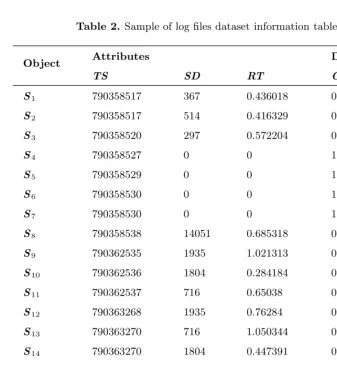
In our research, BU Web trace dataset from Oceans Research Group at Boston University are used [47]. We considered 20 sample objects only, i.e., January 1995 records. In our previous research, we used the same dataset with implementation of RS [59] and integration of Neurocomputing and Particle Swarm Optimization (PSO) algorithm [60] to optimize the Web caching performance. Three condi-tional attributes are taken into consideration; request time (Timestamp, TS) in seconds and microseconds, a current CPU usage (Sizedocument, SD) in bytes and response time (Objectretrievaltime, RT) in seconds. Consequently, a cache, CAis chosen as a decision for the information table; 1 for cache and 0 for not cache. Decision rules are obtained using RS based Inductive Learning [57] for
Table 2.Sample of log files dataset information table
Object Attributes Decision
TS SD RT CA
S1 790358517 367 0.436018 0
S2 790358517 514 0.416329 0
S3 790358520 297 0.572204 0
S4 790358527 0 0 1
S5 790358529 0 0 1
S6 790358530 0 0 1
S7 790358530 0 0 1
S8 790358538 14051 0.685318 0
S9 790362535 1935 1.021313 0
S10 790362536 1804 0.284184 0
S11 790362537 716 0.65038 0
S12 790363268 1935 0.76284 0
S13 790363270 716 1.050344 0
S14 790363270 1804 0.447391 0
S15 790363329 1935 0.553885 0
S16 790363330 716 0.331864 0
S17 790363330 1804 0.342798 0
S18 790363700 0 0 1
S19 790363700 0 0 1
Web caching. Table 2 depicts the structure of the study: 20 objects, 3 attributes, and a decision.
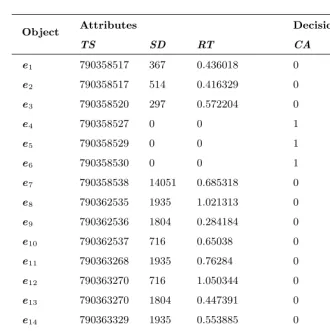
Detailed description and analysis are given in Table 3. The domainEand two conceptsYcache and Ynotcache from the decision attribute (CA) are obtained as
follows:
E={e1,e2,e3,e4,e5,e6,e7,e8,e9,e10,e11,e12,e13,e14,e15,e16,e17,e18, e19, e20}
Ycache ={e4,e5,e6,e17}
Ynotcache ={e1,e2,e3, e7,e8,e9,e10,e11,e12,e13,e14,e15,e16,e18}
Initially we find the indiscernibility classes based onT S that are{e1, e2},{e12, e13}, {e15, e16},{e17, e18}and{e3}, {e4},{e5},{e6},{e7}, {e8},{e9},{e10}, {e11}, {e14}.
The discriminant index of a conceptY is defined using the following formula: αCi(Y) = 1− |Y −Y|/|E| (3)
Consequently, the discriminant index of T S is αC1(Y) = 1− |Y −Y|/|E| = 1-(9-0)/20 = 0.55 determines the effectiveness of the singleton set of attributes consisting ofT S in specifying the membership in Y (the cache concept). Sub-sequently, the indiscernibility classes of SD is conducted and the results are {e4, e5, e6, e17},{e10, e12, e15},{e9, e13, e16},{e8, e11, e14}and
{e1},{e2},{e3},{e7},{e18}.
The lower approximation is illustrated as
Y=∪Ωi⊆Y Ωi={e1},{e2},{e3},{e7},{e18}. The upper approximation is given as
Y=∪Ωi∩Y=∅Ωi={e4, e5, e6, e17, e10, e12, e15, e9, e13, e16, e8, e11, e14}. Hence, the
discriminant index ofSD isαC2(Y) = 1− |Y −Y|/|E|= 1−(15−5)/20 = 0.5. The indiscernibility classes based onRT are{e4, e5, e6, e17}and {e1},{e2}, {e3},{e7},{e8},{e9},{e10},{e11},{e12},{e13},{e14},{e15},{e16},{e18}. The lower approximation is given as Y= ∪Ωi⊆Y Ωi=∅. The upper approximation is
Y=∪Ωi∩Y=∅Ωi={e4, e5, e6, e17}. The discriminant index of RT is αC3(Y) =
1− |Y −Y|/|E|= 1 - (6 - 0)/20 = 0.7.
By comparing the discriminant indices of all attributes, we identify that the discriminant index ofRT has the highest value,αCondition3(Y)= 0.7. This value determines better membership inY. Hence, the first rule is obtained as:
R1 :{Objectretrievaltime = 0}⇒{Cache = 1}
SinceRT is the most important condition attribute, we merge this condition attribute with other condition attributes to produce a new domain and to execute new rules (refer to Table 3).
Table 3.Collapsed log files dataset information table
Object Attributes Decision Total
TS SD RT CA
e1 790358517 367 0.436018 0 1
e2 790358517 514 0.416329 0 1
e3 790358520 297 0.572204 0 1
e4 790358527 0 0 1 1
e5 790358529 0 0 1 1
e6 790358530 0 0 1 2
e7 790358538 14051 0.685318 0 1
e8 790362535 1935 1.021313 0 1
e9 790362536 1804 0.284184 0 1
e10 790362537 716 0.65038 0 1
e11 790363268 1935 0.76284 0 1
e12 790363270 716 1.050344 0 1
e13 790363270 1804 0.447391 0 1
e14 790363329 1935 0.553885 0 1
e15 790363330 716 0.331864 0 1
e16 790363330 1804 0.342798 0 1
e17 790363700 0 0 1 2
e18 790363700 1136 0.428784 0 1
Table 4.Horizontal selection of collapsed table
Object Attributes Decision Total
TS SD RT CA
e4 790358527 0 0 1 1
e5 790358529 0 0 1 1
e6 790358530 0 0 1 2
Table 5.Further horizontally collapsed reduction table
Object Attributes Decision Total
TS CA
e4 790358527 1 1
e5 790358529 1 1
e6 790358530 1 2
e17 790363700 1 2
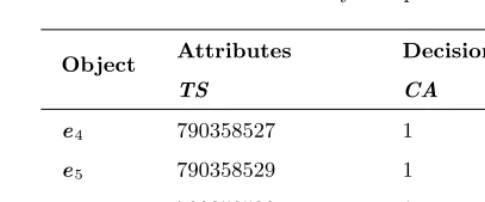
Subsequently, the horizontal selection of the collapsed information table is obtained (Table 4). The total number of objects becomes 6.
The illustrations of this selected information table are given as Ycache =
{e4,e5, e6, e17} and Ynotcache= ∅, and the domain is E= {e4,e5, e6, e17}. We
locate the indiscernibility classes based on SD and RT as ∅. The lower ap-proximation isY=∪Ωi⊆Y Ωi=∅ and the upper approximation isY=∪Ωi∩Y=∅
Ωi={e4, e5, e6, e17}. The discriminant index of SD and RT is αC2,C3(Y) = 1− |Y −Y|/|E|= 1−(6−0)/6 = 0.
The indiscernibility classes based onT SandRT is {e4, e5, e6, e17}. The lower approximation is Y=∪Ωi⊆Y Ωi={e4, e5, e6, e17} and the upper approximation
isY =∪Ωi∩Y=∅Ωi ={e4, e5, e6, e17}. The discriminant index ofT S and RT is
αC1,C3(Y) = 1− |Y −Y|/|E|= 1 - (6 - 6)/6 = 1.
By comparing the discriminant indices, we discover thatαC1,C3(Y) = 1 best determines the membership inY. Thus, we attain the sample of second rule:
R2 :{Timestamp = 790358527, Objectretrievaltime =0}⇒{Cache
= 1}
Two rules have been found. If new domain is uncovered and new rules are computed using the same method as previous, then the irrelevant elements can be removed as (E−Y)∪(Y) =∅ ∪ {e4, e5, e6, e17}.
By referring to Table 3, we can see that the first set is empty and the second set has been handled by rule 2. Hence, the new set of elements becomes (E− [(E−Y)∪(Y)] ={e4, e5, e6, e17}.
Based on this assumption, we obtain supplementary collapsed information table in which SD and RT are omitted due to superfluous attributes (see Table 5).
The rules are fruitfully induced. A question that rises is how much we can believe in these rules. Therefore, we need to evaluate the strength of the rules as follows [61, 54]:
# of positive objects covered by the rule
Based on this equation, the first rule has strength of 6/20. It shows that 30% Classes ofe4, e5, e6,ande17(Table 3) are positive examples covered by the rule. Classe1is a negative example covered by the first rule. The second rule has the strength of 6/6, that is, 100%. In applying the first rule to this object, there is a 30% chance that the reason for cache the object is exclusively the cache ofRT. However, there is a higher probability that the reason for cache is due to extra timing of T S and RT, due to 100% strength of the second rule. Algorithm 1 illustrates the algorithm of rules induction using RS [57].
Algorithm 1. Rough set algorithm [57] 1: foreach decision classdo
2: Initialise universe of objects 3: Select decision class 4: Find class relation 5: repeat
6: foreach attributedo 7: Select attribute
8: Find equivalence relation 9: Find lower subset 10: Find upper subset
11: Calculate discriminant index 12: end for
13: Select attribute with highest discriminant index 14: Generate rules
15: Reduce universe of objects 16: Reduce class relation
17: untilno objects with selected decision class 18: end for
This part presents substantial RS analysis based on Inductive Learning meth-ods to optimize Web caching performance to probe significant attributes and generate the decision rules. RS granularity in Web caching allows decision rules to be induced. These rules are important in optimizing user storage by exe-cuting caching strategy in specifying the most relevant condition attributes. This approach provides guidance to the administrator in Web caching regarding to selection of the best parameters to be cached. Based on this analysis, the administrator may reorganize the parameter of log data set in proxy caching accordingly.
6
Experimental Results
6.1 BU Log Dataset
In this experiment, BU Web Trace collected by Oceans Research Group at Boston University is employed. BU traces records consist of 9,633 files with a population of 762 different users, and recording 1,143,839 requests for data transfer. The data for January 1995 comprises of 11 to 220 users with 33,804 records. However, after data cleaning, only 10,727 dataset is left.
Moreover, in this research RS is exploited to reduce the rules of a log file and simultaneously to enhance the prediction performance of user behavior. RS is beneficial in probing the most significant attributes with crucial decision rules to facilitate intelligent caching and prefetching to safeguard limited bandwidth and minimize the processing cost.
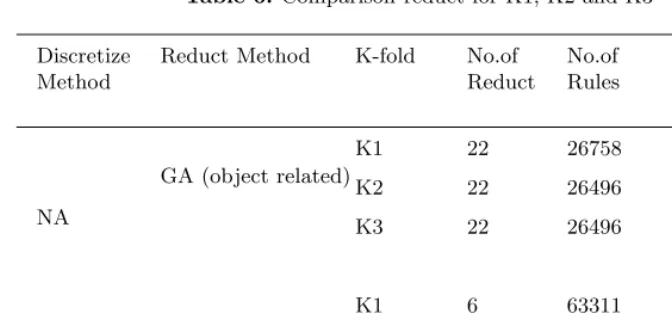
The dataset is split in two; 70% (7,187 objects) for training and 30% (3,540 objects) for testing. To simplify data representation, a Na¨ıve Discretization Algorithm (NA) is exploited and Genetic Algorithm (GA) is chosen to generate the object rules. Next, Standard Voting Classifier (SVC) is selected to classify the log file dataset. The derived rules from the training are used to test the effec-tiveness of the unseen data. In addition, 3-Fold Cross Validation is implemented for validation of our experiment. First fold (K1) the testing data from 1 to 3540, second fold (K2) from 3541 to 7081 and third fold (K3) from 7082 to 10622. Data are stored in decision table. Columns representattributes, rows represent
objects whereas every cell containsattribute value for corresponding objects and attributes. A set of attributes are URL, Machinename, Timestamp, Useridno, Sizedocument, Objectretrievaltime, andCache as a decision.
6.2 Data Discretization and Reduction
Training data is discretized using NA. This discretization technique is imple-mented a very straightforward and simple heuristic that may result in very many cuts, probably far more than are desired. In the worst case, each observed value is assigned its own interval. GA is used for reduct generation [63] as it provides more exhaustive search of the search space. Reducts generation have two options [64]; full object reduction and object related reduction. Full object reduction produces set of minimal attributes subset that defines functional dependencies, while reduct with object related produce a set of decision rules or general pat-tern through minimal attributes subset that discern on a per object basis. The reduct with object related is preferred due to its capability in generating reduct based on discernibility function of each object.
Table 6.Comparison reduct for K1, K2 and K3
Discretize Method
Reduct Method K-fold No.of Reduct
No.of Rules
Testing Accuracy (%)
NA
GA (object related)
K1 22 26758 96.8644
K2 22 26496 96.8644
K3 22 26496 96.8079
GA (full object)
K1 6 63311 98.4618
K2 6 63311 5.76271
K3 6 63311 5.79096
6.3 Rule Derivation
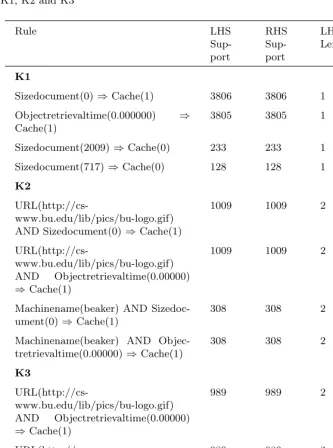
A unique feature of the RS method is its generation of rules that played an important role in predicting the output. ROSETTA tool has listed the rules and provides some statistics for the rules which are support, accuracy, coverage, stability and length. Below is the definition of the rule statistics [64]:
• The rule LHS support is defined as the number of records in the training data that fully exhibit property described by the IF condition.
• The rule RHS support is defined as the number of records in the training data that fully exhibit the property described by the THEN condition. • The rule RHS accuracy is defined as the number of RHS support divided by
the number of LHS support.
• The rule LHS coverage is the fraction of the records that satisfied the IF conditions of the rule. It is obtained by dividing the support of the rule by the total number of records in the training sample.
Table 7.Sample for sorted of highest rule support values from data decision table for K1, K2 and K3
Rule LHS
Sup-port
RHS Sup-port
LHS Length
RHS Length
K1
Sizedocument(0)⇒Cache(1) 3806 3806 1 1
Objectretrievaltime(0.000000) ⇒ Cache(1)
3805 3805 1 1
Sizedocument(2009)⇒Cache(0) 233 233 1 1
Sizedocument(717)⇒Cache(0) 128 128 1 1
K2
URL(http://cs-www.bu.edu/lib/pics/bu-logo.gif) AND Sizedocument(0)⇒Cache(1)
1009 1009 2 1
URL(http://cs-www.bu.edu/lib/pics/bu-logo.gif) AND Objectretrievaltime(0.00000) ⇒Cache(1)
1009 1009 2 1
Machinename(beaker) AND Sizedoc-ument(0)⇒Cache(1)
308 308 2 1
Machinename(beaker) AND Objec-tretrievaltime(0.00000)⇒Cache(1)
308 308 2 1
K3
URL(http://cs-www.bu.edu/lib/pics/bu-logo.gif) AND Objectretrievaltime(0.00000) ⇒Cache(1)
989 989 2 1
URL(http://cs-www.bu.edu/lib/pics/bu-logo.gif) AND Sizedocument(0)⇒Cache(1)
989 989 2 1
Machinename(beaker) AND Sizedoc-ument(0)⇒Cache(1)
306 306 2 1
Machinename(beaker) AND Objec-tretrievaltime(0.00000)⇒Cache(1)
6.4 Classification
From the analysis, it shows that the classification is better. Furthermore, the core attributes and the significant rules can improve the accuracy of classification. Table 8 shows the result of classification performance of K1, K2 and K3 for the original table and the new decision table of log file dataset. Hence, Figure 2 depicts an over-all accuracy for log file, 36.67% for over-all rules in original decision table and 96.85% for selected rules in new decision table. This result shows a different of overall accuracy up to 60.18% between the original decision table and new decision table.
Table 8.Classification performance of K1, K2 and K3 for both original decision table and new decision table of log file dataset
Decision Table Rule Set K-fold Accuracy (%)
Overall Accu-racy (%)
New decision table Selected rules
K1 96.8644
96.85
K2 96.8644
K3 96.8079
Orig. decision table All rules
K1 98.4618
36.67
K2 5.76271
K3 5.79096
Rough Web Caching 22
7
Conclusions
This chapter illustrated the usage of rough set theory for performance enhance-ment of Web caching. The RClass System framework [46] is used as a knowledge representation scheme for uncertainty in data for optimizing the performance of proxy caching that use to store the knowledge discovery of user behaviors in log format.
Furthermore, substantial RS analysis based on Inductive Learning methods is presented to optimize Web caching performance to probe significant attributes and generate the decision rules. RS granularity in Web caching allows decision rules to be induced. These rules are important in optimizing users’ storage by exe-cuting caching strategy in specifying the most relevant condition attributes. This approach provides guidance to the administrator in Web caching regarding to selec-tion of the best parameters to be cached. Based on this analysis, the administrator may reorganize the parameter of log data set in proxy caching accordingly.
Moreover, an empirical study has been conducted for searching optimal classi-fication. A RS framework for log dataset is illustrated mutually with an analysis of reduced and derived rules, with entrenchment of their implicit properties for better classification outcomes.
In the future, more experiments on huge data will be conducted on hybridiza-tion of RS and evoluhybridiza-tionary computahybridiza-tion to deal with multiple knowledge of Web caching in reducing network latency.
Acknowledgements
This work is supported by MOSTI and RMC, Universiti Teknologi Malaysia, MALAYSIA. Authors would like to thank Soft Computing Research Group, Faculty of Computer Science and Information System, UTM for their continuous support and fondness in making this work an accomplishment.
References
1. Walter, J.D., Ahrvind, J.T.: The economic value of rapid response time. Technical Report GE20-0752-0, IBM, White Plains, NY (November 1982)
2. James, T.B.: A theory of productivity in the creative process. IEEE Computer Graphics and Applications 6(5), 25–34 (1986)
3. Chris, R.: Designing for delay in interactive information retrieval. Interacting with Computers 10, 87–104 (1998)
4. Judith, R., Alessandro, B., Jenny, P.: A psychological investigation of long retrieval times on the World Wide Web. Interacting with Computers 10, 77–86 (1998) 5. Nina, B., Anna, B., Allan, K. (2000) Integrating user perceived quality into Web
server design. In: Proceedings of the Ninth International World Wide Web Con-ference, Amsterdam (May 2000)
6. Zona, The economic impacts of unacceptable Web site download speeds. White paper, Zona Research (1999),
7. Lu, J., Ruan, D., Zhang, G.: E-Service Intelligence Methodologies. In: Technologies and Applications. Springer, Heidelberg (2006)
8. Davison, B.D.: The Design and Evaluation of Web Prefetching and Caching Tech-niques. Doctor of Philosophy thesis, Graduate School of New Brunswick Rutgers, The State University of New Jersey, United State (2002)
9. Nagaraj, S.V.: Web Caching and Its Applications. Kluwer Academic Publishers, Dordrecht (2004)
10. Krishnamurthy, B., Rexford, J.: Web Protocols and Practice: HTTP 1.1, Network-ing Protocols. CachNetwork-ing and Traffic Measurement. Addison Wesley, ReadNetwork-ing (2001) 11. Acharjee, U.: Personalized and Intelligence Web Caching and Prefetching. Mas-ter thesis, Faculty of Graduate and Postdoctoral Studies, University of Ottawa, Canada (2006)
12. Garg, A.: Reduction of Latency in the Web Using Prefetching and Caching. Doctor of Philosophy thesis, University of California, Los Angeles, United State (2003) 13. Kroeger, T.M., Long, D.D.E., Mogul, J.C.: Exploring The Bounds of Web
La-tency Reduction from Caching and Prefetching. In: Proceedings of the USENIX Symposium on Internet Technology and Systems, pp. 13–22 (1997)
14. Davison, B.D.: A Web Caching Primer. IEEE Internet Computing, pp. 38–45 (2001),http://computer.org/internet
15. Wong, K.Y., Yeung, K.H.: Site-Based Approach in Web Caching Design. IEEE Internet Comp. 5(5), 28–34 (2001)
16. Wong, K.Y.: Web Cache Replacement Policies: A Pragmatic Approach. IEEE Net-work (January/Feburary 2006)
17. Mohamed, F.: Intelligent Web Caching Architecture. Master thesis, Faculty of Computer Science and Information System, Universiti Teknologi Malaysia, Malaysia (2007)
18. Mohamed, F., Shamsuddin, S.M.: Smart Web Caching with Structured Neural Networks. In: Proc. Of The 2ndNational Conf. on Computer Graphics and Multi-media, Selangor, pp. 348–353 (2004)
19. Mohamed, F., Shamsuddin, S.M.: Smart Web Cache Prefetching with MLP Net-work. In: Proc. Of The 1st IMT-GT Regional Conf. On Mathematics, Statistics and their Applications, pp. 555–567 (2005)
20. Curran, K., Duffy, C.: Understanding and Reducing Web Delays. Int. J. Network Mgmt. 15, 89–102 (2005)
21. Web Caching, Caching Tutorial for Web Authors (2008),
http://www.web-caching.com/mnot tutorial/intro.html
22. Saiedian, M., Naeem, M.: Understanding and Reducing Web Delays. IEEE Com-puter Journal 34(12) (December 2001)
23. Foedero.com, Dynamic Caching (2006),
http://www.foedero.com/dynamicCaching.html
24. Fan, L., Jacobson, Q., Cao, P., Lin, W.: Web prefetching between low-bandwidth clients and proxies: potential and performance. In: Proceedings of the 1999 ACM SIGMETRICS International Conference on Measurement and Modelling of Com-puter Systems, Atlanta, Georgia, USA, pp. 178–187 (1999)
25. Yang, Q., Zhang, Z.: Model Based Predictive Prefetching. IEEE, 1529-4188/01: 291–295 (2001)
26. Yang, W., Zhang, H.H.: Integrating Web Prefetching and Caching Using Prediction Models. In: Proceedings of the 10th international conference on World Wide Web (2001)
28. Jiang, Z., Kleinrock, L.: An Adaptive Network Prefetch Scheme. IEEE Journal on Selected Areas in Communications 16(3), 1–11 (1998b)
29. Santhanakrishnan, G., Amer, A., Chrysanthis, P.K.: Towards Universal Mobile Caching. In: Proceedings of MobiDE 2005, Baltimore, Maryland, USA, pp. 73–80 (2005)
30. Ari, I., Amer, A., Gramacy, R., Miller, E.L., Brandt, S., Long, D.D.E.: Adaptive Caching using Multiple Experts. In: Proc. of the Workshop on Distributed Data and Structures (2002)
31. Teng, W.-G., Chang, C.-Y., Chen, M.-S.: Integrating Web Caching and Web Prefetching in Client-Side Proxies. IEEE Transaction on Parallel and Distributed Systems 16(5) (May 2005)
32. Kobayashi, H., Yu, S.-Z.: Performance Models of Web Caching and Prefetching for Wireless Internet Access. In: International Conference on Performance Evaluation: Theory, Techniques and Applications (PerETTA 2000) (2000)
33. Markatos, E.P., Chironaki, C.E.: A Top 10 Approach for Prefetching the Web. In: Proc. of INET 1998:Internet Global Summit (1998)
34. Duchamp, D.: Prefetching Hyperlinks. In: Proceedings of the 2nd USENIX Sympo-sium on Internet Technologies & Systems(USITS 1999), Boulder, Colorado, USA (1999)
35. Deshpande, M., Karypis, G.: Selective Markov Models for Predicting Web-Page Accesses. In: Proceedings SIAM International Conference on Data Mining (2001) 36. Song, H., Cao, G.: Cache-Miss-Initiated Prefetch in Mobile Environments.
Com-puter Communications 28(7) (2005)
37. Yin, L., Cao, G.: Adaptive Power-Aware Prefetch in Mobile Networks. IEEE Trans-actions on Wireless Communication 3(5) (September 2004)
38. Wu, S., Chang, C., Ho, S., Chao, H.: Rule-based intelligent adaptation in mobile information systems. Expert Syst. Appl. 34(2), 1078–1092 (2008)
39. Komninos, A., Dunlop, M.D.: A calendar based Internet content pre-caching agent for small computing devices. Pers Ubiquit Comput. (2007), DOI 10.1007/s00779-007-0153-4
40. Cao, P., Zhang, J., Beach, K.: Active Cache:Caching Dynamic Contents on The Web. Distributed Systems Engineering 6(1), 43–50 (1999)
41. Shi, Y., Watson, E., Chen, Y.-S.: Model-Driven Simulation of World-Wide-Web Cache Policies. In: Proceedings of the 1997 Winter Simulation Conference, pp. 1045–1052 (1997)
42. Abrams, M.: WWW:Beyond the Basics (1997),
http://ei.cs.vt.edu/∼wwwbtb/fall.96/bppk/chap25/index.html
43. Abrams, M., Standridge, C.R., Abdulla, G., Williams, S., Fox, E.A.: Caching prox-ies: Limitations and Potentials. In: Proceedings of the 4th International WWW Conference, Boston, MA (December 1995),
http://www.w3.org/pub/Conferences/WWW4/Papers/155/
44. Zadeh, L.: Fuzzy sets. Information and Control 8, 338–353 (1965)
45. Pawlak, Z.: Rough Sets - Theoretical Aspects of Reasoning about Data. Kluwer Academic Publishers, Dordrecht (1991)
46. Triantaphyllou, E., Felici, G.: Data Mining and Knowledge Discovery Approaches Based on Rule Induction Techniques. Massive Computing Series, pp. 359–394. Springer, Heidelberg (2006)
47. BU Web Trace,http://ita.ee.lbl.gov/html/contrib/BU-Web-Client.html
49. Liang, A.H., Maguire, B., Johnson, J.: Rough Set WebCT Learning, pp. 425–436. Springer, Heidelberg (2000)
50. Ngo, C.L., Nguyen, H.S.: A Tolerence Rough Set Approach to Clustering Web Search Results, pp. 515–517. Springer, Heidelberg (2004)
51. Chimphlee, S., Salim, N., Ngadiman, M.S., Chimphlee, W., Srinoy, S.: Rough Sets Clustering and Markov model for Web Access Prediction. In: Proceedings of the Postgraduate Annual Research Seminar, Malaysia, pp. 470–475 (2006)
52. Khasawneh, N., Chan, C.-C.: Web Usage Mining Using Rough Sets. In: Annual Meeting of the North American Fuzzy Information Processing Society (NAFIPS 2005), pp. 580–585 (2005)
53. Pawlak, Z.: Rough Sets, pp. 3–8. Kluwer Academic Publishers, Dordrecht (1997) 54. Johnson, J., Liu, M.: Rough Sets for Informative Question Answering. In:
Proceed-ings of the International Conference on Computing and Information (ICCI 1998), pp. 53–60 (1996)
55. Liang, A.H., Maguire, B., Johnson, J.: Rough set based webCT learning. In: Lu, H., Zhou, A. (eds.) WAIM 2000. LNCS, vol. 1846, pp. 425–436. Springer, Heidelberg (2000)
56. Johnson, J.A., Johnson, G.M.: Student Characteristics and Computer Program-ming Competency: A Correlational Analysis. Journal of Studies in Technical Ca-reers 14, 23–92 (1992)
57. Tsaptsinos, D., Bell, M.G.: Medical Knowledge Mining Using Rough Set Theory,
http://citeseer.ist.psu.edu/86438.html
58. Shan, N., Ziarko, W., Hamilton, H.J., Cercone, N.: Using rough sets as tools for knowledge discovery. In: Proceedings of the International Conference on Knowledge Discovery and Data Mining (KDD 1995), pp. 263–268. AAAI Press, Menlo Park (1995)
59. Sulaiman, S., Shamsuddin, S.M., Abraham, A.: An Implementation of Rough Set in Optimizing Mobile Web Caching Performance. In: Tenth International Conference on Computer Modeling and Simulation, UKSiM/EUROSiM 2008, pp. 655–660. IEEE Computer Society Press, Los Alamitos (2008)
60. Sulaiman, S., Shamsuddin, S.M., Forkan, F., Abraham, A.: Intelligent Web Caching Using Neurocomputing and Particle Swarm Optimization Algorithm. In: Second Asia International Conference on Modeling and Simulation, AMS 2008, pp. 642– 647. IEEE Computer Society Press, Los Alamitos (2008)
61. Pawlak, Z., Grzymala-Busse, J., Slowinski, R., Ziarko, W.: Rough sets. Communi-cations of the ACM 38(11), 89–95 (1995)
62. Johnson, J., Liu, M.: Rough Sets for Informative Question Answering. In: Proceed-ings of the International Conference on Computing and Information (ICCI 1998), pp. 53–60 (1996)
63. Wr´oblewski, J.: Finding minimal reducts using genetic algorithms. In: Proceed-ings of Second International Joint Conference on Information Science, pp. 186–189 (1995)
![Fig. 1. Framework of the RClass System [46]](https://thumb-us.123doks.com/thumbv2/123dok_us/1298841.1162490/11.513.45.387.283.559/fig-framework-of-the-rclass-system.webp)