ENGINEERING AND GINNING
Effect of Machine-Fiber Interaction on Cotton Fiber Quality and
Foreign-Matter Particle Attachment to Fiber
Ruixiu Sui*, J. Alex Thomasson, Richard K. Byler, J. Clif Boykin, and Edward M. Barnes
R. Sui, R.K. Byler, and J.C. Boykin, USDA/ARS, Cotton Ginning Research Unit, PO Box 256, 111 Experiment Station Rd, Stoneville, MS 38776; J.A. Thomasson, Biological and Agricultural Engineering Department, Texas A&M University, College Station, TX 77843; E.M. Barnes, Cotton Incorporated, 6399 Weston Parkway, Cary, NC 27513
*Corresponding author: [email protected] AbstRACt
Changes in cotton fiber quality and attach -ment forces between foreign-matter particles and
fibers were studied at different stages from the
time of harvest through lint cleaning to develop new and less damaging methods for removing
foreign-matter particles from cotton fiber. The study involved 75 samples collected from five field
locations near College station, texas, including
three replications and five harvesting and pro -cessing treatments: (1) hand picked and hand ginned, (2) machine picked and hand ginned, (3) machine picked, seed-cotton cleaned, and hand ginned, (4) machine picked, seed-cotton cleaned, and machine ginned, and (5) machine picked, seed-cotton cleaned, machine ginned, and
one-stage lint-cleaned. A microscope was used to identify foreign-matter particles in each sample.
Physical characteristics of the particles and their
attachment to fibers were investigated and clas
-sified. Results indicated that each machine-fiber
interaction during the harvesting through ginning process had the net effect of decreasing the size
of foreign-matter particles. The particles had no
obvious difference in shape across the processing
stages. The tightness of particle-fiber attachment, the number of neps, and the short-fiber content differed significantly as a function of mechani -cal interactions: they increased as the number of
mechanical interactions increased. Processing
through the gin stand was a major contributor to
the increase in short fiber content. The majority of
the foreign-matter particles were leaves, but pro-portions of the particle categories changed with
stages of processing. With an increased number
of mechanical interactions the proportion of leaf particles decreased and the proportion of
seed-coat fragments and stems increased.
C
otton goes through a series of mechanical processes from being harvested in the field to being pressed into a bale at the gin. At each step of the process cotton fiber quality is affected by interactions between fiber and mechanical actions (Mangialardi, 1985). U.S. cotton is mechanically harvested by eithera cotton picker or a cotton stripper. A cotton picker uses high-speed rotating spindles to remove seed cotton from plant bolls. Then counter-rotating doffers unwind the cotton from the spindles, and the loose cotton is blown up through a duct into a basket and subsequently formed into a module. A cotton stripper removes the seed cotton by stripping the entire boll off the plant. The cotton is then separated from other plant material in the field or at a gin with mechanical cleaning devices. In comparison with hand harvesting, machine harvesting of cotton dramatically speeds up and reduces the cost of harvest in U.S. However, in general, machine harvesting decreases cotton fiber quality, particularly in terms of increased nep content and lint foreign-matter level (Baker and Brashears, 2000; Baker and Hughs, 2008; Calhoun et al., 1996; Faulkner et al., 2008; Hughs et al., 2000; Willcutt et al., 2002).
through a set of feed rollers. While the fiber batt is on the saw cylinder, it is cleaned by a combination of centrifugal force, scrubbing action between saw cylinder and grid bars, and gravity assisted by an air current (Anthony and Mayfield, 1994).
Seed cotton and lint cleaning are necessary steps in the ginning process. However, these steps,
particularly saw-type lint cleaning, create fiber dam
-age. For example, Mangialardi (1985) found that the seed-cotton drying and cleaning system and the gin stand produce neps. Furthermore, the saw-type lint cleaner damaged fiber by creating neps and reducing staple length (Mangialardi and Anthony, 1998). According to Gordon and Bagshaw (2007),
a fixed-batt saw lint cleaner caused 10% to 20% in
-crease in the nep level, 0.3- to 0.4-mm reduction in the upper-quartile length by weight, and significant increase in short-fiber content (SFC), depending on varieties ginned. The longer and finer a cotton fiber is, the greater the damage caused by the lint cleaner.
As cotton fiber quality has become more impor
-tant on the world market, researchers have worked to find the causes of fiber damage and to develop new methodologies and mechanical systems to reduce damage and loss of fiber while retaining the high efficiency of the saw-type lint cleaner (Anthony and Griffin, 2001; Baker, 1987; Columbus, 1985; Gordon and Bagshaw, 2007; Hughs et al., 1992; Rutherford et al., 1999). Many improvements have been made in saw-type lint cleaner manufacturing over the years, but today the same cleaning principles that were de-veloped in the 1940s are still used (Baker et al., 1992). To explore the possibility of inventing a new fiber cleaning device that is significantly different from “saw and bar” processing, it is critical to develop a fundamental understanding of the nature of cotton lint and foreign matter and their physical, chemical, and possibly even electrical interactions before and during the cleaning process. Imaging sensors and software analysis have been used in High Volume Instrument (HVI) machines to provide an estimate of lint trash content. More recently, Whitelock et al. (2009) have examined the variation in particle size distribution of trash particles before and after lint cleaning using image analysis. As other studies have shown (e.g., Morey et al., 1976b), foreign-matter content was found to decrease with lint cleaning; however, the rate of trash removal was not consistent across particle sizes. Although maximum particle size decreased with increased levels of lint cleaning, average particle size increased.
Another method to understand the interaction between processing stages and the impact on foreign matter is through microscopic examination of foreign matter and its interactions with cotton fiber. Morey et al. (1976a) used stereomicroscopy and bright-field microscopy to examine the botanical composition of Shirley Analyzer waste from machine-picked and machine-stripped seed cotton. Bract content ranged from 32% to 52% of the total waste amount, and cot-ton leaves and weed particles were major components. They observed that seed cotton contained a larger proportion of bract and leaf materials than lint did before lint cleaning. Using the same method, Morey et al. (1976b) determined the type of trash materials present in lint before and after saw-type cleaning, and whether lint cleaning selectively removed any of the botanical components. As the size of particles decreased, the proportion by weight of bract and leaf increased, and the content of seed-coat fragments decreased. They found lint cleaning to be ineffective at reducing the proportion by weight of leaf particles, but heavier materials such as stem particles were re-duced in proportion. Although the work of Morey et al. (1976a, b) was aimed at illuminating the botanical composition of trash particles in cotton and not at the
way those particles are attached to the fiber, it indi
-cated that much can be learned through microscopy on foreign-matter particles in cotton fiber.
The objectives of this study were 1) to deter-mine changes in the type and size of foreign-matter particles, on particle-fiber attachment, and on cotton fiber damage at each stage of machine processing from harvesting through ginning; 2) to determine the particle-fiber attachment force differences among various particle types.
MAtERIAls AND MEthoDs
picker (model 9996). Each sample weighed approxi -mately 2 kg. When the sample was hand harvested, all the cotton on a plant was picked except that from immature and partially open bolls that a cotton picker might not be able to pick up. Those hand-picked and machine-harvested samples were sub sampled to make three replicates and hand ginned at the labora-tory. Cotton modules that contain cotton from the sampling location were identified, and samples were
collected from the identified modules after the mod
-ules were ginned with a Lummus system (Lummus 158 gin stand) at Scarmardo Gin Co. (Caldwell, Texas). The cotton went through a drying process to remove moisture before seed-cotton cleaning.
Five treatments representing various processing stages of the cotton were used in the study:
Treatment 1: Hand harvested and hand ginned (HH). Samples of seed cotton were hand harvested at
the five locations and were hand ginned, rep
-resenting fiber prior to mechanical interaction. Treatment 2: Machine harvested and hand ginned
(MH). Samples were collected from cotton har
-vested by a cotton picker at the five locations. These samples were also hand ginned, and they
represent fiber that has only undergone mechani
-cal interaction with the harvester.
Treatment 3: Machine harvested, seed-cotton cleaned, and hand ginned (MSH). The modules made from the cotton harvested in the same field locations were ginned at a commercial gin. Samples that were collected at the feeder apron were hand ginned, and they represent fiber that has undergone mechanical interactions with the harvester and seed-cotton cleaning equipment in the gin.
Treatment 4: Machine harvested, seed-cotton cleaned, and machine ginned (MSM). As the modules described in treatment 3 were ginned, samples were collected immediately after fiber-seed separation, and they represent fiber that has undergone mechanical interactions with the harvester, the seed-cotton-cleaning equipment in the gin, and the gin stand.
Treatment 5: Machine harvested, seed-cotton cleaned, machine ginned, and one-stage lint-cleaned (MSML). Samples from the modules were collected after one stage of lint cleaning, and they represent fiber that has undergone mechanical interactions with the harvester, the seed-cotton-cleaning equipment in the gin, the gin stand, and one saw-type lint cleaner.
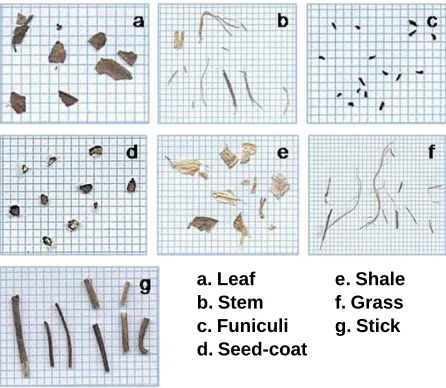
Each treatment was replicated three times. In total there were 75 samples (5 field locations, 5 treatments, and 3 replicates). For each sample, the subsampling procedure involved removing a randomly selected portion of lint weighing 2.0 to 2.3 g. The subsamples were placed under a Caltex Scientific LX100 digital video microscope (Irvine, CA). Fifty randomly selected foreign-matter particles were manually removed with delicate tweezers from most of the lint subsamples, and particular attention was paid to minimizing the number of fibers removed with the particles. There were nine subsamples that contained a total number of visible particles of fewer than 50. All the particles in those nine subsamples were removed for particle clas-sification. Each particle was identified as belonging to one of seven categories: leaf, stem, funiculi, seed-coat fragment, shale (lining of the bur), stick, and grass (Fig. 1). Each particle was assigned a two-dimensional shape
that best described it: rectangular, square, triangular, or round. Each particle was also measured for length in two dimensions. While being removed, each particle was subjectively assigned to a category regarding strength of attachment to the fiber (low to high was represented by the numbers 1 through 5, respectively) and the level regarding number of fibers attached (low, medium, high, respectively). It should be pointed out that all fibers on the seed-coat fragment, including the fibers that are physically attached to and biologically growing out of the seed-coat fragment were counted as attached fibers. After the 50 particles (except for the aforementioned
nine subsamples) had been removed and categorized, all remaining visible particles were carefully removed, and the mass of all foreign-matter particles measured.
a. Leaf b. Stem c. Funiculi d. Seed-coat
e. Shale f. Grass g. Stick
Figure 1. Seven categories of foreign-matter particles includ
matter-to-fiber-mass ratio (10.93%), and the ratio decreased with additional processing. It was obvious that hand-harvested cotton was much cleaner than machine-harvested.
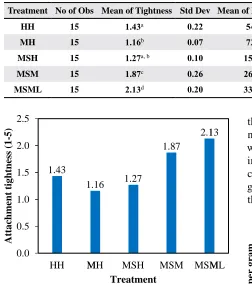
The foreign-matter particles had no obvious dif-ference in distribution of shapes among the processing stages (Table 2). However, particle size decreased as cotton went through more and more machine-process-ing stages. The relative importance of fracturmachine-process-ing of particles versus selective removal of larger particles is unknown. In samples from MH through MSML, the additional stages of mechanical interaction re-duced the number of low-level number of attached fibers from 93% to 52% and increased the number of medium and high levels from 6% to 41% and 1% to 7%, respectively. This suggests that the number of fibers attached to a particle increases with increasing mechanical interaction, but it is still unclear what roles are played by removal of easy-to-remove par-ticles versus increasing the difficulty to remove each particle. Furthermore, more mechanical processing stages were associated with more tightness of attach-ment between particles and fibers (Fig. 2). A one-way ANOVA test revealed that tightness of particle-fiber attachment differed significantly among processing
stages (F (4, 70) = 75.71, p < 0.0001). Tukey
post-hoc comparison of the five processing stages (Table 3) indicated that MSML samples had significantly higher particle-fiber tightness (M = 2.13, SD = 0.20) than the other sample types. The tightness of MSM samples (M = 1.87, SD = 0.26) was significantly higher than that of the HH, MH, and MSH samples. The tightness of MSH samples (M = 1.27, SD = 0.10) did not significantly differ from that of MH and HH samples. The tightness of HH samples (M = 1.43, SD = 0.22) was significantly higher than that of MH samples (M = 1.16, SD = 0.07). This could be due to the larger proportion of seed-coat fragments in the HH samples (Table 1). Tighter particle-fiber attachment was generally associated with seed-coat fragments.
All 75 samples were analyzed at Cotton Incor
-porated to determine the effect of mechanical inter-actions, from harvesting through ginning, on fiber quality. Fiber quality parameters including neps and SFC were measured with Advance Fiber Information System (AFIS) and HVI tests.
Data Analysis. Averages of particle measurements for each sample and treatment were calculated, includ-ing the ratio of trash to fiber mass, proportion of foreign-matter types, dimensions of the particles, tightness of particle-fiber attachment, and level of number of fibers attached to the particle. One-way ANOVA and a Tukey post-hoc test were conducted with SAS to compare the
effects of mechanical interactions on particle-fiber at
-tachment, nep content, SFC, and micronaire. The effect of the sampling location on those parameters was also analyzed using the ANOVA test.
REsults
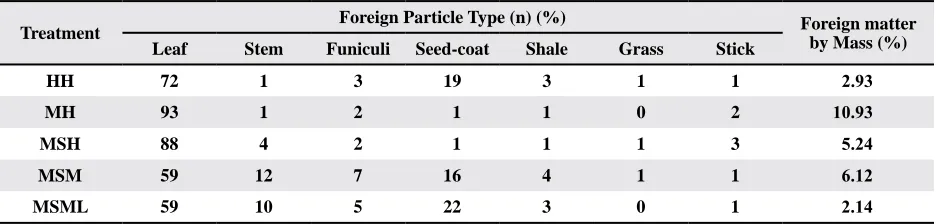
Objective 1 (Changes During Processing). The percentage of particles of the various types of foreign matter and the mass ratio of foreign-matter particle to fiber varied among the processing stages (Table 1). The majority of foreign-matter particles were leaf in all the processing stages, with high percentages in the MH (93%) and MSH (88%) samples. In the MSM and MSML samples, the proportion of leaf particles decreased while the proportion of the stem and seed-coat fragment particles increased. This occurrence could be attributable to stem breakage and creation of seed-coat fragments by the gin stand during fiber-seed separation. After lint cleaning, the majority of particles remaining in the lint were leaf and seed-coat fragment particles, a fact consistent with the results of Boykin et al. (2009). It is also apparent that hand ginning led to a substantial amount of seed-coat fragments, as they were 19% of the total amount of particles in the HH samples (Table 1). The MH samples had the highest
foreign-Table 1. Types of foreign-matter particle and the ratio of foreign matter to fiber mass across treatments.
treatment Foreign Particle type (n) (%) Foreign matter
by Mass (%)
leaf stem Funiculi seed-coat shale Grass stick
hh 72 1 3 19 3 1 1 2.93
Mh 93 1 2 1 1 0 2 10.93
Msh 88 4 2 1 1 1 3 5.24
MsM 59 12 7 16 4 1 1 6.12
Results in this study suggest that each cot-ton processing stage created neps (Fig. 3). The ANOVA test showed that the nep content differed
significantly as a function of increasing mechani
-cal interactions (F (4, 70) = 473.82, p < 0.0001).
Tukey post-hoc comparison across the processing stages indicated that the mean number of neps of
MSH samples (M = 150.73, SD = 26.86) was sig
-nificantly higher than that of HH (M = 54.26, SD = 16) and MH samples (M = 72.8, SD = 17.87). The
number of neps of MSM samples (M = 264.93, SD = 25.40) was significantly higher than that of MSH samples, and the number of neps of MSML samples (M = 338.60, SD = 21.22) was significantly higher
than that of MSM samples (Table 3). Comparing nep content among nearby processing stages, it was found that the dryer and seed-cotton cleaners increased the nep content from 72.80 to 150.73 cnt/g, the nep level increased to 264.93 cnt/g after gin stand, and became as great as 338.6 cnt/g after the first saw-type lint cleaner.
Figure 2. Mean of tightness of attachment between foreign-matter particles and fiber among various processing stages.
Table 2. Distribution of level of number of fibers attached to particle, particle shape, and particle dimension across treatments.
treatment level of Attached Fibers (%) Particle shape (%) Dimension (mm)
low Med high Square Rectangular triangular Round X Y
hh 80 7 13 11 58 21 10 3.32 1.62
Mh 93 6 1 12 57 21 10 3.70 1.86
Msh 88 11 1 10 62 20 8 3.37 1.39
MsM 63 32 5 14 59 17 10 2.96 1.24
MsMl 52 41 7 11 64 17 8 2.58 1.07
Table 3. Effect of the mechanical interactions on the tightness of particle-fiber attachment, nep content, and SFC (AFIS test). Means with the same letter are not significantly different.
treatment No of obs Mean of tightness std Dev Mean of Neps (cnt/g) std Dev Mean of sFC (w) (%) std Dev
hh 15 1.43a 0.22 54.26a 16.00 3.89a 1.64
Mh 15 1.16b 0.07 72.80a 17.87 7.83a,b 2.20
Msh 15 1.27a, b 0.10 150.73b 26.86 10.62b 3.34
MsM 15 1.87c 0.26 264.93c 25.40 21.02c 6.81
MsMl 15 2.13d 0.20 338.60d 21.22 20.92c 4.84
0.0 0.5 1.0 1.5 2.0 2.5
A
ttac
hme
nt
tig
ht
ne
ss
(1-5
)
1.43 1.
HH M
16 1.27
MH MSH
Treatment
1.87 2.1
MSM MSM 13
ML
Figure 3. Nep content across the treatments.
0 100 200 300 400
Neps per gram
54.3 72.8
150.77
264.9
338.6
Treatment
HH MMH MSH MSM MSMML
The one-way ANOVA test indicated that the ef-fect of mechanical interactions on SFC (AFIS test)
was also significant (F (4, 70) = 51.40, p < 0.0001).
Effect of the mechanical interactions on micro-naire and SFC (HVI test) is given in Table 4. As shown in the AFIS data, the ANOVA test indicated
again that the SFC differed significantly as a func
-tion of increasing mechanical interac-tions (F (4, 70)
= 93.14, p < 0.0001). The ANOVA test showed that
the effect of mechanical interactions on micronaire
was significant (F (4, 70) = 23.92, p < 0001). The
micronaire of MSH samples (M = 4.44, SD = 0.21) was significantly lower than that of MH samples (M = 4.78, SD = 0.19).
(HVI test, F (4, 70) = 0.85, p = 0.4993)). However,
the effect of sampling location on micronaire of the
cotton samples was significant (F (4, 70) = 4.08, p
= 0.0050). Spatial variability in micronaire existed within the field. Similar results were found in studies by Elms et al. (2001) and Guo et al. (2004).
objective 2 (Particle types and Attachment
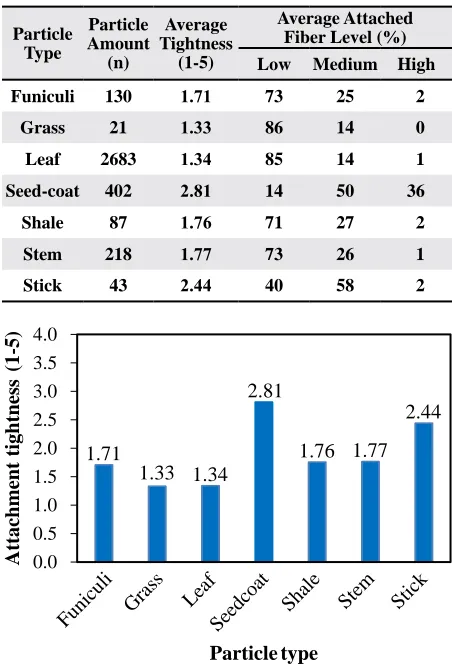
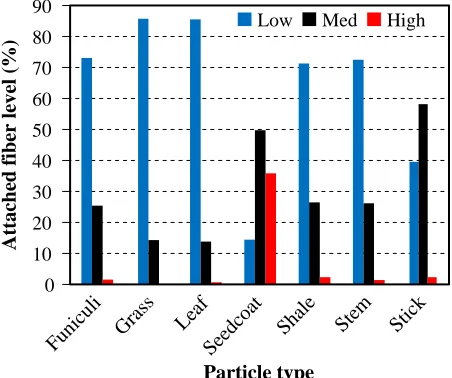
Force). Upon considering the effect of particle type on tightness of particle-fiber attachment and number of fibers attached to a particle (Table 5), seed-coat fragments had the highest tightness index of 2.81 (Fig. 5). Sticks were second highest (2.44), followed by funiculi, shale, and stem particles, which had similar tightness (1.71-1.77). Leaf and grass particles
were attached to the fiber most loosely, with a tight
-ness index of 1.3.
3.9
7.8
10.6
21.0 20.9
0 5 10 15 20 25
HH MH MSH MSM MSML
Short fiber content (w) (%)
Treatment
Figure 4. SFC (AFIS test) of the lint at each processing stage.
Table 4. Effect of the mechanical interactions on micronaire and SFC (HVI test). Means with the same letter are not significantly different.
treatment No of obs
Mean of Micronaire
std Dev
Mean of sFC (%)
std Dev
hh 15 4.87a 0.21 5.99a 0.50
Mh 15 4.78a 0.19 6.83b 0.28
Msh 15 4.44b 0.21 7.57c 0.72
MsM 15 4.49b 0.13 8.53d 0.49
MsMl 15 4.35b 0.14 9.19e 0.50
was observed that the gin stand was a major contribu-tor to SFC, producing increase of SFC from 10.62% to 21.02% during fiber-seed separation. Though seed-cotton cleaning was associated with an increase in SFC, the effect was not statistically significant. The SFC of MSM samples was about the same as that of MSML samples. This fact could possibly be attributed to similar levels of creation and removal of short fiber by the lint cleaner.
One way ANOVA tests revealed that sampling location had no significant effect on the tightness
of particle-fiber attachment (F (4, 70) = 0.38, p =
0.8200), nep content (F (4, 70) = 0.04, p = 0.9964),
and SFC ((AFIS test, F (4, 70) = 0.17, p = 0.9533);
Figure 5. Tightness of particle-fiber attachment of various particle types.
Table 5. Type of foreign-matter particle versus the tightness of particle-fiber attachment and level of number of fibers attached to particle.
Particle type
Particle Amount
(n)
Average tightness
(1-5)
Average Attached Fiber level (%) low Medium high
Funiculi 130 1.71 73 25 2
Grass 21 1.33 86 14 0
leaf 2683 1.34 85 14 1
seed-coat 402 2.81 14 50 36
shale 87 1.76 71 27 2
stem 218 1.77 73 26 1
stick 43 2.44 40 58 2
Funiculi Grass LeafSeedcoat Shale Stem Stick 1.71
1.33 1.34 2.81
1.76 1.77 2.44
0.0 0.5 1.0 1.5 2.0 2.5 3.0 3.5 4.0
Attachment
tightness
(1
-5)
Particletype
Fig. 6). In general, the least number of fibers were attached to leaf and grass particles. The number of fibers attached to funiculi, shale, and stem particles was at a medium level compared to seed-coat and stick group and the leaf and grass group.
to 338.60 cnt/g) increases in nep content, respectively. Increased mechanical harvesting and processing of seed-cotton resulted in reduced micronaire values because of more immature fiber being removed from the plant relative to hand harvesting and changes in
trash size and content that affect the reading. Compar
-ing SFC before and after fiber-seed separation, the gin stand was associated with a 98% increase in SFC. No significant effect of sampling location on the tightness of particle-fiber attachment, nep content, and SFC was found in this study. Spatial variability of the micronaire within the field was observed.
Seed-coat fragment and stick particles were
more tightly attached to the fiber than the other for
-eign-matter particles such as the funiculi, shale, and stem. Relatively speaking, the leaf and grass particles were more loosely attached to the fiber and easier to remove. Along the same lines, more fibers were attached to seed-coat fragments and stick particles than to the other types of foreign-matter particles. Smaller numbers of fibers were found to be attached to leaf and grass than to funiculi, shale, and stem.
In measuring tightness of particle-fiber attach
-ment and number of fibers attached to particles, the fibers that are physically attached to the seed-coat fragment were not considered separately from fibers biologically growing out of the seed-coat fragment;
i.e., all fibers attached to a seed-coat fragment par
-ticle were counted as attached fibers. Considering this, it is possible that stick particles would have the highest tightness index of particle-fiber attachment and the greatest number of the fibers attached. This might be determined if the fibers growing out of seed-coat fragments were not counted as attached fibers in classifications.
This study has helped develop a fundamental understanding of the effect of mechanical interactions with cotton on physical characteristics of foreign-matter particles, particle-fiber attachment, and fiber
quality. However, due to the great difficulty of accu
-rate quantitative measurements, critical factors such as tightness of particle-fiber attachment and number
of fibers attached to a particle were determined sub
-jectively (1 to 5 for the tightness index; low, medium, high for the number of fibers attached). With a view to developing new methods for cleaning cotton that reduce fiber damage, quantitative measurements of these factors might be more illuminating. More re-search is also needed to determine how foreign-matter particles are physically, chemically, and even electri-cally attached to fiber at various processing stages.
Figure 6. Effect of foreign-matter particle type on the level of number of fibers attached.
Funiculi Grass LeafSeedcoat Shale Stem Stick
0 10 20 30 40 50 60 70 80
90 Low Med High
Particle type
Attached fiber level (%)
DIsCussIoN AND CoNClusIoN
The distribution of foreign-matter particle shape showed no obvious difference among various pro-cessing stages. Particle size decreased as the number of mechanical interactions increased. Leaf was the major component of foreign matter in cotton across all processing stages. With an increasing number of mechanical interactions the proportion of leaf in total foreign-matter particles decreased and the proportions of seed-coat fragments and stems increased. This could
be due to an increase in tightness of particle-fiber at
-tachment caused by the mechanical interactions, or it could be due to the possibility that each processing stage removes easy-to-remove particles and leaves the more difficult-to-remove particles. Mechanical interactions had a statistically significant effect on
particle-fiber tightness of attachment. Tightness in
-creased with an increasing number of the mechanical
interactions. The number of fibers attached to the par
ACKNOWLEDGMENT
The authors would like to extend their appre-ciation to Weihua Jiang for her meticulous work on classifying foreign-matter particles in this study.
DIsClAIMER
Mention of a commercial product is solely for the purpose of providing specific information and should not be construed as a product endorsement by the authors or the institutions with which the authors are affiliated.
REFERENCEs
Anthony, W.S., and A.C. Griffin, Jr., 2001. Fiber breakage at cotton gins: Causes and solutions. p. 1347–1357. In Proc. Beltwide Cotton Conf., Anaheim, CA. 9-13 Jan. Natl. Cotton Counc. Am., Memphis, TN.
Anthony, W.S., and W.D. Mayfield, eds. 1994. Cotton Ginners Handbook, rev. U.S. Department of Agriculture, Agricul-tural Handbook 503, pp. 102–104.
Baker, R.V. 1987. Influence of lint cleaning on fiber quality. p. 535. In Proc. Beltwide Cotton Prod. Res. Conf., Dallas, TX. 4-8 Jan. Natl. Cotton Counc. Am., Memphis, TN.
Baker, R.V., and A.D. Brashears. 2000. Combined effects of field cleaning and lint cleaning on stripper harvested cotton. p. 1616–1621. In Proc. Beltwide Cotton Conf., San Antonio, TX. 4-8 Jan. Natl. Cotton Counc. Am., Memphis, TN.
Baker, K.D., and S.E. Hughs, 2008. Cotton quality as affected by changes in the spindle picker. In Proceedings of the World Cotton Research Conference, September 9-15, 2007, Lubbock, Texas. 2007 CDROM.
Baker, R.V., S.E. Hughs, and G.J. Mangialardi. 1992. Lint cleaning: Basic principles and new developments. p. 538–542. In Proc. Beltwide Cotton Conf., Nashville, TN. 6-10 Jan. Natl. Cotton Counc. Am., Memphis, TN.
Boykin, J.C., C.B. Armijo, D.P. Whitelock, M.D. Buser, G.A. Holt, T.D. Valco, D.S. Findley, E.M. Barnes, and M.D. Watson. 2009. Fractionation of foreign matter in ginned lint before and after lint cleaning. Transaction of the ASABE, Vol. 52(2):419–426.
Calhoun, D.S., T.P. Wallace, W.S. Anthony, M.E. Barfield. 1996. Comparison of lint fraction and fiber quality data from hand- vs machine-harvested samples in cotton yield trails. p. 611–615. In Proc. Beltwide Cotton Conf., Nash-ville, TN. 9-12 Jan. Natl. Cotton Counc. Am., Memphis, TN.
Columbus, E.P. 1985. Effect of lint cleaner saw speed and tooth density on cotton quality. p. 358. In Proc. Beltwide Cotton Prod. Res. Conf., New Orleans, LA. 6-11 Jan. Natl. Cotton Counc. Am., Memphis, TN.
Elms, M. K., C. J. Green, and P. N. Johnson. 2001. Variability of cotton yield and quality. Commun. Soil Sci. Plant Anal. 32: 351–368.
Faulkner, W.B., B.W. Shaw, and E. Hequet. 2008. Effects of harvesting method on foreign matter content, fiber quality, and yarn quality from irrigated cotton on the high plains. p. 612–619. In Proc. Beltwide Cotton Conf., Nashville, TN. 8-11 Jan. Natl. Cotton Counc. Am., Memphis, TN.
Funk, P.A., C.B. Armijo, A.T. Hanson, Z.A. Samani, M.A. Macias-Corral, G.B. Smith, and J.T. Riordan. 2005. Con-verting gin and Dairy wastes to methane. Transactions of ASAE, Vol. 48(3):1197–1201.
Gordon, S.G., and K.M. Bagshaw. 2007. The effect of work-ing elements in the fixed batt saw lint cleaner on ginned fiber properties. p. 1977–1982. In Proc. Beltwide Cotton Conf., New Orleans, LA. 9-12 Jan. Natl. Cotton Counc. Am., Memphis, TN.
Guo, W., S Maas, E. Hequet, R. Lascano, and J. Brightbill. 2004. Variability of cotton fiber quality in West Texas. p. 2318–2325. In Proc. Beltwide Cotton Conf., San An-tonio, TX. 5-9 Jan. Natl. Cotton Counc. Am., Memphis, TN.
Hughs, S.E., C.K. Bragg, and C. Owen. 2000. Where neps in Pima cotton are made. p. 1593–1595. In Proc. Beltwide Cotton Conf., San Antonio, TX. 4-8 Jan. Natl. Cotton Counc. Am., Memphis, TN.
Hughs, S.E., M.N. Gillum, W.F. Lalor,Sr., and D. Vandoorn, Sr. 1992. Coupled lint cleaning: Solution to minimiz -ing fiber damage. p. 20–21. In Proc. Beltwide Cotton Conf., Nashville, TN. 6-10 Jan. Natl. Cotton Counc. Am., Memphis, TN.
Mangialardi, G.J., Jr. 1985. An evaluation of nep formation at the cotton gin. Tex. Res. J. 55:756–761.
Mangialardi, G.J., Jr. and W.S. Anthony. 1998. Field evalua-tions of air and saw lint cleaning systems. J. Cotton Sci. 2:53–61.
Morey, P.R., P.E. Sasser, R.M. Bethea, and M.T. Kopetzky. 1976a. Variation in trash composition in raw cottons. Am. Ind. Hyg. Assoc. J. 37:407–412.
Rutherford, R.D., D.W. Van Doorn, and M.D. Cory. 1999. The Lummus SentinelTM lint cleaner. p. 81–85. In Proc.
Beltwide Cotton Conf., Orlando, FL. 3-7 Jan. Natl. Cot-ton Counc. Am., Memphis, TN.
Thomasson, A.J., Ruixiu Sui, R.K. Byler, J.C. Boykin, and E.M. Barnes. 2009. Trash particle attachment to fiber and the effects of various machine-fiber interactions. p. 388–391. In Proc. Beltwide Cotton Conf., San Antonio, TX. 5-8 Jan. Natl. Cotton Counc. Am., Memphis, TN .
Whitelock, D.P., M. Siddaiah, E. Hughs, and E.M. Barnes. 2009. Effects of lint cleaning on lint trash particle size distribution. p. 514–520. In Proc. Beltwide Cotton Conf., San Antonio, TX. 5-8 Jan. Natl. Cotton Counc. Am., Memphis, TN.
Willcutt, M.H., E. Columbus, T.D. Valco, P. Gerard. 2002. Cotton lint qualities as affected by harvester type in 10 and 30-inch production systems. Unpaginated CD-R.