A New Fourth-Order Embedded Method
Based on the Harmonic Mean
Nazeeruddin Yaacob & Bahrom Sanugi
Department of Mathematics
Universiti Teknologi Malaysia
81310 UTM Skudai, Johor, Malaysia
Abstract In this paper we formulate an embedded method based on harmonic and arithmetic means of order 4. This method together with RK-Harmonic scheme may be used to estimate the solutions of initial value problems. The absolute stability region of this scheme is also studied and we conclude with a numerical example to justify the effectiveness of the method.
Keywords Harmonic Mean, Runge-Kutta method, stability, error control.
Abstrak Dalam kertas ini kami rumuskan satu kaedah terbenam berperingkat 4 yang berasaskan min harmonik dan min aritmetik. Kaedah ini berserta de-ngan skema RK-Harmonik boleh digunakan bagi mede-nganggarkan penyelesaian kepada masalah nilai awal. Rantau kestabilan untuk skema ini juga dikaji dan kita simpulkan dapatan ini dengan satu contoh masalah sebagai mengesahkan keberkesanan kaedah ini.
Katakunci Min-Harmonik, Kaedah Runge-Kutta, kestabilan, kawalan ralat.
1
Introduction
One of the difficulties in implementing the classical Runge-Kutta method is the absence of estimation of errors procedure in computating the numerical solutions. Several methods have been developed to overcome these weaknesses, specifically this is done by introducing the procedure that can estimate the errors in the results. Amongst them are methods developed by Merson, Scraton [2] and Fehlberg [1]. Related work was carried out by Sanugi [3], who introduced a fourth order AGM method which is based on geometric mean plus a fourth order method based on arithmetic mean. Both methods used the common k’s,
ki, i = 1,2,3,4 . Similarly, we develop a much simpler embedded method of fourth order
2
Formulation of Fourth Order RK-HM-AM Scheme
Sanugi and Evans [4] had introduced a fourth order RK formula based on the harmonic mean with parameters
a1= 1/2, a2=−1/8, a3= 5/8, a4=−1/4, a5= 7/20,anda6= 9/10,
where
k1=f(xn, yn), (1)
k2=f(xn+a1h, yn+a1hk1), (2)
k3=f(xn+ (a2+a3)h, y)n+a2hk1+a3hk2), (3)
k4=f(xn+ (a4+a5+a6)h, yn+a4hk1+a5hk2+a6hk3), (4)
and
ynHM+1 =yn+
2h
3
k1k2
k1+k2
+ k2k3
k2+k3
+ k3k4
k3+k4
. (5)
Using the common aiwe try to formulate another scheme which combines both arithmetic
mean (AM) and harmonic mean (HM). We propose the following scheme:
ynAHM+1 =yn+h
h
d1k1+d2k2+d3k3+d4k4+d5
k1k2
k1+k2
+d6
k
2k3
k2+k3
+d7
k
3k4
k3+k4
i
, (6)
with constants dj,j= 1,2, . . . ,7, that are still undetermined andki+ki+16= 0.
By consideringy0=f(y), wheref is a function ofy only andy is either monotonically
increasing or decreasing, we expand the equations (6) andy(xn+h) using the Taylor series
expansion. Using a symbolic computational package, MATHEMATICA, we compare the coefficients forh,h2,h3, andh4 to obtain the following seven linear equations:
hf : 1−d1−d2−d3−d4−
d5
2 −
d6
2 −
d7
2 = 0 (7)
h2fy:
1 2−
d2
2 −
d3
2 −d4−
d5
8 −
d6
8 −
d7
8 = 0 (8)
h3f fy2:
1 6−
5d3
16 − 5d4
8 +
d5
32− 5d6
64 − 13d7
64 = 0 (9)
h3f2fyy:
1 6− d2 8 − d3 8 − d4 2 − d5 32− d6 16− 5d7
32 = 0 (10)
h4f fy3: 1 24−
9d4
32 −
d5
128− 7d7
128 = 0 (11)
h4f2fyfyy:
1 6−
15d3
64 − 25d4
32 +
d5
64− 15d6
256 − 53d7
256 = 0 (12)
Solving (7)-(13) yields
d1= 0, d2=
1 6, d3=
1
6, d4= 0, d5= 2
3, d6= 0, d7= 2 3. Thus, equation (6) becomes
yAHMn+1 =yn+h
h1
6k2+ 1 6k3+
2 3
k
1k2
k1+k2
+2 3
k
3k4
k3+k4
i
. (14)
We shall refer this formula as RK-HM-AM in the following sections.
3
Stability Analysis for RK-HM-AM Scheme
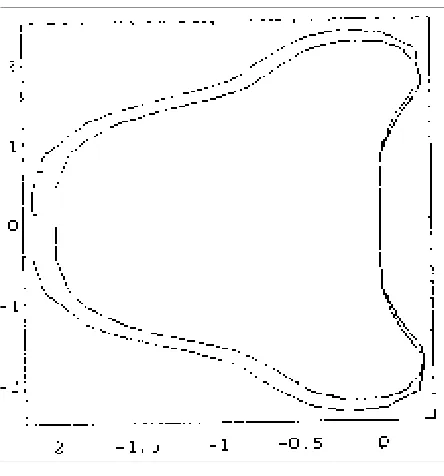
We used the test equation y0 = λy, λ is a constant, to obtain absolute stability regions
for both RK-HM and RK-HM-AM methods. Substituting λ0
n = λyn in ki, i = 1,2,3,4
respectively, we obtain
k1=f(yn) =λyn (15)
k2=f
yn+
hk1
2
=λyn
1 +λh 2
(16)
k3=f
yn−
hk1
8 + 5hk2
8
=λyn
1 +λh 2 +
5(λh)2
16
(17)
k4=f
yn−
hk1
4 + 7hk2
20 + 9hk3
10
=λyn
1 +λh+5(λh)
2
8 + 9(λh)3
32
(18)
Substituting these values in (5) and (14) will yield
yHM n+1
yn
= 1 +λh+(λh)
2
2 + (λh)3
6 + (λh)4
24 − 3(λh)5
128 +O(h
6) (19)
and
yAHM n+1
yn
= 1 +λh+(λh)
2
2 + (λh)3
6 + (λh)4
24 −
47(λh)5 3072 +O(h
6). (20)
If λh = z, then (19) and (20) are the stability polynomials of RK-HM and RH-HM-AM respectively,
QHM(z) =y
HM n+1
yn
= 1 +z+z
2 2 + z3 6 + z4 24− 3z5
128+O(h
6) (21)
and
QAHM(z) =y
AHM n+1
yn
= 1 +z+z
2 2 + z3 6 + z4 24− 47z5
3072+O(h
6) (22)
Figure 1: Absolute stability regions for the RK-HM (smaller) and RK-HM-AM methods
4
Error Estimation
In RK-Fehlberg scheme [1], estimated errors are obtained by taking the difference of fifth order RK and fourth order RK solutions. While in Merson scheme [2], estimated errors are obtained by taking difference of solutions of two fourth order methods with different number of stages. In our scheme, we used two methods (5) and (14) sharing the samea’s and k’s (equal number of stages) but having different form ofyn+1.
Local truncation errors (LTE) for RK-HM method is given as,
LTE(HM) =y(xn+h)−ynHM+1 =
61
1920f f
4
y −
61 7680f
2f2
yfyy−
17 960f
3f2
yy
− 1
640f
3
fyfyyy−
1 2880f
4
fyyyy
h5+O(h6) (23)
while LTE for RK-HM-AM is given as
LTE(AHM) =y(xn+h)−yAHMn+1 =
121
5120f f
4
y−
61 7680f
2f2
yfyy−
17 960f
3f2
yy
− 1
640f
3f
yfyyy−
1 2880f
4f
yyyy
h5+O(h6) (24)
Now, subtracting (23) from (24) yields,
or
f fy4h5=
3072 25 y
HM
n+1 −yAHMn+1
. (25)
Iffyy= 0, thenfyyy=fyyyy= 0, i.e. f is a linear function iny. Thus using (25) we obtain
LTE(HM) = 3.904 ynHM+1−ynAHM+1
(26)
and
LTE(AHM) = 2.904 ynHM+1 −ynAHM+1 (27) This implies that the estimated errors of RK-HM and RK-HM-AM are approximately four and three times the difference of both methods.
5
Numerical Results
The folowing example shows how error estimation and error control are used.
y0= 1
y, y(0) = 1, 0≤x≤1.25.
The exact solution isy(x) =√2x+ 1.
Using error estimation = 2.904 yHM−yAHM, with error tolerance = 10−6 we obtain
the following results.
COMPUTER OUTPUT
ERROR TOLERANCE =.1D-05 X0 = 0.00000
Y0 = 0.1000000D+01
Table 1: H = 0.1250000
X EXACT SOLN YAHM |ERROR| |EST. ERROR|
0.1250 1.1180340 1.1180337 0.3344949E-06 0.5463125E-06 0.2500 1.2247449 1.2247443 0.6111894E-06 0.2171449E-06 0.3750 1.3228757 1.3228750 0.6969985E-06 0.1036227E-06 0.5000 1.4142136 1.4142128 0.7167391E-06 0.5678877E-07 0.6250 1.5000000 1.4999993 0.7110623E-06 0.3479989E-07
Table 2: H= 0.2500000
X EXACT SOLN YAHM |ERROR| |EST. ERROR|
6
Conclusion
In this paper we have developed an embedded method of order 4 based on arithmetic and harmonic means. By having equal number of stages and different form ofyn+1, we are able
to reduce the cost of computation for complicated function. From Table 1, obviously, for the first few steps, the absolute errors are approximately closed to the estimated errors. Con-sequently, the former become larger due to the effect of global errors. These are expected. Further research is recommended especially for problem of the type
y0=f(x, y), y(a) =η, a≤x≤b.
References
[1] R.L. Burden and J.D. Faires,Numerical Analysis, PWS Publishing Co., 1993.
[2] J.D. Lambert,Computational Methods in Ordinary Differential Equations, John Wi-ley & Sons, Great Britain, 1973.
[3] B.B. Sanugi, Ph.D. Thesis Loughborough University of Technology, 1986.