Abstract
ANANTARAMAN, ARAVINDH VENKATASESHADRI. Analysis-Managed Processor (AMP): Exceeding the Complexity Limit in Safe-Real-Time Systems. (Under the direction of Dr. Eric Rotenberg).
Safe-real-time systems need tasks’ worst-case execution times (WCETs) to guarantee deadlines. With increasing microarchitectural complexity, the analysis required to derive WCETs is becoming complicated and, in some cases, intractable. Thus, complex microarchitectural features are discouraged in safe-real-time systems.
My thesis is that microarchitectural complexity is viable in safe-real-time systems, if control is provided over this complexity. I propose a reconfigurable processor, the Analysis-Managed Processor (AMP), that offers complete control over its complex features. The ability to dynamically manage the AMP enables novel cooperative static and run-time WCET frameworks that break the limitations of the traditional static-only WCET model, allowing complex features to be safely included.
(i) The Virtual Simple Architecture (VISA) framework avoids analyzing complex features. VISA derives tasks’ WCETs assuming a simple processor. At run-time, tasks are speculatively attempted on the AMP with complex features enabled. A run-time framework dynamically confirms that WCETs are not exceeded.
I propose that out-of-order execution is not inherently intractable, rather its interaction with control-flow is intractable. Out-of-order processors overlap the execution of 10s to 100s of in-flight instructions. Variable control-flow causes an explosion in the number of potential overlap schedules. I propose two timing analysis techniques that reduce the number of possible schedules.
(i) Repeatable Execution Constraints for Out-of-ORDER (RECORDER) eliminates variable control-flow and implied data-flow variations, guaranteeing a single input-independent execution schedule that can be derived via simulation, using arbitrary (random) program inputs.
(ii) Drain-and-Branch (DNB) restricts instruction overlap by insulating a branch’s control-dependent region from the effects of instructions before and after the region.
ANALYSIS-MANAGED PROCESSOR (AMP):
EXCEEDING THE COMPLEXITY LIMIT IN SAFE-REAL-TIME SYSTEMS
by
ARAVINDH VENKATASESHADRI ANANTARAMAN
A dissertation submitted to the Graduate Faculty of North Carolina State University
in partial fulfillment of the requirements for the Degree of
Doctor of Philosophy
COMPUTER ENGINEERING
Raleigh
2006
APPROVED BY:
_______________________________________________ Dr. Eric Rotenberg, Chair of Advisory Committee
________________________________ ________________________________ Dr. Thomas M. Conte Dr. Alexander G. Dean
ii
iii Biography
Aravindh Venkataseshadri Anantaraman was born in October 1979 in the Union Territory of Pondicherry, India. In 2001, he graduated with a B.E (Honors) degree in Electrical and Electronics Engineering from the Birla Institute of Technology and Science (BITS), Pilani, Rajasthan, India. He received his M. S. in Computer Engineering from North Carolina State University in May 2003. Since then, he has been a Ph. D. student, working under the guidance of Dr. Eric Rotenberg in the areas of computer architecture and real-time embedded systems.
iv
Acknowledgements
I would like to thank my advisor, Eric Rotenberg, for taking me as his student and giving me this wonderful opportunity. This thesis would not have been possible without his support and encouragement. Eric has been a big source of inspiration and an excellent role-model. I continue to be amazed by his work ethics, his attention to detail, his objective evaluation, and his penchant for big ideas. Everything I know about computer architecture and about research is due to him. He has been an excellent advisor, always making sure that I was on the right track, while giving me the freedom to work on new and interesting ideas. Apart from being my advisor, Eric has always been genuinely interested in my welfare and has been a very good friend. I am deeply indebted to him for his help and I hope to make him proud by excelling in my future endeavors.
Next, I would like to thank my parents, Anantaraman and Rukmani. They have supported me in all my decisions. They have sacrificed a lot to provide me with the best things in life. They taught me to always set my goals high and motivated me to achieve these goals. I am very grateful to them for all they have done for me.
v
I would like to thank my committee members, Dr. Tom Conte, Dr. Alex Dean, and Dr. Frank Mueller for agreeing to be on my committee and for their feedback about this research. Special thanks to Dr. Mueller, for playing an active part in my research, and giving me excellent advice and feedback.
I would like to thank my colleague and partner-in-crime, Ali El-Haj-Mahmoud. Ali is a very good friend and has helped me in numerous ways. Being the only two “real-time” researchers in our group, I have had the opportunity to work closely with him and I have learnt a lot from this experience. For posterity’s sake, I would like to document some good memories: trips to DC and NY, getting lost on the way to an IEEE meeting, learning Arabic (at least the important phrases), “Haifa” screensaver, CESR open house, ECE open house, latex vs. MS Word, generating input sets for our experiments, scheduling prelims and final defenses, and trips to Neomonde. I wish him the best of luck in his position as a professor at American University of Dubai.
I would also like to thank other members of my research group: Ahmed Al-Zawawi for his excellent and ready advice on all topics under the sun (be it technical, or online shopping, or dealing with insurance companies), Vimal Reddy for his help with all my programming questions, Ravi Venkatesan for helping me out on various occasions (ride to Charlotte, Smithfield, etc), Muawya Al-Otoom for being a good friend and for help in class projects, and Hashem Hashemi for keeping me sane the last 2 hours before my final defense.
vi
and Sailashri Parthasarathy. Special thanks to Prakash, Nikhil, Zach, and Jinson for helping me in my job search. Sailashri deserves special mention for being a great sport (a chill-pill, as she likes to say) and for putting up with my constant leg-pulling. My vocabulary now includes colorful words/phrases we refer to as “sailashri-isms” (e.g., proppa proppa, dodo, no-big-shakes, etc).
I would like to thank other members of CESR: Chad Rosier, Paul Bryan, Saurabh Sharma, Jesse Bue, and Shobhit Kanaujia for helping me with compiler-related questions and for making also CESR a fun place to work. Special thanks to Mazen Kharbutli for regaling us with his jokes and puzzles.
I would like to thank the CESR administrative assistant, Sandy Bronson, for her help with all the paperwork and for taking very good care of my plants when I was traveling.
vii
viii
TABLE OF CONTENTS
LIST OF TABLES ... xi
LIST OF FIGURES ...xii
LIST OF SYMBOLS OR ABBREVIATIONS ... xv
Chapter 1 Introduction ... 1
1.1. Analysis-managed processor... 3
1.2. Virtual simple architecture (VISA) ... 6
1.3. Non-uniform program analysis (NUPA) ... 9
1.4. Understanding and overcoming complexity of analyzing out-of-order pipelines. ... 14
1.4.1. Repeatable execution constraints for out-of-order (RECORDER) ... 17
1.4.2. Drain and branch (DNB) ... 21
1.5. Putting it all together: An AMP-based high-performance hard-real-time system ... 25
1.6. Contributions... 26
1.7. Thesis organization... 30
Chapter 2 Real-Time Systems Primer... 32
Chapter 3 Related Work... 35
3.1. Worst-case timing analysis ... 35
3.2. Architectural support for real-time systems... 36
3.3. Simulation-based timing analysis techniques ... 38
3.4. Timing analysis of out-of-order pipelines ... 40
3.5. Dynamic voltage scaling... 42
3.6. Relation to microarchitectural techniques in general-purpose systems... 43
Chapter 4 Virtual Simple Architecture ... 44
4.1. VISA specification ... 47
4.2. VISA-compliant AMP ... 51
4.2.1. Complex mode... 51
4.2.2. Reconfiguring to the simple mode... 53
4.3. Run-time VISA framework... 57
4.3.1. Sub-task-based checking ... 57
4.3.1.1. Sub-task selection... 59
4.3.1.2. Computing checkpoints ... 60
4.3.1.3. Enforcing checkpoints and detecting missed checkpoints ... 64
4.3.1.4. Headstart assessment... 65
ix
4.3.1.5.1. Explicit padding ... 71
4.3.1.5.2. Dynamic headstart accrual... 71
4.3.2. Instruction-based checking... 76
4.3.2.1. Checking methodology... 77
4.3.2.2. Headstart assessment... 78
4.3.2.3. Emulator design ... 80
4.3.3. Multi-tasking support... 82
4.3.3.1. Saving/restoring VISA state ... 82
4.3.3.2. Accounting for pre-emption overheads ... 83
4.4. VISA applications and results ... 85
4.4.1. Evaluation methodology ... 85
4.4.1.1. Simulator framework... 85
4.4.1.2. Benchmarks ... 85
4.4.1.3. Worst-case timing analysis ... 86
4.4.1.4. Power modeling ... 86
4.4.2. Saving power/energy consumption... 90
4.4.2.1. Transparency to DVS algorithms... 91
4.4.2.2. VISA with look-ahead EDF-DVS... 91
4.4.2.2.1. Results ... 93
4.4.2.3. VISA with frequency speculation ... 97
4.4.2.3.1. Extending frequency speculation for multi-tasking systems ... 97
4.4.2.3.2. Results ... 103
4.4.3. Increasing throughput ... 106
4.4.3.1. Sporadic tasks ... 108
4.4.3.2. Soft real-time tasks... 112
4.4.3.3. Sporadic and soft real-time tasks ... 116
4.4.3.4. Sporadic, soft real-time, and non-real-time tasks ... 118
4.4.4. Improving fault-tolerance... 121
Chapter 5 Non-Uniform Program Analysis ... 123
5.1. NUPA framework... 126
5.1.1. NUPA timing analysis framework... 126
5.1.1.1. Analyzing single control-flow paths ... 128
5.1.1.2. Analyzing multiple control-flow paths... 129
5.1.1.3. Switching overheads ... 130
5.1.1.4. Composing the overall WCET... 130
5.1.2. NUPA run-time framework... 132
5.1.2.1. NUPA-compliant AMP ... 133
5.1.2.2. Switching modes ... 133
5.1.3. NUPA limitations ... 134
5.1.4. Accounting for pre-emptions... 135
5.1.5. Task-set level NUPA ... 136
5.1.6. Results ... 137
x
Chapter 6 Analyzing Out-of-Order Pipelines... 142
6.1. Repeatable execution constraints for out-of-order (RECORDER) ... 145
6.1.1. RECORDER constraints ... 145
6.1.1.1. Constraint I ... 146
6.1.1.2. Constraint II ... 148
6.1.2. Implementing RECORDER ... 150
6.1.2.1. Phi-predication... 150
6.1.2.2. Implementing RECORDER without predication support ... 153
6.1.2.2.1. Converting branches into mask computation ... 153
6.1.2.2.2. Implementing select instruction in software... 154
6.1.2.2.3. Handling predicated store instructions ... 157
6.1.2.2.4. Software-only RECORDER overheads... 159
6.1.3. RECORDER benefits... 159
6.1.4. Results ... 161
6.1.5. RECORDER limitations ... 162
6.1.6. Combining NUPA and RECORDER... 163
6.2. Drain and branch (DNB)... 164
6.3. Results... 169
Chapter 7 Conclusions ... 172
Chapter 8 Future Research ... 176
xi
LIST OF TABLES
Table 4-1. VISA caches and latencies... 49
Table 4-2. Benchmark description. ... 86
Table 4-3. Task-sets for evaluating power/energy savings yielded by VISA. ... 94
Table 4-4. Task-sets for evaluating throughput benefits yielded by VISA... 108
xii
LIST OF FIGURES
Figure 1-1. (a) AMP operation in complex mode. (b) AMP operation in simple mode... 5
Figure 1-2. High-level view of first technique: Virtual Simple Architecture (VISA)... 8
Figure 1-3. High-level view of second technique: Non-Uniform Program Analysis (NUPA). ... 11
Figure 1-4. (a) VISA framework, (b) NUPA framework, (c) A combined VISA-NUPA framework... 14
Figure 1-5. (a) NUPA framework, (b) NUPA-RECORDER framework, (c) A combined NUPA-VISA-RECORDER framework. ... 20
Figure 1-6. (a) NUPA-DNB framework. (b) A combined DNB-RECORDER technique for analyzing out-of-order pipelines... 25
Figure 1-7. The versatile AMP enables a variety of techniques, all of which can work in combination, to allow complex microarchitectural features to be safely included in hard-real-time systems. ... 26
Figure 2-1. Example showing two periodic hard-real-time tasks... 33
Figure 4-1 Example VISA specification. ... 50
Figure 4-2. Complex mode of the example AMP... 52
Figure 4-3. Simple mode of the AMP... 56
Figure 4-4. (a) Non-speculative timing on simple pipeline. (b) Successful timing speculation in the complex mode. (c) Unsuccessful timing speculation in complex mode and subsequent recovery in simple mode... 59
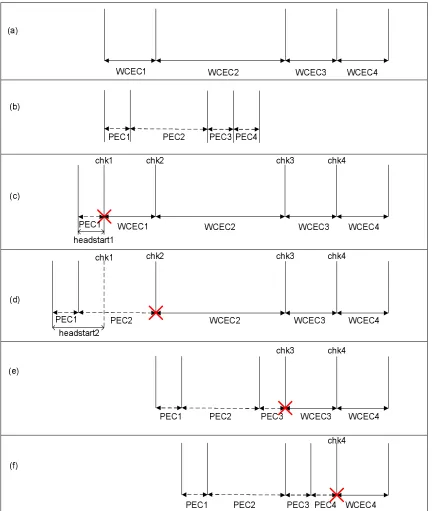
Figure 4-5. (a) WCEC of task with 4 sub-tasks, (b) checkpoint for sub-task 1, (c) checkpoint for sub-task 2, (d) checkpoint for sub-task 3, (e) checkpoint for sub-task 4. 63 Figure 4-6 (a) WCEC of task with 4 sub-tasks, (b) PEC of task with 4 sub-tasks, (c) Computing headstart for sub-task 1, (d) Computing headstart for sub-task 2, (e) Computing headstart for sub-task 3, (f) Computing headstart for sub-task 4. ... 67
Figure 4-7. (a) Sub-task-delineated task showing WCETs of sub-tasks. (b) Successful timing-speculation in the complex mode using dynamic headstart accrual approach. (c) Unsuccessful timing-speculation in the complex mode using dynamic headstart accrual75 Figure 4-8. Energy comparison of simple processor and AMP... 89
Figure 4-9. Detailed breakdown of energy consumption of the simple processor and AMP @ 1GHz... 90
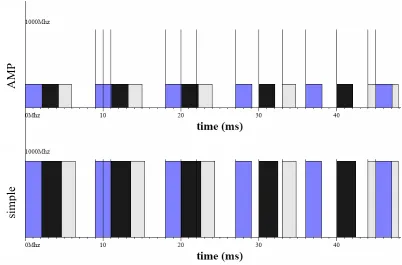
Figure 4-10. Frequency profile for task-set AMS on simple and AMP, both using lookahead EDF-DVS. ... 93
xiii
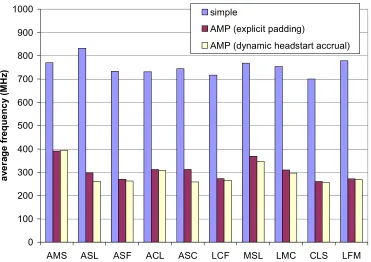
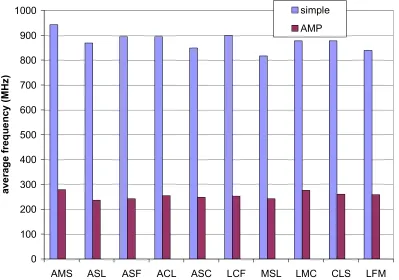
Figure 4-12. Energy savings of AMP over simple, both using lookahead EDF-DVS. .... 96 Figure 4-13. Frequency profile for task-set AMS on the simple and AMP, both using static frequency speculation adapted for multi-tasking... 102 Figure 4-14. Average frequencies for AMP over explicitly-safe simple, both using static frequency speculation... 104 Figure 4-15. Energy savings of AMP over simple, both using static frequency
speculation. ... 105 Figure 4-16. Energy savings of AMP with static frequency speculation over simple with lookahead EDF-DVS. ... 105 Figure 4-17. (a) Percentage of sporadic tasks accepted and (b) idle time percentage. ... 110 Figure 4-18. Acceptance rate for successively larger sporadic tasks, for 3 base task-sets (FC, AS, AL).... 112 Figure 4-19. (a) Percentage of MPEG frames successfully serviced and (b) idle time percentage. (Results are for a single periodic soft-real-time task.)... 114 Figure 4-20. (a) Percentage of MPEG frames successfully serviced, and (b) idle time percentage. (Results are for two periodic soft-real-time tasks.) ... 116 Figure 4-21. (a) Percentage of sporadic tasks accepted and (b) percentage of MPEG frames serviced. ... 118 Figure 4-22. (a) Percentage of sporadic tasks accepted, (b) percentage of MPEG frames successfully serviced, and (c) number of instructions committed for the non-real-time task. ... 121 Figure 5-1. Non-uniform program analysis vs. conventional timing analysis. ... 128 Figure 5-2. VISA yields a lower actual execution time (AET) compared to conventional timing analysis while NUPA yields a lower WCET compared to conventional analysis. Combining VISA and NUPA can drastically reduce both the WCET and the AET
compared to conventional analysis. ... 141 Figure 6-1. Variability in execution time due to variability in the dynamic instruction stream. ... 147 Figure 6-2. Variability in execution time due to uncertainty in when ultimate producer instruction completes. ... 149 Figure 6-3. Non-predicated and phi-predicated versions of an example program segment.
... 152 Figure 6-4. Implementing RECORDER constraints without hardware support. The figure on the right illustrates how the hardware phi-instruction can be implemented using logic instructions... 157 Figure 6-5. Benefits of RECORDER. ... 160 Figure 6-6. Actual execution times and worst-case execution times for simple and
xiv
xv
LIST OF SYMBOLS OR ABBREVIATIONS
VISA – Virtual Simple Architecture AMP – Analysis-Managed Processor NUPA – Non-Uniform Program Analysis
RECORDER – Repeatable Execution Constraints for out-of-ORDER PEC – Predicted Execution Cycles
1
Chapter 1
Introduction
In a hard-real-time system, safe operation depends upon meeting task deadlines. Real-time scheduling theory provides the basis for determining whether or not a set of periodic tasks will meet their deadlines. A key input to this analysis is the worst-case execution time (WCET) of each periodic task.
Tasks’ WCETs are typically derived using some kind of timing analysis. Conventional timing analysis techniques examine all possible control-flow paths through a task (path analysis) and account for cycle-level timing of the underlying microarchitecture (microarchitecture analysis). The maximum execution time of a task is its WCET.
2
also support overlapped execution of 10s to 100s of speculative in-flight instructions in the pipeline.
For this reason, microarchitectural complexity is discouraged in hard-real-time systems. My thesis is:
Microarchitectural complexity is viable in hard-real-time systems, if control is provided over this complexity.
The ability to dynamically manage the microarchitecture enables fundamentally different approaches to timing analysis: cooperative static and run-time WCET frameworks that break the limitations of the traditional static-only WCET model. These frameworks enable complex microarchitecture features if benefits can be derived and if overall safety can be assured. Conversely, these features are disabled if no benefits are derived or if safety cannot be assured.
3
separately or in combination: neither framework requires the other, yet benefits are multiplied when they are used together.
VISA exploits the AMP to avoid analyzing complex microarchitecture features. The key idea is to statically derive tasks' WCETs assuming a simple processor, and, at run-time, speculatively execute tasks with complex features enabled and dynamically confirm that tasks' WCETs are not exceeded. VISA does not reduce WCETs with respect to a simple processor, but it does impose WCETs with respect to a complex processor without actually analyzing it. Aside from this unusual and unprecedented "functional" benefit (i.e., correctness without explicit analysis), the quantitative benefit is large dynamic slack, enabling various run-time optimizations such as significant processor frequency reduction and/or higher throughput of other types of tasks.
NUPA exploits the AMP to efficiently analyze complex microarchitecture features. The key idea is to match different program segments to different operating modes of the AMP. WCETs are reduced for program segments that are efficiently (i.e., practically) and safely analyzable in the context of complex microarchitecture features, without the severe burden of requiring all program segments to be analyzed this way. At run-time, AMP configurations are dynamically altered to correspond with the variable analysis.
1.1.
Analysis-managed processor
4
providing complete control over its features, the AMP enables unconventional timing analysis frameworks that can exploit the reconfigurable AMP in many different ways. Since timing analysis is responsible for managing the processor, i.e., enabling and disabling features, the processor is called analysis-managed processor.
5 (a)
(b)
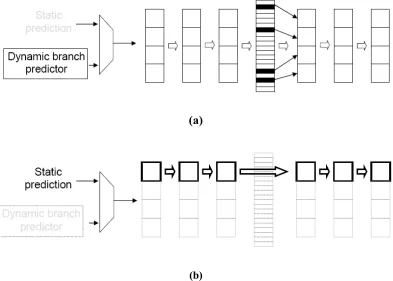
Figure 1-1. (a) AMP operation in complex mode. (b) AMP operation in simple mode.
Note that this is just an example AMP that happens to have two modes. In general, an AMP can have any number of modes, depending on the requirements of the timing analysis frameworks managing the AMP. In the most flexible case, single features or components can be individually enabled/disabled.
6
1.2.
Virtual simple architecture (VISA)
The first technique is called the Virtual Simple Architecture (VISA). The VISA framework allows us to safely use an unanalyzable high-performance complex pipeline at run-time without having to statically analyze the complex pipeline. The key idea behind VISA is that the run-time pipeline does not have to explicitly match the pipeline model used to derive the WCET, as long as the execution time on the run-time pipeline does not exceed the prescribed WCET. If a pipeline is too complex for timing analysis to handle, the VISA framework can choose to not analyze the complex pipeline, and instead use a simple pipeline as the basis for deriving tasks’ WCETs. At run-time, tasks are speculatively attempted on the unsafe complex pipeline. Since the complex pipeline was not explicitly analyzed, tasks’ WCETs are not guaranteed on the complex pipeline. To ensure overall system safety, VISA provides a run-time safety mechanism that continuously gauges progress on the complex pipeline. If there are early warning signs that speculative execution on the complex pipeline is not satisfactory, i.e., WCETs are in jeopardy, the run-time framework disables unsafe complex features before a “point-of-no-return”, ensuring that tasks’ WCETs are never exceeded.
7
8
Simple
pipeline
AMP
VISA framework
p ro ce ss o r u til iz a tio n 100% p ro ce ss o r u til iz a tio n dynamic slack dynamic slack Worst-case equivalent systems 100%worst
case
actual
case
worst
case
actual
case
CONVENTIONAL SYSTEM
NEW SYSTEM
Figure 1-2. High-level view of first technique: Virtual Simple Architecture (VISA).
Note that the VISA framework does not actually reduce tasks’ WCETs even though it employs a high-performance complex mode. This is because tasks’ WCETs are derived using the simple mode and the VISA framework only guarantees that these WCETs are not exceeded. As such, the high-performance features of the complex mode cannot be used to reduce tasks’ WCETs.
The quantitative advantage of VISA is that task execution is typically (but not provably) accelerated in the high-performance complex mode, i.e., tasks have smaller actual execution times, creating large amounts of dynamic slack as seen in Figure 1-2.
9
1. Dynamic voltage scaling (DVS): Since tasks typically finish much faster on the complex mode, a large amount of slack is generated. This slack can be exploited to reduce the system frequency and voltage to lower the power/energy consumed.
2. Higher throughput in mixed-task systems: While VISA does not reduce the perceived worst-case utilization, actual utilization due to hard-real-time tasks is significantly reduced. The spare computational capacity can be used to increase throughput for sporadic hard-real-time tasks, soft-real-time tasks, and non-real-time tasks.
3. Fault-tolerance: The high-performance complex mode might mitigate the cost of redundant task executions, for detecting and recovering from transient faults. The VISA framework can provide time-redundancy-based fault tolerance in situations where a conventional simple pipeline cannot due to tight utilizations.
1.3.
Non-uniform program analysis (NUPA)
10
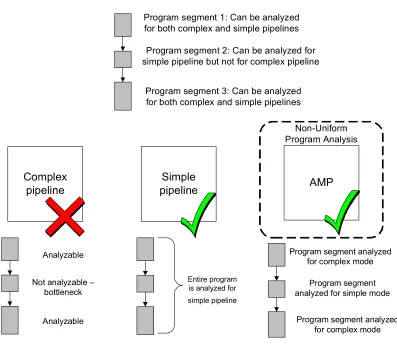
NUPA advocates an unconventional non-uniform approach, where the key idea is to match each program segment with a pipeline model that is most suited for that program segment, in terms of efficient (practical) analysis and a tight WCET. The AMP is a natural substrate for the NUPA framework. Segments of the program that allow efficient analysis on the complex mode of the AMP are analyzed in the context of the complex mode, while remaining parts of the program are analyzed for the simple mode. NUPA enables us to exploit high-performance microarchitectural features to reduce tasks’ WCETs, with the ability to opt out for program segments that cannot be efficiently analyzed for the complex mode. At run-time, the AMP is configured in complex mode for segments of code that were analyzed for the complex mode and the AMP is switched to the simple mode for segments that were analyzed for the simple mode.
Figure 1-3 shows a program that has been divided into three segments. The first and third program segments can be analyzed for both a low-performance simple pipeline and a high-performance complex pipeline. The middle program segment is analyzable only for the simple pipeline and is not analyzable for the complex pipeline.
11 Simple
pipeline AMP
Non-Uniform Program Analysis
Complex pipeline
Analyzable Program segment analyzed
for complex mode Program segment analyzed for simple mode
Entire program is analyzed for simple pipeline
Program segment analyzed for complex mode Not analyzable –
bottleneck
Analyzable
Program segment 1: Can be analyzed for both complex and simple pipelines
Program segment 2: Can be analyzed for simple pipeline but not for complex pipeline
Program segment 3: Can be analyzed for both complex and simple pipelines Program X
Figure 1-3. High-level view of second technique: Non-Uniform Program Analysis (NUPA).
The middle part of the figure shows conventional analysis on a conventional simple pipeline. Conventional analysis can derive the program’s WCET since the entire program is analyzable in the context of the simple pipeline.
12
NUPA was inspired by a hybrid timing analysis technique called SYMTA (symbolic hybrid timing analysis) [46]. SYMTA combines simulation and formal analysis for efficient worst-case timing analysis. In the SYMTA approach, some program segments are analyzed via simulation and other program segments are analyzed using formal timing analysis techniques. However, this approach is still limited by the fact that it assumes a single pipeline model for the entire program, even though different analysis techniques are employed for different program segments.
13
14
AMP
VISA
WCET (simple)
AMP
NUPA
WCET (simple) WCET (complex)
AMP
NUPA
WCET (simple) WCET (complex) VISA
(a) (b) (c)
Figure 1-4. (a) VISA framework, (b) NUPA framework, (c) A combined VISA-NUPA framework.
1.4.
Understanding and overcoming complexity of analyzing
out-of-order pipelines
While the example NUPA framework, proposed in the previous section, allows program segments with a single-control-flow path to be analyzed for the complex mode via simple simulation/static analysis, program segments with multiple control-flow paths are still limited to the simple mode. The next logical step is to devise techniques that will allow program segments with multiple control-flow paths to be analyzed for the complex mode. So far, I have implied a connection between variable (input-dependent) control-flow in a task and complexity of deriving the task’s WCET for a complex pipeline. This crucial connection is explained in this section and the insight is the basis for novel solutions. We specifically concentrate on complexity of analyzing out-of-order execution.
15
more than 20 pipeline stages. To support such a wide and deep pipeline, the microarchitecture supports as many as 126 in-flight instructions in the scheduling window. Statically deriving the WCET requires examining a corresponding scheduling window in software, and anticipating the worst-case schedule that would be formed dynamically by the processor.
The run-time schedule can be deduced easily, a priori, if there is no variable flow and no variable or unknown latencies. In the absence of variable control-flow, there is only one path of dynamic instructions, hence only one schedule. On the other hand, variable control-flow increases the number of possible paths through the program, which causes a corresponding increase in the number of possible execution schedules. Each additional branch doubles the number of paths and the number of possible schedules. Returning to the Pentium 4 example, assuming a branch every 8 instructions, we can have as many as 16 branches in the window. Worst-case timing analysis has to consider 216 (65,536) possible execution schedules in this case. As each new processor generation supports successively larger windows, timing analysis becomes intractable.
out-16
of-order, continuous-window processor is to enumerate every possible execution schedule through the entire program.
I propose two techniques that attack the problem of analyzing variable control-flow on an out-of-order pipeline. Both techniques try to limit the number of execution schedules that must be examined by timing analysis.
The first technique, called Repeatable Execution Constraints for Out-of-Order (RECORDER), takes an extreme approach by specifying two constraints that guarantee the total elimination of variable control-flow and its implied data-flow variations. Meeting RECORDER constraints yields a single input-independent execution schedule, common to all program runs. Simple simulation with randomly generated inputs, or even static analysis, can be used to derive this execution schedule and hence the WCET.
The second technique, called Drain and Branch (DNB), simplifies timing analysis by insulating a branch region from instructions before and after the branch region. Now, the two paths of a branch can be analyzed in isolation, without having to account for overlap of instructions from before and after the branch region. By limiting overlap, this approach naturally restricts the number of possible execution schedules, simplifying timing analysis. Note that DNB restricts overlap only across branch regions. Instructions that are within the branch region can still execute out-of-order.
17
1.4.1. Repeatable execution constraints for out-of-order (RECORDER)
I propose a strict set of constraints, called Repeatable Execution Constraints for out-of-ORDER (RECORDER), which facilitates easy timing analysis of a program on an out-of-order pipeline, by ensuring a single execution time that is independent of the program’s input. The key idea is to eliminate variable control-flow and data-flow caused by input-dependent branches, yielding a single execution schedule that does not depend on program inputs. In turn, WCET can be derived by simple simulation with randomly generated program inputs.
Eliminating only control-flow for tractable timing analysis was first proposed by Puschner and Burns in the Single-Path Architecture [47][30], but their technique is not sufficient for an out-of-order pipeline as they do not eliminate variable data-flow arising from control-flow. They used conventional if-conversion (predication). Predication converts input-dependent control-flow into input dependent data-flow. Executing both paths of a branch yields multiple potential producer instructions of a value. Ambiguity in who produces the value is referred to as input-dependent dataflow in this dissertation. There may be a later consumer instruction, after the predicated block, that depends on this value. It is now ambiguous as to when the consumer executes because it depends on which producer is the true producer and when that producer executes (assuming predicate is known first). Thus, input-dependent data-flow can cause variations in execution time and has to be accounted for by timing analysis. Unfortunately, analyzing input-dependent data-flow is just as complex as analyzing input-dependent control-flow.
18
number of dynamic instances of an instruction must be constant across program runs, independent of the program’s input. This can be implemented by predicated execution, i.e., executing both paths of a predicated branch and using the results of the correct-path instructions and discarding the results of the wrong-path instructions. This constraint is similar to the single-path architecture.
The second constraint requires that a dynamic instance of an instruction execute at the same instant of time across different program runs, again independent of the program’s input. This constraint ensures that execution time is not affected by any input-dependent data-flow. This is achieved by issuing/executing a input-dependent instruction only after all potential producer instructions have executed, effectively eliminating any timing variations due to input-dependent data-flow.
RECORDER guarantees a single execution time that is independent of the program’s input, and this execution time is both the actual execution time and the worst-case execution time. Using RECORDER, the execution time of a program can be recorded once using arbitrary (random) inputs and this does not change across program runs. The uniqueness of RECORDER lies in the fact that it allows instructions to execute out-of-order within a program, while guaranteeing that a specific dynamic instance of an instruction executes at the same time across different program runs, independent of the program’s inputs.
19
of phi instructions and predicate registers. Then, I propose a novel, all-software RECORDER implementation (no special ISA/hardware support) that converts branches into a mask computation and uses “logical AND” and “logical OR” instructions to mimic phi instructions (logically a MUX).
Note that RECORDER can allow whole programs to be analyzed in the context of a complex pipeline. This suggests that RECORDER does not require the reconfigurable AMP. However, for some program segments, it is not possible to satisfy RECORDER constraints. For example, it is not possible to predicate a branch with a function call embedded in one of its paths. In other cases, satisfying RECORDER constraints may inflate the WCET compared to WCET on a simple pipeline, defeating the purpose of using a high-performance pipeline. For example, to satisfy the first RECORDER constraint, instructions from both paths of a branch must be executed always, irrespective of whether the branch is taken or not. This may degrade performance due to resource contention from wrong-path instructions. To address problems with RECORDER, I propose a combination of NUPA and RECORDER. The idea is to use RECORDER for a program segment only if its WCET on the complex mode is less than the corresponding WCET on the simple mode. The better policy is selected accordingly: simulation of RECORDER version on complex mode vs. conventional static timing analysis of non-RECORDER version on simple mode. Other factors may also be weighed in the policy decision, such as power consumption or feasibility of meeting RECORDER constraints.
20
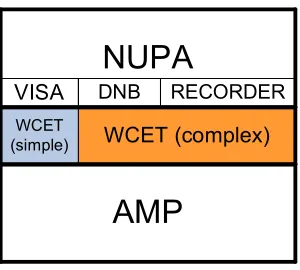
simple mode (shown in blue). Figure 1-5 (b) shows a combined NUPA-RECORDER framework. Recall that RECORDER allows program segments with multiple control-flow paths to be analyzed for the complex mode. As a result, we see that the fraction of the program analyzed for the complex mode (shown in orange) is larger compared to the vanilla NUPA case shown in Figure 1-5 (a). A subtle point is that program segments with a single control-flow path automatically satisfy RECORDER constraints. So, I classify these as RECORDER segments in the figure. Thus, RECORDER improves NUPA performance by allowing more program segments to be analyzed for the complex mode. At the same time, NUPA ensures that RECORDER is only applied when it is beneficial, i.e., only for branches that reduce WCET when predicated and not for branches that inflate WCET when predicated.
AMP
NUPA
WCET (simple) (complex)WCET
AMP
NUPA
WCET (simple)
WCET (complex) RECORDER
AMP
NUPA
WCET (simple)
WCET (complex) VISA RECORDER
(a) (b) (c)
Figure 1-5. (a) NUPA framework, (b) NUPA-RECORDER framework, (c) A combined NUPA-VISA-RECORDER framework.
21
speculatively attempted on the complex mode of the AMP with the VISA protection mechanisms turned on (as shown in Figure 1-5 (c)).
Note that this technique of using complex with RECORDER for some program segments, and the simple mode for other program segments, requires a reconfigurable AMP.
1.4.2. Drain and branch (DNB)
RECORDER allows analysis of programs in the context of an out-of-order pipeline by phi-predicating input-dependent branches (i.e., eliminating variable control-flow and data-control-flow) to create a single execution schedule. While this approach simplifies timing analysis, executing both paths of a branch and delaying variable data-flow may artificially inflate the WCET, especially for branches with large control-dependent regions (long branch paths). By predicating a branch, both paths of the branch contribute to the WCET. On the other hand, if the branch was not predicated, then only one path (i.e., the longer of the two branch paths) would be included in the WCET. However, analyzing the un-predicated branch is very complicated because each path of the branch has to be analyzed assuming that its instructions can overlap with instructions from any possible control-flow paths before the branch region, and any possible control-flow paths after the branch region. This causes an explosion in the number of execution schedules to be examined.
22
key idea is to insulate instructions in a branch’s control-dependent region from the effects of instructions before and after the branch region. That is, DNB ensures that instructions in a branch’s control-dependent region are not affected by the execution of instructions before and after the branch region. Now, the branch region can be analyzed in isolation without having to account for overlap from instructions before and after the region. By restricting overlap, DNB limits the number of execution schedules to be examined by timing analysis. In fact, the number of execution schedules to be examined for a DNB-type branch is equal to the number of its control-dependent paths and is not dependent on the number of paths before and after the branch. The largest execution time among the different control-dependent paths of a DNB-type branch is chosen as the WCET for that branch region. The overall task WCET is the sum of the WCETs of the individual branch regions.
23
after the branch’s control-dependent region are fetched. The second DNB instruction does not have a target since it does not redirect control-flow – it is only responsible for draining the pipeline. Accordingly, when this DNB instruction is retired, the fetch unit fetches the next sequential instruction. Note that the penalty of draining the pipeline at the start and end of each branch region has to be accounted for in the overall WCET.
While DNB greatly simplifies timing analysis of tasks on an out-of-order pipeline, DNB may inflate overall tasks’ WCETs due to the overhead of draining the pipeline at every branch. For branches with long control-dependent regions, the reduction in WCET of the branch region yielded by out-of-order execution, with respect to WCET on a simple in-order pipeline, may justify pipeline draining overheads. However, for branches with small dependent regions, the amount of parallelism present in the control-dependent region may not be sufficient to offset the overhead of draining the pipeline. I propose two options for dealing with branches, for which DNB is not favorable.
24
The second and more interesting option is to use DNB and RECORDER in combination. These two techniques complement each other nicely. Branches with small control-dependent regions are not good candidates for DNB. On the other hand, phi-predicating these branches may not be very expensive. So, branches with small control-dependent regions can be analyzed using RECORDER. Conversely, branches with large control-dependent regions are not suitable for RECORDER because phi-predicating these branches results in executing a large number of wrong-path instructions. On the other hand, these branches are ideally suited for the DNB technique since their large control-dependent regions can more than offset the penalty of draining the pipeline. Branches with varying path lengths (one path is long and the other path is short) are analyzed using both DNB and RECORDER and the technique that yields the lower WCET is chosen. Intuition tells us that the innermost nested branches will be analyzed via RECORDER and DNB will be used as we proceed towards outermost branches.
The combined DNB-RECORDER framework addresses deficiencies of both DNB and RECORDER. RECORDER can be used to improve the performance of DNB by creating large branch regions by predicating nested branches, allowing instructions from multiple branch regions to execute out-of-order. On the other hand, branches that inflate the WCET because of predication and branch regions that cannot satisfy RECORDER constraints can now be analyzed on the out-of-order pipeline via DNB.
25
suite [45]. DNB-RECORDER yields a 35% reduction in WCET on a 4-way superscalar out-of-order processor compared to a scalar in-order processor.
AMP
NUPA
WCET (simple)
WCET (complex)
DNB
Complex
NUPA
WCET
RECORDER DNB
(a) (b)
Figure 1-6. (a) NUPA-DNB framework. (b) A combined DNB-RECORDER technique for analyzing out-of-order pipelines.
1.5.
Putting it all together: An AMP-based high-performance
hard-real-time system
In the discussion so far, I introduced the reconfigurable AMP, two timing analysis frameworks (VISA and NUPA), and two timing analysis techniques for out-of-order pipelines (RECORDER and DNB). I also discussed the advantages of pairwise combining these techniques. In this section, I am going to describe how of all these techniques can be used in combination to yield a high-performance hard-real-time system.
26
framework tries to match each segment of a program to a pipeline model and timing analysis technique that is most suited for that program segment, in terms of efficient analysis and a tight WCET. Accordingly, some program segments are analyzed for the complex mode via RECORDER or DNB (shown in orange in Figure 1-7), while other program segments are analyzed for the simple mode via conventional static timing analysis (shown in blue in Figure 1-7). Moreover, program segments that are analyzed for the simple mode can be speculatively attempted in the complex mode with the VISA protection mechanisms turned on.
AMP
NUPA
WCET
(simple) WCET (complex)
VISA DNB RECORDER
Figure 1-7. The versatile AMP enables a variety of techniques, all of which can work in combination, to allow complex microarchitectural features to be safely included in hard-real-time systems.
1.6.
Contributions
In this thesis, I make nine major contributions, outlined below.
27
Virtual Simple Architecture. I describe the basic components of the VISA framework. This includes the VISA timing analysis, VISA-compliant AMP, and run-time framework for checking. I propose two checking mechanisms, (1) sub-task-based checking and (2) instruction-based checking.
Understanding VISA, limitations, and overheads. I provide key insight about the purpose of the VISA framework. Also, I identify some fundamental limitations of the VISA framework such as the inability to improve worst-case schedulability. Also, I describe sources of schedule overhead due to the new approach. I propose an intuitive and systematic approach for computing and budgeting the overhead.
Eliminating VISA overheads. I propose an alternative VISA speculation approach, called dynamic headstart accrual, that eliminates the speculation overhead. The key idea is to exploit naturally occurring dynamic slack to enable speculation, as opposed to explicitly budgeting the speculation overhead in the WCET.
Demonstrating VISA benefits. The VISA framework generates large amounts of dynamic slack that can be exploited to (1) reduce frequency/voltage for power/energy savings, or (2) increase throughput of sporadic hard-real-time, soft-real-time, and non-real-time tasks, or (3) enable time-redundant task execution for fault tolerance. The benefits of the VISA framework are shown in the following key results.
28
· I show that the VISA framework is transparent to DVS schedulers (and all software layers in general, due to preserving the WCET task abstraction) and can be used with arbitrary DVS schedulers. I demonstrate this by using the VISA framework with two different DVS schemes.
· I show that the VISA framework can improve the throughput of sporadic hard-real-time tasks and soft-hard-real-time tasks. For example, an AMP in the VISA framework accepts 2.4 to 16 times more sporadic tasks than an explicitly-safe simple processor, without compromising safety of base periodic hard-real-time tasks.
Extending frequency speculation to multiple tasks. The VISA framework yields large amounts of slack. In the course of my research, I found that previously proposed DVS schemes do not efficiently exploit this slack. I propose an extension to a DVS scheme called frequency speculation, to work in the context of multi-tasking hard-real-time systems. I show that the adapted DVS scheme performs better than the well-known look-ahead EDF-DVS scheme in the context of the VISA framework.
29
complex mode and program segments with multiple control-flow paths are analyzed for the simple mode. I also describe the limitations and overheads due to NUPA.
Repeatable Execution Constraints for Out-of-ORDER. I propose a set of constraints that enables analysis of program segments with arbitrarily complex control-flow on an out-of-order processor. I extend the single-path architecture to be safely used for out-of-order processors. I show how a previously proposed technique called phi-predication already meets these constraints. I identify the limitations of RECORDER and propose a combined NUPA-RECORDER technique that can eliminate the limitations of both NUPA and RECORDER.
All-software RECORDER implementation. I propose an all-software implementation of the RECORDER technique. I propose a novel software-only technique using “logical AND” and “logical OR” instructions to implement the phi (select) instruction provided by phi-predication. Also, I propose a novel software-only technique to implement conditional store instructions.
30
1.7.
Thesis organization
In Chapter 2, I provide a brief introduction to real-time systems. Related work is discussed in Chapter 3.
I describe the Virtual Simple Architecture in detail in Chapter 4. I present a sample VISA specification and describe the VISA time framework. The VISA run-time framework includes different techniques for budgeting the headstart amounts and different checking mechanisms to gauge progress on the complex mode. I also describe two different applications of the VISA framework. First, I show how VISA can be used in conjunction with unmodified DVS to greatly reduce power/energy consumption. Second, I show the throughput benefits yielded by the VISA framework for sporadic hard-real-time tasks, soft-real-time tasks, and non-real-time tasks. I briefly touch upon the fault tolerance aspects of the VISA framework.
In Chapter 5, I elaborate on non-uniform program analysis (NUPA). I describe an example NUPA framework and show how a program can be analyzed differently based on the nature of control-flow. I present results for task-set-level NUPA where different tasks in a task-set are analyzed for different pipeline modes.
31
32
Chapter 2
Real-Time Systems Primer
A real-time embedded system is characterized by a collection of tasks (called a task-set), where each task is expected to complete before a certain time, called the deadline. There are two major types of real-time tasks based on the criticality of meeting task deadlines – (1) hard-real-time tasks and (2) soft-real-time tasks. A hard-real-time task is expected to meet its deadlines 100% of the time. A hard-real-time task missing its deadline can lead to disastrous consequences. Examples of hard-real-time systems include avionics, automobile systems, etc. On the other hand, deadline misses in soft-real-time systems can be tolerated. A soft-soft-real-time task missing its deadline typically manifests itself as a loss in the quality of service. Examples of soft-real-time tasks include streaming audio and video applications. A typical real-time system is composed of a mix of hard-real-time, soft-real-time, and non-real-time tasks. We refer to these mixed systems as safe-real-time systems.
hard-real-33
time deadlines. An added facet of sporadic tasks is that it is acceptable to drop (i.e., not start) a sporadic task if its deadline cannot be guaranteed.
In this dissertation, we primarily deal with periodic hard-real-time systems. In a system with periodic hard-real-time tasks, schedulability analysis is done beforehand to determine whether or not all of the tasks can be executed concurrently on the processor, always adhering to the periodicity of each task. Since tasks repeat indefinitely and at different rates, schedulability analysis is based on a utilization test. Utilization of a task is the fraction of time that the processor spends executing the task. In the worst case, the utilization of a task i is simply its worst-case execution time (WCET) divided by its period: Ui = WCETi / periodi. The example in Figure 2-1 shows two tasks A and B with worst-case utilizations of 1/3 (WCETA = 1 unit, periodA = 3 units) and 1/4 (WCETB = 1 unit, periodB = 4 units), respectively. Task release points indicate when the next instance of a task is queued by the scheduler and occur at constant intervals equal to the period. The total utilization of a task-set is the sum of individual task utilizations, and must be less than 1 for the task-set to be schedulable under worst-case conditions, assuming earliest-deadline-first (EDF) scheduling. The task-set in Figure 2-1 is schedulable since its total utilization is 7/12 < 1.
time
WCETA = 1, WCETB = 1
periodA = 3
A1 B1 A2 B2 A3 B3 A4 A5 Task A
release Task B
release periodB = 4
34
Note that aperiodic and sporadic tasks are not accounted for in the schedulability analysis. This is because the utilization of these tasks is not constant and varies over time. As a result, it is very difficult to a priori guarantee deadlines for aperiodic and sporadic tasks. While this is not a problem for aperiodic tasks because most aperiodic tasks are soft-real-time in nature, sporadic tasks have to be handled. I mentioned that it is acceptable to not start a sporadic task if its deadline cannot be guaranteed. Accordingly, sporadic tasks are accepted dynamically based on an online acceptance test. When a sporadic task is released, the scheduler checks to see if there is sufficient time in the schedule to finish the sporadic task before its deadline, while budgeting enough time to complete all pending and future instances of periodic tasks and previously accepted sporadic tasks that have not yet completed. If sufficient time is available, the newly released sporadic task is accepted.
35
Chapter 3
Related Work
3.1.
Worst-case timing analysis
Scheduling theory for hard-real-time systems, such as rate-monotone scheduling (RMS) and earliest-deadline-first (EDF) scheduling, relies on known WCET bounds for tasks [54][55][21].
Over the past decade, various research groups have investigated static approaches for bounding WCETs of real-time programs. Static analysis has been extended from un-optimized programs on simple CISC processors [56][32][29][27] to un-optimized programs on pipelined RISC processors [13][42][20][57][36], and from uncached architectures to architectures with instruction caches [4][25][57][19][18] and data caches [12][17][19][33][39][40][38]. Lundqvist and Stenstrom modified an architectural simulator to determine WCET bounds by considering alternate execution paths in parallel (instead of following a trace) combined with pruning techniques to reduce the search space [22]. More recent work is taking a probabilistic approach to provide certainty levels of the WCET based on a sample of observed executions supported by the pWCET tool [58].
36
As improved timing analysis techniques, that can analyze increasingly complex features, emerge, we can include complex features in the simple mode of the AMP. While we expect continued success in extending timing analysis to increasingly complex processors, this effort will always lag behind microprocessor technology. The AMP, and the new timing analysis approaches it enables, may expedite the use of complex features in safe systems, at the same time fully leveraging the significant investment in timing analysis tools. For example, a recent technique attempts to bound the number of branch mispredictions for two-level dynamic predictors [24]. This analysis technique can safely configure the AMP to include a two-level dynamic branch predictor in the simple mode.
3.2.
Architectural support for real-time systems
It has been noted that complex architectural features are allowable as long as they are disabled based on analyzability requirements [7][11]. This was proposed in the context of mixed task systems consisting of hard-real-time and non-real-time tasks. Since real-time tasks do not require WCETs, complex components can be enabled for non-real-time tasks, but these complex components had to be disabled at the onset of hard-real-time tasks.
37
be statically proven. In NUPA, complex components are disabled at various times within a task, when they cannot be safely or efficiently handled by timing analysis, but they are not disabled for the whole task.
Cache partitioning was proposed to separate the cache footprint of each real-time task [59]. Subsequently, software partitioning schemes of caches were studied [60][61]. The above techniques are static and do not allow components to be enabled and disabled as needed. For example, a task is limited to a certain cache size and the cache partition allotted to a task cannot be dynamically changed at run-time. Doing so would require timing analysis to explicitly analyze the larger cache. On the other hand, the AMP offers maximum flexibility because it allows its components to be enabled and disabled both speculatively (using VISA) and non-speculatively (using NUPA).
38
Cazorla et. al [70] proposed architectural support for real-time tasks in SMT processors. The key idea is to reserve a minimum amount of the SMT processor’s resources for the time-critical thread, to ensure that it meets its deadline. The remaining resources are assigned to other non-real-time threads. A key limitation of this approach is that the underlying SMT processor’s resources are not completely partitioned, leaving some residual sharing of resources between the time-critical and non-critical tasks. Contention for these shared resources may result in missed deadlines. The VISA framework also allows hard-real-time tasks and non-real-time tasks to be simultaneously executed on an AMP that supports SMT. In addition, VISA truly guarantees the hard-real-time task’s deadline by continuously monitoring its progress and completely disabling SMT at the earliest warning sign that a deadline could be missed.
3.3.
Simulation-based timing analysis techniques
39
mode for SFPs via simulation, while still enabling efficient static analysis of MFPs on a simple mode.
The Single-Path Architecture [47], proposed by Puschner and Burns, is closely related to RECORDER [69]. In the single-path architecture, variable control-flow is removed by if-conversion [48]. The idea is to force a single execution path through the program and use simulation to derive the WCET. The single-path architecture implicitly assumes that instructions are executed in strict program order. This assumption does not hold in an out-of-order pipeline. Due to out-of-order execution, a value guarded by a predicated branch may be forwarded at different times depending on when the candidate producer instructions complete and when the predicate is computed, leading to variation in execution time. As a result, the single-path architecture cannot guarantee a single execution time on an out-of-order pipeline (in spite of ensuring a single path through the program). We demonstrate the problem with the single-path architecture on an out-of-order pipeline, using the same example provided in their paper, shown below.
1. r1 = expr1; 2. r2 = expr2; 3. test cond; 4. movt rr, r1; 5. movf rr, r2;
40
instructions that consume rr can now execute without having to wait for r1 to be computed. Similarly, if cond is true, inst. 4 executes, writing the value of r1 into rr. Later instructions that consume rr can now execute without having to wait for r2. Summing up, later dependent instructions may execute at different times based on the outcome of cond and when r1 and r2 are computed. There can be variations in execution time even with a single path, depending on the outcome of inst. 3 (i.e., cond).
Moreover, it is difficult or impossible to employ if-conversion in certain scenarios (for example, function calls in branch paths). It might be impossible to convert a whole program into a single path. Finally, whole-program if-conversion may also result in inflated WCETs and high power consumption. RECORDER also has the above issues. Nonetheless, NUPA permits us to opt out of the complex mode when phi-predication is difficult or not beneficial and allows us to revert to the simple mode instead.
3.4.
Timing analysis of out-of-order pipelines
Timing analysis of out-of-order processors has been extensively researched in recent years. Lundqvist and Stenstrom explained the difficulties in analyzing an out-of-order processor [63]. They showed how a cache miss could result in a shorter execution time than a cache hit due to dynamic out-of-order scheduling of instructions. Sainrat explains the difficulties in analyzing a processor which includes branch prediction, caches, and dynamic scheduling [64].
41
are affected by instructions in the preceding and successive basic blocks [65]. While this technique works for processors with small issue queues (4 to 8 entries), this technique is extremely complex for processors with a reasonably sized issue queue (32 to 64 entries) because the number of basic blocks that can overlap greatly increases with the issue queue size. As more basic blocks overlap, the number of possible combinations of overlapping basic blocks grows rapidly.
Alternatively, Sainrat and Rochange proposed a technique called instruction-flow regulation that allows out-of-order processors to be easily analyzed [62]. Their approach is to eliminate any overlap across basic blocks by stalling fetching of a new basic block until all the instructions in the previously fetched basic block are scheduled. This way, instructions in a basic block are not affected by instructions in preceding or successive basic blocks. Each basic block can now be analyzed in isolation and the overall WCET can be easily composed by summing the WCETs of the individual basic blocks. The downside of this scheme is that only instructions within a basic block can execute out-of-order, while instructions across basic blocks cannot execute out-of-order. As a result, this technique does not exploit the full potential of an out-of-order pipeline.
42
strategy allows instructions from multiple basic blocks to overlap (but with easy analysis due to RECORDER), allowing us to better exploit an out-of-order pipeline.
3.5.
Dynamic voltage scaling
Related work on DVS scheduling for hard real-time systems has demonstrated significant energy savings for time-constrained embedded systems [6][43][34][28][16][35]. These techniques generally are variations on slack reclamation schemes ranging from static to dynamic analysis schemes, with sources of slack originating from idle, inter-task savings (early completion), and intra-task savings (early sub-task completion). I integrated the lookahead EDF-DVS scheme proposed by Pillai and Shin [28] into the VISA framework, with no modifications to the DVS scheme, demonstrating the transparent nature of the VISA framework. Also, I extended frequency speculation, initially proposed by Rotenberg [34] for single-task systems, to work in multi-tasking systems. I also showed how frequency speculation can yield significant power savings via the VISA framework.
43
3.6.
Relation to microarchitectural techniques in general-purpose
systems
In VISA, timeliness is verified dynamically which allows critical tasks to run safely on what are considered to be unsafe components. This approach is analogous to the DIVA verification paradigm [5], in which proving correctness of a complex microarchitecture is avoided by dynamically confirming equivalence between the complex microarchitecture and a verified checker pipeline. In our case, we dynamically verify timeliness instead of functionality. As such, the simple mode of operation is a subset of the complex pipeline rather than a dedicated processor.
44
Chapter 4
Virtual Simple Architecture
The key idea behind the Virtual Simple Architecture (VISA) is that the pipeline model used for timing analysis does not have to literally match the physical run-time pipeline. If the physical run-time pipeline is too complex and cannot be safely analyzed, timing analysis can use a simple pipeline model as a proxy for the complex run-time pipeline to derive the WCET. While the complex pipeline is expected to perform better than the simple proxy, thanks to its high-performance features, we cannot statically prove that the complex pipeline will always perform better than the simple proxy. It is possible that some anomalous scenario can cause the complex pipeline to perform worse than the simple proxy. So, we need a means to ensure that the tasks’ WCETs, derived using the simple proxy, are never exceeded on the complex pipeline, to ensure overall system safety. According to VISA, if the unanalyzable complex pipeline provides a means to ensure that tasks’ WCETs – derived using a simple proxy – are never exceeded, the complex pipeline can be safely used even though the complex pipeline itself was not explicitly analyzed. Such a complex pipeline is called a VISA-compliant pipeline.
45
a task’s progress is continuously gauged. If the task’s progress is satisfactory, we continue executing the task on the complex mode. If task progress is not satisfactory, it is no longer safe to continue executing the task on the complex mode since it could result in actual execution time exceeding the WCET. In this case, we reconfigure the AMP to operate in the back-up simple mode. Recall that the simple proxy is the only pipeline on which the tasks’ WCETs are provably safe since tasks are explicitly analyzed on the simple proxy. Since the simple mode matches the simple proxy used for timing analysis, the execution time of the remaining portion of the task is bounded and the WCET is guaranteed to be safe. Thus, the reconfigurable nature of the AMP provides us with a means of enforcing the WCET if the complex mode performs worse than the simple proxy.
The VISA framework consists of three components. The first component is the pipeline timing specification – the VISA – that is the basis for timing analysis. We present an example VISA in Section 4.1.
The second component is the VISA-compliant AMP. We describe the architecture of a VISA-compliant AMP, in detail, in Section 4.2. The complex mode of the AMP is described in Section 4.2.1. Then in Section 4.2.2, we enumerate the modifications needed to reconfigure the AMP to operate in the simple mode.
46
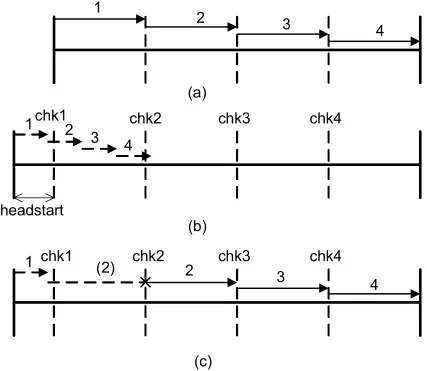
In the first gauging technique, called sub-task-based checking (Section 4.3.1), a task is divided into smaller portions called sub-tasks (Section 4.3.1.1). Each sub-task is assigned a soft deadline called a checkpoint before which it is expected to complete. Checkpoint computation is described in Section 4.3.1.2. In Section 4.3.1.3, we show how a hardware cycle counter can be used to enforce checkpoints and detect missed checkpoints. An artifact of the checkpoint strategy is that a small headstart is required to enable speculation in the complex mode. In Section 4.3.1.4, we describe the need for the headstart amount and present a systematic and intuitive technique to assess the headstart amount. We present two ways of budgeting the headstart amount (Section 4.3.1.5). The first variant, called explicit padding, the headstart amount is padded to the tasks’ WCET (Section 4.3.1.5.1). In the second variant, dynamic headstart accrual, a task is started in the simple mode and accrued slack is used to enable speculation in the complex mode (Section 4.3.1.5.2).
47
a simple emulator. The emulator uses a set of rules to compute the hypothetical completion times of instructions. The emulator and the rules are described in Section 4.3.2.3.
In a multi-tasking real-time system, lower-priority tasks are pre-empted by higher priority tasks. Task pre-emptions disrupt the VISA gauging mechanisms. In Section 4.3.3, we describe how the VISA gauging mechanisms are augmented to work in the presence of task pre-emptions.
In Section 4.4, we present different applications of VISA, discuss benefits, and present results.
4.1.
VISA specification
48
the indirect branch executes. There are four stages between fetch and execute. Therefore, the conditional branch misprediction penalty and indirect branch stall time are both four cycles.
The instruction decode stage decodes 1 instruction per cycle. There is no register renaming, because WAW hazards are handled by in-order completion and WAR hazards are handled by early-reads/late-writes. The register read stage checks for RAW hazards and reads source operands from the register file. There is a single, un-pipelined, universal function unit in the execute stage, and all the usual data bypasses to the function unit from later pipeline stages. The universal function unit handles address generation and all integer and floating-point ALU instructions. There are only two causes for stalling an instruction in the register read stage. First, an instruction stalls