R E S E A R C H
Open Access
Almost sure synchronization control for
stochastic delayed complex networks based
on pinning adaptive method
Tianbo Wang
1*, Shouwei Zhao
1, Wuneng Zhou
2and Weiqin Yu
1*Correspondence: [email protected]
1College of Fundamental Studies, Shanghai University of Engineering Science, Longteng Road, Shanghai, P.R. China
Full list of author information is available at the end of the article
Abstract
This paper investigates the almost sure synchronization control problem for a class of stochastic delayed complex networks by using the stochastic differential equation theory and the Kronecker product technique. Different from the existing works, the considered problem is that all the nodes in the complex networks can synchronize with each other although the target node is unknown. Some sufficient conditions which guarantee the complex networks to have almost sure synchronization are derived and two kinds of controllers are designed, respectively. Finally, a numerical example is given to illustrate the effectiveness of the main results.
Keywords: complex network; almost sure synchronization; stochastic disturbance; pinning adaptive control
1 Introduction
Complex dynamical networks are composed of a family of interconnected nodes, in which each node denotes an individual element in the network and adjusts its behavior by the information received from its neighbor nodes. They can be used to model some complex nonlinear dynamical systems in science and engineering. Thus, in recent years, complex networks have attracted increasing attention in various fields such as biology [, ], soci-ology [], and physics [, ].
In the dynamical behaviors of complex networks, synchronization motion is one of the important elements. Synchronization means that all the nodes’ action in complex net-works will attain the same dynamic behavior along with the time evolution. For example, both a group of fish swarming together and a flock of birds synchronously flying belong to the synchronization phenomena. Up to now, there exists much literature such as [– ] studying the synchronization control problem of complex networks by using different methods. For instance, [, ] study the synchronization control problem of discrete com-plex dynamical networks with a time varying delay by using the method of partitioning time delay and chief stability function, respectively. For the continuous complex networks with different characters, such as time delayed complex networks [–], stochastic com-plex networks [, ], comcom-plex networks with switching topology [–], there have ex-isted a great deal of papers to study the synchronization control problem. The control methods mainly include pinning control [–], impulsive control [, ], adaptive
trol [–],etc.The adopted theories mainly include Lyapunov stability theory, the chief stability function method, andM-matrix theory.
It should be noted that most of these works required all the nodes in complex networks to synchronize with the target node or the isolated node given beforehand. If the target node is unknown, then these results and methods could fail to achieve the synchronization because the designed controllers are usually based on the state information of the target node. In fact, when the target node is known, each node in the complex networks could adjust its behavior according to the error with the target node. However, if the target node is unknown, each node can only adjust its behavior according to the information from its adjacent nodes, at the same time, the adjacent nodes are varying. Practically, the phenom-ena of the unknown target node also exist in the real world. For example, for a complex network consisting of some multi-agents without leader, all the agents achieve consensus by adjusting the information received from its adjacent agents. In addition, sometimes it is difficult to precisely describe the state equation of the target node when systems are dis-turbed by stochastic noise and transmission time delay. Hence, it is necessary to analyze the synchronization control problem of complex networks with unknown target node.
On the other hand, the stochastic complex networks models are very common and there also exists much literature such as [, ] and [–] studying synchronization problems of stochastic complex network. However, these papers mainly focus on the synchroniza-tion in mean square. For the almost sure synchronizasynchroniza-tion of complex networks, there ex-ist few results. Especially, the complex network which is the almost sure synchronization could not have synchronization in mean square, the relative counter-example can be found in [–].
Motivated by the above discussion, in this paper, we will consider the almost sure syn-chronization control problem for a class of stochastic delayed complex networks. The con-tributions of our paper are as follows. (i) The almost sure synchronization control other than synchronization in mean square is investigated. (ii) The provided results can suit for the synchronization of complex networks with the target node unknown. (iii) The ob-tained results only depend on the complex network’s parameters.
The rest of this paper is organized as follows. In Section , we introduce the stochastic delayed complex dynamical network model and some useful lemmas. In Section , some criteria which ensure that the complex network synchronizes well are derived and some synchronization controllers are given. In Section , a numerical example is provided to il-lustrate the effectiveness of our proposed results. Finally, this paper ends with conclusions in Section .
Notation RnandRn×mdenote then-dimensional Euclidean space and the set of alln×m dimensional real matrices, respectively. For a vector v= (v,v, . . . ,vn)T ∈Rn, whose -norm is denoted byv=
n
i=vi.AT,tr(A), anddet(A) represent the transpose, trace, and determinant of the matrixA, respectively.λmin(A) andλmax(A) represent the mini-mum and maximini-mum eigenvalues of the matrixA, respectively.X≥Y(respectively,X>Y) means thatX–Yis a symmetric positive semi-definite matrix (respectively, positive def-inite matrix), whereX,Y are symmetric matrices.In is then×nidentity matrix,⊗is the Kronecker product. The set (,F,{Ft}t≥,P) denotes the complete probability space with a filtration {Ft}t≥ satisfying right continuity and F containing all P-null sets. Cb
2 Problem formulation and preliminaries
In this paper, we consider the following stochastic delayed complex network composed of N identical nodes with linear couplings. Each node is ann-dimensional dynamical sub-system, whose state equation is described by
⎧ ⎪ ⎨ ⎪ ⎩
dxi(t) = [Axi(t) +f(t,xi(t),xi(t–τ)) + N
j=cijxj(t–τ) +ui(t)]dt +g(xi(t))dw(t), i= , , . . . ,N,
xi(t) =ψi(t), t∈[–τ, ],
()
whereNis the number of coupled nodes.xi(t) = (xi(t),xi(t), . . . ,xin(t))T∈Rndenotes the state vector,A∈Rn×nis a constant real matrix,f(·)∈Rnis a continuous differential vector function.C= [cij]∈RN×N is the outer-coupling matrix, wherecijis defined as follows: if there exists a connection between nodeiwith nodej, thencij> ; otherwise,cij= . In addition, the elements of the matrixCsatisfy
cii= – N
j=,j=i cij.
∈Rn×nis the inner-coupling matrices,τ> denotes the transmission time delay,u i(t)∈ Rn is the control input to be designed in the sequel.w(t) is a -dimensional Brownian motion defined on the probability space (,F,{Ft}t≥,P) with
E w(t)= , E dw(t)=dt.
g(·)∈Rnis the noise intensity. The initial conditionψi(t)∈Rnis a continuous vector func-tion.
Definition Complex network () is said to have almost sure synchronization if
lim t→+∞
xi(t) –xj(t)
= , a.s.
holds fori,j= , , . . . ,N.
Remark The idea of Definition comes from [–]. It is obvious that complex net-work () can achieve almost sure synchronization only if
lim t→+∞
xi(t) –x(t)
= , a.s.
holds fori= , . . . ,N. Compared with the synchronization in mean square for complex networks [–], the almost sure synchronization is more general, the detailed difference for this two concepts can be found in []. On the other hand, it should be noticed that the theory used in this paper is similar to []. But the proposed results and methods in [] are not suitable for this paper. This paper considers a complex network with the unknown target node other than a master-slave system.
state of the target node isx(t). Letei(t) =xi(t) –x(t), then one gets the error system as
thus error system () can be written in the following compact form: ⎧
Remark Different from [–], it is not necessary to exactly know the state equation of the target node
˙
s(t) =As(t) +fs(t) ()
in this paper. Hence, the methods in these papers are not suitable for our paper.
Before moving on, we present some necessary assumptions and lemmas. (H) Assume that there exist two constantsM≥andM≥such that
Lemma ([]) The matrix C has a single eigenvalueand all the other eigenvalues are negative.
Remark Without loss of generality, in this paper, we assume that the eigenvalues of the matrixCare =λ≥λ≥λ≥ · · · ≥λN.
Lemma The eigenvalues of the matrix C are composed of the eigenvalues of matrixC˜ and.
Proof According to the definition of the eigenvalue and properties of the determinant, we have
Therefore, one more eigenvalue of matrixC thanC˜ is the single . The proof is
com-pleted.
From Lemma , we know that the eigenvalues of the matrixC˜ areλ,λ, . . . ,λN, respec-tively.
Lemma ([]) Assume that the stochastic differential delay equation
dx(t) =fx(t),x(t–τ),tdt+gx(t),x(t–τ),tdυ(t) ()
exists a unique solution x(t,ξ(t))on t≥for any given initial conditionξ(t)∈Cb
V(x(t),t)∈C,(Rn×R
+;R+),β(t)∈L(R+;R+)andω,ω∈C(Rn;R+)such that
LVx(t),x(t–τ),t≤β(t) –ω
x(t)+ω
x(t–τ), ∀x(t)∈Rn,
ω
x(t)>ω
x(t), ∀x(t)= , lim
x→∞≤inft<∞V
x(t),t=∞,
then
lim t→∞x
t,ξ(t)= , a.s.
for everyξ(t)∈CFb ([–τ, ];Rn),where the operatorLV(x(t),t)is defined as
LVx(t),t=Vt
x(t),t+Vx
x(t),tfx(t),x(t–τ),t
+ tr g
Tx(t),x(t–τ),tV xxg
x(t),x(t–τ),t, ()
Vt(x(t),t) = ∂V(x(t),t)∂t ,Vx(x(t),t) = (
∂V(x(t),t)
∂x ,
∂V(x(t),t)
∂x , . . . ,
∂V(x(t),t)
∂xn )and Vxx= [
∂V(x(t),t)
∂xi∂xj ]n×n.
Lemma ([]) The Kronecker product⊗has the following properties: () (A+B)⊗C=A⊗C+B⊗C,C⊗(A+B) =C⊗A+C⊗B; () (A⊗B)T=AT⊗BT;
() (A⊗C)(B⊗D) =AB⊗CD;
() λ(A⊗B) ={γiθj,i= , , . . . ,n,j= , , . . . ,m},
where A,B,C,and D are real matrices with appropriate dimensions,γi(i= , , . . . ,n)are the eigenvalues of the matrix A∈Rn×nandθ
j(j= , , . . . ,m)are the eigenvalues of matrix B∈Rm×m.
3 Synchronization analysis and control
3.1 Synchronization analysis
In this section, we will first analyze the almost sure stability of system () without control input,i.e.,
de(t) = [(IN–⊗A)e(t) +F(t,e(t),e(t–τ)) + (C˜ ⊗)e(t–τ)]dt+G(e(t))dw(t),
e(t) =(t), t∈[–τ, ]. ()
Theorem Suppose that assumptions(H)and(H)hold.If there exist positive definite symmetric matrices P,R∈Rn×nand positive constantsα> ,β> ,μ> ,such that
P<μIn ()
and
= ⎡ ⎢ ⎣
, P P P –αIn
P –βIn
⎤ ⎥
where
,=PA+ATP+τR+ (Mα+Mα+μL)·In+βλNT,
then system()is almost sure asymptotic stability for any initial condition.
Proof Choose the following Lyapunov function:
Ve(t)=eT(t)(IN–⊗P)e(t) +
By Lemma , the differential ofV(e(t)) along the state trajectories of system () is
≤λmax(P) N
i=
gxi(t)
–gx(t) T
gxi(t)
–gx(t)
≤λmax(P)L N
i=
eTi (t)ei(t)
≤μLeT(t)e(t). ()
On the other hand, it is noted that the inequality
eT(t)(I
N–⊗P)(C˜⊗)e(t–τ)
≤β–eT(t)(IN–⊗P)(IN–⊗P)e(t)
+βeT(t–τ)(C˜⊗)T(C˜ ⊗)e(t–τ) () holds for any positive constantβ> .
From ()-() and Lemma , one gets
LVe(t)≤eT(t) IN–⊗
PA+ATP+τR+ (Mα+μL)·In
+α–+β–(IN–⊗P)(IN–⊗P)
e(t)
+eT(t–τ)Mα·In(N–)+β(C˜ ⊗)T(C˜ ⊗)
e(t–τ).
= –eT(t)e(t) +eT(t–τ)e(t–τ), ()
where
= –IN–⊗
PA+ATP+τR+ (Mα+μL)·In
–α–+β–(IN–⊗P)(IN–⊗P),
=Mα·In(N–)+β(C˜⊗)T(C˜⊗). We have
– =Mα·In(N–)+β(C˜⊗)T(C˜ ⊗) +IN–⊗
PA+ATP+τR+ (Mα+μL)·In
+α–+β–(IN–⊗P)(IN–⊗P) =IN–⊗
PA+ATP+τR+ (Mα+Mα+μL)·In
+β(C˜⊗)T(C˜ ⊗) +α–+β–(IN–⊗P)(IN–⊗P)
≤IN–⊗
PA+ATP+τR+ (Mα+Mα+μL)·In
+βλNIN–⊗
T+α–+β–(IN–⊗P)(IN–⊗P) =IN–⊗
PA+ATP+τR+ (Mα+Mα+μL)·In
+βλNT+α–+β–P. ()
Remark Inequalities () and () are linear matrix inequalities and can be easily solved by the LMI’s toolbox in Matlab. Moreover, these inequalities only depend on the networks’ parameters and the time delay. In addition, different from [, ], the inner-coupling ma-trixneed not to be a diagonal matrix in this paper.
3.2 Synchronization controller design
In general, a complex network is not able to achieve synchronization without a control input. In this section, we will design appropriate controllers such that the closed-loop complex network has almost sure synchronization. Next, we introduce two methods, re-spectively.
(I) If we only control a part of nodes in the complex network. Without loss of generality, let the index number of controlled nodes bei= , , . . . ,l+ , ≤l<N– , respectively. We take the controller as
ui(t) = –kiei(t),
then one gets
U(t) = –[K⊗In]e(t), ()
whereK=diag{k,k, . . . , kl+ l
, , . . . ,
N––l
},ki> is the control gain to be determined. Thus, we obtain the closed-loop system
⎧ ⎪ ⎨ ⎪ ⎩
de(t) = [(IN–⊗A–K⊗In)e(t) +F(t,e(t),e(t–τ)) + (C˜ ⊗)e(t–τ)]dt+G(e(t))dw(t), e(t) =(t), t∈[–τ, ].
()
From Theorem , the following result is obtained.
Theorem Suppose that assumptions(H)and(H) hold. If there exist positive defi-nite symmetric matrices P,R∈Rn×n and positive constants α> , β> , μ> ,k
i> (i= , , . . . ,l),such that
P<μIn ()
and
= ⎡ ⎢ ⎣
, IN–⊗P IN–⊗P IN–⊗P –αIn(N–) IN–⊗P –βIn(N–)
⎤ ⎥
⎦< ()
hold,where
,=IN–⊗
PA+ATP+τR+ (Mα+Mα+μL)·In+βλNT
As a special case of (I), if we only control one node, without loss of generality, assuming that the index number of controlled node isi= . We take the controller as
u(t) =k N
i= ei(t),
thus
U(t) = –k[L ⊗In]e(t), ()
whereL is aN– order square matrix whose elements are ,k> is the control gain to be determined. Under the action of controller (), we obtain the following closed-loop system:
⎧ ⎪ ⎨ ⎪ ⎩
de(t) = [(IN–⊗A–kL ⊗In)e(t) +F(t,e(t),e(t–τ)) + (C˜ ⊗)e(t–τ)]dt+G(e(t))dw(t), e(t) =(t), t∈[–τ, ].
()
From Theorem , the following corollary is obtained.
Corollary Suppose that assumptions(H)and(H)hold.If there exist positive definite symmetric matrices P,R∈Rn×n and positive constantsα> , β> ,μ> ,k> ,such that
P<μIn ()
and
= ⎡ ⎢ ⎣
, IN–⊗P IN–⊗P IN–⊗P –αIn(N–) IN–⊗P –βIn(N–)
⎤ ⎥
⎦< ()
hold,where
,=IN–⊗
PA+ATP+τR+ (Mα+Mα+μL)·In+βλNT
– kL⊗P, then complex network () has almost sure synchronization under the action of con-troller().
(II) In order to obtain better control performance, we can use the following pinning adaptive controller. Let the index number of controlled nodes bei= , , . . . ,l+ , ≤l< N– , respectively. Taking the controller as
ui(t) = –ki(t)ei(t)
and updated law as
˙
ki(t) =δei(t)
then one gets obtain the following closed-loop system:
⎧
Similar to Theorem , we obtain the following result.
Theorem Suppose that assumptions(H)and(H)hold.If there exist positive definite symmetric matrices P,R∈Rn×nand positive constantsα> ,β> ,μ> ,k∗> ,such
},then complex network()has almost sure synchroniza-tion under the acsynchroniza-tion of pinning adaptive controller().
Proof Choose the Lyapunov function as
V
whereV(e(t)) is the same as in Theorem . After some necessary computation, we find that the differential ofV(e(t)) along the state trajectories of system () satisfies
LV
e(t)<LVe(t)– eT(t)Ke(t). ()
Remark It is worth mentioning that the pinning control is one of important control methods for complex network and has been studied in some literature such as [–]. Obviously, this method also suits for the case of controlling every node in complex net-work. Specially, while controllingN– nodes, inequalities () and () must exist feasible solutions becausek∗can be chosen sufficiently large, which shows that complex network () could achieve synchronization under the action of adaptive controller (). Further-more, the synchronization speed can be adjusted by tuningδ.
4 A numerical example
In this section, we provide a numerical example to illustrate the effectiveness of our pro-posed methods.
Example Consider the following dynamical system:
⎧ ⎪ ⎨ ⎪ ⎩
˙
z(t) = [z(t) –z(t) –f(z(t),z(t–τ))],
˙
z(t) =z(t) –z(t) +z(t),
˙
z(t) = –z(t) – .z(t),
()
wheref(z(t),z(t–τ)) =bz(t) + .(a–b)(|z(t) + |–|z(t–τ) – |),a,bare two constants. System () can be written in vector form,
˙
z(t) =Az(t) +fz(t),z(t–τ), ()
where
z(t) =z(t),z(t),z(t) T
,
A= ⎡ ⎢ ⎣
– – – –.
⎤ ⎥ ⎦,
fz(t),z(t–τ)=–f
z(t),z(t–τ)
, , T.
Since
fz(t),z(t–τ)–fz(t),ˆ z(tˆ –τ)
= f
z(t),z(t–τ)
–f
ˆ
z(t),zˆ(t–τ)
≤
|b|+ |a–b|
·z(t) –zˆ(t)
+ |a–b| ·z(t–τ) –zˆ(t–τ)
≤
|b|+ |a–b|
·z(t) –z(t)ˆ
+ |a–b| ·z(t–τ) –z(tˆ –τ)
Consider complex network () with ten nodes (N= ) and take system () as each node. Other parameters are as follows:
C= ⎡ ⎢ ⎢ ⎢ ⎢ ⎢ ⎢ ⎢ ⎢ ⎢ ⎢ ⎢ ⎢ ⎢ ⎢ ⎢ ⎢ ⎢ ⎢ ⎣
– – – – – – – – – –
⎤ ⎥ ⎥ ⎥ ⎥ ⎥ ⎥ ⎥ ⎥ ⎥ ⎥ ⎥ ⎥ ⎥ ⎥ ⎥ ⎥ ⎥ ⎥ ⎦ ,
= ⎡ ⎢ ⎣
. –. – . –. . –. .
⎤ ⎥ ⎦,
Table 1 The solutions of the inequalities in Theorems 1-3 and Corollary 1 with the parameters such as Example 1
P R α β μ
Theorem 1 - - -
-Corollary 1 - - -
-Theorem 2 P3 R3 0.1226 0.1474 1.4654 l= 9,k= 50 Theorem 3 P4 R4 0.2079 0.0403 0.6772 l= 9,k∗= 30
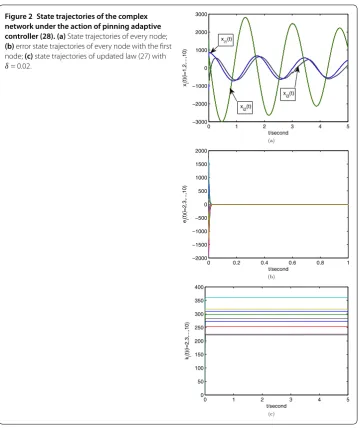
Figure 2 State trajectories of the complex network under the action of pinning adaptive controller (28). (a)State trajectories of every node; (b)error state trajectories of every node with the first node;(c)state trajectories of updated law (27) with
δ= 0.02.
a= –.,b= –.,τ = . The noise intensity isg(xi(t)) =tanh(xi(t)) for ≤i≤. It is easy to verify that assumption (H) holds when settingL= . By the LMI’s toolbox in Matlab, we obtain the feasible solutions of the inequalities in Theorems - and Corollary shown in Table , respectively, where
P= ⎡ ⎢ ⎣
. –. . –. . –.
. –. . ⎤ ⎥
⎦, R= ⎡ ⎢ ⎣
. . –. . . . –. . .
⎤ ⎥ ⎦,
P= ⎡ ⎢ ⎣
. . . . . –. . –. .
⎤ ⎥
⎦, R= ⎡ ⎢ ⎣
. . –. . . . –. . .
⎤ ⎥ ⎦.
control input or only controlling one node, and they could synchronize well if utilizing pinning controller or pinning adaptive controller. Our simulating computation, we depict in five figures. In particular, Figure is the state trajectories of complex network and its error system under the action of pinning controller (), these figures show that all the nodes synchronize well. Figure is the state trajectories of complex network, its error system and updated laws under the action of pinning adaptive controller (), respectively, which shows that all the nodes have synchronization.
5 Conclusions
This paper has investigated the almost sure synchronization control problem for a class of stochastic delayed complex networks based on the stochastic differential equation theory. Some synchronization criteria and two kinds of pinning controllers have been proposed. These results reflect the relation of synchronization to the parameters of complex net-works. A numerical example has shown that our method is effective.
This paper investigated the almost sure synchronization control other than synchro-nization in mean square of complex networks, and the obtained results may be appropri-ate for the synchronization of complex networks with the target node unknown. Specially, the results obtained only depend on the complex network’s parameters.
Competing interests
The authors declare that they have no competing interests. Authors’ contributions
The authors contributed equally to this article. The authors read and approved this article. Author details
1College of Fundamental Studies, Shanghai University of Engineering Science, Longteng Road, Shanghai, P.R. China. 2College of Information Sciences and Technology, Donghua University, Renmin Road, Shanghai, P.R. China.
Acknowledgements
This work was supported by the National Natural Science Foundation of China (11602134), the Shanghai Natural Science Foundation (16ZR1413700), and the Natural Science Foundation of Shanghai University of Engineering Science (nhrc-2015-06).
Received: 21 May 2016 Accepted: 25 October 2016
References
1. Jeong, H, Tombor, B, Albert, R, Oltvai, ZN, Barabasi, AL: The large-scale organization of metabolic networks. Nature
407, 651-654 (2000)
2. Bennett, M, Zukin, B: Electrical coupling and neuronal synchronization in the mammalian brain. Neuron41, 495-511 (2004)
3. Strogatz, SH: Exploring complex networks. Nature410, 268-276 (2001)
4. Li, ZK, Duan, ZS, Chen, GR, Huang, L: Consensus of multi-agent systems and synchronization of complex networks: a unified viewpoint. IEEE Trans. Circuits Syst. I, Regul. Pap.57, 213-224 (2010)
5. Yahyazadeh, M, Noei, AR, Ghaderi, R: Synchronization of chaotic systems with known and unknown parameters using a modified active sliding mode control. ISA Trans.50, 262-267 (2011)
6. Lu, WL, Chen, TP: Global synchronization of discrete-time dynamical network with a directed graph. IEEE Trans. Circuits Syst. II, Express Briefs54, 136-140 (2007)
7. Shen, B, Wang, ZD, Liu, XH: BoundedH∞synchronization and state estimation for discrete time-varying stochastic complex networks over a finite horizon. IEEE Trans. Neural Netw.22, 145-156 (2011)
8. Wang, JL, Wu, HN, Huang, TW: Passivity-based synchronization of a class of complex dynamical networks with time-varying delay. Automatica56, 105-112 (2015)
9. Jin, T, Li, WX, Feng, JY: Outer synchronization of stochastic complex networks with time-varying delay. Adv. Differ. Equ.2015, 359 (2015)
10. Wang, L, Qian, W, Wang, QG: Exponential synchronization in complex networks with a single coupling delay. J. Franklin Inst.350, 1406-1423 (2013)
11. Jin, YG, Zhong, SM: Function projective synchronization in complex networks with switching topology and stochastic effects. Appl. Math. Comput.259, 730-740 (2015)
13. Yao, J, Wang, HO, Guan, ZH, Xu, WS: Passive stability and synchronization of complex spatio-temporal switching networks with time delays. Automatica45, 1721-1728 (2009)
14. Chen, WH, Jiang, ZY, Lu, XM, Luo, SX:H∞synchronization for complex dynamical networks with coupling delays using distributed impulsive control. Nonlinear Anal. Hybrid Syst.17, 111-127 (2015)
15. Li, CJ, Yu, WW, Huang, TW: Impulsive synchronization schemes of stochastic complex networks with switching topology: average time approach. Neural Netw.54, 85-94 (2014)
16. Wu, YY, Wei, W, Li, GY, Xiang, J: Pinning control of uncertain complex networks to a homogeneous orbit. IEEE Trans. Circuits Syst. II56, 235-239 (2009)
17. Gong, XL, Wu, ZY: Adaptive pinning impulsive synchronization of dynamical networks with time-varying delay. Adv. Differ. Equ.2015, 240 (2015)
18. Zhou, J, Wu, QJ, Xiang, L: Pinning complex delayed dynamical networks by a single impulsive controller. IEEE Trans. Circuits Syst. I, Regul. Pap.58, 2882-2893 (2011)
19. Yang, XS, Cao, JD, Lu, JQ: Stochastic synchronization of complex networks with nonidentical nodes via hybrid adaptive and impulsive control. IEEE Trans. Circuits Syst. I, Regul. Pap.59, 371-384 (2012)
20. Wu, ZY, Wang, HJ: Impulsive pinning synchronization of discrete-time network. Adv. Differ. Equ.2016, 36 (2016) 21. Yu, WW, DeLellis, P, Chen, GR, Bernardo, M, Kurths, J: Distributed adaptive control of synchronization in complex
networks. IEEE Trans. Autom. Control57, 2153-2158 (2012)
22. Zhu, QX, Cao, JD: Adaptive synchronization of chaotic Cohen-Crossberg neural networks with mixed time delays. Nonlinear Dyn.61, 517-534 (2010)
23. Mahbashi, GA, Noorani, MS, Bakar, SA, Sawalha, MA: Adaptive projective lag synchronization of uncertain complex dynamical networks with delay coupling. Adv. Differ. Equ.2015, 356 (2015)
24. Song, B, Park, JH, Wu, ZG, Zhang, Y: Global synchronization of stochastic delayed complex networks. Nonlinear Dyn.
70, 2389-2399 (2012)
25. Rakkiyappan, R, Dharani, S, Zhu, QX: Stochastic sampled-dataH∞synchronization of coupled neutral-type delay partial differential systems. J. Franklin Inst.352, 4480-4502 (2015)
26. Zhou, WN, Wang, TB, Mou, JP, Fang, JA: Mean square exponential synchronization in Lagrange sense for uncertain complex dynamical networks. J. Franklin Inst.349, 1267-1282 (2012)
27. Yang, XS, Cao, JD, Lu, JQ: Synchronization of delayed complex dynamical networks with impulsive and stochastic effects. Nonlinear Anal., Real World Appl.12, 2252-2266 (2011)
28. Hu, LJ, Mao, XR: Almost sure exponential stabilization of stochastic systems by state-feedback control. Automatica44, 465-471 (2008)
29. Zhu, QX, Li, XD: Exponential and almost sure exponential stability of stochastic fuzzy delayed Cohen-Grossberg neural networks. Fuzzy Sets Syst.203, 74-94 (2012)
30. Mao, XR, Shen, Y, Yuan, CG: Almost surely asymptotic stability of neutral stochastic differential delay equations with Markovian switching. Stoch. Process. Appl.118, 1385-1406 (2008)
31. Zhu, QX, Cao, JD: Adaptive synchronization under almost every initial data for stochastic neural networks with time-varying delays and distributed delays. Commun. Nonlinear Sci. Numer. Simul.16, 2139-2159 (2011)
32. Lu, JQ, Daniel, WCH: Globally exponential synchronization and synchronizability for general dynamical networks. IEEE Trans. Syst. Man Cybern.40, 350-361 (2010)
33. Mao, XR: A note on the LaSalle-type theorems for stochastic differential delay equations. J. Math. Anal. Appl.268, 125-142 (2002)