Volume 2010, Article ID 623706,16pages doi:10.1155/2010/623706
Research Article
Load Balancing Routing with Bounded Stretch
Fan Li,
1Siyuan Chen,
2and Yu Wang
21Beijing Laboratory of Intelligent Information Technology, School of Computer Science, Beijing Institute of Technology, Beijing 100081, China
2Department of Computer Science, College of Computing and Informatics, The University of North Carolina at Charlotte, Charlotte, NC 28223, USA
Correspondence should be addressed to Yu Wang,[email protected]
Received 27 April 2009; Accepted 19 June 2009
Academic Editor: Benyuan Liu
Copyright © 2010 Fan Li et al. This is an open access article distributed under the Creative Commons Attribution License, which permits unrestricted use, distribution, and reproduction in any medium, provided the original work is properly cited.
Routing in wireless networks has been heavily studied in the last decade. Many routing protocols are based on classic shortest path algorithms. However, shortest path-based routing protocols suffer from uneven load distribution in the network, such as crowed center effect where the center nodes have more load than the nodes in the periphery. Aiming to balance the load, we propose a novel routing method, calledCircular Sailing Routing(CSR), which can distribute the traffic more evenly in the network. The proposed method first maps the network onto a sphere via a simple stereographic projection, and then the route decision is made by a newly defined “circular distance” on the sphere instead of the Euclidean distance in the plane. We theoretically prove that for a network, the distance traveled by the packets using CSR is no more than a small constant factor of the minimum (the distance of the shortest path). We also extend CSR to a localized version,Localized CSR, by modifying greedy routing without any additional communication overhead. In addition, we investigate how to design CSR routing for 3D networks. For all proposed methods, we conduct extensive simulations to study their performances and compare them with global shortest path routing or greedy routing in 2D and 3D wireless networks.
1. Introduction
Recently, wireless networks draw lots of attention due to their potential applications in various areas. They intrinsically have many special characteristics and some unavoidable limitations compared with traditional fixed infrastructure networks. Energy conservation and scalability are probably two most critical issues in designing protocols for large scale wireless networks because wireless devices are usually powered by batteries only with limited computing capability and the number of such devices could be very large.
Routing is one of the key topics in wireless networks and has been well studied. Many routing protocols were proposed
for different purposes. For example, there are power efficient
routing for better energy efficiency, cluster-based routing
for better scalability and geographical routing to reduce the overhead. In this paper, we are interested in designing a load balancing routing for large wireless networks. By spreading
the traffic across the wireless network via the elaborate design
of the routing algorithm, load balancing routing averages the
energy consumption. This extends the lifespan of the whole network by extending the time until the first node is out of energy. Load balancing is also useful for reducing congestion hot spots thus reducing wireless collisions. Notice that there
are already several load balancing routing protocols [1–5]
in literature. However, most of them try to dynamically
adjust the routes to balance the real time traffic load based
on the knowledge of current load distribution (or current remaining energy distribution), which is not very scalable for large wireless networks. Here, we assume that individual node does not know the current load and each node may want to talk with all other nodes. We then address how to design load balancing routing for all-to-all communication scenario in a network.
(a) network topology
Figure1: In a grid network, nodes in the center area have much heavier traffic load than nodes in other areas. Here, shortest path routing is applied for all possible source-destination pairs.
greedy routing, the packet is forwarded to the neighbor which is nearest to the destination. Taking the shortest path can achieve smaller delay or traveled distance, however it
can also lead to the uneven distribution of traffic load in
a network. For example, nodes in the center of a network
will have heavier traffic since most of the shortest routes
go through them. This is just like the transportation system around a big city where the downtown area is always
the “hot spot.” Figure 1 shows a simulation result on this
scenario. The network is distributed on a 9×9 grid, and the
network topology is shown inFigure 1(a). Consider an
all-to-all communication scenario, that is, each node sends one packet to all other nodes using Shortest Path Routing (SPR)
algorithm.Figure 1(b)illustrates the cumulative traffic load
(i.e., number of packets passing through) for each node. It is
clear that nodes in the center area have much higher traffic
load than nodes in other areas, therefore, nodes in the center will run out of their batteries very quickly.
To avoid the uneven load distribution of shortest path routing, we focus on designing routing protocols for wireless networks which can achieve both small traveled distance and evenly distributed load in the network. Inspired from circular sailing (or called globular sailing), which sails on the arc of a great circle to make the shortest distance between two places on the earth, we propose a new routing algorithm
calledCircular Sailing Routing(CSR). In CSR, wireless nodes
in a 2D network are mapped to a sphere using reversed stereographic projection and the routing decision is made based on a newly defined “circular distance” on the sphere instead of the Euclidean distance in 2D plane. By doing so,
the traffic from one side to another side of the network area
will avoid the center area. Thus, “hot spots” are eliminated and the load is balanced.
However, there is no such thing as a free lunch. While load balancing routing protocol try to even the load distri-bution, it also uses longer routes than the shortest paths. In general, this means load balancing routing may need more relaying nodes to deliver the packets thus leads to
large energy consumption. We treat the increase of path length as the cost of load balancing. We formally define thecompetitivenessandstretch factorof any routing method
compared to SPR. Given a routing methodA, letPA(s,t)
be the path found byAto connect the source nodesand
the target nodet. A routing methodAis calledl-competitive
if for every pair of nodessand t, the total length of path
PA(s,t) is within a constant factor l of the length of the
shortest path connectingsandtin the network. The constant
factorlis calledstretch factor (or competitiveness factor) of
A. Then, we theoretically prove that for any networks, the
stretch factor of CSR is bounded by max(π(1+)/2,π), where
is a constant parameter only depends on the ratio between
the size of the network and the radius of the sphere used in CSR. In other words, CSR can guarantee the total distance traveled by packets is constant competitive even in the worst case.
Notice that recently Popa et al. [6] also proposed a
similar routing technique, called curveball routing (CBR), which maps the 2D network on a sphere using another stereographic projection method and route the packets based on spherical distances between their virtual coordinates on the sphere. However, the authors did not provide any formal study on the competitiveness of CBR, except claimed that “in the presented simulation, curveball routing increases the average path length by less than7.5%compared to the greedy paths. Similarly, the longest path increases by59%.”
CSR can be easily implemented based on either shortest path routing or greedy routing. The only modification is a simple mapping calculation of the position information and the computational overhead is negligible. There are no changes to the communication protocol and no any additional communication overhead.
The rest of the paper is organized as follows. InSection 2,
we first introduce stereographic projection and different
dis-tance metrics. Then we present ourCircular Sailing Routing
S(0, 0, 0)
(a) Stereographic projection I
m’(x’, y’, z’)
(b) Stereographic projection II
O(0, 0, r)
(c) Lambert azimuthal equal-area projection
Figure2: Projection from a sphere to a plane: one-to-one mappings from a nodemon a sphereSto a nodemin a plane.
Section 3. InSection 4, we extend CSR to a localized version (LCSR) and compare its performance with greedy routing. In Section 5, we further extend CSR and LCSR to 3D versions for 3D networks. Two mapping methods for 3D CSR are proposed and theoretical analysis of their stretch factor are
provided. We review related work inSection 6and conclude
our paper in Section 7. A preliminary conference version
of this article appeared in [7]. This version introduces a
new definition of circular distance which fixes a bug in the
proof ofLemma 2, contains a new 3D projection method and
stretch analysis for 3D networks, and provides better overall presentation.
(a) 2D grid topology
S
10
5
2
(b) Size of sphere
2
Figure3: The reversed stereographic projections of a grid network (9×9 grid in a 20×20 square area) to the sphere with various radii (2, 5, and 10).
2. Preliminaries
bijective. It is also conformal, meaning that it accurately represents angular relationships (i.e., local angles on a sphere are mapped to the same angles in the projection). On the other hand, it does not accurately represent area, especially near the projection point. Stereographic projection finds usage in many fields including cartography, geology, and
crystallography. Sarkar et al. [9] first applied stereographic
projection in wireless networks. They proposed a double rulings scheme for information brokerage in sensor networks where data replica are stored at a curve (a circle on the sphere), and the consumer travels along another curve which is guaranteed to intersect with the producer curve. In this paper, we use a reversed stereographic projection to map wireless nodes in a 2D plane onto a 3D sphere. (When the context is clear, we ignore the word of “reversed”.)
Figures2(a)and2(b)show two approaches to perform
stereographic projection and they place the plane differently.
In this paper, we use the first approach. As shown in Figure 2(a), we put a sphere with radius r tangent to the plane at the origin (0, 0, 0). Denote this tangent point as the
south poleSand its antipodal point as the north poleN. A
point mon the 2D plane is mapped to m on the sphere,
which is the intersection of the line throughmandN and
the sphere. This provides a one-to-one mapping from the 2D projective plane to a 3D sphere. Notice that stereographic projection preserves circles and angles. That is, a circle on the sphere is a circle in the plane and the angle between two lines on the sphere is the same as the angle between their projections in the plane.
By simple geometric calculations, we can compute the 3D position on the sphere via the reversed projection by the following method.
Method 1. Given a node m with position (x,y) in the 2D plane, the 3D position of its reversed stereographic
projection pointmis (x,y,z), wherex=4r2x/(x2+y2+
4r2);y=4r2y/(x2+y2+4r2);z=2r(x2+y2)/(x2+y2+4r2).
Figure 3 illustrates examples of reverse stereographic
projection of an 81-node grid network (9×9 grid in a 20×20
square area). We use the position of the center node as the tangent point where the sphere is put. Nodes in the grid network are mapped to nodes on the sphere. Here, we try
different sizes of the sphere (with radii 2, 5, or 10). It is
clear that the size of the sphere affects the distribution of the
mapped nodes on the sphere. With a larger sphere (r =10),
the mapped nodes are all nearer to the south pole in the lower half sphere and have similar distribution of the original
grid network. With a smaller sphere (r = 2), more nodes
are mapped to the upper half sphere. Withr = 5 which is
near the half of the radius of the grid network, all nodes are mapped to the lower half sphere more evenly.
Actually, there are several one-to-one projections to map points on a sphere to points in the plane. Besides
stereographic projections (Figures 2(a) and 2(b)), there
are area-preserving map projections, such as the Lambert
azimuthal equal-area projection. As shown in Figure 2(c),
Lambert azimuthal equal-area projection maps m on the
sphere to m in the plane, such that the distance from m
to the tangent pointSis equivalent to the distance from its
projectionmtoS. This mapping is not conformal, but
equal-area. An equal-area projection maintains size at the expense of shape. In this paper, we use stereographic projection in our scheme and remark that other spherical mapping can also be used but the bounded stretch may not hold.
2.2. Distance Metrics. In this paper, we will use three different distances as the route metric in routing algorithm: Euclidean distance, spherical distance and circular distance.
The Euclidean distance between two pints u and v,
denoted byuv, is the length of the straight line connected
uandv. This distance metric is used by classic shortest path
routing and greedy routing.
Thespherical distance(also called great circle distance or geodesic shortest distance) between two projection points
uandv on the sphere, denoted byd(uv), is the shortest
distance between any two points on the surface of a sphere measured along a path on the surface of the sphere. See Figure 4(a)for illustration. The shortest distance ofmandn
on the surface is the arc distanced(mn) along the greatest
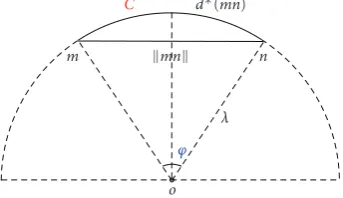
The third distance, circular distanced∗(mn) between
two projection points u andv, is a new distance on the
sphere introduced by us in this paper. Let the great circle
passingm,nand centered at ObeC(m,n,O). Then its
corresponding projection in the 2D plane is also a circle,
denoted byC(m,n,o), which passesm,nand is centered ato.
the circular distance, as shown inFigure 4(b). In this case,
d∗(mn)> d(mn). In summary, the circular distant can be
3. Circular Sailing Routing
In this section, we first present our Circular Sailing Routing (CSR) based on stereographic projection, and then give both theoretical analysis on the stretch factor of CSR and simulation results of CSR compared with the shortest path routing.
n’
Figure4: The shortest distance between two pointsmandnon the sphere is the shorter segment of the greatest circle betweenmandn.
In this case, the circular distance is equal to the spherical distance, sinceϕ < π. Otherwise, the circular distance is the longer segment of the greatest circle.
1: Mapping:Map each nodem(x,y, 0) in the 2D plane to a nodem(x,y,z) on the sphereS(using Method1).
2: New Metrics:For any existing linkmnbetween two nodesmandnin the network, calculate the shortest
circular distance on the sphere between their projected nodesmandn(i.e.,d∗(mn)). We used∗(mn) as
the cost of link,mnand call itcircular distance. 3: Routing:Applying general shortest path routing with
circular distance as the routing metric, choose the route with smallest total circular distance.
Algorithm1: Circular sailing routing.
region of the plane. Let this region be called P. With the
information of the network region, we can place the south
pole S of a sphere S at the center of the network, whose
coordinate is (0, 0, 0). The radius r of S is an adjustable
parameter for our proposed routing method. Here, we
assume each node knows the radius r of the projection
sphere. This can be done via either a pre set before the deployment or a broadcast operation after the deployment.
Any pointm(x,y, 0) inPmaps tom(x,y,z) on the sphere
S. It is a one-to-one mapping, wherez ≤ kfor some 0 <
k <2r. Herekis thezvalue of the highest projection on the sphere.
The basic idea of circular sailing routing is letting packet follow the circular shortest paths on the sphere instead of the Euclidean shortest paths in 2D plane. Because there is no hot spot on the sphere where most of the circular shortest paths must go through, we expect circular sailing routing can achieve better load balancing than shortest path routing. The
detailed routing algorithm is given asAlgorithm 1.
3.2. Analysis of Stretch Factor. In this section, we provide theoretical analysis on the stretch factor of CSR. Recall that
a routing methodAis calledl-competitiveorwithl-bounded
stretchif for every pair of nodessandt, the total length of
pathPA(s,t) found byAis within ltimes of the shortest
path connectingsandtin the network. Hereafter, we calll
theStretch Factor(SF).
3.2.1. Relationships among Distance Metrics. Before giving the proof, we need to present some preliminaries for stereographic projection. Assume that the furthest wireless
node is of distanceDfrom the center (i.e., south pole of the
sphere), then thez value of the highest projection on the
sphere (i.e., the value ofk) is
Recall that circles on the sphere map to circles in the
plane, thus the projection of a great circle on the sphereS
is also a circle in the plane. The spherical distanced(mn) is
the distance of the shorter arcCfrom a nodemto a node
nalong the great circle on the surface ofS. Letd(mn) be the
distance of an arcC betweenmandnalong the projection
ofCand the great circle in the plane (Figure 5). The circular
distanced∗(mn) is also the distance of the shorter arc from
m to n on the great circle (i.e., d∗(mn) = d(mn), as
shown inFigure 4(a)) whenϕ≤πand is the distance of the
longer arc frommtonon the great circle whenϕ > πas
shown inFigure 4(b). Letd∗(mn) be the distance of an arc
in the plane betweenmandnalong the projection of the arc
ofd∗(mn) as inFigure 4(b). Remember thatmndenotes
the Euclidean distance betweenmandnin the plane. The
following two lemmas show that the relationships among
d∗(mn), d(mn), and mn. The major part (relation
betweend(mn) andd(mn)) ofLemma 1and its proof are
the same with those of [9, Theorem 1]. However, we provide
its proof for completeness.
Lemma 1. Consider any two nodesmandnon the sphereS with their projections in the planemandn, one has
m
Figure6: The relationship between the arc distanced∗(mn) along a circle and Euclidean distancemn.
that is,mn ≤ d(mn). Second, the spherical distance on
the sphere is always smaller than the circular distance on the
sphere, that is,d(mn)≤d∗(mn). Thus, we only need to
proved(mn)≤(2r/(2r−k))d(mn)=(1 +)d(mn).
Notice that it is one-to-one mapping between points on
C and points on C ·Cdx = d(mn), where dx is a
miniature segment onC. Similarly,Cdx = d(mn), where
dx is the projection of dx in the plane. See Figure 5 for
illustration.pqis a tiny segment onCwith lengthdx →
N,pandq), more specifically, the two arcs pass throughpq
andpqare concentric at north poleN. Then,
This finishes our proof.
Lemma 2. Consider any two pointsmand non the sphere with their projections on the planemandn, one has
d∗(mn)≤d∗(mn)≤π
2mn. (8)
Proof. Similar to the proof ofLemma 1, assume thatdxis a
miniature segment onCdefined ford∗(mn) anddxis the
projection ofdxin the plane. From the proof ofLemma 1,
we knowdx/dx=(2r−zp)/2r≤1. Thus,dx≤dx, and
owith the radiusλ. Notice thatois not necessarily the center
Oof the sphere. Then we haved∗(mn)= ϕλandmn =
2λsin(ϕ/2). By the definition of circular distance, the angleϕ
of the arcd∗(mn) is less or equal toπ. Therefore,
Notice that the relation in above lemma does not hold for
spherical distance, sinceϕfor spherical distance maybe larger
thanπas shown inFigure 4(b). In other words,d(mn) could
be larger than (π/2)mn.
3.2.2. Bounded Stretch Factor of CSR. Now we are ready to prove the main theorem of this paper about the stretch factor of CSR. We want to prove CSR can find a path whose length is within a small constant factor of the minimum even in the worst case scenario.
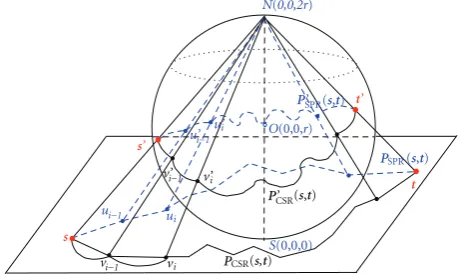
There are four paths we will use in the proof. Figure 7
illustrates their definitions and the relationship among them. The dotted line in the plane represents the shortest path generated by a shortest path routing connecting the source
s and the destination t, denoted by PSPR(s,t). The dotted
line on the sphere is the surface path connecting all the
projections on the sphere of each node alongPSPR(s,t) using
the circular distance, denoted by PSPR(s,t). The solid line
in the plane represents the path found by CSR protocol,
denoted by PCSR(s,t) and the solid line on the sphere is
the surface path connecting all the projections of each node
along PCSR(s,t), denoted by P
CSR(s,t). Notice that, in any
two points along a path in the plane, the shortest distance is the straight line connecting them, meanwhile the circular distance of its projection on the sphere is a segment (an arc)
O(0,0,r)
Figure7: The Euclidean path length of proposed CSR protocol is bounded by the Euclidean path length of shortest path routing.
as the summation of the Euclidian distance of each link in
PA. For a path PA on the sphere, we defined(PA) as the
summation of the length of each arc inPA.
Theorem 1. The stretch factor of CSR is bounded by(π/2)(1 + ), that is,
sandtare the projections of sourcesand destinationton
the sphere. Notice thatmmay not equal ton.
FromLemma 1, we knowvi−1vi ≤(1 +)d∗(vi−1vi),
shortest path using circular distance metric on the sphere. FromLemma 2, we haved∗(ui−1ui)≤(π/2)ui−1ui. Thus,
Theorem 1gives a theoretical bound of the stretch factor of CSR protocol. It shows that the path length in CSR
proto-col is not too much different from the shortest path routing.
Since=D2/(4r2), with the adjustable parameterr(i.e., the
radius of the sphere), we can control the stretch factor.
3.3. Simulation. We now evaluate the performance CSR via simulations for both grid networks and random networks. In
both cases, wireless nodes are distributed in a 20×20 square
area. In CSR, the south pole of the sphere is tangent at the center of this area. Nodes in the area are mapped to nodes on the sphere during the calculation of new metric. Here, we try
different sizes of the sphere (with radii 2, 5, or 10, as shown
inFigure 3). It is clear that the size of the sphere affects the distribution of the mapped nodes on the sphere.
Grid Networks. We first deploy the 81 nodes on a 9×9 grid in
a 20×20 square area, and then set the transmission rangeRof
all nodes to 3. The resulted topology is shown inFigure 3(a).
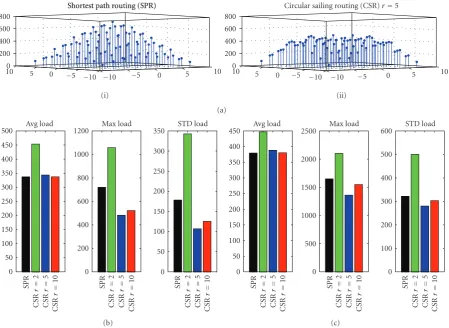
We compare the performance of the shortest path routing (SPR) and the circular sailing routing (CSR) under the all-to-all communication scenario. In other words, we assume every pair of nodes in the network has unit message to
communicate. Figure 8(a) shows the distributions of each
node’s traffic load for both SPR and CSR when the radius
of the sphere r = 5. It is clear that the load of CSR
(Figure 8(a)(i)) is more evenly distributed than the load of
SPR (Figure 8(a)(ii)). The hot spot problem (center nodes
with highest load) is avoided in CSR.Figure 8(b)shows the
average (Avg), maximum (Max) traffic load, and standard
deviation (STD) of traffic load for all nodes in the network
for SPR and CSR with different radii. The average traffic load
of CSR are larger than SPR, especially when r = 2 (i.e.,
most nodes are mapped to the upper half sphere). This is
reasonable because the SPR has the least total traffic load
than any other routing algorithms. Remember that SPR uses
the shortest path for each pair of nodes. Whenr = 5 and
10, CSR has smaller maximum load and the STD of load is
much less than SPR. Thus, CSR can balance the load traffic
for each node (s.t., the power consumptions of all nodes are
more even). These results meet our design objective well with
only a little bit more average traffic load. We also find that
when the nodes are mapped to the bottom half sphere (i.e.,
r =5), CSR has the best performance compared with other
sizes of the sphere. When the radius is very large, the nodes are mapped to the area around the south pole, which has similar distribution with the original network. In such case, simulation results show that CSR’s performance is similar to SPR on the original network.
We also study the stretch factor (SF) of CSR. From Theorem 1, the distance traveled by CSR satisfies
PCSR(s,t) ≤(π/2)(1 +)PSPR(s,t), where=D2/(4r2).
In our simulation settings,D=10√2. Thus, whenr =2, 5,
and 10, CF = 21.2, 4.7, and 2.4, respectively. We measure
the SF for each route generated by CSR in our simulation. Table 1gives the average and maximum stretch factor (Avg
SF and Max SF) of CSR with different radii. The simulation
results of SFs confirm our theoretical bounds. Actually the practical SFs are much smaller than the bounds, and very
close to 1. In other words, not only CSR has balanced traffic
load but also the distance traveled by the packets is almost the same as the minimum (the distance of the shortest path).
Random Networks. We also test the performance of CSR with random networks. 81 nodes are randomly deployed in
the field with transmission range R set to 4. We run the
Shortest path routing (SPR)
Shortest path routing (SPR)
10 5 0 −5
Circular sailing routing (CSR)r=5
(i) (ii)
1: For each neighborv, nodeumaintains both a 2D position ofvin the plane and a 3D position of its projectionvon the sphereS. Nodeualso maintains
its own 2D position and its projection’s 3D position. 2: Whilenodeureceives a packet with destinationt do
3: ifut ≤R, whereRis the transmission rangethen
4: Forward the packet totdirectly and return. 5: Maptto its projectiont(i.e., get its 3D position). 6: if∃v,s.t., its projectionvsatisfiesd∗(vt)< d∗(ut)
then
7: Forward packet to nodevwith the minimumd∗(vt).
8: else
9: Simply drop the packet.
Algorithm2: Localized circular sailing routing.
Figure 8(c) and the lower half of Table 1 summarize the performance comparison of CSR for random networks. CSR
(r = 5) has the best performance, that is, much smaller
maximum load and load STD with little greater average load
and the average SF is very close to 1.0. CSR (r = 10) has
similar performance with SPR because the mapped positions on the sphere are similar to those in the original network.
4. Localized Circular Sailing Routing
The geometric nature of wireless networks allows the promising idea: localized routing protocols. In localized routing protocols, by assuming each node has position information, the routing decision is made at each node by using only local neighborhood information. It does not need the dissemination of route discovery information, and no routing tables are maintained at each node. The most
popu-lar localized routing isgreedy routing[10] where the current
nodeualways finds the next relay nodevsuch that the
dis-tancet−vis the smallest among all neighbors ofu. Our
cir-cular sail routing is easy to be extended to a localized version which can achieve better load balancing than greedy routing.
4.1. Routing Algorithm. Similar to the classical greedy
rout-ing, the Localized Circular Sailing Routing (LCSR) just
forwards the packet to the neighbor whose projection is closest to the projection of the destination on the sphere. Notice that each node only needs to know its neighbors’ positions to make the routing decision. The detailed routing
algorithm is given inAlgorithm 2.
LC
(a) 3D Grid Network
LC
(b) 3D Random Network
Figure9: Traffic load of Greedy Routing and LCSR: (a) traffic load of a 9×9 grid network; (b) traffic load of 81-nodes random networks.
However, LCSR cannot always find the forwarding neighbor since it could fail into a local minimum where no such
neighbor vexists. To solve this problem, we can switch to
greedy routing to find a forwarding neighbor who is nearest to destination in 2D plane. If the greedy routing cannot find a forwarding neighbor either, face routing in the plane can
be applied to get out of the local minimum as in [10,11].
If the packet reaches a location whose projection is closer to the projection of the destination than the projection of the position where the previous LCSR has failed, then LCSR is resumed.
4.2. Simulation. We test the performance of LCSR algorithm by using the same grid and random networks which are
used inSection 3.3. We also assume all-to-all
communica-tion in the networks. Classical greedy routing is used for comparison. For simplicity, in the simulation, we implement LCSR without any recovery mechanisms, that is, LCSR (Algorithm 2) simply drops the packet at the local minimum.
Figures9(a)and9(b)show the performance comparison
of Greedy Routing and LCSR for the grid networks and random networks, respectively. Here, the data for random networks is the average value of 50 random generated
networks. It is clear that LCSR with r = 5 has the best
performance, that is, smallest maximum traffic load and STD
load for both gird and random networks. The delivery ratio is 100% and almost 100% for grid and random networks,
respectively. For example for the gird network, themax load
of Greedy Routing is 400 while themax loadof LCSR (r=5)
is 350, which is reduced about 12.5%. TheSTD loadis also
decreased by about 22.2%(from 90 to 70). Theavg loadof
LCSR (r =5) and Greedy Routing are at the same value of
208. Again, LCSR (r=10) has very similar performance with
greedy routing, since the larger the sphere, the more alike the distribution on the sphere to the original 2D distribution.
We also measure the Stretch Factor (SF) of CSR. Here, CF is the factor between the distance traveled by the packet in CSR and the distance traveled in greedy routing, if both
Table1: Stretch factor (SF) of CSR (various sphere size).
Network topology Radiusr Avg SF Max SF
Grid
Table2: Stretch factor (SF) of LCSR (various sphere size).
Network topology Radiusr Avg SF Max SF
Grid
routing methods can find a path between the source and the destination. In the simulation, we randomly select 100 routes (10 source nodes and 10 destination nodes are randomly
chosen ) and calculate the SF for each route. Table 2gives
the results for both grid and random networks. Though we do not have any proof of theoretical bounds, the SFs are very small in practice.
5.
3
D Circular Sailing Routing
So far we consider routing in 2D network and how to map the nodes onto a sphere so that routing along the sphere can
bal-ance the traffic load. The assumption of 2D network is
(a) 3D grid network
Figure10: Uneven load in 3D network using SPR: (a) a 3D grid network with 216 nodes, and (b) the traffic load distribution of SPR at each node on each level.
However, 2D assumption may no longer be valid if a wireless network is deployed in space, atmosphere, or ocean, where nodes of a network are distributed over a three-dimensional
(3D) space and the difference in the third dimension is
too large to be ignored. In fact, recent interest in wireless sensor networks hints at the strong need to design 3D wireless networks. 3D wireless networks can be used in many applications, such as a underwater wireless sensor network
[12] for 3D ocean environment observation or a 3D space
network for space explorations [13]. In a 3D network, the
problem of uneven load distribution also exists.Figure 10(a)
shows a 3D grid network with 6×6×6 nodes. Consider an
all-to-all communication scenario, that is, each node sends one packet to all other nodes using shortest path routing
protocol.Figure 10(b)illustrates the cumulative node traffic
(i.e., number of packets passing through) for each node. Clearly, the center nodes of each level have higher load and the two middle levels have much higher load than the top and bottom levels. Therefore, nodes in the center or in the middle levels may run out of their batteries very quickly. To avoid the uneven load distribution of shortest path routing, we are also interested in how to extend the circular sailing routing to 3D wireless networks. To the best of our knowledge, our 3D method (3D-CSR) is the first one to target at the design of load balancing routing in 3D wireless networks.
Fortunately, the idea of circular sailing routing can also be extended to 3D. Instead of mapping a plane to the surface of a sphere, 3D-CSR maps wireless nodes in a 3D region to the surface of a 3D or 4D sphere.
5.1. One-to-One Projection Methods. We propose two projec-tion methods to map the nodes in 3D Euclidean space to a sphere (either a 3D sphere or a 4D sphere).
Projection Method 1: Projection on 3D Sphere. For a 3D wireless network, wireless nodes are distributed in a finite
3D region R (e.g., a cube). With the information of the
network region, we can place the centerOof a 3D sphere at
the center of the network, whose coordinate is (0, 0, 0). The
radiusr of the 3D sphere is again an adjustable parameter.
Any pointm(x,y,z) inRmaps tom(x,y,z,φ) on the 3D
sphere. Here (x,y,z) is the 3D position of the projection
nodem, andφis the Euclidean distance frommto the center
O. As shown inFigure 11(a),mis the intersection point of
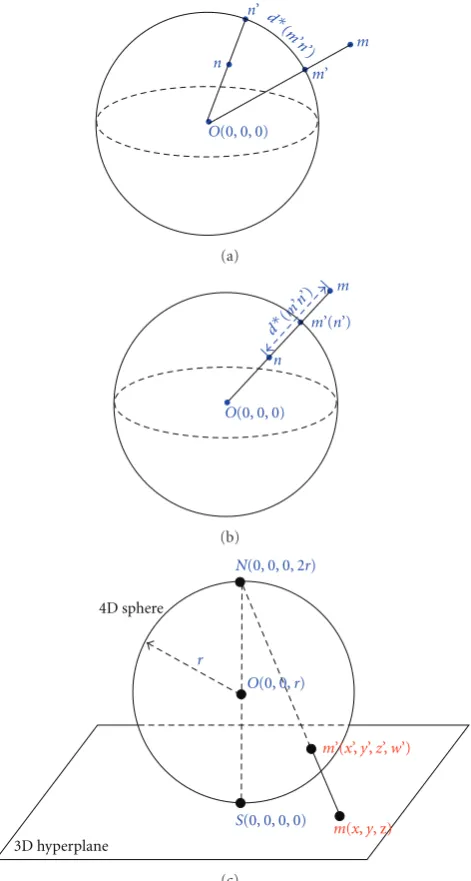
the 3D sphere and linemO. Sometimes the node is inside the
sphere as nodeninFigure 11(a). It is easy to show that the
virtual coordinates ofmcan be computed by the following
equations:x=(r/x2+y2+z2)x,y=(r/x2+y2+z2)y,
O(0, 0, 0)
are the same point on the sphere. (c) Projection Method 2— Stereographic Projection: an one-to-one mapping from a nodem
in a 3D hyperplane to a nodemon a 4D sphere.
that we need to specially deal with the node O(0, 0, 0) to
guarantee that the projection is a one-to-one mapping. Here, we force to map it to the north pole with virtual coordinates
(0, 0,r, 0).
To calculate the circular distanced∗(mn) between two
projections m and n, there are two cases as shown in
Figures 11(a) and 11(b). If m and n are in different
positions on the sphere (Figure 11(a)), d∗(mn) is the
shortest surface distance on the sphere, which can be
computed by d∗(mn) = rarccos((Om2 + On2 −
mn2)/(2OmOn)). In the second case,m andn
are at the same point on the sphere (Figure 11(b)), then we
calculated∗(mn) as the Euclidean distance between nodes
mandn, that is,d∗(mn)= mn = |φm−φn|.
Projection Method 2: Projection on 4D Sphere. In the second projection method, we still use the stereographic projection to map the nodes in 3D networks to a 4D sphere. Stere-ographic projection can be extended to high-dimensional space and sphere. Here, we use it to map a 3D region (a 3D hyperplane) onto a 4D sphere. A 4D sphere (also called
3-sphere in math), often written asS3, is the set of points in
4-dimensional Euclidean space which are at distancer from
a fixed point of that space. This fixed point is the center of the 4D sphere. Stereographic projection is conformal in any dimension, that is, it preserves the angles at which curves cross each other and also preserves circles. Therefore, a circle on the sphere is also a circle in the plane (or hyperplane).
As shown inFigure 11(c), we put a 4D sphere with radiusr
tangent to the 3D hyperplane at the center of the network.
Denote this tangent point as the south poleS(0, 0, 0, 0) of
the 4D sphere and its antipodal point as the north pole
N(0, 0, 0, 2r). This 4D sphere can be defined asx2+ y2+
z2+ (w−r)2 =r2. A pointm(x,y,z) in the 3D hyperplane
is mapped tom(x,y,z,w) on the 4D sphere, which is the
intersection of the linemNwith the 4D sphere. This provides
a one-to-one mapping of the 3D projective hyperplane to a
4D sphere. It is easy to show that the virtual coordinates ofm
can be computed by the following equations:x=4r2x/(x2+
y2+z2+ 4r2),y=4r2y/(x2+y2+z2+ 4r2),z=4r2z/(x2+
y2+z2+ 4r2), andw=2r(x2+y2+z2)/(x2+y2+z2+ 4r2).
Geodesics are curves on a surface which give the shortest distance between two points. They are generalization of the concept of a straight line in the plane. For all spheres, the
geodesics are great circles. For any two nodesmandnin 3D
network, the geodesic of its projectionmandnon the 4D
sphere isd(mn)=rθwhereθ=∠mOn=arccos((xmxn+
ymyn+zmzn+ (wm−r)(wn−r))/r2) . Similar to 2D case, we
can then define our circular distance as follows,
d∗(mn)=
5.2. Routing Algorithm. All the routing algorithms (3D-CSR or 3D-LCSR) in 3D networks are the same as 2D-CSR and
2D-LCSR (Algorithms 1 and2), except for the projection
method and the definition of circular distance d∗(mn).
In 3D CSR, each nodeuuses the above projection method
(either method 1 or method 2) to compute the virtual
coordinates of itself and its neighbors on the sphere. For any
link uv, 3D-CSR can calculate the circular distance on the
sphere between projected nodesuandv(i.e.,d∗(uv)) and
use it as the routing metric. For 3D-LCSR, current nodeu
chooses the neighborvifd(vt) is the minimum among all
neighbors.
center effect, but at the same time it uses longer path between the source and the destination than the shortest path routing. This may increase the total delay of the packet delivery. Therefore, we now theoretically study the stretch factor of 3D CSR with Projection Method 1 or Projection Method 2.
Theorem 2. The stretch factor of 3D CSR with Projection Method 1 (3D-CSR-I) is not bounded.
Proof. We prove the theorem by constructing an
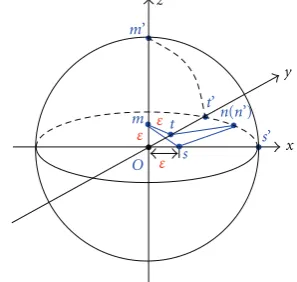
exam-ple where CSR has a arbitrary large SF. See Figure 12
for illustration. The network only has four nodes: s, t,
m, and n with coordinates (ε, 0, 0), (0,ε, 0), (0, 0,ε), and
((√2/2)r, (√2/2)r, 0), respectively. Here, ε could be an
arbitrary small number. The network only has four links:
sm, sn, tm, and tn. From s to t, there are two paths,
s → m → t and s → n → t. Applying the first
projection method (Projection Method 1), 3D-CSR-I gets
the positions of the projected nodes:s(r, 0, 0,ε),t(0,r, 0,ε),
m(0, 0,r,ε), andn((√2/2)r, (√2/2)r, 0,r). Sinced∗(sn) +
d∗(nt)=πr/2, which is smaller thand∗(sm)+d∗(mt)=
πr, 3D-CSR-I will chose node n to be the relay node for
packets between sandt. The total distance of PCSR(s,t) =
small,lcan be arbitrary large.
Theorem 2implies that 3D-CSR-I may use an arbitrary longer path than the shortest path in the worst case. Fortunately, the worst case seldom occurs in a random network. Later, our simulation results show that the SF of 3D-CSR-I is not very large for grid or random networks in practice.
For the stretch factor of CSR with Projection Method 2 (3D-CSR-II), the analysis is very similar to the case of 2D CSR. Recall that stereographic projection is conformal in any dimension. Using the similar proofs (as we did for Lemma 1, Lemma 2, and Theorem 1), we can prove the following theorem.
Theorem 3. The stretch factor of 3D CSR with Projection Method 2 (3D-CSR-II) is bounded by(π/2)(1 +), that is,
PCSR(s,t) ≤π
2(1 +)PSPR(s,t). (14)
The only difference in the proofs is in 2D case the nodes
in the 2D network plane are projected onto a 3D sphere and in 3D case the nodes in the 3D hyperplane are projected
onto a 4D sphere.Theorem 1shows that the path length of
3D-CSR-II protocol is not too much different from the path
length of the shortest path routing.
5.4. Simulation. We now evaluate the performance of 3D-CSR and 3D-L3D-CSR via extensive simulations for both 3D
grid networks and 3D random networks in a 20×20×20
cubic area. Again, we compare their performance under
m’
Figure12: Illustration for the proof of unbounded SF for CSR with Projection Method 1.
Table3: Stretch factor (CF) of CSR (various sphere size).
Network
r Avg SF Max SF
topology 3D-CSR-I 3D-CSR-II 3D-CSR-I 3D-CSR-II
Grid
3 1.1554 1.0116 6.6569 1.3314 5 1.1438 1.0019 6.6569 1.1716 15 1.1245 1.0000 3.8284 1.0000
Random
3 1.0809 1.0432 2.8972 1.6342 5 1.1125 1.0245 3.1463 1.3987 15 1.1076 1.0124 2.6744 1.3462
the all-to-all communication scenario. Hereafter, we use 3D-CSR-I/3D-LCSR-I to denote the routing methods with Projection Method 1 (mapping nodes on a 3D sphere) and 3D-CSR-II/3D-LCSR-II to denote the routing methods with Projection Method 2 (mapping nodes on a 4D sphere).
5.4.1. CSR versus SPR. For grid network, 216 wireless nodes
are distributed in 6×6×6 grids (seeFigure 10(a)). The
transmission range (Tr) is set to 4.5. For 3D random
networks, 100 nodes are randomly distributed in the 20×20×
20 cube with each node’s Tr set to 6. We run the simulation for 100 random networks and take the average. For both grid
and random networks, we try different sizes of the sphere
(with radii 3, 5, and 15). The furthest node is of distance
D =10√2 =14.1 from the center of the network cube (or
projection sphere). Whenr =15, the projection sphere is a
little bit larger than the network cube.
Figure 13 demonstrates the average (Avg), maximum
(Max) traffic load, and standard deviation (Std) of load for
SPR, 3D-CSR-I and 3D-CSR-II with different sphere sizes
(r = 3, 5, and 15) for the grid and random networks.
Table4: Stretch factor (SF) and delivery ratio of LCSR (various sphere size).
Network Topology Radiusr Avg SF Max SF Delivery ratio
3D-LCSR-I 3D-LCSR-II 3D-LCSR-I 3D-LCSR-II Greedy 3D-LCSR-I 3D-LCSR-II
Grid
3 1.0392 1.0308 1.5892 1.3060
1.0000
1.0000 1.0000
5 1.0318 1.0479 1.3060 1.3060 0.9960 1.0000
15 1.0368 1.0308 1.3060 1.3060 1.0000 1.0000
Random
3 1.0613 1.0592 2.9016 3.2485
0.9835
0.9533 0.9165
5 1.0621 1.0601 2.4369 2.4265 0.9487 0.9529
15 1.0597 1.0603 2.7630 2.4967 0.9687 0.9863
r
(a) 3D Grid Network
r
(b) 3D Random Network
Figure13: Traffic load comparison among SPR, CSR-I and 3D-CSR-II with radiir = 3, 5, and 15: (a) traffic load of a 63 grid network; (b) traffic load of 100-nodes random networks.
maximum load of 3D-CSR-II (r = 5) for grid network has
decreased about 40.9% compared with SPR (from 1978.0 to
1050.0); and the Std of 3D-CSR-I (r =3) has about 55.4%
deduction compared with SPR (from 423.4 to 188.9). Thus,
our simulation results show that 3D-CSR can achieve better load balancing than SPR.
r
(a) 3D Grid Network
r
(b) 3D Random Network
Figure 14: Traffic load comparison among greedy routing, 3D-LCSR-I and 3D-3D-LCSR-II with radiir=3, 5 and 15: (a) traffic load of a 3D grid (4×4×4); (b) traffic load of 64-nodes random network.
We also study the stretch factor (SF) of CSR by measuring the SF of each route generated by CSR in our simulation. Table 3gives the average and maximum stretch factor (Avg SF and Max SF) of CSR with various radii. Remember that
3D-CSR has unbounded SF in theory. As shown inTable 3,
are around 6.6 which are much larger than the Max SFs
of 3D-CSR-II. From Theorem 1, the distance traveled by
3D-CSR-II satisfiesPCSR(s,t) ≤(π/2)(1 +)PSPR(s,t),
where =D2/(4r2). In our simulation settings,D=10√2.
Thus, when r = 3, 5, and 15, respectively, SF bounds are
10.3, 4.7, and 1.9. The simulation results of SFs confirm our
theoretical bounds of 3D-CSR-II. Actually the practical SFs are much smaller than the bounds, and very close to 1 (from
1.00 to 1.64). In other words, not only 3D CSR has balanced
traffic load but also the distance traveled by the packets is
almost the same as the minimum.
5.4.2. LCSR versus Greedy. We then study the performance of 3D LCSR via 3D grid and random networks. For grid
network, we use a network with 64 nodes in a 4×4×4 grids
and set Tr to 8. For random network, we generate 50 random
networks with 64 nodes in a 203cube and set Tr to 8. For all
results, we take the average of these 50 networks.
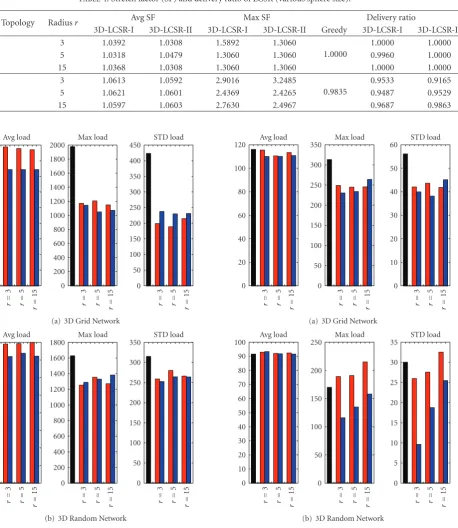
Figure 14shows the performance comparison of greedy routing, 3D-LCSR-I and 3D-LCSR-II for the grid and ran-dom networks. The leftmost bar of each subgraph represents the greedy routing method, red bars represent 3D-LCSR-I, and blue bars represent 3D-LCSR-II. For the grid network, 3D-LCSR-I has larger maximum load than greedy algorithm for all radii, but 3D-LCSR-II has much better performance than greedy, that is, almost the same average load with much smaller maximum load and Std of load. For example, the Std
of load for 3D-LCSR-II (r =3) has decreased dramatically
from 30.0 to 9.6 (about 68%). In the scenario of random
networks, 3D-LCSR-I and 3D-LCSR-II both have similar average load to greedy routing, and their maximum load and Std of load are smaller than greedy routing.
We measure the SFs of 3D LCSR compared with greedy routing method by randomly selecting 100 node pairs and
calculating the SF for each successful route.Table 4provides
the results for both grid and random networks. Though we do not have any theoretical bounds for 3D LCSR, the SFs are
very small in practice, that is, ranged from 1.03 to 3.25. This
table also gives the delivery ratios. The delivery ratios of 3D-LCSR-II and -I are 100% and almost 100%, respectively, for
grid network with different radii. For the random networks,
the delivery ratios of both 3D-LCSR-II and -I are still very high (more than 91%).
6. Related Work
Load balancing routing protocols has been studied recently. Most load balancing routing protocols are based on reactive routing and evaluate the routes by weights, which depend on
the traffic load information collected by each intermediate
nodes. The load state information can be collected from the queue size of each node, the transmission quality of each radio link, or the number of connection held by each node. Based on the collected information, each hop in a route is assigned a corresponding weight and the route with the lowest weight is selected as the default route for the connection. We call this kind of load balancing routing protocols as load aware based routing. Dynamic
Load-Aware Routing (DLAR) [1], Load-Balanced Ad hoc
Routing (LBAR) [2], and Load-Sensitive Routing (LSR) [3]
are some examples of this category. Some load aware routing
schemes such as Load aWare Routing [4] and Simple
Load-balancing Approach (SLA) [5] focus on the route reply phase
to prevent unnecessary flooding packet forwarding thus to reduce congestion and interference. They allow each node to drop RREQ packet or give up packet forwarding depending
on its own traffic load. If the traffic load is high, node may
deliberately give up packet forwarding to save its own energy.
In Hotspot Mitigation Protocol (HMP) [14], mobile nodes
independently monitor local buffer occupancy, packet loss,
MAC contention and delay conditions, and take local actions in response to the hotspots, such as suppressing new route requests and rate controlling TCP flows. Most of the existing load aware based routing try to dynamically adjust the routes
to balance the real time traffic based on the knowledge of
current load distribution, which is not very scalable for large wireless networks.
Multipath routing between any source-destination pair of nodes has been studied thoroughly in the context of wired networks. The general understanding is that dividing the
traffic flow among a number of paths (instead of using a
single path) results in a better balancing of load throughout
the network [15–18]. Although research has been covered
quite thoroughly in wired networks, similar research for wireless networks is still in the early ages. Wu and Harms
[19] propose an on-demand method to efficiently search
for multiple node-disjoint paths and present the correlation factor as the criteria for selecting the multiple paths. Correlation factor of two node-disjoint paths is defined as the number of links connecting the two paths which is used
to describe the interference of traffic between two
node-disjoint paths. Dynamic Source Routing [20] inherently
supports Multipath routing by allowing caching multiple paths. Multipath Routing Protocol with Load Balancing
(MRP-LB) [21] is an extension of DSR. MRP-LB replies first
N request packets and the source routes data packets over
N paths in such a way that the total number of congested
packets on each route is equal. However, [22] showed unless
using a very large number of paths the load distribution is almost the same as single path routing. Furthermore, how to discover, maintain and coordinate multiple routing paths is a very complicated issue.
Global load balancing in fixed networks has also been
studied [23,24]. The proposed methods usually define the
load balancing routing as flow problems and use integer linear programming to solve them. Even they can optimally
handle arbitrary traffic distribution (other than all-to-all unit
traffic here), these methods are too complex for wireless
systems with small devices (e.g., sensor networks) or large dense networks.
Unlike all the above load balancing routing protocols, the routing protocols in the next category focus on balance the load for the whole network without knowing the current load information. Our circular sailing routing protocol also
falls into this category. Hyyti¨a and Virtamo [25] studied how
radii to level the load. Gao and Zhang [26] consider a special case when all nodes are located in a narrow strip with
width at most√3/2 times the communication radius. They
proposed an algorithm that achieve bounded stretch factor and bounded load-balancing ratio (the constant bounds are
4 and 3, resp.). In [27], the same authors discussed the
trade-offs between the competitiveness factor and load balancing
ratio in routing on certain type of graphs (namely, growth
restricted graphs). Recently, Popa et al. [6] also proposed
a similar routing technique with our CSR, called curveball routing, to map the 2D network on a sphere using the stereographic projection method and route the packets based
on their virtual coordinates on the sphere. The differences
between our CSR and curveball routing are (1) the mapping
method is different, CBR uses the projection method as
shown inFigure 2(b)while CSR uses the projection method
as shown inFigure 2(a); (2) CBR directly uses the spherical
distance as the routing metric while CSR uses the circular distance; (3) they did not give any theoretical analysis of the stretch factor of their routing method, while we theoretically proved that CSR has a bounded stretch factor, that is, it can guarantee the total distance traveled by packets is constant competitive even in the worst case compared with shortest path routing; (4) we extend CSR to a localized version by modifying the greedy routing without any additional communication overhead, which is more suitable for wireless networks; (5) we investigate how to design CSR for 3D networks by providing two mapping methods for 3D CSR, that is, wireless nodes in a 3D network are projected on a 3D and 4D sphere and give theoretical proofs of their stretch factors. All the previous work deals with load balancing in 2D networks, to the best of our knowledge, our paper is the first one to target at the design of load balancing routing in 3D wireless networks.
7. Conclusion
In this paper, we proposed a set of novel routing
proto-cols, called Circular Sailing Routing for multihop wireless
networks to avoid the uneven load distribution caused by shortest path routing or greedy routing. By spreading the
traffic across a virtual 3D sphere which is mapped from the
network and routing packets based on newly defined circular distance, CSR (LCSR) can reduce hot spots in the networks and increase the energy lifetime of the network. CSR can be easily implemented using any existing routing protocols without any major changes or additional overhead. The only modification is a simple mapping calculation of the position information. In this paper, we not only provided a theoretical proof of the bounded stretch factor of CSR, but also con-ducted extensive simulations to evaluate the proposed proto-cols. We leave theoretical analysis of (1) the load distribution of CSR and (2) stretch factor of CBR as our future work. Notice that the stretch factor of CBR is still an open problem.
Acknowledgments
The authors would like to thank Xiang-Yang Li for the helpful discussions which inspired this work. Special thanks
to Jie Gao for providing the detailed proof of [9, Theorem
1] which is included here as Lemma 1. This work was
supported in part by the US National Science Foundation (NSF) under Grant No. CNS-0721666 and CNS-0915331, and funds provided by the University of North Carolina at Charlotte. The work of Fan Li was partially supported by Beijing Key Discipline Program and funds provided by Beijing Institute of Technology.
References
[1] S.-J. Lee and M. Gerla, “Dynamic load-aware routing in ad hoc networks,” in Proceedings of the IEEE International Conference on Communications (ICC ’01), vol. 10, pp. 3206– 3210, Helsinki, Finland, June 2001.
[2] H. Hassanein and A. Zhou, “Routing with load balancing in wireless ad hoc networks,” inProceedings of the 4th ACM International Workshop on Modeling, Analysis and Simulation of Wireless and Mobile Systems (MSWIM ’01), pp. 89–96, ACM, 2001.
[3] K. Wu and J. Harms, “Load-sensitive routing for mobile ad hoc networks,” inProceedings of the 10th International Conference on Computer Communications and Networks, pp. 540–546, 2001.
[4] Y. Yi, T. J. Kwon, and M. Gerla, “A load aware routing (LWR) based on local information,” inProceedings of the 12th IEEE International Symposium on Personal, Indoor and Mobile Radio Communications (PIMRC ’01), vol. 2, pp. 65–69, 2001. [5] Y. Yoo and S. Ahn, “A simple load-balancing approach in
cheat-proof ad hoc networks,” in Proceedings of the IEEE Global Telecommunications Conference (GLOBECOM ’04), vol. 6, pp. 3573–3577, Dallas, Tex, USA, November-December 2004.
[6] L. Popa, A. Rostamizadeh, R. Karp, C. Papadimitriou, and I. Stoica, “Balancing traffic load in wireless networks with curveball routing,” inProceedings of the 8th ACM International Symposium on Mobile Ad Hoc Networking and Computing (MobiHoc ’07)), pp. 170–179, September 2007.
[7] F. Li and Y. Wang, “Circular sailing routing for wireless networks,” in Proceedings of the 27th IEEE Conference on Computer Communications (INFOCOM ’08), pp. 2020–2028, 2008.
[8] H. S. M. Coxeter,Introduction to Geometry, John Wiley & Sons, New York, NY, USA, 2nd edition, 1969.
[9] R. Sarkar, X. Zhu, and J. Gao, “Double rulings for information brokerage in sensor networks,” in Proceedings of the 12th Annual International Conference on Mobile Computing and Networking (MOBICOM ’06), pp. 286–297, Los Angeles, Calif, USA, September 2006.
[10] P. Bose, P. Morin, I. Stojmenovi´c, and J. Urrutia, “Routing with guaranteed delivery in ad hoc wireless networks,”Wireless Networks, vol. 7, no. 6, pp. 609–616, 2001.
[11] B. Karp and H. T. Kung, “GPSR: greedy perimeter stateless routing for wireless networks,” inProceedings of the 6th Annual International Conference on Mobile Computing and Networking (MOBICOM ’00), pp. 243–254, ACM, 2000.
[12] I. F. Akyildiz, D. Pompili, and T. Melodia, “Underwater acous-tic sensor networks: research challenges,”Ad Hoc Networks, vol. 3, no. 3, pp. 257–279, 2005.
Communications Conference (MILCOM ’01), vol. 1, pp. 418– 422, 2001.
[14] S.-B. Lee, J. Cho, and A. T. Campbell, “A hotspot mitigation protocol for ad hoc networks,”Ad Hoc Networks, vol. 1, no. 1, pp. 87–106, 2003.
[15] R. Krishnan and J. A. Silvester, “Choice of allocation granu-larity in multipath source routing schemes,” inProceedings of the 12th Annual Joint Conference of the IEEE Computer and Communications Societies (INFOCOM ’93), vol. 1, pp. 322– 329, 1993.
[16] I. Cidon, R. Rom, and Y. Shavitt, “Analysis of multi-path routing,”IEEE/ACM Transactions on Networking, vol. 7, no. 6, pp. 885–896, 1999.
[17] M. R. Pearlman, Z. J. Haas, P. Sholander, and S. S. Tabrizi, “On the impact of alternate path routing for load balancing in mobile ad hoc networks,” inProceedings of the 1st ACM International Symposium on Mobile Ad Hoc Networking & Computing (MobiHoc ’00), pp. 3–10, IEEE Press, Piscataway, NJ, USA, 2000.
[18] P. P. Pham and S. Perreau, “Performance analysis of reactive shortest path and multi-path routing mechanism with load balance,” inProceedings of the 14th Annual Joint Conference of the IEEE Computer and Communications Societies (INFO-COM ’03), vol. 1, pp. 251–259, 2003.
[19] K. Wu and J. Harms, “Performance study of a multipath routing method for wireless mobile Ad hoc networks,” in Proceedings of the IEEE International Workshop on Modeling, Analysis, and Simulation of Computer and Telecommunication Systems (MASCOTS ’01), pp. 99–107, 2001.
[20] D. B. Johnson and D. A. Maltz, “Dynamic source routing in ad hoc wireless networks,” inMobile Computing, T. Imielinski and H. Korth, Eds., vol. 353, chapter 5, pp. 153–181, Kluwer Academic Publishers, Dordrecht, The Netherlands, 1996. [21] P. Pham and S. Perreau, “Multi-path routing protocol with
load balancing policy in mobile ad hoc network,” in Proceed-ings of the 4th IEEE International Workshop on Mobile and Wireless Communications Network, pp. 48–52, 2002.
[22] Y. Ganjali and A. Keshavarzian, “Load balancing in ad hoc networks: single-path routing vs. multi-path routing,” in Proceedings of the 23rd Annual Joint Conference of the IEEE Computer and Communications Societies (INFOCOM ’04), vol. 2, pp. 1120–1125, 2004.
[23] Y. Wang and Z. Wang, “Explicit routing algorithms for internet traffic engineering,” inProceedings of the International Con-ference on Computer Communications and Networks (ICCCN ’99), pp. 582–588, 1999.
[24] L. Fratta, M. Gerla, and L. Kleinrock, “The flow deviation method: an approach to store-and-forward communication network design,”Networks, vol. 3, no. 2, pp. 97–133, 1973. [25] E. Hyyti¨a and J. Virtamo, “On traffic load distribution
and load balancing in dense wireless multihop networks,” EURASIP Journal on Wireless Communications and Network-ing, vol. 2007, no. 1, p. 21, 2007.
[26] J. Gao and L. Zhang, “Load balanced short path routing in wireless networks,” inProceedings of 23rd Annual Joint Con-ference of the IEEE Computer and Communications Societies (INFOCOM ’04), 2004.