R E S E A R C H
Open Access
Lattice reduction aided with block
diagonalization for multiuser MIMO
systems
Md Hashem Ali Khan, Jin-Gyun Chung and Moon Ho Lee
*Abstract
The block diagonalization (BD) precoding technique is a well-known linear transmit strategy for multiuser multi-input multi-output (MU-MIMO) systems. The MU-MIMO broadcast channel is decomposed into multiple independent parallel single user MIMO (SU-MIMO) channels and achieves the maximum diversity order at high data rates. The lattice reduction-aided decoding (LRAD) features the reduced decoding complexity in MIMO communications. The Lenstra-Lenstra-Lovasz (LLL) algorithm has been extensively used to obtain better bases of the channel matrix while the complex lattice reduction (CLR) is aimed at improving orthogonality of basis vectors and shortening them. The orthogonalization and size reduction work are left for the CLR algorithm so that a modification of the channel matrix is carried out, resulting in better precoding and detection performances. We also derive bounds for lattice decoding. Simulation results show that the bit error rate (BER) performance of our proposed algorithm is better than that of conventional ones and it reduces the complexity compared with the LLL algorithm-based schemes.
Keywords: Complex lattice reduction, Block diagonalization, Multiuser MIMO, Detection algorithms, Proximity factors, Low complexity
1 Introduction
Multiple-input multiple-output (MIMO) systems have been proposed for the next-generation wireless commu-nication systems to increase the transmission capacity, and therefore, a high-performance and low-complexity MIMO detector becomes an important issue. The max-imum likelihood detector (MLD) is known to be an opti-mal detector; however, it is impractical for realization owing to its great computational complexity. Signal pro-cessing is performed on a per-cell basis in conventional wireless systems. The zero-forcing (ZF) and minimum mean-square error (MMSE) precoding are the well-known linear precoding schemes. Although linear pre-coding techniques have considerably low computational complexity, they show relatively low performance due to the susceptible noise amplification, particularly when the
channel matrix is ill-conditioned. The block diagonaliza-tion (BD) is one of the key processing techniques for multiuser MIMO (MIMO) systems. The MU-MIMO downlink channel can be decomposed into mul-tiple parallel single user MIMO (SU-MIMO) channels with the use of BD which was first proposed in [1]. Be-cause of no interference between the users after BD, the MU-MIMO channel can be transformed into equivalent SU-MIMO channels [2], and then the SU-MIMO tech-niques can be applied. Two singular value decompos-ition (SVD) operations have to be implemented through the BD algorithm for the complete or full BD reported in [1, 3]. By using the first SVD, the multiuser interference (MUI) is forced to be zero and the second SVD is used to produce orthogonal parallel SU-MIMO channels. By replacing the first SVD operation with a less complex so-lution to mitigate the MUI, a QR decomposition-based BD precoding scheme is presented in [4] for MU-MIMO systems. QR-BD utilizes a QR decomposition to the MUI-MIMO channel to obtain the null space of MUI. There-fore, the complexity of SVD operation on BD precoding is * Correspondence:[email protected]
This paper was partially presented at the 5th International Conference on Ubiquitous and Future Networks (ICUFN-2013), Da Nang, Vietnam, 2–5 July, 2013.
Division of Electronics and Information Engineering, Chonbuk National University, Jeonju 54896, Republic of Korea
reduced by QR operation in QR-BD precoding. A generalized ZF channel inversion (GZI) precoding method is developed in [4], where the MUI-MIMO channel is operated by pseudo inversion and QR decomposition to mitigate the MUI. Furthermore, the generalized MMSE channel inversion precoding scheme denoted as GMI is proposed in [4] to balance the MUI and the noise for each user effectively.
Lattice reduction (LR) is another preprocessing and detection technique that has recently attracted significant research efforts. Yao and Wornell used the LR algorithm in conjunction with MIMO detection techniques [5]. LR is a powerful concept for solving diverse problems involv-ing point lattices. The LR has been successfully used in signal processing applications including global positioning system (GPS), frequency estimation, and particularly data detection and precoding in wireless communication sys-tems. Besides linear detection schemes based on the ZF or the MMSE criterion, successive interference cancelation (SIC) is a popular way to detect the transmitted signals at the receiver side [6]. The LR has been proposed in order to transform the system model into an equivalent one with a better-conditioned channel matrix prior to low-complexity linear or SIC detection [6]. The symbol error rate (SER) curves can parallel those of the MLD algo-rithms by using LR-aided detection schemes, which has devoted a great deal of interest to exploring the applica-tion of LR in MIMO systems. The LR-aided detecapplica-tion schemes with respect to the MMSE criterion have been extended by Wuebben et al. [6]. In [7], both the LR-aided SU-MIMO detection and the LR-aided SU-MIMO pre-coding have been investigated. LR-aided MIMO prepre-coding for decentralized receivers was discussed in [8–12]. The aim of the complex LR (CLR) algorithm is to find a new basis which is shorter and nearly orthogonal as compared to the original matrix [12]. Therefore, if the second pre-coding filters for the equivalent SU-MIMO channels after the first SVD were designed based on the lattice-reduced channel matrix, a better bit error rate (BER) performance can be achieved. Then, a CLR-aided regularized BD (RBD) precoding algorithm is proposed, which not only has a lower complexity but also achieves a better BER perform-ance than the RBD or QR/SVD RBD [12, 13].
Among the LR algorithms, the Lenstra-Lenstra-Lovasz (LLL) algorithm is most commonly used, which was first proposed by Lenstra et al. in [14]. However, a real value-based matrix can be processed which may lead to high complexity when the channel has large dimensions. The complex LLL (CLLL) algorithm was proposed in order to reduce the computational complexity [15]. The over-all complexity of the CLLL algorithm is nearly half of the LLL algorithm without any performance degradation [15]. The essence of the LR algorithm is to try to orthog-onalize the columns of the channel matrix and reduce
its size as well [12]. Gram-Schmidt orthogonalization (GSO) procedure and size reduction are the two core components of the LR algorithm. The main contribu-tions of our paper are summarized as below:
We propose complex lattice reduction aided with block diagonalization for MU-MIMO systems. A BD-based precoding algorithm is able to separate
several SU-MIMO channels from the MU-MIMO downlink channel as well as achieve the maximum diversity order at high data rates and reduce the interference.
To reduce the complexity of precoding scheme, we employ the CLR to replace the SVD of conventional BD-based precoding algorithm by introducing a combined channel inversion to eliminate the MUI. The LLL algorithm has been used to obtain better
bases of the channel matrix, while the CLR is aimed at improving orthogonality of basis vectors and shortening them. We also derive the bounds for lattice decoding.
The simulation results show that the BER performance of our proposed algorithm is better than that of conventional algorithms and the complexity is reduced compared with the LLL algorithm-based schemes.
This paper is organized as follows. A system model is introduced in Section 2. In Section 3, we present pre-coding techniques in detail. In Section 4, we describe complex LR-aided block diagonalization. In Section 5, MIMO detection algorithms are presented. In Section 6, we introduce performance bounds for lattice decoding, and complexity analysis is described in Section 7. Simu-lation results are presented in Section 8, and conclusions are drawn in Section 9.
2 System model
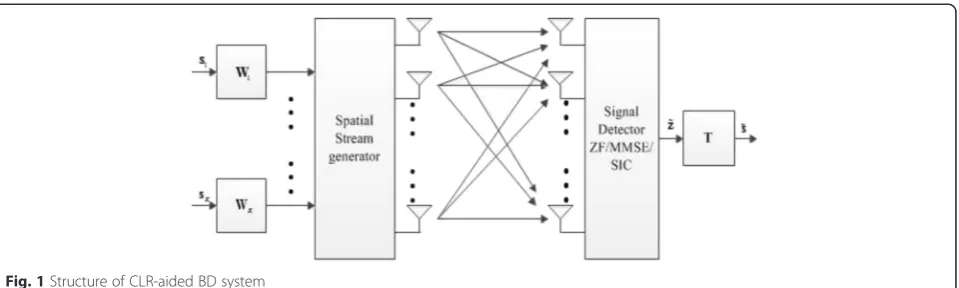
The MU-MIMO broadcast model is shown in Fig. 1,
where K users equipped with Ni receiving antennas on
an individual basis and data streams manipulated at the
base station by a precoder with NTantennas are sent to
the corresponding receiving antennas, respectively. The
total number of receiving antennas is NR¼X
k
i¼1
Ni. We
assume that the total number of transmitted data streams isr≤min(NR,NT). The received signal vector ycan be expressed as
y¼D HWsð þnÞ; ð1Þ
where D∈ℂrNR is the detection matrix, H∈ℂNRNT is the complex Gaussian channel matrix with zero mean
s∈ℂr× 1
is the data vector, and n∈ℂr is the Gaussian noise with independent and identically distributed (i.i.d) entries of zero mean and varianceN0.
3 Precoding technique
In this section, we discuss conventional BD and CLR al-gorithms. This drawback would be more serious when the channel is highly correlated. One solution for this problem is known as BD which was first proposed in [3].
3.1 Block diagonalization
The MUI constraint forces all interference terms to be zero, which is known as the ZF precoding. The
precod-ing matrix W is designed to satisfy the transmit power
constraint. The channel inversion is applied to both the ZF and MMSE precoding approaches. An additional power is needed to force two closely spaced antennas of a single user in order to receive different signals, which would be a more serious disadvantage in the event of the highly correlated channel. The BD is well known as one of the solutions for this problem. The precoding matrix is defined as
W¼½W1;W2;⋯;WK; ð2Þ
where Wi∈ℂNTri is the i-th user’s precoding matrix
which lies in the null space of the other users’channel matrices. Without losing generality, excluding the i-th user’s channel matrix,H~iis defined as
~
Hi¼ HTi;⋯;HiT−1HTiþ1;⋯;HTK
T: ð
3Þ
From the SVD ofH~i, we obtain
~
Hi;eff ¼U~iΛ~i V~ð Þi1V~
0 ð Þ
i
h iH
; ð4Þ
where Ũi and Λi~ denote the left singular vector matrix and the matrix of ordered singular values of H~i,
respect-ively. Matrices V~ð Þi1 and V~ð Þi0 denote the right singular matrices where each consists of the singular vectors
corresponding to non-zero singular values and zero singu-lar values, respectively. V~ð Þi0 forms an orthogonal basis for the null space of H~i, that is, we choose Wi¼V~ð Þi0 to force
the MUI to be zero. After removing the effect of the inter-fering users’streams, the BD maximizes the data through-put by the well-known water-filling (WF) algorithm and the highest sum rate is achieved. The SVD is defined as
HiV~ 0
ð Þ
i ¼UiΛi V0
ð Þ
i V
0 ð Þ
i
h iH
: ð5Þ
The product of Vð Þi1 and V~ð Þi0 can yield an equivalent SU-MIMO channel with orthogonal bases. Orthogonal-ity can be measured by the coefficients μi;j¼hhi;hji
hj
k k2 ,
where hi,hj are the columns of the equivalent channel
HiV~ 0 ð Þ i V
1 ð Þ i .
3.2 CLLL reduction algorithm
A complex lattice is a set of points [9],
ℒð Þ ¼H Hx=hi∈ℂNiNT;xi∈ℤ þjℤ;
ð6Þ
where H¼fh1;h2;⋯;hNTg contains the bases of the latticeℒ(H). It is well known thatHHHis diagonal when
the channel matrix H in Eq. (1) is orthogonal, and the
decision region of the linear detectors required to find the nearest lattice point is the same as that of the ML
detector. Actually, any matrix HLR can generate the
same lattice if and only if HLR=HeffT with a
uni-modular matrix. Since the LR scheme is adopted, the complex valued system model given in Eq. (1) is trans-formed into the equivalent real valued system as
H¼ ℛJð Þð ÞHH −Jℛð ÞHð ÞH
; ð7Þ
y¼hℛJð Þð Þyyi;s¼hJℛð Þð Þssi;n¼hℛJð Þð Þnni; ð8Þ
where ℛð Þ⋅ ;Jð Þ⋅ is the real and imaginary part,
The LR algorithm aims to find a new basis HLRfor a
givenℒ(H) which is shorter and nearly orthogonal com-pared with the original matrixH. Let the orthogonal
fac-tor be represented as μi;j¼ hi;h
the vectors generated by the GSO procedure.
Definition (δ-LLL-reduced basis): A basis HLR by the
QR decomposition, i.e., HLR¼Q~R~, is regarded as δ
-LLL-reduced basis where 1/4 <δ< 1, if
ui;j≤1=2;1≤j<i≤NT ð9Þ
performance with lower complexity. If only Eq. (9) is sat-isfied, this basis is the size-reduced basis as well. The parameter δ influences the quality of the reduced basis. Throughout this paper,δ= 3/4 as in [14].
4 Proposed complex LR-aided BD
In this section, we combined the BD and CLR techniques. To cancel the MUI, we took the similar design concept from BD and thus the MU-MIMO channel can be transformed into equivalent SU-MIMO channels. We assume that the channel information is perfectly known both at the transmit side and the receiving side. We remark that a performance study of the proposed scheme with imperfect channel infor-mation and limited feedback can be considered.
We employ a similar strategy derived from the BD scheme in order to eliminate the interference between users. We successfully transform the MU-MIMO chan-nel into equivalent SU-MIMO chanchan-nels after the pre-coding. Each equivalent SU-MIMO channel has the same properties as a conventional SU-MIMO channel, and when increasing the number of transmit antennas of the MU-MIMO system by one, the number of spatial channels of each user is also increased by one. The equivalent SU-MIMO channel is given by
Heff ¼HW ð11Þ
The received signal at the receiving side is
y¼Heffsþn ð12Þ
By using the CLLL algorithm, we can make the col-umns ofHefforthogonal and shorter, that is
HLR¼HeffT: ð13Þ
We can rewrite Eq. (12) as
y¼HeffTT−1sþn¼HLRzþn; ð14Þ
wherez=T−1sand HLRpossesses a better channel
qual-ity, and we can design the detector based on the better
detector performance which can be achieved due to less
noise enhancement increased by HLR. The basic idea
behind approximate lattice decoding (LD) is to use LR in conjunction with traditional low-complexity decoders. With LR, the basis B is transformed into a new basis consisting of roughly orthogonal vectors. And the complexity is reduced also compared to the SVD technique.
5 MIMO detection algorithms 5.1 ZF and MMSE detection algorithms
The interference is completely suppressed in a ZF detector
by multiplying the receiving signal vector y with the
pseudo-inverse of the channel matrix H†LR¼ HTLRHLR
−1
HT
LR. Given the received signal y in Eq. (14), the MLD
problem consists of determining the vector z with the
highest likelihood, that is, solving the following integer least squares problem [7]:
~
zML¼ arg min
z∈ℤr ky−HLRzk
2: ð15Þ
However, the MLD is usually impractical due to its complexity that grows exponentially with the number of constellation points and the number of transmitted
streams r. The decision step consists of mapping each
element of the filter output vector
~sZF ¼H†LRy¼sþ HTLRHLR
−1
HT
LRn ð16Þ
onto an element of the symbol alphabet by a minimum
distance quantization, which in case of M-QAM
corre-sponds to a simple rounding operation to the allowed range of values. For an orthogonal channel matrix, ZF is identical to ML. The MMSE detector takes the noise term into account and thereby leads to an improved performance.
~sMMSE¼H†LRy¼ HTLRHLRþσ2nI
−1
HT
LRy: ð17Þ
5.2 Lattice-reduction-aided linear detection
Linear detection is optimal for an orthogonal channel matrix. For s∈ℤm, we also havez∈ℤm, sosandz stem from the same set. The idea behind LR-aided linear detection is to consider the equivalent system model in
Eq. (14) and perform the nonlinear quantization on z
instead ofs. For LR-aided ZF, this means that first
~
zLR−ZF ¼T−1~sZF ¼HLRy¼zþHLRn ð18Þ
is calculated, where the multiplication with HLRusually
causes less noise amplification than the multiplication with H†LR in Eq. (14) due to the roughly orthogonal
col-umns of HLR. Therefore, a hard decision based on
~
may apply a MMSE filter instead of the ZF solution in
order to get an improved estimate for z. One obvious
way is given by the MMSE-solution of the lattice-reduced system (Eq. (14))
~
5.3 Lattice-reduction aided SIC
As shown in several publications, e.g., [16, 17], SIC can be well described in terms of the QR decomposition of the channel matrix. Applying this strategy to the system model from Eq. (14), we get
~
zLR–ZF–SIC ¼Q~Ty¼Rz~ þQ~Tn; ð20Þ
whereQ and~ R~ have already been calculated by the LLL algorithm. Similar to linear detection, we can consider the lattice-reduced version of the extended system model with the equivalent channel matrix HLR¼Q~R~ .
This leads to LR-aided MMSE-SIC with decision vari-ables given by
~
zLR–MMSE–SIC ¼Q~Ty¼Rz~ þη; ð21Þ
where the newly defined noise termη also incorporates
residual interference. The detection procedure equals that of LR-aided ZF-SIC.
6 Performance bounds for lattice decoding
In this section, we shall introduce an analytic tool for approximate LD. However, such results do not directly translate into how close approximate LD is to LD in terms of the minimum distance, which is more useful in digital communications [18].
Consider a fixed but arbitrary n-D complex lattice Λ.
The decision regions of ZF and SIC have 2n faces. We
only have to study ndistances due to symmetry. Thei
-th distance of ZF is di,ZF= (1/2)‖hi‖sinθi, for i= 1,…,n,
whereθidenotes the acute angle between and the linear
space spanned by the othern−1 basis vectorsh1,…,hi−
1,hi+ 1,....,hn. For the SIC detector, the i-th distance is given by 1ð =2Þ hi .
The minimum distance of the lattice decoder is
dLD= (1/2)λ(Λ), where λ(Λ) is the length of the
short-est vector of lattice Λ. We are motivated to define
the proximity factors measuring the proximity be-tween the performances of LD and approximate LD as follows:
For each decoder, an error occurs when the noise falls outside of R. Accordingly, given the basis B, the error probability for vector x is given by
Peð Þ ¼B Pðx≠0=x¼0Þ ¼P nð ∈RÞ ð24Þ
To keep the results general, we write SNR=c/σ2,
wherecis a constant depending on the problem. By the
symmetry of the Voronoi cell, we have the lower bound on the conditional decoding error probability of LD
Pe;LDðSNR;BÞ≥2Q dσLD
Meanwhile, the union bound on the conditional error probability of ZF reads
Pe;ZFðSNR;BÞ≤2
where the factor 2 is due to symmetry. The union bound for SIC admits a form similar to Eq. (26). Given the same basis matrix B, the conditional error probabil-ity of LR-aided ZF can be bounded above as
Pe;ZFðSNR;BÞ≤2
since Q(·) is a decreasing function. It is worth pointing
Table 2Computational complexity of QR/SVD-BD [22]
Steps Operations Flops Case
1 H=QR 16K N2 Table 1Complexity of LR algorithm
Steps Operations Flops Case (2, 2, 2) × 6
0 2 4 6 8 10 12 14 16 0
0.5 1 1.5 2 2.5x 10
5
NT
F f
o r
e
b
m
u
N
e
h
T
SVD-BD QR-BD CLR-BD
Fig. 2The required flops versus the number of the transmit antennas,NT
1 2 3 4 5 6 7
0 1 2 3 4 5 6 7 8 9x 10
6
Nk
s
p
ol
F f
o r
e
b
m
u
N
e
h
T
SVD-BD QR-BD CLR-BD
0 5 10 15 20 25 30 10-4
10-3 10-2 10-1 100
Eb / N0 [dB]
R
E
B
ZF ZF-BD MMSE MMSE-BD LR-ZF(LLL) LR-MMSE(LLL) ML
Fig. 4BER performances of the LR linear precoding schemes
0 5 10 15 20 25 30
10-5 10-4 10-3 10-2 10-1 100
Bit Error Rate with 4 by 4 MIMO,4-QAM
Eb / N0 [dB]
BER
ZF-SIC LR-ZF-SIC MMSE-SIC LR-MMSE-SIC ML
out that while the distancedLDis a function ofB,ρi,ZFis
not. Now, combining (25) and (26), we have
Pe;ZFðSNR;BÞ≤
Xn
i¼1
Pe;LD SNRρ i;ZF
;B
!
: ð28Þ
Since Eq. (28) holds for any B, averaging out B, we obtain
Pe;ZFðSNRÞ≤
Xn
i¼1
Pe;LD SNRρ i;ZF
!
ð29Þ
for arbitrary SNR. In particular,
Pe;ZFðSNRÞ≤nPe;LD SNRρ ZF
: ð30Þ
The relations Eq. (29) and Eq. (30) hold irrespective of fading statistics, and similar relations exist for SIC. They reveal, in a quantitative manner, that approximate LD performs within a constant bound from LD. The mere effect on the error rate curve is a shift from that of LD, up to a multiplicative factorn, which obviously does not change the diversity order. In other words, the diversity order is the same as that of LD [18]. Therefore, existing results on the diversity order of LD can be extended to approximate LD. Moreover, since LD achieves full receive diversity in the uncoded V-BLAST system [19], approximate LD also achieves full diversity. This provides an alternative way of showing the diversity order of LR-aided decoding given in [19, 20].
7 Complexity analysis
The LLL algorithm leads to a significant reduction of the computational complexity. The complexity of the LLL reduction algorithm depends on the random basis
matrix H. We use the total number of flops to measure
the computational complexity of the existing algorithms [12, 13, 21, 22]. We summarize the total flops needed for the matrix operations below:
Multiplication ofm×nandn×pcomplex matrices: 8mnp
QR decomposition of anm×n(m≤n) complex matrix: 16(n2m−nm2+ 1/3m3)
SVD of anm×n(m≤n) complex matrix where only
Σ and Vare obtained: 32(nm2+ 2m2)
SVD of anm×n(m≤n) complex matrix where
U,Σ, and Vare obtained: 8(4n2m+ 8nm2+ 9m3) Inversion of anm×mreal matrix: 2m3−2m2+m
For the case shown in Tables 1 and 2, the complexity
of the LR-ZF is about 46.1 % of BD and 70.3 % of QR/
SVD-BD, while the complexity of the LR-MMSE is about
55.8 % of BD and 85.1 % of the QR/SVD-BD [12].
similar as SVD-BD but replacing the SVD operation with the fast Givens QR operation.
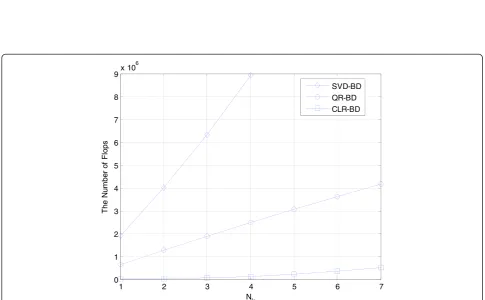
We give the calculated results of the flops of the alterna-tive methods in Figs. 2 and 3. We consider the case that
NT=KNk as shown in Fig. 2. We set Nk= 2 and express
the computation cost as a function of NT. We consider
the case thatKNk<NTwhile expressing the computation cost as a function ofNk.
8 Simulations results
In this section, we evaluate the BER performance of the LR-aided linear precoding. We use both linear ZF and MMSE precoding schemes with the conventional LLL algorithm. From Fig. 4, linear precoding jointly applied with LLL algorithm clearly outperforms the linear
precoding. At a target BER of 10−3, the gain in the
transmission power is 7.5 dB.
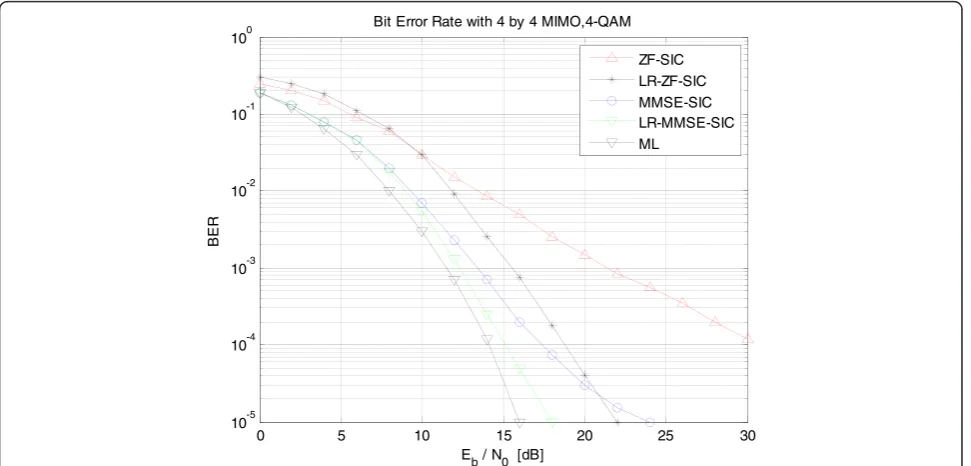
The performances of the successive detection schemes with optimum ordering are provided in Fig. 5. Note that this improvement comes at almost no cost because the complexity of SIC is comparable to that of linear de-tection. Again, detection with respect to the LR sys-tem significantly reduces the BER. The LR-MMSE-SIC scheme achieves almost ML performance, while the main computational effort is required only once per transmitted frame.
The analysis of probability of error is compared to the BER results of simulations.
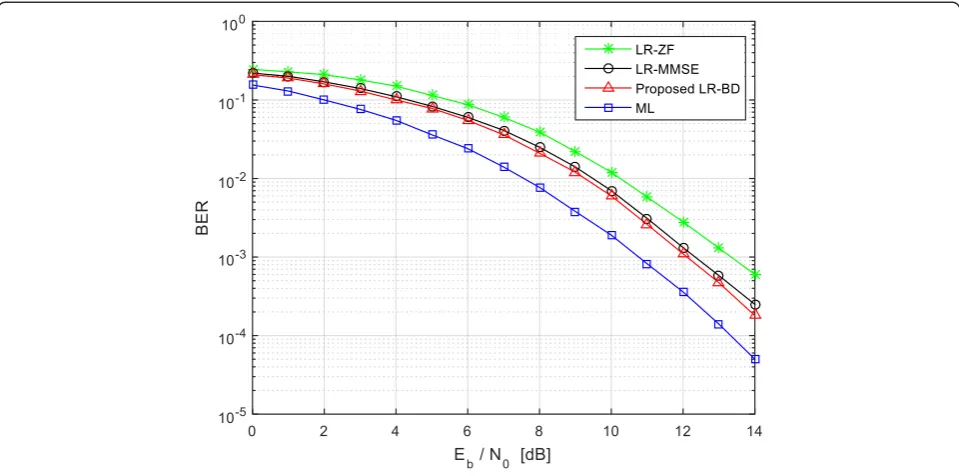
We investigate the performance comparison in terms of BER given a bit SNR, i.e., Eb/N0 in Fig. 6. The 4×4 MIMO precoding and detection techniques are given and compared with the proposed schemes. Figure 6 shows the comparison where 16-QAM modulation is used. The ML is the best performance of all techniques, while the LR-MMSE outperforms the LR-ZF. It is clear that the performance of BD precoding with LR is as almost similar to the LR-MMSE detection in Fig. 6.
9 Conclusions
In this paper, several detection schemes for multiple antenna systems are investigated, which make use of the LR algorithm proposed by [14]. It is shown that the performance of our proposed algorithm is better than that of conventional methods and the complexity is reduced compared with the LLL-based schemes. It is clear that the performance of BD precoding with LR is as almost similar to the LR-MMSE detection. Aside from the improved performance, it is suggested that the MMSE-based LR has a significantly smaller complexity than the ZF-based LR. Simulation results evidence that our proposed algorithms have substan-tial performance gains compared to the existing MU-MIMO linear precoding and BD detection.
Competing interests
The authors declare that they have no competing interests.
Acknowledgements
This work was supported by the MEST 2015R1A2A1A 05000977, NRF, Korea.
Received: 9 August 2015 Accepted: 2 November 2015
References
1. Q Spencer, M Haardt, Capacity and downlink transmission algorithms for a mutli-user MIMO channel, inProc. 36th Asilomar Conf. on Signals, Systems, and Computers(IEEE Computer Society Press, Pacific Grove, 2002) 2. LU Choi, RD Murch, A transmit preprocessing technique for multiuser MIMO
systems using a decomposition approach. IEEE Transactions on Wireless Communications3(1), 20–24 (2004)
3. QH Spencer, AL Swindlehurst, M Haardt, Zero-forcing methods for downlink spatial multiplexing in multiuser MIMO channels. IEEE Transactions on Signal Processing52(2), 461–471 (2004)
4. H Sung, S Lee, I Lee, Generalized channel inversion methods for multiuser MIMO systems. IEEE Trans. Commun.57(11), 3489–3409 (2009)
5. H Yao, G Wornell, Lattice-reduction-aided detectors for MIMO communication system, inIEEE Proc. Globecom(IEEE, Taipei, 2002) 6. D Wubben, R Bohnke, V Kuhn, KD Kammeyer,MMSE based lattice reduction
for near ML detection of MIMO systems. ITG workshop on Smart Antennas, 2004, pp. 106–113
7. D Wübben, R Böhnke, V Kühn, K-D Kammeyer, Near maximum-likelihood detection of MIMO systems using MMSE-based lattice-reduction, inProc. 2004 Int. Conf. Commun. (ICC’04)(IEEE, Paris, 2004), pp. 798–802 8. C Windpassinger, R Fischer, Low-complexity near maximum likelihood
detection and precoding for MIMO systems using lattice reduction, inProc. IEEE Inf. Theory Workshop(IEEE, Paris, 2003), pp. 345–348
9. K Zu, RC de Lamare,Lattice Reduction-Aided Preprocessing and Detection Techniques for MU-MIMO in Broadcast Channel. 11thEuropean Wireless Conference 2011 (VDE, Vienna, 2011)
10. C Windpassinger, R Fischer, JB Huber, Lattice-reduction-aided broadcast precoding. IEEE Trans. on Communications52, 2057–2060 (2004) 11. RFH Fischer, CA Windpassinger, Improved MIMO precoding for
decentralized receivers resembling concepts from lattice reduction, inProc. of IEEE Global Telecommunications Conf(IEEE, San Francisco, 2003), pp. 1852–1856
12. K Zu, RC Lamare, Low-complexity lattice reduction-aided regularized block diagonalization for MU-MIMO systems. IEEE Commun. Lett.16, 6 (2012) 13. K Zu, RC de Lamare, M Haart, Generalized design of low-complexity block
diagonalization type precoding algorithms for multiuser MIMO systems. IEEE Trans. on Communications61, 10 (2013)
14. AK Lenstra, HW Lenstra, L Lov’asz, Factoring polynomials with rational coefficients. Math. Ann261, 515–534 (1982)
15. YH Gan, C Ling, WH Mow, Complex lattice reduction algorithm for low-complexity full-diversity MIMO detection. IEEE Transactions on Signal Processing57(7), 2701–2710 (2009)
16. D Wubben, R Bohnke, V Kuhn, KD Kammeyer, MMSE extension of V-BLAST based on sorted QR decomposition, inIEEE Proc. VTC-Fall(IEEE, Orlando, 2003) 17. R Bohnke, D Wubben, V Kuhn, KD Kammeyer, Reduced Complexity MMSE
Detection for BLAST Architectures, inIEEE Proc. Globecom(IEEE, San Francisco, 2003) 18. C Ling, On the proximity factors of lattice reduction aided decoding. IEEE
Trans. on Signal Processing59, 6 (2011)
19. J Jald´en, P Elia, LR-aided MMSE lattice decoding is DMT optimal for all approximately universal codes, inProc. Int. Symp. Inform. Theory (ISIT’09)
(IEEE, Seoul, 2009)
20. M Taherzadeh, A Mobasher, AK Khandani, LLL reduction achieves the receive diversity in MIMO decoding. IEEE Trans. Inform. Theory53, 4801–4805 (2007) 21. GH Golub, CF Van Load,Matrix Computations, 3rd edition(The John Hopkins
University Press, Baltimore and London, 1996)
![Table 2 Computational complexity of QR/SVD-BD [22]](https://thumb-us.123doks.com/thumbv2/123dok_us/944309.1115135/5.595.304.540.676.734/table-computational-complexity-of-qr-svd-bd.webp)