Hydroxyapatite/Eudragit® Matrix For Continuous And
Controlled Release Of Ibuprofen
1
SY P M, MBAYE1 G, DIOUF1 L A D, SOUMBOUNDOU1 M, DJIBOUNE1 A R, NDIAYE1 I M E, NDONG2 B,NDIAYE1 A, DIEDHIOU3 A, DIOP2 O, BATHILY2 El H A L, MBODJ2 M, DIARRA1 M.
1
Physics and Biophysics pharmaceutical laboratory. Faculty of Medicine, Pharmacy and Dentistry. University
Cheikh Anta Diop of Dakar, SENEGAL. 2
Medical Biophysics and Nuclear Medicine Laboratory. Faculty of Medicine, Pharmacy and Dentistry.
University Cheikh Anta Diop of Dakar, SENEGAL. 3
Therapeutic and Organic Chemistry Laboratory, Faculty of Medicine, Pharmacy and Dentistry. University
Cheikh Anta Diop of Dakar, SENEGAL.
Corresponding authors Email : [email protected], [email protected], [email protected]
Téléphone: +221 77 552 56 86, 77 560 15 28, 77 502 21 72 –
SUMMARY
Introduction
We were interested in developing a hydroxyapatite/Eudragit matrix for continuous and controlled release of ibuprofen. The choice of hydroxyapatite and Eudragit (RS 100 and RSPO) as main excipients is justified by the fact that the latter are used to modify the release of active ingredients. In addition, the hydroxyapatite has a mineral whose composition close to that of bone and teeth, gives it the ability to be used as bone restorative material.
Materials and method
We have developed hydroxyapatite/Eudragit matrix with hydroxyapatite annealed at 800°C and not annealed. As plasticizer we used butylphthalate, the active ingredient being ibuprofen which is a nonsteroidal anti-inflammatory used in the treatment of pain and fever. The study of the release of ibuprofen was performed in phosphate buffer medium (pH = 6.8) at room temperature with a UV-visible spectrophotometer ( model 1371 ) at 264 nm and lasted 28 days. For each batch, the study was conducted on three units of known mass.
Results
Quantities released depend on the form of hydroxyapatite used (annealed or unannealed ) but also on the initial load of ibuprofen. The release profiles follow first order kinetics, modeled by the following equation : Qt = Q28 A1 + e- (t / k).This setting allows not only to predict the
precise amounts of ibuprofen to release at the sites of action based on need, but also to control the release of the latter.
Conclusion
These results show that hydroxyapatite powder is suitable for the development of a hydroxyapatite/Eudragit matrix for the controlled and sustained release of ibuprofen. Such a system would allowed not only bone or dental restoration but also as well as an adapted and controlled formulation in terms of dose of active principle provided to the patient.
Keywords: Matrix - hydroxyapatite / Eudragit® - controlled release - ibuprofen
INTRODUCTION
During the last two decades, significant progress has been made in the pharmaceutical
industry to improve adherence to treatment through the development of controlled and
continuous release systems of active ingredients [1, 2]. Thus, these systems with proper
release profiles will contribute to reducing the risks of overdose, the number of outlets,
oversights and allow permanently delivery of an effective dose of active ingredients in the
body. Thus, we have developed and evaluated systems for the controlled and continuous
release of ibuprofen which is a nonsteroidal anti-inflammatory widely used in the treatment of
pain, fever and inflammation. We choose hydroxyapatite, as main vehicle for the development
of systems thanks to its properties [3] and Eudragit (RS100 and RSPO). Indeed,
hydroxyapatite is a ceramic-based biomaterial having the same mineral composition as bones
and teeth, which ensures biocompatibility (osteoconductivity, ostéophily, ability to contain
and release active principles) [3].
MATERIALS AND METHODS
MATERIAL
The active ingredient
As active principle, we used ibuprofen as a white crystalline powder. Ibuprofen comes from
PHARMACARE LIMITED, THAILAND laboratories.
Hydroxyapatite
Hydroxyapatite was produced by direct precipitation by adding with stirring a solution of
phosphoric acid 0.3M (H3PO4) at a rate of 25 ml per minute to a freshly prepared suspension
of calcium hydroxide (Ca ( OH)2) 0.5 M according to the reaction :
(
OH
)
2
Ca
10
(
PO
4
) (
6
OH
)
2
18H
2
O
10Ca
4
PO
3
6H
+
→
+
Thus, two powder samples were selected for the realization of matrix:
- The powder precipitated between 80-95 °C, then filtered and dried in an oven at 80 °C
for 24 hours. This powder corresponds to the Unannealed Hydroxyapatite (HNR) sample, it
has a specific surface of 40 m2/g and is formed with 10 to 20 nm sized grains;
- The powder precipitated between 80-95 °C, filtered and dried in an oven at 80 °C for
24 hours, then annealed at 800 °C during 3 hours. This powder corresponds to the Annealed
Hydroxyapatite (HR) sample, it has a specific surface of 75 m2/g and is formed with 100 to
200 nm sized grains.
Before use, the samples are passed through sieve equipped with a gate bore 125 µm.
Eudragits
The binders that we have chosen for the development of matrix are Eudragit. They are
esterified copolymers of acrylic and methacrylic acid containing a low content of quaternary
ammonium groups [4, 5] that make them permeable. They are insoluble in water and in
biological fluids, which explains their use in controlled release systems. As Eudragit, we
have:
- Eudragit® RS PO which are in powder form ready to be used directly in internal phase in
the formulation of matrix;
- Eudragit® RS 100 that are used in external phase through the wetting liquid. These form a
microporous film.
- Butylphthalate
Butylphthalate, belong to a family of chemical products made of a benzene ring and two
carboxylate groups generate a diester structure. It is used as a plasticizer to reduce the
stiffness of the material and allow to modify the diffusion properties of the latter [6].
METHODS
Matrix preparation
For matrix development, work has been carried out and the proportions for obtaining proper consistency matrix are:
- X% hydroxyapatite;
- Y% active ingredient;
- RS PO Eudragit 20%;
- Eudragit RS 100 5%;
Y ranges from 5 to 25%; X ranges from 50 to 70%.
Eudragit RS 100 are used as binder in outer phase at 11.6% in a mixture of ethanol (85.5%) and butyl phthalate (2.9%).
Protocol for preparing matrix is described as follows:
weigh the amounts of hydroxyapatite of Eudragit RS PO and active ingredient (ibuprofen) for a total mixture of 10 grams;
mix these three products using a glass mortar until obtaining a homogeneous mixture;
add the wetting liquid containing Eudragit RS 100 (external phase binder);
grind during 10 minutes, we get a homogeneous mass that does not adhere to fingers and mortar walls;
Using a spatula, fill to the brim, the alveoli previously coated with absolute ethanol;
Dry them in an oven at 30 °C during 24 hours. Composition of these different batches
is shown in Tables I and II.
Table I : Composition (%) of matrix based on annealed hydroxyapatite (HR) Composition
HAP recuite Liants Ibuprofène
Eudragit interne Eudragit externe
HR5 70 20 5 5
HR10 65 20 5 10
HR15 60 20 5 15
HR20 55 20 5 20
HR25 50 20 5 25
Table II : Composition (%) of matrix based on non annealed hydroxyapatite (HNR)..
HAP non recuite Liants Ibuprofène
Eudragit interne Eudragit externe
HNR5 70 20 5 5
HNR10 65 20 5 10
HNR15 60 20 5 15
HNR20 55 20 5 20
HNR25 50 20 5 25
From this protocol, batches of hydroxyapatite-polymer-active ingredient controlled release
matrix were manufactured.
For each batch 20 units were manufactured; the alveoli used have an internal diameter of 12
mm to a depth of 4 mm.
All systems prepared were weighed after drying in an oven; which allowed us to calculate the
average mass, standard deviations minimum and maximum allowable weights to meet the
standards of the pharmacopoeia.
Study of ibuprofen’s liberation
The study of the release of ibuprofen was carried out in phosphate buffer medium at pH = 6.8.
For each batch, the study was carried out on three units of known mass. The average
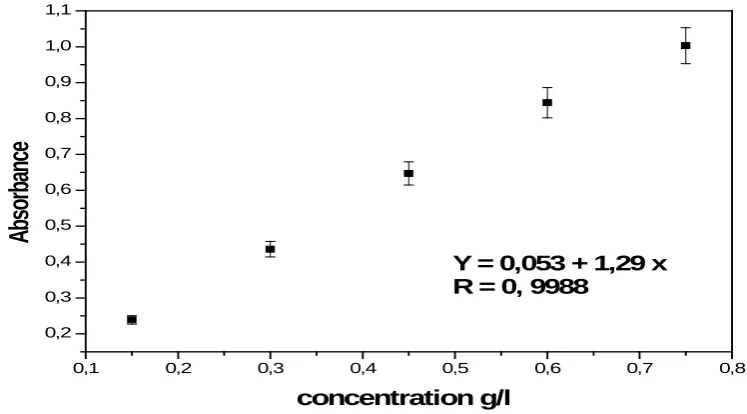
cumulative release curve is calculated from a calibration curve (Figure 1).
0,1 0,2 0,3 0,4 0,5 0,6 0,7 0,8
0,2 0,3 0,4 0,5 0,6 0,7 0,8 0,9 1,0 1,1
Y = 0,053 + 1,29 x R = 0, 9988
Abs
or
ba
nc
e
concentration g/l
Figure 1 : Ibuprofen calibration curve
.
The release of ibuprofen was studied according to the following protocol:
- we used plastic pots, cylindrical, with a nominal capacity of 100 ml in which we have introduced an equivalent amount of a solution of phosphate buffer at pH = 6.8. These pots are provided with a screw-on lid to limit evaporation of the dissolution medium;
- samples selected for each batch are introduced without stirring in the dissolution medium, the pots are kept at room temperature, protected from light;
- 1 ml samples are taken every 24 hours and are immediately replaced by a fresh solution of phosphate buffer at pH = 6.8;
- the container is returned three times before each withdrawal;
- aliquots collected parts are properly diluted before dosing amounts of ibuprofen released, with visible UV spectrophotometer (1371 model) at 264 nm.
RESULTS
Mass uniformity test
Average mass of controlled release hydroxyapatite - polymers - ibuprofen matrix, standard
deviation, minimum and maximum weights allowable to meet the standards of the
pharmacopoeia are calculated and reported in Tables III and IV.
Table III : Pharmaco-technical parameters of matrix containing ibuprofen in annealed
hydroxyapatite (IHR).
Masse moyenne Ecart-type (g) Max. autorisé (g) Min autorisé (g)
IHR5% 0,848 0,03952 0,890 0,805
IHR10% 0,803 0,01805 0,843 0,762
IHR15% 0,773 0,01743 0,811 0,734
IHR20% 0,709 0,02821 0,744 0,673
IHR25% 0,721 0,03097 0,757 0,684
Table IV : Pharmaco-technical parameters of matrix containing ibuprofen in non annealed
hydroxyapatite (IHNR).
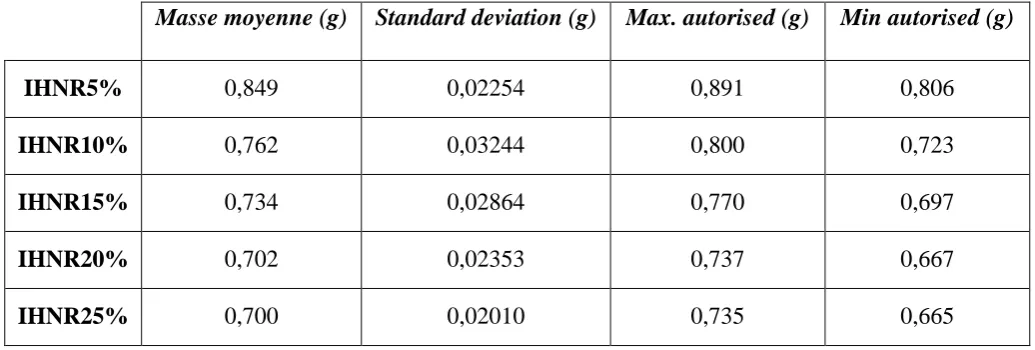
Masse moyenne (g) Standard deviation (g) Max. autorised (g) Min autorised (g)
IHNR5% 0,849 0,02254 0,891 0,806
IHNR10% 0,762 0,03244 0,800 0,723
IHNR15% 0,734 0,02864 0,770 0,697
IHNR20% 0,702 0,02353 0,737 0,667
IHNR25% 0,700 0,02010 0,735 0,665
All lots are considered compliant to Pharmacopoeia [7], indeed we have:
M
max= m
mean± 0,050m
meanThe results obtained in the ibuprofen release studies from matrix based on annealed
hydroxyapatite (HR) and unannealed hydroxyapatite (HNR) forms are shown in curves
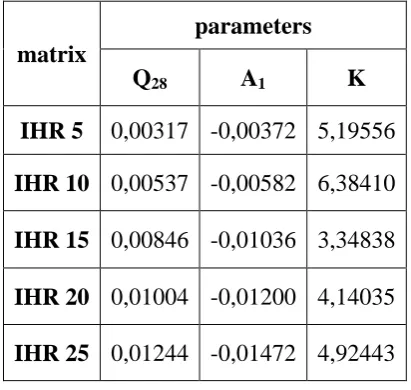
(Figures 2 and 3) and tables (V, VI, VII et VIII).
Thus, the quantities released by unit area Qs ( g/cm2) versus time are shown in Figures 2 and
3, the modeling parameters of release profiles in Tables V and VI and the average dissolution
efficiencies of each batch are shown in tables VII and VIII.
0 5 10 15 20 25 30 35 40
0,000 0,002 0,004 0,006 0,008
quant
ités
li
bér
ées
Q
s(g/
cm
2)
temps (jours) IHR 5 IHR 10 IHR 15 IHR 20 IHR 25Figure 2 : Ibuprofen releasing profiles in matrix IHR5, IHR10, IHR15, IHR20 and IHR25
0 5 10 15 20 25 30 35 40
0,000 0,002 0,004 0,006 0,008 0,010 0,012 0,014 IHNR 5 IHNR 10 IHNR 15 IHNR 20 IHNR 25 quant ités li bér ées Q s
(
g/ cm 2)
temps (jours)Figure 3 : Ibuprofen releasing profiles in matrix IHNR5, IHNR10, IHNR15, IHNR20 and IHNR25.
Table V : Modeling parameters of release profiles in Figure 2.
matrix
parameters
Q28 A1 K
IHR 5 0,00334 -0,00370 12,39507
IHR 10 0,00437 -0,00460 11,74577
IHR 15 0,00561 -0,00615 8,86956
IHR 20 0,00614 -0,00668 8,19263
IHR 25 0,00621 -0,00686 7,33139
Table VI : Modeling parameters of release profiles in figure 3.
matrix
parameters
Q28 A1 K
IHR 5 0,00317 -0,00372 5,19556
IHR 10 0,00537 -0,00582 6,38410
IHR 15 0,00846 -0,01036 3,34838
IHR 20 0,01004 -0,01200 4,14035
IHR 25 0,01244 -0,01472 4,92443
Table VII : Average dissolution efficiencies in matrix IHR5, IHR10, IHR15, IHR20 and IHR25
matrix 7th day 14th day 21th day 28th day
IHR 5% 16,181 35,277 48,864 61,630
IHR 10% 15,400 28,223 36,818 45,635
IHR 15% 16,297 28,816 37,289 45,183
IHR 20% 16,106 27,471 34,875 41,879
IHR 25% 13,848 23,358 29,002 34,444
Table VIII : Average dissolution efficiencies in matrix IHNR5, IHNR10, IHNR15, IHNR20 and
IHNR25
matrix 7th day 14th day 21th day 28th day
IHNR 5 % 36,012 59,234 71,008 81,492
IHNR 10% 33,636 52,284 63,469 74,084
IHNR 15% 51,295 72,192 82,502 91,057
IHNR 20% 42,126 62,382 72,776 81,792
IHNR 25% 37,294 58,624 70,344 80,070
DISCUSSION
Ceramic based controlled release matrix doesn’t release their entire load of active ingredient
in less than 12 hours [8; 9; 10, 11] so we chose to perform assays every 24 hours.
The ibuprofen release studies that we performed on batches based on hydroxyapatite annealed
and not annealed lasted 28 days.
In general, the release curves obtained from units within the same batch are comparable. This
is confirmed by reproducing the standard deviation for each point in the form of vertical bars
at the release curves.
The analysis of curves representing the amounts of ibuprofen released per unit area as a
function of time shows that the various systems have the same release profiles. Modeling
these release profiles can be obtained by the following relationship, which recalls a first-order
kinetics release which is identical to that of release of acetaminophen and acetylsalicylic acid
[12, 13, 14, 15].
Qt = Q28 + A1 e
- (t/k); (Qt is the amount of ibuprofen released per unit area after time t; Q28is the amount of ibuprofen released per unit area after 28 days; A1 is a dimensionless constant;
K is a time constant).
Release profiles show that for both matrix based of annealed hydroxyapatite and those based
on unannealed hydroxyapatite, the amount of ibuprofen released (Qe (mg/cm2) increases
when the initial load increases. This confirming that annealed and unannealed hydroxyapatite
are suitable to prepare controlled release matrix of active ingredients [16, 17].
Ibuprofen release curves for the annealed from the hydroxyapatite-based matrix have
substantially the same manners as those matrix based of unannealed hydroxyapatite, ie we
have first kinetics order profiles. The release of ibuprofen in such systems is a function of its
residual concentration in the pharmaceutical considered form [12, 13].
Regarding the efficiencies of dissolution, we note that average dissolution efficiencies vary
according to the composition of the matrix. Indeed, the specific area of hydroxyapatite
particles plays a key role on the amount of released ibuprofen [18, 19, 20].
For hydroxyapatite annealed based matrix, specific area and particle size explain their high
affinity for ibuprofen. Thus, they tend to retain it in the matrix, resulting in relatively low
dissolution efficiencies. Moreover, in these systems, batches with low initial load of ibuprofen
present the most important dissolution efficiencies. For non-annealed hydroxyapatite based
matrix, ibuprofen dissolution rate is significant hence much larger dissolution efficiencies. In
these systems, the affinity between the hydroxyapatite powder and the drug ingredient is less
important. Therefore these matrix are emptied more rapidly than the systems based on
annealed hydroxyapatite [2, 20].
CONCLUSION
Given the results, we can say that hydroxyapatite powder is suitable for the development of a
hydroxyapatite/Eudragit matrix for controlled and controlled release of ibuprofen. Such a
system would not only allowed bone or dental restoration but also an adapted and controlled
formulation in terms of dose of active principle to provide the patient.
REFERENCES
1- MUSTER D. Biomatériaux, et bio-matériels en chirurgie osseuse et dentaire
(1ère partie) Edition techniques Encyclo. Med. Chir. (Paris, France), Stomatologie ET
odontologie 22-014-F-10, 1993: 27p.
2- DIARRA M. Elaboration et évaluation d’un système hydroxyapatite/polymère pour une
libération contrôlée de substances actives au niveau de la cavité buccale. Thèse sciences
pharmaceutiques, n °3247, Université Louis Pasteur (Strasbourg).
3- HISASHI S., MASAO Y., SHINJI T., MASAYUKI H., EIJI K., et al. Control of
Bisphosphonate Release Using Hydroxyapatite granules. Journal biomedical materials
Research Part B: applied biomaterials. Interscience Mars 2006, D O1 10.1002, p 215-221.
4- KHAN M.A., REDDY I.K. Controlled drug delivery development of solid oral dosage
forms with acrylate polymers. S.T.P Pharma. Sc. 1997, 7, 6 : p 483-490.
5- PLAIZER-VERCAMMEN J., DAUWE D., BRION P. Possibility of use of Eudragit
R.S. as a susteined release matrix agent for the incorporation of water soluble active
compounds at high percentages. S.T.P. Pharma. Sc., 1997, 7, 6: 491-497.
6- RHAINDS M., SAINT LAURENT L. Release of medroxyprogesterone acetate from a
silicone polymer. J. Pharm. Sc. 1970, 59, (3):353-357.
7- PHARMACOPEE EUROPEENNE 3nd ed., 1997, conseil de l’Europe Strasbourg 1918p.
8- LASSERRE A. MBE. And BAJPAI P.K.PH.D. Ceramic drug delivery devices.
Critical ReviewTM in therapeutic drug carrier systems, 1998, 15 (1): 1-56.
9- MOLDOVAN K. M., BAJPAI P. K. A ceramic system for continuous release of
acetylsalicylic acid. Biomed. Sci. Instrum., 1994, 30: 175-180.
10- OTSUKA M., YOSHIHISA M., TADASHI K., SATARU Y., TAKASHI N., TAKA
Y. Drug release from novel self-setting bioactive glass bone cement containing cephalexin
and its physicochemical properties. J. Biomed. Mat. Res.,1995, 29 : 33-38.
11- MUDRA D. R., MOLDOVAN K. M. Development of a B – Tricalcium phosphate
ceramic system for in vitro and in vivo release of acetaminophen. 14th Southern biomedical
Engineering Conference, Shreveport, Louisiana April, 1995, 7-9.
12- LI WAN PO A., WONG L.P., GILLIGAN C.A. Characterization of commercially
available theophylline sustained or controlled release systems: in vitro drug release profiles.
Int. J. Pharm., 1990, 66: 111-130.
13- RACZ I., ZELKO R., BI HARY E. Mathematical modeling of magnesium oxide release
from granules produced by laboratory fluidization. D. Dev. Ind. Pharm., 1996, 22, 3:
225-230.
14- DIOUF L A D, MBAYE G, NDIAYE A, DIEDHIOU A, CISSE A, DIARRA M.
Development of hydroxyapatite/polymers systems for paracetamol controlled release. Dakar
Medical, 2009 (1), 14-22.
15- G MBAYE, L A D DIOUF, A NDIAYE, A S DIALLO, M SOUMBOUNOU, A R
DJIBOUNE, P M SY, A DIEDHIOU, M MBODJ, O THIOUNE, A M DIEYE, A Y
DIOP, M DIARRA. Developement of system hydroxyapatite/polymers for controlled release
of acetylsalicylic acid. Journal des sciences pharmaceutiques et biologiques, 2009, 10, 2,
pp.21-29.
16-XU Q, AND CZERNUSZKA J T. Controlled release of amoxicillin from hydroxyapatite-coated poly(lactic-co-glycolic acid) microspheres. J Control release. 2008;127(2):146-153.
17 -MELVILLE A J, RODRÍGUEZ-LORENZO L M, AND FORSYTHE J S. Effects of calcination temperature on the drug delivery behaviour of Ibuprofen from hydroxyapatite powders. J Mater Sci Mater Med. 2008; 19(3):1187-95.
18- DIARRA M., POURROY G., BOYMOND C., MUSTER D. Fluoride controlled
release tablets for intrabuccal use. Biomaterials, 2003, 24: 1293-1300.
19- DIOUF L.A.D. Systèmes hydroxyapatite/polymères pour la libération contrôlée du
paracétamol et de l’acide niflumique. Thèse Pharm., Dakar, 2004; n°71.
20- DIOP A.Y. Système hydroxyapatite/polymères pour la libération contrôlée de l'acide
acétylsalicylique. Thèse Pharm., Dakar, 2003; n°7.