AES Cipher Keys Suitable for Efficient Side-Channel
Vulnerability Evaluation
Takaaki Mizuki Yu-ichi Hayashi Tohoku University
tm-paper+aes10rd[atmark]g-mail.tohoku-university.jp
Abstract
This paper investigates pairs of AES-128 cipher keys and plaintexts which result in being “quiet” in the final round, i.e., whose 128-bit State holds the same bit pattern before and after Round 10. We show that the number of such quiet plaintexts (resulting in Hamming distance 0) for any cipher key is at most 5,914,624, and that there exist exactly 729 cipher keys having such a maximum number. The same holds if “quiet” is replaced by “noisy” (which means to have Hamming distance 128). Because such quiet and noisy plaintexts make extreme actions in the final round of the AES encryption, these AES-128 cipher keys are quite useful for AES hardware designers to efficiently evaluate the vulnerabilities of their products, for instance, the performance of their side-channel attack countermeasures.
1
Introduction
Consider the execution of the AES (Advanced Encryption Standard) encryption, for in-stance, the Cipher specified in AES-128 [13]. Then, a cipher key and a plaintext determine its entire action, of course, i.e., the 128-bit State deterministically changes in rounds by transformations (SubBytes,ShiftRows,MixColumns, andAddroundKey) and the key expan-sion according to the algorithm. For example, if we fix an AES-128 cipher key as
Cipher Key = 07 c2 f0 bb c0 c3 df 42 d4 85 0c 5f 39 9a 0f c6, (1)
then inputting a 128-bit plaintext, say
Input = 4b 32 f8 2e c4 48 7e ed 21 66 32 8b dd 2f 8b 67, (2)
to theState changes it as follows.
before Round 1 4c f0 08 95 04 8b a1 af f5 e3 3e d4 e4 b5 84 a1 after Round 1 2b 18 79 39 c7 6c b8 fc 50 8c 4f 92 b4 1c c1 e7
after Round 2 e0 a0 11 9a d6 11 fb f7 32 76 7b 8e 70 28 b9 8b
after Round 6 8a 37 df 13 d4 37 58 96 3b 64 55 de a6 8d d2 f7
after Round 7 f4 e3 22 d0 e5 35 9e b7 84 95 58 21 8a a8 4d a6 after Round 8 40 b4 6f e9 f6 27 23 bd d9 c7 b6 f9 39 bc 93 79 after Round 9 17 0a 05 0a 17 b4 05 e0 17 66 63 66 17 e0 63 b4
after Round 10 17 0a 05 0a 17 b4 05 e0 17 66 63 66 17 e0 63 b4
Here, the last two 128-bit sequences are worthy of notice because they are the same; in other words, their Hamming distance is 0. We say that such a plaintext is quiet(in Round 10) for that cipher key.
Then, are there any other quiet plaintexts for the above cipher key? The answer is YES, and in fact, it has 5,914,624 quiet plaintexts. So, what about other cipher keys?—does every cipher key have a quiet plaintext? The answer is NO; 97.37% of 2128 cipher keys have no quiet plaintext. Thus, in this paper, we investigate the relationship between cipher keys and their quiet (and “noisy”) plaintexts in detail.
1.1 Our Results for Quiet and Noisy Plaintexts
As mentioned, the above cipher key has 5,914,624 quiet plaintexts, and in fact, this is the maximum number of quiet plaintexts that any cipher key can have. More specifically, there are only 729 cipher keys that have this maximum number of quiet plaintexts. We present further details in Sections 2 to 6.
Similarly, we can easily deal withnoisyplaintexts, that mean to have Hamming distance 128. That is, there are also exactly 729 cipher keys that have the maximum number (5,914,624) of noisy plaintexts. In addition, we investigate cipher keys that have both quiet and noisy plaintexts (as many as possible) in Section 7.
1.2 Motivation
Undoubtedly, the AES plays an important role in an information-oriented society, and enor-mous amounts of research and development such as implementation and cryptanalysis have been devoted to it (e.g., [1, 3, 4, 5, 11]). One of these continuously growing research areas is the field of side-channel attacks and countermeasures, where breaking and/or protecting cryptographic devices implementing AES is studied (refer to [10] for a comprehensive sur-vey). The side-channel attack often utilizes the difference of power consumption depending on cipher keys and plaintexts (e.g., [2, 8]).
2
Road Map for Determining Quiet Plaintexts
As mentioned before, this paper focuses on the final round of the AES-128 encryption, i.e., it addresses change of the 128-bitStatebefore and after the 10th round. Note that the 10th round applies SubBytes, ShiftRows, and AddroundKey in this order, and that, contrary to other rounds,MixColumnsis not applied.
We first review Round 10 and describe the necessary notation in Section 2.1. We then outline our approach to determine quiet plaintexts in Section 2.2.
2.1 Notation
We denote theState just before Round 10 by an array
s0,0 s0,1 s0,2 s0,3
s1,0 s1,1 s1,2 s1,3
s2,0 s2,1 s2,2 s2,3
s3,0 s3,1 s3,2 s3,3
,
that is, si,j is an intermediate (one-byte) value immediately after Round 9 for each 0 ≤
i, j ≤ 3. For a byte s ∈ {0,1}8, we denote by Sb(s) the output of the S-box (used in
SubBytes) inputting s. Furthermore, we denote the round key used in Round 10 by
w0,0 w0,1 w0,2 w0,3
w1,0 w1,1 w1,2 w1,3
w2,0 w2,1 w2,2 w2,3
w3,0 w3,1 w3,2 w3,3
.
According to the notation above, after applyingSubBytes,ShiftRows, andAddroundKey, i.e., after Round 10 ends, we have theState
Sb(s0,0)⊕w0,0 Sb(s0,1)⊕w0,1 Sb(s0,2)⊕w0,2 Sb(s0,3)⊕w0,3
Sb(s1,1)⊕w1,0 Sb(s1,2)⊕w1,1 Sb(s1,3)⊕w1,2 Sb(s1,0)⊕w1,3
Sb(s2,2)⊕w2,0 Sb(s2,3)⊕w2,1 Sb(s2,0)⊕w2,2 Sb(s2,1)⊕w2,3
Sb(s3,3)⊕w3,0 Sb(s3,0)⊕w3,1 Sb(s3,1)⊕w3,2 Sb(s3,2)⊕w3,3
,
which is the resulting ciphertext (because Round 10 is the final one), denoted also by
c0,0 c0,1 c0,2 c0,3
c1,0 c1,1 c1,2 c1,3
c2,0 c2,1 c2,2 c2,3
c3,0 c3,1 c3,2 c3,3
.
Throughout this paper, as above, we use si,j,wi,j, and ci,j for 0≤i, j ≤3 to represent
2.2 Outline of Our Approach
Our approach to determine quiet plaintexts is simple and straightforward: we search for a pair (si,j, wi,j) such thatsi,j=ci,j.
Because of the specification of ShiftRows, tactics slightly differ for each row in theState. For example, computing s⊕Sb(s) for every byte s∈ {0,1}8 is sufficient to enumerate all possible such pairs (s0,j, w0,j) for 0 ≤j ≤3, as shown in Section 3 in detail. On the other
hand, with regard to the second and fourth rows, we compute
(s0⊕Sb(s1), s1⊕Sb(s2), s2⊕Sb(s3), s3⊕Sb(s0))
for every quadruple (s0, s1, s2, s3) ∈ ({0,1}8)4, as shown in Section 4. Thus, the former needs to search 28 elements, and the latter needs to search 232 elements, both of which are feasible (within our computational capabilities). We also consider the third row in Section 5. Merging these observations, we can obtain the results on quiet plaintexts, as presented in Section 6.
3
Quiet 1-Byte Intermediate Values
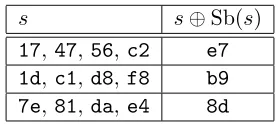
In this section, we explore the relationship between 1-byte partial round keys and their quiet 1-byte intermediate values. In fact, Nakasone et al. have already clarified such a relationship when they calculated the frequency of “clockwise collisions” [12]. Below, we rephrase that to fit our context, adding a little something not seen before (Table 2).
We start with an example. From the specification for the S-box of the AES, we calculate
17⊕Sb(17) =47⊕Sb(47) =56⊕Sb(56) =c2⊕Sb(c2) =e7.
Therefore, if we set a 1-byte partial round key (applied to the first row of the State) to
w0,j =e7 for every 0≤j≤3, then each intermediate value s0,j ∈ {17,47,56,c2}satisfies
s0,j⊕c0,j =s0,j⊕(Sb(s0,j)⊕w0,j) = (s0,j⊕Sb(s0,j))⊕e7=00,
meaning that the Hamming distance betweens0,j andc0,j is 0, namely, all the intermediate
values 17, 47, 56, and c2 are quiet for partial round key e7. Consequently, the 4-byte partial round key (often called a word)e7e7e7e7has 44 quiet 4-byte intermediate values
[17|47|56|c2].[17|47|56|c2].[17|47|56|c2].[17|47|56|c2]
where [· | · | · | ·] indicates that we can choose any one of the four strings (and a period indicates concatenation throughout this paper).
As listed in Table 2, in addition to e7, there are two 1-byte partial round keys b9 and
8d that have four quiet intermediate values. Includinge7, these three 1-byte partial round keys have the maximum number of quiet intermediate values, as can be seen in Table 3.
s s⊕Sb(s)
17,47,56,c2 e7 1d,c1,d8,f8 b9 7e,81,da,e4 8d
Table 2: Four 1-byte intermediate valuessthat have the same value ofs⊕Sb(s). Rank # of quiet values # of keys
1 4 3
2 3 15
3 2 54
4 1 91
5 0 93
Table 3: The ranking of the numbers of 1-byte quiet intermediate values. The same statistics appeared in [12].
4
Quiet 4-Byte Intermediate Values
While the previous section tackled the first row in the State, this section deals with the second and fourth rows, addressing 4-byte partial round keys along with their quiet 4-byte intermediate values, as follows.
First, consider the second row in the State, namely s1,j, w1,j, and c1,j for 0 ≤j ≤ 3. For example, if we set a 4-byte intermediate value and a 4-byte partial round key to
s1,0.s1,1.s1,2.s1,3=1c88859a
and
w1,0.w1,1.w1,2.w1,3=d81f3d06,
respectively, then we have
c1,0 = Sb(s1,1)⊕w1,0 = Sb(88)⊕d8=c4⊕d8=1c
c1,1 = Sb(s1,2)⊕w1,1 = Sb(85)⊕1f=97⊕1f=88
c1,2 = Sb(s1,3)⊕w1,2 = Sb(9a)⊕3d=b8⊕3d=85
c1,3 = Sb(s1,0)⊕w1,3 = Sb(1c)⊕06=9c⊕06=9a,
and hence the intermediate value is quiet (in the second row) for the partial round key (including 1c88859a, there are 12 quiet intermediate values).
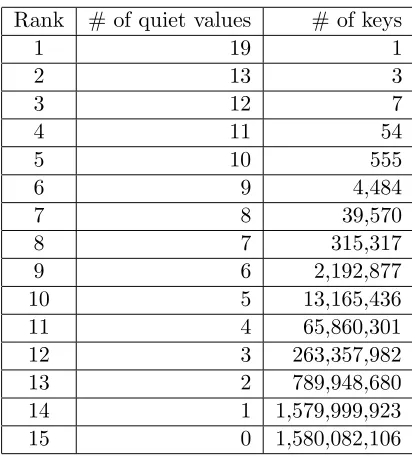
Table 4 shows the ranking for the 4-byte quiet intermediate values. Notice that there is only one partial round key that has the maximum number, namely 19, of quiet intermediate values; that key is
Rank # of quiet values # of keys
1 19 1
2 13 3
3 12 7
4 11 54
5 10 555
6 9 4,484
7 8 39,570
8 7 315,317
9 6 2,192,877
10 5 13,165,436
11 4 65,860,301
12 3 263,357,982 13 2 789,948,680 14 1 1,579,999,923 15 0 1,580,082,106
Table 4: The ranking of the numbers of 4-byte quiet intermediate values.
and it has the following 19 quiet intermediate values:
s1,0.s1,1.s1,2.s1,3 =
0ab466e0,b466e00a,66e00ab4,e00ab466,
0dcfd450,cfd4500d,d4500dcf,500dcfd4,
2f6fc892,6fc8922f,c8922f6f,922f6fc8,
46dd46dd,dd46dd46,
6dbb6dbb,bb6dbb6d,
b9d1b9d1,d1b9d1b9,
cccccccc.
(3)
Note that since the key consists of four bytes of the same value (namely,87), if an interme-diate value
s0.s1.s2.s3
is quiet, then s1.s2.s3.s0 (shifted cyclically) is also quiet.
Somewhat surprisingly, the second largest number of quiet intermediate values is 13 as shown in Table 4. That is, there is no partial round key having 18, 17, 16, 15, or 14 quiet intermediate values. Table 4 also shows that 36.79% of all 4-byte partial round keys have no quiet intermediate value.
5
Quiet 2-Byte Intermediate Values
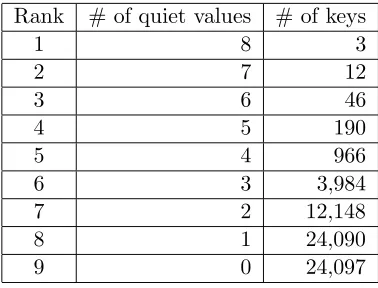
Similarly to the previous two sections, we calculate the ranking for the 2-byte case as shown in Table 5.
Rank # of quiet values # of keys
1 8 3
2 7 12
3 6 46
4 5 190
5 4 966
6 3 3,984
7 2 12,148
8 1 24,090
9 0 24,097
Table 5: The ranking of the numbers of 2-byte quiet intermediate values.
Thus, the maximum number of quiet intermediate values is eight, and there are three partial round keys that have such values, as listed in Table 6. Note that the keysfe08and
08fealong with their intermediate values are “symmetric,” as is the key a6a6itself.
Intermediate values Round key
0563,3410,3a88,b365,d50b,d93d,e0e9,f281 fe08 00c5,1756,2e97,5f69,c500,5617,972e,695f a6a6 6305,1034,883a,65b3,0bd5,3dd9,e9e0,81f2 08fe
Table 6: All 2-byte round keys that have eight quiet intermediate values.
6
Cipher Keys with Quiet Plaintexts
In this section, based on the observations thus far, we discuss 128-bit cipher keys with quiet plaintexts.
We here explore all cipher keys having the maximum number of quiet plaintexts. To this end, we summarize the corresponding round keys used in Round 10. As shown in Section 3, each w0,j in the first row can be one of three candidates: e7, b9, or 8d. As shown in Section 4, bothw1,0.w1,1.w1,2.w1,3 in the second row and w3,0.w3,1.w3,2.w3,3 in the
fourth row can be only87878787. As seen in Section 5, bothw2,0.w2,2 andw2,1.w2,3 in the
third row can be one of three candidates: fe08, a6a6, or 08fe. In other words, we have determined the desired round keys as
w0,0 w0,1 w0,2 w0,3
87 87 87 87
such that
w0,0, w0,1, w0,2, w0,3 ∈ {e7,b9,8d}
w2,0.w2,2, w2,1.w2,3 ∈ {fe08,a6a6,08fe}.
Therefore, there are exactly 34×32 = 729 candidate round keys, and hence the same number of corresponding AES-128 cipher keys exist. Note that, given a round key in Round 10, one can easily calculate the corresponding AES-128 cipher key following the specification of the AES-128 round key schedule algorithm.
Let us fix a cipher key that has the maximum number of quiet plaintexts. The first row then has 44 candidates for intermediate values (as shown in Table 2), the second and fourth rows have 19 candidates each (as shown in Eq. (3)), and the third rows has 82candidates (as shown in Table 6). Therefore, there are exactly 44×192×82 = 5,914,624 quiet plaintexts. Note that one can easily generate such quiet plaintexts using the intermediate values in Table 2, Eq. (3), and Table 6.
Furthermore, the rate of cipher keys that have no quiet plaintext can be computed as follows:
1−
28−93 28
4
×
232−1580082106 232
2
×
216−24097 216
2
= 97.37%.
7
Considering Noisy Plaintexts
Until now, we have considered only quiet plaintexts, but we can easily deal with noisy plaintexts (which mean to have Hamming distance 128) as well; in Section 7.1, we enumerate all of the cipher keys that have the maximum number of noisy plaintexts in a similar manner. We also consider cipher keys that have both quiet and noisy plaintexts in Section 7.2.
7.1 The 729 Cipher Keys with Noisy Plaintexts
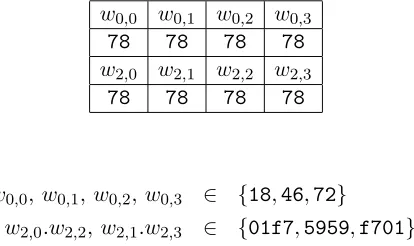
We are able to discuss the ’noisy’ case in the same way as the ‘quiet’ case simply by negating all bits in the round key. That is, the 729 cipher keys having the maximum number 5,914,624 of noisy plaintexts are characterized by the round keys:
w0,0 w0,1 w0,2 w0,3
78 78 78 78
w2,0 w2,1 w2,2 w2,3
78 78 78 78
where
w0,0, w0,1, w0,2, w0,3 ∈ {18,46,72}
w2,0.w2,2, w2,1.w2,3 ∈ {01f7,5959,f701}.
7.2 Cipher Keys Having Both Quiet and Noisy Plaintexts
Given a cipher keyK ∈ {0,1}128, we denote the number of its quiet plaintexts byquiet(K), and the number of its noisy ones bynoisy(K). Here, we reveal the cipher keys K such that min{quiet(K),noisy(K)} is maximized. Actually, our calculation has shown that one can enumerate all such cipher keys (and their quiet/noisy plaintexts) using the following table.
72/8d
quiet/noisy c6,49
noisy/quiet e4,da,81,7e 5959/a6a6
quiet/noisy f61b,a67d,a263,7da6,63a2,4343,1bf6
noisy/quiet c500,972e,695f,5f69,5617,2e97,1756,00c5 659a659a/9a659a65
quiet/noisy 7be98fbb,7e449c69,8fbb7be9,9c697e44,9f14e641,ce0ee711,e6419f14,e711ce0e
noisy/quiet 0ee711ce,11ce0ee7,14e6419f,419f14e6,449c697e,697e449c,bb7be98f,e98fbb7b ab54ab54/54ab54ab
quiet/noisy 4e2a8a7b,52698b54,717ac3f7,85c385c3,8a7b4e2a,8b545269,c3f7717a,dfcadfca
noisy/quiet 2a8a7b4e,5452698b,698b5452,7ac3f771,7b4e2a8a,c385c385,cadfcadf,f7717ac3 afd8afd8/50275027
quiet/noisy 040e4a2a,06b706b7,115a115a,4a2a040e,4d3b4d3b,56695669,5f175f17,772d772d
noisy/quiet 1eb6ac55,2b03a6d6,47874787,a6d62b03,ac551eb6,b0a0eac0,d341d341,eac0b0a0 d8afd8af/27502750
quiet/noisy 0e4a2a04,175f175f,2a040e4a,2d772d77,3b4d3b4d,5a115a11,69566956,b706b706
noisy/quiet 03a6d62b,41d341d3,551eb6ac,87478747,a0eac0b0,b6ac551e,c0b0a0ea,d62b03a6
This table indicates that partial round key 72 has two quiet intermediate values (c6,
49) and four noisy ones (e4,da,81,7e), key8d has two noisy ones (c6,49) and four quiet ones (e4,da, 81,7e), key 5959has seven quiet ones and eight noisy ones, and so on. For example, if we set a round key to be
72 72 8d 8d 65 9a 65 9a 59 a6 59 a6 65 9a 65 9a
,
then the corresponding cipher key,
Cipher Key = bb 05 16 0c 54 5a 7a cc a0 8e be 2d 80 8d 49 55, (4)
has (22 ×42)×8×(7×8)×8 = 229,376 quiet plaintexts and the same number of noisy ones. Thus, there are exactly 42×8×2×8 = 768 cipher keys K that have the maximum value of min{quiet(K),noisy(K)}= 229,376.
men-given the motivation and computing resources). However, we report these results because quiet/noisy plaintexts can play an important role in designing AES-implemented hardware, as discussed in the next section.
8
Applications to Side-Channel Vulnerability Evaluation
In this section, we propose applications of quiet/noisy plaintexts to efficient side-channel vulnerability evaluation; they will be useful when designing secure AES-implemented hard-ware.
We first explain briefly how quiet and noisy plaintexts can be utilized for efficient side-channel vulnerability evaluation in Section 8.1. We then demonstrate this efficient evalua-tion method: we present the theoretical background in Secevalua-tion 8.2 and show the results of an experiment in Section 8.3.
8.1 Basic Idea
As shown above, the cipher keys found in the previous sections have numerous quiet and noisy plaintexts. Any one of these cipher keys along with any of its quiet and noisy plain-texts results in a Hamming distance of 0 and 128, respectively, between the State before and after the final round during the AES-128 encryption. Furthermore, it is well-known that fluctuation of the power consumption in the AES-implemented hardware can leak in-formation about the cipher key stored inside the hardware, and that the amount of power consumption depends on the Hamming distance (e.g., [10]).
Thus, if a designer with a prototype stores a cipher key chosen from the found keys and inputs both some quiet plaintexts and some noisy ones, then he/she can generate a large power consumption fluctuation. Using this idea, we can efficiently evaluate how much and/or how far the cipher-key information leaks around an AES device by measuring the voltage drop or probing the electromagnetic field. We could even determine a 3D leakage map around the prototype hardware. The key point is that we need only a small number of plaintexts for the evaluation (and can therefore dramatically reduce the measurement time and computation cost).
8.2 Theoretical Background
To evaluate side-channel vulnerability, we present an efficient method for measuring “Signal-to-Noise Ratios (SNR)” (in the context of power analysis attack scenarios) [10], that indicate how much information leakage occurs.
Assume that there is an AES-128-implemented device in which a cipher key is set. We input a bunch of random plaintexts while measuring the power consumption. Then, following the notation in [10], the power consumption P can be modeled as
P =Pexp+Pnoise+C
where Pexp is a random variable indicating the exploitable power consumption, Pnoise is a random variable representing the noise, and C is the constant component. Furthermore, the SNR is defined as
We suppose that the device obeys the so-called Hamming-distance model, i.e., the ex-ploitable power consumption can be written asPexp =dH wheredis a constant, and H is
a random variable representing the Hamming distance between the State before and after the final round. Since the plaintexts are chosen randomly, one may assume thatH follows a binomial distributionB(128,1/2). Therefore, we have
Var(Pexp) = Var(dH) =d2·128·(1/2)(1−1/2) = 32d2.
Regarding the noise component, one may assume that Pnoise follows a normal distribution
N(μ, σ2) for some μ and σ2. Hence, we have
SNR= 32d
2
σ2 .
Thus, in order to determine how much cipher key information leaks (at the measuring position), it is sufficient to learn dand σ2.
To this end, we can utilize quiet and noisy plaintexts as follows. Note that, when the plaintext is quiet, the power consumption will be Pnoise+C; when the plaintext is noisy,
it will be 128d+Pnoise+C. Now, as designers, we wish to learn d and σ2 of the device efficiently. First, we choose one of the cipher keys given in Section 7.2 and prepare a number of quiet and noisy plaintexts for the key. We then measure the power consumption while inputting these quiet plaintexts; we calculate the average of the power consumption pquiet
and its empirical variance s2. Similarly, we obtain the average of the power consumption
pnoisyby inputting the noisy plaintexts. As can easily be noticed, the differencepnoisy−pquiet
corresponds to an estimation of 128d. Also,σ2 can be estimated just by s2. In this way, we can easily and efficiently estimate d and σ2 and hence the SNR by the use of quiet/noisy plaintexts.
8.3 Experiment
Based on the idea mentioned in the previous subsection, we conducted a fundamental ex-periment using a standard side-channel attack evaluation board, the SASEBO-G [14], in which the AES-128 encryption is implemented on its FPGA. We set an AES-128 cipher key as given in Eq. (4). Executing encryption of the 10 quiet plaintexts and the 10 noisy plaintexts given in Appendix A, we measured the electromagnetic field by a magnetic probe at five positions on and near the FPGA (namely, 0.0, 0.5, 1.0, 2.0, and 3.0 cm away from the FPGA). For every position and every plaintext, we obtained 100 waveforms. That is, we have 1,000 waveforms of quiet plaintexts and 1,000 waveforms of noisy ones in total for each position.
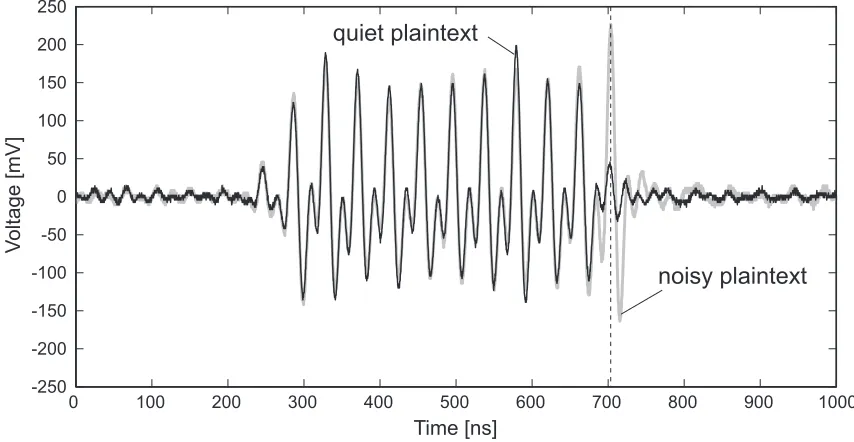
Figure 1 shows a waveform of a quiet plaintext and a waveform of a noisy one at the position contacting the FPGA (0.0 cm away). As can be seen in the figure, there is a significant difference between the two waveforms at 704 ns where the manipulation related to Round 10 occurred. That is, we can confirm that quiet/noisy plaintexts made extreme actions in the final round of the AES encryption.
We calculated the averages pquiet,pnoisy, and the empirical variance s2 to estimate the SNR. Table 8 shows the results, where
ˆ
SNR= 32
0 100 200 300 400 500 600 700 800 900 1000 -250
-200 -150 -100 -50 0 50 100 150 200 250
V
oltage [mV]
Time [ns]
noisy plaintext quiet plaintext
Figure 1: A waveform of a quiet plaintext and a waveform of a noisy one.
is the estimated value.
Position pquiet (mV) pnoisy (mV) s2 (mV2) SNRˆ
0.0 cm 40.9 215.5 29.17 2.041 0.5 cm 17.8 36.2 6.71 0.098 1.0 cm 9.2 12.9 7.13 0.003 2.0 cm 5.0 5.7 6.16 0.000 3.0 cm 3.5 3.6 5.27 0.000
Table 8: The Estimated SNR at various distances from the FPGA.
Thus, even with a small number of waveforms, we can check for cipher-key information leakage, allowing us to efficiently evaluate side-channel attack vulnerability.
9
Conclusion
In this paper, we investigated pairs of AES-128 cipher keys and plaintexts which result in being quiet/noisy in the final round. We described some interesting cipher keys that have quiet and/or noisy plaintexts. Since both the quiet and noisy plaintexts make extreme actions in the final round of AES encryption, the AES-128 cipher keys described here are quite useful for evaluating side-channel attack vulnerability, as we demonstrated.
of our technique is in fact an advantage because our evaluation method is simple and hence can be easily implemented by almost all designers with little cost and effort.
Note that quiet/noisy plaintexts would be useful for cryptographic hardware designers, but not for attackers (at least not directly). Actually, some recent research has been adopt-ing the idea that suitable plaintexts, say those with rather small (but non-zero) Hammadopt-ing distances in the final round, are chosen for efficient side-channel attack evaluation (e.g., [6, 7]). However, to the best of our knowledge, there has not been any study that uses quiet plaintexts (i.e., those with exactly-zero-Hamming distance) yet. Therefore, we believe that our results in this paper will enhance the efficiency of existing methods for side-channel attack evaluation. It should be noted that there is a gap between the almost-zero-Hamming distance and exactly-zero-Hamming distance cases because the action for the latter case tends to be somewhat different from the others (cf., [9, 12]).
References
[1] C. Bouillaguet, P. Derbez, and P. Fouque, “Automatic search of attacks on round-reduced AES and applications,” Advances in Cryptology CRYPTO 2011, Lecture Notes in Computer Science, Vol. 6841, pp. 169–187, 2011.
[2] E. Brier, C. Clavier, and F. Olivier, “Correlation power analysis with a leakage model,” CHES 2004, Lecture Notes in Computer Science, Vol. 3156, pp. 16–29, 2004.
[3] P.A. Fouque, J. Jean, and T. Peyrin, “Structural evaluation of AES and chosen-key distinguisher of 9-Round AES-128,” Advances in Cryptology CRYPTO 2013, Lecture Notes in Computer Science, Vol. 8042, pp. 183–203, 2013.
[4] C. Gentry, S. Halevi, and N. P. Smart, “Homomorphic evaluation of the AES cir-cuit,” Advances in Cryptology CRYPTO 2012, Lecture Notes in Computer Science, Vol. 7417, pp. 850–867, 2012.
[5] V. Grosso, F.X. Standaert, and S. Faust, “Masking vs. multiparty computation: how large is the gap for AES?,” CHES 2013, Lecture Notes in Computer Science, Vol. 8086, pp. 400–416, 2013.
[6] Y. Hayashi, N. Homma, T. Mizuki, H. Shimada, T. Aoki, H. Sone, L. Sauvage, and J.-L. Danger, “Efficient evaluation of EM radiation associated with information leakage from cryptographic devices,” IEEE Trans. on Electromagnetic Compatibility, Vol. 55, No. 3, pp. 555–563, 2013.
[7] Y. Kim, T. Sugawara, N. Homma, T. Aoki, and A. Satoh, “Biasing power traces to improve correlation power analysis attacks,” Proc. Int. Workshop Constructive Side-Channel Anal. Secure Design, pp. 77–80, 2010.
[9] Y. Li, D. Nakatsu, Q. Li, K. Ohta, and K. Sakiyama, “Clockwise collision analysis – overlooked side-channel leakage inside your measurements. cryptology,” ePrint Archive, Report 2011/579, 2011.
[10] S. Mangard, E. Oswald, and T. Popp, Power Analysis Attacks: Revealing the Secrets of Smart Cards, Springer-Verlag New York, Inc., Secaucus, NJ, USA, 2007.
[11] A. Moradi, A. Poschmann, S. Ling, C. Paar, and H. Wang, “Pushing the limits: a very compact and a threshold implementation of AES,” Advances in Cryptology EURO-CRYPT 2011, Lecture Notes in Computer Science, Vol. 6632, pp. 69–88, 2011.
[12] T. Nakasone, Y. Li, Y. Sasaki, M. Iwamoto, K. Ohta, and K. Sakiyama, “Key-dependent weakness of AES-based ciphers under clockwise collision distinguisher,” In-formation Security and Cryptology (ICISC 2012), Lecture Notes in Computer Science, Vol. 7839, pp. 395–409, 2013.
[13] NIST FIPS PUB 197, “Announcing the ADVANCED ENCRYPTION STANDARD (AES),” National Institute of Standards and Technology, U. S. Department of Com-merce, 2001.
[14] Side-channel Attack Standard Evaluation Board, 2007. http://www.risec.aist.go.jp/project/sasebo/
A
Quiet and Noisy Plaintexts used in our Experiment
Fix a cipher key:
Cipher Key = bb 05 16 0c 54 5a 7a cc a0 8e be 2d 80 8d 49 55.
The following table lists 10 of its quiet plaintexts.
09 c2 59 35 cb da 4f 6d 6a 66 0e 98 79 06 f3 2a 72 e4 59 81 f5 b9 3a 60 b4 5a 2e 02 6c 1b 93 fb af 7c 99 f4 03 1e 5a 96 70 35 3e cf 3a 84 5c b6 97 76 a8 ac c9 d8 cb 1b 96 a8 50 91 0d 7d 5f 94 04 d5 29 6a 0c 42 90 85 2d 75 20 26 41 2a 9c 1a 83 2c 67 c7 4a ef f1 82 da 94 d9 a3 11 d5 bf 4a 24 c0 21 0a 0b b6 fe 53 7b 53 e2 1d 39 b6 6d 03 36 52 0a 47 31 42 0d 6e 62 e4 ea 89 69 c5 15 b2 a6 3b 89 ac 3f 1b 95 2d 14 a2 de 20 78 55 7f 23 10 b6 73 ef 7d c0 93 22 be 6c 99 c1 24 99 85 46