1 INTRODUCTION
1.1 Axial Pile Design Methods
Design methods for axially loaded driven piles in sands have evolved significantly over the past 20 years, mainly driven by the requirements of the offshore oil and gas industry. For fixed offshore struc-tures, driven open-ended steel piles are the most common foundation solution, due to their relative ease of driveability and their ability to resist large moment loading (Schneider, 2007). The increasing
de-Ageing effects and CPT based design methods for driven piles in sands
D. Igoe, L. Kirwan and K.G. Gavin
Geotechnical Research Group, School of Civil, Structural and Environmental Engineering, University College Dublin, Ireland
ABSTRACT: The offshore wind industry has traditionally relied on foundation and support structures that were developed for the oil and gas sector. As wind farms move into deeper water and thus more complex ground conditions, efficient foundation design will become increasingly more important. In wa-ter depths > 30 m jacket foundations become a viable economic method of supporting wind turbines. These structures rely on axially loaded piles to provide foundation support. Recent years have seen the emergence of CPT based design methods that use the CPT qc profile to make more reliable predictions of the capacity of driven piles. These new design methods, including the ICP-05, Fugro-05, NGI-05 and UWA-05 have significantly improved the accuracy of predictions, proving the usefulness of site specific data, in this case CPT qc data, for pile design. However, it is becoming clear through recent research that further factors need to be incorporated into the design codes to further improve the reliability of predic-tions. One such variable is the effect of ageing on the pile shaft capacity. Many researchers have shown that the capacity of driven piles in sand increases over time. This paper presents the results of a set of field tests in a dense silica sand site in Blessington, Ireland. A number of 340mm diameter open-ended steel piles were driven 7m into dense sand and load tested at different times after driving to obtain the pile’s capacity. Predictions of the pile capacity using CPT design methods are compared with the meas-ured capacities and it is shown that unless a time factor is included in the design method, the prediction ability of these design codes is confined to the short term capacity of piles, in the days after driving. In-corporating an Intact Ageing Characteristic, originally proposed for the ICP-05 design method, resulted in significantly improved predictions of the pile capacities at Blessington.
mands of the offshore industry requires the continuing evolution of pile design methods to improve effi-ciency of design and to allow extrapolation of design methods to the extreme pile geometries now used in offshore renewables industry. Due to the large number of variables known to affect pile capacity in sand, existing theoretical methods for predicting the soil response during and after installation are gener-ally considered inadequate (Randolph 2003). As a result a wide range of empirical approaches are cur-rently in use. Traditional design methods for predicting the pile shaft capacity are based on the earth pressure approach which relates the local unit shaft friction, τf, to the in-situ vertical effective stress, σ'v0. These earth pressure based approaches have been used successfully for over 50 years in the offshore in-dustry and are included in the main text of the American Petroleum Institute (API) recommended prac-tice for fixed offshore structures (RP2A) as follows:
. ′ [1] Where β is an empirical parameter based on the soil relative density, Dr, originally derived as the product of the coefficient of lateral earth pressure, Kf, and the tan of the interface friction angle. In re-cent editions of the guidelines API (2008), recommended values of β vary from 0.29 for medium dense sand-silts to 0.56 for very dense sand. The API methods poor predictive performance has been high-lighted by several researchers (Toolan et al., 1990, Jardine et al., 2005, Lehane et al., 2005, Schneider et al., 2008, Gavin et al., 2011 and others) who compared the API capacity predictions to a database of static load tests. Significant bias in capacity predictions were noted with regards to the pile slenderness (ratio of pile length, L, to diameter, D) and soil relative density. The inherent bias evident in the API main text procedure has long been recognized and has driven research efforts to improve pile design methods.
The Cone Penetration Test (CPT) can provide a large amount of repeatable information on the verti-cal variability of the soil strength and compressibility (Schneider et al. 2008) and the penetration of a cone into the soil can be seen as somewhat analogous to closed-ended pile installation. A campaign of field tests using a highly instrumented closed-ended model pile was started by Imperial College in the early 1990s. The Imperial College Pile (ICP) was jacked into a medium-dense sand site at Labenne (Le-hane, 1992) and into dense marine sand at Dunkirk (Chow, 1997). Several key findings stemmed from this research as follows:
a) The local shear stress during failure was seen to follow a Mohr – Coulomb failure criterion and was dependent on the equalised radial effective stress, σ'rc; a component related to the increase in radial stress as a result of dilation, σ'rd; and the tan of the interface friction angle at failure, δf:
′ ∆ ′ . [2] b) Both the local shear stress, τf, and the equalised radial effective stress, σ'rc, at any location on the
pile shaft were seen to closely mirror the CPT cone resistance, qc, profile.
c) The ratio of σ'rc/qc or (τf / qc) was similar at both sites, despite the largely different CPT qc pro-files, and reduced as the distance from the pile tip, h, increased. This phenomenon is known as friction fatigue.
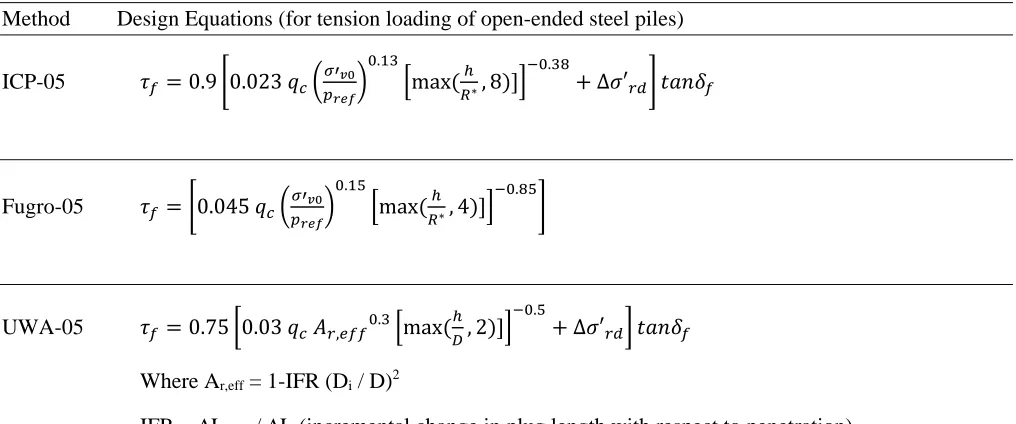
campaign of field tests conducted by the Norwegian Geotechnical Institute (NGI) resulted in the devel-opment of the NGI-05 (Clausen et al. 2005) CPT based pile design method. A summary table of the de-sign formulations of the four new methods for tension loading of steel open-ended piles is shown in Ta-ble 1.
[image:3.612.53.561.162.374.2]
Table 1: Recent CPT-Based Design Methods for Shaft Friction of Driven Piles in Siliceous Sand Method Design Equations (for tension loading of open-ended steel piles)
ICP-05 0.9 0.023
.
max ∗, 8 . ∆ ′
Fugro-05 0.045
.
max ∗, 4 .
UWA-05 0.75 0.03 , . max , 2 . ∆ ′
Where Ar,eff = 1-IFR (Di / D)2
IFR = Lplug / L (incremental change in plug length with respect to penetration)
NGI-05 2.1 0.4 ln 0.1 .
.
0.1 ′
Note: σ'rd ≈ 4Gy/D; pref = 100kPa; R*=equivalent pile radius = (R2‐ Ri2)0.5, R and Ri is the external & internal pile radius = Di/2; qc1N =
(qc/pref)/( σ'v0/pref)0.5
Lehane et al. (2005) performed an assessment of the reliability of the four new CPT design methods and noted considerable improvement in the predictive performance of the CPT methods when compared with the traditional API main text approach. As a result the four CPT based methods were included in the commentary of the API design guidelines and were suggested to be “fundamentally better and show statistically closer predictions of pile load test results” than the API main text approach. The API com-mentary suggests that the new CPT methods are preferred to the main text approach but stipulated that “more experience is required with all these new methods before any single one can be recommended for routine design instead of the Main Text method”.
1.2 Pile Ageing
driven in Dunkirk. The piles, which had a relatively complicated loading history involving multiple re-load tests exhibited an 85% increase in capacity over 5 years. Based on equation 2, Chow suggested three possible mechanisms for the ageing which occurred at Dunkirk:
1) Changes in the stress regime around the pile which led to an increase in the equalised radial ef-fective stress, σ'rc
2) The effect of ageing on soil properties resulting in enhanced constrained interface dilation and an increase in σ'rd
3) Chemical corrosion resulting in an increase in surface roughness and thus a higher mobilised in-terface friction angle
Following on from the findings of Chow et al. (1997) at Dunkirk, Jardine and Standing (2000) and Jardine et al. (2006) presented data from a program of large scale, 457mm diameter, pile tests specifical-ly investigating pile ageing. The load test program included multiple tension static load tests on previ-ously untested ‘virgin’ piles at different time intervals after driving. The results from the virgin static load tests are plotted in Figure 1a and show a 2.3 fold increase in capacity between 9 and 235 days after driving. Based on these findings Jardine et al. (2005) suggested an Intact Ageing Characteristic (IAC) for previously unfailed ‘virgin’ piles in the ICP-05 design procedures as seen in Figure 1b. The original ICP-05 shaft capacity prediction, Qp-ICP, was suggested to predict the medium term (approximately 10-day) capacity, with the end of driving (1-10-day) capacity tentatively suggested to equate to 0.7 times the ICP prediction (i.e. 0.7 Qp-ICP). Another finding of the Dunkirk experiments was that testing and failing piles resulted in significant disruption of the ageing process, with re-tested aged piles showing substan-tially lower capacity increases due to ageing.
[image:4.612.62.531.403.572.2]
Figure 1 (a) Virgin Tension Tests from Dunkirk and (b) Intact Ageing Characteristic from Dunkirk (after Jardine et al. 2006)
With the exception of the ICP method, none of the other three CPT methods account for the signifi-cant effects of ageing in their calculation procedures. The CPT design method calculations are consid-ered to be representative of the short to medium term pile capacities (typically less than 50 days), with database study reviews of the design methods thus far ignoring ageing effects or excluding aged piles al-together. The database of tension pile tests compiled by Gavin et al. (2011), which had significant com-monality with the UWA database described by Schneider et al. (2008) and previous databases, is
rein-0 500 1000 1500 2000 2500 3000 3500
0 10 20 30 40
Tension Head Load (kN) Displacement (mm) R1 R6 R2 9 day 81 day 235 day 0 0.5 1 1.5 2 2.5 3
1 10 100 1000 10000
Qm /Q p-ICP Time (days) Intact Ageing Characteristic R1 R2 R6
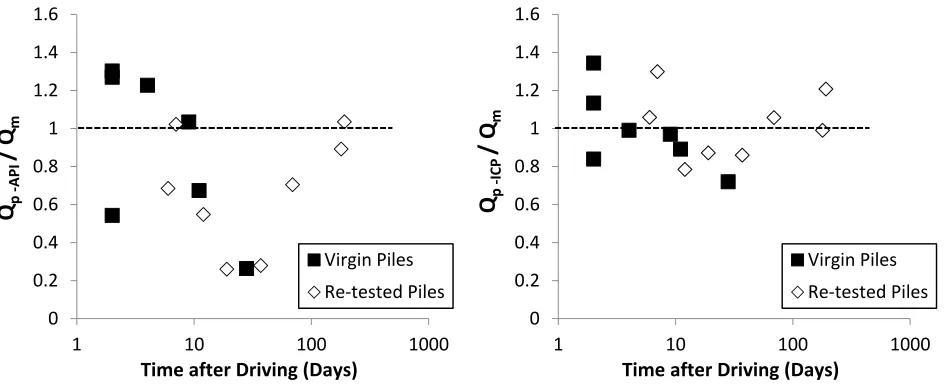
terpreted with respect to pile ageing in Figure 2. The database is limited to piles where siliceous sands contributed more than 75% of the shaft capacity. The piles in the database are separated into ‘virgin’ previously untested piles and re-tested piles and the normalised predicted capacities using the API and ICP calculation procedures are plotted against time. Taking the overall dataset as a whole, it is clear that the ICP method shows much less scatter than that of the API suggesting significantly improved predic-tive reliability. Another notable feature when considering the database as a whole is the lack of any strong ageing trend with time, contrary to what one might expect in light of the Dunkirk tests. However when considering the virgin pile tests only (closed symbols), there appears to be a strong trend for both the API and ICP design methods to over-predict the capacity of recently installed piles (<10 days) and under-predict the capacities of older piles. In the database compiled by Gavin et al. (2011) the oldest virgin pile test was test 28 days after driving. The retested piles (open symbols) appear to be unaffected by ageing, which follows from the conclusions of Jardine et al. (2006) who suggest that pfailed or re-tested piles exhibited substantially less ageing effects. Therefore, as the database consists of mainly rela-tively un-aged ‘virgin’ piles and older pile re-tests, no significant conclusions regarding ageing effects can be drawn. This paper presents results of pile field tests conducted by University College Dublin at the Blessington sand research site. The pile tests followed a testing program specifically designed to in-vestigate the effects of pile ageing and cyclic loading.
[image:5.612.64.537.318.511.2]
Figure 2 Normalised predicted over measured pile capacities with time for (a) the API and (b) the ICP calcu-lation procedures
2 BLESSINGTON AGEING TESTS
2.1 Experimental Details
The pile testing program described in this paper involved driving five open-ended steel piles, designated S2 – S6 into dense sand. The 340 mm diameter piles were driven to 7m depth using a Junntan PM-16 drop hammer piling rig. Pile driving was paused every 1m to take internal soil plug length measure-ments. After installation the piles were load tested in tension at various time intervals after driving. The tests were scheduled primarily to capture the ageing effects on previously untested ‘virgin’ piles over the first few weeks and months after driving. With this in mind, piles S2, S3, S4, S5 and S6 were scheduled for first time load testing 1 day, 10 days, 30 days, 220 days and 144 days after driving respectively.
Fur-0 0.2 0.4 0.6 0.8 1 1.2 1.4 1.6
1 10 100 1000
Qp ‐ API / Qm
Time after Driving (Days) Virgin Piles Re‐tested Piles
0 0.2 0.4 0.6 0.8 1 1.2 1.4 1.6
1 10 100 1000
Qp ‐ ICP / Qm
ther static tension tests and cyclic tests were performed after these first time tests. Full details of the ex-perimental testing programme are given in Igoe et al. (2014). The tension load tests were conducted us-ing a 5m long loadus-ing frame which transferred the load through reaction beams into the ground. A metal top cap, welded onto the piles after installation, allowed the piles to be pulled using a 45mm threaded bar. The static tension tests were loaded in 40 kN increments using a fully automated load controlled hydraulic system which maintained each target load level for a 10 minute period before ramping up to the next load level.
2.2 Site Description
The pile tests were performed at the University College Dublin (UCD) sand test site situated in Bless-ington, 25 km southwest of Dublin city. The ground conditions at the site and the sand properties have been reported in Gavin et al. (2009) and Doherty et al. (2012) amongst others. In summary, the ground conditions comprise of a very dense, glacially deposited fine sand with a relative density close to 100%, CPT qc resistance in the range of 15 to 20 MPa, and a small strain stiffness (G0) in the range 100 to 150 MPa. A total of 10 CPTs were conducted on the site with two CPTs each conducted 1.5m either side of piles S2 – S5 (Figure 3). In general the CPTs showed very good repeatability although the CPT profiles adjacent pile S4 show a slightly lower qc value from 6 – 7 m depth compared with those adjacent piles S2, S3 and S5. Dilatometers conducted at the site indicated a lift off pressure, P0 of between 800 – 1000 kPa with limit pressures, PL, approaching 3500 kPa at depth. Particle size distribution analyses per-formed on samples taken from depths ranging from 0.7 m to 2 m below ground level (bgl) indicated the mean particle size, D50, varied between 0.1 and 0.2 mm. The sand had a fines content (percentage of clay and silt particles) of between 5 and 15 %. Samples typically had less than 10% coarse grained parti-cles (> 0.6 mm). The water table was approximately 13 m bgl.
[image:6.612.58.444.427.642.2]
2.3 Load Test Results
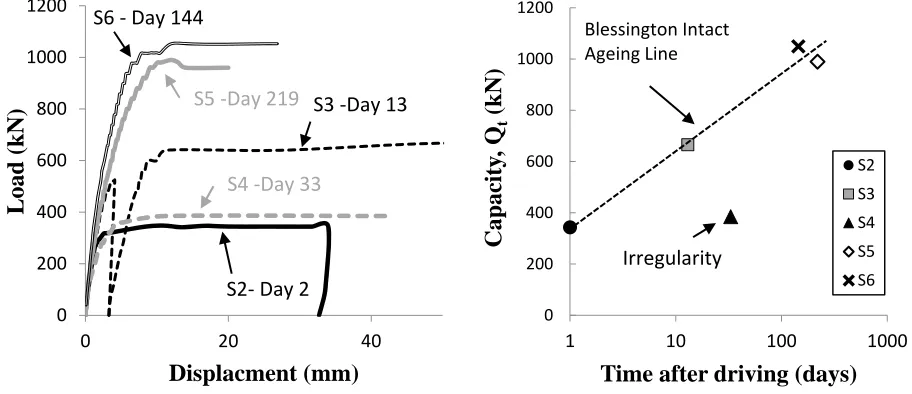
The virgin static load test results for piles S2 – S5 have previously been reported by Gavin et al. (2013). Additional virgin static load –displacement test data from pile S6 is shown in Figure 4a. With the excep-tion of pile S4 it is evident there is a strong trend for capacity to increase with time. The ultimate pile tension capacities are plotted against the log of time in Figure 4b. The capacity of the piles appears to increase linearly with the log of time except capacity of pile S4 plotting well below the general trend line. Gavin et al. (2013) noted that pile S4 had a lower CPT resistance over the bottom 1m of the pile, exhibited notably less plugging during installation and had a significantly lower blow-count during driv-ing then the other piles. This would indicate that pile S4 may have a substantially lower end of drivdriv-ing capacity and hence does not match the ageing trendline exhibited by the other 4 piles. This pile was de-scribed as a normal irregularity and further investigation is underway to determine the cause.
[image:7.612.59.515.243.440.2]
Figure 4 Blessington Pile Test (a) Static Load Displacement curves and (b) Capacity Variation with Time
3 COMPARISON OF CPT METHOD PREDICTIVE PERFORMANCE
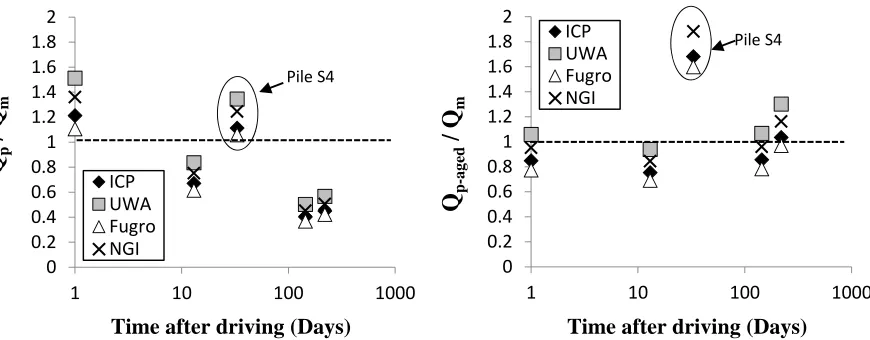
Predictions of the capacities of piles S2 – S6 were made using the four recent CPT methods. The pre-dicted capacity, Qp, normalised by the measured capacity, Qm, for each method is plotted against time in Figure 5. Figure 5a shows the design methods where standard design predictions with no ageing factor are applied. The ageing trend is quite clear with all four CPT methods over-predicting the 1-day capacity of pile S2 but under-predicting the capacity of all other piles (with the exception of pile S4 which is thought to be an irregularity as mentioned previously). When the Intact Ageing Characteristic described in the ICP-05 design method is applied to all the design methods, their predictive performance is im-proved significantly with all the predictions matching the measured capacities closely (except pile S4). It is clear that using ageing factors, such as the Imperial College Intact Ageing Characteristic can lead to notably better capacity predictions with time. The authors are currently investigating the mechanisms controlling pile ageing and are reinterpreting the original pile test database to assess the effect of ageing on piles of varying sizes and geometries.
0 200 400 600 800 1000 1200
0 20 40
Load (kN)
Displacment (mm) S2‐Day 2
S3‐Day 13
S5 ‐Day 219
S4 ‐Day 33
S6 ‐Day 144
0 200 400 600 800 1000 1200
1 10 100 1000
Capacity
, Q
t
(kN)
Time after driving (days) S2 S3 S4 S5 S6
Blessington Intact Ageing Line
Figure 5 Normalised Predicted Capacity for the four recent CPT design methods (a) with no ageing factor and (b) using the Imperial College Intact Ageing Characteristic
4 CONCLUSIONS
This paper presents new field test data from a series of large scale pile tests investigating pile ageing. The piles, which were driven at the University College Dublin, research sand test site at Blessington, were tested sequentially to assess the effects of ageing on the tension capacity of open-ended steel piles in sand. The data from the field tests indicate that pile capacity can increase 300% over the 5 months fol-lowing driving. A reassessment of a pile test database compiled by Gavin et al. (2011) indicates that there is dearth of previously unfailed ‘virgin’ tests on aged piles. Four recent offshore CPT based design methods, which are included in offshore design guidelines, are discussed and their predictive perfor-mance is assessed against the measure pile capacities at Blessington. All four methods offer reasonable predictions of the short to medium term pile capacities but significantly under-estimate the capacities of aged piles. When an ageing factor, the Intact Ageing Characteristic proposed by Imperial College, was applied to the calculations to account for ageing effects, significantly improved predictive performance was noted for all four design methods. Further research is currently underway to investigate the mecha-nisms controlling pile ageing and to assess if these ageing factors can be extropolated to different pile sizes and geometries and be used routinely and safely in design practice.
REFERENCES
Randolph, M. F., 2003. "Science and empericism in pile foundation design," Geotechnique, Vol. 53, No. 10, pp. 847-875.
API, 2008. Recommended Practice for Planning, Designing and Constructing Fixed Offshore Platforms - Work-ing Stress Design. API RP2A. WashWork-ington, D.C., American Petroleum Institute.
Toolan, F. E., Lings, M. L. and Mirza, U. A.,1990. "An appraisal of API RP2A recommendations for determining skin friction of piles in sand," 22nd Offshore Technol. Conf., Houston, Tex., OTC 6422.,
Jardine, R. J., Chow, F. C., Overy, R. F. and Standing, J., 2005. “ICP Design Methods for Driven Piles in Sands and Clays”. T. Telford. London, University of London (Imperial College).
Lehane, B. M., Schneider, J. A. and Xu, X.,2005. "The UWA-05 method for prediction of axial capacity of driven piles in sand," Frontiers in Offshore Geotechnics: ISFOG, Perth, University of Western Australia.
0 0.2 0.4 0.6 0.8 1 1.2 1.4 1.6 1.8 2
1 10 100 1000
Qp
/ Q
m
Time after driving (Days)
ICP UWA Fugro NGI
Pile S4
0 0.2 0.4 0.6 0.8 1 1.2 1.4 1.6 1.8 2
1 10 100 1000
Q
p-aged
/ Q
m
Time after driving (Days)
ICP UWA Fugro NGI
Schneider, J. A., Xu, X. and Lehane, B. M., 2008. "Database assessment of CPT based design methods for axial capacity of driven piles in siliceous sand," Journal of Geotechnical and Geoenvironmental Engineering, Vol. 134, No. 9, pp. 1227-1244.
Gavin, K. G., Igoe, D. and Doherty, P., 2011. "Use of open-ended piles to support offshore wind turbines: A state of the art review," Proceedings of the ICE - Geotechnical Engineering, Vol. 164, No. GE4, pp. 245-256. Axelsson, G., 2000. "Long term set-up of driven piles in sand," PhD Thesis, Royal Institute of Technology. Bullock, P., Schmertmann, J. H., McVay, M. and Townsend, F., 2005. "Side shear setup 1: test piles driven in
Folrida," Journal of Geotechnical and Geoenvironmental Engineering, Vol. 131, No. 3, pp. 292-300. Jardine, R. J., Standing, J. and Chow, F. C., 2006. "Some observations of the effects of time on the capacity of
piles driven in sand," Geotechnique, Vol. 56, No. 4, pp. 227-244.
Chow, F., Jardine, R. J., Brucy, F. and Nauroy, J. F., 1997. "Time related increases in the shaft capacities of driv-en piles in sand," Geotechnique, Vol. 47, No. 2, pp. 353-361.
Jardine, R. J. and Standing, J. R., 2000. Pile load testing performed for HSE cyclic loading study at Dunkirk, France. Report OTO 2000 007. London, Health and Safety Executive.
York, D., Brusey, W., Clemente, F. and Law, S., 1994. "Setup and relaxation in glacial sand," Journal of Ge-otechnical Engineering, Vol. 120, No. 9, pp. 1498-1513.