Angular analysis of the
e
+e
−→
D
(∗)D
∗process near the
open-charm threshold using initial-state radiation
ValentinaZhukova1,∗
1P.N. Lebedev Physical Institute of the Russian Academy of Sciences, Moscow, Russia
Abstract. We report new measurement of the exclusivee+e−→D(∗)±D∗∓cross
sections as a function of center-of-mass energy from theD(∗)±D∗∓threshold up
to √s =6.0 GeV with initial state radiation. The analysis is based on a data sample collected by the Belle detector with an integrated luminosity of 951 fb−1. The accuracy of the cross section measurement is increased by a factor of 2 in comparison with the first Belle study. We have performed the first angular analysis of thee+e−
→ D∗±D∗∓process and decomposed this exclusive cross
section into three components corresponding to the differentD∗helicities.
1 Introduction
Charmonium states with quantum numbers 1−− (calledψ-states) were discoveried in e+e− collaiders experiments more than forty years ago. In spite of both teoreticals and experimen-tators numerous effots the nature and propeties of theseψstates are not fully understood yet. Until recently the parameters of the vector charmonia lying above open-charm threshold were extracted from the total cross section of thee+e−annihilation into charmed hadrons. However
parameters obtained by this way are model dependent and suffered from large uncertanties. The analusis of the exclusive cross sections allow to obtain the parameters ofψstates by the model independent way.
The exclusive e+e− cross sections to different open-charm final states were measured
first atB-factrories by Belle [2–7] and BaBar [8–10] using the initial state radiation (ISR) technique. The ISR process, in which a hard photon with a significant part of initial en-ergy is emitted beforee+e−annihilation, allows one to get center-of-mass energies below the
energy ofB-factory. Accurate measurements of two body open charm final states were pre-sented by CLEO [11] using an energy scan in the narrow range of 3.97-4.26 GeV. Moreover Belle has demonstrated that in the studied energy region the sum of the measured two body (D(∗)D¯(∗)
,D(s∗)+D
(∗)−
s ,Λ+cΛ−c) and three bodyDD¯
(∗)π
cross sections saturates within errors the total hadronic cross section (after subtraction of theu,d, andscontinuum) [12]. The main contribution to the inclusive cross section comes from theDD¯,DD¯∗, andD∗D¯∗final states.
Recently were presented the first attempt to extract the parameters ofψstates (in particu-lar, their couplings to the open-charm channels) from a combined coupled-channel fit for all measured by Belle exclusive open charm cross sections Ref. [13]. Although the suggested approach provides a good overall description of the line shapes, reliable conclusions have not be made because of the limited statistical accuracy of the data and because of the absence of the experimental information on the three helicity amplitudes of theD∗D¯∗system.
∗e-mail: [email protected]
Here we report a new measurement of the exclusive cross sections e+e− → D(∗)D∗ as
function of the center-of-mass energy near theD(∗)D∗ threshold with initial state radiation
(charge-conjugate modes are included throughout this paper). The increased data sample collected by Belle, the improved track reconstruction, few additionalDandD∗decay modes
used in event reconstruction provided more accurate cross sections results. We also perform the first angular analysis of thee+e−→D∗±D∗∓processes which allows to decompose
explic-itly the studied cross section into three components corresponding to differentD∗’s helicities.
2 Data sample and Belle detector
The reported analysis is based on the data sample with the integrated luminosity of 951 fb−1 collected by Belle detector [14] at the KEKB asymmetric energye+e−collider at the energies
of theΥ(4S) andΥ(5S) resonances and the nearby continuum [15].
The Belle detector is a large-solid-angle magnetic spectrometer that consists of a silicon vertex detector (SVD), a 50-layer central drift chamber (CDC), an array of aerogel threshold Cherenkov counters (ACC), a barrel-like arrangement of time-of-flight scintillation counters (TOF), and an electromagnetic calorimeter (ECL) composed of CsI(Tl) crystals located inside a superconducting solenoid coil that provides a 1.5 T magnetic field. An iron flux-return located outside of the coil is instrumented to detect K0
Lmesons and to identify muons (KLM).
A detailed description of the detector can be found in [14].
3 Method
We use the method elaborated by Belle [3] to select thee+e− → D(∗)D∗γIS R signal events.
To increase the statistic we require full reconstruction of only one of theD∗+(fore+e− →
D∗+D∗−
) or D+meson (for e+e− → D+D∗−
), theγIS R photon, and the slow pion from the
otherD∗−decay. Such partialD∗−reconstruction without reconstruction of the ¯D0
from the
D∗− decays allows to significantly increase the overall efficiency by a factor of ∼ 20 for
e+e− → D∗+D∗−
and∼ 10 fore+e− → D+D∗−
, while the method allows to suppress the backgrounds down to a low level and to subtract the residual backgrounds reliably using the data. Usually for analising ISR procsses we regquired the fully reconstruction of the hadronic final state andγIS R is inferred from the spectrum of masses recoiling against the
hadronic system. But here we require the reconstruction of theγIS R. In spite of tendency to
emit ISR photon outside the detector acceptance, the requirement to reconstructγIS Rdoes not
significantly decrease the efficiency as slow pions fromD∗±decays have low reconstruction
efficiency whenγIS Ris outside the detector acceptance because of very lowp⊥ofγIS Rin this
case. Thus, if the ISR photon is emited along the beam pipe and undetected, the hadronic part of the ISR event can not be reconstructed as well.
For the signal events the spectrum of masses recoiling against theD(∗)+γ
IS Rsystem
Mrec(D(∗)+γIS R)= q
(Ec.m.−ED(∗)γ
IS R)
2 −p2
D(∗)γIS R, (1)
peaks at theD∗−mass. HereEc.m.is thee+e−
center-of-mass energy,ED(∗)+γ
IS RandpD(∗)+γIS Rare
the center of mass energy, and momentum of theD(∗)+γ
IS R system, respectively. According
to Monte Carlo (MC) study, this peak is wide (σ∼150MeV/c2) and asymmetric due to the asymmetric photon energy resolution function and higher order ISR corrections (i.e. more than oneγIS R in the event). Because of poor Mrec(D(∗)+γIS R) resolution the signals from DD¯,DD¯∗, andD∗D¯∗strongly overlap, hence one cannot separate these processes using this
To resolve this problem we use the information provided by the slow pion from the un-reconstructed D∗−meson. The distribution of the difference between the masses recoiling
against theD(∗)+γ
IS RandD(∗)+π−slowγIS R(recoil mass difference),
∆Mrec=Mrec(D(∗)+γIS R)−Mrec(D(∗)+π−slowγIS R), (2)
has a narrow peak for the signal process around them∗+
D−mD0mass difference. The resolution
of this peak is better than 2 MeV/c2as the uncertainty ofγ
IS Rmomentum is mostly canceled
out for this variable. Thus the existence of a partially reconstructed D∗− in the event is
identified by the presence of this peak. The method does not exclude contribution to the∆Mrec
peak from processes with extra neutrals in the final state (e.g. e+e−→ D(∗)D∗π0). However this background is suppressed and its residual contribution can be reliably determined using the data, as discussed below.
To measure the exclusive cross sections as a function of √sone needs to obtain the
D(∗)D∗
mass spectrum while one of D∗ mesons remains unreconstructed. In the absence
of higher-order QED processes, the D(∗)D∗
mass corresponds to the mass recoiling against the single ISR photon: M(D(∗)D∗
) ≡ Mrec(γIS R). However, the poorMrec(γIS R) resolution
(σ ∼ 120MeV/c2) does not allow the study of relatively narrow charmonium states in the D(∗)D∗mass spectra. To improve theM
rec(γIS R) resolution we refit the recoil mass against
theD(∗)+γ
IS Rsystem, constrained to theD∗mass. This procedure utilizes the well-measured
momentum of the reconstructedD(∗)+meson to correct the momentum of the ISR photon. It works well even in case of a second ISR photon as checked with the MC. As a result, the
Mrec(γIS R) resolution is drastically improved: near the threshold the resolution is better than
3 MeV/c2, and smoothly increases up to 15 MeV/c2 at √s
∼6 GeV. The resolution of the recoil mass difference after refit,∆Mrecf it, improves also by a factor of∼2, which is exploited
for more effective suppression of the combinatorial background.
4 Backgrounds
We consider the following background sources:
1. combinatorialD(∗)+
candidate combined with a true slow pion fromD∗−decay;
2. realD(∗)+
mesons combined with a combinatorial slow pion;
3. bothD(∗)+andπ−
sloware combinatorial;
4a. reflection from the processese+e−→D(∗)+D∗−π0
missγIS Rwith a lostπ
0in the final state,
includinge+e−→D∗+D∗−γIS Rfollowed byD∗+
→D+π0;
4b. reflection frome+e−→D∗+D∗−γ
IS Rfollowed byD∗+→D+γ;
5. contribution frome+e−→D(∗)+D∗−π0
f ast, where the fastπ
0
f astis misidentified asγIS R.
The contribution from the combinatorial backgrounds (1)-(3) is extracted using two-dimensional sideband regions of the D(∗)+
candidate mass versus the recoil mass dif-ference.The dominant part of the background (4) suppressed by tight requirement on
Mrec(D(∗)+)γIS R. The remaining part is estimated from the data measuring the
isospic-conjugated processe+e− → D(∗)0D∗−π+γ
IS R. We applied the similar partial reconstruction
method by replacingD(∗)+withD(∗)0. Background (5) is estimated similarly to the study of e+e− → D(∗)+D∗−γ
IS R (by replacing γIS R withπ0f ast) and found to be negligibly small. Its
possible contribution is included into the systematic uncertainty.
The obtainedD+D∗−andD∗+D∗−mass spactra, after appling all requirements, are shown
in Fig. 1.
0 100 200 300 400
4 4.5 5 5.5 6
M(D+ D*– ) GeV/c2
Events/20 MeV/c
2
N/10 MeV/c
2
0 50 100 150 200
4 4.2 4.4
0 100 200 300 400
4 4.5 5 5.5 6
M(D*+D*– ) GeV/c2
Events/20 MeV/c
2
N/10 MeV/c
2
0 50 100 150 200
4 4.1 4.2 4.3 4.4
Figure 1. The a)D+D∗−and b)D∗+D∗−mass spectra in the data after applying all selection criteria
(points with error bars). The sum of backgrounds (1)–(3) is shown as the hatched histogram. The inset shows the spectrum near the threshold with finer bins.
√s GeV
σ
(nb)
0 1 2 3 4
4 4.5 5 5.5 6
0 2 4
4 4.2 4.4
√s GeV
σ
(nb)
0 1 2 3
4 4.5 5 5.5 6
0 1 2 3
4 4.2 4.4
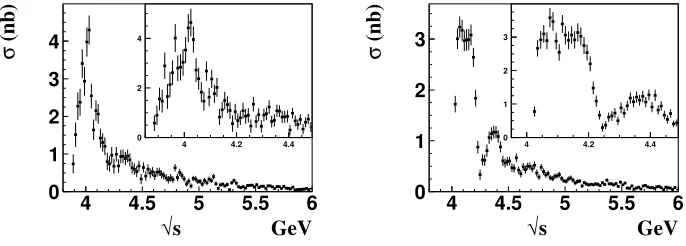
Figure 2.The exclusive cross sections as functions of√sfore+e−→D+D∗−(left) ande+e−→D∗+D∗−
(right). The insets show the zoomed spectrum near the threshold with a half-size bin width.
5 Cross sections
We calculate the exclusive cross sections of the processese+e−→DD∗ande+e−→D∗D∗as
a function of √saccording to the formula:
σe+e−→D(∗)D∗=
dN/dM ηtot(M)·dL/dM
(3)
where M is the D(∗)D∗
mass, equivalent to √s, dN/dM is the measured M(D(∗)D∗ ) mass spectrum,ηtot is a M-dependent total efficiency, anddL/dM is the differential luminosity, caluclated theoretically up to the second order QED corrections.
Finally, the obtained exclusivee+e−→DD∗ande+e−
→D∗D∗cross sections are shown
in Fig. 2.
6 Angular analysis
We analyzed theD∗±helicities for bothe+e− → D+D∗−γ
IS R ande+e− → D∗+D∗−γIS R
pro-cesses. TheD∗± helicity angle,θ, is defined as the angle between the π±
slow fromD∗±
Figure 3.The components of thee+e−→D+D∗−γIS Rcross section corresponding to the differentD∗−
helicity: left is transverse; right is longitudinal.
the D∗− decays can be studied even in case of partial D∗− reconstruction. The refit
pro-cedure of Mrec(D∗+γIS R) to mD∗− provides sufficient accuracy in the unreconstructed D∗−
momentum determination. The helicity angle resolution of the partially reconstructed D∗±
mesons (σθ ∼ 0.06 rad) is slightly worse than those of the fully reconstructedD∗±mesons
(σθ∼0.05 rad).
For thee+e− → DD∗ process the helicity of theD∗−meson is uniquely defined by the
angular momentum and parity conservation: theD∗−meson polarization should be transverse.
Thus we perform the D∗− angular analysis for this process to verify the method only. The
longitudinal component of the cross section is consistent with 0, as expected (Fig. 3). For the processe+e−→D∗D∗according to theoretical predictions [16], the helicity
com-position of the D∗D∗ final state is a mixture of D∗
TD∗T, D∗TD∗L andD∗LD∗L. We perform a
study of theD∗± helicity angle distribution in each bin ofM(D∗D∗). We analyze the
two-dimensional distribution ofc1 ≡cosθf versusc2 ≡cosθp, where the first helicity angle,θf,
corresponds to the fully reconstructedD∗+
, and the second,θp, is calculated for the partially
reconstructedD∗−.
0 0.5 1 1.5
4 4.5 5 5.5 6
√s GeV
σ
(nb) D
*+ T D
*-T
0 0.5 1 1.5
4 4.1 4.2 4.3 4.4 4.5
0 0.5 1 1.5
4 4.5 5 5.5 6
√s GeV
σ
(nb) D
*+ T D
*-L
0 0.5 1 1.5 2
4 4.1 4.2 4.3 4.4 4.5
0 0.5 1
4 4.5 5 5.5 6
√s GeV
σ
(nb) D
*+ L D
*-L
0 0.5 1
4 4.1 4.2 4.3 4.4 4.5
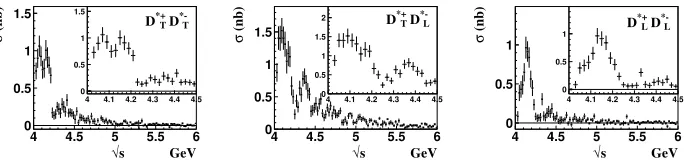
Figure 4.The components of thee+e−→D∗D∗γIS Rcross section corresponding to the differentD∗±’s
helicities. The insets show the zoomed spectrum near the threshold with a half-size bin width.
The angular fit results are presented in Fig. 4. The cross sections corresponding to the differentD∗D∗helicities have different √s-dependence. Near the threshold, theT T andT L
components have a similar sharp rise, while theLL component rises slowly. This can be explained by the higher centrifugal barrier for the LLcomponent which originates fromF
wave [1](chapter 48). All three components reach the same value of∼1 nb at √s∼ 4.15 GeV and fall into a common dip at √s ∼4.25 GeV. Then theLLandT T components are attenuated and only theT Lcomponent survives in the region of high √s>4.5 GeV, which is in good agreement with theoretical predictions [17].
7 Summary
In summary, we report updated measurements of the exclusivee+e−→ D+D∗−ande+e−→
D∗+D∗−cross sections at √snearD+D∗−andD∗+D∗−thresholds. Due to increased data
sam-ple, improved track reconstruction efficiency and additional modes for the charmed meson reconstruction the accuracy of the cross section measurements is increased by a factor of 2 in comparison with the previous Belle study [3]. The systematic uncertainties are significantly improved. We extend the energy region up to √s=6 Gev, and taking advantage of the im-proved resolution and high statistics, decrease the size of the √ssteps close to threshold by a factor of two.
The complex shape of thee+e−→D∗+D∗−
cross section can be explained by the fact that its components can reinforce or reduce each other. The fit of this cross section is not trivial, because it must take into account the threshold and coupled channels effects [13].
The first angular analysis of thee+e− → D∗+D∗−process allows to decompose the
cor-responding exclusive cross section into three components for the longitudinally and trans-versely polarizedD∗± mesons. The obtained components have different behavior near the
D∗+D∗−threshold. The only non-vanishing component at higher energy is theT Lhelicity of
theD∗+D∗−final state. The measured decomposition allows measurement of the couplings
of vector charmonium states into different helicity components, useful to identify their nature and to test the heavy quark symmetry [18].
Acknowledgement We acknowledge support from the Russian Foundation for Basic Re-search No. 18-32-00091 and No. 17-02-00485.
References
[1] C. Patrignaniet al.(Particle Data Group), Chin. Phys. C40, 100001 (2016). [2] G. Pakhlovaet al.(Belle Collaboration), Phys. Rev. D77, 011103 (2008). [3] K. Abeet al.(Belle Collaboration), Phys. Rev. Lett.98, 092001 (2007). [4] G. Pakhlovaet al.(Belle Collaboration), Phys. Rev. Lett.100, 062001 (2008). [5] G. Pakhlovaet al.(Belle Collaboration), Phys. Rev. Lett.101, 172001 (2008). [6] G. Pakhlovaet al.(Belle Collaboration), Phys. Rev. D80, 091101 (2009). [7] G. Pakhlovaet al.(Belle Collaboration), Phys. Rev. D83, 011101 (2011). [8] B. Aubertet al.(BaBar Collaboration), Phys. Rev. D76, 111105 (2007). [9] B. Aubertet al.(BaBar Collaboration), Phys. Rev. D79, 092001 (2009). [10] P.A. Sanchezet al.(BaBar Collaboration), Phys. Rev. D82, 052004 (2010). [11] D. Cronin-Hennessyet al.(CLEO Collaboration), Phys. Rev. D80, 072001 (2009). [12] A. J. Bevanet al.(BaBar and Belle Collaborations), Eur. Phys. J. C74, 3026 (2014). [13] T. V. Uglov, Y. S. Kalashnikova, A. V. Nefediev, G. V. Pakhlova and P. N. Pakhlov, JETP
Letters105, 1, 3 (2017)
[14] A. Abashianet al.(Belle Collaboration), Nucl. Instr. and Meth. A479, 117 (2002). [15] S. Kurokawa, E. Kikutani, Nucl. Instr. and Meth. A499, 1 (2003); and other papers
included in this volume.
[16] J.D. Richman “An experimenter’s guide to the helicity formalism”,Technical Report CALT-68-1148, California Institute of Techology, 1984.
[17] A.G. Grozin and M. Neubert, Phys. Rev. D55, 272 (1997).