Total Monte Carlo acceleration for the PETALE experimental programme in
the CROCUS reactor
AxelLaureau1,∗,VincentLamirand1,2,DimitriRochman2, andAndreasPautz1,3
1Laboratory for Reactor Physics and Systems behaviour (LRS), Ecole Polytechnique Fédérale de Lausanne (EPFL), CH-1015
Lau-sanne, Switzerland
2Laboratory for Reactor Physics and Thermal Hydraulics (LRT), Paul Scherrer Institut (PSI), CH-5232 Villigen, Switzerland 3Nuclear Energy and Safety Research Division (NES), Paul Scherrer Institut (PSI), CH-5232 Villigen, Switzerland
Abstract.The Bayesian Monte Carlo technics requires individual evaluations of random cross section files based on a Total Monte Carlo propagation. This article discusses the use of a Correlated Sampling accelera-tion applied to TMC calculaaccelera-tions for experiments where a brute force technics is too expensive. An efficient estimation of the reaction rate uncertainties in small dosimeters is obtained, together with the inter-dosimeter correlation associated to the cross section uncertainties.
1 Introduction
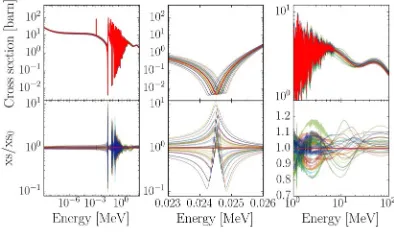
The Bayesian Monte Carlo (BMC) is one of the assimila-tion technics used to provide feedback from critical reac-tors to the nuclear cross sections themselves. This technics is working together with a Total Monte Calo (TMC) uncer-tainty propagation able to provide observables of interest (keff, activity, ...) calculations associated to a set of random cross sections such as displayed in Fig. 4 for the56Fe. The comparison of measurements and calculations provides a χ2value to each random cross section and then a weight is calculated: exp−χ2/
2.
Figure 1.56Fe random Cross Section from the TENDL library
A very large number of random cross sections can be required in order to apply the BMC assimilation. This ap-proach is already used [1] on fast critical systems with a large prior uncertainty and a short calculation time. If the evaluation of the random cross sections requires a large computation time, this step represents a limitation for the
∗e-mail: [email protected]
applicability of the method. For the PETALE experimen-tal program at EPFL, the observables are the reaction rates in small dosimeters located inside a metallic reflector of a water reactor that requires Monte Carlo transport calcu-lations to be correctly estimated. The estimation of the dosimeter activities for a single random cross section can require days of calculation.
For this reason, as presented in this article, an accel-eration of the TMC uncertainty propagation has been de-veloped, based on a Correlated Sampling (CS) technics as detailed in Sec. 2. Two application cases are used to compare the developed method with reference and legacy approaches (Sec. 3): the HMI-001 benchmark and the PETALE setup itself. Finally, an approach able to quan-tify the correlation between the dosimeters for the nuclear data uncertainty is proposed in Sec. 4.
2 TMC acceleration using the Correlated
Sampling technics
The correlated sampling [2] technics is a numerical method for Monte Carlo particle transport that allows to maintain the representativeness of two systems using a sin-gle particle track. For that, at each sampled event, the probability to do this event is calculated for the reference and the modified systems. For example, the system can be ‘modified’ according to dimensions, concentration, tem-perature or cross sections, the latter being the one of in-terest in this study. Then with a "modified weight" associ-ated to the neutron transport, and then by multiplying this weight by the ratio of the two probabilities and finally by correcting all the scores using this weight, all the scores are representative of the two systems. A detailed pre-sentation of this implementation in the Serpent2 [3] code is available in [4] for thermal feedback estimations. For
example, for a neutron distance samplingdwith a total macroscopic cross section ofΣt in the reference system
andΣ0tin the modified system, the ‘modified weight’
mul-tiplication term is: Σ
0 texpΣtd
ΣtexpΣ0td. Note that this weight has to be
propagated to the next generations of neutrons in order to take into account that the fission source is also modified.
In this study, the calculations are performed using the TENDL library. The first set of cross sections is consid-ered arbitrarily as the "reference system". All the other random cross sections are considered as "modified sys-tems". For each transported neutron, an array of modified weights corresponds to each modified system. An array of arrays of the neutron father’s weight is also generated to take into account the fission source modification induced by the modification of the random cross sections.
The sampling distance and the type of interaction are considered here in the modified weight calculation. An unbiased estimation of the score modification due to these phenomena is expected even if a large cross section modi-fication implies a slower convergence. A possible bias can be observed regarding the scattering anisotropy since the associated ratio of probabilities is not taken into account in this first implementation.
Considering an iron material definition with a pertur-bation of the56Fe, and assuming that the Fe56.####c el-ement exists in the xsdata file where #### are the "0000, 0001, 0002, ..." random cross section files, the modified Serpent2 input file using the correlated sampling on 256 libraries is given in Fig. 2
mat mat_iron autopert 0 256 -7.874
Fe54.03c 0.05845 Fe56.0000c 0.91754
Fe57.03c 0.02119 Fe58.03c 0.00282
Figure 2.Iron material definition with 256 different ACE files
During the Serpent2 initialisation phase, an optional "autopert" key has been added in the material definition. When declared, all the isotopes defined with ".0000c" are then automatically duplicated for the correlated sampling with the labels ".0000c", ".0001c", ".0002c"...
3 Validation
The overall objective of the current work being the inte-gral experimental program PETALE (see section 3.3) as-sociated to the stainless steel at high neutron energy, the HMI-001 benchmark has first been selected for its high sensitivity to the56Fe uncertainty. It consists of a highly enriched uranium/iron metal core reflected by a stainless-steel reflector. In a second step, the approach is also val-idated on the reaction rates of dosimeters located in the PETALE experimental setup.
3.1 Comparison of uncertainty propagation approaches
Three technics are considered here to compute the TMC uncertainty propagation.
The "TMC-Ref" is the classic Total Monte Carlo un-certainty propagation technics. It requires n independent calculations for n random cross section files. This technics provides a reference distribution of the propagated uncer-tainty.
The "TMC-CS" is the new TMC uncertainty propa-gation using the correlated sampling technics. Up to 128 random cross section files are propagated in a single calcu-lation. Multiple calculations are then combined altogether using the same "reference system".
Finally the "TMC-sensi" is based on sensitivity calcu-lations. The sensitivity array is estimated using Serpent2, and represents thekeffvariation due to a 1 % perturbation of the cross sections in a given energy range. Associated to the actual cross section relative variations between the cross section files Fe56.####c and Fe56.0000c, the uncer-tainty is propagated for each random cross section file.
3.2 HMI-001 benchmark
3.2.1 Classic TENDL library
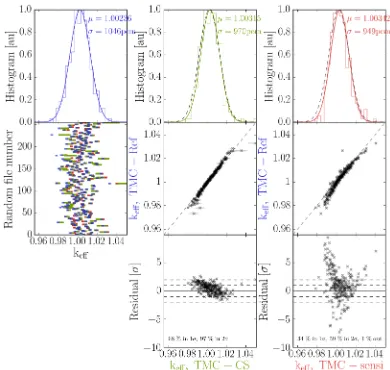
The effective multiplication factor distribution according to the random cross sections is presented in Fig. 3 We can
Figure 3.keffdistribution associated to the56Fe uncertainty. The
plots on the first line respectively present the results of the TMC-Ref, TMC-CS and TMC-sensi approaches. The second line cor-responds to thekeffvalues and the agreement between the three approaches for each value. The third line presents the associated residuals.
see that the impact of the56Fe cross section on thek effis significant, around 1000 pcm of uncertainty. We also ob-serve that the three uncertainty propagation technics pro-vide a standard deviation with a very good agreement.
the TMC-Ref results. The residuals are good even if a slightly non-linear effect seems to appear, possibly due to the angular effect that is not taken into account. A non-linearity appears on the sensitivity approach when the re-activity variation (and then the cross section variation) is too large. The global trend is not linear but looks like a coma curve, resulting in larger residuals even if the global agreement is good.
3.2.2 Extended TENDL library
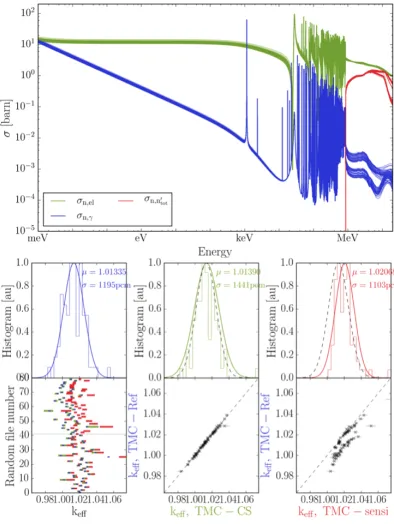
The classic TENDL library performs a sampling of the nuclear parameters and compares the generated cross sec-tions to the EXFOR database in order to obtain random cross sections. In the extended TENDL library used here, the sampling is performed on the nuclear models them-selves in order to have a larger cross section dispersion and thus to better check the validity of the methods.
Figure 4 shows the dispersion of the cross sections (left) using different sets of nuclear models, each model being declined with the sampling of the model parame-ters. We can see that two packs of cross sections are vis-ible at high energy for the inelastic and capture cross sec-tions. Fig. 4-right presents the uncertainty propagation us-ing these cross sections. A larger non-linearity appears with two distinct coma lines, each line being associated to a pack of cross sections with a discontinuity between the two.
Figure 4. Extended TENDL library cross sections and
corre-sponding uncertainty propagation (see legend of Fig. 3
3.3 Dosimetry in the PETALE setup of the CROCUS reactor
The HMI-001 benchmark illustrates the good capability of the TMC-CS technics to predict reactivity variations asso-ciated to the random cross sections. This section aims to validate the method for reaction rate estimation in dosime-ters.
Figure 5 presents the PETALE setup in the CROCUS reactor. A full description of the experiment is available
Figure 5. Serpent2 CROCUS geometry with the PETALE
ex-perimental setup
in [5] and the description of the experimental program is available in [6]. The PETALE setup is composed of 8 metallic plates (in gray) interleaved with nine dosimeters (in green). In this paper the metallic reflector is composed of pure iron, and the dosimeters are made of indium in this section.
During the calculations, the reaction rate score is de-clined using different modified weights that correspond to the different sets of random cross sections. The corre-sponding reaction rates are presented in Fig. 6. We can see that the reaction rates as a function of the dosimeter num-ber (top) have a very different pattern between the capture (left) and the inelastic (right) reactions. This is due to the different characteristic energies of the neutron doing the interaction: at high energy for the threshold inelastic cross section and at thermal energy for the capture reaction. The impact of the random cross sections is visible through the curve dispersions, and the relative variation is presented on the second line. We can see that this dispersion reaches a maximal value of around 15%. A very good agreement is obtained between the TMC-Ref (dashed lines) and the TMC-CS (plain lines) calculations. We also observe that the statistical uncertainty on the reaction rate variation is reduced with the TMC-CS. With the classic TMC-Ref ap-proach, a difference between two independent calculations with their independent statistical uncertaintiesσ1andσ2
leads to a total uncertainty of qσ2
Figure 6. Reaction rate distributions (top) for the capture (left) and inelastic (right) reactions; relative variations with one color per random cross section of the classic TENDL library (second line) with the TMC-CS in plain lines and the TMC-Ref in dashed lines; and residuals (bottom)
4 Dosimeter correlations
The TMC-CS is used to estimate the reaction rate values in dosimeters for multiple random cross sections with a single calculation. Multiple dosimeters can be used, by putting the dosimeters side by side or using distinct calcu-lations. The first solution is considered in this section.
Figure 7 shows the reaction rate dispersion for two threshold reactions: the rhodium and the indium inelas-tic reactions. One can see that the ordering between the
Figure 7. Inelastic reaction rate distributions (top) for the rhodium (left) and indium (right) elements and the relative vari-ation between the random cross sections (bottom)
random cross section curves is very similar. For example, in volume 8, even if the relative variation is larger for the
rhodium (20 %) compared to indium (30 %), the ordering is the same: brown curve for the maximal, then the yellow curve, the blue, the brown, the green one... This means that, if we assume that the measurement has no experi-mental uncertainty and that there is no nuisance parame-ters, the two dosimeters will provide the same information. For example if we also assume for a simplification pur-pose that one of the TENDL random cross sections (corre-sponding for example to #42 associated to the blue color in the figure) is very close to the real one, then the in-dium measured value will be the blue curve, and the BMC will provide a large weight for all the curves with a sim-ilar value (the yellow, blue, brown ones). And then since the ordering is the same with the rhodium dosimeter, the selected curves will be identical. In the opposite situation, a differentuncorrelateddistribution would provide a dis-tinct information and allows to discriminate between the remaining cross section files.
For this reason we can use the correlation matrix of this reaction rate dispersion in order to discriminate between independent dosimeters and quantify the level of correla-tion. Figure 8 presents this correlation matrix for a set of dosimeters. We can see that as expected the rhodium and
Figure 8.Correlation matrix of the reaction rate dispersion after the TMC-CS uncertainty propagation with different dosimeters ordered by the lethargy average incoming neutron energy. Each sub-matrix in the diagonal corresponds to one element with the correlation of the different positions (nine distinct dosimeters), and the sub-matrix off-diagonal corresponds to the inter-element correlations.
5 Conclusions
The correlated sampling technics is used to propagate ran-dom cross sections through a single Monte Carlo cal-culation. This propagation has been validated for iron cross sections by comparison with a reference Total Monte Carlo approach. Two gains are obtained with this technics: a strong reduction of the number of Monte Carlo calcula-tions; and thanks to the estimation of the score difference using a single neutron path, the variance on the difference is reduced. This method appears to be very useful for inte-gral experiments requiring long calculations with a small statistical uncertainty, such as reaction rate estimations in a reflector.
References
[1] Rochman, D. A., Bauge, E., Vasiliev, A., Ferroukhi, H. and Perret, G., EPJ Nuclear Sciences &
Technolo-gies,4, 7 (2018).
[2] Rief, H., Annals of nuclear energy, 11, 9, 455–476 (1984).
[3] Leppänen, J., Pusa, M., Viitanen, T., Valtavirta, V. and Kaltiaisenaho, T., Annals of Nuclear Energy,82, 142– 150 (2015).
[4] Laureau, A., Buiron, L. and Fontaine, B., EPJ Nuclear Sciences & Technologies,3, 16 (2017).
[5] Lamirand, V., Perret, G., Radman, S., Siefman, D. J., Hursin, M., Frajtag, P., Gruel, A, Leconte, P., Blaise, P. and Pautz, A., ISRD16 International Symposium on Reactor Dosimetry (2017).