A Hybrid Routing Protocol for Ad-hoc
Wireless Network Based on Proactive and
Reactive Routing Schemes
Chetana K. Kamate, Dr. Santosh L. Deshpande
Department P.G. Studies in Computer Network and Engineering, Visvesvaraya Technological University, Belagavi,
Karnataka, India
Professor, Department P.G Studies in Computer Network and Engineering, Visvesvaraya Technological University,
Belagavi, Karnataka, India
ABSTRACT: Several routing protocols have been proposed, even though it’s a well known fact that one of the critical issue in adhoc network is routing. Providing quick response to network topology change is primary requirement to develop better routing protocol. Table driven protocol in adhoc network maintains tables at each node which causes network overhead due to frequent update. On demand protocol creates path when desired by the node which causes high delay to find a path. To overcome disadvantages of both protocols a novel hybrid protocol is proposed. In this, every node in network maintains table containing routing information like proactive protocol and employs on-demand approach for table update process, which is determined by timer of its node. And triggers exponentially using back-off mechanism based on network information received from its neighbor for overhead reduction.
KEYWORDS: Adhoc network, Proactive, Reactive, AODV, hybrid routing protocol and MATLAB.
I. INTRODUCTION
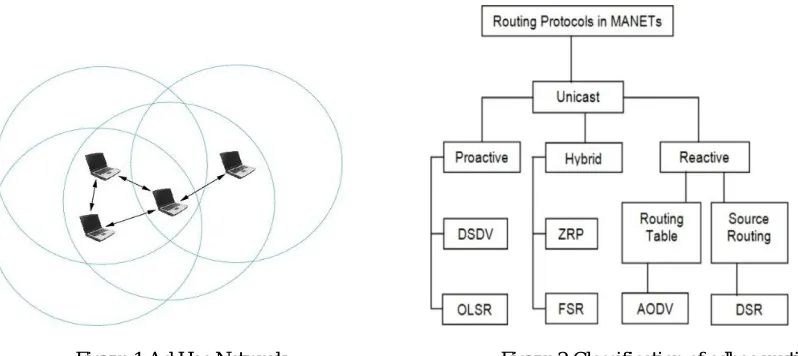
Figure 1 Ad Hoc Network Figure 2 Classification of adhoc routing
In proactive routing protocol, routes are updated by continuous observation of the network. Proactive is also termed as table driven. The function of table driven routing protocol is that every time each
network node maintains the path to all the nodes by flooding routing information in a whole network. When any node in the network requires the route to reach to the destination it uses path finding mechanism by referring to the details of the routing table. Disadvantage: in large network control overhead can be significant. The proactive protocols such as the link state routing (LSR) protocol (open shortest Path first) and the distance vector routing protocol (Bellman–Ford). In Reactive, route is established only when there is requirement of it. Reactive can be also termed as on demand. The function of on demand is nodes discover routes to destination only if they are actually needed. It does not maintain any topology information of the network. It obtains necessary paths on demand by using connection establishment technique. Examples of Reactive routing protocol are ad hoc on-demand distance vector routing protocol, temporally ordered routing algorithm and Dynamic source routing protocol [01]. The only disadvantage of reactive is the high latency time to find a route. Both the routing protocols are having their own boon points and curse points. Combination of these two Routing Protocols forms the hybrid Protocols. Proactive executes advantageously in small networks and reactive gives high performance in large network. Hybrid is integration of advantages of proactive and reactive protocols. Example of hybrid routing protocol is ZRP.
II. LITERATURE SURVEY
Survey is done on examining routing protocols for ad hoc networks and how nodes decide which way to route packets between computing devices in adhoc network. In neerja khatri et.al[] represents brief classification of adhoc routing protocols.
Qualitative Analysis of Hybrid Routing Protocols Against Network Layer Attacks in MANET is the method proposed by Apoorva Chandra and Sanjeev Thakur[02]. against the real time vulnerable security attacks in the network layer, this proposed paper gives utmost predictive comparative analysis of two hybrid routing protocol which includes Zone routing protocol (ZRP), Hybrid wireless mesh protocol (HWMP) and reactive protocol which is Adhoc On Demand Distance Vector (AODV) routing protocolwith different types of attackes such as: Black Hole Attack, Gray Hole attack and Jelly fish re-ordering.with all the parameters comparison table is updated in the paper.
Josh Broch et.al. Proposed a method called A Performance Comparison of Multi-Hop Wireless Ad Hoc Network Routing Protocols [06]. Here author kept main point for verification of the ability of the routing protocols to react to network topology change while continuing to successfully deliver data packets to their destinations. Initially shortest path distribution for all the nodes is calculated by the author in terms of ms. After the completion of the network topology packet delivery ration, routing over head and path optimization values are calculated and compared with previously existing methods.
Amith Khandakar proposed a paper where in author provided a Step by Step Procedural Comparison of DSR, AODV and DSDV Routing protocol [07]. In the proposed paper author mainly pointed at two comparison points. Comparison based on Packet Delivery Fraction (PDF), End to End Delay and Routing Load keeping the Pause time constant and varying Speed and Comparison based on Packet Delivery Fraction (Pdf), End to End Delay and Routing Load keeping the Speed constant and varying Pause time. The comparison is provided by changing the number of nodes. Author considered nodes range as 15 to 45 in steps of 15.
III. PROPOSED PROTOTYPE
The motivation behind novel hybrid protocol is that there are some nodes which have number of fixed neighbors for a long time. These nodes under proactive approach create more overhead by continuously updating table with same network information. If the node has updated routing table by on demand request packet to all destinations, & wait for some period to get changed network information for its neighbor, it will reduces network overhead, decreases the latency time to find routes and gives fast processing.
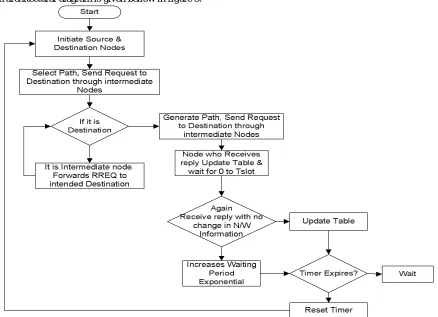
All these individual advantages of proactive and reactive routing protocols are merged to get best performance from the network. By merging these two types we can also overcome the drawbacks of the network systems. The proposed system architectural diagram is given bellow in figure 3.
In this protocol we have chosen AODV is base protocol & modified in such a way that each node should maintain routing table and update periodically which consists list of neighbors it can reach in one hop distance. Also it manages timer for each node which directly proportional to the movement of neighbor nodes. This proposed protocol also uses the control packets like AODV for route discovery process.
Initially each node starts building its routing table by sending hello packets in its coverage area to reach its neighbors. To manage tables of all the nodes the communication continuous by sending request packets. Every node checks for route in its table before communicating with any other node. If route exist, exchange of data takes place. If not, initiates route discovery process with reverse request (RREQ). Each RREQ packet consist sequence number, which helps to prevent from loops because in flooding node may receive duplicate requests from different paths. If node receives request with highest sequence number, it generates reply for respective source node. If not, it discards the request. For every node sequence number is initiated and inserted in to the routing table. Each time sequence number is incremented and routing table is updated. Doing so, we ensure loop freedom for routes to a destination. When destination node receives the request, generates reply & sends through intermediate nodes to source node. Reply packets include destination identification same as request packet. As reply passes through intermediate nodes, these nodes update their routing tables & timer starts to wait to generate request for next update, that waiting period may increases exponentially whenever node receives multiple replies from neighbors for this exponential back-off algorithm is preferred. So that can help to reduce control overhead & message can be routed through these nodes to the destination.
If a node has received no messages from some neighbor node for some period of time, then that node is presumed to be no longer reachable. Whenever node detects any of its next hop(neighbor) is unreachable, it place distance to infinity & generate error message by setting timer to 0. It is a result of broken link. The node floods error message to its neighbors to update their tables and they distribute it to its neighbor by checking timer condition.
IV. METHODOLOGY
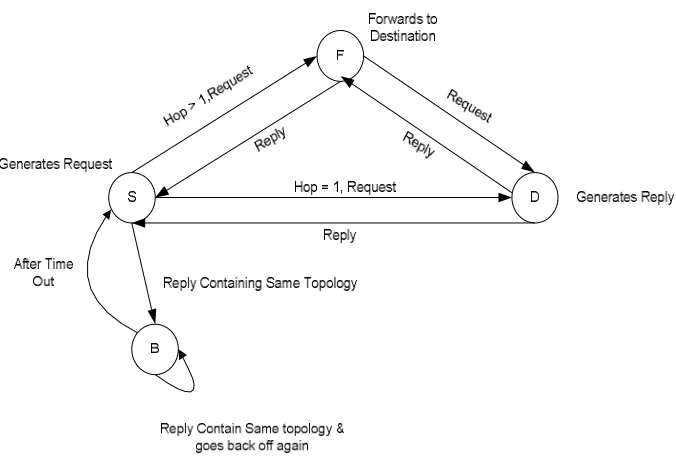
State diagram of the proposed method is given in figure 4.
Figure 4 State Diagram.
State diagram of proposed protocol is shown in fig 4.1.1. It includes 4 states namely s,d,f,b. State 1: Generates request(s)
After receiving request message from source it creates reply State 3: forward (f)
If hop count between node source & destination is one, both communicate directly by sending request & reply. If hop count from source to destination is greater than one, intermediate nodes help to forward request reply packets.
State 4: wait (b)
If neighbors are fixed for long time, source gets the same reply for each request which triggers to start the timer. If node receives numerous replies from its neighbor with no change in network information that results into wait state for that node whose period increases exponentially.
V. SIMULATION RESULTS
In the proposed system we are developing a network with consideration of number of nodes to be 10. Initially network is formed for given number of nodes. Simulation of proposed protocol is implemented in Matlab. Network is having the coverage area of 250*250 sq.kms. Source and destination nodes are dispersed across the network. The performance is recorded by considering the parameters as shown in table 6.2.
Table 6.1: Simulation Parameters
PARAMETERS VALUE
Simulator MATLAB
Area 250*250
No. of nodes 10
Routing protocol Hybrid
Simulation time 263s
Traffic flow Constant bit rate
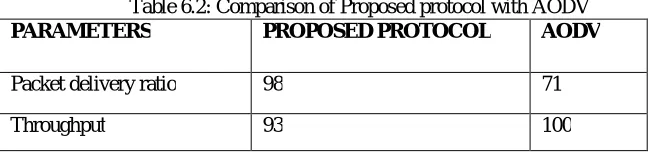
Expected results are obtained by comparing parameters of proposed protocol with AODV protocol which is implemented in the journal paper by Neerja Khatri. This is implemented using Matlab Simulator. The resultant table depicts the comparison of proposed protocol with the AODV of the paper mentioned above by considering 10 nodes.
Table 6.2: Comparison of Proposed protocol with AODV
PARAMETERS PROPOSED PROTOCOL AODV
Packet delivery ratio 98 71
Throughput 93 100
(a)
(b)
(c)
0 50 100 150 200 250
0 50 100 150 200 250 1 2 3 4 5 6 7 8 9 10
0 0.5 1 1.5 2 2.5 3 3.5 4
93 94 95 96 97 98 99 100
No of process communication
th ro u g h p u t
Throughput Vs number of communication process
0 0.5 1 1.5 2 2.5 3 3.5 4
95 95.5 96 96.5 97 97.5 98 98.5 99 99.5 100
No of process communication
P a c k e t D e li v e ry R a ti o
(d)
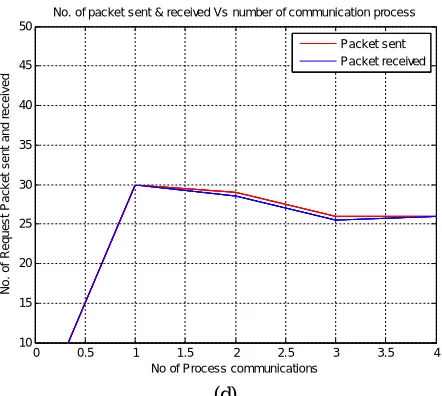
Figure 5 (a)Initial Network, (b) Shows the performance of throughput at different process communications, (c) Shows performance analysis of PDR with respect to process communication,
(d) Shows the no of packet sent and received at different process communications
Throughput: Throughput is equal to number of packets sent divided by the total number of packets. Greater the value of the throughput better is the performance. Figure shows the throughput performance of the proposed protocol at different communication process.
Overhead: It is the ratio of number of control messages transmitted in the network to the sum of this number and the number of data messages sent. In the Proposed protocol, overhead is lower than AODV because, the numbers of request packets are not broadcasted by neighbour nodes due to on-demand updating of routing tables. Overhead of proposed protocol is 0.33.
Packet delivery ratio: It is equal to the number of received messages divided by the number of transmitted messages. Decrease in nodes mobility, increases the PDR. However, in proposed protocol due to updating routing tables of nodes, all active routes remain in their table, but transmitting data packets before route discovery in AODV would be undelivered. Therefore, the PDR in proposed protocol is better than AODV. It is concluded from the table 6.2. Figure shows the PDR performance at different process communication.
VI. CONCLUSION
Each network protocol is having some explicit advantages and disadvantages and is well accommodated for some situations. Both of the routing protocols of adhoc like table-driven and on-demand have some drawbacks in certain environments. The drawbacks of both include overhead in communication across the network terrain and maximum latency time taken for path finding process respectively.
To overcome the above limitations the choice is made as hybrid, by integrating the properties of both the protocols. From the resultant plots it is clear that the proposed protocol has the packet delivery rate as 98, throughput as 93 and overhead as 0.33. From the comparison table it is concluded that the proposed protocol gives better performance compared to AODV.
REFERENCES
1) CHAHIDI and Abdallah EZZATI, “Hybrid Routing Protocol For wireless sensor networks”, IJCSI International Journal of Computer Science Issues, Vol. 9, Issue 2, No 1, 2012.
2) Apoorva Chandra and Sanjeev Thakur, “Qualitative Analysis of Hybrid Routing Protocols Against Network Layer Attacks in MANET”, International Journal of Computer Science and Mobile Computing, Vol. 4, Issue. 6, June 2015, pg.538 – 543.
0 0.5 1 1.5 2 2.5 3 3.5 4
10 15 20 25 30 35 40 45 50
No of Process communications
N o . o f R e q u e s t P a c k e t s e n t a n d r e c e iv e d
No. of packet sent & received Vs number of communication process
3) Dr.S.S.Dhenakara and A.Parvathavarthini, “An Overview of Routing Protocols in Mobile Ad-Hoc Network”, International Journal of Advanced Research in Computer Science and Software Engineering, Volume 3, Issue 2, February 2013
4) Mehdi Barati, Kayvan Atefi, Farshad Khosravi and Yashar Azab Dafial, “Performance Evaluation of Energy Consumption for AODV and DSR Routing Protocols in MANET”, International Conference on Computer & Information Science (ICCIS).
5) Mr. Pradip A. Chougule, Mr. Rajesh A. Sanadi and Mr. U. H.Kamble, “Comparative Study of Table Driven Routing Protocols in Ad Hoc Wireless Networks”, IOSR Journal of Computer Engineering (IOSR-JCE).
6) Josh Broch David A. Maltz David B. Johnson Yih-Chun Hu Jorjeta and Jetcheva, “A Performance Comparison of Multi-HopWireless Ad Hoc Network Routing Protocols”.
7) Amith Khandakar, “Step by Step Procedural Comparison of DSR, AODV and DSDV Routing protocol”, International Conference on Computer Engineering and Technology, vol.40, 2012.