Volume 2009, Article ID 278041,13pages doi:10.1155/2009/278041
Research Article
Cross Layer PHY-MAC Protocol for Wireless Static
and Mobile Ad Hoc Networks
Sylwia Romaszko and Chris Blondia
Interdisciplinary Institute for Broadband Technology, University of Antwerp, Middelheimlaan 1, 2020 Antwerp, Belgium
Correspondence should be addressed to Sylwia Romaszko,[email protected]
Received 31 January 2008; Revised 5 June 2008; Accepted 26 July 2008 Recommended by S. Toumpis
Multihop mobile wireless networks have drawn a lot of attention in recent years thanks to their wide applicability in civil and military environments. Since the existing IEEE 802.11 distributed coordination function (DCF) standard does not provide satisfactory access to the wireless medium in multihop mobile networks, we have designed a cross-layer protocol, (CroSs-layer noise aware power driven MAC (SNAPdMac)), which consists of two parts. The protocol first concentrates on the flexible adjustment of the upper and lower bounds of the contention window (CW) to lower the number of collisions. In addition, it uses a power control scheme, triggered by the medium access control (MAC) layer, to limit the waste of energy and also to decrease the number of collisions. Thanks to a noticeable energy conservation and decrease of the number of collisions, it prolongs significantly the lifetime of the network and delays the death of the first node while increasing both the throughput performance and the sending bit rate/throughput fairness among contending flows.
Copyright © 2009 S. Romaszko and C. Blondia. This is an open access article distributed under the Creative Commons Attribution License, which permits unrestricted use, distribution, and reproduction in any medium, provided the original work is properly cited.
1. Introduction and Problem Definition
The IEEE 802.11 [1], standard for wireless local area networks (WLANs) specifies as contention-based MAC mechanism the DCF, which is based on carrier sense multiple access with collision avoidance (CSMA/CA). The CSMA/CA mechanism assumes that each node uses a certain fixed transmission power for each transmission and that the network is homogeneous. However, nowadays wireless nodes, such as laptops, personal digital assistants (PDAs), and other handheld units, are usually equipped with batteries that provide a limited amount of energy. Since the power level determines the network topology, the battery life extension (thus the lifetime of a node) is an important factor in ad hoc networks. In a pure wireless multihop network, nodes have a limited transmission range. Depending on the number of active nodes, the density of the network affects the energy consumption, because with an increasing number of collisions and retransmissions, the expenditure of energy increases as well. One well-known direction in order to save energy and reuse the channel is by manipulating the power (power saving/controlling) or the carrier sense
threshold. Another direction is focused on enhancements of the IEEE 802.11 MAC since the existing standard does not meet multihop mobile ad hoc network expectations. The weaknesses and unfairness of the binary back-offalgorithm (BEB) of the IEEE 802.11 DCF and contention window resetting scheme used by this standard is the reason to improve/change the back-offmechanism and resetting CW algorithm.
The observation of these two problems led to the design of a novel cross-layer protocol, SNAPdMac. On one hand, our protocol employs tuning of the transmit power based on the level of noise and the collision ratio on the MAC level. On the other hand, it tackles the weaknesses and unfairness of the IEEE 802.11 MAC layer by tuning the lower and upper bounds of the contention window range and employing a different resetting strategy.
and Section 6 shows the performance evaluation of the proposed protocol against the IEEE 802.11 DCF and thebasic
power control protocol [2]. Finally, concluding remarks are formulated inSection 7.
2. IEEE 802.11 Standard
The IEEE 802.11 standard specifies two medium access control mechanisms of which only the DCF is relevant to ad hoc operation. The DCF specifies that a node needs to sense the medium before transmitting. If the medium is idle, the node waits for a random deferral time before transmitting. This back-offtime is a random value multiplied by the slot time, where the random value is a pseudorandom integer, picked from the [0, CW] range. In each slot where the medium is sensed idle, the back-offcounter is decremented until it reaches zero. When the counter reaches zero, the node starts its transmission. If during back-offthe medium is sensed busy, the back-off counter is frozen during the ongoing transmission and decrements again as soon as the medium is sensed idle.
When a transmission fails, that is, no acknowledgment is received, the DCF specifies that the CW needs to be doubled according to the BEB algorithm, up to a maximum back-off size, the maximum value of CW (CWmax). When the packet
is not transmitted successfully after a maximum number of retransmissions, the packet is dropped. Upon a successful transmission or when a packet has been dropped, the CW is reset to thestaticminimum CWDCF
min value.
This approach of resolving collisions is not only unfair but also inefficient. Although the CW is doubled upon a retransmission, there is always a probability that contending nodes randomly choose the same contention slot, especially when the number of active nodes increases. On the other hand, receiving a packet successfully does not mean that the contention level has been dropped. Furthermore, the minimum and maximum CW sizes (where CWmin ≤
CW ≤ CWmax) are fixed in the IEEE 802.11 DCF standard
independently of the network load and channel conditions.
3. Related Work
Many approaches have already been proposed to reduce the number of collisions by substituting the binary exponential back-off algorithm of the IEEE 802.11 by novel back-off approaches or selecting an intermediate value instead of resetting the CW value to its initial value. Several papers focus on changing the lower and upper bounds of the CW interval [3–5] but usually with different goals, such as the mitigation of selfish MAC misbehavior ([4]) or the reduction of the latency for event-driven wireless sensor networks (WSNs) ([3]). The most related work to our back-offmechanism is the determinist contention window algorithm (DCWA) in [5]. DCWA increases the upper and lower bounds instead of just doubling the CW value. In each contention stage, a station draws a back-off interval from a distinct back-off range that does not overlap with the other back-offranges associated to the other contention stages. In addition, the back-offrange is readjusted upon
each successful transmission by taking into account the current network load and history (resetting the back-offranges
mechanism; see details in [5]).
Among the related work concerning energy conservation, such as power saving or power control mechanisms, the power saving mechanism (PSM) is the most familiar. It is provided by the standard [1], which allows a node to go into doze mode.Power controlschemes, varying the transmit power in order to reduce the energy consumption, have already been presented in many studies; for example, see [2, 6–10]. These schemes and many others have shown that power control protocols can achieve a better power conservation and higher system throughput through a better spatial reuse of the spectrum.
Antagonists of power control approaches argue that adjusting/changing the power level introduces asymmetric links while the carrier sense (CS) range is always symmetric. However, in a real world both asymmetric links and asym-metric CS ranges exist [11]. That is why there is a plenty of work in this field focusing not only on power saving or power control, but also on spatial reuse that employs the IEEE 802.11 physical carrier sensing.
One part of the research in this field focuses on dependencies and tradeoffs between both thetransmit power
and thecarrier sense threshold [12,13], while another part focuses only on the adjustment of the carrier sense threshold [14–16]. The work in [12] investigated the tuning of the transmit power, carrier sense threshold, and data rate in order to improve spatial reuse. The authors have shown that tuning thetransmit poweris more advantageous than tuning the carrier sense threshold.
Cross-layer protocols contributing to the enhancement of the MAC layer and the adjustment of the power level have also been presented in many papers. One of them, the power adaptation for starvation avoidance (PASA) algorithm [17], was designed following the observation from [10] that the request-to-send/clear-to-send (RTS/CTS) collision avoidance mechanism of the IEEE 802.11 DCF cannot eliminate collisions completely. This can lead to a channel capture where a channel is monopolized by a single or a few nodes. The authors of [17] studied how to control the transmission power properly in order to offer a better fairness and throughput by avoiding a channel capture. The power level increases exponentially and decreases linearly in the PASA, while using an RTS/CTS control scheme. PASA is not applicable with the basic access scheme. It requires that a neighbor power table (NPT) is maintained by each node with information such as the minimum power that must be maintained according to the distance to the destinations, which should be obtained through some location service. PASA achieves a better Jain’s fairness index, however it suffers from a degradation of the throughput, which is noticeable in mobile ad hoc scenarios. After all, maintaining the NPT table with “fresh” data is not realistic in a mobile ad hoc environment taking into account interferences, fading effects, movement of the nodes, and deaths and new entriers of nodes.
CSMA/PB reduces the transmission power level in order to avoid collisions, following the observation that, in a smaller transmission area, interferences and contentions are expected to be reduced. Results obtained in [18] are based on anoptimistic centralized power-aware routingstrategy which illustrates the potential of the power back-off. The CSMA/PB protocol has been evaluated with three transmission power levels only, thus the amount of power decreases fast. Therefore, it is really important that the routing protocol takes power levels into account. Each node has to maintain the routing table with entries for each destination with corresponding power levels.
4. Proposed Protocol
The goal of the SNAPdMac protocol is to save energy (which leads to an extension of the lifetime of nodes) and to reduce the number of collisions. However, the SNAPdMac protocol does not degrade the throughput performance and fairness in terms of the throughput and sending rate, while fulfilling these goals.
The SNAPdMac protocol tackles a couple of problems that exist in the current implementation of the standard. It does this by two means, first it concentrates on the flexible adjustment of the upper and lower bounds of the CW to lower the number of collisions. Secondly, it uses a power control scheme to limit the waste of energy and also to lower the number of collisions. Hence, it has a MAC-PHY cross-layer architecture.
To tackle the inefficient use of the back-offwindow in the standard, we developed a MAC protocol that makes use of our prior work (Enhanced selection Bounds algorithm (EsB) [19]) during the recovery stage. The EsB adjusts the lower and upper bounds of the CW range, taking into account the number of retransmissions attempts, the 1-hop active neighbors, and the remaining battery level. Each node can estimate how many neighbors it has in its 1-hop neighborhood, based on successfully detected signals or using the table that is built by a routing mechanism. In [20] the utilization rate of the slots (slot utilization) observed on the channel by each station is used for a simple, effective and low-cost load estimate of the channel congestion level. During the resetting stage, the CW value is reset to a value which depends on the history of collisions. This forms the MAC part of the SNAPdMac protocol and results in a reduction of the number of collisions.
The goal is not only to lower the number of collisions, but also to save energy. If we reflect on the reason why messages collide, it becomes clear that this is because too many nodes are too close to each other. They could be positioned a few meters from each other, but their transmission range is far greater than these few meters. Hence, the nodes are too close to each other relative to their respective transmission range. This not only results in a higher number of collisions, but also in an excessive use of energy to transmit a packet.
The SNAPdMac power control part is based on this observation and it lowers its transmission power (while observingtoo high noise in the vicinity) when it does not get the acknowledgment that a packet has been received
successfully. The final result will be that all nodes will find their optimal transmission power that ensures that they can reach their neighbors, but not interfere with other nodes.
However, not receiving an acknowledgment for a sent packet does not always mean that the packet was lost or corrupted because there was too much interference. It could also happen that the transmission power was simply too low to reach any of the surrounding nodes. Therefore, the SNAPdMac protocol takes the signal-to-interference-and-noise ratio (SINR) into account. If no acknowledgment has been received, but the noise level (deducted from the SINR) is low, then we assume that the transmission power was too low to reach any of the neighbors. In that case the transmission power is increased.
The signal to interference and noise ratio,
SINR= PowerRX
Noise + Interferences, (1) is an important metric of the wireless communication link quality. A radio signal can be correctly decoded by the intended receiver only if the ratio between the sender power (PowerRX) of the actual signal to be received and the
sum of all power levels experienced due to other signals (Interferences) currently transmitted plus an ambient noise power level (Noise) is above a certain hardware-dependant thresholdβ(minimum signal-to-interference ratio required to successfully receive a message):
SINR≥β. (2)
The higher the SINR, the higher the rate that packets can be transmitted reliably. Depending on the modulation scheme, different threshold valuesβare valid.
Figure 1 shows a detailed diagram describing how the SNAPdMac protocol works. In the figure, the PHY layer has been placed in a dashed area. Note that the protocol considers threemaincases for each transmission:
(a)recovery mechanism, the number of retransmission attempts is larger than 0 and lower than the thresh-old,
(b)dropped packet, the number of retransmission attempts exceeds the threshold,
(c)CW resettingupon a successful reception.
4.1. Recovery Mechanism. When a packet has to be retrans-mitted but the number of retransmission attempts does not exceed the limit, the recovery mechanism is processed. The recovery mechanism makes use of the EsB algorithm from our prior work [19]. EsB is focused on adjusting the lower and upper bounds of the CW interval, considering the number of retransmission attempts (nrATT), the number
of 1-hop active neighbors (NrN), and the coefficient of remaining energy (coeRE).
Packet received
No collision
CW
×2
CW
=CWmin
Yes RatioColl >threshold
No
Packet dropped
CW
=CWmax
RatioColl >threshold
No
Yes Yes
Power TR
PHY
Power TR
×2
Collision & try again CW EsB withlowerB=0
Power TR
PHY
Power TR No
Yes CW EsB
Too much noise
MAC
Collision
Transmission Yes
Tries>max No
Retransmission No
Figure1: Diagram of the SNAPdMac protocol.
-Upon first
transmission-lB0=lBDCF=0; uB0=CWmin=CWDCFmin; -Upon each
retransmission-(1)IBtmp=uBi−1
2 +NrN+nrATT
∗log10(nrATT+γ) (2)lBi=lBtmp∗coeRE;
where a constantγ=3.0;
(3)uBi=(2∗uBi−1)∗log10(NrN∗coeRE+nrATT+γ) whereγ=3.0ifNrN <2,and0otherwise;
(4)IF(uBi>CWmax)thenuBi=CWmax,
where CWmax=CWDCFmax+ CWDCFmin;
Algorithm1: EsB algorithm.
back-offtimer is randomly selected from the range delimited by the lower bound (lB) and upper bound (uB): back off timer =random[lBi,uBi].Figure 2depicts an example of a
possible selection of the lower and upper bounds in the EsB algorithm. In this case, we consider the prior (Ti−1), current
(Ti), and future (Ti+1) state. In the prior (Ti−1) state, the
lower bound is a bit lower than CWDCF(128) and the upper bound a bit lower than 256 (next chosen upper bound by the BEB algorithm of the IEEE 802.11 DCF standard). In the current state, these values are increased but they can be lower or larger than consecutive BEB values as depicted in the figure. We also let a node exceed the CWDCFmax value, but
not more than the number of CWDCFmin slots. The algorithm of
the EsB scheme is shown inAlgorithm 1.
The lBi is dependent on the uBi−1/2 value and the
logarithmic function (line 1) in order to ensure that this bound does not increase too fast. First, the use ofuBi−1/2
prevents choosing too high values of the lower bound, in particular if theNrNandnrATTare not (so) high.
Secondly, the logarithmic function takes care of the slight increase of the lower bound. Theγis chosen in such a way that the result of the logarithmic function is higher than 1/2,
lBi−1
lBi
lBi+1
uBi−1
uBi
uBi+1 Ti−1
Ti
Ti+1
128 256 512 1024
CWDCFmin Initial-previous values oflB,uB Consecutive possible values oflB,uB BEB values of 802.11 DFC
Figure2: Bounds selection of EsB algorithm.
hence the lower bound will be reasonably higher relative to the previous selected one. Thus, if a node has only a few active neighbors, thelBivalue will be small. If a node resides
in a dense network with many active nodes, this is reflected in a larger value of thelBi, apart from the currentnrATT.
We also let each node shrink or extend theupper bound
(uBi) relative to the uBiDCF. The uBi is logarithmically
dependent on theNrN andnrATT. In this way we obtain a
slight change (an increase or decrease) of theuBicompared
to the uBi achieved by [1]. An upper bound of the CW
interval should not increase too fast, because of unnecessary deferring of contending nodes.
Energy level (%)
100 85 70 55 40 25
Co
e
ffi
cient
o
f
energ
y
(c
o
eRE
)
0.5 0.55 0.6 0.65 0.7 0.75 0.8 0.85 0.9
Figure3: Change of coeRE.
(1) PtDIFF=ε∗log10
NrN
CURRENT NrNDESIRED
∗PtTR−1; whereε=NrN1
DESIRED
—is a constant -recovery
mechanism-(2a)IF(SINRCURRENT>SINRTHRESHOLD)
(3a) PtTR=PtTR−1+ (ζ−1)∗PtDIFF;
(4a)ELSE
(5a) PtTR=PtMAX−(ζ)∗PtDIFF;
Algorithm2: Enhanced power control.
of remaining energy (coeRE) in the algorithm. Depending
on the energy level of the battery, the coeRE value varies
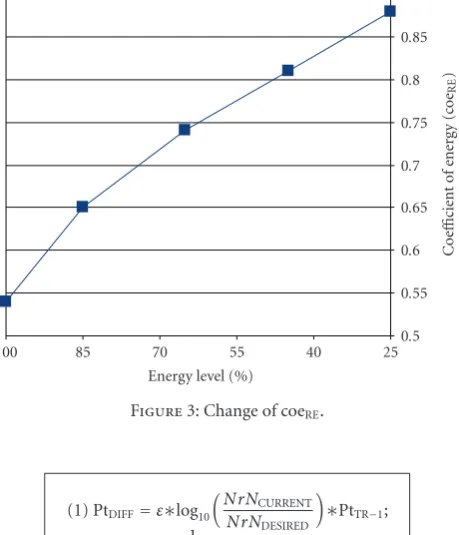
(Figure 3). Notice that the value of coeRE logarithmically
increases, when the energy level decreases. We allow the upper bound of the CW to decrease slightly depending on the energy level. If a node has its maximum energy level, it needs to wait a shorter time compared to a node with a lower battery level, if both nodes have recognized the same
NrN and have an equalnrATT. The upper bound increases
with a decreasing battery energy level. Thus, nodes with a lower battery level wait longer in order to avoid a potential collision.
As opposed to [5], a selected back-off intervali from back-off stageiby a given node may overlap with a selected
back-offintervali−1 from back-off stagei−1 of this node in
the EsB mechanism. This way the algorithm is less prone to unnecessary loss of free slots both in sparse and dense networks (when many neighbors are occasionally active).
The recovery mechanism of SNAPdMac is not limited to the use of EsB only, it also employs our novel enhanced power controlof which the pseudocode of the recovery part is presented inAlgorithm 2.
The recovery part of theenhanced power controlis based on the noise level in the neighborhood. The amount of
noise in the vicinity, which is measured by assessing the current SINR value, determines whether the power level should increase or decrease. If the noise level is too low (the current SINR, SINRCURRENT, is higher than the threshold
SINRTHRESHOLD), the power level increases. Otherwise, the
power level decreases. The amount of increase and decrease of the power is determined by the number of 1-hop active neighbors (NrNCURRENT) and the previous transmit power
(PtTR). PtMAXis the maximum transmission power.
We have assumed that the desired number of neighbors
NrNDESIRED is fixed and set to 3, because at least 3 nodes
provide a completely connected network. The speed of the decrease or increase can be adjusted by the variableζ(2 or 3 in simulations), but a decrease of the power is always faster than an increase.
During therecovery mechanismof SNAPdMac, the EsB is used unchanged to adjust the CW range when the noise level of the neighborhood is high. The presence of a lot of noise is an indication that a lot of nodes are in the vicinity. To lower the possibility of another collision even more, SNAPdMac also decreases its transmission power as described in the
enhanced power control. By decreasing the power, a node gives opportunity to other nodes to access the wireless channel, which leads to the enhancement of the fairness between nodes.
When, on the other hand, the noise level is low in the neighborhood, only the upper bound of the CW range is adjusted according to the EsB, whereas the lower bound is kept at 0. Low noise level means that there is not so much traffic in the air, and a node has more chance to access the wireless medium compared to a node which happens to be in a high contention area. Even more, if a retransmission occurs but the noise level is low, a collision is not necessarily the reason of the failed transmission. There exists a high probability that the transmission of the packet failed, because no receiver was in the range, or because of fading effects, mobility, and so on. This is why we increase the power level to extend the transmission range when the noise level is low during the recovery mechanism.
4.2. Dropped Packet. A packet isdroppedwhen the number of retransmission tries (TriesinFigure 1) exceeds the threshold
MAX. Upon this event, the CW value is not reset to its minimum value as in the IEEE 802.11 DCF, but it maintains its value of CWmax. Since the packet has been retransmitted
a maximum number of attempts with different power levels (upon each retransmission), the probability that a next packet will be sent successfully is very low, therefore resetting the CW to the minimum is pointless.
Although the CW value does not change when a packet has been dropped, the power level decreases, in order to lower the possibility of collisions. The pseudocode of the dropped part of the enhanced power control algorithm is presented above inAlgorithm 3, which shows that the power always decreases when a packet is dropped, because the packet is abandoned anyway.
Unlike in the recovery part of theenhanced power control
(1) PtDIFF=ε∗log10
NrN
CURRENT NrNDESIRED
∗PtTR−1;
whereε= 1
NrNDESIRED
is a constant
-dropped
packet-(2b)IF(Drop and RatioColl>RatioCollTHR)
(3b) PtTR=PtMAX−(ζ+ 1)∗PtDIFF;
(4b)ELSE
(5b) PtTR=PtMAX−(ζ)∗PtDIFF;
Algorithm3: Enhanced power control.
current level of SINR. The amount of decrease of the power is determined, like in the recovery part, by the number of 1-hop active neighbors (NrNCURRENT) and the previous
transmit power (PtTR). However, thehistory of the collision ratio also affects the speed of the decrease of the power. The history,RatioColl, is taken into account by means of an exponential weighted mean average (EWMA) with respect to past measurements, as shown in the following equation:
RatioColl=χ∗RatioColli−1+ (1−χ)∗RatioColli, (3)
where
RatioColli=
CounterPacketSENT −CounterPacketACK CounterPacketSENT
. (4)
The CounterPacketSENT increases each time by one upon a first
transmission of a packet (this counter does not increase upon retransmission attempts) and the CounterPacketACK increases by
one upon a successful reception of the acknowledgment (ACK) of the transmitted (SENT) packet. Depending on the
RatioColl, the power decrease isnormalorfaster(faster=2
∗normal). In static environments, the history plays a more important role than in mobile environments. Therefore, we allow the tuning of theχvalue, which represents the amount of importance history has. In static networks theχis set to a value larger than 0.5. On the other hand, in mobile networks, where the history is less important because of the nodes movement and fast changing instantaneous conditions, the
χvalue is set to a value lower than 0.5.
Based on our extensive simulations, we have noticed that an appropriate transmission power level is really important since, if the rate of decrease/increase is too fast or too slow, the protocol can be either too conservative or too aggressive. Thanks to the possibility of tuning the variables ζ (speed of the change of the power level) and/or RatioCollTHR, the
connectivity of the network can be adjusted which leads to a significant improvement of the throughput and lifetime performance.
4.3. CW Resetting. Upon the successful reception of a packet, the CW value is reset depending on the history of the collision ratio. The CW value is reset based on whether the value of RatioColl (3) is larger than the threshold,
RatioCollTHR, or not. If the value of RatioColl is larger
than the threshold, the CW is decreased exponentially.
Otherwise, the CW value is reset to the initial minimum value, which equals the initial minimum CW value of the DCF mechanism.
5. Simulation Environment
5.1. Metrics and Parameters. The proposed cross-layer proto-col has been implemented in the ns-2.29 network simulator [21]. The simulations have been carried out for various topologies, scenarios with different kinds of traffic, and routing protocols. The following performance metrics have been used:
(i) total packets received, (ii) average throughput (Mbps), (iii) lifetime LND (seconds),
(iv) FND: first active node died (seconds), (v) lifetime RCVD (seconds),
(vi) sending bit rate Jain’s fairness0. . .1, (vii) throughput Jain’s fairness0. . .1, (viii) average aggregate delay (seconds),
(ix)κ-coefficient of collisions.
The first node died metric is defined as the instant in time when the active (a node transmitting/receiving) first node died. We have defined the network lifetime as the time duration from the beginning of the simulation until the instant when theactive(a node transmitting/receiving) last node died, that is, there is no live transmitter-receiver pair left in the network. TheLifetime RCVDis specified as the instant in time when the last packet is received.
Theaverage throughputhas been defined as
Thr=Total number
Packets received
Simulation Time [Mbps] (5) andaverage sending bit ratehas been defined as
Sbit=Total number Packets
sent
Simulation Time [Mbps]. (6) The sending bit rate or throughput Jain’s fairness index is estimated according to the following equation:
f(x)= ( n
i=1αi)2
n(ni=1α2 i)
whereαi≥0, (7)
wherenis the number the contending flows, andαissending bit rate(Sbit) orthroughput(Thr). If all flows get the same amount of α (sending bit rate or throughput), then the fairness index equals 1, thus the network is 100% fair [22].
Since the SNAPdMac protocol lives longer than the IEEE 802.11 DCF, we have defined a coefficient of collisions,κ, which equals
TotalCollision
Table1: Simulations parameters.
Parameter Values
Number of active nodes 25, 50(default)
Simulations area ≤1500×1500 m
Topology Random
PHY/MAC DSSS, IEEE 802.11a
SINR thr. (dB) 24.05
Type of netwok homo/hetero-geneous
Initial energy (J) variable=0.5–. . ., 5, 20
PtMAX−250 m 0.281838 W
PtMAX−100 m 0.007214 W
txPowerinit 250100 meters
rxPower 45% of PtMAX
idlePower 30% of PtMAX
Capture Thr.(dB) 10
Traffic model CBR/UDP
Payload size (bytes) 2048100–8192
CWmin−CWmax(slots) 15–1023
RatioCollTHR(%) 25–50, 50(default)
χ(mobilestatic) (0.1, 0.3(default)0.6, 0.8)
NrNDESIRED 3
ζ 2 (default)3
Simulation time (s) ≤350
Routing AODV(default), DSR, OLSR
Movement random and constant
Mobility model Random Waypoint Model
Speed (m/s) 0−2 ≤20; 1.5−(default)
Access scheme Basic(default)RTS/CTS
Table 2: Typical values of path loss exponent and shadowing deviation.
Environment ρ(dB) σ(dB)
OutdoorFree space 2 4 to 12
OutdoorShadowed Urban 2.7 to 5 4 to 12
IndoorLine-of-sight 1.6 to 1.8 3 to 6
IndoorObstructed 4 to 6 6.8
in order to be able to compare fairly the total number of collisions experienced with respect to the total number of packets received.
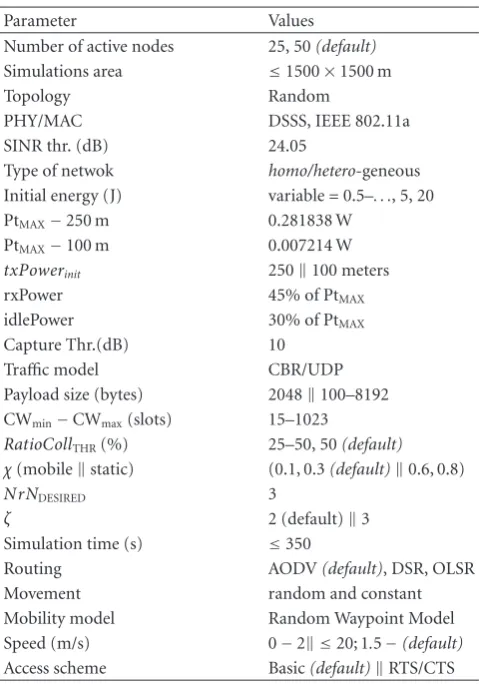
InTable 1we present the general simulation parameters, where the abbreviation thr. means a threshold. Other parameters used in specific simulations are mentioned in the corresponding paragraphs. If we do not mention parameters in some paragraphs, then the default values (in italic in bracketsshown in the table) are used.
In all simulations we have applied theshadowing prop-agation model [21] with different values of the path loss exponent (ρ) and shadowing deviation (σ), according to the
Table 2(see details in [21]).
We have assumed that the receive power (rxPower) is approximately 45% (like in [23]) of the maximum transmit power (PtMAX). The idle power (idlePower) is approximately
30% of the maximum transmit power (PtMAX), since in
reality the interface has a very largeidleenergy consumption when it operates inad hoc mode, as reported in [24]. The maximum transmit power of a node is assumed to cover the whole transmission range of 100 meters (or 250 meters, resp.). When the node energy level goes down to 0, a node dies out.
In order to avoid the hidden and exposed node problems in a wireless medium, the CSMA/CA protocol is extended with a virtual carrier sensing mechanism, namely, RTS and CTS control packets. We have executed simulations with both the basic access and RTS/CTS schemes, however, we have also observed that the usefulness of the RTS/CTS exchange (especially in an ad hoc mobile environment) is under discussion as already reported in [25–28].
5.2. Set Goals. In the simulations presented in the next sec-tion, we have investigated the performance of the SNAPdMac protocol against the IEEE 802.11 DCF standard and/or the
basicpower control protocol from [2] (see in the appendix a short description of the protocol). The IEEE 802.11 DCF standard is later referred to asstandardorSTDin the text or figures. We have defined three different scenarios:
(1) random static/mobile network with optimistic traffic, (2) high density and contention (HD/C) homogeneous
network with a sudden change of contention level, (3) high density and contention (HD/C) heterogeneous
network with a sudden change of contention level. The goals of the first scenario are the following:
(i) verification whether the SNAPdMac protocol decreases both the total number of collisions and the number of collision per node in a static network as expected,
(ii) the same verification as above but in mobile condi-tions,
(iii) tuningRatioCollTHRin order to find the best
thresh-old in static and mobile conditions,
(iv) verification of the importance of the transmission failure history by tuning theχvalue.
The goal of the second scenario is the investigation of the behavior of the considered protocols in a mobile homoge-neous ad hoc network with smooth and then sudden, sharp increase of the contention level followed by a sudden, sharp decrease of the network load.
The third scenario is focused on
(i) analysis of the behavior of considered approaches in heterogeneous networks with basic and RTS/CTS exchange scheme,
Node id number
0 5 10 15 20 25 30 35 40 45 50
N
u
mber
of
co
llisions
0 400 800 1200 1600 2000 2400 2800 3200 3600
“STD” “SNAPdMac”
Shadowed urban area, 50 static nodes
Figure4: Number of collisions per node; static network.
6. Simulations and Results
6.1. Random Network with Optimistic Traffic
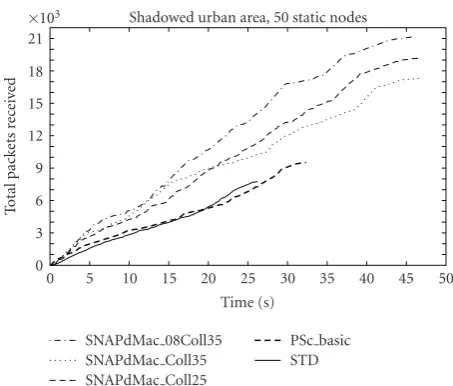
6.1.1. Static Environment. First, we defined a simulation scenario with 50 static nodes randomly distributed in a shadowed urban area where nodes send a CBR packet (2048 bytes payload size) from the beginning till the end of the simulation every 0.025 seconds.Figure 4depicts the number of collisions per node in one of the simulation scenario runs (10 simulation runs in total). Notice that with the SNAPdMac protocol most of the nodes have much fewer collisions, although the lifetime of the network is increased significantly (SeeFigure 6).Figure 5shows the total number of packets received by the DCF standard, basic power control protocol, and SNAPdMac protocol. The tuning of the SNAPdMac protocol has been investigated as can be observed in the figure. TheSNAPdMac Coll25andSNAPdMac Coll35
represent SNAPdMac withRatioCollTHRequal to 25% and
35%, respectively. TheSNAPdMac 08Coll35has aχvalue set to 0.8 instead of 0.6. Independently of the adjusted values of SNAPdMac, the protocol outperforms the IEEE 802.11 DCF standard and basic power control protocol noticeably. The
SNAPdMac 08Coll35achieves the best performance, which means that the history of collisions experienced has an influence in a static environment.
Figure 6 shows the gain in percentage over the IEEE 802.11 DCF standard obtained by the basic power control protocol in the static network and the SNAPdMac protocol in both static and mobile networks. Note that, thanks to PHY (power level adjustment) and MAC (recovery mechanism and CW resetting) layer treatment, the number of collisions can be decreased noticeably while saving lot of the energy which leads to an increase of the lifetimes (LND and lifetime RCVD) of the network and the throughput. The performance of the Lifetime RCVD is worse than the performance of the lifetime of the network, which means that some last transmitter-receiver pairs still have connections; however, the packets cannot be routed to the destination. The
Shadowed urban area, 50 static nodes
Time (s)
0 5 10 15 20 25 30 35 40 45 50
T
o
tal
p
ac
ke
ts
re
ce
iv
ed
0 3 6 9 12 15 18 21
×103
SNAPdMac 08Coll35 SNAPdMac Coll35 SNAPdMac Coll25
PSc basic STD
Figure 5: Total number of packets received versus time; static network.
Pa
ck
et
s
R
CVD
κ
FND
Lifetime Lifetime RCVD Sbit fair
ness
Thr fair
ness
Dela
y
Gain
o
ver
D
C
F
802.11
(%)
−20 35 90 145 200 255 310
Power basic-static SNAPdMac-static SNAPdMac-mobile
Figure6: General results, 50 static and mobile nodes.
performance of the throughput fairness, which is improved tremendously, is explainable since nodes give others more opportunity to access a wireless channel while decreasing the transmit power level. On the other hand, by increasing the power (upon a consecutive collision and too low noise in the vicinity), their chance to get to the channel is increased since their coverage transmit area is wider. However, the average delay is degraded, because the SNAPdMac protocol adjusts both the lower and upper bounds of the CW range and allows to decrease (apart from an increase) the power level, which in consequence can increase the average delay.
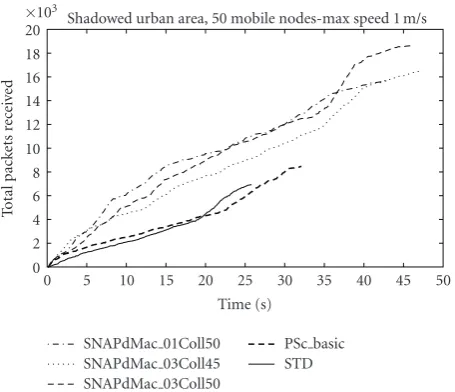
6.1.2. Mobile Environment. We have also executed simula-tions in a mobile environment (with the maximum speed of nodes 0.5, 1.0, and 1.5 m/s, resp.) with the same simulation settings as above but this time with 20 simulation runs in order to ensure the validity of our results. Figure 7
Shadowed urban area, 50 mobile nodes-max speed 1 m/s
Time (s)
0 5 10 15 20 25 30 35 40 45 50
T
o
tal
p
ac
ke
ts
re
ce
iv
ed
0 2 4 6 8 10 12 14 16 18 20
×103
SNAPdMac 01Coll50 SNAPdMac 03Coll45 SNAPdMac 03Coll50
PSc basic STD
Figure7: Total number of packets received; mobile network.
802.11 DCF standard, thebasicpower control protocol and tuned SNAPdMac. In this simulation theRatioCollTHR has
been set to 50% and 45% since the amount of collisions in mobile networks is expected to be larger than in a static environment. The χ value has been set to 0.3 and 0.1 since in mobile conditions the history of collisions is less important, because conditions change fast with the movement of nodes. However, the history should be anyway taken into account, and, as we have seen in our simulations, theχvalue should not be too low. Notice that the SNAPdMac protocol with χ = 0.1 (SNAPdMac 01Coll50) performs best till around 37 seconds; however, later it performs worse than the SNAPdMac protocol with the χ equal to 0.3 (SNAPdMac 03Coll50), achieving a worse throughput and lifetime performance. Notice that it is better to set the
RatioCollTHRto 50% than to a lower value in order to obtain
the best throughput performance.
Analyzing the general results depicted in Figure 6 we can see that despite the mobile conditions, the SNAPdMac protocol still outperforms the IEEE 802.11 DCF standard noticeably in terms of the coefficient of collisions (κ), throughput, (receiving) lifetime, and FND performance. The throughput fairness is worse in comparison with static networks but still tremendously better than the standard. It is expected that with an increasing speed of the nodes it is more difficult to ensure a throughput fairness but thanks to the MAC-PHY solution of our protocol it should still be much better than the careless scheme of the DCF standard.
6.2. High Density and Contention Scenario with a Sudden Change of the Contention Level—Homogeneous Network. In the high density and contention (HD/C) simulations we have defined a scenario which helps to investigate the behavior of the IEEE 802.11 DCF standard and SNAPdMac protocol in the mobile ad hoc network with the followingsteps(see HD-C scenario 1depicted inFigure 8):
(1) smooth increase of the contention level,
Time (s)
0 50 100 150 200 250 300 350
Nu
m
b
er
o
f
fl
o
w
s
0 5 10 15 20 25 30 35
HD-C scenario 1 HD-C scenario 2
Figure8: High density/contention scenarios.
(2) sudden increase of the contention level, (3) sudden, sharp decrease of the network load,
(4) performance of “overworked” nodes with possibly low energy.
This simulation has been executed in a homogeneous network where each node has an initial energy equal to 20 J. Nodes are randomly distributed in a 1000×1000 m area. Nodes are transmitting with a 0.25 seconds interval. The packet size is varied randomly (from 100 till 8192 bytes). The number of simulation runs equals 10. Thebasic access scheme of the DCF is used. SNAPdMac uses the default parameters specified in Table 1. Since the DCF standard lives much shorter than our protocol we have compared the following periods of time:
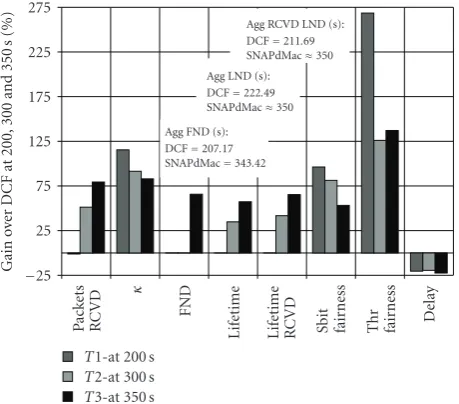
(i)T1: 0–200 seconds—period of time with moderate contention level and before a sudden increase of traffic; both protocols are transmitting and receiving, (ii)T2: 200–300 seconds—period of time during sudden increase and decrease of contention; DCF died before 230 seconds, but SNAPdMac is still alive,
(iii)T3: 300–350 seconds—period of time after a high contention level period and when nodes (can) have depleted the battery; at 350 seconds is the end of our simulations but SNAPdMac is still alive with nodes having an energy from 0 till 1.5 J.
In order to verify the lifetime of both protocols and remaining energy, the throughput and energy performance is plotted inFigure 9. As we can see in the figure, the DCF standard is alive till 222.49 seconds, while a lot of the nodes using the SNAPdMac protocol have not run out of energy yet at 350 seconds.
Time (s)
0 50 100 150 200 250 300 350
Thr
o
ug
hpu
t
(Mbps)
0.001 0.01 0.1 1 10 100 1000
0.001 0.01 0.1 1 10 100
0 50 100 150 200 Throughput: DCF
Energ
y
(J
)
0 4 8 12 16 20
0 100 200 300 Time (s) DCF SNAPdMac
Throughput: SNAPdMac Energy over the time
Figure9: Throughput and energy performance (HD/C).
the fairness between flows remarkably, and decreases the number of collisions meaningly. In period T2, the DCF nodes already die, whereas with the SNAPdMac protocol none of the nodes dies (in all of the simulation runs). In addition, the throughput performance gain over the IEEE 802.11 DCF standard is already noticeable. In the last period of time (T3), the throughput performance gain increases even more (till almost 80%). Note that this gain will be higher while prolonging the simulation time, because many of the SNAPdMac nodes are still alive at 350 seconds. The first SNAPdMac node scarcely dies just before the end of the simulation. The throughput fairness gain still remains significant at the end of the simulation.
6.3. High Density and Contention Scenario with a Sudden Change of the Contention Level—Heterogeneous Network. We have defined another HD/C scenario (H-D/C scenario 2in
Figure 8), in which a contention level is induced faster than in the previous scenario. Thebasicaccess scheme of the DCF is used. The network is heterogeneous, where nodes have an initial energy randomly selected from the range 1–11 Joules. Increases and decreases of the contention level are alternated in short periods of time. These simulations point out the importance of the speed of decrease/increase of the power level. Therefore, we have adjusted the physicalparameterζ
of the SNAPdMac protocol in these simulations.Figure 11
shows the total packets received versus the simulation run achieved by the tuned SNAPdMac protocol against the basic power control protocol and IEEE 802.11 DCF standard. We can easily see that the difference between the SNAPdMac protocol performance and other schemes is huge. Comparing both schemes, we can conclude that the SNAPdMac protocol with ζ = 3 can improve the throughput performance around 1.5%, and the FND and lifetime around 3%, however it imposes more loss of routes (where nodes can think that a packet is not received, because a collision occurred somewhere), resulting in a decrease of the throughput fairness around 23% with these simulation settings. This behavior can be explained as follows: because nodes decrease their power level too fast, their signal strength
Pa
ck
et
s
R
CVD
κ
FND
Lifetime Lifetime RCVD Sbit fair
ness
Thr fair
ness
Dela
y
Gain
o
ver
D
C
F
at
200,
300
and
350
s
(%)
−25 25 75 125 175 225 275
T1-at 200 s T2-at 300 s T3-at 350 s
Agg RCVD LND (s): DCF=211.69 SNAPdMac≈350
Agg LND (s): DCF=222.49 SNAPdMac≈350
Agg FND (s): DCF=207.17 SNAPdMac=343.42
Figure10: General results of HD/C scenario (1)—homogeneous network.
Number of seed
1 2 3 4 5 6 7 8 9 10
T
o
tal
p
ac
ke
ts
re
ce
iv
ed
0 4 8 12 16 20×
103
DCF Basic power
SNAPdMacζ=2 SNAPdMacζ=3
Figure11: The total number of packets received—heterogeneous network, Basic access scheme.
is not strong enough to capture a wireless channel or reach a destination (or another node on the way to a destination), which leads to loss in the throughput fairness. These simulations show that it is important to analyze both the total throughput performance and the fairness between nodes. Using a similar power control protocol in WSNs changes the point of view, since in WSNs this factor does not play an important role (on the contrary, some nodes are more important than others), only the lifetime of the network is. In this case, the fairness performance can be ignored emphasizing the energy performance.
Figure 12depicts the throughput (small figures) and total number of packets received (large figure) performance over the time. In this simulation run, the SNAPdMac protocol with ζ = 3 (32SNAPdMac) receives more packets and it lives a bit longer than the SNAPdMac protocol with ζ =
50 mobile nodes-HD, heterogenous initial energy (1–11 J)
Time (s)
0 20 40 60 80 100 120 140 160 180 200
T o tal p ac ke ts re ce iv ed 0 10 20 30 40
×103
Thr
o
ug
hput
(Mbps)
0.001 0.01 0.1 1 10 100
0 50 100 150 Time (s) STD Thr o ug hput (Mbps)
0.001 0.01 0.1 1 10 100
0 50 100 150 200 Time (s)
32SNAPdMac
21SNAPdMac
STD
32SNAPdMac
Figure 12: Total number of packets received and throughput— heterogeneous network, Basic access scheme.
50 mobile nodes-HD,
heterogenous initial energy (1–11 J), RTS/CTS scheme
Time (s)
0 20 40 60 80 100 120 140 160 180 200
T o tal p ac ke ts re ce iv ed 0 5 10 15 20 25 30 35
×103
Thr
o
ug
hput
(Mbps)
0.001 0.01 0.1 1 10 Thr o ug hput (Mbps)
0.001 0.01 0.1 1 10
0 50 100 150 Time (s) STD PSc basic Thr o ug hput (Mbps)
0.001 0.01 0.1 1 10
0 50 100 150 200 Time (s)
SNAPdMac
PSc basic
STD
SNAPdMac
Figure 13: Total number of packets received and throughput— heterogeneous network, RTS/CTS exchange scheme.
huge improvement in terms of total packets received, the throughput, and lifetime performance. Notice that between 37 and around 55 seconds (in the small left figure or big one) the standard receives only 2 packets (in order to observe this behavior better, we have plotted the standard performance with points), which does not happen in the case of the SNAPdMac protocol.
We have executed the same simulation scenario with the RTS/CTS exchange scheme.Figure 13 depicts the total number of packets received (large figure) and the throughput performance (small figures) of the SNAPdMac protocol against the basic power control protocol and IEEE 802.11 DCF standard. The DCF does not solve the problem of a very bad performance between 37 and 55 seconds using the RTS/CTS exchange scheme. The basic power control scheme encounters the same problem, but receiving more packets than the standard later on (see small figure). The SNAPdMac protocol has no problem at all during the com-plete simulation period of time receiving packets regularly.
Pa ck et s R CVD κ FND
Lifetime Lifetime RCVD Sbit fair
ness Thr fair ness Dela y Gain o ver the D CF 802.11 (%) −30 40 110 180 250 Power basic-basic SNAPdMac-basic Power basic-RTS/CTS SNAPdMac-RTS/CTS Figure14: General results of HD/C scenario (2)—heterogeneous network.
It outperforms the DCF andbasicpower control protocol in terms of the throughput, total packets received, and the life-time. Passing to the general results (with basic and RTS/CTS access scheme) plotted in Figure 14 we can conclude that the SNAPdMac protocol considerably outperforms other schemes in terms of the sending bit rate/throughput fairness and throughput performance. This is achieved again at the expense of the delay; however, it is compensated by a noticeable improvement of the FND and lifetime metrics. Notice that in this simulation using power control without any control from the MAC layer induces more collisions even than in the DCF standard. The power control triggered through the MAC layer avoids a lot of collisions improving the performance noticeably.
7. Concluding Remarks
In this work we have designed a novel cross-layer protocol, SNAPdMac. The protocol adjusts the upper and lower bounds of the contention window to lower the number of collisions. Secondly, it uses a power control scheme, triggered by the MAC layer, to limit the waste of energy and also to decrease the number of collisions. The protocol has been evaluated in three different scenarios and compared to the IEEE 802.11 DCF standard and the basic power control protocol [2].
In the first scenario, our expectation that the SNAPdMac protocol decreases the number of collisions (total and per node) is confirmed. Moreover, it has been affirmed that the transmission failure history is important in a static network, and it should not be entirely neglected in mobile conditions. The second scenario, high density and contention homo-geneous network evaluation, shows that the DCF lacks fairness, where the SNAPdMac protocol can tolerate high contention conditions which is confirmed by a very late death of the first node and the high activity of many nodes at the end of the simulations.
-upon change in NrN-(1)IF (NrNi≤NrNDESIRED)
(2) PtTR=PtMAX;
(3)ELSE
(4) x=NrNNrNi
DESIRED;
(5) PtDIFF=ε∗log10(x)∗PtHIST;
(6)IF (NrNi< NrNi−1NrNi> NrNi−1)
(7) PtTR=PtMAX−PtDIFF;
(8)ELSE
(9) Do nothing
Algorithm4: Basic power control protocol.
the sending bit rate fairness but also its total packets received performance degrades while comparing it with the homogeneous scenario. In this scenario we have also verified that the power adjustment should not be too fast or too slow, because it induces too aggressive or too conservative behavior. We have shown that using a faster decrease (increase) of the power leads to a degradation of the throughput fairness. Using the power control without considering the MAC informations can lead to an increase of collisions as it happens with thebasicpower control protocol. Summarizing, the SNAPdMac protocol outperforms the IEEE 802.11 DCF [1] andbasicpower control protocol [2] in static and mobile ad hoc networks both in homogeneous and heterogeneous environments. Thanks to a noticeable energy conservation and decrease of the number of colli-sions, SNAPdMac improves significantly the lifetime of the network and increases both the throughput performance and the sending bit rate/throughput fairness among contending flows.
Appendix
Basic Power Control Protocol
The basic principle of the basic power control protocol is using a logarithmic increase and decrease of the transmit power depending on thenumber of 1-hop neighbors(NrN). If the number of neighbors increases, the power decreases, otherwise the power level increases. The algorithm is exe-cuted every time when the number of neighbors changes. The pseudocode of the algorithm is presented inAlgorithm 4
where the ε is a variable and equals 1/NrNDESIRED where
different values of theNrNDESIRED have been discussed in
[29].
References
[1] The Institute of Electrical and Electronic Engineers, “IEEE Computer Society LAN MAN Standards Committee: Wireless LAN Medium Access Control (MAC) and Physical Layer (PHY) Specifications. ANSI/IEEE Std. 802.11,” ANSI/IEEE Std. 802.11, 1999 Edition, 1999.
[2] S. Romaszko and C. Blondia, “A MAC protocol for wireless ad
hoc networks with power control,” inProceedings of the
Inter-national Workshop on Wireless Ad-hoc Networks (IWWAN ’05), no. 54, London, UK, May 2005.
[3] K. Jamieson, H. Balakrishnan, and Y. C. Tay, “Sift: a MAC protocol for event-driven wireless sensor networks,” in Proceedings of the 3rd European Workshop on Wireless Sensor Networks (EWSN ’06), vol. 3868, pp. 260–275, Zurich, Switzerland, February 2006.
[4] L. Guang and C. Assi, “Mitigating smart selfish MAC layer
misbehavior in ad hoc networks,” in Proceedings of IEEE
International Conference on Wireless and Mobile Computing, Networking and Communications (WiMob ’06), pp. 116–123, Montreal, Canada, June 2006.
[5] A. Ksentini, A. Nafaa, A. Gueroui, and M. Naimi, “Determinist
contention window algorithm for IEEE 802.11,” inProceedings
of the 16th IEEE International Symposium on Personal, Indoor and Mobile Radio Communications (PIMRC ’05), vol. 4, pp. 2712–2716, Berlin, Germany, September 2005.
[6] P. Karn, “MACA—a new channel access method for packet
radio,” in Proceedings of the ARRL/CRRL Amateur Radio
9th Computer Networking Conference, pp. 134–140, Ontario, Canada, September 1990.
[7] S. Agarwal, R. H. Katz, S. V. Krishnamurthy, and S. K. Dao, “Distributed power control in ad-hoc wireless networks,” in
Proceedings of the 12th IEEE International Symposium on Per-sonal, Indoor and Mobile Radio Communications (PIMRC ’01), vol. 2, pp. F59–F66, San Diego, Calif, USA, September-October 2001.
[8] A. Acharya, A. Mishra, and S. Bansal, “MACA-P: a MAC for concurrent transmissions in multi-hop wireless networks,” IBM Research Report RC22528, IBM Corporation, Armonk, NY, USA, July 2002.
[9] E. Poon and B. Li, “SmartNode: achieving 802.11 MAC
interoperability in power-efficient ad hoc networks with
dynamic range adjustments,” inProceedings of the 23rd IEEE
International Conference on Distributed Computing Systems (ICDCS ’03), pp. 650–657, Providence, RI, USA, May 2003. [10] E.-S. Jung and N. H. Vaidya, “A power control MAC protocol
for ad hoc networks,” in Proceedings of the 8th Annual
International Conference on Mobile Computing and Networking (Mobicom ’02), pp. 36–47, Atlanta, Ga, USA, September 2002. [11] J. Lee, S.-J. Lee, W. Kim, D. Jo, T. Kwon, and Y. Choi, “RSS-based carrier sensing and interference estimation in 802.11
wireless networks,” in Proceedings of the 4th Annual IEEE
Communications Society Conference on Sensor, Mesh and Ad Hoc Communications and Networks (SECON ’07), pp. 491– 500, San Diego, Calif, USA, June 2007.
[12] T.-S. Kim, H. Lim, and J. C. Hou, “Improving spatial reuse through tuning transmit power, carrier sense threshold, and
data rate in multihop wireless networks,” inProceedings of the
12th Annual International Conference on Mobile Computing and Networking (Mobicom ’06), pp. 366–377, Los Angeles, Calif, USA, September 2006.
[13] J. Fuemmeler, N. H. Vaidya, and V. V. Veeravalli, “Selecting transmit powers and carrier sense thresholds for CSMA proto-cols,” Tech. Rep., University of Illinois at Urbana-Champaign, Urbana, Ill, USA, October 2004.
[14] X. Yang and N. H. Vaidya, “On physical carrier sensing in
wireless ad hoc networks,” inProceedings of the 24th Annual
[15] X. Yang,Efficient packet scheduling in wireless ad hoc networks, Ph.D. thesis, University of Illinois at Urbana-Champaign, Urbana, Ill, USA, 2005.
[16] A. Vasan, R. Ramjee, and T. Woo, “ECHOS: enhanced
capacity 802.11 hotspots,” inProceedings of the 24th Annual
Joint Conference of the IEEE Computer and Communications Societies (INFOCOM ’05), vol. 3, pp. 1562–1572, Miami, Fla, USA, March 2005.
[17] J. Chen, S.-H. G. Chan, Q. Zhang, W.-W. Zhu, and J. Chen, “PASA: power adaptation for starvation avoidance to
deliver wireless multimedia,”IEEE Journal on Selected Areas in
Communications, vol. 21, no. 10, pp. 1663–1673, 2003. [18] C. J. Colbourn, M. Cui, E. L. Lloyd, and V. R. Syrotiuk,
“A carrier sense multiple access protocol with power backoff
(CSMA/PB),”Ad Hoc Networks, vol. 5, no. 8, pp. 1233–1250,
2007.
[19] S. Romaszko and C. Blondia, “Bounds selection—dynamic
reset protocol for wireless ad hoc LANs,” in Proceedings of
IEEE Wireless Communications and Networking Conference (WCNC ’07), pp. 248–253, Kowloon, Hong Kong, March 2007.
[20] L. Bononi, M. Conti, and E. Gregori, “Runtime optimization
of IEEE 802.11 wireless LANs performance,”IEEE Transactions
on Parallel and Distributed Systems, vol. 15, no. 1, pp. 66–80, 2004.
[21] The Network Simulator NS:http://www.isi.edu/nsnam/ns.
[22] R. K. Jain, D.-M. Chiu, and W. R. Hawe, “A quantitative measure of fairness and discrimination for resource allocation in shared computer system,” DEC Research Report TR-301, Digital Equipment Corporation, Littleton, Mass, USA, 1984. [23] S. Gobriel, R. Melhem, and D. Moss´e, “BLAM: an
energy-aware MAC layer enhancement for wireless adhoc networks,” in Proceedings of IEEE Wireless Communications and Net-working Conference (WCNC ’05), vol. 3, pp. 1557–1563, New Orleans, La, USA, March 2005.
[24] L. M. Feeney, “Investigating the energy consumption of an IEEE 802.11 network interface,” Tech. Rep. T99/11, Swedish Institute of Computer Science (SICS), Kista, Sweden, Decem-ber 1999.
[25] M. Conti, “Body, personal, and local ad hoc wireless
net-works,” inThe Handbook of Ad Hoc Wireless Networks, chapter
1, pp. 3–24, CRC Press, Boca Raton, Fla, USA, 2002.
[26] S. Xu and T. Saadawi, “Does IEEE 802.11 MAC protocol
work well in multi-hop wireless ad hoc networks?” IEEE
Communication Magazine, vol. 39, no. 6, pp. 130–137, 2001. [27] S. Xu and T. Saadawi, “Revealing the problems with 802.11
medium access control protocol in multi-hop wireless ad hoc
networks,”Computer Networks, vol. 38, no. 4, pp. 531–548,
2002.
[28] F.-Y. Hung and I. Marsic, “Effectiveness of physical and virtual
carrier sensing in IEEE 802.11 wireless ad hoc networks,” in
Proceedings of IEEE Wireless Communications and Networking Conference (WCNC ’07), pp. 143–147, Kowloon, Hong Kong, March 2007.
[29] S. Romaszko and C. Blondia, “Enhancements of the IEEE 802.11, a MAC protocol for ad hoc network with history of
power adjustment,” inProceedings of the 3rd IEEE International