
CONTROL OF ONE-DIMENSIONAL CURSOR MOVEMENT BY NONINVASIVE BRAIN-COMPUTER INTERFACE IN HUMANS
SITI ZURAIMI SALLEH
A thesis submitted in fulfilment of the requirements for the award of the degree of
Master of Engineering (Electrical)
Faculty of Electrical Engineering Universiti Teknologi Malaysia
iii
To my mother and father, husband,
and sensei,
iv
ACKNOWLEDGEMENT
In the name of Allah, the Almighty and the Merciful. Alhamdulillah, praise to Allah S.W.T for the guidance, strength and bless which He gave upon me to complete this research work.
First and foremost, I would like to express my sincere gratitude and appreciation to my beloved supervisor, Dr. Norlaili bt Mat Safri for her advice, knowledge, supports, kindness and patience throughout this research work. I also would like to express my thanks to Dr. Fauzan, Mr. Afzan, Mrs. Husnaini and Ms. Ashikin for their useful discussion, assistance and supports.
v
ABSTRACT
vi
ABSTRAK
vii
TABLE OF CONTENTS
CHAPTER TITLE PAGE
DECLARATION ii
DEDICATION iii
ACKNOWLEDGEMENT iv
ABSTRACT v
ABSTRAK vi
TABLE OF CONTENTS vii
LIST OF TABLES xi
LIST OF FIGURES xii
LIST OF ABBREVIATIONS xvi
LIST OF APPENDICES xvii
1 INTRODUCTION 1
1.1 Introduction 1
1.2 Problem Statement 2
viii
1.4 Scope of Project 3
1.5 Project Contribution 4
1.6 Thesis Outline 4
2 LITERATURE REVIEW 6
2.1 Introduction 6
2.2 Electroencephalography 6
2.2.1 EEG Waveform 7
2.3 The International 10-20 of Electrode
Placement System 9
2.4 Brain-Computer Interface (BCI) 10 2.4.1 Invasive and Noninvasive BCI 11 2.4.2 Imagination vs. Actual Movement 12 2.4.3 Electrophysiological Sources 12
2.4.4 Signal Processing 15
2.5 Published Work on BCI 16
2.5.1 Published Work on Neurofeedback 17 2.5.2 Published Work on Cursor Control 18 2.5.3 Published Work on Other Control 19
2.6 Discussion on Published Work in BCI 20
3 METHODOLOGY 22
3.1 Introduction 22
3.2 Experimental Set Up 22
ix
3.2.2 Preparation of Subject 24
3.2.2.1 Installing of Electrodes onto Electrode Board Adapter 24
3.2.3 Clean Up 25
3.3 Data Acquisition and Recording Process 26
3.3.1 Participant 26
3.3.2 Conditions 26
3.3.3 Data Acquisition 26
3.3.4 Data Analysis 27
3.4 Flow Chart of Data Analysis 29
3.5 Software Development 31
4 FREQUENCY ANALYSIS AND FINDINGS 35
4.1 Introduction 35
4.2 EEG Signals 35
4.3 Feature Extraction Analysis 37
4.3.1 1024 ms Time Interval 38
4.3.2 512 ms Time Interval 40
4.3.3 Mean for All Trials 43
4.4 Feature Translation 45
5 DISCUSSION 48
5.1 Introduction 48
x
6 CONCLUSION 51
6.1 Conclusion 51
6.2 Recommendation for Future Work 52
REFERENCES 53
xi
LIST OF TABLES
TABLE NO. TITLE PAGE
2.1 Frequency band for EEG signals 7 2.2 Electrophysiological sources used in BCI 13
3.1 Electrodes position 25
4.1 Channels combination 45
4.2 Hit rate and mean time 46
4.3 Comparison of hit rates and movement precision 46 4.4 Size of target, cursor and workspace 47
xii
LIST OF FIGURES
FIGURE NO. TITLLE PAGE
1.1 Scope of project 3
2.1 EEG waveforms 8
2.1 (a) Delta wave 8
2.1 (b) Theta wave 8
2.1 (c) Alpha wave 8
2.1 (d) Beta wave 8
2.1 (e) Gamma wave 8
2.2 The 10-20 electrode placement system 9 2.3 Basic design and operation of a BCI system 10 2.4 Present-day human BCI system types 14
2.4(a) Sensorimotor rhythm 14
xiii
2.4(c) P300 evoked potential 14 2.4(d) Cortical neuronal activity 14 3.1 Equipment used in the experiment 23
3.1 (a) Electro-cap 23
3.1 (b) Electro board adapters 23
3.1 (c) Body harness 23
3.1 (d) Disposable sponge disks 23 3.1 (e) Blunted needle/syringe kit 23
3.1 (f) Ear electrodes 23
3.1 (g) Electrode board adapter connector 23 3.2 Sequence of data acquisition 27 3.3 Division of data for 1024 ms and 512 ms time interval 27 3.4 Flow chart of parameter determination process 29 3.5 Flow chart of finalized parameter determination
process 30
3.6(a) Syntax of workspace 31
3.6(b) Workspace 31
3.7(a) Syntax of baseline 32
3.7(b) Baseline 32
3.8(a) Syntax of cursor 33
xiv
3.9(a) Syntax of target 34
3.9(b) Target 34
4.1 Example of 1 second of raw EEG signal from subject 1
at PZ channel 36
4.2 Example of power spectrum of EEG signal from subject 1
at PZ channel 36
4.3 Example of 1 second data of EEG signal from subject 1 37 4.4 (a) The occurrences of maximum DP for trial 1 for 1024 ms
time interval 38
4.4 (b) The occurrences of maximum DP for trial 2 for 1024 ms
time interval 39
4.4 (c) The occurrences of maximum DP for trial 3 for 1024 ms
time interval 39
4.4 (d) The occurrences of maximum DP for trial 4 for 1024 ms
time interval 40
4.5 (a) The occurrences of maximum DP for trial 1 for 512 ms
time interval 41
4.5 (b) The occurrences of maximum DP for trial 2 for 1024 ms
time interval 41
4.5 (c) The occurrences of maximum DP for trial 3 for 1024 ms
xv
4.5 (d) The occurrences of maximum DP for trial 4 for 1024 ms
time interval 42
4.6 Average of percentage of the maximum DP for 1024 ms
time interval 43
4.7 Average of percentage of the maximum DP for 1024 ms
time interval 44
xvi
LIST OF ABBREVIATIONS
ALS - Amyotrophic lateral sclerosis BCI - Brain-computer interface DP - Difference power
ECoG - Electrocorticography/electrocorticogram EEG - Electroencephalography/electroencephalogram ERP - Event-related potential
Hz - Hertz
ms - Milisecond
xvii
LIST OF APPENDICES
APPENDIX TITLE PAGE
A Coding of cursor movement 57
B Coding to determine parameters 70
C List of publications 74
1
CHAPTER 1
INTRODUCTION
1.1 Introduction
For normal people, communication is a need to undergo their daily activities. Communication is a process to transmit or transfer information, thought or by feeling by or to or between people or groups. It is a connection allowing access between persons by either verbal contact or action.
2
BCI can be divided into two general categories, i.e., invasive and noninvasive [3]. Most of noninvasive BCI systems use electroencephalogram (EEG) signals; i.e., the electrical brain activity recorded from electrodes placed on the scalp. The main source of the EEG is the synchronous activity of thousand of cortical neurons. Measuring the EEG is a simple noninvasive way to monitor electrical brain activity, but it does not provide detailed information on the activity of single neurons (a few μVolts) and noisy environment (especially if recording outside shield rooms) [3]. In invasive BCI systems, the activity of single neurons (their spiking rate) is recorded from microelectrodes implanted in the brain. Such systems are being studied mainly in nonhuman primates, for example see [4]. These invasive BCIs face substantial technical difficulties and entail significant clinical risks as they require that recording electrodes be implanted in the cortex and function well for long periods, and they risk infection and other damage to the brain [5]. For human, therefore, noninvasive BCI systems are applied due to clinical risks and ethics [3].
1.2 Problem Statement
Among of the most important evaluation in one or two dimensional cursor movement-BCI is hit rate. It is an onset element to design a practical application of BCI that depends in speed and accuracy. If the speed and accuracy can be substantially improved, the range of applications and the number of potential users would greatly increase [1].
3
1.3 Objectives
This study was conducted with the objective of:
• To determine parameters that will drive or control cursor in brain-computer interface (BCI) using noninvasive EEG signal.
• To determine parameters that can produce faster hit rate of brain-computer interface.
1.4 Scope of Project
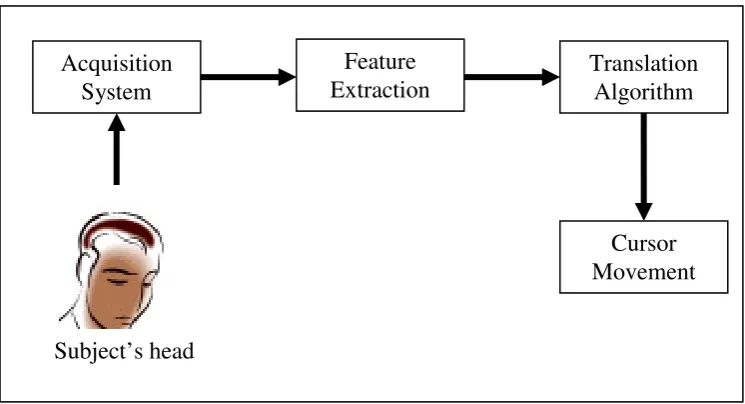
Figure 1.1 depicts the block diagram for this study’s scope of work. First, EEG is recorded from the scalp and digitalized using acquisition system. Then the digitalized signals are subjected to feature extraction procedures, such as spectral analysis or spatial filtering. Afterwards, translation algorithm converts the EEG feature into command of the cursor movement. At the monitor screen, the cursor moves and hit target.
Figure 1.1 Scope of project Acquisition
System
Feature Extraction
Translation Algorithm
Cursor Movement
4
1.5 Project Contribution
BCI uses human brain signal to control other devices. This technology has advances significantly in the world but not many researches can be found in Malaysia. Advanced research has lead to potential use in medical field as well as in computer games industry. This research has few purposes; firstly to develop human capital in BCI for Malaysia. Secondly, is to provide platform for a more advance application such as a two-dimensional cursor movement. A study by other researchers has found that slow frequency gave highest correct response rate when presented with visual presentation of target and non-target. This research also has found slow frequency as optimum parameter to control cursor movement. However, it is noted that the methodology for the experimental set-up was weak, leading to limited application to only specific one-dimensional cursor movement as any imagination may bring about the same results. However, with proper methodology and feature extraction, there is possibility of using slow frequency for BCI application that will increase the versatility of the field.
The contribution of this research would be in the developed in-house software of BCI. The developed software is integrated with an existing hardware. The software main contribution is that it is an open source, has adjustable cursor and target size, and is panel window size-independent software. With the robust software, a more advance application can be developed and together with correct methodology, the objectives are obtainable.
1.6 Thesis Outline
5
statement, objectives of the project, the main objectives, scope of the project and the project contribution. This chapter is referred to conclude the findings of the project in conclusion part.
Chapter 2 discussed about reviewed literatures and published works on BCI in view of applied methodologies over the years. This chapter also discussed on several types of electrophysiology sources and experimental designs including general overview of BCI study.
The project methodology is covered in Chapter 3 that include discussion on the processes and steps involve in managing the raw data from EEG, the formula that being used and the information on software and hardware utilize in this study.
Chapter 4 contains the result of feature extraction and feature translation in offline analysis. In feature extraction, EEG signals were analyzed using Fast Fourier Transform (FFT) in two time interval i.e. 1024 ms and 512 ms. Afterward, two parameters from the transformed data in frequency domain were extracted, i.e., scalp location and frequency band. Applying a value coordinated by those two parameters, translation algorithm was performed. The performance in mean time, hit rate and movement precision were observed and compared with previous studies.
Chapter 5 summarizes the results and findings from the previous chapter. The values of maximum difference in power which are pointed by the two parameters might be use to control and one-dimensional cursor movement.
![Crystal structure of bis[(5 amino 1H 1,2,4 triazol 3 yl κN4)acetato κO]diaquanickel(II) dihydrate](data:image/gif;base64,R0lGODlhAQABAIAAAP///wAAACH5BAEAAAAALAAAAAABAAEAAAICRAEAOw==)