International Conference on Knowledge Management (ICKM) 2005.
Knowledge Sharing Role in IT Outsourcing
Zuraini Ismail1
Assoc. Prof. Dr. Husnayati Hussin [email protected]
Assoc. Prof. Dr. Mohd Adam Suhaimi [email protected]
Dr Nor Shahriza Abdul Karim [email protected]
Abstract
Knowledge has emerged as a strategically significant resource to organization. In recent studies, there has been much interest in knowledge sharing between service receiver and service provider through an outsourcing partnership and its effect on information technology (IT) outsourcing success. Besides the frequent cited reasons of economic and technological benefits for IT outsourcing there is a growing concern of organizations evaluating its success or activity involved in IT outsourcing. Knowledge sharing is considered as one of the major motives of outsourcing partnership based on trust to ensure partnership quality. This study examines the relationship between knowledge sharing and IT outsourcing success. We argue that knowledge sharing is positively associated with IT outsourcing success. This paper further reports on the ongoing empirical work conducted on both public and private organizations in Malaysia that have outsourced their IT functions. We seek to investigate the issue of knowledge sharing from the service receivers’ perspective. It is anticipated that our research will elucidate the importance of knowledge sharing for both practitioners and knowledge management researchers, lens on IT outsourcing.
Keywords
1. INTRODUCTION
The 1989 Kodak and DEC successful outsourcing relationship created the wave of IT
outsourcing phenomena. Ever since then many large corporations are treating IT as a
commodity service, opting from a focus on internal development of information systems
to external partnership and alliances (Kern and Willcocks,2000, Kakabadse, N and
Kakabadse, A. 2000). This bandwagon effect definitely shaped the spending on IT
outsourcing services as it has reached over USD60 billion in 2001 and is expected to
grow by a 5 year compound average growth rate (CAGR) of 12% (Computerworld
Malaysia, 2003). In Malaysia, International Data Corp (IDC) reports the local companies’
expenditures on outsourcing their ICT management services reached US$89 million
(RM338 million) in 2001 (Manecksha, 2003). It forecasted that with a compound annual
growth rate of 15%, the amount is expected to be US$164 million by the year 2005.
Malaysia can expect to attract at least RM11.4 billion of the global outsourcing business
that is projected to be worth RM1.9 trillion by 2008, briefs Price Waterhouse Coopers
(Cheong, 2003).
The word ‘outsourcing’ has been described as an act of predetermined subcontracting
part or all a company’s IT function to one or more external vendors (Sengupta & Zviran,
1997). The underlying concept of IT outsourcing is the acquisition of services and/or
products, through continuous interactions between parties to the agreement; may it be
temporary or designated within an agreed length of time (Hirschheim and Lacity, 2000).
Malaysia is no exception to IT outsourcing. Increasingly, Malaysia’s private sector and
the government are seeing a rising trend in engaging into IT outsourcing relationships
outsourcing contracts in the private sectors include RM1.3 billion Maybank deal, the
RM440 million Malaysian Airline System Bhd (MAS) deal, and Permodalan Nasional
Bhd. (PNB) RM32 million extension contract (The Star, 2003). These large outsourcing
deals are also sparked by Bank Negara Malaysia (BNM). As an effort to strengthen
Malaysian banking industry following the 1997 financial crisis, BNM had directed local
banks to merge and to form only ten anchor banks (Muzaffar Shah, 2002). In the
Financial Master Plan revealed in 2001, BNM encourages banks to outsource their
non-core back office and IT processes to enhance their internal efficiency and enable them to
focus on selling and marketing financial services products.
Taking cue from the private sector, outsourcing move is seen as a favorable alternative
for the Government. Interest in IT outsourcing is on the rise among Government
agencies riding on high public expectations while finances are limited and skilled
resources are scare, this according to analysts and industry observers (Kasim, 2005). In
the recent 2005 Budget, a sum of RM500 million has been allocated for infrastructure
outsourcing projects especially in the education and health sectors. Among the early
Malaysian government’s large-scale systems integration projects in 1990s were POS
Malaysia Berhad, Amanah Saham Nasional Berhad and Permodalan Nasional Berhad
(PNB) (Mohammad, 2003). These massive computerization projects were outsourced to
one of Malaysian’s leading total ICT solution and service provider. Other IT outsourcing
project includes the Malaysian Smart Schools, which was awarded to Telekom Malaysia
Consortium (EDS Release, 1999), and the Generic Office Environment (GOE) project
which was awarded to Electronic Data Services (EDS) Malaysia. Despite these
experiences, Beulen, E., Ribbers, P. (2003) concluded that generally, Asia’s level of
experience with the management of IT outsourcing is low compared to the rest of the
The magnitude of deals involved in IT outsourcing has established concern with
ensuring successful outsourcing relationship between service receivers and service
providers. It has been indicated that one particular factor that can contribute to
successful outsourcing relationship is knowledge sharing (Lee and Kim, 2003).
Accordingly, knowledge sharing becomes a factor to gain and sustain a competitive
advantage, and improved business performance (Choi and Lee, 2003). Knowledge
sharing is not merely a neutral exchanged of information but it affects working
relationships, distribution of power, patterns of influence and alters how individual define
their responsibilities (Willet, 2002).
This study explores the service receiver and service provider relationship and provides
and anticipates the best relationship to strike in determining a successful IT outsourcing
partnership. Although there may be many factors involved in influencing IT outsourcing
success, this study focuses only on ‘partnership’ domain in examining knowledge
sharing.
2. LITERATURE REVIEW
Grover et.al. (1996) suggested current IT outsourcing nature has evolved in the
following ways: (i) larger companies are indulging outsourcing; (ii) a greater range and
depth of services are involved; (iii) service provider are agreeing to more responsibility
and risk-taking; (iv) more functional outsourcing occurring; and (v) the nature of
relationship with service provider is changing. Among the major trends in outsourcing,
the change of relationship between the clients and the service providers is the most
a relationship of customer and vendor, to a partnership relationship in accordance to
achieve goals of participants.
In recent studies, there has been much interest in knowledge sharing through
outsourcing partnership and its effect on outsourcing success (Sengupta and Zviran,
1997, Lee, 2001). However, knowledge sharing among different organizations is not an
easy alliance. Nonaka and Takeuchi (1995) notes that knowledge sharing is based on
organizational context, and thus knowledge cannot be easily transferred among
organization with different cultures, structures and goal. Hence, a successful knowledge
sharing in an outsourcing partnership, both the service receiver and service provider
must congregate to a strategic partnership and do not act opportunistic (Lee and Kim,
1999). This indicates the importance of knowledge sharing in building a successful
partnership to reap benefits through outsourcing practices.
Many researchers reported that closer relationships result from more frequent and
relevant knowledge exchanges among high performance partners. Partnerships can
create a competitive advantage through strategic sharing of organizations’ key
information (Probst et al., 2000).
In a case study, Beulen and Ribbers (2003) examined an Asian IT outsourcing
partnership in the discrete manufacturing industry. The findings of this exploratory
research confirm that knowledge sharing is essential in managing IT outsourcing
relationships.
Choi and Lee (2003) study done on service industry explored the relationship between
middle managers. Their findings strengthen the argument that knowledge management
dynamic style integrating explicit with tacit-oriented methods is found to improved
business performance.
Lee (2001) conducted a survey on public sector organizations in Korea. He concluded
that knowledge sharing is significantly associated with the degree of attainment of
outsourcing benefits. The ability of the service receiver to absorb the needed knowledge
has a significant direct effect on attaining benefits.
3. RESEARCH OBJECTIVES and KEY VARIABLES
The basic model studied the relationship between knowledge sharing and outsourcing
success, focus on the service receiver perspective.
3.1 Knowledge Sharing
Literature review on knowledge management revealed two forms of knowledge, namely
tacit and explicit. Tacit knowledge, as defined by Nonaka and Takeuchi (1995), is highly
personal, hard to formalize, difficult to communicate or share with others. Explicit or
codified knowledge on the other hand, refers to knowledge that is transmittable in formal,
systemic language. Shared knowledge is defined as extend to which critical or propriety
information is communicated between partners (Willett, 2002; Lee and Kim, 1999, 2003).
Therefore, increasing attention is paid to how organizations learn from their partners and
develop new competencies through strategic alliances. Lee (2000) defines knowledge
sharing as activities of transferring or disseminating knowledge from one person, group
or organization to another. Crofts and Swatman (2002), affirms that outsourcing lead to
irreplaceable tacit, cross-functional knowledge pertaining to the mind of professional
system analyst. Hence, knowledge sharing is considered one of the dimensions of
partnership quality associated with IT outsourcing.
3.2 IT Outsourcing Success
IT outsourcing success is the dependent variable to be explored, which is not easy to
measure. Researchers have investigated the success of information technology in
myriad ways (Garrity and Sanders, 1998). Lee and Kim (2003) defined outsourcing
success as ‘the level of fitness between the service receiver requirements and
outsourcing outcomes delivered by the service provider’. Three strategies are commonly
cited in attaining optimal IT outsourcing success though the focus may varies from one
company to another (Grover et al., 1996; Lee and Kim, 1999; Lee, 2001; Lee and Kim,
2003).
In view of the lack of empirical studies examining IT outsourcing success in the
Malaysian context and further identify the role of knowledge sharing in IT outsourcing
practices among Malaysian organizations, such a study is thus timely. Hence, we
hypothesize:
H1: Knowledge sharing is positively associated with IT outsourcing success.
4. MEASURES
A questionnaire based on previous literature was developed. A multiple-item method
was used and each item was measured on a seven-point Likert scale from ‘ strongly
In this study, knowledge sharing is defined as activities of transferring or disseminating
knowledge from one person, group or organization to another with broadly includes tacit
and explicit knowledge (Lee and Kim, 1999; Lee, 2001). Four items from Lee and Kim
(1999) and Lee (2001) were used to operationalize knowledge sharing. These measures
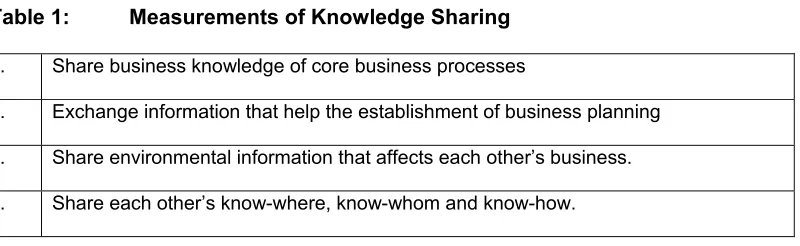
were adopted due to high reliability in previous studies. Table 1 depicts knowledge
sharing measures.
Table 1: Measurements of Knowledge Sharing
1. Share business knowledge of core business processes
2. Exchange information that help the establishment of business planning
3. Share environmental information that affects each other’s business.
4. Share each other’s know-where, know-whom and know-how.
IT outsourcing success measure of this study refers to the overall organizational
advantage obtained from organizations outsourcing their IT functions. There are two
constructs of IT outsourcing success, namely net benefits and service quality.
Outsourcing is motivated by the strategic, economic and technological benefits (Grover
et al., 1996; Lee and Kim, 2003). To capture these advantages of outsourcing Grover,
Cheon and Teng (1996) ‘s instrument was adopted to access the degree of achieving
strategic, economic and technological benefits of outsourcing. Ten items were adapted
to operationalize net benefits (strategic, economic and technological benefits). Grover
and Teng’s instrument had been widely used by researchers and hence this instrument
was a valid and acceptable measure for the net benefits constructs.
In view of the changes in the role of IT environment such as IT outsourcing, DeLone and
IT outsourcing success. Jiang et al. (2003) offered a method for quantifying a measure
of service quality that includes both the user and the IT service provider perspective.
Hence, in addition, service quality measures were adopted from Jiang et al. (2002, 2003)
for this study. There are five dimensions used by service receivers to evaluate most type
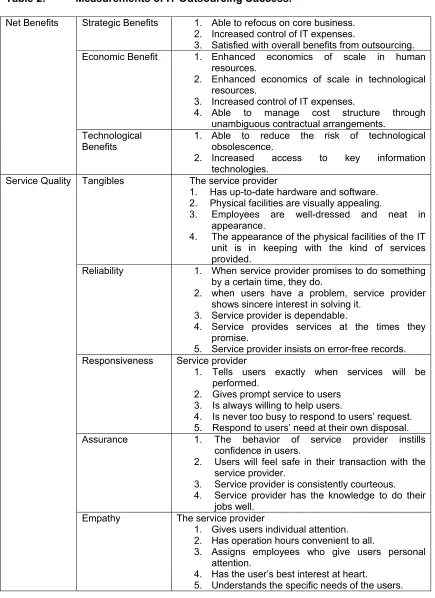
of services. Other researchers had validated this instrument. Table 2 depicts the
measures for IT outsourcing success.
Besides the above items, demographic factors on respondent profile (age, gender,
educational level, job hierarchy, length of working experiences and duration of handling
outsourced IT functions) and company profile (organization primary industry, size,
percentage IT functions outsource, drivers for outsourcing, type of outsourcing
relationship, type of IT function outsourced, type of service provider and approach used
Table 2: Measurements of IT Outsourcing Success.
Net Benefits Strategic Benefits 1. Able to refocus on core business.
2. Increased control of IT expenses.
3. Satisfied with overall benefits from outsourcing.
Economic Benefit 1. Enhanced economics of scale in human
resources.
2. Enhanced economics of scale in technological resources.
3. Increased control of IT expenses.
4. Able to manage cost structure through unambiguous contractual arrangements.
Technological Benefits
1. Able to reduce the risk of technological obsolescence.
2. Increased access to key information
technologies.
Service Quality Tangibles The service provider
1. Has up-to-date hardware and software. 2. Physical facilities are visually appealing.
3. Employees are well-dressed and neat in appearance.
4. The appearance of the physical facilities of the IT unit is in keeping with the kind of services provided.
Reliability 1. When service provider promises to do something
by a certain time, they do.
2. when users have a problem, service provider shows sincere interest in solving it.
3. Service provider is dependable.
4. Service provides services at the times they promise.
5. Service provider insists on error-free records.
Responsiveness Service provider
1. Tells users exactly when services will be performed.
2. Gives prompt service to users 3. Is always willing to help users.
4. Is never too busy to respond to users’ request. 5. Respond to users’ need at their own disposal.
Assurance 1. The behavior of service provider instills
confidence in users.
2. Users will feel safe in their transaction with the service provider.
3. Service provider is consistently courteous. 4. Service provider has the knowledge to do their
jobs well.
Empathy The service provider
1. Gives users individual attention. 2. Has operation hours convenient to all.
3. Assigns employees who give users personal attention.
4. Has the user’s best interest at heart.
5. SAMPLE and DATA COLLECTION
In this study, the unit of analysis is organizational level. Organizations comprise of
corporations, business units, subsidiaries or divisions served by service providers
(Grover et al., 1996). We used cross-sectional survey research method. A sampling
frame was developed from Small and Medium Industries Development Corporation
(SMIDEC) (50), Bursa Malaysia (82), Federation of Malaysian’s Manufacturers (464),
Malaysian Companies Directory (185) and Malaysian Civil Service Link (MCSL) (129).
The targeted respondents were IT managers or IT project managers running the
outsourced IT projects of both public and private organizations located in the Klang
Valley.
A total of 910 questionnaires were mailed during the first week and third week of April
2005. In order to increase response rate, cover letters, personalized addresses and
self-address return envelopes were provided. From the 910 questionnaires distributed, to
date 145 questionnaires were returned after duration of four weeks, which yielded about
15.9 % response rate. 32 questionnaires indicated that their companies do not practice
IT outsourcing. Ten questionnaires were returned with no responses from unknown
respondents. At this point in time, 91 responses were used for data analysis. Data
collection is in progress and expected to be completed by mid June, 2005.
6. ANALYSIS
6.1 Sample characteristics
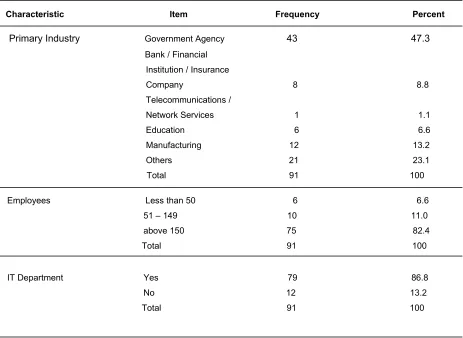
The sample was analyzed using SPSS for Windows, Version 12.0. The descriptive
statistics of the responding organizations are shown in Table 3. It summarizes the
of IT department, percentage of IT functions being outsourced, type of outsourcing
relationship, type of service provider engaged with and approach used by service
provider. Majority of the primary industry are government agencies. 82.4 % have more
than 150 employees indicating organizations are large-sized. Seventy-nine organizations
have IT departments. Table 4 depicts twenty-six organizations (28.6%) outsourced 20%
of their IT functions against 16 organizations (17.6%) that outsource more than 80% of
their IT functions. Forty-nine organizations (53.8%) engaged in selective outsourcing.
Most of the organizations (87.9%) outsource their IT functions to local service providers.
64.8 % of the service providers practice single term approach in implementing their
services to service receivers.
Table 3: Company Profile
Characteristic Item Frequency Percent
Primary Industry Government Agency 43 47.3 Bank / Financial
Institution / Insurance
Company 8 8.8 Telecommunications /
Network Services 1 1.1 Education 6 6.6 Manufacturing 12 13.2 Others 21 23.1
Total 91 100
Employees Less than 50 6 6.6 51 – 149 10 11.0 above 150 75 82.4
Total 91 100
IT Department Yes 79 86.8 No 12 13.2
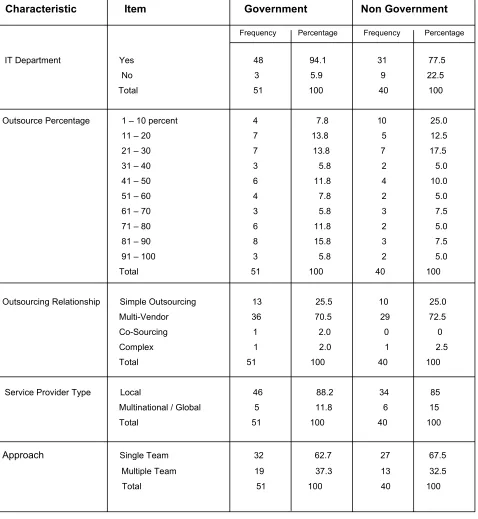
Table 4 further depicts and explains the descriptive statistics of the sample comparing
government and non-government organizations. Government agencies showed a higher
percentage (94.1%) of in-house IT departments as compared to non-government
agencies (77.5%). Non–government organizations registered 37.5% minimal outsourcing
(outsourcing below 20% of their IT functions) as compared to government agencies of
21.6%. Selective outsourcing (outsourcing between 20% and 80% of their IT functions)
is preferred, as government statistics reflected 56.8% while non-government
organization registered 50%. The findings is in line with an extensive study on selective
versus total outsourcing decisions conducted by Lacity et. al. (1994). They concluded
that selective outsourcing is preferred because it is more controllable. Total outsourcing
is only successful if there is a tight and well-monitored contract or agreement between
the sourcing firms and the external parties. Bowen and LaMorica (1998) reaffirmed that
most organizations opt for selective outsourcing to minimize overall IT management
burden, while retaining control of strategic decision-making.
Findings showed that both government (70.5%) and non-government (72.5%) employed
multi vendor outsourcing relationships. Both government and non-government
organizations showed preference for local service providers, with 80.2 % for government
and 85% for non-government, with single team approach during implementation which
Table 4: Comparison of Government and Non-Government Organizations
Characteristic Item Government Non Government
Frequency Percentage Frequency Percentage
IT Department Yes 48 94.1 31 77.5 No 3 5.9 9 22.5
Total 51 100 40 100
Outsource Percentage 1 – 10 percent 4 7.8 10 25.0 11 – 20 7 13.8 5 12.5 21 – 30 7 13.8 7 17.5 31 – 40 3 5.8 2 5.0 41 – 50 6 11.8 4 10.0 51 – 60 4 7.8 2 5.0 61 – 70 3 5.8 3 7.5 71 – 80 6 11.8 2 5.0 81 – 90 8 15.8 3 7.5 91 – 100 3 5.8 2 5.0
Total 51 100 40 100
Outsourcing Relationship Simple Outsourcing 13 25.5 10 25.0 Multi-Vendor 36 70.5 29 72.5 Co-Sourcing 1 2.0 0 0 Complex 1 2.0 1 2.5 Total 51 100 40 100
Service Provider Type Local 46 88.2 34 85 Multinational / Global 5 11.8 6 15
Total 51 100 40 100
Approach Single Team 32 62.7 27 67.5 Multiple Team 19 37.3 13 32.5
6.2 Descriptive Statistics of Independent and Dependent Variables
Descriptive statistics depicted in Table 5 describes the knowledge sharing variable with
its four items displaying its central tendency and variability. Table 6 shows the mean of
knowledge sharing and IT outsourcing success. Generally, IT managers’ belief that
knowledge sharing is important in their organization (mean=4.9808, SD = 1.05). Also,
generally IT managers’ belief that IT outsourcing success is important in the
organization (mean = 5.0196, SD = 0.76571).
Table 5: Descriptive Statistics for Items of Independent Variable
N Minimum Maximum Mean Std. Deviation Variance
Service provider share
business knowledge 91 2.00 7.00 5.0989 1.18373 1.401
Service provider share
environmental info 91 1.00 7.00 4.9011 1.24771 1.557
Service provider exchange information , help in
business planing 91 2.00 7.00 5.0220 1.11533 1.244
Service provider share each other's know-how &
know-whom 91 2.00 7.00 4.9011 1.16481 1.357
Valid N (listwise) 91
Table 6: Mean of Independent Variable and Dependent Variables
N Minimum Maximum Mean Std. Deviation
Knowledge Sharing 91 2.00 7.00 4.9808 1.04896
IT Outsourcing Success 91 2.48 6.52 5.0196 .76571
Valid N (listwise) 91
6.3 T-Test for Two Unrelated Means
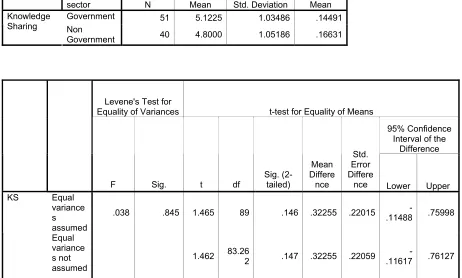
T-test is conducted to determine if the means of government and non-government
Table 7 : Independent Sample Test
Group Statistics
Type of
sector N Mean Std. Deviation
Std. Error Mean
Government 51 5.1225 1.03486 .14491
Knowledge
Sharing Non
Government 40 4.8000 1.05186 .16631
Levene's Test for
Equality of Variances t-test for Equality of Means
95% Confidence Interval of the
Difference
F Sig. t df Sig. (2-tailed)
Mean Differe nce Std. Error Differe
nce Lower Upper
Equal variance s assumed
.038 .845 1.465 89 .146 .32255 .22015 .11488- .75998
KS
Equal variance s not assumed
1.462 83.262 .147 .32255 .22059 .11617- .76127
In relation to knowledge sharing as shown in Table 7, Levene’s test was not significant
and thus we interpret the equal variance estimates. Consulting out t-value, df and
two-tail significant, again no significant differences are apparent (p>.05). Thus, there is no
significant difference in knowledge sharing between government and non-government,
t (89) = 1. 465, p>.05. Alternatively, the t-value is 1.465 with 89 degree of freedom. A
probability of 0.146 5 indicates there is no significant difference in the two groups.
6.4 Reliability of Constructs
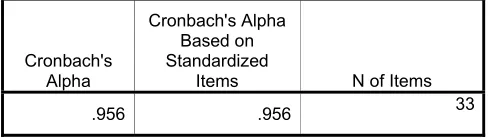
Table 8 and Table 9 summarize the number of items and the results of reliability tests for
measures (Cronbach’s alpha) were obtained in order to assess the reliability of the
measurement instruments.
Table 8: Cronbach’s alpha for Knowledge Sharing Measures
Cronbach's Alpha
Cronbach's Alpha Based on Standardized
Items N of Items
.912 .913 4
The Cronbach’s alpha for knowledge sharing is 0.912, as shown above in Table 8. The
generally agreed upon lower limit for Cronbach’s alpha is 0.70 (Hair et al., 1998). Thus
we conclude that knowledge sharing is reliable. Table 9 depicts the consistency of the
entire scale of IT outsourcing success measures. The Cronbach’s alpha reads 0.956.
Thus, we conclude that IT outsourcing success measures are also reliable.
Table 9: Cronbach’s alpha for IT Outsourcing Success Measures
Cronbach's Alpha
Cronbach's Alpha Based on Standardized
Items N of Items
.956 .956 33
We checked for normality of the distribution of data. The Kolmogorov- Smirnov statistic
with a Lilliefors significance level is produced. Since the significance level is greater than
0.05, then normality is assumed. Test of normality for government agencies registered at
non-government organizations. This confirms there is no violation of assumption for
correlation analysis.
6.5 Results of Correlation Analysis
In order to support our hypothesis, a simple bivariate correlation was carried out. A
Pearson-product-moment correlation coefficient describes the relationship between
knowledge sharing and IT outsourcing success.
Table 10: Correlations of Knowledge Sharing / Success for Government Agencies
KnowledgeSharing SUCCESS
Knowledge Sharing Pearson Correlation 1 .462(**)
Sig. (2-tailed) . .001
N 51 51
SUCCESS Pearson Correlation .462(**) 1
Sig. (2-tailed) .001 .
N 51 51
** Correlation is significant at the 0.01 level (2-tailed).
Table 10 shows that there is a significant positive correlation between IT outsourcing
success and knowledge sharing (r= .462, p<.001) for government agencies. Since
Pearson’s r is 0.462, this would indicate a modest positive relationship between the two
variables.
Table 11: Correlations for of Knowledge Sharing / Success Non-Government Organizations
Knowledge Sharing SUCCESS
Knowledge
Sharing Pearson Correlation 1 .344(*)
Sig. (2-tailed) . .030
N 40 40
SUCCESS Pearson Correlation .344(*) 1
Sig. (2-tailed) .030 .
N 40 40
Table 11 depicts that there is a significant positive correlation between IT outsourcing
success and knowledge sharing (r=.344, p<.001) for non-government agencies. Since
Pearson’s r is 0.344, this would indicate a low positive relationship between the two
variables.
Thus, we conclude that government and non-government organizations, have significant
positive correlation between knowledge sharing and IT outsourcing success. However, r
of 0.462 for government agencies is larger than r of 0.344 for non-government
organizations. This leads to next stage of summarizing the relationship between the two
variables.
6.6 Results of Linear Regression
Regression analysis was conducted to summarize the nature of relationship between
variables and making predictions of likely values of the dependent variables (Bryman
and Cramer, 2002). Simple linear regression was conducted on government (refer to
Table 12) and non-government organizations (refer to Table 13).
Table 12: Linear Regression of Knowledge Sharing on Government Organizations
Model Summary(b)
Model R R Square Adjusted R Square the Estimate Std. Error of
1 .462(a) .213 .197 .75461
ANOVA(b)
Model
Sum of
Squares df Mean Square F Sig.
1 Regression 7.572 1 7.572 13.296 .001(a)
Residual 27.903 49 .569
Total 35.474 50
a Predictors: (Constant), KS b Dependent Variable: SUCCESS
Coefficients(a)
Model Unstandardized Coefficients Standardized Coefficients t Sig.
B Std. Error Beta
1 (Constant) 3.256 .539 6.044 .000
Knowledge
Sharing .376 .103 .462 3.646 .001
a Dependent Variable: SUCCESS
Refering to the tables above, regression equation is success = 3.26 + 0.38KS. This
implies that for every increment of knowledge sharing, success increases by 0.38.
Coefficient of determination, r2, which is 0.213 implies that 21.3 percent of the variance
in success is explained by knowledge sharing. Its significance is indicated by the F-value
of 13.296. Thus we conclude, knowledge sharing predicts IT outsourcing success F(1,
49) =13.296, p< .05 for government organizations.
Table 13: Linear Regression of Knowledge Sharing on Non-Government Organizations
Model Summary(b)
Model R R Square Adjusted R Square the Estimate Std. Error of
1 .344(a) .118 .095 .72566
ANOVA(b)
Model
Sum of Square
s df Mean Square F Sig.
1 Regression 2.681 1 2.681 5.091 .030(a)
Residual 20.010 38 .527
Total 22.691 39
a Predictors: (Constant), KS b Dependent Variable: SUCCESS
Coefficients(a)
Model Unstandardized Coefficients Standardized Coefficients t Sig.
B Std. Error Beta
1 (Constant) 3.839 .543 7.075 .000
Knowledge
Sharing .249 .110 .344 2.256 .030
a Dependent Variable: SUCCESS
Based on Table 13, the regression equation: success = 3.84 + 0.25KS. This implies that
for every increment of knowledge sharing, success increases by 0.25. Coefficient of
determination, r2, which is 0.118 implies that 11.8 percent of the variance in success is
explained by knowledge sharing. Its significance is indicated by the F-value of 5.091.
Thus, we conclude that knowledge sharing predicts IT outsourcing success F(1, 38)
=5.091, p< .05 for non- government organizations.
Based on the results from the regression analysis, we conclude that knowledge sharing
significantly predicts IT outsourcing success for both government and non-government
organizations.
7. DISCUSSION and CONCLUSION
The objective of this study was to investigate the impact of knowledge sharing on IT
organizations, we demonstrated that the early analysis indicates support for the
proposition that knowledge sharing is positively associated with IT outsourcing success.
The results of this study indicated that knowledge sharing is significantly associated with
the attainment of IT outsourcing success, both for the government and non-government
organizations. More specifically, the empirical results supports the hypothesis put
forward. With respect to partnership quality, result indicates that knowledge sharing is an
important variable for outsourcing success. Our study supports the previous study
conducted by Lee (2001), Choi and Lee (2003) and Beulen and Ribbers (2003). This
confirms the widely held belief that knowledge sharing is one of the predictors for IT
outsourcing success.
The significance of this study is to add upon empirical study in Malaysian context
between knowledge sharing and IT outsourcing success in relation to government
organizations and non-government organizations. Secondly, is to provide information
that can be used by stakeholders to extend their understanding in IT outsourcing
success and promoting positive managerial values like adopting knowledge sharing
strategies toward contributing outsourcing success. Third, this study has refined and
validated existing outsourcing success and knowledge sharing instruments in the IT
outsourcing environment.
This study is not without limitations. One limitation of this study was that the knowledge
sharing was only viewed from the service receivers’ perspective. Knowledge sharing
should also been investigated from the service providers’ perspective however, to a
significant extend knowledge is transferred and gained during the duration of alliance.
REFERENCES
Beulen, E., Ribbers, P. 2003. International Examples of Large-Scale systems-Theory and Practice II: A Case study of Managing IT Outsourcing Partnerships in Asia. Communications of the Association for Information Systems.Vol.11:pp357-376.
Bryman, A. and Cramer, D. 2002. Quantitative Analysis with SPSS Release 10 for Windows.: A guide for social scientists. Routledge.
Choi, B. and Lee, H. 2003. An empirical investigation of KM styles and their effect on corporate performance. Information & Management. 40.pp 403-417.
Crofts, M.R. and Swatman, P.A. 2002. Investigating information System Analysts’ Possession of Tacit Organisational Knowledge. Proceedings of the 35th Hawaii International Conference on System Sciences.
DeLone, W.H., McLean, E.R.2003. The DeLone and McLean Model of Information Systems Success: A Ten-Year Update. Journal of Management Information Systems. Vol. 19. No4: pp9-30.
EDS Release. 1999. EDS Wins Bid in Malaysian Smart Schools Project. Retrieved 5 October, 2003 from http://www.eds.com/news/news_release-template.shtml?rowid=166
Garrity, E.J and Sanders, G.L. 1998. Dimensions of Information Systems. In E.J. Garrity & G.L. Sanders(Eds), Information Success Measurement. Hershey, PA: Idea Group Publishing.
Grover, V., Cheon, M.J., Teng, J.T.C.1996. The effect of service quality and partnership on the outsourcing of information systems functions. Journal of Management Information Systems. Vol.12.Issue4:pp 89-116.
Hair,J.F., Anderson, R.E., Tatham, R.L and Black,W.C. 1998. Multivariate Data Analysis. Prentice-Hall. USA.
Hancox, M. and Hackney, R. 1999. Information Technology Outsourcing: Conceptualizing Practice in the Public and Private Sector. Proceedings of the 32nd Hawaiii International Conference on System Sciences.pp7067.
Hirschheim, R., & Lacity, M. 2000. The myths and realities of information technology insourcing. Communications of the ACM. 43(2):99-107.
Jiang, J.J., Klein, G. and Carr, C.L. 2002. Measuring information systems service quality: SERVQUAL from the other side. MIS Quarterly. Vol.26. Issue 2, pp145-166.
Jiang, J.J., Klien, G., Tesch, D. and Chen, H-G. 2003. Closing the User and Provider Service QUALITY GAP: A method for measuring service quality that includes both the user and IS service provider perspectives. Communications of the ACM. Vol.46, No.2:pp 72-76.
Kakabadse, N and Kakabadse, A. 2000. Critical review – Outsourcing: a paradigm shift. The Journal of Management Development, Vol.19. Issue 8: pp 670-728.
Kern, T. and Wilcocks, L. 2000. Exploring information technology outsourcing relationships: theory and practice. The Journal of Strtegic Information Systems. Vol.9. Issue 4;pp 321-350.
Klepper R. and Jones W.O. 1998. Outsourcing information technology, systems, and services. Upper Saddle River, NJ: Prentice Hall PTR.
Lacity, M.C., Hirschheim R., Willcocks L. 1994. Realizing Outsourcing Expectations: Incredible Expectations, Credible Outcomes. Information Systems Management. Vol.11.No.4.pp 7-18.
Lee, Jae-Nam and Kim, Young-Gul. 1999. The Effect of Partnership Quality on IS Outsourcing Success: Conceptual Framework and Empirical Validation. Journal of Management Information Systems, Vol. 15, No.4 : pp. 29-61.
Lee, Jae-Nam; Huynh Minh Q.; Kwok, Chi-Wai and Pi, Shih-Ming. 2000. The Evolution of Outsourcing Research: What is the Next Issue? Proceedings of the 33rd Hawaii International Conference on System Science.
Lee, J.N. 2001. The impact of knowledge sharing, organizational capability and partnership quality on IS outsourcing success. Information and Management, Vol.38, Issue 5, p. 323-335.
Lee, J.N. and Kim, Y.G. 2003. Exploring a Casual Model for the Understanding of Outsourcing Partnership. Proceedings of the 36th Hawaii International Conference on System Science.p. 268b.
Levina, N. and Ross, J.W. 2003. From The Vendor’s Perspective: Exploring the Value Proposition in Information Technology Outsourcing. MIS Quarterly. Vol.27. No.3. pp. 2221-364.
Malaysia Press releases. 2002. Captive Outsourcing Still in its Infancy, says IDC. http: //www.idc.com.my/Press/releases/PR-MY-captive_outsourcing.htm retrieved on 5 October,2003.
Manecksha, F. 2003. Outsourcing sector to keep growing. Computimes, New Straits Times, 6 October: 6.
Mohammad, S. 2003. Toward a Knowledge Society: Case Studies of ICT Adoption in the Malaysian Public Sector. Building a knowledge society: Value Creation Through People, Knowledge and ICT. Abd Rahman, M.Z., Abu Bakar, A.B et al, (eds), Research Centre and Kulliyyah of ICT, International Islamic University Malaysia, Kuala Lumpur NCICT 03, Oct 21st and 22nd, p. 61-67.
Nonaka, I. and Takeuchi, H. 1995. The Knowledge-Creating Company. Oxford University Press, New York.
Probst, G.; Raub, S.; and Romhardt, K. 2000. Managing knowledge: Building bloks for success. England: John Weily & Sons Ltd.
Sengupta, K. and Zviran, M.1997. Measuring user satisfaction in an outsourcing environment. Engineering Management, IEEE, Vol:44. Issue 4.pp.81-103.