A Web App for Interactive Coding Challenge
R.Mohankumar1, P.Raageshigha2, K.Srikavi3, M.S.Suwetha4, R.Vishalini5
Assistant Professor, Dept. of Computer Science and Engg, Saranathan College of Engineering, Panjappur,
Tiruchirapalli, India.1
B.E Students, Dept. of Computer Science and Engg, Saranathan College of Engineering, Panjappur,
Tiruchiraapalli, India.2,3,4,5
ABSTRACT: The title of the proposed system is, “A web app for interactive coding challenge”. This will help the students to participate in the contest and to work out programming exercises in various programming languages. Added to this, it also includes the group challenges by challenging other group that are requested to participate. Based on their active participation and answering, each group is given credits. For the individual profile, the person will be awarded credits based on their performance which will be evaluated by the staff. This will overcome the practise of being take place with help of paper and pen and will help the students to complete their task within the time limit.
KEYWORDS: Web Application, Online Exam System, Interactive System
I. INTRODUCTION
Web apps are very dynamic and allow users to interact with data to get the exact information they want. They are also very good at automating day-to-day tasks.They are accessed over the Internet; anyone with a browser can use them. They can integrate seamlessly with the web site since they are accessible in a browser, most websites have a web app component for support questions or product catalogues.
In computing, a web application or web app is a client–server software application in which the client (or user interface) runs in a web browser. Common web applications include webmail, online retail sales, online auctions, wikis, instant messaging services and many other functions. The general distinction between a dynamic web page of any kind and a "web application" is unclear. Web sites most likely to be referred to as "web applications" are those which have similar functionality to a desktop software application, or to a mobile app. HTML5 introduced explicit language support for making applications that are loaded as web pages, but can store data locally and continue to function while offline.
II. RELATED WORK
The system is now held in the form of objective type questions and normal coding tasks. There is a chance of duplicating the questions so that everyone can answer when the questions are repeated. In order to overcome this, the database is maintained for all the questions that are posted previously. Also in the existing system there is no group challenge till date. So this enhances the thinking of the students and to improve the skills. This present system is concerned with a group of people who are interested in coding; there is no special attention for each individual.
In the existing system, only interested students will take the challenge and submit their tasks. There is no compulsion for doing the tasks. So other students may lack interest when they are not concern about the challenge. The notifications are sent only for the task assignments but not for the results that are announced later.
III.PROPOSED SYSTEM
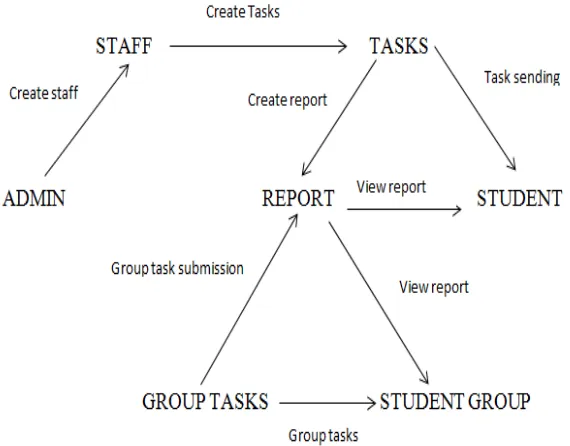
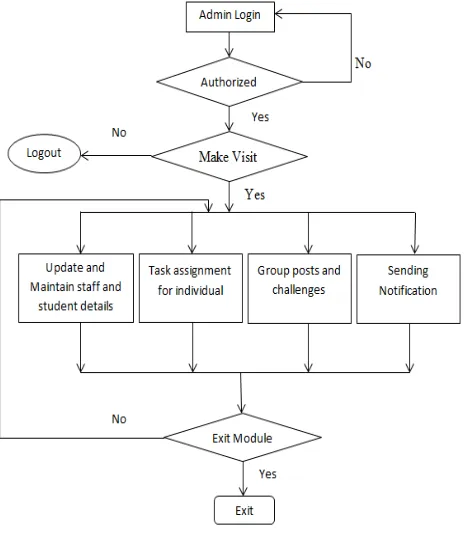
This project will acts as an interface between the students and the staff who are registered in it. Admin will add the staff and will maintain the database for all the students and staff. Each and every staff is given a login id and password. The students will register by themselves and have their own login id.
For the individual challenge, staff will post the task in the respective page and the students will be notified via the email that is registered. So the students will be able to post the answers with the help of text editor.
This project proposed a new approach emphasizing the group challenge that can be created by the students who got a certain credits based on their performance in individual challenge. This will enhance each group to share their knowledge repeatedly after posting questions on each other’s turn. The group will be awarded some credits based on their answers. Each group will have limit of ten members.The Challenge aims to encourage creation of innovative, easy to use designs and solution that can enable convenient access to students without infringing the academic performance.
A. System Design:
IV.MODULE DESCRIPTION
A. Student Module:
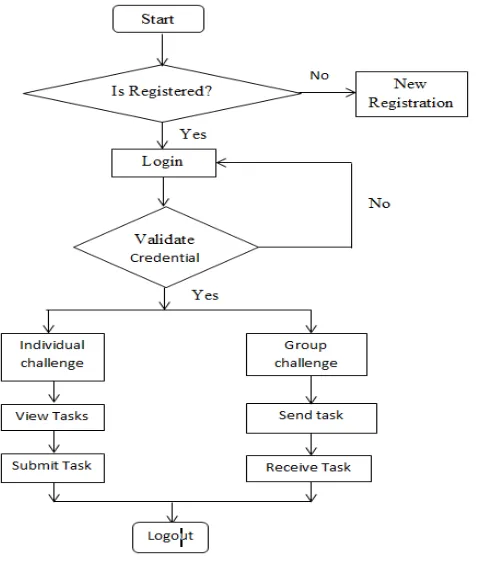
The student can log in to the system if they have already registered. After login they will view the tasks and reply for the task within the time limit. They can also create group among then and can challenge each other. Fig.2 shows the flow of this module.
Fig 2. Student module
B. Staff Module
Fig 3. Staff Module
C Admin Module
V. RESULTS
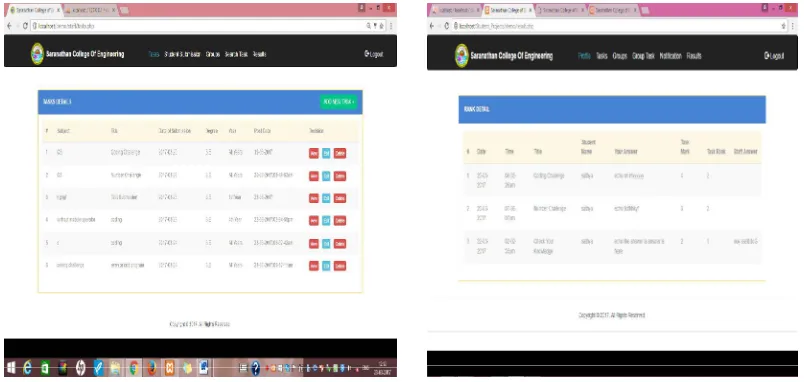
In the first module, we have created the registration and login page to authenticate the user. The staff login id and password are given by the admin. Admin will maintain the data for the staff and all the students who have registered. The staff will post the tasks into the application and that will be displayed in the student’s page as shown in Fig.5. The students will be notified via email that the question has been posted. The students on receiving their tasks will try the tasks and submit the answers within the time limit. The tasks will be closed once the time gets elapsed and it will not take any further submissions from the students.
After receiving the answers from the students, the staff will evaluate all the responses and they will be awarded marks based on their answer. Those marks will be maintained separately in the database by the admin. The top three answers and the correct answer are published along with the rank as in Fig.6. Added to this, the student can also search the tasks that are posted on different dates along with the answers and the winners of that task.
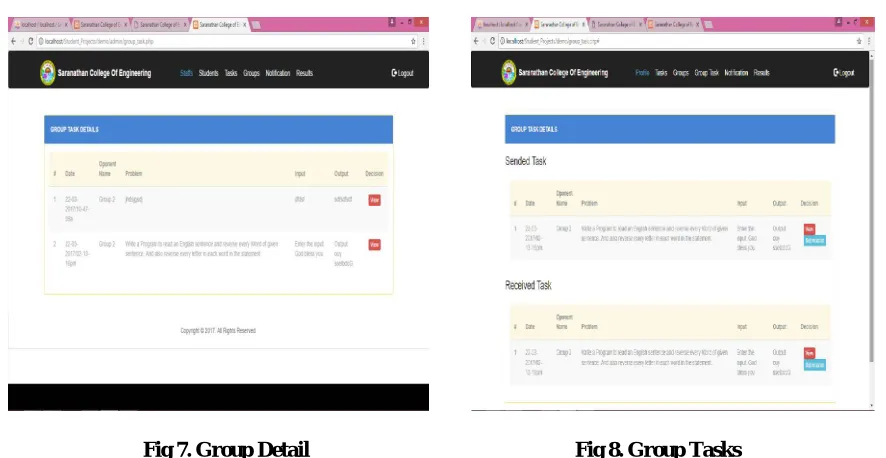
When the students obtain the credit of upto 50 marks each the admin will notify the student to create a group for the group challenge. This challenge will take place among them to interact for sharing the ideas and knowledge as Fig.7. The group will request another group to join the challenge. The requested group will post the questions and will award them marks based on their answer. The group will see all the sent tasks and received tasks as represented in Fig.8. These group interactions are also viewed by the admin to monitor their interactions.
Fig 7. Group Detail Fig 8. Group Tasks
VI.CONCLUSION AND FUTURE WORK
The project has been developed for the students to actively participate in the coding contest. It will motivate them to do more tasks when staff uploads the task on the web application.This also includes group challenge which will help the students to share their knowledge and information based on their queries. This project is an initiation for the better growth of the technical knowledge of each student.There is a big scope for improvement of the system and this can be extended to further development. Based on the performance of the students the valuation and credits can be converted to make reference to companies for the placements. Further development of the project like adding features for the student’s convenience in compilation of the program within the application will be more helpful. Using cloud computing and storage it will reduce the maintenance work.
REFERENCES
1. Bhagyashri, Samiksha and Shelukars (2014) ‘Online Descriptive Examination and Assessment’, an International Journal for Emerging Technology and Advanced Engineering, Vol 4, Issue 3.
2. Yuan Zhenming. Zhang Liang amd Zhan Guohua ‘A Novel Web-based Online Eamination System’, Frontiers in Education,2003 3. J. M. Vara Mesa, ―ATL/AMW use case modeling Web applications: Detailed description and user guide, (2009, access date) 4. Luke Welling and Laura Thomson (Fifth Edition), ‘PHP and MYSQL Web Development’.
5. Steven Holzner, ‘The Complete Reference’ for PHP.
6. Thomas Powell (Fifth Edition), ‘The Complete Reference’ for HTML & CSS. 7. Steven S. Skiena and Miguel A. Revilla, ‘The Programming Contest Training Manual’. 8. https://www.codechef.com/contests