Electronic Theses and Dissertations Theses, Dissertations, and Major Papers
2013
Aging and Semantic Processing
Aging and Semantic Processing
Gillian Macdonald
University of Windsor
Follow this and additional works at: https://scholar.uwindsor.ca/etd
Recommended Citation Recommended Citation
Macdonald, Gillian, "Aging and Semantic Processing" (2013). Electronic Theses and Dissertations. 4738.
https://scholar.uwindsor.ca/etd/4738
This online database contains the full-text of PhD dissertations and Masters’ theses of University of Windsor students from 1954 forward. These documents are made available for personal study and research purposes only, in accordance with the Canadian Copyright Act and the Creative Commons license—CC BY-NC-ND (Attribution, Non-Commercial, No Derivative Works). Under this license, works must always be attributed to the copyright holder (original author), cannot be used for any commercial purposes, and may not be altered. Any other use would require the permission of the copyright holder. Students may inquire about withdrawing their dissertation and/or thesis from this database. For additional inquiries, please contact the repository administrator via email
Aging and Semantic Processing by
Gillian Macdonald
A Dissertation
Submitted to the Faculty of Graduate Studies through the Department of Psychology in Partial Fulfillment of the Requirements for
the degree of Doctor of Philosophy at the University of Windsor
Windsor, Ontario, Canada 2013
Aging and Semantic Processing
by
Gillian Macdonald
APPROVED BY:
_______________________________________________ M. Fernandes, External Examiner
University of Waterloo
_______________________________________________ P. Boulos
Department of Philosophy
_______________________________________________ C. Abeare
Department of Psychology
_______________________________________________ A. Baird
Department of Psychology
_______________________________________________ L. Buchanan, Advisor
Department of Psychology
_______________________________________________ M. Rehse, Chair of Defense
Faculty of Graduate Studies
AUTHOR’S DECLARATION OF ORIGINALITY
I hereby certify that I am the sole author of this thesis and that no part of this thesis has been published or submitted for publication.
I certify that, to the best of my knowledge, my thesis does not infringe upon anyone’s copyright nor violate any proprietary rights and that any ideas, techniques, quotations, or any other material from the work of other people included in my thesis, published or otherwise, are fully acknowledged in accordance with the standard referencing practices. Furthermore, to the extent that I have included copyrighted material that surpasses the bounds of fair dealing within the meaning of the Canada Copyright Act, I certify that I have obtained a written permission from the copyright owner(s) to include such material(s) in my thesis and have included copies of such copyright clearances to my appendix.
ABSTRACT
DEDICATION
ACKNOWLEDGMENTS
I would like to begin by acknowledging my supervisor, Lori Buchanan. It was during her undergraduate course that I first became interested in neuropsychology. Lori, you have been instrumental in my academic journey right from the beginning, thank you for your guidance and unwavering support over the years.
Thanks are extended to each of my committee members: Chris Abeare, Anne Baird, Pierre Boulos, and Myra Fernandes. Your interest, guidance, and many helpful suggestions and comments throughout this process have been so appreciated. Thank you to my fantastic lab mates and grad school friends, especially Tara, Ann, and Shelley for all the academic and (most importantly) emotional support.
Thank you to my parents for instilling in me the value of learning and education from an early age. Your love and support has made this degree possible.
TABLE OF CONTENTS
DECLARATION OF ORIGINALITY………...iii
ABSTRACT………...iv
DEDICATION……….v
ACKNOWLEDGMENTS………..vi
LIST OF TABLES……….…...………….ix
LIST OF FIGURES………x
LIST OF APPENDICES………xi
CHAPTER 1: INTRODUCTION………..……….1
Semantics……….3
Semantics and Models of Visual Word Recognition………...…....3
Distributed Models………...………...7
Semantic Processing………...…………...…10
Semantic Neighbourhoods ………...….12
Semantic Influences in Visual Word Recognition………...18
Aging and Cognition………...…...24
Vocabulary and Word Association Studies………..…...…26
Aging and Fluency………...………...28
Semantic Priming Effects with Aging………...31
Aging and Semantic Neighbourhoods………...…35
Models of Cognitive Aging………...…...37
Rationale and Outline of Experimental Series………...41
CHAPTER 2: EXPERIMENT SERIES………...……….43
Experiment 1:Defining Semantic Neighbourhood Size in the WINDSORS Model………..….…...43
Methods………...…..43
Results………...45
Discussion………...46
Experiment 2: The Effect of Semantic Neighbourhood Size………47
Methods………...…50
Results……….………...51
Discussion.……….…………....55
Experiment 3: The Effect of Semantic Density………...57
Methods……….……...58
Results………...61
Discussion………..…....63
Experiment 4: Semantic Priming with Close versus Distant Neighbours………..65
Methods……….….66
Results………....67
Discussion………..…....72
CHAPTER 3: GENERAL DISCUSSION………...73
Current Findings and Models of Word Recognition ………...75
Aging and Semantics………...79
Reading Level, Education, and IQ, ………...83
Conclusions and Future Experiments……….…...84
REFERENCES………...…...86
APPENDICES………...106
LIST OF TABLES
Table Description
1 Overall Mean semantic neighbourhood sizes and Standard Deviations, as determined by the WINDSORS model of lexical co-occurrences, for a subset of words (1343) provided
by the Balota, Cortese, and Pilotti (1999) corpus. 46 2 Experiment 2: Means and Standard Deviations of Participant
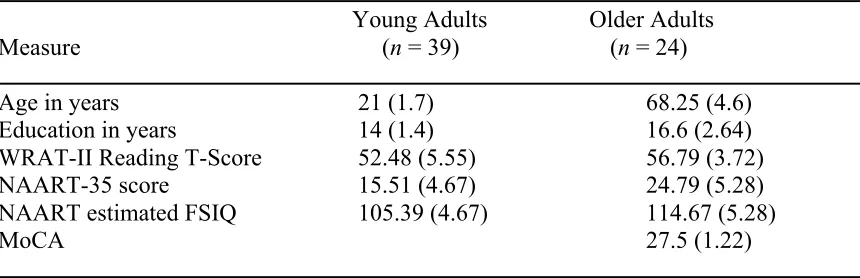
Characteristics by Age. 53
3 Mean reaction time (RT), standard deviations (SD), and error rates as a function of semantic neighbourhood size and age in
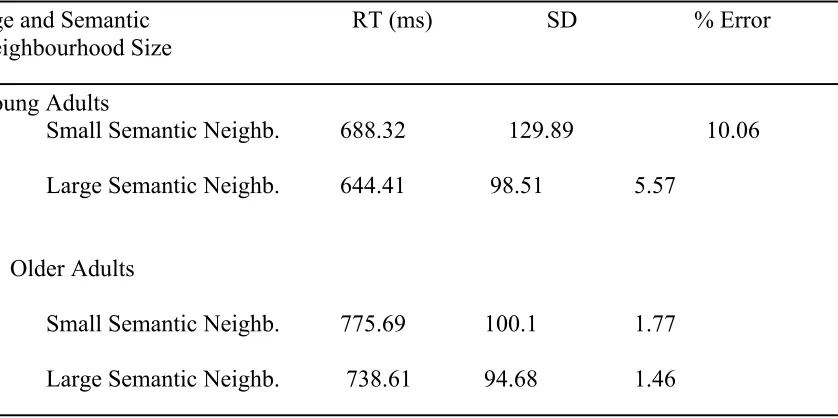
a lexical decision task. 54
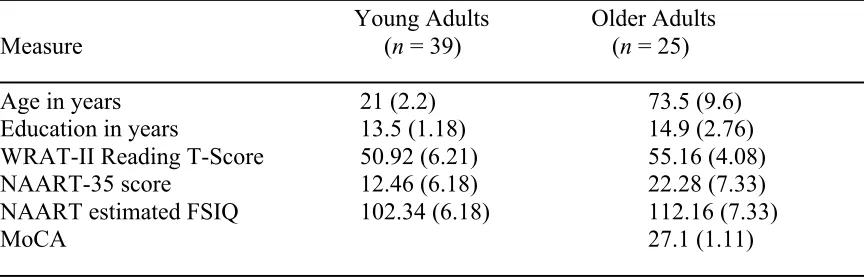
4 Experiment 3: Means and Standard Deviations of Participant
Characteristics by Age. 62
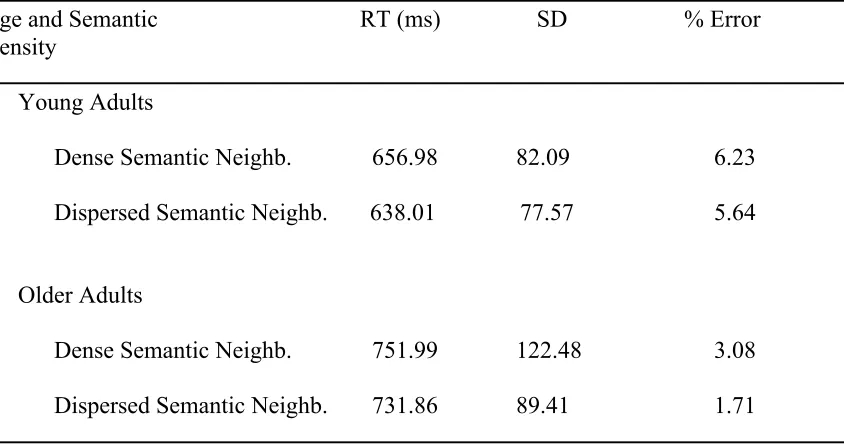
5 Mean reaction time (RT), standard deviations (SD), and error rates as a function of semantic density and age in a lexical
decision task. 63
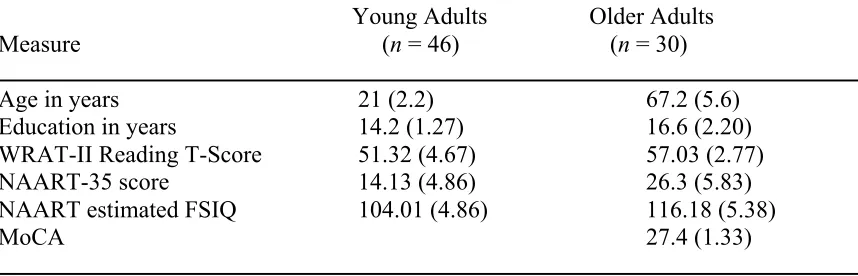
6 Experiment 4: Means and Standard Deviations of Participant
Characteristics by Age. 68
7 Mean reaction time (RT), standard deviations (SD), and mean error rates as a function of semantic distance in prime target
pairs and age in a lexical decision task. 70
8 Mean priming effects in RT milliseconds and standard deviations (SD) as a function of semantic distance of prime
LIST OF FIGURES
Figure Description
1 Mean reaction time latencies as a function of
neighbourhood size and age. 55
2 Representation of a sparse semantic neighbourhood
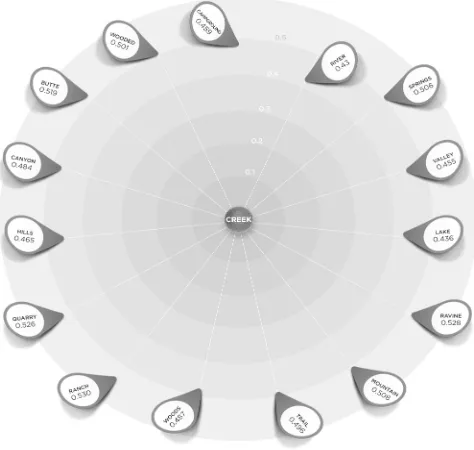
using the 15 closest neighbours to the word creek. 59
3 Representation of a dense semantic neighbourhood
using the closest 15 neighbours for the word sail. 60 4 Mean reaction time latencies as a function of
neighbourhood density and age. 64
5 Mean priming effects as a function of semantic similarity
LIST OF APPENDICES
Appendix Description
A Questionnaire for young adults 106
B Questionnaire for older adults 108
C Instructions for lexical decision experiments 110
D Word stimuli for Experiment 2 111
E Word stimuli for Experiment 3 115
CHAPTER 1:
INTRODUCTION
Cognitive models of word recognition are often informed by research examining the effects of various word characteristics such as semantics, phonological, and orthographic features (e.g., Borowsky & Masson, 1996; Coltheart, Davelarr, Johnson, & Besner, 1977; Coltheart, Rastle, Perry, Ziegler, & Langdon, 2001; Forster, 1976; Grainger & Jacobs, 1996; Harm & Seidenberg, 1999; 2004; McClelland & Rumelhart, 1981; Morton, 1969; Seidenberg & McClelland, 1989; Plaut, 1997; Plaut & Booth, 2000; Plaut, McClelland, Seidenberg, & Patterson, 1996). One means of examining the influence of such
characteristics is by looking at neighbourhood effects. For example, an orthographic neighbour is a word that differs from a target word by one letter (Sears et al., 1995) whereas a phonological neighbour is a word that differs by one phoneme (Coltheart et al., 1977). To illustrate these concepts, the words bike and like are orthographic neighbours because they differ by one letter whereas bike and beak are phonological neighbors because they differ by one phoneme. Orthographic and phonological neighbourhood effects have been relatively well studied (e.g., Andrews, 1997; Forster & Shen, 1996; Frost, 1998; Lukatela & Turvey, 2000; Luce & Large, 2001; Luce & Pisoni, 1998, Sears et al., 1995; Vitevich & Luce, 1999). However, the structure and influence of semantic neighbourhoods (i.e., words that are closely related to a given target word based on their meaning) are less well understood. Nonetheless, research in the area of semantic
Westbury, & Burgess, 2001; Dunabeitia, Aviles, & Carreiras, 2008; Grondin, Lupker, & McRae, 2009; Hino, Lupker, & Pexman, 2002; Locker, Simpson, & Yates, 2003;
Pexman, Hargreaves, Edwards, Henry, & Goodyear, 2007; Pexman, Hargreaves, Siakaluk, Bodner, & Pope, 2008; Pexman & Lupker, 1999; Pexman, Lupker, & Hino, 2002; Recchia & Jones, 2012; Schvaneveldt, Durso, & Mukherji, 1982; Siakaluk, Buchanan, & Westbury, 2003; Strain, Patterson, & Seidenburg, 2005; Yap, Pexman, Wellsby, Hargreaves, & Huff, 2012; Yap, Tan, Pexman, & Hargreaves, 2011; Yates, Simpson, & Locker, 2003).
Semantics is an important aspect of language and the store of general knowledge thought to build up over a lifetime (Lund & Burgess, 1996) is commonly referred to as semantic memory (Spaan, Raaijmakers, & Jonker, 2003). Importantly, our knowledge of the world is not static and it has been suggested that lifetime experiences with language dynamically change and shape the structure of our semantic representations (Burke & Shafto, 2008). The age-related changes to the structure and influences of the semantic lexicon are therefore important aspects of our understanding of cognitive aging. Interestingly, although cognitive changes are reported as a part of the normal aging process, research suggests that semantic processing remains relatively stable throughout healthy aging (e.g., Burke, Mackay, & James, 2000; Burke & Shafto, 2008; Kemper, 1992; Thornton & Light, 2006). This relative stability notwithstanding, semantic language deficits, along with other cognitive and neurological symptoms, are widely reported in pathological cognitive aging such as neurodegenerative dementias, including most prominently Alzheimer’s disease and semantic dementia, a variant of
& Patterson, 1995; Lambon et al., 2001; Perry & Hodges, 1999; Rabinovici & Miller, 2010). Examining the subtle changes in semantic structure and processes that may occur in healthy aging is therefore an important undertaking as it contextualizes the more pathological changes that occur with dementia.
This review has two main sections. The first section describes the role and the arrangement of the semantic lexicon within relevant models of visual word recognition and outlines the semantic effects that such models must accommodate. The second section of the review describes age effects in semantic language processes including general semantic abilities related to vocabulary and word associations, semantic priming effects and semantic richness in aging. To provide a context for aging and language changes, models of cognitive aging are presented with a focus on how they relate to semantic processing.
The experimental series that follows the review examines semantic
neighbourhood effects with young and older adults in order to extend our knowledge of how semantics impacts the word recognition process and how that occurs in the context of aging.
Semantics
Semantics and Models of Visual Word Recognition
The mental lexicon is a mental storehouse of all knowledge acquired about words including orthographic (visual), phonological (auditory), and semantic (meaning)
Pexman & Lupker, 1999; Pexman, Lupker, & Hino, 2002; Rodd, Gaskell, & Marslen-Wilson, 2002; Strain, Patterson, & Seidenburg, 1995; Wurm, Vakoch, & Seaman, 2004; Yates et al., 2003). Similar to findings for other word properties (orthography and phonology) words that are closely related to many other words based on their meaning are thought to be processed more quickly than words with few semantic neighbours (Buchanan et al., 2001, Pexman et al., 2007; Plaut & Shallice, 1993). This section reviews models of visual word recognition with an emphasis on semantic processing.
In Morton’s (1969) threshold activation model, each unit of meaning is divided into units called “logogens”. These logogens are composed of information related to a word including visual, auditory, and semantic properties of the word. Logogens behave like detectors, gathering evidence from input units within the sensory system. Once a certain amount of evidence has been accumulated (through visual or auditory activation), a threshold is reached and a logogen’s meaning is activated, thus allowing a response. A logogen’s basic resting level of activation may vary according to several factors, such as word frequency and context (Morton, 1969). For example, frequency effects occur as each logogen has a resting activation level that is proportional to its frequency within a language (Coltheart et al., 2001). Thus, low frequency words need greater activation to reach threshold than their high frequency counterparts.
In terms of semantics, when a word occurs without contextual information, its semantic content only becomes activated once activation of the logogen itself has reached threshold. Therefore, in this model, with identification occurring prior to semantic
Unlike the logogen model, Forster’s serial search model (1976) is not a threshold model but assumes a matching processing between incoming information about a word and knowledge of words already stored. According to this model, incoming information, in either orthographic or phonological form, is grouped into bins based on similar descriptions. These bins are ordered by frequency, with higher frequency words appearing first in the bin. Words are then compared to a master file, containing all information in the mental lexicon. When a sufficient match is made between the lexical entry and the master file, word recognition occurs. Therefore, the search process is akin to the structure of a library search (Forster, 1976). The serial search model is similar to the logogen model in that it assumes that semantic information becomes activated only after access to the word has occurred (Rodd, 2004).
activation of words or “nodes” occurs through a combination of excitatory and inhibitory connections.
To accommodate demonstrations of pre-lexical semantic influences on word recognition researchers have proposed modifications to some of the above models (e.g., Balota et al., 1991; Forster & Hector, 2002). Forster and Hector (2002) suggest that selection of a candidate does not involve activation of semantic features, but rather is influenced by a network of semantic associates that occur between a specific lexical entry and previously established semantic connections. In this way, the check is akin to
referencing “a thesaurus” that provides some information about category membership but does not activate full semantic features (Forster & Hector, 2002).
Balota et al. (1991) further proposed a modification to the IAC model, in which a meaning-level unit is added to the system. This meaning-level unit is added to the
previous model as a fourth level of activation. With this addition to the model, activation is spread first from the feature level to the letter level, the letter level to the word level, and finally word level to the meaning-level. In keeping with the IAC model, the “bottom-up” driving force of activation spreads in a continuous flow through the units. Once activated, semantic-level units can activate word-level units through feedback
“more-means-better” approach to semantics: stronger meaning representations provide for greater facilitation for word recognition. According to this modification, more semantic
neighbours would therefore increase activation at the semantic level, which feeds down to the orthographic level. Facilitation is achieved through this increase in activation at the orthographic level, which as previously stated, is necessary for making lexical decisions during visual word identification.
The models presented thus far can all be described as localist models because in such architectures word meanings are represented by a single unit. For word recognition to occur, a single unit corresponding to the word needs to be activated. However, more recent distributed models of word recognition propose a different type of representation in visual word recognition (e.g., Borowsky & Masson, 1996; Plaut & McClelland, 1993; Plaut, et al., 1996; Rogers & McClelland, 2004; Seidenberg & McClelland, 1989).
Distributed Models
experience (Rogers & McClelland, 2004). Learning is an important assumption of distributed models as a means to model how representations develop. It is emphasized in order to examine how children acquire language (e.g., Harm & Seidenberg, 1999), how skilled cognitive processes develop and also how degradation can occur in the system (e.g., Rogers et al., 2004). For example, Rogers et al. (2004) trained a model of semantics based on visual features and verbal descriptors of objects and then simulated lesions in the model to examine whether error types were similar to those made by people with semantic dementia. The implementation of these distributed models provides a way to examine how cognitive processes are acquired, become skilled, and mature or decline. Connections between the units can be competitive or cooperative. Each time the units are activated, a reconstruction of internal representations occurs through a “filling in” process. Knowledge is reconstructed when propagation occurs over a certain pattern of activation (Rogers & McClelland, 2004). During visual word recognition, incoming information through orthography activates hidden weighted units, which in turn activate semantic units and phonological units (Harm & Seidenberg, 2004). Due to the dynamic nature of the model, interconnected units serve to constrain each other. Activation eventually settles into a distributed pattern over time. The meaning that is computed is the one that satisfies the most constraints between the units in the network (Harm & Seidenberg, 2004).
the impact of semantics on word recognition (Yates et al., 2003). In a distributed model of this type, connections between orthography, phonology, and semantics are interactive and bidirectional.
These bidirectional connections allow for a cascade of activation. Models that rely on cascaded processing assume activation is spread throughout the system automatically, and therefore allow the possibility of semantic influences on word recognition, before the stimulus has been fully recognized (Coltheart et al., 2001; McClelland & Rumelhart, 1981; Plaut, et al., 1996). For example, a person may read the letters “spli” that begin a word, and activate word meanings such as “split” or “splinter” providing semantic feedback to the word recognition process, before the word gains complete lexical access and is recognized.
Lexical decisions are made primarily based on activation in the orthographic units (Pexman & Lupker, 1999) with responses made once settling occurs in the orthographic units. Settling refers to the process where as many as possible constraints are satisfied between the phonological, orthographic, and semantic connections to find the appropriate solution. The amount of time it takes for settling can vary, and semantics may play a role in this model by influencing the settling process (e.g., Pexman & Lupker, 1999; Yates et al., 2003). According to Yates et al. (2003), when words have large semantic
orthographic units to reach a stabilization point more quickly resulting in a facilitatory effect during lexical decision (Yates et al., 2003).
In sum, the presumed role of semantics within models of visual word recognition varies considerably. In localist models, the original assumption regarding semantics was that activation only happened once full lexical access had occurred and as a result semantics could not affect the word recognition process. In contrast, interactive models have provided a way to accommodate semantic neighbourhood influences on word recognition through spread of activation and feedback (Balota et al., 1991; Hino & Lupker, 1996). Distributed models, propose a similar feedback mechanism as means for semantic influence despite a different underlying mechanism. Semantic neighbourhoods may influence the rate of settling due to richer representations providing stronger
feedback to orthographic units which are used when making lexical decisions (Yates et al., 2003).
Semantic Processing
Semantic processing is the way in which semantic information is transmitted and communicated. The following review focuses on semantic activation and its transmission.
Quillian’s original theory (1969) of semantic processing described concepts (e.g., words) as being represented as nodes with relational links to other concept nodes.
Memory searches resulted in “tagging” related conceptual nodes that would, in turn, “tag” other related nodes. The architecture of a taxonomic hierarchy provided a way to store and retrieve semantic information. For example, activation of the word canary
hypothesized, words that were more related were proposed to have stronger links between them.
Building on semantic processing experiments, Collins and Loftus (1975)
expanded Quillian’s (1969) theory with their automatic spreading activation hypothesis. This theory posits that a word automatically causes a spreading of activation throughout the semantic system activating a related concept node (Collins & Loftus, 1975). One extension of their original theory is that the spreading of activation occurs as a decreasing gradient, losing strength over time. Another extension is the assumption that concepts are organized by semantic similarity: The more properties words have in common, the more closely they will be linked in the network. For example, fire engine will prime vehicle, which will, in turn, prime ambulance and bus.
In the case of semantic priming, when a prime is presented, activation spreads to semantically related words causing them to be above resting level (Collins & Loftus, 1975). This higher resting level means less visual encoding and processing resources are needed in order to recognize the word. The amount of activation necessary for
recognition is reduced, and activation is facilitated for a related word.
In sum, although the mechanisms for semantic processing differ based on
Semantic Neighbourhoods
In visual word recognition, context or semantic priming has been used to examine how people respond to context within sentences, paragraphs, and also as single words (e.g., Balota et al., 1991; Balota et al., 2004; Zelinski & Hyde, 1996). There have been a variety of outcome measures to examine this processing, the majority of which examine response times. In the lexical decision task, participants are shown either a real word or a non-word, and are asked to make a decision about whether it is a real English word (Rubenstein, Garfield, & Millikan, 1970). Furthermore, they are asked to make this decision as quickly as possible. In a word naming task, participants are required to read the presented word aloud as quickly as possible. In a semantic categorization task, participants are shown words that either belong to a certain category, or do not, and are asked to decide whether a particular word is part of that category (e.g., is an animal).
Generally, large orthographic neighbourhoods have a facilitative effect on reaction times, possibly due to global activation and feedback from multiple neighbours (Grainger & Jacobs, 1996). Prior research has demonstrated that words with many orthographic neighbours are responded to more quickly in lexical decision and semantic organization tasks (e.g., Andrews, 1997; Forster & Shen, 1996; Sears et al., 1995). However, this is not always the case for phonological neighbourhoods. When examining spoken word production, close phonological neighbours have actually created an
Less is known regarding semantic lexical arrangement than about its phonological or orthographic counterparts. One reason is that unlike orthography and phonology, words related to each other based on meaning have considerably more variability (Buchanan et al., 2001). Buchanan et al. propose that at one extreme this may mean that semantic organization is completely unique to each individual and therefore cannot be defined beyond the individual level. At the other end, it may mean that semantics has a large and variable structure but it also has many shared characteristics. Buchanan et al.’s (2001) approach is midway between the extremes with the assumption that although individual variability exists in semantics, there are nonetheless organizational influences that define the structure of semantic space.
There have been many ways that the organization of semantic space is said to occur. Early categorization based models (Collins & Quillian, 1969) proposed that semantic organization followed a taxonomic structure based on a hierarchy. Over time, there have been many additions to the dimensions of semantics. Contextual dispersion, which examines the number of times words appear in different content areas, is said to capture semantic information as words that are more widely distributed across content areas are thought to be more richly represented (Pexman et al., 2008). Research has found that words that appear in more samples from a corpus (i.e., have greater contextual
object has in interacting with the human body (Siakaluk et al, 2008). Words high in body-object interaction have shown facilitation effects in lexical decision and semantic
categorization tasks due to greater activation of sensorimotor information for high BOI words enhancing semantic feedback (Siakaluk et al., 2008; Siakaluk, Pexman, Aguilera, Owen, & Sears, 2008).
One commonly used measure for representing semantics involves the number of features of a word. Feature based models propose that nearness in a semantic system reflects the amount of feature overlap between representations, as well as correlations between features and the distinctiveness of features related to a concept (McRae, de Sa, & Seidenberg, 1997). In this view, neighbourhoods are developed by presenting
participants with concepts and asking them to give all the features that come to mind when they think of that concept (McRae, Cree, & Seidenberg, 2005; Vinson & Vigliocco, 2008). For example, TIGER and DOG share many features such as “has four legs”, “has fur” etc. When a word is activated, its semantic features also become activated through automatic spreading of activation. Through the same automatic spreading activation principle, these semantic features will activate another word that also has those features in common. For example, TIGER may activate the feature FUR which in turns activates the word DOG because it has that feature. Therefore, similarity is based on the number of shared features (McRae et al., 2005).
& Schreiber, 1994). For example, for the word CAT, responses may include MEOW,
DOG, WHISKERS, etc. The proportion of participants producing a response to a word is then used as the “strength” of connection between two words; responses given more often (by more people) are closer associates than words that are given less often (Nelson et al., 1997).
An alternative method for generating association values comes from lexical co-occurrence models derived from a large corpus of text. The number of times pairs of words co-occur within large bodies of text is computed and used to determine a measure of semantic relatedness (e.g., Durda & Buchanan, 2008; Lund & Burgess, 1996; Shaoul & Westbury, 2006; 2010). One early example of a co-occurrence model is the
hyperspace analogue to language (HAL; Lund & Burgess, 1996). This model sees words or concepts as represented as points or vectors in a multi-dimensional space. Once established, relationships between these points are quantified and can be tested through distance metrics (Lund & Burgess, 1996). In this model, a large number of words (e.g., 300 million) are examined using a moving window over 10 words at a time. HAL generates co-occurrence values for the words that occur together within this window of words. The associative strength is inversely related to the number of words separating them. For example, words that are adjacent receive a value of 10, while words that are separated by nine other words receive a value of one. A matrix for each word is
contexts that occur close to one another will form clusters of semantic neighbourhoods. HAL has been shown to capture semantic (words that have similar meanings; e.g., bed-table), categorical (words that capture categorical information; e.g., bird-eagle), and associative information (words that tend to occur together; e.g., coffee-cup) as well as behavioural data (Lund & Burgess, 1996; Lund et al., 1995).
There is support for the value of lexical co-occurrence models in word recognition (e.g. Bodner, & Pope, 2008; Buchanan et al., 2001; Lund & Burgess, 1996; Pexman et al., 2003; Siakaluk et al., 2003). However, early models of HAL have been criticized for the influence of frequency on both its vector representations and also the distances between vectors (e.g., Shaoul & Westbury, 2006).
ARC. However, no such measures exist for the WINDSORS model of lexical
co-occurrence (Durda & Buchanan, 2008). Experiment 1 of the present study addresses this gap.
Additionally, lexical co-occurrence models examine large bodies of text produced by adults across the lifespan and consequently the values derived from them can be assumed to reflect sampling across a wide age-range. In contrast, word association norms and feature norms are typically developed by asking university students (e.g., Nelson et al., 1994) to name the first meaningful word that comes to mind when reading a target word or to name features associated with a word. This may be especially relevant for research on semantics and aging as word associates produced by university students, composed mainly of young adults, may not be the same as those produced by older adults and may not be representative of their semantic networks. Co-occurrence models
Semantic Influences in Visual Word Recognition
Words that have a high number of semantic features have resulted in faster lexical decision and naming times (Pexman et al., 2002). Pexman, Holyk, and Monfils (2003) examined how context information might influence the facilitation effects seen for words with many semantic features. Participants read sentences where a congruent word was presented at the end of the sentences (e.g., After the crash Bob was nervous about getting on an airplane), an incongruent word was at the end of the sentences (e.g., When I go home from work I tend to travel by airplane), or unrelated word was at the end of the sentences (e.g., After a heavy snowfall, Joel has to wear his airplane). When congruent sentences were presented, context appeared to constrain processing such that the
facilitation advantage for words with many semantic features did not occur. Furthermore, in a semantic categorization task, when the semantic category provided specific
contextual information (bird/non-bird) compared to less specific contextual information (animal/non-animal), Pexman et al. (2003) found less facilitation for words with many features. Therefore, neighbourhood size produces a process-constraining effect that is similar to that produced by context.
lexical activation is required for words that are less rich semantically. Enhanced N400 amplitudes were also seen during EEG recordings for words with many semantic features when participants’ ERPs were recorded while performing a lexical decision task
(Rabovsky, Sommer, & Rahman, 2012).
Semantic relatedness has been found to impact memory performance (Fernandes, Craik, Bialystok, & Krueger, 2007). When participants heard words and were
simultaneously asked to perform a visual task involving either semantically related (compared to unrelated words) during encoding, they later had poorer recall of words. Thus competition effects may also emerge for words that are more similar in meaning than unrelated words during learning trials.
Although there are many ways of measuring semantic neighbourhood size or semantic richness, it appears that words with larger semantic neighbourhoods result in faster processing than words with smaller semantic neighbourhoods (e.g., Buchanan et al., 2001; Pexman et al., 2008; Siakaluk et al., 2003; Yap et al., 2011; Yap et al., 2012; Yates et al., 2003). The effect of semantic neighbourhood size or semantic richness was found even after other word characteristics were controlled (e.g., Balota et al., 2004; Buchanan et al., 2001).
related word that comes to mind. For the lexical co-occurrence model, words that are more closely related based on meaning are closer together in high-dimensional space. Semantic distance was measured using the HAL (Lund & Burgess, 1996) model by computing the average distance from a word to its 10 closest neighbours. The lower the semantic distance number, the more semantic neighbours a word has within a specified area. In a hierarchical regression, word characteristics of log frequency, orthographic neighbourhood size, word length, number of associates, and semantic distance were examined. Results reveal that both semantic distance and number of semantic associates impacts lexical decision times, although semantic distance effects were more robust. Additionally, their results revealed that the greater the mean distance from a word to its 10 closest neighbours, the greater the lexical decision time. In sum, close semantic neighbourhoods facilitate word processing (Buchanan et al., 2001).
To further extend these findings, Siakaluk et al. (2003) manipulated semantic distance by creating low and high semantic distance groups formed by examining the mean distance between a word and its 10 closest neighbours. Two forms of semantic categorization tasks were given: a yes/no task, asking participants if the word is an animal name, and a go/no-go task, in which participants only respond to non-animal words. This was done in order to examine the effects of semantic distance on tasks that requires the meaning of a word be activated before making a decision, that is to say, complete lexical selection must take place. Overall, the findings indicated that semantic distance (mean distance from a word to its 10 closest neighbours) impacts word
Yates et al. (2003) examined the effect of semantic size using the number of words produced in a word association task (Nelson, Schreiber & McEvoy, 1992) as a measure of semantic neighbourhood size. In a lexical decision task, facilitation was found for words with larger semantic neighbourhoods. They further examined the effect of semantic neighbourhood size by using a pseudohomophone task. A pseudohomophone is a non-word that sounds like a real word but its spelling is not orthographically correct (e.g., nale). When participants made lexical decisions about pseudohomophones, words with larger semantic neighbourhoods took longer to reject as real words than those with smaller semantic neighbourhoods (Yates et al., 2003). The authors propose that semantic activation occurs for the word nail when nale is viewed. If nail is part of a large semantic neighbourhood, feedback is increased to the orthographic level, with additional feedback from the phonology level, which makes it appear more “word-like”, and takes longer to reject as a non-word.
al. (2011) included a measure of semantic richness, number of semantic associates (i.e., the number of distinct first associates produced for a word in a free association task), word ambiguity (the number of senses for a given word) and used a different lexical co-occurrence model to estimate number of semantic neighbours (mean semantic similarity 5000; MSS-5000; Shaoul & Westbury, 2010). Three outcome variables were examined: speeded pronunciation, lexical decision, and semantic categorization. In a regression model, their results indicated that the MSS-5000 variable influenced reaction time in a lexical decision task but not speeded pronunciation or semantic categorization. Number of features and context dispersion accounted for unique variance for all three tasks while number of senses was not related to performance on a speeded pronunciation.
Interestingly, number of associates was not related to performance on any of the three tasks.
In the most recent extension of this work, Yap et al. (2012) conducted a
comprehensive comparison of measures of semantic association or richness. Similar to past research, their results support the influence of semantic richness on various word recognition tasks including lexical decision, speeded pronunciation, semantic
the authors questioned whether their results may have been influenced by competing facilitation and inhibitory effects associated with close and distant neighbours. It was postulated that this may be a reason for the non-effect seen in a semantic categorization task (Yap et al., 2012).
As part of an examination of the effects of close and distant neighbours, Mirman and Magnuson (2008) studied the effect of the spread of semantic neighbourhoods in an investigation of the effectiveness of several models of semantic representation contrasting feature, association-based, and computational models. The authors discovered that in some cases semantic neighbourhood size had an inhibitory effect on speed in a
categorization task, while in other cases it was facilitatory. Furthermore, when words had many near neighbours as compared to many distant neighbours, the results were
inhibitory. Mirman and Magnuson (2008) argue that near neighbours delay processing, because they act as competitors while distant neighbours create a gradient that increases settling for the correct word. These results indicate that competition and facilitation effects emerge depending on the number of close and distant neighbours. However, research into this area is sparse and a greater understanding of the impact of close and distant neighbours may provide greater insight into the effect of lexical associates across task performance, particularly for lexical decision and semantic categorization tasks.
impacted by adulthood and aging. The following sections examine the process of cognitive aging and include more specifically language and aging with a review of relevant models of cognitive aging.
Aging and Cognition
Research in the area of aging and cognition suggests that as we age cognitive abilities begin a gradual decline that occurs in some cases beginning in early adulthood; declines are seen behaviourally across a wide variety of cognitive abilities (Craik & Salthouse, 2008; Park, 2002; Park & Gutchess, 2005; Salthouse 1996; Schaie, 1994; 2005). In terms of memory abilities, Rabinowitz, Craik, & Ferguson, (1982) theorized that inadequate processing resources were the mechanisms behind poor memory performance in the form of declining attentional resources. Salthouse (1993; 1996) further suggested a more generalized explanation of poorer cognitive abilities with aging. He proposed that as people age there is general slowing, a reduction in processing speed which constrains other cognitive abilities reliant on this process and, in turn, also limits the amount of information that can be processed at any given time (Salthouse, 1996).
Reductions in working memory capabilities have also been proposed as an underlying mechanism; working memory involves the ability to hold information online, process, and manipulate it. It has been proposed as an important construct in the
less able to inhibit irrelevant information, which interferes with directive attention and cognitive processing.
More recently, with greater technological advances in imaging abilities, there has been growing interest in neuroanatomical changes and cognitive aging. In general, older adults show reduced cerebral volume in the frontal lobes (Raz, 2000). In terms of functional patterns, for certain cognitive processes older adults have broader bilateral activation across the cortices while young adults demonstrate a more lateralized
activation (Cabeza et al., 1997). Interestingly, if older adults are given instructions and are asked to deeply process the meaning of a word during a memory task as opposed to simply remember them, they show patterns of neural activity (i.e., greater recruitment of frontal regions) similar to young adults (Logan et al., 2002).
Thus semantic associations appear to reduce age related deficits: During a memory task where young and older adults were provided with contextual information only younger adults effectively used the context rich information for recollection (Skinner & Fernandes, 2009). However, once older adults were instructed to encode stimuli more deeply by creating associations between they were able to effectively use this strategy to improve their recollection on a memory task (Skinner & Fernandes, 2009). Thus, meaning and context appear to shrink the age gap in terms of functional and behavioural abilities.
Vocabulary Studies and Word Association Studies
Although age related declines in retrieval have been shown at the
orthographic/phonological level of language processing, evidence suggests fewer age related deficits in semantics (Burke & Shafto, 2008). In fact, vocabulary and verbal reasoning scores appear to remain relatively intact over the lifetime for healthy adults and may even show an increase (Lezak, Howieson, Loring, Hannay, & Fischer, 2004). In a longitudinal study examining 5000 adults over the span of as long as 35 years, no decline in verbal abilities was found (Schaie, 1994). In addition, examination of verbal abilities across the lifespan indicates well preserved functioning into the 90s for healthy adults (Schum & Sivan, 1997). Verhaeghen (2003) conducted a meta-analysis examining vocabulary scores between 1986 and 2001, and found an increase in vocabulary test scores with aging. However, some findings indicate an adverse influence for the eldest of older adults. Longitudinal research by Backman and Nilsson (1996), examining changes in semantic memory over a 10-year period, found that even after controlling for
intelligence, a decrease in semantic performance began once participants reached their 75th or 80th year. However, prior to 75, no age related deterioration was observed. Findings of intact semantic language functioning also include current-events knowledge, which appears to be positively correlated with age (Beier & Ackerman, 2001).
same semantic category due to similarities between the two category exemplars. The authors proposed that context effects in the sentence serve to constrain and pre-activate features of likely upcoming words. Thus, younger and older adults showed similar influence of semantics.
In contrast to the above findings, some tasks requiring more complex meaning interpretations from context show decline in older adults. Zelinski and Hyde (1996) examined the effects of context in aging by having older and younger adults produce interpretations after reading short stories. Older adults were more likely than younger adults to generalize, leading to erroneous interpretations.
In word association tasks, participants are asked to give the first word that comes to mind after being presented with a word. Older and younger adults produced similar word associates in these tasks (e.g., Burke & Peters, 1986). Burke and Peters (1986) found that older and younger adults gave the same number and proportion of responses in a word association task, although older adults provided slightly more variability in their responses. When they controlled for verbal abilities, no differences were found in the proportion of unique responses between the younger and older samples. The authors concluded that differences in vocabulary affected variability in responses for word associations and that semantic structure is influenced by verbal abilities and not by age.
the commonly used verbal fluency task. The following review will examine literature related to fluency and aging.
Aging and Fluency
A commonly used test of verbal abilities in neuropsychology is the verbal fluency test; in this task participants must generate as many words as possible based on
with aging and consequently an examination of results found on fluency tests may provide some insight into language changes with older adults.
Generally, studies have found that older adults perform more poorly than younger adults on fluency tasks (Auriacombe, Farbrigoule, Lafont, Jacqmin-Gadda, & Dartigues, 2001; Kempler, Teng, Dick, Taussig, & Davis, 1998; Lanting, Haugrud, & Crossley, 2009). A meta-analysis of norms for the COWAT found a progressive age related decline in fluency (Loonstra, Tarlow, & Seller, 2001). These findings would suggest that through the lifespan there is a decline in the ability to retrieve words in a certain lexical category. However, one alternate explanation is that the decline is reflective of overall slowed processing speed in older adults rather than impoverished lexical or semantic stores (e.g., Phillips, 1999). Fluency tests are timed and thus processing speed decreases may lead to a reduction in the number of generated words when older adults are compared to younger adults.
However, results in this area have not always been consistent: Some studies report equivalent rates of fluency in older and younger adults (e.g., Bolla, Lindgren, Bonaccorsy, & Bleecker, 1990; Crawford, Bryan, Luszcz, Obansawin, & Steart, 2000; Parkin & Java, 1999; Treitz, Heyder, & Daum, 2007) while others report greater fluency in elderly adults relative to younger adults (e.g., Llewellyn & Matthews, 2009;
that their findings of equivalent fluency rates for younger and older adults may have been due to a higher level of verbal intelligence in their population. They suggest that older adults with higher verbal intelligence may use compensatory strategies to mask the normal age related changes in performance with the use of more effective recall and organizational strategies, a broader vocabulary, and greater facility with semantics (Bolla et al, 1990). Studies have also found positive correlations between education level and fluency rates (e.g., Tombaugh, Kozak, & Rees, 1999).
When examining semantic and phonemic fluency rates separately, an interesting finding has emerged in healthy older adults. Semantic fluency abilities appear
significantly worse than phonemic fluency in older adults compared to younger adults (e.g., Brickman et al., 2005; Parkin, Hunkin, & Walter, 1995; Troyer, 2000). For pathological aging, semantic and phonemic fluency rates are reduced for older adults with amnestic MCI compared to healthy older controls (Nutter-Upham et al., 2008) and participants with Alzheimer’s disease produced significantly fewer animal names than healthy older adults, people vascular dementia, and those with a mild cognitive
impairment (Hall, Harvey, Vo & O’Bryant, 2011). Further, poorer semantic fluency compared to phonemic fluency have been shown for those with Alzheimer’s disease compared to healthy older adults (Monsch, Bondi, Butters, & Salmon, 1992).
possibilities exist as it has also been suggested that education and verbal IQ may influence these findings. To focus more specifically on semantics, a review of semantic priming effects and aging will follow as the vast majority of studies examining the structure of semantic organization and aging have used this paradigm (Ferraro, 1995).
Semantic Priming Effects with Aging
Semantic priming provides a simple way of examining the impact of semantic context on word recognition (e.g., Meyer & Schvaneveldt, 1971; Neely, 1991). In a priming task (see Neely, 1991), two events occur. The first involves presentation of a word (the prime) for a brief period of time, for which no response is needed on the part of the participant. This prime is followed by another word (the target), or by a non-word. Participants are then required to make a word/non-word decision about the target item, referred to as a lexical decision task. In the semantic priming condition, the prime and target are semantically related. For example, the prime CAT might be used to prime the target DOG. Facilitation is said to occur (i.e., a priming effect occurs) if the response times are faster for the word DOG when CAT is used as a prime compared to response times to DOG when it is primed by an unrelated word such as PIN. The semantic priming effect is the difference of the unrelated minus the related condition.
There are several mechanisms that have been proposed to explain semantic priming effects; the two most prominent are automatic spread of activation and
2003). Faster automatic recognition of a target after presentation of a semantically related prime is posited to be due to automatic spreading of activation (Collins & Loftus, 1975). When a prime is presented, its activation is spread automatically throughout the semantic system to other memory nodes that are related to the prime. Once these other nodes become activated their resting level is increased. This increased resting levels means that less activation is needed for them to become activated (Collins & Loftus, 1975).
The second mechanism involves expectancy as a means to explain priming. Expectancy is an attentional process such that participants may come to expect that a certain type of word will always follow another word. This expectancy effect, unlike automatic spreading activation, cannot occur without awareness and intention (Neely, 1991). Participants will therefore expect that a particular type of target word will follow the prime word and generate a set of potential targets after viewing the prime (Neely, 1991). Thus, faster recognition occurs by reducing the demands on additional activation requirements. Automatic spreading of activation and expectancy reduces the amount of sensory processing needed for word recognition (Neely, 1991).
priming effects for older adults, there have been several explanations for the underlying cause of this finding (e.g., Giffard et al., 2003; Laver, 2009; Laver & Burke, 1993; Myerson, Hale, Chen & Lawrence, 1997).
In Laver and Burke’s (1993) meta-analysis of semantic priming effects, most individual studies showed a non-significant increase in semantic priming for older adults. However, these effects reached significance in the meta-analysis. The authors conclude that greater semantic priming for older adults is due to greater experience with language and elaboration of connections in the semantic system. Younger adults show smaller semantic priming effects because they do not have the benefit of years of language experience leading to more connections in the semantic system.
However, other studies have supported a general slowing hypothesis as an explanation for larger priming effects in older adults. Myerson et al. (1997) compared young and older adults’ reaction times to lexical decision and semantic categorization tasks. Their results reveal that after controlling for lexical slowing, young and older adults had equivalent priming rates. They suggest that the slower responses found for older adults across tasks are consistent with slowed processing speed but otherwise intact semantic organization.
Similarly, results by Giffard et al. (2003) reveal that when using standardized residuals (instead of raw reaction time) in a lexical decision task there were equivalent semantic priming effects obtained for the younger and older groups. The authors
the effect of semantics, semantic priming effects are comparable between the two age groups.
Laver (2009) compared semantic and episodic priming (repeated presentation of prime-target pairs) in young, middle aged, and older adults controlling for response time variability. Due to the fact that participants are required to make a response as quickly as possible in a pronunciation task, longer overall response latencies have been found in older adults. This increased time to respond allows for more processing time for older adults compared to younger adults (Laver, 2009). As a result, slowed cognitive
processing in aging would lead to an increase in context effects of semantics because the long processing time allows semantics to build up and has a greater chance to take effect (Giffard et al., 2003). In order to control for the extra processing time that older adults may have over younger adults due to their slower responding, several techniques have been used. Laver (2009) incorporated a response signal so that all participants respond within a particular window of time. Results reveal no differences in automatic semantic or episodic priming for young, middle aged, and older adults.
Additionally, further investigation into the neuroanatomical basis for semantic priming has revealed that both younger and older participants show similar neural correlates during this task (Gold, Anderson, Jicha, & Smith, 2009). Activation occurred in the inferior temporal region, for both older and younger adults, in a semantic priming paradigm; the authors concluded that a preserved fMRI response pattern for older adults occurred in lexical decision trials. Gold et al. (2009) propose that the similar
Thus, research findings on semantic abilities, particularly in automatic processes, is somewhat mixed. In some cases it appears that older adults have stable priming effects while others show that older adults may be more influenced by semantics when it is extended to a priming paradigm. The following section focuses on semantic
neighbourhood and density effects for healthy older adults.
Aging and Semantic Neighbourhoods
Extensive research has examined semantic priming effects in older adults. However, few studies have examined the influence of semantic richness as measured by language based models of semantic arrangement on older adults’ word processing. Studies in this area have found interesting results regarding the possible changes in semantic representations with age.
Using word naming data provided by Spieler and Balota (1998), Buchanan et al. (2001) compared different measures of semantic relatedness for young and older adults. Semantic association size, defined as the mean number of responses from participants when they are asked to say the first thing that comes to mind after hearing a word, was provided by Nelson et al. (1994). This was compared with semantic density (defined as the mean distance between a word and its 10 closest neighbours) using a lexical co-occurrence model (HAL; Lund & Burgess, 1996). In a regression analysis controlling for frequency, orthographic neighbourhood size, and word length, results revealed a
More recently, Dunabeitia, Marin, and Carreiras (2009) used word association norms to compare words with many semantic associates and words with few semantic associates for a group of individuals with Alzheimer’s disease and a control group of healthy older adults. Although healthy older adults responded faster than Alzheimer’s patients in a lexical decision task, both groups showed facilitation for words with more semantic associates.
Further investigations into the density of older adults’ semantic neighbourhoods have produced some interesting findings. Burgess and Conley (2002) examined bodies of text produced by younger and older adults using a lexical co-occurrence model. When examining their semantic neighbourhoods (10 closest neighbours) they found that older adults had greater semantic similarity between neighbours, which they equated to an increase in density (many close neighbours). It was posited that experience may lead to greater accumulation and elaboration of semantic representations over time, resulting in denser neighbourhoods. However, a similar study was also conducted comparing transcribed text from interviews of older adults and Alzheimer’s patients (Conley, Burgess, & Glosser, 2001). Again, using a lexical co-occurrence model they examined the semantic neighbourhoods of those interviews. Comparing the 10 closest neighbours, it was found that Alzheimer’s patients had denser (closer semantic neighbours) than healthy older adults.
word processing. The recent expansion of examinations of semantic neighborhood size and density (Mirman & Magnuson, 2008) provides a potential foothold to further our understanding.
Models of Cognitive Aging
Theories of aging and cognition have sought to explain the different patterns of language processing that change with aging (e.g., Cerella, 1985; Hasher & Zacks, 1979; Salthouse, 1996). The following consists of a basic overview of selected models of cognitive aging with an emphasis on how they address language functioning.
later operations cannot be used due to decay or displacement over time (Salthouse, 1996). The result is processing deficits due to degraded time course of activation. With respect to our current understanding of the impact of semantic neighborhood size and spread on word processing such a view would suggest that older adults will be slowed in terms of their speed of processing semantic and spread variables.
For lexical processing, especially in a semantic priming paradigm, researchers have attempted to find a regression coefficient, known as the Brinley plot, to quantify the amount of slowing for older adults in word recognition (e.g., Cerella, 1985; Lima, Hale, & Myerson, 1991; Myerson, Ferraro, Hale, & Lima, 1992). In a Brinley plot, mean reaction times of older adults are regressed on mean reaction times of younger adults to indicate a consistent slowing factor. This may differ based on the level of difficulty of the task demands (Cerella, 1985).
These results support the theory that older adults are less efficient in their ability to inhibit semantically related, and possibly irrelevant, information. With respect to semantic neighborhood effects, according to this view, older adults should show a greater disadvantage for words with many near neighbors compared to younger adults.
The transmission deficit theory (Burke et al., 2000; Burke & Shafto, 2004) postulates that language processing depends on how quickly and how much priming can be processed across connections of representational units (nodes), within the language-memory system (Burke & Shafto, 2004). Connections within the representational unit are strengthened with frequent and recent use and weakened with disuse. Aging is thought to weaken connection strength at all levels, leading to processing deficits (Burke & Shafto, 2008). Although transmission deficits may result from weakened connections within the representational units at a general level, architecture and structure of systems such as memory and language provide the framework for examining functional deficits.
More specifically, during reading, bottom-up priming from many orthographic and phonological nodes all converge upon a single node. This then allows for activation of a lexical node, which transmits priming to semantic nodes to activate word meaning (Burke & Shafto, 2004). The phonological system’s architecture is such that phonological representations are organized hierarchically from syllables to the lowest level of
their memory but are temporarily unable to access or retrieve the information (Brown, 1991). This is one of the most frequent kinds of memory failure in older adults and appears to increase with age (e.g., Juncus-Rabadan, Facal, Rodriguez, & Pereiro, 2010; Rastle & Burke, 1996).
The transmission deficit theory proposes that in contrast to the phonological system, the semantic system remains intact. The semantic system has many redundant and converging connections that are built up over time causing them to be more resistant to degradation (Burke & Shafto, 2004). In other words, older adults have acquired more general knowledge over the course of their lifetime, as compared to younger adults, leading to more elaboration of connections within the semantic system. This enrichment leads to greater interconnections between concepts allowing for convergence or
summation priming to occur faster and more easily on semantic nodes (Burke et al., 2000). This has been offered as a possible explanation for the finding of larger semantic priming effects in older adults. In the current context, this view would lead to a prediction that elderly adults show larger effects of semantic neighborhood size than young adults.
The preceding theories of cognitive aging related to language processing and semantics provide a framework for understanding how language representations may change over the course of adulthood. Examining semantic neighbourhood effects in a lexical co-occurrence model provides an interesting way to not only examine how neighbourhood affects word reading but also how it may change with aging.
There were two major goals for these experiments. The first was to further
and word recognition. The second was to examine semantic effects in aging as research is sparse examining the impact of semantic richness on older adults.
Rationale and Study Outline
In order to address the second goal of the experiment series, both young and older adults participated in all experiments. As was previously mentioned, the WINDSORS model is a model of semantic space, designed to capture semantic information by examining large bodies of text and looking at the number of times words co-occur
together. It is similar to other co-occurrence models, such as the Hyperspace Analogue to Language Model (HAL; Lund & Burgess, 1996) but offers an advantage over other models by controlling for the effects of word frequency. In lexical co-occurrence models, such as WINDSORS, words are represented as vectors. The distance between words in semantic space corresponds to their similarity in meaning (Durda & Buchanan, 2008). Words that are very close together in semantic space are, therefore, more similar. Thus, the first experiment used behavioural data to evaluate semantic similarity and define neighbourhood size in the WINDSORS model (Durda & Buchanan, 2008).
The goal of the third experiment was to examine the effects of semantic density. Previous measures of semantic density used a cut-off of the 10 closest neighbours
(Buchanan et al., 2001; Siakaluk et al., 2003). However, one criticism of this approach is that the 10 closest neighbours is an arbitrary measure of distance (Shaoul & Westbury, 2010). This way of measuring does not take into account the potential confounding effect of overall neighbourhood size. It is possible that a word with many semantic neighbours has more close neighbours than a word with few neighbours by sheer virtue of its size and therefore greater probability of both more close and distant neighbours (Shaoul & Westbury, 2010). Further distinction around the distribution of neighbours is therefore needed to disentangle these effects. Recall that for the purposes of the present experiments density refers to the distribution or amount of spread of neighbours through a semantic neighbourhood irrespective of size, while semantic neighbourhood size refers to the sheer number of semantic neighbours within a defined neighbourhood size. The examination of semantic density provides a deeper analysis of the properties of their neighbourhoods and their influence on lexical decision latencies.
we do not have a great deal of information on how more distant neighbours might impact word recognition for older adults. This experiment will provide a more detailed
examination of the priming process by using close, distant, and unrelated prime-target pairs.
CHAPTER 2:
EXPERIMENT SERIES
Experiment One: Defining Semantic Neighbourhood Size in the WINDSORS Model
In order to evaluate the impact of semantic neighbourhood sizes on reaction time, the neighbourhoods first needed to be defined. This experiment was exploratory in nature with the purpose of examining several different thresholds for neighbourhood size to determine which one best captured a target word’s semantic information.
Experiment 1: Methods
Participants
Stimuli and Procedure
In order to develop semantic neighbourhoods, the distance between a target word and every other word in the WINDSORS model (Durda & Buchanan, 2008), which contains approximately 50000 words, was calculated. These represent the similarity between words in semantic space. Similarity ratings range from 1 to -1. The scores can be thought of as a continuum with similarity scores close to 1 indicating more semantic similarity and words ranging from 0 to -1 indicating little to no relationship. For example, the words north and south have a high similarity rating of .73, while movie and usher
have a lower similarity rating of .03. The next step involved calculating the means, standard deviations, and standard scores of these similarities. All words with a standard score above a certain threshold were considered as part of a target word’s semantic neighbourhood. Recall that semantic neighbours with larger similarity ratings (i.e. closer to 1) indicate greater semantic closeness. Therefore, words with standard similarity scores above a certain cut-off were included in the semantic neighbourhood.
Results
Young Adults
Six hierarchical multiple regressions were run using mean lexical decision reaction times for each word as the dependent variable. The following cut-off points, in standard
deviations, were used to determine semantic neighbourhood size: .5 SD, 1.5 SD, 2.5 SD, 3.5 SD, 4.5 SD, and 5.5 SD.. Each distance was tested separately. For each regression step 1 was identical: word characteristics known to influence word recognition were statistically controlled by entering them in step 1. These variables are orthographic frequency and orthographic neighbourhood size, both known to affect lexical decision reaction times. Step 1 was significant for orthographic frequency and orthographic neighbourhood size, F(2, 1340) = 119.01, p < .001. In the second step of the model, one of six semantic neighbourhood sizes was entered as determined by standard deviation cut-offs. With the addition of semantic neighbourhood size as a predictor in step 2, the model was significant for the 1.5 SD cut-off [F(1, 5.83) = p < .05; R2 = .151 in step 1 and .155 in step 2] and 3.5 SD cut-off [F(1, 1339) = 4.33, p < .05; R2 = .151 in step 1 and .154 in step 2]. The semantic neighbourhood sizes created from remaining four cut-off points (.5 SD, 2.5SD, 4.5 SD, 5.5SD, and 6.5SD) were each run in a hierarchical multiple regression but did not reach significance.
Older Adults
The analyses were identical to those described above except that the dependent or predicted variable was the mean reaction times of thirty older adults. In these analyses, step 1 was significant for orthographic frequency and orthographic neighbourhood size,
predictor in step 2, the model was significant for the 1.5 SD [F(1, 1339) = 6.96, p < .05; R2 = .096 in step 1 and .101 in step 2) and the 3.5 SD cut-off [F(1, 1339) = 4.36, p < .05; R2 = .096 in step 1 and .099 in step 2]. The semantic neighbourhood sizes created from remaining four cut-off points (.5 SD, 2.5 SD, 4.5 SD, 5.5 SD, and 6.5 SD) were
submitted to hierarchical multiple regression but did not reach significance.
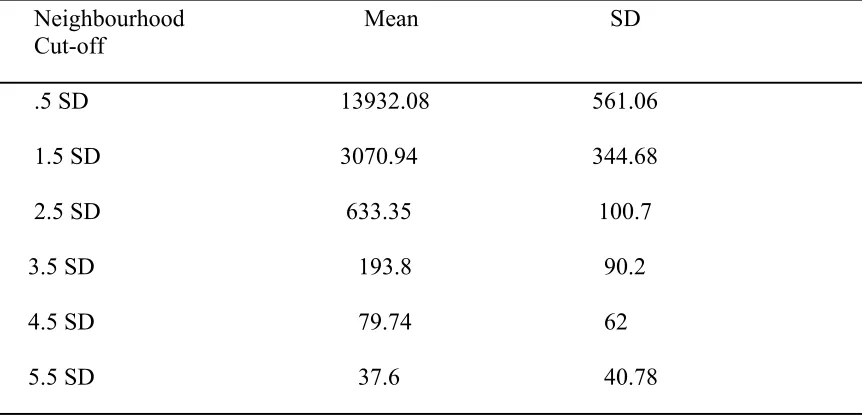
Table 1
Overall Mean semantic neighbourhood sizes and Standard Deviations, as determined
by the WINDSORS model of lexical co-occurrences, for a subset of words (1343)
provided by the Balota, Cortese, and Pilotti (1999) corpus.
Neighbourhood Mean SD Cut-off
.5 SD 13932.08 561.06
1.5 SD 3070.94 344.68
2.5 SD 633.35 100.7
3.5 SD 193.8 90.2
4.5 SD 79.74 62
5.5 SD 37.6 40.78
Discussion