Scholarship at UWindsor
Scholarship at UWindsor
Electronic Theses and Dissertations Theses, Dissertations, and Major Papers
2016
The Rise of Body-Worn Camera Programs in Canada and the
The Rise of Body-Worn Camera Programs in Canada and the
United States: An Extension of the Surveillant Assemblage
United States: An Extension of the Surveillant Assemblage
Thomas Karl Bud University of Windsor
Follow this and additional works at: https://scholar.uwindsor.ca/etd
Recommended Citation Recommended Citation
Bud, Thomas Karl, "The Rise of Body-Worn Camera Programs in Canada and the United States: An Extension of the Surveillant Assemblage" (2016). Electronic Theses and Dissertations. 5722.
https://scholar.uwindsor.ca/etd/5722
This online database contains the full-text of PhD dissertations and Masters’ theses of University of Windsor students from 1954 forward. These documents are made available for personal study and research purposes only, in accordance with the Canadian Copyright Act and the Creative Commons license—CC BY-NC-ND (Attribution, Non-Commercial, No Derivative Works). Under this license, works must always be attributed to the copyright holder (original author), cannot be used for any commercial purposes, and may not be altered. Any other use would require the permission of the copyright holder. Students may inquire about withdrawing their dissertation and/or thesis from this database. For additional inquiries, please contact the repository administrator via email
The Rise of Body-Worn Camera Programs in
Canada and the United States: An Extension of
the Surveillant Assemblage
by Thomas Bud
A Thesis
Submitted to the Faculty of Graduate Studies
through the Department of Sociology, Anthropology, and Criminology in Partial Fulfillment of the Requirements for
the Degree of Master of Arts at the University of Windsor
The Rise of Body-Worn Camera Programs in Canada and the United States: An Extension of the Surveillant Assemblage
by
Thomas Bud
APPROVED BY:
________________________________________________ Vincent Manzerolle, External Reader
Department of Communication, Media & Film
_________________________________________________
John Deukmedjian, Departmental Reader
Department of Sociology, Anthropology & Criminology
_________________________________________________ Randy Lippert, Advisor
Department of Sociology, Anthropology & Criminology
AUTHOR’S DECLARATION OF ORIGINALITY
I hereby certify that I am the sole author of this thesis and that no part of this thesis has been published or submitted for publication.
I certify that, to the best of my knowledge, my thesis does not infringe upon anyone’s copyright nor violate any proprietary rights and that any ideas, techniques, quotations, or any other material from the work of other people included in my thesis, published or otherwise, are fully acknowledged in accordance with the standard referencing practices. Furthermore, to the extent that I have included copyrighted material that surpasses the bounds of fair dealing within the meaning of the Canada Copyright Act, I certify that I have obtained a written permission from the copyright owner(s) to include such material(s) in my thesis and have included copies of such copyright clearances to my appendix.
ABSTRACT
ACKNOWLEDGEMENTS
I would first like to acknowledge the support of my loving parents, Karoly and Eniko. Thank you for your unconditional love and encouragement. Without your continued support, I would not have had the opportunity to complete this thesis.
TABLE OF CONTENTS
DECLARATION OF ORIGINALITY iii
ABSTRACT iv
ACKNOWLEDGEMENTS v
1. INTRODUCTION 1
2. LITERATURE REVIEW: RESEARCH ON BODY-WORN CAMERAS 4
3. THEORETICAL FRAMEWORK: ERICSON’S COUNTER-LAW REGIME 8
4. METHODOLOGY AND DATA SOURCES 14
5. ANALYSIS 18 I. Presence of Precautionary Logic 18
II. Counter-Law I: Law against Law 21
A. United States 22 B. Canada 31
III. Counter-Law II: Surveillant Assemblage 37
A. United States 38
B. Canada 44
IV. Encountering Resistance as part of the Surveillant Assemblage 49
6. CONCLUSIONS 53
I. How and To What Extent are Body-Worn Camera Programs a 53 Form of Counter-Law?
II. How and To What Extent is Ericson’s Counter-Law Framework in need of 57 refinements in light of Body-Worn Camera Programs?
REFERENCES 63
APPENDIX A: SUMMARY OF STATE LEGISLATIVE AMENDMENTS 70 AND POLICE AGENCY BODY-CAM GUIDELINES
1. INTRODUCTION
The events that unfolded on August 9, 2014 in Ferguson, Missouri and July 17, 2014 in
New York City involved extreme police brutality and misconduct (see Lieb and Zagier, 2014;
Murray et al., 2014). Following these events, other videos of police misconduct have flooded the
Internet that further highlight the extent of this problem. There are numerous incidents of police
misconduct that have occurred in Canadian cities too (see Edwards, 2011; Hasham, 2013;
Woodward, 2014). Two of the most infamous cases are the death of Robert Dziekanski in 2007
at the hands of RCMP officers and the shooting of Sammy Yatim in 2013 by a Toronto police
officer (see Keller, 2015; Rogan, 2014). These high profile incidents of police brutality have
created a public uproar for justice and a demand to increase police accountability. The Sammy
Yatim incident sparked a nationwide push for body-worn cameras (Abid, 2014). These cameras
are being proposed as the technology that will significantly enhance police transparency and
accountability. These cameras are miniature audio and video recording devices that allow
officers to record their daily interactions with citizens (Mateescu, Rosenblat and Boyd, 2015).
Pilot projects are emerging at a rapid pace in several Canadian cities. For a pilot project, a small
number of police officers from a given police service are equipped with body-worn cameras. The
proposed aim of these projects is to test the effectiveness of body-worn cameras to monitor
police officer conduct (Burgmann, 2015; Gillis, 2014; Kotsis, 2014; Mahoney and Hui, 2014;
Nickel, 2015) Previous projects in the U.S. have claimed success by showing a drop in police
misconduct and citizen complaints against police (Carroll, 2014).
There are enormous privacy concerns regarding the implementation of body-worn
cameras. In Canadian police services, such as the Toronto Police Service, police officers would
investigating an incident (Mehta, 2015). These recordings are to be safely stored in a database
and used if a case of misconduct should arise. These body-worn cameras may also be used to
assist in police investigations such that the recordings will become evidence in court proceedings
(Derosa, 2015). The mobility of the body-worn camera makes the acquisition of consent to be
recorded from citizens very challenging because, unlike CCTV cameras, body-worn cameras are
attached to the uniform of a police officer.
The widely touted aim of body-worn cameras is to increase police accountability and
transparency by recording the conduct of a police officer who wears it (see Lorinc, 2014; Mehta,
2015; Van Rassel, 2013). However, given that the cameras are clipped onto the police officer
uniform and pointed outwards, they also allow for the mass surveillance of the citizenry with
whom the police officers are interacting on a daily basis. The technological potential is clearly
present to surveil the public indiscriminately. Body-worn cameras can be considered a part of the
surveillant assemblage. Ericson (2007a) explains that the surveillant assemblage may extend
beyond the traditional standards of law that are considered obstacles to strategies of pre-emption.
With the current lack of specific privacy legislation in Canada regarding body-worn cameras, the
information acquired through such recordings may exceed the original scope of many pilot
projects (see for example Monahan and Mokos, 2013).
To understand the emergence and nature of police body-worn cameras as well as their
potential to extend a blanket of surveillance on the public and further extend the surveillant
assemblage, this thesis used Ericson’s (2007a) ideas of the precautionary logic and counter-law.
The precautionary logic can be understood as the logic of uncertainty. It confronts the limits of
science and technology as producers of knowledge regarding frequency and severity of risks.
The use of the precautionary logic leads to the eventual criminalization of actions through
counter-law (Ericson, 2007a: 22). There are two kinds of counter-law. Counter-law I entails the
formation of new laws against existing law. New laws are created and new uses of existing law
are invented in order to eliminate or erode traditional principles and procedures of criminal law
that act as obstacles to the pre-emption of imagined sources of harm (Ericson 2007a: 24).
Counter-law II is the idea of surveillant assemblages (see also Haggerty and Ericson, 2000). The
surveillant assemblage entails a loose collection of varying forms of information (Wilkinson and
Lippert, 2012: 312). Essentially, the surveillant assemblage operates by abstracting human
bodies from there settings and categorizing them into different information flows (Haggerty and
Ericson, 2000: 606). These flows of information are then reorganized into distinct ‘data doubles’
(Haggerty and Ericson, 2000: 606). The resulting ‘data doubles’ can now be targeted for various
purposes of intervention (Haggerty and Ericson, 2000: 606). Furthermore, Ericson (2007a: 24)
explains that new elements are constantly being incorporated into the existing surveillant
assemblage that in many cases result in the elimination traditional principles of criminal law that
block pre-emptive measures. This thesis was consequently guided by two research questions:
First, how and to what extent are police body-worn camera programs consistent with a
precautionary logic as well as with counter-law I and II? The mobility and surveillance potential
of body-worn cameras bring about unique legal and social challenges unseen before with other
video surveillance devices. Guided by this initial question, this thesis also asked: to what extent
does the model of counter-law I and II need to be refined to account for body-worn camera
2. LITERATURE REVIEW: RESEARCH ON BODY-WORN CAMERAS
Police body-worn cameras have recently entered the forefront of policing in North
America; however, the current criminological literature lacks a coherent and in depth
investigation of body-worn camera programs. Although there are existing studies that address the
use of body-worn cameras, the majority of these studies focus on the effectiveness of these
devices in reducing complaints against police. An experiment conducted in Rialto, California had
54 officers randomly assigned to wear body-worn cameras (or not) based on the officer’s shift.
The experiment lasted 12 months and the officers equipped with cameras showed a 59 percent
reduction in use of force incidents and an 87.5 percent reduction in citizen complaints when
compared to estimates for all officers prior to implementation (Barak, Farrar and Sutherland,
2014). While this experiment had clearly outlined control and experimental groups and had a
randomized assignment of body-worn cameras, the drastic reductions in use of force and citizen
complaints make it questionable whether or not all possible variables were considered. Aside
from the questionable results, there is a very clear conflict of interest in the experiment. A
co-author of the study, W. A. Farrar, is the police chief for the Rialto Police Department (Carroll,
2013). Given this, the results may have been biased towards the effectiveness of the body-worn
cameras in this particular experiment.
Another experiment conducted in Mesa, Arizona revealed similar results. The Mesa
Police Department studied body-worn cameras for a one-year period and compared 50 officers
equipped with cameras to 50 other officers who did not have cameras. Their evaluation revealed
a 48 percent reduction in citizen complaints and 75 percent reduction in use of force complaints
against officers equipped with these cameras (Ready and Young, 2015). These reductions in
when body-worn cameras are engaged. Officers are more likely to follow legal and constitutional
standards of conduct when a body-worn camera is present (Harris, 2010; Jennings, Fridell and
Lynch, 2014; Ready and Young, 2015). While these two studies are noteworthy, they have relied
exclusively on randomized control trials focused on the effectiveness of body-worn cameras in
reducing complaints against police. These studies provide an inadequate understanding of the
greater implications of body-worn cameras programs within criminological theory. This research
project intends to address these gaps and effectively situate body-worn camera programs within
the larger counter-law framework and the surveillant assemblage.
Aside from previously discussed benefits of body-worn cameras to reduce complaints,
these devices could reduce police exposure to litigation. Police officers equipped with
body-worn cameras are claimed to potentially save a police department significant amount of
resources on civil law suit damage payouts and legal costs (Ramirez, 2014). However, these
claims have not been backed up by detailed reports of the costs involved. While body-worn
cameras have the potential to assist in separating legitimate from meritless complaints, (see Roy,
2014), there is no research evidence of the benefits of body-worn cameras as a resource saving
tool. Nevertheless, police departments across North America are rapidly initiating pilot projects
despite the inconclusive research (Lorinc, 2014). While the widespread deployment of these
cameras in the face of inconclusive research is problematic on its own, existing research is
inadequate in conceptually framing body-worn camera programs as a resource saving tool. This
research responds to this gap by examining how body-worn camera programs can be considered
a type of precautionary response to recent police brutality incidents.
While the proposed aim of body-worn cameras is to increase police accountability and
police misconduct incidents (Victoria Police Service, 2010). Although the usefulness of these
cameras in evidence collection has not yet been conclusively demonstrated, there are a few
isolated cases where they provided enhanced evidence useful during trials. For example,
evidence gathered through the use of body-worn cameras at domestic violence incidents have
been demonstrated to being useful in supporting witnesses through the court process in the UK
(see Goodall, 2007). Although these cameras may provide supplemental information for legal
cases (see also Fouche, 2014), it is unclear whether or not this information may be useful in all
types of cases. The study conducted in the UK aimed to specifically test the effectiveness of
body-worn cameras in the collection of evidence (Goodall, 2007). However, absent in this study
is how the evidence that is collected may also be used for surveillance purposes and to monitor
the citizenry. As an evidence gathering tool, body-worn cameras may record information that
extends beyond that which may be useful for court trials. This research will address such gaps by
examining how the collection of evidence through body-worn cameras may lead to the extension
of the surveillant assemblage.
While the majority of the existing projects examined the overall effectiveness of
body-worn cameras, Brucato (2015) attempts to conceptualize these devices in existing surveillance
theory as a type of counter-sousveillance technology. With the increasing of citizen recordings of
police behaviour, these devices attempt to nullify citizen recordings by favouring the officer’s
point of view through the use of body-worn cameras. Brucato (2015) explains that police
agencies are adopting these devices with the idea of protecting officers from frivolous
complaints. While Brucato (2015) problematizes the presumed objectivity of body-worn camera
purposes of gathering information. This research attempts to bridge this gap by conceptualizing
body-worn cameras as a new police surveillance tool part of the existing surveillant assemblage.
Aside from concerns for citizen surveillance, the adoption of body-worn camera
programs creates numerous legal implications that remain inadequately addressed in existing
research. Officers equipped with these cameras have the capability to record the inside of private
residences, which in certain contexts may constitute an invasion of privacy at an intimate level
(Ramirez, 2014; Stanley, 2015). In the U.S., numerous state legislatures enacted new legislation
to regulate the use of body-worn cameras as a response to these concerns. Parts of these
legislations intended to exempt body-worn camera footage from disclosure requirements within
existing public records legislation (Newell, 2016). While public access to body-worn camera
recordings is an important aspect of increasing police transparency, public disclosure of camera
footage may jeopardize individual privacy rights. As a result, these exemptions become largely
justified by the fact that they are intended to protect individual privacy rights (Newell, 2016).
Despite such justifications, existing literature neglects to address the larger implications of these
exemptions to existing standards of law. This research will examine how such exemptions
facilitate the use of body-worn cameras as a new surveillance device through the criminalizing
process of counter-law.
Body-worn cameras are being implemented at an alarming rate both in Canada and the
U.S. whilst legislation on their use is either lagging behind or simply nonexistent (see Lorinc,
2014). Aside from the focus of body-worn cameras on creating better accountability and
transparency of police interactions with the public, these cameras have the potential for other
purposes that the current literature does not address and of which the public seem unaware. The
new police surveillance device through function creep. Omitted from existing research is how the
incoherence of existing privacy legislation facilitates the use of body-worn cameras further than
their initially intended purpose. Existing research is ripe with the benefits of body-worn cameras;
however, this is inadequate to understand the much larger implications of body-worn camera
programs within counter-law and the surveillant assemblage (see Jennings, Fridell and Lynch,
2014; Miller et al., 2014).
The aim of this thesis was therefore to examine and critically analyze the legal and
discursive frameworks that underlie the implementation of police body-worn camera programs
through a counter-law and precautionary logic approach as well as to determine how and to what
extent body-worn camera programs reflect Ericson’s (2007a) counter-law framework and logic
of uncertainty. Furthermore, the numerous privacy concerns involved with the use of body-worn
cameras require careful examination in relation to Ericson’s (2007a) counter-law framework.
3. THEORETICAL FRAMEWORK: ERICSON’S COUNTER-LAW REGIME
There has been an expanding shift in recent criminological literature towards examination
and analysis of risk (see Goold, Loader and Thumala, 2010; Lentzos and Rose, 2009; O’Malley,
2002). The obsession with the predictability of risks and dangers through risk management
techniques has become the centre point of the neoliberal risk society. Individuals, organizations,
and environments are sorted into different categories that fit with the purpose of the institution
that desires their increasing predictability (Ericson and Haggerty, 1997). Pre-emptive notions are
apparent in anticipatory endeavours and actuarial predictions that are focused on minimizing loss
(Zedner, 2007). As a result, current criminological inquiries have been entirely refocused,
The notion of precautionary logic is central to Ericson’s (2007a) notion of uncertainty. The focus
of the precautionary principle is on uncertainties that have no calculable price, such as
catastrophes. The idea of the precautionary logic has moved beyond the calculable loss
prevention through risk management techniques (Ericson, 2007a). According to Lyon (2003), in
the aftermath of the 9/11 terrorist attacks, suspicion became commonplace. The aftermath was
marked by a time of crisis that generated extraordinary measures of pre-emption that relied on
public feelings of insecurity and uncertainty. These measures go beyond the limits of the
traditional principles of law and as a result risky populations become criminalized based on
actuarial knowledge of potential harms. Risky populations are those individuals who are
predicted, based on actuarial knowledge, to have the highest likelihood of being involved in
problematic activities or behaviours (see Ericson, 2007a). In the aftermath of the 9/11 terrorist
attacks, individuals that befit the descriptions of a terrorist were detained and interrogated simply
on the basis of actuarial knowledge that they could be involved in terrorist activities (see Lyon,
2003). Nevertheless, these extraordinary responses are justified by the precautionary logic
(Ericson, 2007a).
Risky populations are actively criminalized through applications of counter-law.
Criminalization through counter-law I has occurred in numerous cases (see Ericson, 2007a;
Ericson, 2007b; Levi, 2009). Counter-law I entails the creation of laws against law. New laws
are created and new uses of existing laws are developed to eliminate traditionally enshrined
principles, standards, and procedures of criminal law that act as obstacles for the effective
pre-emption of imagined harms (Ericson, 2007a). With the application of criminalization through
counter-law I, every imaginable sources of harm are reconceptualized as criminal acts. The
suitable enemies, abandon any thought about false identification, eliminate any pretense of due
process and ultimately to create summary justice through incapacitation, torture and elimination
(Ericson, 2007a).
Part of the larger theoretical framework of counter-law, the surveillant assemblage, or
counter-law II, is very closely interconnected with counter-law I (see Haggerty and Ericson,
2000). The surveillant assemblage operates by means of absorbing individuals from their
contextual settings and then separating them into different categories. These categories are then
sorted into ‘data doubles’, which become the targets of intervention (Haggerty and Ericson,
2000). Wilkinson and Lippert (2012: 312) refer to the surveillant assemblage as a loose
collection of varying forms of information that temporarily converge to work together. As a
visualizing device, the suveillant assemblage integrates various types of information about an
individual’s body and renders it more mobile and comparable (Haggerty and Ericson, 2000).
Ultimately, the information that is gathered through the different flows of the surveillant
assemblage becomes scrutinized with the purpose of creating different strategies for the
governance and control of the human population (Haggerty and Ericson, 2000). As part of
counter-law II, Ericson (2007a) explains that new elements are constantly being integrated into
the existing surveillent assemblage that subsequently also eliminate traditional standards and
procedures of criminal law that act as barriers to measures of pre-emption (Ericson, 2007a).
Contemporary techniques of surveillance have moved beyond the Foucaultian
explanation of a disciplinary function of surveillance towards a security function (see Foucault,
1977). Apparatuses of discipline operate through methods of prevention, corrections as well as
enforcement. Apparatuses of security on the other hand operate through varying thresholds of
and events to identify what is beyond a specified tolerance threshold (Deukmedjian, 2013).
Ericson’s (2007a) logic of uncertainty operates within neoliberal social imaginaries that heavily
rely on conceptualizations of risk and the application of the precautionary logic. Given the
dominance of risk taking over risk aversion in the neoliberal risk society today, Ericson’s
(2007a) counter-law regime is beyond the disciplinary function of surveillance, with the focus
being on security through efforts of pre-emption by means of criminalization through
counter-law.
There is an increasing convergence of discrete systems of surveillance and the past two
decades are marked by an exponential proliferation of information and data gathering techniques
(Hier, 2003). The notion of the surveillant assemblage marks the movement away from panoptic
to post-panoptic systems of surveillance in which social control becomes deterritorialized
(Bogard, 2006: 97). Within the post-panoptic era, CCTV surveillance for example loses its
deterrent effect and instead becomes conceptualized as part of the surveillant assemblage (see
Lippert, 2009). However, the criminalization process advanced by the surveillant assemblage
encounters various forms of resistance. With the abundance of visual information due to the
prevalence of CCTV surveillance, there are increasing levels of resistance from policing agents
due to heightened levels of workload (see Wilkinson and Lippert, 2012). Resistance may take the
form of technical, organizational, and social processes that consequentially hinder the movement
of visual information through the police institution (Wilkinson and Lippert, 2012: 313).
Technical limitations and the reliance on human labour leads to only a select few CCTV images
becoming targets of intervention by the police institution, while filtering out the remaining
majority (Wilkinson and Lippert, 2012: 324). However, resistance of the kind mentioned above
Increasing levels of technological sophistication, such as real time video analysis, will reduce
dependence on human labour and ultimately overcome the resistance to new surveillance
systems (see Wilkinson and Lippert, 2012: 320).
The notion of counter-law I and the surveillant assemblage have been refined numerous
times since their initial conceptualization by Ericson (2007a) and Ericson and Haggerty (2000).
Although Ericson (2007a) effectively conceptualized the counter-law framework within realms
of national, social, corporate and domestic securities, new developments are constantly arising
that incorporate varying applications of counter-law. Ericson (2007a: 208) points out that there is
considerable variation across applications of counter-law and the surveillant assemblage
dependent on the localized politics of uncertainty. His book is intended to illustrate areas that
most effectively exemplify the overall presence of the counter-law regime. However,
refinements to the counter-law framework are needed to account for these variations.
There are numerous refinements to the counter-law framework that have been put
forward by scholars. Their intent was to exemplify variations across the theoretical application of
counter-law. Lippert (2009) has refined the counter-law regime regarding CCTV camera
configurations and their relationship with law. With an increasingly heavy reliance on CCTV
signage, CCTV cameras lose their deterrent and panoptic effects and instead become part of the
surveillant assemblage. CCTV signs become just as important as the cameras themselves
because they expose the citizenry to a political subjectification through the surveillant
assemblage.
Ericson (2007a) conceptualizes the function of counter-law I as a type of criminalizing
force. The enactment of new laws erodes certain standards of law and ultimately criminalize a
this criminalizing force of counter-law with its application in the Gang Congregation Ordinance
in Chicago during the 1990s to the counter-law regime. This Ordinance intended to criminalize
certain perceived threats by expanding the interpretive and definitional limits of ‘harmful’
conduct. However, these laws were intentionally created to be very broad (Levi, 2009: 133). This
inherent broadness exemplifies Ericson’s (2007a) counter-law framework very effectively
because it shows how the Gang Ordinance intended to cast the net as widely as possible and to
identify all the suitable enemies.
More recently, Chase (2012) refined the counter-law framework with its application in
Canada’ peace bond regime. In Canadian law, peace bonds are orders put forward by a court that
obligate a person to be on good behaviour for a predetermined about of time. For the duration of
the peace bond, the individual cannot be charged with other criminal offences (Chase, 2012).
Although peace bonds do not put forward a criminalizing process, they ultimately illustrate
tenets of Ericson’s (2007a) counter-law framework though their rampant erosions of due process
by reducing the criminal burden of proof of “beyond a reasonable doubt”. Chase (2012)
exemplifies that the peace bond program befits the counter-law framework because it allows for
exceptions to take hold that ultimately erode traditional standards of law. As such, Chase (2012)
illustrates that counter-law does not necessarily require a criminalizing force. Exceptions to
traditional legal standards regarding peace bonds nevertheless exemplify the presence of
counter-law.
By incorporating the understanding of the precautionary logic and counter-law, this thesis
critically examined the extent of the presence of the precautionary logic and a counter-law
regime within the development and subsequent use of police body-worn cameras by North
this thesis also looked at how and to what extent counter-law I and II are concepts that need to be
refined in relation to police body-worn camera programs.
4. METHODOLOGY AND DATA SOURCES
To understand the discursive frameworks regarding body-worn camera programs as well
as the extent to which these discourses on body-worn camera programs reflect Ericson’s (2007a)
precautionary logic and counter-law, five different data sources were examined. First, I
examined the body-worn camera program policy texts of five different police services in
Canada1 that have had pilot projects or were in the process of implementing one during the time
of this research. Given that police body-worn cameras are only starting to be implemented by
Canadian police, I also looked 33 different police agencies from the U.S. 2 that have completed
or were completing pilot projects during the time of this research. To determine the extent to
which Ericson’s (2007a) counter-law and precautionary logic is reflected, it was central to
analyze how body-worn camera programs are conceptualized and justified by law enforcement
authorities who are being equipped with these devices.
Second, in addition to police program texts that provide a law enforcement point of view,
print media has a vast array of information regarding body-worn cameras that provide a different
perspective. Well established news websites and newspapers have extensive reports on various
issues concerning body cameras and their implementation. Similarly, with program texts, the
print media documents I analyzed covered both Canadian and United States contexts. The
purpose behind looking at print media was to get a better understanding of the overall public
1 Canadian police services included: Amherstburg (ON), Calgary (AB), Edmonton (AB), Toronto (ON), Victoria (BC)
2 U.S. police agencies included: Phoenix (AZ), Los Angeles (CA), Rialto (CA), New Haven (CT), Denver (CO), Washington
perception surrounding the implementation of body-worn cameras. Well established news
websites such as The Globe and Mail provided valuable insight into the public’s opinion of
body-worn cameras and the popular belief surrounding their use as well as problematic aspects
of their use. The material published by print media was also be analyzed to determine how and to
what extent it was reflective of Ericson’s (2007a) counter-law regime.
Third, various body-worn camera manufacturers’ websites provided a unique viewpoint
on how these devices become marketed. These websites provided unique information about
various technological features and also different purposes these devices may be useful for.
Furthermore, the analysis of body-worn camera manufacturers’ websites provided insight into
the potential technological capacities of these devices and the extent to which they fit into the
counter-law framework, and more specifically the notion of the surveillant assemblage (Ericson,
2007a).
Fourth, privacy guidelines and legislation contained information on the privacy concerns
regarding body-worn cameras. The Office of the Privacy Commissioner of Canada was a crucial
source for data regarding guidelines to be followed on the use of body-worn cameras. To
determine how and to what extent privacy guidelines regarding police body-worn cameras reflect
Ericson’s (2007) counter-law framework, the recently published Guidance for the Use of
Body-Worn Cameras by Law Enforcement Authorities by the Office of the Privacy Commissioner of
Canada was analyzed. This guidance was at the time and currently still is the only document that
addresses the privacy concerns that have recently come to light because of body-worn cameras.
This guidance was simply intended to provide law enforcement authorities with different things
to take into consideration when implementing body-worn cameras. Furthermore, other crucial
Privacy Act, and the Canada Evidence Act. These pieces of legislation were analyzed and coded
using Ericson’s (2007a) counter-law approach based on their relationship to the implementation
and use of body-worn cameras. I have also looked at various pieces of legislation for the U.S.
that addressed the implementation of body-worn cameras. Given the extensive legislative
autonomy of each state, I analyzed the legislative amendments regarding body-worn cameras of
32 different U.S.states3.
Lastly, I selected three police services in Canada that initiated pilot projects for
body-worn cameras to focus upon in more detail. The focus was on the municipal police services of
Amherstburg (Ontario), Calgary (Alberta) and lastly Edmonton (Alberta). I submitted freedom of
information requests to each of these police services to access general records regarding the
implementation of their specific pilot projects. The Freedom of Information Act was a valuable
research tool on policing security related practices (see Lippert and Walby, 2012). The purpose
of these requests was to provide crucial insight into the numerous considerations surrounding
funding, cost, retention, as well as use of body-worn cameras and ultimately to supplement the
earlier mentioned data sources. Gathering information through Freedom of Information requests
helped to provide better insights into details and practices that would otherwise would have been
hidden and as a result become rarely analyzed (see Lippert and Walby, 2012). Moreover, the
requests requested information regarding the underlying rationale behind the decision to
implement body-worn cameras and any measures of effectiveness.
To fully and critically answer the research questions, this thesis used discourse analysis
as its method. “A discourse is a set of interrelated texts, in which the practices of their
production, dissemination and reception bring an object into being” (Philips and Hardy, 2002: 3).
3 U.S. states: Arizona, California, Connecticut, Colorado, District of Columbia, Florida, Georgia, Idaho, Illinois, Indiana, Iowa,
Texts are considered a discursive ‘unit’ and a material manifestation of discourse (Chalaby,
1996). Considering Ericson’s (2007a) counter-law framework, the analysis of text was the most
crucial component of this thesis. For the purpose of this study, the discourse that was examined
was the representation of police body-worn cameras in written texts, specifically police program
texts, security magazines, print media, privacy legislation and freedom of information requests.
This discourse was analyzed in relation to Ericson’s counter-law approach. To aid with the
analysis of the police body-worn camera discourse, I coded for central themes that aimed to
capture something important about the data (Braun and Clarke, 2006). In this case, the analysis
of the body-worn camera discourse aimed to capture whether parts of Ericson’s counter-law
were operationalized in the texts. The notion of precautionary logic was analyzed in its relation
to body-worn cameras as a response to police brutality and misconduct. Legal aspects associated
with body-worn cameras were also examined, such as the Guidance for the Use of Body-Worn
Cameras by Law Enforcement Authorities. Although the guidance is not considered legislation, it
nevertheless contained aspects of counter-law I. Haggerty and Ericson’s (2000) surveillant
assemblage was also operationalized in terms of the capabilities of extending surveillance
networks and practices of police services through the use of body-worn cameras. These camera
programs were examined for how they fit into the surveillant assemblage and whether their use
extended beyond traditional procedures and principles of criminal law. While there may be
similarities in body-worn camera programs across Canada and the U.S., I did not engage in any
comparisons. As a result, I analyzed these programs separately for each country under separate
subheadings. Ultimately, this analysis examined the discourse of police body-worn cameras in
Canada and the U.S. to determine how and whether it befits Ericson’s (2007) counter-law
5. ANALYSIS
I. Presence of Precautionary Logic
The notions of risk and precaution regarding police body-worn cameras become
pronounced when considering the reason behind their rise in policing and their proposed aim.
Amongst the primary aims of increasing police accountability and transparency, one of the other
purported aims of body-worn cameras is their potential ability to reduce police exposure to
litigation and unwanted citizen complaints (Ramirez, 2014). Whether or not body-worn cameras
can indeed reduce the unwanted citizen complaints against police and their exposure to civil
litigation remains to be seen. Nevertheless, one of the major claims of police pilot projects both
in Canada and the U.S. remains that these cameras have the potential to reduce complaints
against police (see Barak, Farrar and Sutherland, 2014; Calgary Police Service, 2015a;
Edmonton Police Service, 2015b; Ready and Young, 2015). The current body-worn camera
program in place at Calgary Police Service identifies the reduction of complaints from citizens as
one of the benefits that may come about as a result of body-worn cameras (Calgary Police
Service, 2015a: 18).
The frequency of unwanted citizen complaints against police can be conceptually
considered a risk to police legitimacy in the eyes of the public that police services
consequentially have to deal with (see Kochel, 2015). Within conceptualizations of risk, the
frequency of harmful occurrences and the severity of the harm caused are of paramount
importance (Ericson, 2007a). As such, the frequency of complaints against police and the
severity of these complaints become crucial factors in risk analysis. Although overall complaints
against police have been decreasing (see Ontario Human Rights Commission, 2007; Shallwani
and Dawsey, 2015; Williams, 2015), the frequency and severity of high profile police brutality
overall police institution (see Wines and Cohen, 2015). As such, the widespread implementation
of body-worn camera programs across North American police departments invoke a
precautionary response to the uncertainties surrounding future police brutality incidents.
In the aftermath of 9/11, suspicion and surveillance intensified significantly. Everyone
became the target of surveillance (Lyon, 2003). The U.S. Patriot Act was enacted following 9/11
and it aimed to give unlimited presidential authority to criminalize “unlawful enemy
combatants”. The aim was to criminalize these suspects for an imagined future harm they might
cause. However, the major consequence of the U.S. Patriot Act was the unprecedented powers of
surveillance it gave to state authorities. Although foreign terrorist attacks the scale of 9/11 have
not occurred since 2001, the main justification for intensified surveillance is the threat of future
terrorist attacks. “The FBI justified electronic surveillance applications in the name of foreign
threats to national security” (Ericson, 2007a: 56). The precautionary justifications of future
attacks become the focal point for the intensification of surveillance.
The aftermath of the Ferguson, Missouri incident signified the start of a push for
body-worn cameras. Similarly, to the terrorist threats to national security, incidents of police brutality
and citizen complaints become conceptualized as threats to police legitimacy. Consequentially,
police body-worn cameras can be regarded as a precautionary tool because of their focus on
uncertainties, such as the future occurrence of more incidents of police brutality.
Police agencies are rapidly adopting these devices with the purpose of saving police
resources from being spent on civil law suits. The proposed benefit as potential tools to save
police resources by preventing future frivolous complaints does act as a major justification to
move forward with their widespread adoption. Calgary Police Service (2015c: 2) states that “one
misconduct”. It remains inconclusive whether the reduction of frivolous complaints saves police
resources. However, the widespread implementation of these cameras in face of such
inconclusive research befits the notion of a precautionary response.
“The politics of uncertainty leads to enormous expenditures on risk assessment and
management that reveal the limits of risk based reasoning and intensify uncertainty” (Ericson,
2007a: 1). After 9/11, surveillance of the public greatly intensified and enormous resources were
appropriated for national security based on precautionary measures (Ericson, 2007a). Similarly,
the politics of uncertainty is clearly present within the current body-worn camera discourses
regarding their proposed costs and benefits. A few isolated success stories do show the ability of
body-worn cameras to exonerate police officers of unsubstantiated citizen complaints that would
have otherwise cost a police service a large amount of resources. The mere presence of these
recordings in many cases leads to the alleged plaintiffs to simply drop the accusations (Calgary
Police Service, 2015a). However, Edmonton Police Service’s 3-year pilot program reveals that
these cameras made no statistical difference in resolving police complaints (Casey, 2016;
Edmonton Police Service, 2015b). Despite the inconclusive results from Edmonton, a few
particular success incidents act as a strong enough justification that the potential is there. This
resulting uncertainty leads to the “enormous expenditures” that are currently being spent on the
deployment of body-worn cameras. Calgary Police Service’s pilot program also reveals
inconsistent results on whether body-worn cameras are effective in saving resources.
Nevertheless, they plan to roll out 1,100 cameras by the end of 2016 regardless of the
inconsistent results produced in the pilot study (Casey, 2016). This undoubtedly befits the
Although there are no detailed statistical reports available that highlight the degree of
police resources spent on police misconduct lawsuits, in the U.S. these resources are estimated to
be in the millions (see Wing, 2015). Between 2011 and 2014, the city of Baltimore spent $5.7
million on lawsuits involving allegations of false arrests, false imprisonment and excessive force.
Moreover, these lawsuits were paid for through taxpayer funds (Puente, 2014). These figures
covered a period of three years only for Baltimore, a medium sized U.S. city. Lawsuit costs may
be proportionally higher across the U.S. for larger police agencies and larger cities. In Canada, a
similar situation exists. Between 2000 and 2015, the Toronto Police Service has spent $27
million on civil lawsuits (see Andrew-Gee, 2013). The majority of the settlement claims included
allegations of use of force, false arrests and negligent investigations. It is clear that both in
Canada and the U.S., police services spend a large amount of resources on civil lawsuits that are
appropriated through taxpayer funds (Andrew-Gee, 2013).
Whether or not the widespread departmental adoption of body-worn cameras is
considered an entrepreneurially wise risk taking endeavour to deal with police misconduct
incidents becomes insignificant (see Deukmedjian, 2014). According to Ericson (2007a),
uncertainty itself is what leads to expenditures on risk assessments that consequentially reveal
the limits of risk based reasoning. As such, the conceptualizations of body-worn cameras clearly
befit the theoretical confines of a precautionary tool within the larger politics of uncertainty and
risk.
II. Counter-Law I: Law against Law
The notion of the precautionary logic and counter-law are conceptually linked. Precaution
surveillance (see Lyon 2003). As a result, the application of the precautionary logic progresses to
the criminalization of certain activities through counter-law. There are numerous examples of
previously legal activities that became criminalized with the enactment of counter-law (see
Ericson, 2007a; Ericson 2007b; Levi, 2009; Lippert and Wilkinson, 2010; Wilkinson and
Lippert, 2012). The process by which most of these activities became criminalized was the
enactment of laws or legal reforms intended to counteract already existing laws. These new
reforms or laws were essentially invented with the purpose of eroding or eliminating traditional
principles, standards and procedures of existing law. However, counter-law I may also take the
form of a “state of exception” (see Agamben, 2005). Under exceptional circumstances like a
state of emergency, normal legal principles, standards and procedures may be suspended
(Ericson, 2007a). The politics of uncertainty becomes a strong factor in justifying when such
exceptional measures may be implemented.
A) United States
Body-worn camera programs have been introduced by police agencies across to the U.S.
at a very rapid pace. However, legislation in some states has only caught up to this technology in
the past year. To an extent, the legislative amendments that address body-worn cameras are very
similar in each state; however, given the large degree of state autonomy in the U.S., there are
some significant differences in some situations. When it comes to the deployment of body-worn
cameras in general, the presence of uncertainty does not directly lead to the criminalization of
certain activities through counter-law I as Ericson (2007a) conceptualized. The legislative
amendments in the U.S. regarding body-worn cameras in many cases legally enabled these
prohibited (see Georgia General Assembly, 2015; Nevada General Assembly, 2015; Utah
General Assembly, 2015). In these cases, the presence of counter-law I is expressed through
legislative amendments resulting in exemptions to privacy and public records law.
When it comes to privacy legislation in general, there is a two-fold divide in the U.S., the
majority of the states allow only for single-party4 consent when recording audio and video
communications (U.S. Department of Justice, 2012: 7). A single-party consent system entails the
notion of consent only from the part of the officer. As such, when it comes to the use of
body-worn cameras in these particular states, notification of recording is not required (U.S.
Department of Justice, 2012: 7). Consequentially, the absence of any notification also entails the
absence of being able to consent to the actual recording from the part of the citizen. The state of
Iowa is a single party consent state and as a result notification of recording is not legally required
under any existing legislation. Nevertheless, the Iowa General Assembly does address the notion
of consent when it comes to body-worn camera recordings. Section 2(5) states that “a person
shall inform a person when that person is being recorded by a body camera unless informing the
person would be unsafe, impractical, or impossible” (Iowa General Assembly, 2015: 3). The
acquisition of consent on part of the citizen also becomes desirable when entering a person’s
residence without a warrant or where no exigent circumstances exist. In situations like that,
section 2(5)(a) states that “the peace officer shall immediately ask whether the resident desires
the peace officer to stop the body cameras recording while the peace officer is in the residence”
(Iowa General Assembly, 2015: 3). While it may appear that consent is actually required from
the citizen when the recording is occurring in their private homes, section 2(5)(a) does not
4 States with single-party consent systems: Arkansas, Colorado, Georgia, Hawaii, Idaho, Indiana, Iowa, Kansas, Louisiana,
address whether or not the officer is legally required to comply with the citizen’s request to cease
the recording. Consequentially, the police officer holds a significant amount of discretion
whether or not to turn the camera off in such circumstances.
Other single-party consent states also amended their privacy legislation to facilitate the
operation of body-worn cameras in general. In the state of Georgia, the acquisition of consent in
public areas did not pose an obstacle to the operation of body-worn cameras given that Georgia
is a single-consent state. Obstacles arose when the area where the recording occurred was inside
of a private residence. The state of Georgia passed bill no. 94 that intended to amend existing
legislation to allow body-worn camera recordings to occur inside a private residence without the
acquisition of citizen consent if the officer’s presence was lawful or was pursuant to an
investigation (Georgia General Assembly, 2015). The American Civil Liberties Union (herein
referred to as ACLU) opposed various parts of this bill. They proposed that in cases of
non-emergency or where there is no reasonable suspicion of wrong doing, the police should be
required to ask for consent to record in private places (Torres, 2015). Despite ACLU concerns,
bill no. 94 received the signature of the governor and was passed into law at the start of April
2015. The act also specifically notes at the end in section 7 that “all laws and parts of laws in
conflict with this Act are repealed (Georgia General Assembly, 2015: 5). As such, section 7 is
intended to override existing laws that may be in conflict with bill no. 94. Under normal
circumstances, operating a video/audio recording device inside a private residence would be
considered unlawful on U.S. soil. However, this particular amendment legalizes such an activity
specifically regarding body-worn cameras operated by police officers. The above discussed
amendments effectively erode traditional standards of law because they exempt the use of
Although the majority of the states only allow for single party consent during video and
audio communications, a few states are part of the two-party5 consent system and require all
parties to consent to recording of video and audio communications (U.S. Department of Justice,
2012: 8). Under the two-party consent laws, police officers are legally required to inform the
citizens when a recording is occurring and also to obtain the citizen’s consent to record (Miller et
al., 2014). The two-party consent system is a significant challenge to the operation of body-worn
cameras because on many occasions, citizens would deny the consent to record and as a result
police officers were legally required to turn the camera off. The state of Washington is a
two-party consent state and required officers to obtain consent before initiating a recording. However,
amendments were made to existing privacy legislation to eliminate this need to acquire consent
when operating body-worn cameras. The Washington Supreme Court reassessed and
reinterpreted the Washington Privacy Act that a conversation between a police officer and a
member of the public that occurs during the officer’s duties is not considered private. As a result,
consent on part of the citizen is not required (Sullivan, 2014). The Seattle Police Department
body-worn camera policy text also addressed the notion of consent. Their policy requirements
similarly reinterpret the need for consent like the Washington Supreme Court. The policy clearly
states that in private residences, officers will ask for the individual’s consent to record with the
body-worn camera. The request and the response must be recorded and if the request is denied
by the individual, the officer must comply and turn the camera off during the time that they are
in the private area (Seattle Police Department, 2015: 3). However, the policy text categorizes this
requirement as an exception to the rule as being the only situation when the acquisition of
5 States with two-party consent systems: California, Connecticut, Delaware, Florida, Illinois, Maryland, Massachusetts,
consent is required from the citizen. When an interaction is occurring in public areas, consent is
no longer required and as such does not pose an obstacle to the operation of body-worn cameras.
The state of Washington is not the only state with a two-party consent system that
amended its privacy legislation and subsequently created exemptions to the two-party rule
regarding the use of body-worn cameras. In the state of California, there are numerous police
agencies that have initiated body-worn camera pilot projects. One of them being Los Angeles
Police Department which is in the process of deploying 7,000 body-worn cameras by the end of
2016 (see Markowitz, 2016). California being a two-party consent state, such consent
requirements would significantly hinder the use of these 7,000 proposed body-worn cameras.
Consequentially, the state of California legislature amended sections of its penal code and
privacy legislation regarding the use of body-worn cameras. Existing law in California makes it a
crime to intentionally record a confidential communication without the consent of all parties to
the communication. The proposed amendments would exempt certain peace officers from this
particular consent requirement if they were acting within the scope of their authority (California
General Assembly, 2015). The amendment does not go into more detail about what constitutes a
peace officer’s scope of authority; nevertheless, the amendment effectively exempts body-worn
cameras from consent requirements under the two-party consent system. The Los Angeles Police
Department body-worn camera policy text reveals similar exemptions to the use of these devices.
Although officers are encouraged (though not legally required) to inform the citizens whom they
are interacting with that a recording is occurring, they are not required to obtain consent from the
members of the public if the officers are lawfully in the area where the particular recording is
taking place. This also includes private residences, given that the officers presence in someone’s
to be considered a lawful presence for an officer is not elaborated on and as a result becomes
very ambiguities and open to interpretation.
In all of the 12 states that are considered to be part of the two-party consent system, their
privacy legislation was amended and exemptions were created that facilitated the operation of
body-worn cameras in these states by removing the obstacles of citizen consent. Such
exemptions are evidence for the presence of counter-law because the legislative amendments that
were enacted eroded traditional principles, standards and procedures of privacy law (see Ericson,
2007a: 24). Although Ericson (2007a) addressed counter-law I with relation to the erosion of
standards and principles in the area of criminal law, counter-law I can occur and does occur in
other areas of law as well, as illustrated by these legislative amendments in privacy legislation
and the subsequent exemptions they created.
Such legislative amendments regarding the operation of body-worn cameras are not only
occurring in privacy legislation. Public records law has been amended in many states where
body-worn camera projects have been initiated. Public records are defined as “all documents,
papers, letters, maps, books, tapes, photographs, films, sounds recordings, data processing
software, or other material, regardless of physical form, characteristics, or means of
transmission, made or received pursuant to law or ordinance in connection with the transactions
of official business by any agency” (Florida General Assembly, 2015). Under this definition,
body-worn camera recordings become interpreted as a public record that may be requested to be
viewed by any member of the public. Although each state has its own public records law, the
general outlines of what a public record entails is very similar across all states. With the advent
of body-worn camera programs, many state legislatures amended their public records law to limit
regarding body-worn cameras. Although Louisiana did not specifically amend sections of their
public record law, bill no. 183 did make body-worn camera records completely exempt from the
audio and video data requirements provided for in Louisiana’s Public Records Law (Louisiana
General Assembly, 2015). Similarly, the Utah General Assembly amended the Utah Code of
Criminal Procedure and the Government Records Access and Management Act by interpreting a
recording from a body-worn camera by a police officer as constituting a private record. This
classification does run contrary to the definition of “public record” under section 103 of the Utah
Code (Utah General Assembly, 2015). However, the Utah General Assembly repeals all other
existing laws in conflict with this new amendment. Consequentially, body-worn camera
recordings become an exception to the rule of what is to be considered a “public record” and
become classified as a private record.
Some states6 do not yet have any legislation that governs and regulates the use of
body-worn cameras. However, some police agencies have still initiated body-body-worn camera programs
despite the absence of appropriate legislation (see for example Cleveland Police Department
2015; Missoula Police Department, 2014).
However, not all states completely exempted body-worn camera recordings from public
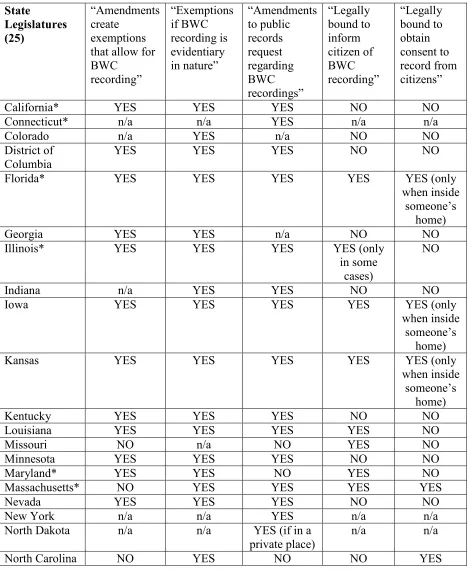
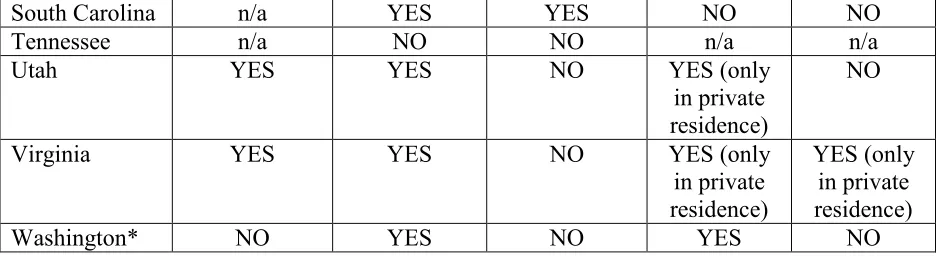
records law requirements entirely (see Table 1). In some cases, the location where the recording
occurred affected whether or not it could be released to the public and exempting such scenarios
from public records requirements (see Table 1). In North Dakota, any image that was recorded
by a police officer with a body-worn camera that occurred in a private place becomes exempt
from public record requirements (North Dakota General Assembly, 2015). Individual privacy
becomes the key justification for this particular exemption. However, the North Dakota General
6
Assembly does not define what constitutes a “private place” and leaves the term open to a broad
or restrictive interpretation by police agencies.
Although body-worn cameras are not explicitly purported to be a new police surveillance
device, the majority7 of the U.S. police agencies examined do not prohibit use of these devices
for surreptitious recordings. In the case of Nevada, existing state law does prohibit the use of
surreptitious electronic surveillance on public grounds. However, Bill 111 of the Nevada General
Assembly aimed at the governance of body-worn cameras, creates an exemption. “Sections 3 and
5 of this bill create an exception for peace officers employed by the Nevada Highway Patrol
wearing a portable event recording device from certain provisions relating to unlawful
surreptitious electronic surveillance” (Nevada General Assembly, 2015: 1). The justification for
this exemption becomes framed in the context that body-worn cameras do not constitute a covert
surveillance device with the purpose of surreptitious surveillance. Given the absence of any
consent requirements in Nevada, this amendment exempted body-worn cameras from electronic
surveillance laws and as such effectively eroded traditional principles and standards of law.
Consequentially, these devices can now be used for police surveillance without any legal
obstacles and as such befitting Ericson’s (2007) counter-law and surveillant assemblage
framework.
The previously mentioned exemptions are no doubt evidence for the presence of
law in body-worn camera legislations. However, these exemptions are not the only way
counter-law is created. As explained earlier, inherent broadness and ambiguity is clearly present within
the newly enacted legislations that aim to govern how, where, and when body-worn cameras may
be operated. As explained earlier with the Gang Congregation Ordinance in Chicago, expansive
7 With the exception of Phoenix Police Department who prohibit the use of body-worn cameras to surreptitiously record
interpretive and definitional limits of newly enacted legislation constitute a form of counter-law
(see Levi, 2009). In the case of antisocial behaviour ordinances, the lack of a proper legal
definition allows for a broad legal interpretation, which consequentially allows for an expansive
scope. For all the state legislations that were analyzed, they all show evidence of extreme
vagueness and ambiguity, much like the definitional vagueness of anti-social behaviour laws and
Gang Congregation Ordinance.
Interpretational broadness within these new laws becomes evident when considering how
body-worn camera recordings become categorized as evidentiary data. Miami is the only police
agency whose policy text clearly defines what constitutes evidentiary data. None of the other 31
police agencies analyzed for this thesis give any clear definitional or categorical guidelines.
Thus, no guideline at all is the norm. For Miami, evidentiary data becomes defined as “footage
of an incident or encounter that could prove useful for investigative purposes, such as a crime, an
arrest or citation, a search, a use of force incident, or a confrontational encounter with a member
of the public” (Miami Police Department, 2015: 2). The California General Assembly (2015) in
section 5(b) defines evidentiary data as “data of an incident or encounter that could prove useful
for investigative purposes, including, but not limited to, a crime, an arrest or citation, a search, a
use of force incident, or a confrontational encounter with a member of the public”. Although
most of the police agencies lack clear definitional guidelines, definitions like the one put forward
by California may filter down and adopted at the police agency level. The definition put forward
by the Miami Police Department is very similar to California’s. However, the California
legislature lists a particular set of circumstances in which a recording may be useful for an
investigation but it clearly states that the interpretive/definitional confines of “evidentiary data”