Perturbation Method for Data Privacy, Divide
and Conquer Method
Bhavesh Patil1, Anita Patil2, Sujata Patil3, Gayatri Pawar4
BE Student, Dept. of Computer Engineering, SSBT College of Engineering and Technology, North Maharashtra
University, Jalgaon, Maharashtra, India1
BE Student, Dept. of Computer Engineering, SSBT College of Engineering and Technology, North Maharashtra
University, Jalgaon, Maharashtra, India2
BE Student, Dept. of Computer Engineering, SSBT College of Engineering and Technology, North Maharashtra
University, Jalgaon, Maharashtra, India3
BE Student, Dept. of Computer Engineering, SSBT College of Engineering and Technology, North Maharashtra
University, Jalgaon, Maharashtra, India4
ABSTRACT: Data mining process is used to find patterns among the dozens of fields in the large database. The main challenge in data mining is to maintain the privacy of confidential information. In order to share data while protecting privacy, data owner must achieve the goal of privacy preservation. Data perturbation has been used to protect the privacy of sensitive information. The proposed approach uses tuple values of the sensitive attribute to generate a normalized value which produces perturbed data. The resulting data records look very different from the original records and the distribution of data values is also different from the original distribution. The proposed mechanism gives low error rate compared with existing methods.
KEYWORDS: Privacy Preserving, Data Mining, Data Perturbation, Sensitive Attribute
I. INTRODUCTION
Data mining technology has a goal of providing tools for intelligently transforming a large amount of data in knowledge relevant to users[1]. The derive Knowledge often convey in form of association rules, decision trees or clusters, allows one to find attractive patterns and regularities deeply buried in the data that are meant to promote decision making processes. Such a knowledge revelation process, however,can also return sensitive information about individuals, compromising the individual's right to privacy. Moreover, data mining techniques can reveal critical information about business transactions, compromising the free competition in a business setting. Thus, there is a strong need to restrict disclosure not only of confidential personal information but also of knowledge which is considered sensitive in a given context. For this reason, recently much research effort has been dedicated to addressing the problem of privacy preserving in data mining.
II. BACKGROUND
The condensation approach[2] is a typical multidimensional reconstruction technique, which intention at preserving the covariance matrix for multiple columns. Thus, some geometric properties such as the shape of decision boundary are well protected. Different from the randomization approach, it regenerates multiple columns as a whole to generate the entire reconstructed data set. As the reconstructed data set retains the covariance matrix, many existing data mining algorithms can be used directly to the reconstructed data set without requiring any change or new improvement of algorithms.
In data swapping, technique confidentiality protection can be achieved by selectively exchanging a subset of attributes values between selected record pairs. Data swapping preserves the privacy of original sensitive information available at the record level. If the records are picked at random for each swap then it is called random swaps. It is difficult for an infiltrator to recognize distinct person or entity in the database because all the records are modified to the maximum level. The enviable properties of swapping technique are that it is simple and can be used only on sensitive data without disturbing non-sensitive data.
The present method simple additive noise (SAN) method [3] is adding the noise parameter which has mean zero and variance proportion parameter determined by the user to the initial confidential attribute then the result is a reconstructed value of a confidential attribute. The disadvantage of simple additive noise method is that the noise is independent of the scale of a confidential attribute.
To defeat the SAN method drawback next advanced approach is multiplicative noise (MN) [4], in this method, the confidential attribute is multiplied with the noise with mean one to get reconstructed value of a confidential attribute. These two methods are causes the bias in the variance of the confidential attribute, as well as in the relationships between attributes.
Another proposed method is micro aggregation (MA)[2],[5] the MA reconstructs data by aggregating confidential values, instead of adding noise. For a data set with a single confidential attribute, univariate micro aggregation (UMA) involves sorting records by the confidential attribute, grouping adjacent records into groups of small sizes, and replacing the individual confidential values in each group with the group average. Related to SAN and MN, UMA produces bias in the variance of the confidential attribute, as well as in the relationships among attributes. Multivariate micro aggregation (MMA)[5],[6] groups data using a clustering technique that is based on a multidimensional distance measure.
As a result, the relationships within attributes are supposed to be better protected. However, this benefit comes with a higher computational time complexity, which could be inefficient for large data sets. So in order to provide privacy to the large data sets, we are going to proposing an approach based on the reconstruction trees[9], a kd-tree is a data structure for partitioning the and storing data.
III.PROPOSEDALGORITHM
The proposed approach, aim to achieved better result for privacy on the database than the existing system. The Proposed approach uses value distortion method for data perturbation. The proposed mechanism of reconstruction tree will handle the data partitioning on the data sets and subsets. The each subset must satisfy some minimum conditional values which store and from as leaf of the tree. This subset partitioning is a combination of the confidential and non-confidential data. The proposed mechanism works and implements the approach of reconstruction tree[9], as one of the general methods like divide and conquer method.
System Architecture
Fig.1.System Architecture
A. Query Handler
The query handler is accepting the query data from the client and process the query to the database and fetching the datasets from the database.
B. Reconstruction Tree
Reconstruction tree is proposed approach. This approach is using the divide and conquers technique. This technique will be using the following process; this approach accepts the datasets as input. These data sets will be divided into subsets by using above mention technique and storing in tree format up to in tree each child of leaf node having the attributes as the user mention equals or fewer values. After completion of the division process, each leaf node attributes sensitive data will replacing with the average value and sending to the shareable person or other requested client.
C. Result Evaluation
The result evaluation is a process to find the error rate of different states in the data reconstruction of original data andthe reconstructed data.
D. Splitting Criteria
E. Dynamic Programming
This method will divide the data into the datasets and subsets, this datasets and subsets are conquering in the tree set approaching. This subset partitioning is a combination of the confidential and non-confidential data. The proposed approach works efficiently and effectively, due to the recursive divide and conquers technique adopted when dealing with the large data sets. A divide-and-conquer approach uses four basic steps to generating a super tree from an input dataset, S:
Step 1: Decompose the dataset into smaller, overlapping subsets.
Step 2: Construct trees on the subsets using the desired base reconstruction method. Step 3: Merge the subtrees into a single tree on the entire dataset.
Step 4: Refine the resulting tree to produce a binary tree.
It is challenging to handle the sensitive data from the various private databases. Generally to solve this type of problem Data reconstruction technique can be used with some specific mechanism in existing methods. The challenge comes from the individuals need to protection and privacy of sensitive and private data. To do this work the traditional system using various different approaches, this approaches are concentrating the mining of data as sensitive with confidential and non-confidential datasets.
To vary the confidential data from entire data is risk and the data of a confidential rules changes on the data access vendor. It is very costly operation on mining the data from databases and handling the sensitive data.
To protect the data supplementary noise will be mixing with the actual data. To providing the results the encryption of data will be used with noise and decrypting the data to divide the actual data and noise data. The intended mechanism of reconstruction tree will manage the data partitioning of the data sets and subsets.
The each subset must meet some minimum conditional values will stock and from as leaf of the tree. This subset partitioning is the union of the confidential and non-confidential data. The proposed mechanism performs the method of reconstruction tree, as one of the common method like divide and conquers technique.
This technique will divide the data in the datasets and subsets, this datasets and subsets are conquering in the tree set approaching. This tree leaf sets are connected in from of average squared distances.
F.MATHEMATICAL MODEL
Reconstruction tree method consists numerous confidential and non-confidential datasets. The general idea of reconstruction tree is
Step 1: Let J be the number of attributes, including confidential attributes in data. Normalize the data to the unit scale. Step 2: Let Q be the normalized data matrix at the current node. Compute the variance of each dimension, based on Q. Let j* be the dimension with the max. Variance.
Step 3: Find the median (mid-range) of attribute j*. Partition Q into two subsets (child nodes) based on the median. Step 4: Repeat step-2 and 3 for each of child nodes. Stop the process when the node contains less than a pre-specified number of nodes.
Step 5: For a leaf t with nt records, let xt1....xtnt be the confidential values. Reconstruct the data by replacing these values with their Avg. Repeat this step for each leaf in the tree built in step-4. (If there are multiple attributes to be reconstructed, the Avg. of each attribute is used to replace the values of that attribute.)
Reconstruction Divide and conquer Algorithm Input: original sensitive attribute value
Output: perturbed sensitive attribute value if(dataset.length> 3 &&dataset.length != 3) For: w=0 to dataset.length do
wage = wage + Double.parseDouble(dataset[w][1]) end for
left = new ArrayList<String>() right = new ArrayList<String>() For: d=0 to dataset.length
if( dataset[d][1])> root)
tmp = dataset[d][0]+dataset[d][1]+dataset[d][2] left.add(tmp)
else
tmp = dataset[d][0]+dataset[d][1]+dataset[d][2] right.add(tmp)
end for
conVar = makeStringArray(left) divAndCon(conVar)
conVar = makeStringArray(right) divAndCon(conVar)
The outcomes of this algorithm are the perturbed sensitive attribute value which replaces original sensitive attribute value in the database.
IV.SIMULATIONRESULTS
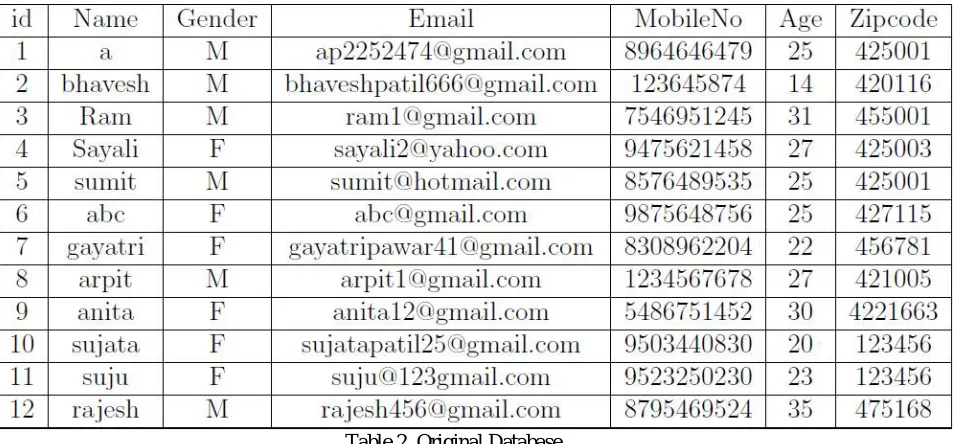
Table 2 shows Original database. The database shows all available attribute information to the user without preventing sensitive attribute.
Table.2. Original Database
Table.3. Perturbed Database
Error Rate Analysis
Following Table 3 shows error rate analysis between SAN, MN and perturbation tree method:
Table3.Error Rate Analysis
The operation was carried on data set to evaluate the proposed algorithm. Both regression and classification analysis is conducted, where the confidential attribute serves as the dependent or class variable. Dataset is randomly divided into two parts: approximately 75 percent for training, and 25 percent for testing.
V. CONCLUSIONANDFUTUREWORK
Perturbation mechanism provides the privacy preserving on sensitive data with low error rate compared with existing methods. To evaluate the mechanism, few test cases can be performed on real data for providing the protection and privacy on confidential data. The typical challenge of mining the confidential data from datasets problem solved by perturbation tree.
Future work along this direction is to study how to apply two ways perturbation method, so user can able to retrieve original values from perturbed values. Also, perturbation method can apply on character attribute values to protect sensitive attribute values.
REFERENCES
[1]Kun Liu, Hillol Kargupta, IEEE, "Random Projection Based Multiplicative Data Reconstruction for Privacy Preserving Distributed Data Mining," IEEE Trans Knowl. Data Eng, VOL. 18, NO. 1, JANUARY 2008
[2]C.C. Aggarwal and P.S. Yu, “A Condensation Approach to Privacy Preserving Data Mining,” Proc. Ninth Int’l Conf. Extending Database Technology, pp. 183-199, 2004.
[3] N.R. Adam and J.C. Wortmann, “Security-Control Methods for Statistical Databases: A Comparative Study,” ACM Computing Surveys, vol. 21, no. 4, pp. 515-556, 1989.
[4]R. Agrawal and R. Srikant, “Privacy-Preserving Data Mining,” Proc. 2000 ACM SIGMOD Int’l Conf. Management of Data, pp. 439- 450, 2000 [5] J. Domingo-Ferrer and J.M. Mateo-Sanz, “Practical Data-Oriented Micro aggregation for Statistical Disclosure Control,” IEEE Trans. Knowledge and Data Eng., vol. 14, no. 1, pp. 189-201, 2002.
[6] J. Domingo-Ferrer and V. Torra, “Ordinal, Continuous andHeterogeneous k-Anonymity through Micro aggregation,” Data Mining and Knowledge Discovery, vol. 11, no. 2, pp. 195-212, 2005.