Integrating NLP Tools in a Distributed Environment: A Case Study Chaining a
Tagger with a Dependency Parser
Francesco Rubino, Francesca Frontini, Valeria Quochi
Istituto di Linguistica Computazionale “A. Zampolli” Consiglio Nazionale delle Ricerche
Via Moruzzi, 1 - Pisa, Italy [email protected]
Abstract
The present paper tackles the issue of PoS tag conversion within the framework of a distributed web service platform for the automatic creation of language resources. PoS tagging is now considered a “solved problem”; yet, because of the differences in the tagsets, interchange of the various PoS taggers available is still hampered. In this paper we describe the implementation of a PoS-tagged-corpus converter, which is needed for chaining together in a workflow the FreeLing PoS tagger for Italian and the DESR dependency parser, given that these two tools have been developed independently. The conversion problems experienced during the implementation, related to the properties of the different tagsets and of tagset conversion in general, are discussed together with the solutions adopted. Finally, the converter is evaluated by assessing the impact of conversion on the performance of the dependency parser by comparing with the outcome of the native pipeline. From this we learn that in most cases parsing errors are due to actual tagging errors, and not to conversion itself. Besides, information on accuracy loss is an important feature in a distributed environment of (NLP) services, where users need to decide which services best suit their needs.
Keywords:PoS tag conversion, interoperability, NLP pipelines
1.
Introduction
The possibility to reuse and interoperate language resources and technologies has become a hot theme in current Lan-guage Resource Technology (LRT) research, in particu-lar in areas related to the set-up of infrastructures and distributed platforms for sharing or automatically produc-ing Language Resources (LRs) on demand, e.g. META-SHARE (Federmann et al., 2011), the UIMA1 based U-Compare platform (Kano et al., 2011), GATE (Cunningham et al., 2002), WebLicht (Hinrichs et al., 2010).
Deploying NLP and tools as web services opens up new possibilities not only within the research community, but also for commercial players. However, before such sce-nario of distributed sharing and use of tools and resources becomes a fully operational reality, there are still a number of research and technical issues to be solved.
Mostly these are related to the issue of interoperability, as in fact most of the tools and resources available are indepen-dent: developed by different groups, in different projects, for different purposes. Thus, chaining tools that were not built to work together in pipeline is still a non-trivial task. Such an attempt is made in the EU-FP7 PANACEA project2 whose main objective is to develop a Platform of ‘inter-operable services’ to be used like a factory that allows to dramatically cut the costs for the production of language resources.
This paper describes the creation of a morphosyntactic pipeline composed by chaining together the FREELING PoS tagger3(Padr´o et al., 2010) and the DESR dependency
1http://uima.apache.org 2
http://www.panacea-lr.eu 3
Freeling is actually a library of NLP functionalities. What we refer to here as PoS tagger, is in fact the output of the sentence
parser for Italian (Attardi, 2006; Attardi and Ciaramita, 2007), which were not originally meant to work together and thus have different format and tagset requirements. In-stead of modifying the tools, which may not even be always possible in a platform like PANACEA, for chaining the two tools a converter is developed.
Specifically, the paper will describe some of the conver-sion problems experienced during the implementation of a converter from the Freeling morphosyntactic output (whose tagset is claimed to be EAGLES compliant4) to the input re-quired by the DESR parser for Italian (which uses the Tanl tagset5, CoNNL format), and will assess the impact of such conversion on the performance of the syntactic parser. This is no empty exercise, but a necessary step within a more complex work flow that will allow a user to fully au-tomatically acquire a lexicon of subcategorization frames for Italian. Also, because of licensing and IPR issues, we had to look for open source or freely available tools to de-ploy within the platform.
2.
The PANACEA Platform
PANACEA is an EU-FP7 funded project with the main ob-jective of building a platform that serves as a factory of language resources. The availability of LRs is still a ma-jor bottleneck for most Language Technology applications, e.g. Machine Translation. PANACEA therefore automates the stages involved in the acquisition and production of lan-guage resources, thus helping to cut the costs and time for
splitter, tokeniser, PoS tagger and morphological analyser mod-ules, as these are the basic type of information generally needed for various more sophisticated LT tasks.
4
http://nlp.lsi.upc.edu/freeling/index.php 5
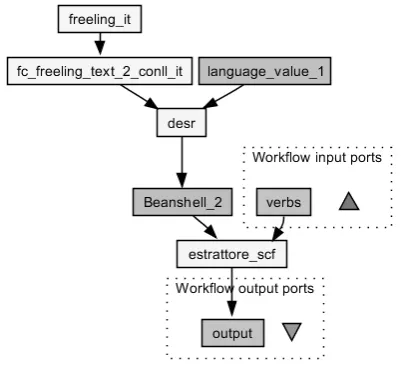
their production. Technically, the goal is to develop a plat-form of interoperable web services. One of the major is-sues that hamper interoperability is not surprisingly the dif-ferent input/outputs that the various tools require. Based on a workflow manager, the PANACEA platform allows the user to combine different LR processors, deployed as web services that may be distributed on different servers and can be used by different users from various locations. Web Service Providers (WSPs) can be institutions (univer-sities, companies, etc.) who offer services for use by a com-munity. The platform is based on a set of Bioinformatics technologies developed by myGrid6 team within the scope of e-Science: Soaplab(Senger et al., 2003), used to deploy WSs, and Taverna(Missier et al., 2010), used for design-ing and runndesign-ing workflows. Many different tools have al-ready been deployed and integrated as WSs by some WSPs: from Python tools to UIMA components (Prokopidis et al., 2011). An advantage of using workflows is that the users do not need to install the tools nor to have deep knowledge of the technical aspects involved in all the technology they need to perform a given complex task. The user instead can create a workflow focusing on high level functionalities. In the specific case of this work, we need to chain together a PoS tagger and a Dependency Parser for Italian in order to have input data for a subcategorisation frame acquisition tool (see the Taverna workflow design in Fig.1 below), yet changing or re-training already existing tools in such a sce-nario is likely not possible, without changing the existing tools themselves .
Figure 1: The Taverna Workflow
Due to practical reasons (mainly related to availability and openness), the Italian morphosyntactic pipeline for the PANACEA platform prototype was created by integrating the Freeling PoS tagger and morphological analyser and the DESR dependency parser. In the following sections we will therefore discuss issues and problems tacked in the devel-opment of the conversion service to be deployed for chain-ing these two tools.
6http://www.mygrid.org.uk
3.
PoS Tagging and Interoperability
Automatic PoS taggingper seis considered to be a “solved problem” in NLP, as demonstrated by the high level of ac-curacy of esp. statistical PoS taggers.Yet, because of the differences in the tagsets used, wider use of the various PoS taggers available (free or open and already trained) is still hampered. With respect to interoper-ability, thus PoS tagging still poses a number of problems. Disregarding theoretical issues related to lexical category attribution, which are not in focus here7, one of the most crucial issues from the practical point of view is that there is not yet a widely agreed upon common set of tags for all languages.
From the practical point of view PoS tags are often a combi-nation of information about the lexical category of the lem-mas and the morphosyntactic features of the tokens. While the tagset for main lexical categories is finite and relatively small (for instance PoS tags may distinguish between finite and non finite verbs, between main verbs, auxiliaries and modals, between numerals and other adjectives), adding morphosyntactic features results in an explosion of possible tags. For Standard Average European languages this means adding information about at least gender, number, case, tense, aspect, degree. The intersection of all these multi-ple dimensions of analysis produces tagsets which may be as large as 274 (Leech and Wilson, 1999). Fortunately, in many cases tags are compositional, so that mapping and conversion can be proceduralised (thanks to the EAGLES initiative).
4.
Converting from the Freeling to Tanl
Freeling PoS tags, in line with the EAGLES specifications (Monachini, 1996) have the form of a single positional code (e.g. VMIP3S0), where the first position of the code is al-ways the main category (verb, adjective,...), and the other positions have values that depend on and may specify the sub-category and various morphological traits (e.g. mood and tense for verbs, gender for nouns and adjectives, per-son, number, etc.).The Tanl tagset is also compliant to the EAGLES guide-lines, but does not make use of positional codes. In fact, it represents the same number and type of information, but in a tab separated form (e.g. V VAnum=s|per= 3|mod=
i|ten=p). Thus, while format conversion is simple, trans-lation of one tagset into the other requires deeper knowl-edge of the tag semantics8.
When mapping a source tagset into a target tagset four cases can take place; following Teufel (1995):
1. 1:1the source tag corresponds exactly to the target tag and only renaming is required;
2. n:1the source tagset makes finer distinctions than the target tagset, thus more than one source tags are col-lapsed into one target tag;
7see (Aarts, 2007) for an overview
8We estimate a total effort of 1 week person for developing the
Freeling+DESR % Tanl+DESR % FreelingGold+DESR % ∆1% ∆2%
Labeled attachment score 84.60 99.40 94.95 14.80 4.45
Unlabeled attachment score 88.21 99.58 97.08 11.37 2.50
Label accuracy score 89.57 99.68 96.41 10.11 3.27
Table 1: Comparison of overall performances of the Freeling+DESR, the Tanl+DESR, and the Freeling-gold+DESR pipelines against the Evalita2009 test set. In both cases Freeling refers to the data analysed with Freeling and then converted with the converter discussed here. ∆1refers to the difference between Freeling+DESR and Tanl+DESR, while∆2refers to the difference between FreelingGold+DESR and Tanl+DESR, which mostly represents loss due to conversion.
Error Rate words head err % dep err % both wrong %
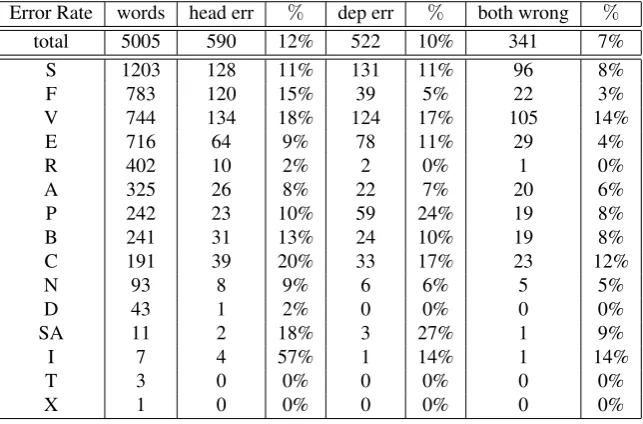
total 5005 590 12% 522 10% 341 7%
S 1203 128 11% 131 11% 96 8%
F 783 120 15% 39 5% 22 3%
V 744 134 18% 124 17% 105 14%
E 716 64 9% 78 11% 29 4%
R 402 10 2% 2 0% 1 0%
A 325 26 8% 22 7% 20 6%
P 242 23 10% 59 24% 19 8%
B 241 31 13% 24 10% 19 8%
C 191 39 20% 33 17% 23 12%
N 93 8 9% 6 6% 5 5%
D 43 1 2% 0 0% 0 0%
SA 11 2 18% 3 27% 1 9%
I 7 4 57% 1 14% 1 14%
T 3 0 0% 0 0% 0 0%
X 1 0 0% 0 0% 0 0%
Table 2: The overall error rate ofF reeling+DESRand its distribution over coarse grain PoS tags.
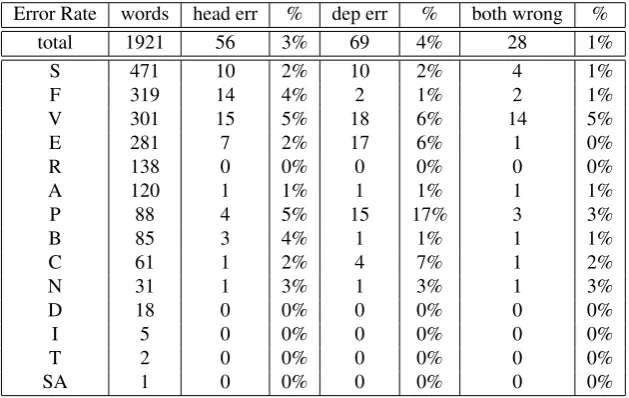
affect the outcome of attachment and labelling. Indeed, there is little evidence that, for 1 : n andn : m cases, the conversionper secauses loss of accuracy, as it seems that the DESR still manages to assign correct parse. In the following section we will discuss in more details the heuristics applied by the converter and their effect on pars-ing results.
5.1. Issues on Mapping Heuristics
Heuristics can be either lossless, i.e. when they perfectly reproduce the native Tanl tagging, or lossy, i.e. when the resulting tagging lacks some information that would have been present in the case of native tagging with Tanl. In the latter case we can also distinguish between harmless loss, when the loss of information has no impact on the subse-quent parsing, and damaging loss, when parsing is affected. In this section we discuss problematic mapping issues and the chosen solutions to them, with a special attention to the impact that these solutions have on parsing with DESR. From this assessment, we observe that the only case of loss-less heuristics is the one allowing us to split Freeling arti-cles into Tanl definite and indefinite artiarti-cles according to the lemma (an example of1:nconversion). Manual inspec-tion shows no mistagging as a consequence of this heuris-tics.
Other cases, especially those involvingn:mmapping, are more complex and heuristics can only approximate the de-sired target tagging. Finally, there are cases for which no
Error Rate words head err % dep err % both wrong %
total 1921 56 3% 69 4% 28 1%
S 471 10 2% 10 2% 4 1%
F 319 14 4% 2 1% 2 1%
V 301 15 5% 18 6% 14 5%
E 281 7 2% 17 6% 1 0%
R 138 0 0% 0 0% 0 0%
A 120 1 1% 1 1% 1 1%
P 88 4 5% 15 17% 3 3%
B 85 3 4% 1 1% 1 1%
C 61 1 2% 4 7% 1 2%
N 31 1 3% 1 3% 1 3%
D 18 0 0% 0 0% 0 0%
I 5 0 0% 0 0% 0 0%
T 2 0 0% 0 0% 0 0%
SA 1 0 0% 0 0% 0 0%
Table 3: The overall error rate ofF reelingGold+DESRand its distribution over coarse-grain PoS tags.
the parsing output from the converted PoS tagged test set, we find out that this information loss or mistagging does not result in mis-parsing. For example, in the sentence:
(2) Abbiamo offerto aiuto a tutti i serbi di Krajina
‘We offered help to all Serbians from Krajina’
the parser behaves in the same way whentuttiis recognized as a predeterminer (T) as when it is tagged as an indefinite determiner (DI) following the conversion. In both cases “a tutti i serbi” is parsed as a prepositional phrase introduced by “a”, with “serbi” as the head and “tutti” as a modifier. A similar case happens with the treatment of numbers: Freeling has a special code for numbers, that can be trans-lated into the Tanl code for cardinal numbers. Tanl, how-ever, has also a special code for ordinal numbers, which Freeling does not recognize treating them as either nouns or attributive adjectives. As in the previous case, no heuristics is attempted, and therefore ordinals will appear in the con-verted Tanl tagging as either an adjectives or nouns, with the tag for ordinals never occurring. Also in this case con-version does not affect parsing, and ordinal numbers are correctly treated as heads (when they are nouns) or modi-fiers (when adjectives) accordingly.
Another case for which we found no impact on the final parse is the interrogative pronoun heuristics. Freeling in fact does not distinguish when a pronoun is relative and when it is interrogative, and it always assigns the tag for interrogative pronouns. Tanl instead has such distinction and apparently DESR has been trained to recognise it. In order to distinguish between relative and interrogative pronouns (as in (3) and (4)) the converter checks for wh-question lemmas (“chi, cosa, quanto”15).
(3) L’immagine che hai visto
‘The picture that you saw’
(4) Gli ho chiesto chi `e venuto ‘I asked him who came’
15
These are generalisations based on most frequent cases.
This rule works for the majority of cases, but introduces er-rors in some less frequent uses ofchias a relative pronoun. E.g.:
(5) Puoi mandare chi vuoi alla conferenza.
‘You may send whoever you want to the conference’
In all inspected cases however this mis-labelling did not im-pact on the capacity of the parser to recognize the function (subject or object) of the pronoun.
Other conversion issues instead do result in mis-parsing. This is the case for example with the verbsstare(stay) and
fare(do). These verbs have two functions in Italian; one as main verbs and one as light verbs in (various) periphrastic constructions such as in (6) and (7).
(6) Giovanni sta facendo la spesa.
‘Giovanni is doing shopping (progressive construction)’
(7) Maria fa scappare il gatto.
‘Maria makes the cat run away (causative construction)’
Freeling does not disambiguate and assigns a specific code (VS and VF respectively) to all instances of the verbs. Tanl assigns V (main verb) or VA (auxiliary) accordingly to the function. It is very hard to define a rule that distinguishes them on the basis of lemma and morphology alone (without checking the context), so we chose to collapse all VSs and VFs onto Tanl main verbs. In this case all instances ofstare
andfarewith support function will be mistagged, with the consequence that the parser fails to identify the main verb as in:
(8) Marco
subj subj
sta
!main-V aux
cercando
!V-mod main-V
di
PP-prep PP-prep
dormire.
com-exercise also shows that an assessment of the impact of one tool on the performances of another, as well as the impact of conversion, constitutes useful information for potential users of such a platform, as this shall help them deciding what tools to choose (if a choice is available) for building their workflows.
As a future development the converter could be imple-mented to natively work on GrAF (Ide and Suderman, 2007), which has been chosen as the standard corpus for-mat for PANACEA and attempts to generalise the converter could be done as well.
On the evaluation side, we intend to perform other experi-ments so as to study more accurately conversion issues and the impact on the overall dependency parsing results of:1− different PoS taggers;2−different conversions strategies.
7.
Acknowledgements
This work has been funded within the EU funded FP7-ICT project PANACEA: Platform for Automatic Nor-malized Annotation and Cost-Effective Acquisition of Language Resources for Human Language Technologies (GA:248064).
8.
References
Bas Aarts. 2007. Syntactic Gradience: The Nature of Grammatical Indeterminacy. Oxford Linguistics. Ox-ford University Press.
Giuseppe Attardi and Massimiliano Ciaramita. 2007. Tree revision learning for dependency parsing. In Candace L. Sidner, Tanja Schultz, Matthew Stone, and ChengXiang Zhai, editors,HLT-NAACL, pages 388–395. The Associ-ation for ComputAssoci-ational Linguistics.
Giuseppe Attardi. 2006. Experiments with a multilan-guage non-projective dependency parser. InProceedings of the Tenth Conference on Computational Natural Lan-guage Learning (CoNLL-X), pages 166–170, New York City, June. Association for Computational Linguistics. Hamish Cunningham, Diana Maynard, Kalina Bontcheva,
and Valentin Tablan. 2002. GATE: A Framework and Graphical Development Environment for Robust NLP Tools and Applications. InProceedings of the 40th An-niversary Meeting of the Association for Computational Linguistics (ACL’02).
Christian Federmann, Byron Georgantopoulos, Ric-cardo del Gratta , Bernando Magnini, Dimitris Mavroei-dis, Stelios PiperiMavroei-dis, and Manuela Speranza. 2011. Meta-share functional and technical specification (de-liverable d7.1). Technical report, METANET, January. Dissemination Level: Restricted.
Erhard W. Hinrichs, Marie Hinrichs, and Thomas Zastrow. 2010. Weblicht: Web-based lrt services for german. In
ACL (System Demonstrations), pages 25–29. The Asso-ciation for Computer Linguistics.
Nancy Ide and Keith Suderman. 2007. GrAF: A graph-based format for linguistic annotations. In Proceed-ings of the Linguistic Annotation Workshop, pages 1–8, Prague, Czech Republic, June. Association for Compu-tational Linguistics.
Yoshinobu Kano, Makoto Miwa, K. Bretonnel Cohen, Lawrence Hunter, Sophia Ananiadou, and Jun ichi Tsu-jii. 2011. U-compare: A modular nlp workflow con-struction and evaluation system. IBM Journal of Re-search and Development, 55(3):11.
Geoffrey Leech and Andrew Wilson. 1999. Standards for tagsets. In H. van Halteren, editor,Syntactic Wordclass Tagging, number 9 in Text, speech, and language tech-nology, pages 55–80. Kluwer Academic Publishers, Dor-drecht.
Paolo Missier, Stian Soiland-Reyes, Stuart Owen, Wei Tan, Aleksandra Nenadic, Ian Dunlop, Alan Williams, Thomas Oinn, and Carole Goble. 2010. Taverna, reloaded. In M. Gertz, T. Hey, and B. Ludaescher, ed-itors,SSDBM 2010, Heidelberg, Germany, June. Monica Monachini. 1996. Elm-it: Eagles specifications
for italian morphosyntax lexicon specification and clas-sification guidelines. Technical report, Paris, France, France.
Llu´ıs Padr´o, Miquel Collado, Samuel Reese, Marina Lloberes, and Irene Castell`an. 2010. Freeling 2.1: Five years of open-source language processing tools. In Nicoletta Calzolari (Conference Chair), Khalid Choukri, Bente Maegaard, Joseph Mariani, Jan Odijk, Stelios Piperidis, Mike Rosner, and Daniel Tapias, editors, Pro-ceedings of the Seventh conference on International Lan-guage Resources and Evaluation (LREC’10), Valletta, Malta, may. European Language Resources Association (ELRA).
Prokopis Prokopidis, Byron Geograntopoulos, and Haris Papageorgiou. 2011. A suite of nlp tools for greek. In Proceedings of the 10th International Conference of Greek Linguistics, Komotini, Greece.
Martin Senger, Peter Rice, and Thomas Oinn. 2003. Soaplab - a unified sesame door to analysis tools. InAll Hands Meeting, September.