Cloud based IOT : Architecture, Application, Challenges and
Future
Zeba Qureshi, Nupur Agrawal, Deepika Chouhan
Department of Computer Science & Engineering, AITR/RGPV, Indore, Madhya Pradesh, India
ABSTRACT
Internet of Things (IoT) is the trending Internet based revolution, which has come to limelight in the recent years. IOT consists of multiple physical objects that can be easily accessed with the help of internet. It provides the flexibility of accessing billions of devices that are connected with each other and can communicate in order to share information. IOT can improve the quality of our daily life by making our daily tasks easy. On the other hand, Cloud Computing is a paradigm that provides on-demand delivery of IT resources over the internet. Both cloud computing and IOT together can be beneficial for us. The IoT has issues such as limited capabilities in terms of processing power, storage, performance, security and reliability. The integration of the IoT with Cloud Computing is the best way to overcome most of these issues. In addition, the Cloud can be benefited from the IoT by breaking the stereotype and dealing with real world objects in a more dynamic and distributed way, and providing new services for billions of devices in different conditions. However, this integration can resolve many issues but there are many issues in the integration of Cloud and IoT. This paper provides an overview of the integration of the Cloud Computing with IoT by highlighting the benefits of integration and implementation challenges that may occur. In this paper we will also discuss the architecture of the new integrated Cloud-based IoT paradigm and the areas of applications.
Keywords : Cloud Computing, Internet of Things, Cloud based IoT, Integration of cloud computing and IoT, Benefits of Cloud based IoT, Challenges in Cloud based IoT
I.
INTRODUCTIONToday's growing world needs to procure the common features of the growing technologies to make computing fast and easier. This is the case with IoT and cloud computing which dispenses many common features and their integration may leads us towards new frameworks. The integration of these fundamental technologies gives us a complete new platform with the features such as reusability, scalability, modularity, flexibility and availability.
Cloud computing reorient the technology to a new level by providing a complete new way to manage,
access and deliver the IT resources [1]. Cloud computing and IoT both serve as an efficiency booster for the technological growth but still share complementary relationship with each other. This integration of technology will encompass a new framework for virtualization, networking, computing and utility servicing [2], [3].Cloud Computing is basically a platform which makes virtualization at different levels in the internet.
be static or dynamic [4]. On the other hand, the IoT can be considered both a dynamic and global networked infrastructure that enhance customer engagement, reduce waste and provide technical optimization.
IoT provides a way of self-organization and automation. The IoT provides us an interface where every object is connected to the internet [5]. IoT involves the large number of objects dealing with the internet with minimum storage and computing capabilities. IoT give rise to big data over the internet through its responses. This data can be operated by the cloud computing to do analytics over that for the future enhancement of the object and their relationship with other objects. Cloud Computing is having highly interoperable in nature while IoT is having of diversified nature [6].
This paper agenda is to analyse the benefits and challenges in the integration of both the technologies.
II.
BASIC CONCEPTSThis section reviews the basic concepts of Cloud Computing, the IoT, and Cloud-based IoT.
A. Cloud Computing
Cloud Computing is an IT paradigm that provides a robust and flexible environment for computation by providing the IT resources to the end users. Though there are many definition for Cloud computing, the one that is widely preferred is the one proposed by the National Institute of Standards and Technology (NIST). The NIST has defined Cloud computing as "a model for enabling ubiquitous, convenient, on-demand network access to a shared pool of configurable computing resources (e.g., networks, servers, storage, applications, and services) that can be rapidly provisioned and released with minimal
management effort or service provider interaction" [7].
According to this definition, Cloud computing comprises of four types of deployment models that are public, private, community and hybrid. There are three different service models which are named as IAAS, PAAS and SAAS..
The public Cloud computing deployment models is the most commonly used and here the resources are delivered to the end users over the Internet. Here the resources are publically available to the consumer. Amazon is the one of the leading public cloud service provider [8]. On the contrary, the private Cloud is commonly provided by a single organization to serve some specific purposes of its users. Microsoft has a big name among various Private Cloud service providers. Hybrid Cloud, as the name suggests is the combination of private and public Clouds. This gives users flexibility of choosing public and private cloud services as per their needs [9]. The community Cloud is a Cloud infrastructure where the IT resources are delivered to a group of users/ organizations that share the same needs [10].
There are 3 different service models provided by cloud computing. The first one is known as Software as a Service (SaaS) model, in which software is provided to the users via Internet (e.g. Google Apps). Next service model is Platform as a Service (PaaS) model, in which a platform to build, test and deploy a software is provided to the users via internet. (E.g. Microsoft Azure) [11]. The Last one is Infrastructure as a Service (IaaS) model, in which the infrastructure such as storage, hardware and servers are provided as a service (e.g. Amazon Web Services).
B. Internet of Things
devices. In fact Iot can be defined as a large network of connected devices and people where they share data about environment and how they are used [12]. The IoT is a modern approach that includes billions of objects that can be anything like smart microwaves, self-driving cars, fitness devices etc. All things like smart devices, sensors, etc in the IoT have their own identity and are combined to form the communication network. These objects may be anything like electronic devices, food, clothing, materials, parts, commodities and luxury items; monuments and landmarks; people , animals etc. These objects are monitored and tracked and they able to create requests and can also alter their states.
The concept of the IoT was introduced by Kevin Ashton in 1999, where he stated “The Internet of Things has the potential to change the world, just as the Internet did. Maybe even more so”. Later, the IoT was formally presented by the International Telecommunication Union (ITU) in 2005 [13]. There are many definitions of the IoT that have been put forth by different researchers and organisations. According to the ITU, the IoT is “a global infrastructure for the Information Society, enabling advanced services by interconnecting (physical and virtual) things based on, existing and evolving, interoperable information and communication technologies” [14].
C. Integration of Iot with Cloud Computing
The IoT and Cloud computing are both different technologies and have independent evolution. Both of these concepts have complementary characteristics and these contrasting characteristics have motivated a number of researchers to experiment with the integration of these two technologies. Iot can be benefited from the unlimited resource capabilities of Cloud such as processing, storage and communication. On the other hand Cloud can also be benefitted from iot in terms of rapidly developing services, and have their own unique characteristics. On the one hand,
the IoT can benefit Cloud in term sof dealing with real world objects in a dynamic and distributed way. Though IoT has widely-distributed devices but it has limited processing and storage capabilities. The devices in IoT face issues such as performance, reliability, privacy, and security. On the other hand, Cloud computing has a massive network with unlimited storage and computation power. Also, it provides a flexible and robust environment which allows for dynamic data integration from various data sources. Cloud computing and IoT can together resolve issues of each other and can open up new directions for business and research.
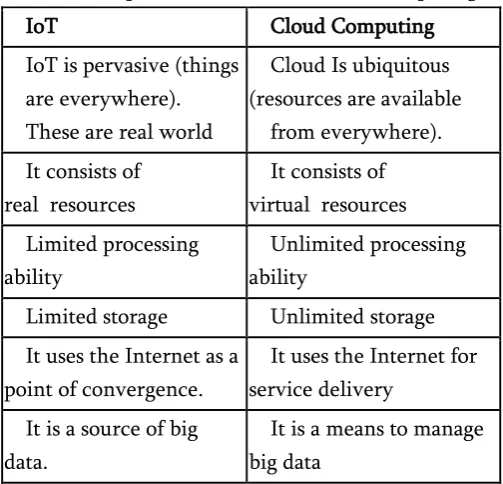
D. Comparison of Iot with Cloud Computing
Table 1. Comparison of Iot With Cloud Computing
IoT Cloud Computing
III.
BENEFITS OF INTEGRATING IOT WITH CLOUDCommunication: These two paradigm work on the principle of resource sharing thus they provide us a common platform to communicate between different components.
computing introduced an economic way to manage this information effectively by storing , processing and accessing that data.
Processing: As the communication goes with heterogeneous devices they will induce heterogeneous collection of data , to convert that data into information integration impart high processing capabilities. As IoT is engaged with complex processing system, to resolve these issues cloud computing provide virtualized processing.
Dynamic Infrastructure Support: IoT connect everything with internet thus, it require various devices to work at variable instance, which leads to variable component configuration with the demands of various processing operations.
Scalability: With Cloud Computing system scalability is increased with the increase in the requirement of infrastructure.
Flexibility: Integration of both the paradigms will result into a flexible environment for the system.
Security: With the growth of number of components or device security of device and data is at high risk. To make these components or data secure we deploy security features in Cloud based IOT model.
IV.
CLOUD-BASED IOT APPLICATIONSThere are various applications of Cloud Based IoT. Some of the applications are listed below:
Smart Cities: There are many IoT applications deployed in a city for the efficient management of city. The applications like water management, energy management, transport management etc are all required for a smart city. These applications consists of multiple devices, computational components and sensors which altogether generate a huge amount of data. Cloud integration with IoT enables the cities to host these applications easily and in cost effective manner. With cloud computing we can easily scale the computational resources as per the needs.
Smart Homes: By embedding Cloud based IoT devices in homes we can automate a number of home activities. Use of smart appliances such as smart microwave, intelligent AC or other devices that are intelligent and are self configuring can change the homes into smart homes. With proper IoT Cloud integration a better and comfortable living environment can be set up for the occupants of the home.
Healthcare: Smart Healthcare applications can ease a patient’s life as it decreases the dependency of patient on the health care takers. The smart phones are equipped with sensors that can help people monitor their blood pressure, pulse, stress levels etc. The data generated by theses applications can be stored on the cloud and can help patients monitor their health in a better way. The hospitals can also uses special sensors for infants or critical patients in ICU and ambulance which can monitor their health continuously and can generate an alert message in case of emergency (i.e when the patient crosses their threshold level in heart rate, BP, temperature etc.
Intelligent business services : The organizations can transform the way they do business by integrating the cloud with IoT. The smart devices can be connected with each other via the IoT (Internet of Things) to create innovative business models. These connected devices generate large amount of data which further leads to the rise of new cloud services. This Cloud based IoT ecosystem will impact consumers and businesses and make business easy.
Intelligent Transportation : Intelligent transportation can bring comfort to people who travels around. The vehicles can be made smart if they are equipped with multiple sensors that can monitor the status of the vehicle and the environment. The data that is produced can be collected and uploaded to the IoT cloud. This Cloud based IOT can maintain records of real-time data and can process that data to assist the driver and make driving easy and comfortable. With the help of intelligent transport system driver can receive emergency warnings and look for shortest routes. Such applications can also provide data about traffic conditions or accident. The IoT cloud can also alert drivers of accident prone areas.
Figure 1: Applications of Cloud based IOT
V.
CHALLENGES FACING CLOUD-BASED IOT INTEGRATIONThe integration of these two paradigms endures some challenges which are as follows:
Security and Privacy: The real data that is imported over the cloud to work efficiently is to be secured and for the same some policies have to be designed and implemented. There exist some issues related to security such as authorisation rules and policies for ensuring access to the sensitive data which have not been resolved. When critical IoT applications with
sensitive data are moved to the cloud, there arise some problems such as lack of trust in the service provider, information regarding service level agreements (SLAs), and the actual location of data[15].
Sensitive information leakage can occur due to multi-tenancy. Public key cryptography cannot be applied to all layers because of the processing power constraints imposed by IoT object. They also require some specific attention if we are working on distributed system.They are exposed to a number of possible attacks such as SQL injection methods, session riding, cross site scripting, session hijacking and problem related to virtualization.
Heterogeneity :The important challenge that can be faced by the Cloud based IOT approach is the substantial heterogeneity of platforms, services, devices and operating systems which can be used for the development of new applications. The heterogeneity is the issue from which the cloud platform is suffering now-a-days. Based on specific providers the cloud services mostly have proprietary interfaces which allows resource integration. When multi-cloud approach is adopted by the end-user then the heterogeneity issue is exacerbated. The application resilience and performance can be improved when multiple providers are used to provide the services.
integrity is crucial element which provides the service quality as well as de the privacy and security to the data.
Performance :High bandwidth is required to transfer the large amount of data created by IOT devices to cloud environment. The key problem is to obtain appropriate network performance so that data is transferred to the cloud environment; truly this is because growth of broadband is not keeping pace with computation and storage evolution. In many scenarios, data and services provision must be achieved with high reactivity. This is because agenda might be affected by real-time applications and unpredictable matters are very sensitive to performance efficiency.
Legal aspects :In recent research, legal aspects have been considered significant in certain applications. There are various international regulations which have adopted for instance service providers. In order to contribute to data collection users must fulfill the legal criteria.
Monitoring :It is the primary operation in cloud computing when it comes to managing, performance, resources, security, capacity planning, SLA and troubleshooting. As an outcome, cloud-based IOT approach demands monitoring from cloud, while there are many related challenges which are impacted by volume, variety and velocity characteristics of IOT [16].
Large scale :The main aim of Cloud based IOT model is to analyze and integrate data coming from the various places (i.e. real world) into IOT objects. The cloud-based IOT paradigms make it possible to design this type of application. The cloud interact with many devices that are distributed across the large area. There are many issues which are raised by the resulting system on the large scale that are difficult to overcome. For instance, it is difficult to achieve the storage capacity and computational capability requirements. The monitoring process of the IOT
devices is becoming difficult in case of distributed environment because the IOT devices are facing latency and connectivity issue.
Cloud- based IOT solution for reference architecture: As described earlier, the existing solutions rely upon the concurrence of IOT and cloud computing are considerably different from each other. This consequence is due to the lack of normalized means for supporting the scheme of these solutions, which result in increase of complexity and significant efforts are required from developer and architects.
Efficient use of cloud resources by IoT devices/applications: The significant amount of network, storage resources and processing will be required when large amount of IOT devices connected to the internet will send and receive data on cloud that is to be processed. The IOT devices will generate huge amount of data and if that data is send to the cloud then network congestion will occur due to massive data streams that is transmitted across the wide area network. The applications which are having the real-time, their communication latency will be intolerable. The current platform of cloud seems prepared to provide as many resources as required but the exhaustive use of these resources can bring expensive monetary costs. It is required to propose the strategies that can minimize the amount of resources that the IOT-based application are using and also decide where the data should be processed that are generated by IOT devices in the efficient way. The strategies proposed by different studies concerning the concept of Fog computing, that extends the cloud computing to the boundary of network that provides storage, processing and networking services in between the cloud platform and devices.
to match the current needs, thus minimizing unnecessary costs and underutilization of resources. Despite being one of the fundamental benefits of Cloud Computing, elasticity has not yet received enough attention in Cloud based IOT paradigm. Due to this the IOT infrastructure cannot take the benefit of elasticity that is provide by cloud computing. Therefore it is required for new approaches to inherent and incorporate elasticity concerns in cloud-based IoT systems.
Dependability concerns: The cloud and IOT environments are extremely dynamic. The unavailability of IOT devices are due to diverse reasons like battery depletion, failure, user mobility, lack of network connectivity etc. The cloud environment experiences particular situation like quality degradation or unavailability of services that are used by various applications. In many cases, it is necessary to provide the application that can adapt the minimal runtime or no disruption, which ensures the responses to various events at runtime along with the satisfaction of non- functional requirement like quality and availability. However, dependability is important for critical-safety of application that as quality or failure degradation which lead to threat to people or economic loss and even physical damage, this requirement is not addressed by any primary study.
VI.
CLOUD BASED IOT MODELCloud based IoT Architectures
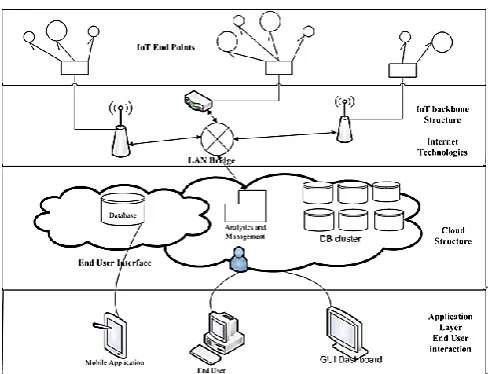
As per studies many architectures for the integration between IoT and Cloud Computing have been proposed. All these architectures have focussed on sharing of data and providing monitoring and actuation capabilities by using the cloud services. Though the proposed architectures differ from each other but some similarities have been noted among them. Some of the common elements in different architectures are as follows: (i) Sensors that are responsible for gathering information from things (
people, animals, environment, devices etc). This data collected from different things is to be made available on the cloud; (ii) Software components of the clouds which are responsible for processing information obtained that is obtained from the IoT devices; and (iii) Network components through which transmission of data takes place.
Device drivers or some smart gateways are required for the communication between devices and these software components[17].
Cloud based IoT Platforms
Like architectures, differents platforms for the integration of the IoT and Cloud Computing paradigms have been proposed. These platforms are necessary to allow integrating, managing, and monitoring IoT devices at real-time through browsers or mobile devices. The resources that are required can be taken from the cloud as per demand and pay as you go model. The platforms support the development of applications using IoT devices by providing APIs for data storage, data retrieval and analysis, and deployment and execution of applications. Besides this the platforms can also provide support for the orchestration of devices and sharing of virtualized IoT devices. The arrangement of devices can be achieved with the help of a dashboard where users can specify a profile to describe the sequence of high-level tasks that must be performed by the integrated devices to perform a given activity.
Cloud based IoT Frameworks.
virtualization to encapsulate and access IoT resources. One of the examples of these frameworks that support the development of applications based on both IoT and cloud is PatRICIA. The PatRICIA framework benefits the developers by providing a programming model where developers can develop the applications without bothering about the complexity of low level device services and raw data streams from the sensors. This framework has defined high-level constructs and operators to ease the development of applications. The operators of PatRICIA framework are: (i) send, for communicating with devices; (ii) notify, for subscribing to and receiving information about events; (iii) poll, for synchronization; and (iv) delimit, which refers to tasks to be performed under satisfaction of certain conditions.
Cloud based IoT Middleware.
Some studies have proposed use of a middleware layer for integrating IoT and Cloud Computing. This middleware layer can help to address important concerns such as: (i) abstractions to virtualize devices, i.e., the low level details of protocols and data formats are hided and only important information is represented; (ii) abstractions to uniquely identify devices; (iii) communication based on the publish-subscribe model [28] where the applications show interest in some specific information and when such an information is updated the applications are immediately notified. This helps in monitoring real time information obtained by sensors (iv) to enable applications to access resources standardized interfaces are provided; (v) security mechanisms to ensure the integrity and privacy of information; (vi) services that help in controlling and managing devices and discovery services that are required to identify new IoT devices. The studies that proposed Cloud Based IoT have particularly targeted few domains , among which smart city domain is mainly talked about [18]. In a study, a middleware called as ClouT is discussed that provides services such as
device discovery, metadata storage and retrieval, and analysis and extraction of data stored on the cloud for identifying events that occur in the city. This middleware is capable of discovering sensors and supports large data processing in the cloud infrastructure.
Figure 2 : Architecture of Cloud based IOT
VII. CONCLUSION
The IoT is the trending computing service and it requires large volumes of data and processing capabilities. However, IoT has limited storage and processing capabilities along with other challenges such as security, privacy, performance, and reliability. Therefore, the integration of the Cloud and IoT is essential and very beneficial to overcome these challenges. In this paper, we have discussed about the integration of IOT and Cloud Computing. We have also discussed the benefits and challenges of Cloud based IOT and the areas of applications. This survey paper has focused on all the aspects of Cloud based IOT including its architecture, platform, middleware etc along with the new research directions in this domain.
VII.
FUTURE SCOPEand which still require more research efforts. These issues include:
Standardization: The Cloud based Iot paradigm lacks standardization. Although some researchers have suggested some standards but to allow interconnection between heterogeneous devices and to generate new services certain architectures, standard protocols, and APIs are required.
Fog Computing: Fog computing is a new model which extends Cloud computing services to the edge of the network. Fog computing is also known as fog networking or fogging. It is a decentralized computing infrastructure where data, computing resources, storage and applications are distributed. Fog computing is basically an extension of Cloud Computing and it acts as an intermediate between the edge of the network and the Cloud. Both Fog and Cloud computing provides storage, computing, and networking capabilities. Fog computing has some specific features such as location awareness and edge location, that provide geographical distribution and low latency. Moreover, in contrast to Cloud Computing, Fog Computing has larger number of nodes that supports real-time interaction and mobility.
Cloud Capabilities: In a distributed environment like Cloud, based IOT security is one of the main issues. There are more chances of attacks in Cloud based IOT paradigm as the attack can be on any side, IOT or Cloud. In the context of IOT, encryption can help to achieve data integrity, confidentiality and authenticity. However, it is difficult to resolve the insider attacks and it is hard to use the IoT on devices with limited capabilities.
VIII.
REFERENCES
[1]. R Buyya, C. Shin, S. Venugopal, J. Broberg, and I. Brandic, "Cloud computing and emerging IT platforms_: Vision , hype , and reality for
delivering computing as the 5th utility," Futur. Gener. Comput. Syst., 2009, pp. 599-616. [2]. M Armbrust, A. Fox, R. Griffith, A. D. Joseph,
R. Katz, A. Konwinski, G. Lee, D. Patterson, A. Rabkin, and I. Stoica, "A View of Cloud Computing," Commun. ACM, vol. 53, no. 4, 2010, pp. 50-58.
[3]. K Gai, "Towards Cloud Computing: A Literature Review on Cloud Computing and its Development Trends," 2012 Fourth Int. Conf. Multimed. Inf. Netw. Secur., 2012, pp. 142-146. [4]. S Zhang, S. F. Zhang, X. B. Chen, and X. Z. Huo, "Cloud Computing Research and Development Trend," In Proceedings of the 2010 Second International Conference on Future Networks (ICFN '10). IEEE Computer Society, Washington, DC, USA, pp. 93-97. DOI=10.1109/ICFN.2010. 58.
[5]. K Ashton, "That 'Internet of Things Thing," RFiD J., 2009, pp. 49-86.
[6]. A Botta, W. de Donato, V. Persico and A. Pescap, "On the Integration of Cloud Computing and Internet of Things," 2014 International Conference on Future Internet of Things and Cloud, Barcelona, 2014, pp. 23-30. [7]. B B. P. Rao, P. Saluia, N. Sharma, A. Mittal and
S. V. Sharma, "Cloud computing for Internet of Things & sensing based applications," 2012 Sixth International Conference on Sensing Technology (ICST), Kolkata, 2012, pp. 374-380. [8]. J Zhou et al., "CloudThings: A common
architecture for integrating the Internet of Things with Cloud Computing," Proceedings of the 2013 IEEE 17th International Conference on Computer Supported Cooperative Work in Design (CSCWD), 2013, pp. 651-657.
[10]. Daz, Manuel, Cristian Martn, and Bartolom Rubio. "State-of-the-art, challenges, and open issues in the integration of Internet of things and cloud computing." Journal of Network and Computer Applications, 2016, pp. 99-117. [11]. J. Zhou, Z. Cao, X. Dong, and A. V Vasilakos,
"Security and Privacy for Cloud-Based IoT: Challenges , Countermeasures , and Future Directions," no. January, 2017, pp. 26-33. [12]. R. Shanbhag and R. Shankarmani,
"Architecture for Internet of Things to minimize human intervention," 2015 Int. Conf. Adv. Comput. Commun. Informatics, 2015, pp. 2348-2353.
[13]. ITU, "The Internet of Things," Itu Internet Rep., 2005, pp. 114-137.
[14]. ITU, "Overview of the Internet of things", 2012, pp. 22-40.
[15]. A. Alenezi, N. H. N. Zulkipli, H. F. Atlam, R. J. Walters, and G. B. Wills, "The Impact of Cloud Forensic Readiness on Security," in 7st International Conference on Cloud Computing and Services Science, 2017, pp. 1-8.
[16]. H. F. Atlam, A. Alenezi, R. J. Walters, and G. B. Wills, "An Overview of Risk Estimation Techniques in Risk-based Access Control for the Internet of Things," in 2nd International Conference on Internet of Things, Big Data and Security, 2017, pp. 1-8.
[17]. J. Zhou et al., "CloudThings: A common architecture for integrating the Internet of Things with Cloud Computing," Proceedings of the 2013 IEEE 17th International Conference on Computer Supported Cooperative Work in Design (CSCWD), 2013, pp. 651-657.