WikiNet: A Very Large Scale Multi-Lingual Concept Network
Vivi Nastase
1, Michael Strube
1, Benjamin B¨orschinger
1,2, C¨acilia Zirn
1,2, Anas Elghafari
1,31HITS gGmbH, Heidelberg, Germany
2Department of Computational Linguistics, University of Heidelberg, Heidelberg, Germany 3Department of Linguistics, University of T¨ubingen, T¨ubingen, Germany
Abstract
This paper describes a multi-lingual concept network obtained automatically by mining for concepts and relations and exploiting a variety of sources of knowledge from Wikipedia. Concepts and their lexicalizations are extracted from Wikipedia pages. Relations are extracted from the category and page network, infoboxes and the body of the articles. The network consists of a central, language independent list of concepts (keeping track of their lexicalizations in various languages), interconnected with a variety of relations to form a very large scale multi-lingual concept network.
1.
Introduction
Machine readable knowledge is crucial for realistic, ro-bust applications such as translation, question answering, summarization. Acquiring such knowledge has, until re-cently, been done manually. Early expert systems fo-cused on small and simplified domains, in the hope that the knowledge from such constrained worlds can be easily captured. Two projects were more ambitious: Cyc aimed at encoding (all) common sense knowledge (Lenat et al., 1990); WordNet (Fellbaum, 1998) organized the words in the English language according to their meanings, and us-ing a selection of relations – such as synonymy, hyper-nymy/hyponymy, meronymy/holonymy, antonymy, deriva-tional. WordNet was extremely successful, in that it was widely adopted to support numerous language processing tasks. The Open Mind Common Sense (Singh, 2002) and MindPixel projects had the ground-breaking idea of using distributed human computation – in the form of collabo-rative endeavours – to gather large repositories of com-mon sense and general knowledge from willing contribu-tors over the web. Splitting the enormous task of gathering knowledge over a large base of contributors had the poten-tial to break the knowledge acquisition bottleneck. These approaches were not widely adopted, and ended short of their stated goals. Acquiring knowledge from unrestricted texts is currently a very active research area. The prob-lem is that while millions of facts can be fast extracted from texts, there are issues related to noise, and – probably most importantly – the large collections built will consist of isolated/loosely-connected facts.
The answer to our knowledge acquisition desires is con-sidered nowadays Wikipedia. Shortly after its launch in January 2001, it has become apparent to researchers in our field that it has huge potential as a vast, multi-lingual source of knowledge. The collaborative nature of the Wikipedia project ensures a wide base of contributors. Its simple edit-ing process and guidelines have led to its steady growth and semi-structured, high quality content.
In this paper we introduce a very large scale, multi-lingual concept network, obtained by exploiting several facets of Wikipedia. The resource consists of a
language-independent concept base extracted from Wikipedia articles and categories, and relations between them. The articles and categories stand for concepts (as commonly done, see (Medelyan et al., 2009)). The cross-language links give lex-icalization options in various languages. Relations between concepts are extracted from the article bodies, infoboxes, categories and the category network. This organization of the resource – an index of concepts and their lexicaliza-tions plus a large repository of relalexicaliza-tions – mirrors Word-Net, which has been intensely used for almost two decades, and with which the NLP community is very much accus-tomed. We intend WikiNet to supplement WordNet, and provide from the start a multi-lingual resource, with mil-lions of named entities (which were outside the scope of WordNet) and numerous relations.
An advantage of such a resource is that it can be used for multiple languages even when it is obtained from only one language version (English), through the multi-lingual index of concepts. The algorithms to build this resource can be applied to the latest Wikipedia versions, and thus obtain an up-to-date resource.
2.
Related Work
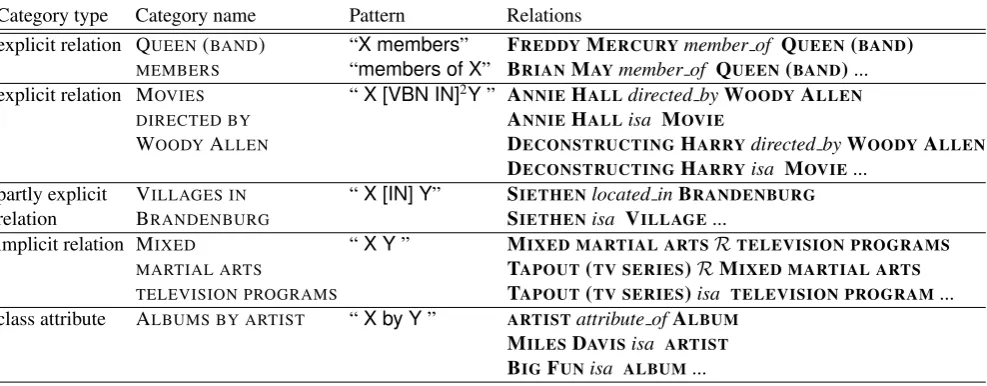
Category type Category name Pattern Relations
explicit relation QUEEN(BAND) “X members” FREDDYMERCURYmember of QUEEN(BAND)
MEMBERS “members of X” BRIANMAYmember of QUEEN(BAND)... explicit relation MOVIES “X [VBN IN]2Y” ANNIEHALLdirected byWOODYALLEN
DIRECTED BY ANNIEHALLisa MOVIE
WOODYALLEN DECONSTRUCTINGHARRYdirected byWOODYALLEN DECONSTRUCTINGHARRYisa MOVIE...
partly explicit VILLAGES IN “X [IN] Y” SIETHENlocated inBRANDENBURG
relation BRANDENBURG SIETHENisa VILLAGE...
implicit relation MIXED “X Y” MIXED MARTIAL ARTSRTELEVISION PROGRAMS MARTIAL ARTS TAPOUT(TV SERIES)RMIXED MARTIAL ARTS TELEVISION PROGRAMS TAPOUT(TV SERIES)isa TELEVISION PROGRAM... class attribute ALBUMS BY ARTIST “X by Y” ARTISTattribute ofALBUM
MILESDAVISisa ARTIST BIGFUNisa ALBUM...
Table 1: Examples of information encoded in category names and the knowledge we extract
serve a purely organizational purpose: e.g. NOVELS BY PHILIP K. DICK, NOVELS BY AUTHORwhich cluster to-gether pages describing concepts with specific properties. Such categories can be deconstructed, to recover the knowl-edge encoded in them (Nastase and Strube, 2008). In brief, five types of categories can be deconstructed to obtain var-ious relations, as presented in Table 1.
These relations are induced following the processing steps, for each categoryCatin the English version of Wikipedia3:
1. determine the constituentsCiof the phraseCatfrom
a syntactic parse ofCat– they will correspond to the (non-overlapping) noun phrases in the parse;
2. determine the dominant constituentCD(it is the one
that has the same syntactic head asCat).
3. form pairs (Ci, CD) for all constituents Ci of Cat
(Ci6=CDand determine the relationCiRCDbased
on matchingCatto the patterns identified and shown in Table 1;
4. for each pagePj subsumed byCat, and all pairs (Ci,
CD):
• add relationsPjRCi.
• add relationsPjisa CD;
Propagating the relationRfrom the category constituents to the pages follows the rule:
ifPjisa CiandCiRCD=⇒PjRCD,
in a way similar to propagating an explicit relation found within a category name, as illustrated in Table 1.
Finding the relation between one pair, (Ci,CD) means
au-tomatically finding the relation between numerous (Pj,CD)
and (Pj,Ci) pairs.
2
“VBN” is the part of speech for participles and “IN” is the part of speech for prepositions in the Penn Treebank set (Santorini, 1990). We delimit POS patterns with square brackets.
3
We use Sans Seriffor patterns and words, italicsfor re-lations, SMALL CAPS for Wikipedia categories and pages, and
BOLDSMALLCAPSfor concepts.
One processing problem that needed to be addressed at this step is finding the concepts corresponding to category con-stituents, such that the relations induced can be mapped onto relations between concepts. To solve this we use the category network, and choose the closest category or article for a constituent derived from a deconstructed category.
3.2.2. Infobox relations
Infoboxes are another source of user structured knowledge. Based on the network built until this point – consisting of the existing category and article network, enhanced with the relations discovered in the previous step – we propagate infobox relations, based on the following observation: re-lations in infoboxes are often important enough and shared by enough entities that Wikipedia contributors use them for categorization. For example: the place of origin for arti-facts is often included in the article’s infobox, if it has one, and is also used in categorization. Katyusha, a weapon, has as place of origin Soviet Union(in its infobox), and is also categorized underMilitary equipment of the Soviet Union, together with several other entities, not all of which have an infobox. The category was used in the previous step (deconstructing categories) to determine that there is a relation between each article under this category and the conceptsMilitary equipmentandSoviet Union. The exist-ing infoboxes help determine that the relation between the articles and Soviet Unionis place-of-origin, as illustrated in Figure 1. This step of propagating information from in-foboxes using the categories will determine (name) some of the anonymous or very general relations established in the previous step.
To establish the link between category names and relations in infoboxes and spread this information through the net-work, we apply the following steps for each category CAT:
1. Gather the information about CAT
• establish the constituents of CAT(as obtained during the category deconstruction process). To simplify the argument let us assume that CAThas two constituents,
2S19 Msta ... Katyusha BM 14
TOS 1 IS_A
Military Equipment Soviet Union Military Equipment of the Soviet Union
R R
R
Figure 1: Some articles under a Wikipedia category contain infoboxes with hand-picked relations. From these we can determine the relation that holds between the corresponding concept and the concepts derived from its parent category, and then propagate these relations in the network.
constituents(CAT, Cx). constituents(CAT, CY).
• gather the pagesPisubsumed by CAT:
PCat={Pi|subsumes(CAT, Pi)}
2. Extract the relations from the pages that have in-foboxes From the pagesPi subsumed by CAT that
con-tain an infobox we extract the tuples:
inf oboxRel(Pi, Rj, Vj).
whereRjis an attribute with valueVjinPi’s infobox.
3. Extract candidates for the relation betweenCXand
CY We say that a relationRjfrom the infobox for a page
P is a candidate relation for a category CAT with con-stituents (CX,CY), if it is associated with the same value
V in all infoboxes in which it appears underC, andV is compatible withCY. Two values are compatible if they are
identical, paraphrases of each other, or are connected in a systematic way –V is a specialized concept ofCY, or for
locations for exampleV part-ofCY (a specific location in
Europe is compatible with EUROPE). This predicate can become more specialized as more relations are added to the fact base. Formally:
candidate(Rj,CAT)←
constituent(CAT, CY)
subsumes(CAT, P)
inf oboxRel(P, Rj, V)
∧(6 ∃Vk,
subsumes(CAT, Pi)
∧inf oboxRel(Pi, Rj, Vk)
∧V 6=Vk)
∧ is compatible(V, CY))
To simplify the process we useV =CY.
The set of candidate relations is:
RCat={Rj|candidate(Rj,CAT)}
4. Choose the relation and propagate it in the network
If there is only one candidate relation (|RCat|= 1), we
pro-pose that this relation (let us call itR0) replaces the
(pos-sibly underspecified) relationRdetermined in the category deconstruction process to hold betweenCX andCY. The
triples (PiRCY) added during the category deconstruction
phase will be replaced by (PiR0CY).
If there is more than one relation, but they are compatible (e.g. birth place,place of birth), we choose one to beR0,
and replace all extracted relations just as above. If the rela-tions extracted are not compatible (or we cannot establish that they are compatible), no further processing takes place, and the originally proposedRremains. At this point com-patibility is established through lexical overlap.
The higher up in the hierarchy, the more pages a category subsumes, and the more heterogeneous the category is. Be-cause of this it is easy to introduce noise, by inducing re-lations that apply only to a small subset of the subsumed pages. Also, processing a heterogeneous category may pre-vent the method from finding one relation that applies to all pages, as there may be several possible. For example, the category PEOPLE FROM CHICAGO, ILLINOIS subsumes pagesPHILIP K. DICK, whose relation withCHICAGO, ILLINOIS isborn-in, and SAUL BELLOW, wholived-in
CHICAGO, ILLINOISbut was not born there. To address this situation, for a category CAT we seek relation candi-dates and propagate them within smaller and more homo-geneous sets of pages, as given by specialized subcategories of CAT, following the same processing steps. The process of propagation is illustrated in Figure 1.
At this point, not all relations from the infobox are included in the resource. The reason is that numerous values of the attributes/relations included in the infobox are not concepts themselves (e.g. surface area and population for a coun-try). Such relations will be included in future versions of the resource, possibly as separate files.
3.2.3. Relations from the article bodies
One of the most obvious sources of additional information from the article bodies are the hyperlinks. They (seem to) highlight concepts that are relevant or related to the concept being described. Milne and Witten (2008a) extracted these concept relations and have shown they can be successfully used for computing semantic relatedness.
A closer inspection shows that this is not necessarily the case, or rather, relations tend to be more distant. For exam-ple, the following sentence is from the article onChocolate:
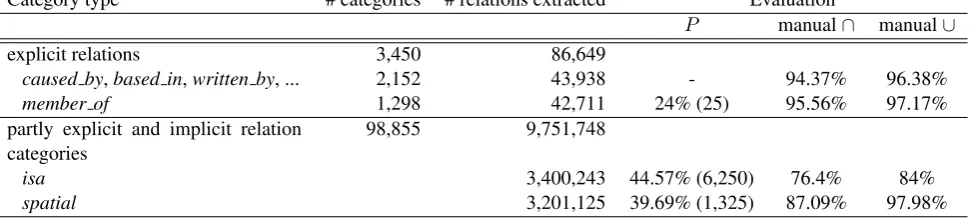
Category type # categories # relations extracted Evaluation
P manual∩ manual∪
explicit relations 3,450 86,649
caused by,based in,written by, ... 2,152 43,938 - 94.37% 96.38%
member of 1,298 42,711 24% (25) 95.56% 97.17%
partly explicit and implicit relation categories
98,855 9,751,748
isa 3,400,243 44.57% (6,250) 76.4% 84%
spatial 3,201,125 39.69% (1,325) 87.09% 97.98%
Table 3: Extracted relations and evaluation results
sent. The guidelines instructed the annotators to assign a
true/false/not relationtag to each instance. The results in terms of precision are presented in Table 4, rela-tive totruetags assigned by both judges (∩) or at least by one judge (∪). The agreement between judges in terms of Cohen’s kappa is 0.62 for the high frequency sample, and 0.81 for the low frequency one.
Sample Instances Evaluation
filtered/all ∩ ∪
high freq 235/250 78.3% / 73.6% 86.8% / 81.6% low freq 235/250 75.7% / 71.2% 77.9% / 73.2%
Table 4: Manual annotation results and evaluation, on the sample with only valid relations/on the full sample
The overlap of the set of 698,929 relation instances with YAGO’s fact base is 7,143 concept pairs. This small over-lap shows that categories, the category structure and in-foboxes are the combined source of novel information, not easily or directly accessible through the article texts or cat-egories alone. 306 YAGO relations are represented within the 7,143 pairs. We consider the top 5, which cover 5854 of the pairs: locatedIn(3163),wrote(972),directed(757),
politicianOf(572) andcreated(390).
To the pairs assignedcreatedin YAGO correspond the fol-lowing relations assigned through the method presented in the paper:
artist(126),writer(89),developer(58),director(37), manufac-turer(14),producer(12),composer(8)8.
It is clear that these relations assigned by propagating relations from the infoboxes are more specific instances than the created relation in YAGO. In the manually an-notated sample we have 14 instances anan-notated with re-lations from this set. Their precision is 87.5% (both ∩ and∪). The same phenomenon occurs for locatedIn– it is a rather general relation, and it corresponds to a vari-ety of more specific spatial relations in our assignment:
subdivision name(1288),prefecture(660),location(257),
neighbouring municipalities, district (142), country (46),
basin countries (37), bundesland (30), county (18). Of these, the relations subdivision name, location, country
also appear in the manually annotated data (80 instances),
8
We show only the most frequent relations, which cover the majority of the pairs.
and (together) have precision 86.25% (∪) / 83.75% (∩) (Ta-ble 5).
ThewroteanddirectedYAGO relations are easily mapped onto the propagated relations: for 963 of the instances with relation wrote in YAGO, the inference process as-signed the relation author(99.07%), and 749 instances of relation directed have relation director after propagation (98.94%). The relation politicianOfis harder to evaluate. None of the relations assigned through relation propaga-tion expresses the same relapropaga-tion, however they are not erro-neous: birth place(350),death place(93),residence(16),
nationality (15). These relations were represented in the manually annotated data (40 instances), and their precision was 72.5% (∪) / 70% (∩).
YAGO relation Overlap Precision
full evaluation
wrote 972 99.07%
directed 757 98.94%
estimation based on manually annotated sample located in 3,163 83.75% (∩) / 86.25% (∪)
created 390 87.5%
Table 5: Evaluation relative to the overlap with YAGO
6.
Conclusion
We have presented a multi-lingual resource, to be used to complement WordNet with knowledge about numerous named entities as well as general concepts. It captures a wide variety of relations, reflecting the encyclopedic nature of the data. We build from the start a multi-lingual resource, to be used for cross-language tasks. To build it we exploit several sources of knowledge from Wikipedia – some ex-plicit (articles, categories and their links, infoboxes), some implicit (category names). This coverage of multiple infor-mation differentiates the resource presented here from sim-ilar endeavours and resources extracted from Wikipedia.
Acknowledgements
7.
References
Sisay Fissaha Adafre and Maarten de Rijke. 2006. Find-ing similar sentences across multiple languages in Wikipedia. InProceedings of the EACL 2006 Workshop on New Text — Wikis and Blogs and Other Dynamic Text Sources,Trento, Italy, 4 April 2006, pages 62–69. S¨oren Auer, Christian Bizer, Jens Lehmann, Georgi
Kobi-larov, Richard Cyganiak, and Zachary Ives. 2007. DB-pedia: A nucleus for a Web of open data. In Proceed-ings of the 6th International Semantic Web Conference and 2nd Asian Semantic Web Conference,Busan, Korea, November 11-15, 2007, pages 722–735.
Christiane Fellbaum, editor. 1998. WordNet: An Electronic Lexical Database. MIT Press, Cambridge, Mass. Evgeniy Gabrilovich and Shaul Markovitch. 2007.
Com-puting semantic relatedness using Wikipedia-based ex-plicit semantic analysis. InProceedings of the 20th In-ternational Joint Conference on Artificial Intelligence,
Hyderabad, India, 6–12 January 2007, pages 1606–1611. Gjergji Kasneci, Maya Ramnath, Fabian M. Suchanek, and Gerhard Weikum. 2008. The YAGO-NAGA approach to knowledge discovery. SIGMOD Record, 37(4):41–47. Douglas B. Lenat, R.V. Guha, Karen Pittman, Dexter Pratt,
and Mary Shepherd. 1990. Cyc: Towards programs with common sense. Communications of the ACM, 33(8):30– 49.
Olena Medelyan, David Milne, Catherine Legg, and Ian H. Witten. 2009. Mining meaning from Wikipedia. In-ternational Journal of Human-Computer Interaction, 67(9):716–754.
David Milne and Ian H. Witten. 2008a. An effective, low-cost measure of semantic relatedness obtained from Wikipedia links. In Proceedings of the Workshop on Wikipedia and Artificial Intelligence: An Evolving Syn-ergy at AAAI-08,Chicago, Ill., 13 July 2008, pages 25– 30.
David Milne and Ian H. Witten. 2008b. Learning to link with Wikipedia. InProceedings of the ACM 17th Con-ference on Information and Knowledge Management (CIKM 2008), Napa Valley, Cal., USA, 26–30 October 2008, pages 1046–1055.
Vivi Nastase and Michael Strube. 2008. Decoding Wikipedia category names for knowledge acquisition. In
Proceedings of the 23rd Conference on the Advancement of Artificial Intelligence,Chicago, Ill., 13–17 July 2008, pages 1219–1224.
Dat P.T. Nguyen, Yutaka Matsuo, and Mitsuru Ishizuka. 2007. Relation extraction from Wikipedia using subtree mining. In Proceedings of the 22nd Conference on the Advancement of Artificial Intelligence,Vancouver, B.C., Canada, 22–26 July 2007, pages 1414–1420.
Simone Paolo Ponzetto and Michael Strube. 2007. Deriv-ing a large scale taxonomy from Wikipedia. In Proceed-ings of the 22nd Conference on the Advancement of Arti-ficial Intelligence,Vancouver, B.C., Canada, 22–26 July 2007, pages 1440–1445.
Beatrice Santorini. 1990. Part of speech
tag-ging guidelines for the Penn Treebank Project. http://www.cis.upenn.edu/∼treebank/home.html.
Push Singh. 2002. The Open
Mind Common Sense project.
http://www.kurzweilai.net/articles/art0371.html. Michael Strube and Simone Paolo Ponzetto. 2006.
WikiRelate! Computing semantic relatedness using Wikipedia. InProceedings of the 21st National Confer-ence on Artificial IntelligConfer-ence,Boston, Mass., 16–20 July 2006, pages 1419–1424.
Fabian M. Suchanek, Gjergji Kasneci, and Gerhard Weikum. 2007. YAGO: A core of semantic knowledge. unifying WordNet and Wikipedia. InProceedings of the 16th World Wide Web Conference,Banff, Canada, 8–12 May, 2007, pages 697–706.
Wolodja Wentland, Johannes Knopp, Carina Silberer, and Matthias Hartung. 2008. Building a multilingual lexi-cal resource for named entity disambiguation, translation and transliteration. In Proceedings of the 6th Interna-tional Conference on Language Resources and Evalua-tion,Marrakech, Morocco, 26 May – 1 June 2008. Fei Wu and Daniel S. Weld. 2007. Autonomously
se-mantifying Wikipedia. InProceedings of the ACM 16th Conference on Information and Knowledge Management (CIKM 2007), Lisbon, Portugal, 6–9 November 2007, pages 41–50.
Appendix
The resource consists of four data files which we describe below.
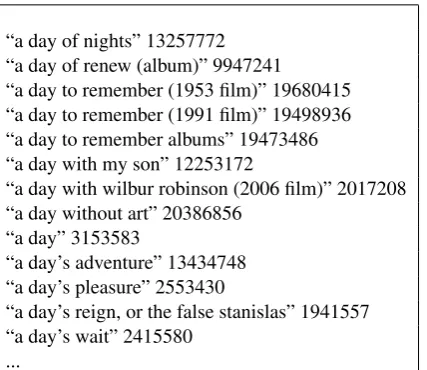
“a day of nights” 13257772 “a day of renew (album)” 9947241
“a day to remember (1953 film)” 19680415 “a day to remember (1991 film)” 19498936 “a day to remember albums” 19473486 “a day with my son” 12253172
“a day with wilbur robinson (2006 film)” 2017208 “a day without art” 20386856
“a day” 3153583
“a day’s adventure” 13434748 “a day’s pleasure” 2553430
“a day’s reign, or the false stanislas” 1941557 “a day’s wait” 2415580
...
12 “gd”:“Ain-Riaghailteachd” “en”:“Anarchism” “fr”:“Anarchisme” “it”:“Anarchismo” ... 25 “en”:“Autism” “et”:“Autism” “ca”:“Autisme” “fi”:“Autismi” “es”:“Autismo” ... 39 “lt”:“Albedas” “en”:“Albedo” “ast”:“Albedu” “hu”:“Albed” “et”:“Albeedo” ... 290 “lb”:“A (Buschtaf)” “uz”:“A (harf)” “ku”:“A (herf)” “fr”:“A (lettre)” ...
303 “lb”:“Alabama (Bundesstaat)” “br”:“Alabama (stad)” “ro”:“Alabama (stat SUA)” ... 305 “lt”:“Achilas” “fr”:“Achille” “en”:“Achilles” “scn”:“Achilli” “sl”:“Ahil” ...
307 “en”:“Abraham Lincoln” “lv”:“Abrahams Linkolns” “la”:“Abrahamus Lincoln” ... 308 “ga”:“Arastotail” “uz”:“Arastu” “kab”:“Aristot” “fr”:“Aristote” ...
309 “pl”:“Amerykanin w Paryu (Gershwin)” “nl”:“An American in Paris (Gershwin)” ...
316 “en”:“Academy Award for Best Art Direction” “es”:“Anexo:scar a la mejor direccin de arte” ... 324 “en”:“Academy Award” “id”:“Academy Awards” “tr”:“Akademi dlleri” ...
...
Figure 3: The reversed index filecontains an ordered listing of numeric IDs and their various lexicalizations. A line starts with a numeric concept ID, and its possible lexicalizations, including variants in other languages, as found in the cross-language links for articles and categories.
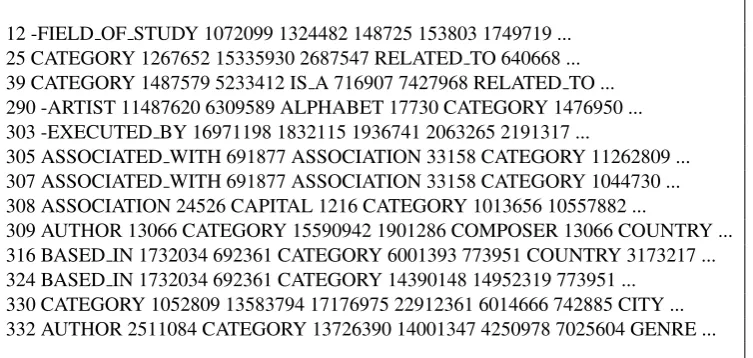
12 -FIELD OF STUDY 1072099 1324482 148725 153803 1749719 ... 25 CATEGORY 1267652 15335930 2687547 RELATED TO 640668 ... 39 CATEGORY 1487579 5233412 IS A 716907 7427968 RELATED TO ... 290 -ARTIST 11487620 6309589 ALPHABET 17730 CATEGORY 1476950 ... 303 -EXECUTED BY 16971198 1832115 1936741 2063265 2191317 ...
305 ASSOCIATED WITH 691877 ASSOCIATION 33158 CATEGORY 11262809 ... 307 ASSOCIATED WITH 691877 ASSOCIATION 33158 CATEGORY 1044730 ... 308 ASSOCIATION 24526 CAPITAL 1216 CATEGORY 1013656 10557882 ...
309 AUTHOR 13066 CATEGORY 15590942 1901286 COMPOSER 13066 COUNTRY ... 316 BASED IN 1732034 692361 CATEGORY 6001393 773951 COUNTRY 3173217 ... 324 BASED IN 1732034 692361 CATEGORY 14390148 14952319 773951 ...
330 CATEGORY 1052809 13583794 17176975 22912361 6014666 742885 CITY ... 332 AUTHOR 2511084 CATEGORY 13726390 14001347 4250978 7025604 GENRE ... ...
Figure 4:The data filecontains a list of relations for each concept (ID), ordered by the ID. Relations are directed. The file contains the relations induced by processing the category structure, categories and infoboxes. The structure of each line is:
ID Rel1ID11ID12... ID1nRel2ID21.... ID is a concept’s ID, Reliare relations from or towards (if the relation is prefixed
by “-”) this concept, and IDijare the concepts connected to ID through relation Reli.
12 10001591 100052 10030 1003654 10060195 10072892 1007418 100758 1008 ... 25 10001591 10008586 10013 10037201 1004186 1004482 10048 10055 1005705 ... 39 1000165 10086584 10112744 10180397 1019817 1028264 1028265 103050 ... 290 100935 10306453 103358 10436364 10437467 10576525 1109441 11388236 ... 303 10001591 10003335 10003629 10003649 10006052 1000637 10006781 ... 305 100254 10069798 1009303 10095749 10140510 10141 101411 10150963 ... 308 1000660 100090 1000978 10010856 1001664 100224 10023307 10024702 ... 330 10145549 13169236 14851243 16765178 169568 18948337 1942277 21148681 ... 332 1176603 1210571 12833051 13393902 13591897 14149608 15092767 15550841 ... 333 1046699 2477285 4104030
334 1137594 11807783 1181 1209 1234 12993 1317 1327 1328262 13909226 ... ...