Combining Quality Prediction and System Selection for Improved
Automatic Translation Output
Radu Soricut
SDL Language Weaver 6060 Center Drive, Suite 150
Los Angeles, CA 90045 [email protected]
Sushant Narsale∗
Google Inc
1600 Amphitheatre Parkway Mountain View, CA 94043 [email protected]
Abstract
This paper presents techniques for reference-free, automatic prediction of Machine Trans-lation output quality at both sentence- and document-level. In addition to helping with document-level quality estimation, sentence-level predictions are used for system selection, improving the quality of the output transla-tions. We present three system selection tech-niques and perform evaluations that quantify the gains across multiple domains and lan-guage pairs.
1 Introduction
Aside from improving the performance of core-translation models, there additionally exist two orthogonal approaches via which fully-automatic translations can achieve increased acceptance and better integration in real-world use cases. These two approaches are: improved translation accuracy via system combination (Rosti et al., 2008; Karakos et al., 2008; Hildebrand and Vogel, 2008), and auto-matic quality-estimation techniques used as an ad-ditional layer on top of MT systems, which present the user only with translations that are predicted as being accurate (Soricut and Echihabi, 2010; Specia, 2011).
In this paper, we describe new contributions to both these approaches. First, we present a novel and superior technique for performing quality esti-mation at document level. We achieve this by
chang-∗
Research was completed before the author started in his current role at Google Inc. The opinions stated are his own and not of Google Inc.
ing the granularity of the prediction mechanism from document-level (Soricut and Echihabi, 2010) to sentence-level, and predicting BLEU scores via directly modeling the sufficient statistics for BLEU computation. A document-level score is then recre-ated based on the predicted sentence-level sufficient statistics. A second contribution is related to system combination (or, to be more precise, system selec-tion). This is an intended side-effect of the granular-ity change: since the sentence-level statistics allow us to make quality predictions at sentence level, we can use these predictions to perform system com-bination by selecting among various sentence-level translations produced by different MT systems. That is, instead of presenting the user with a document with sentences translated entirely by a single system, we can present documents for which, say, 60% of the sentences were translated by system A, and 40% were translated by system B. We contribute a novel set of features and several techniques for choos-ing between competchoos-ing machine translation outputs. The evaluation results show better output quality, across multiple domains and language pairs.
2 Related Work
Several approaches to reference-free automatic MT quality assessment have been proposed, using classi-fication (Kulesza and Shieber, 2004), regression (Al-brecht and Hwa, 2007), and ranking (Ye et al., 2007; Duh, 2008). The focus of these approaches is on sys-tem performance evaluation, as they use a constant test set and measure various MT systems against it.
In contrast, we are interested in evaluating the quality of the translations themselves, while
ing the MT components as constants. In this re-spect, the goal is more related to the area of con-fidence estimation for MT (Blatz et al., 2004). Con-fidence estimation is usually concerned with iden-tifying words/phrases for which one can be confi-dent in the quality of the translation. A sentence-level approach to quality estimation is taken on the classification-based work of Gamon et al. (2005) and regression-based work of Specia et al. (2009).
Our approach to quality estimation focuses on both sentence-level and document-level estimation. We improve on the quality estimation technique that is proposed for document-level estimation in (Sori-cut and Echihabi, 2010). Furthermore, we exploit the availability of multiple translation hypotheses to perform system combination. Our system combina-tion methods are based on generic Machine Learn-ing techniques, applied on 1-best output strLearn-ings. In contrast, most of the approaches to MT system com-bination combine N-best lists from multiple MT sys-tems via confusion network decoding (Karakos et al., 2008; Rosti et al., 2008). The closest system combination approach to our work is (Hildebrand and Vogel, 2008), where an ensemble of hypothe-ses is generated by combining N-best lists from all the participating systems, and a log-linear model is trained to select the best translation from all the pos-sible candidates.
In our work, we show that it is possible to gain significant translation quality by taking advantage of only two participating systems. This makes the system-combination proposition much more palat-able in real production deployment scenarios for Machine Translation, as opposed to pure research scenarios as the ones used in the previous NIST and DARPA/GALE MT efforts (Olive et al., 2011). As our evaluations show, the two participating systems can be at very similar performance levels, and yet a system-selection procedure using Machine Learning techniques can achieve significant translation im-provements in quality. In addition, in a scenario where quality estimation needs to happen as a re-quirement for MT integration in large applications, having two translation systems producing transla-tions for the same inputs is part of the deployment set-up (Soricut and Echihabi, 2010). The improve-ment in overall translation quality comes in these cases at near-zero cost.
3 Sentence-level Quality Predictions
The requirement for document-level quality esti-mation comes from the need to present a fully-automated translation solution, in which translated documents are either good enough to be directly published (or otherwise must undergo, say, a human-driven post-processing pipeline). In the proposal of Soricut and Echihabi (2010), regression models pre-dict BLEU-like scores for each document, based on document-level features.
However, even if the predicted value is at document-level, the actual feature computation and model prediction does not necessarily need to hap-pen at document-level. It is one of the goals of this work to determine if the models of prediction work better at a coarser granularity (such as document level) or finer granularity (such as sentence-level).
We describe here a mechanism for predicting BLEU scores at sentence level, and then combin-ing these scores into document-level scores. To make explicit our prediction mechanism, we present here in detail the formula for computing BLEU scores (Papineni et al., 2002). First, n-gram preci-sion scoresPnare computed as follows:
Pn=
P
C∈CandidatesPn-gram∈CCountclip(n-gram)
P
C∈CandidatesPn-gram∈CCount(n-gram) (1) whereCountclip(n-gram)is the maximum number ofn-grams co-occurring in a candidate translation and a reference translation, andCount(n-gram) is the number ofn-grams in the candidate translation. To prevent very short translations that try to max-imize their precision scores, BLEU adds a brevity penalty, BP, to the formula:
BP =
(
1 if|c|>|r|
e(1−|r|/|c|) if|c| ≤ |r| (2)
where |c| is the length of the candidate translation and|r|is the length of the reference translation. The BLEU formula is then written as follows:
BLEU =BP ·exp( N
X
n=1
wnlogpn) (3)
3.1 The learning method
The results we report in this section are ob-tained using the freely-available Weka engine. 1 For both sentence-level and document-level qual-ity prediction, we report all the results using Weka implementation of M5P regression trees (weka.classifiers.trees.M5P).
We use the components of the BLEU score (Equa-tions 1 and 2) to train fine-granularity M5P models using our set of features (Section 3.2), for a total of five individual regression-tree models (four for the sentence-level precision scoresPn,1 ≤n ≤ 4 fac-tors, and one for the BP factor). The numbers pro-duced individually by our models are then combined using the BLEU equation 3 into a sentence-level BLEU score. The sentence-level predicted BLEU scores play an important role in our system combi-nation mechanism (see Section 4).
At the same time, we sum up the sufficient statistics for the sentence-level precision scoresPn (Equation 1) over all the sentences in a document, thus obtaining document-level precision scores. A document-levelBP score (Equation 2) is similarly obtained by summing over all sentences. Finally, we plug the predicted document-level Pn andBP scores in the BLEU formula (Equation 3) and arrive at a document-level predicted BLEU score.
3.2 The features
Most of the features we use in this work are not internal features of the MT system, but rather de-rived starting from input/output strings. Therefore, they can be applied for a large variety of MT proaches, from statistical-based to rule-based ap-proaches. The features we use can be divided into text-based, language-model–based, pseudo-reference–based, example-based, and training-data– based feature types (these latter features assume that the engine is statistical and one has access to the training data). These feature types can be computed both on the source-side (MT input) and on the target-side (MT output).
Text-based features
These features compute the length of the input in terms of (tokenized) number of words. The
source-1Weka software at http://www.cs.waikato.ac.nz/ml/weka/.
side text feature is computed on the input string, while the target-side text feature is computed to the output translation string. These two features are use-ful in modeling the relationship between the number of words in the input and output and the expected BLEU score for these sizes.
Language-model–based features
These features are among the ones that were first proposed as possible differentiators between good and bad translations (Gamon et al., 2005). They are a measure of how likely a collection of strings is un-der a language model trained on monolingual data (either on the source or target side).
The language-model–based feature values we use here are computed as perplexity numbers using a 5-gram language model trained on the MT training set. This can be achieved, for instance, by using the publicly-available SRILM toolkit2. These two features are useful in modeling the relationship be-tween the likelihood of a string (or set of strings) under an n-gram language model and the expected BLEU score for that input/output pair.
Pseudo-reference–based features
Previous work has shown that, in the ab-sence of human-produced references, automatically-produced ones are still helpful in differentiating be-tween good and bad translations (Albrecht and Hwa, 2008). When computed on the target side, this type of features requires one (or possibly more) secondary MT system(s), used to generate transla-tions starting from the same input. These pseudo-references are useful in gauging translation conver-gence, using BLEU scores as feature values. In in-tuitive terms, their usefulness can be summarized as follows: “if systemXproduced a translationAand systemY produced a translationBstarting from the same input, andAandBare similar, thenAis prob-ably a good translation”.
An important property here is that systemsXand
Y need to be as different as possible from each other. This property ensures that a convergence on sim-ilar translations is not just an artifact of the sys-tems sharing the same translation model/resources, but a true indication that the translations converge. The secondary systems we use in this work are
still phrase-based, but equipped with linguistically-oriented modules similar with the ones proposed in (Collins et al., 2005; Xu et al., 2009). Our exper-iments indicate that this single feature is one of the most powerful ones in terms of its predictive power.
Example-based features
For example-based features, we use a develop-ment set of parallel sentences, for which we pro-duce translations and compute sentence-level BLEU scores. We set aside the top BLEU scoring sen-tences and bottom BLEU scoring sensen-tences. These sets are used as positive examples (with better-than-average BLEU) and negative examples (with worse-than-average BLEU), respectively. We define a positive-example–based feature function as a geo-metric mean of 1-to-4–gram precision scores (i.e., the BLEU equation 3 with theBP term set to 1) be-tween a string (on either source or target side) and the positive examples used as references. That is, we compute precision scores against all the positive examples at the same time, similar with how mul-tiple references are used to increase the precision of the BLEU metric. (The negative-example–based features are defined in an analogous way.) The set of positive and negative examples is a fixed set that is used in the same manner both at training-time (to compute the example-based feature values for the training examples) and at test-time (to compute the example-based feature values for the test examples). The intuition behind these features can be sum-marized as follows: “if system X translated A
well/poorly, andAandBare similar, then systemX
probably translatesB well/poorly”. The total num-ber of features on this type is 4 (2 for positive ex-amples against source/target strings, 2 for negative examples against source/target strings).
Training-data–based features
If the system for which we make the predictions is trained on a parallel corpus, the data in this corpus can be exploited towards assessing translation qual-ity (Specia et al., 2009; Soricut and Echihabi, 2010; Specia, 2011). In our context, the documents that make up this corpus can be used in a fashion simi-lar with the positive examples. One type of training-data–based features operates by computing the num-ber of out-of-vocabulary (OOV) tokens with respect
to the training data (on source side).
A more powerful type of training-data–based fea-tures operates by computing a geometric mean of 1-to-4–gram precision score between a string (source or target side) and the training-data strings used as references. Intuitively, these features assess the cov-erage of the candidate strings with respect to the training data: “if the n-grams of input stringA are well covered by the source-side of the training data, then the translation ofA is probably good” (on the source side); “if the n-grams in the output translation
Bare well covered by the target-side of the parallel training data, thenBis probably a good translation” (on the target side). The total number of features on this type is 3 (1 for the OOV counts, and 2 for the source/target-side n-gram coverage).
Given the described 12 feature functions, the training for our five M5P prediction models is done using the feature-function values at sentence-level, and associating these values with reference labels that are automatically-produced from parallel-text using the sufficient-statistics of the BLEU score (Equations 1 and 2).
3.3 Metrics for Quality Prediction Performance
The metrics we use here are designed to answer the following question: how well can we automatically separate better translations from worse translations (in the absence of human-produced references)?
A first metric we use is Ranking Accuracy (rAcc), see (Gunawardana and Shani, 2009; Soricut and Echihabi, 2010). In the general case, it measures how wellN elements are assigned intonquantiles as a result of a ranking procedure. The formula is:
rAcc[n] =Avgni=1TPNi n
= 1
N ×
n
X
i=1 TPi
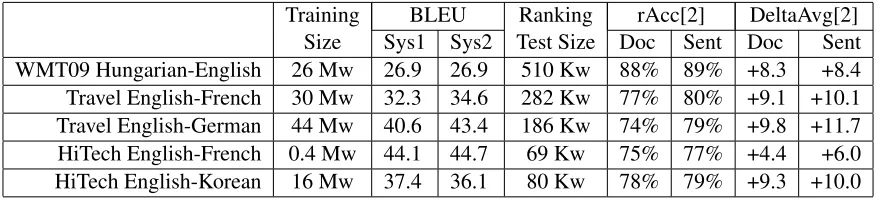
Training BLEU Ranking rAcc[2] DeltaAvg[2] Size Sys1 Sys2 Test Size Doc Sent Doc Sent WMT09 Hungarian-English 26 Mw 26.9 26.9 510 Kw 88% 89% +8.3 +8.4 Travel English-French 30 Mw 32.3 34.6 282 Kw 77% 80% +9.1 +10.1 Travel English-German 44 Mw 40.6 43.4 186 Kw 74% 79% +9.8 +11.7 HiTech English-French 0.4 Mw 44.1 44.7 69 Kw 75% 77% +4.4 +6.0 HiTech English-Korean 16 Mw 37.4 36.1 80 Kw 78% 79% +9.3 +10.0
Table 1: MT system performance and ranking performance using BLEU prediction at Doc- and Sent-level.
best-translated documents (as measured by BLEU against human reference) in the top 50% of ranked documents. Note that a random assignment gives a performance lower bound of 50% accuracy.
A second metric we use here is the DeltaAvg met-ric (Callison-Burch et al., 2012). The goal of the DeltaAvg metric is to measure how valuable a pro-posed ranking (hypothesis) is from the perspective of an extrinsic metric associated with the test en-tries (in our case, the BLEU scores). The follow-ing notations are used: for a given entry sentences,
V(s) represents the function that associates an ex-trinsic value to that entry; we extend this notation to a set S, with V(S) representing the average of allV(s), s ∈ S. Intuitively,V(S)is a quantitative measure of the “quality” of the setS, as induced by the extrinsic values associated with the entries inS. For a set of ranked entriesS and a parametern, we denote byS1the first quantile of setS (the highest-ranked entries), S2 the second quantile, and so on, fornquantiles of equal sizes.3 We also use the no-tation Si,j = Sjk=iSk. Using these notations, the metric is defined as:
DeltaAvgV[n] =
Pn−1
k=1V(S1,k)
n−1 −V(S) (4)
When the valuation functionV is clear from the con-text, we write DeltaAvg[n]for DeltaAvgV[n]. The parameter nrepresents the number of quantiles we want to split the setS into. For simplicity, we con-sider there only the case for n = 2, which gives DeltaAvg[2] = V(S1)−V(S). This measures the difference between the quality of the top quantile (top half)S1and the overall quality (represented by
3
If the size|S|is not divisible byn, then the last quantile Snis assumed to contain the rest of the entries.
V(S)). For the results presented here, the valuation functionV is taken to be the BLEU function (Equa-tion 3).
3.4 Experimental Results
We measure the impact in ranking accuracy using a variety of European and Asian language pairs, using parallel data from various domains. One domain we use is the publicly available WMT09 data (Koehn and Haddow, 2009), a combination of European par-liament and news data. Another domain, called Travel, consists of user-generated reviews and de-scriptions; and a third domain, called HiTech, con-sists of parallel data from customer support for the high-tech industry. Using these parallel data sets, we train statistical phrase-based MT system similar to (Och and Ney, 2004) as primary systems (Sys1). As secondary systems (Sys2) we use phrase-based systems equipped with linguistically-oriented mod-ules similar with the ones proposed in (Collins et al., 2005; Xu et al., 2009). Table 1 lists the size of the parallel training data on which the MT systems were trained in the first column, and BLEU scores for the primary and secondary systems on held-out 1000-sentence test sets in the next two columns.
the work described in (Soricut and Echihabi, 2010), where the BLEU prediction is done using document-level feature values and models. The one labeled as “Sent” is the novel one proposed in this paper, where the BLEU prediction is done using sentence-level feature values and models, which are then ag-gregated into document-level BLEU scores.
Both rAcc[2] and DeltaAvg[2] numbers support the choice of making document-level BLEU pre-diction at a finer, sentence-based granularity level. For Travel English-French, for instance, the accu-racy of the ranking improves from 77% to 80%. To put some intuition behind these numbers, it means that 4 out of every 5 sentences that the ranker places in the top 50% do belong there. At the same time, the DeltaAvg[2]numbers for Travel English-French indicate that the translation quality of the top 50% of the 1000 Ranking Test documents exceeds by 10.1 BLEU points the overall quality of the trans-lations (up from 9.1 BLEU points for the document-level prediction). This large gap in the BLEU score of the top 50% ranked sentences and the overall-corpus BLEU indicates that these top-ranked trans-lations are indeed of much better quality (closer to the human-produced references). The same large numbers are measured on the WMT09 data for Hungarian-English. This is a set for which it is hard to obtain significant improvements via core-model translation improvements. Our quality-estimation method allows one to automatically identify the top 50% of the sentences with 89% accuracy. This set of top 50% sentences also has an overall BLEU score of 35.3, which is better by +8.4 BLEU-points com-pared to the overall BLEU score of 26.9 (we only show the base overall BLEU score and the BLEU-point gain in Table 2 to avoid displaying redundant information).
4 System Combination at Sentence Level
Since we produce two translations for every input sentence for the purpose of quality estimation, we exploit the availability of these competing hypothe-ses in order to choose the best one. In this section we describe three system combination schemes that choose between the output of the primary and sec-ondary MT systems.
4.1 System Combination using Regression
This combination scheme makes use of the regression-based sentence-level BLEU prediction mechanism described in Section 3. It requires that we also train and use an additional BLEU predic-tion mechanism for which the secondary MT sys-tem is now considered primary, and vice-versa. As a consequence, we can predict a sentence-level BLEU score for each of the two competing hypotheses. We then simply choose the hypothesis with the highest predicted BLEU score.
4.2 System Combination using Ranking
This approach is based on ranking the candidate translations and then selecting the highest-ranked translation as the final output. To this end we use SVM-rank (Joachims, 1999), a ranking algorithm built on SVM. We use SVM-rank with a linear ker-nel and the same feature set as the regression-based method (we make the observation here that only the target-based features have discriminative power in this context).
4.3 System Combination using Classification
In this approach, we model the problem of select-ing the best output from the two candidate transla-tions into a binary classification problem. We use the same feature set as before for each candidate transla-tion (again, only the target-based features have dis-criminative power in this context).
The final feature vectors are obtained by subtract-ing the values of the primary-system feature vec-tor from the values of the secondary-system feature vector. The binary classifier is trained to predict ”0” if the primary-system is better, and ”1” if the secondary-system is better.
4.4 Experimental Results
In Table 2, we summarize the results for the three system combination techniques discussed before across our domains (WMT09, Travel, and Hi-Tech). To get an upper bound on the performance of these system combination techniques, we also compute an oracle function which selects the translation with highest BLEU score computed against human-produced references.
combina-BLEU Oracle Regression Rank Classify Sys1 Sys2
WMT09 Hungarian-English 26.9 26.9 30.7(+3.8) 29.0(+2.1) 29.0(+2.1) 28.9(+2.0) Travel English-French 32.3 34.6 38.7(+3.9) 36.2(+1.6) 36.0(+1.4) 35.7(+1.1) Travel English-German 40.6 43.4 47.2(+3.8) 44.5(+1.1) 44.0(+0.6) 44.9(+1.5) HiTech English-French 44.1 44.7 49.8(+5.1) 46.1(+1.4) 46.3(+1.7) 45.3(+0.6) HiTech English-Korean 37.4 36.1 42.2(+4.8) 39.4(+2.0) 39.1(+1.7) 38.8(+1.4)
Table 2: BLEU scores for the proposed system combination techniques across domains and language pairs.
Travel Eng-Fra Hi-Tech Eng-Fra
Sys1 Sys2 KL Sys1 Sy2 KL
BLEU score 32.3 34.6 - 44.1 44.7
-Oracle distr. 34.9% 65.1% 0.00 34.5% 65.5% 0.00
Regression distr. 31.2% 68.9% 0.68 32.3% 67.7% 0.11
Rank distr. 43.4% 56.6% 1.92 47.0% 53.0% 3.31 Classify distr. 47.4% 52.7% 3.78 63.9% 36.1% 17.88
Table 3: Distribution of sentences selected from the participating system for Eng-Fra, across domains (Travel and Hi-Tech).
tion techniques are significant. For instance, both the Regression-based system combination and the Ranking-based system combination achieve a BLEU score of 29.0 on the WMT09 Hungarian-English test set, an increase of +2.1 BLEU points. In the case of Travel English-French, an increase of +1.6 BLEU points is obtained by the Regression-based system combination, in spite of the fact that one of the systems is measured to be 2.3 BLEU points lower in translation accuracy. Increases in the range of +1.5-2.0 BLEU points are obtained across all the experimental conditions that we tried: three different domains, various language pairs (both in and out of English), and various training data sizes (from 0.4Mw to 40Mw).
Since our system-combination methods chose one system translation over another system translation, we can also measure the distribution of choices made between the two participating systems. These bimodal distributions can help us gauge the perfor-mance of various methods, when compared against the BLEU Oracle distribution.
In Table 3, we report the percentages of sentences selected from each system in the oracle combina-tion and each of the described system combinacombina-tion methods. We also report the Kullback-Liebler
di-vergence (KL) between the BLEU Oracle distribu-tion and the distribudistribu-tion induced by each of the sys-tem combination methods. The results indicate that, for both English-French cases that we considered (in the Travel and HiTech domains), the choice dis-tribution of the Regression-based system combina-tion method is much closer to the oracle distribucombina-tion (KL of 0.68 and 0.11, respectively), compared to the other two methods. Note that this does not neces-sarily correlate with the evaluation based on over-all BLEU score of the system-combination meth-ods (Table 2). For instance, for HiTech English-French the best BLEU improvement is obtained by the Rank-based method with +1.7 BLEU points, but the KL divergence score of 3.31 is higher than the one for the Regression-based method (KL score of 0.11). Nevertheless, the choice distributions are an important factor in judging the performance of a given system selection method.
5 Conclusions
solu-tion to mitigate the imperfecsolu-tion of current MT tech-nology and the need to translate large volumes of data on a continuous basis.
We show in this paper that sentence-level tions, when aggregated to document-level predic-tions, outperform previously-proposed document-level quality estimation algorithms. In addition to that, these finer-granularity, sentence-level predic-tions can be used as part of a system selection scheme. The three alternative system selection tech-niques we describe here are intuitive, computation-ally cheap, and bring significant BLEU gains across multiple domains and language pairs. The finding that the regression-based system selection technique performs as well (or sometimes better) compared to the discriminative methods fits well with the overall theme of using two systems for both improved qual-ity estimation and improved MT performance.
References
Joshua Albrecht and Rebecca Hwa. 2007. Regression for sentence-level MT evaluation with pseudo references. InProceedings of ACL.
Joshua Albrecht and Rebecca Hwa. 2008. The role of pseudo references in MT evaluation. InProceedings of ACL.
John Blatz, Erin Fitzgerald, George Foster, Simona Gan-drabur, Cyril Gouette, Alex Kulesza, Alberto Sanchis, and Nicola Ueffing. 2004. Confidence estimation for machine translation. InProceedings of COLING. Chris Callison-Burch, Philipp Koehn, Christof Monz,
Matt Post, Radu Soricut, and Lucia Specia. 2012. Findings of the 2012 workshop on statistical machine translation. InProceedings of the Seventh Workshop on Statistical Machine Translation, Montreal, Canada, June. Association for Computational Linguistics. Michael Collins, Philipp Koehn, and Ivona Kucerova.
2005. Clause restructuring for statistical machine translation. InProceedings of ACL.
Kevin Duh. 2008. Ranking vs. regression in machine translation evaluation. In Proceedings of the ACL Third Workshop on Statistical Machine Translation. Michael Gamon, Anthony Aue, and Martine Smets.
2005. Sentence-level MT evaluation without reference translations: Beyond language modeling. In Proceed-ings of EAMT.
Asela Gunawardana and Guy Shani. 2009. A sur-vey of accuracy evaluation metrics of recommenda-tion tasks. Journal of Machine Learning Research, 10:2935–2962.
Almut Silja Hildebrand and Stephan Vogel. 2008. Com-bination of machine translation systems via hypothesis selection. InProceedings of AMTA.
T. Joachims. 1999. Making large-Scale SVM Learning Practical. M.I.T. Press.
Damianos Karakos, Jason Eisner, Sanjeev Khudanpur, and Markus Dreyer. 2008. Machine translation sys-tem combination using ITG-based alignments. In Pro-ceedings of ACL.
Philipp Koehn and Barry Haddow. 2009. Edinburgh’s submission to all tracks of the WMT2009 shared task with reordering and speed improvements to Moses. InProceedings of EACL Workshop on Statistical Ma-chine Translation.
Alex Kulesza and Stuart M. Shieber. 2004. A learning approach to improving sentence-level MT evaluation. In Proceedings of the 10th International Conference on Theoretical and Methodological Issues in Machine Translation.
Franz Josef Och and Hermann Ney. 2004. The align-ment template approach to statistical machine transla-tion. Computational Linguistics, 30(4):417–449. Joseph Olive, Caitlin Christianson, and John McCary,
ed-itors. 2011. Handbook of Natural Language Pro-cessing and Machine Translation: DARPA Global Au-tonomous Language Exploitation. Springer.
Kishore Papineni, Salim Roukos, Todd Ward, and Wei-Jing Zhu. 2002. BLEU: a method for automatic eval-uation of machine translation. InProceedings of ACL. Antti-Veikko Rosti, Bing Zhang, Spyros Matsoukas, and Richard Schwartz. 2008. Incremental hypothesis alignment for building confusion networks with appli-cation to machine translation system combination. In
Proceedings of Third Workshop on Statistical Machine Translation.
Radu Soricut and Abdessamad Echihabi. 2010. Trustrank: Inducing trust in automatic translations via ranking. InProceedings of ACL.
Lucia Specia, Nicola Cancedda, Marc Dymetman, Mar-cho Turchi, and Nello Cristianini. 2009. Estimating the sentence-level quality of machine translation. In
Proceedings of EAMT.
Lucia Specia. 2011. Exploiting objective annotations for measuring translation post-editing effort. In Proceed-ings of EAMT.
Peng Xu, Jaeho Kang, Michael Ringaard, and Franz Och. 2009. Using a dependency parser to improve SMT for Subject-Object-Verb languages. InProceedings of ACL.