The Metadata-Database of a Next Generation
Sustainability Web-Platform for Language Resources
Georg Rehm
1, Oliver Schonefeld
1, Andreas Witt
1, Timm Lehmberg
2,
Christian Chiarcos
3, Hanan Bechara
1, Florian Eishold
1, Kilian Evang
1,
Magdalena Leshtanska
1, Aleksandar Savkov
1, Matthias Stark
1University of Tübingen, Germany1
University of Hamburg, Germany2
University of Potsdam, Germany3
SFB 441: Linguistic Data Structures SFB 538: Multilingualism SFB 632: Information Structure Nauklerstr. 35, Tübingen Max-Brauer-Allee 60, Hamburg Karl-Liebknecht-Str. 24-25, Potsdam
Corresponding author: [email protected]
Abstract
Our goal is to provide a web-based platform for the long-term preservation and distribution of a heterogeneous collection of linguistic resources. We discuss the corpus preprocessing and normalisation phase that results in sets of multi-rooted trees. At the same time we transform the original metadata records, just like the corpora annotated using different annotation approaches and exhibiting different levels of granularity, into the all-encompassing and highly flexible format eTEI for which we present editing and parsing tools. We also discuss the architecture of the sustainability platform. Its primary components are an XML database that contains corpus and metadata files and an SQL database that contains user accounts and access control lists. A staging area, whose structure, contents, and consistency can be checked using tools, is used to make sure that new resources about to be imported into the platform have the correct structure.
1.
Introduction
This article describes a comprehensive database of meta-data records that can be explored and searched in order to find language resources that are appropriate for one’s spe-cific research needs. It is one of the most crucial architec-tural components of a next generation sustainability plat-form for language resources that is currently under devel-opment in the project “Sustainability of Linguistic Data” (funded by the German Research Foundation, DFG). Our project aims at sustainably archiving (Trilsbeek and Wittenburg, 2006) the language resources that have been developed or are still work in progress in three large-scale collaborative research centres. The groups in Tübin-gen (SFB 441: “Linguistic Data Structures”), Ham-burg (SFB 538: “Multilingualism”), and Potsdam/Berlin (SFB 632: “Information Structure”) built a total of 56 resources (mostly corpora and treebanks, but also lexi-cons, collections of sentences and associated grammatical-ity judgements etc.).1 According to estimates it took more than one hundred person years to collect and to annotate these resources. The project has two primary goals:
1. To process and to sustainably archive the three SFBs’ language resources so that they are still available to the research community and other interested parties in five, ten, or even 20 years time (Schmidt et al., 2006). 2. To enable researchers to query the resources both on the level of their metadata (for example, if a linguist who wants to work on a specific research question, tries to see whether there is an appropriate corpus he or she could use) as well as on the level of linguistic an-notations (e. g., query one or more corpora for certain keywords, part-of-speech tags or syntactic patterns).
1
We process 27 resources (16 corpora, five lexicons, and six sentence collections) from SFB 441, 18 corpora from SFB 538, and 11 corpora from SFB 632.
In more general terms, our main goal is to enable solu-tions that leverage the interoperability, reusability, and sus-tainability of a large collection of heterogeneous language resources. A web-based platform is our tool of choice to make sure that as many researchers as possible can access the language resources – even in the very long term.
2.
Corpus Normalisation and Preprocessing
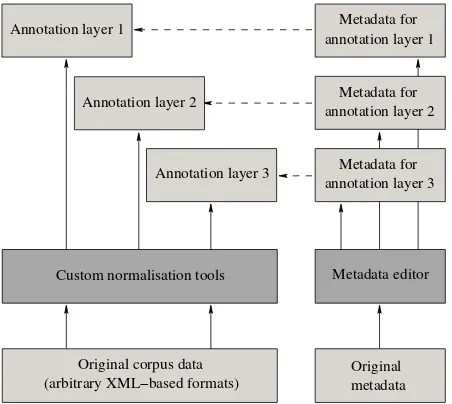
Language resources are almost exclusively built using XML-based markup languages nowadays (Wörner et al., 2006). Most current resources contain several annotation layers that correspond to multiple levels of linguistic de-scription (for example, part-of-speech, syntax, coreference or other information related to semantics, etc.). As we have to process a heterogeneous set of corpora based on a num-ber of different corpus markup languages, our approach in-cludes the normalisation of XML-annotated resources, for example, for cases in which XML-annotated corpora use PCDATA content to capture both primary data (i. e., the original text or transcription) as well as annotation infor-mation (for example, part-of-speech tags). We use a set of tools to ensure that only primary data is encoded in PC-DATA content and that all annotations proper are encoded using XML elements and attributes. Different annotation layers are separated into multiple files (see figure 1). For each layer, a tree consisting of XML elements and attributes is created. All trees share the same primary data. Thus the normalisation of each XML-annotated corpus results in a multi-rooted tree (Witt et al., 2007). Depending on the resource, the process of normalising the corpora and sep-arating the annotation layers to a multi-rooted tree can be achieved using fully automatic or manual techniques. Cus-tom tools are used to check that all files generated in the lat-ter processing step are in fact identical with regard to their primary data.
trans-formed into a shared annotation approach, because we want our users to be able to query both types of resources at the same time and in a uniform way. In fact, the original anno-tation format will be irrelevant to the user, as the graphical interface and the underlying technology abstracts from any idiosyncrasies and peculiarities of the original data formats. Our approach can be compared to the NITE Object Model (Carletta et al., 2003): we developed tools that semiauto-matically split hierarchically annotated corpora that typi-cally consist of a single XML document instance into indi-vidual XML files, so that each file represents all the infor-mation related to a single annotation layer; this approach guarantees that overlapping structures can be represented straightforwardly. Timeline-based corpora are processed using other tools in order to separate graph annotations. This approach enables us to represent arbitrary types of XML-annotated corpora as individual files, i. e., individ-ual XML element trees. These multi-rooted trees are repre-sented as regular XML document instances. Details can be found in (Rehm et al., 2007a) and (Rehm et al., 2008a).
Metadata for
Metadata for
Metadata for
Original corpus data (arbitrary XML−based formats)
annotation layer 1
annotation layer 2
annotation layer 3 Annotation layer 2
Annotation layer 1
Custom normalisation tools
metadata Original Metadata editor Annotation layer 3
Figure 1: Metadata records for each annotation layer file
3.
Legal Issues and the Need for
Fine-Grained Access Control
Modern corpora contain multiple levels of annotation that refer to multiple levels of linguistic description. Before we are able to import corpora into our sustainability platform they are normalised and their individual annotation layers are separated (see section 2). This processing step has se-rious consequences with regard to legal issues that we have to take into account (Zimmermann and Lehmberg, 2007; Lehmberg et al., 2007a; Lehmberg et al., 2007b; Lehm-berg et al., 2008; Rehm et al., 2007b): due to copyright and personal rights specifics that usually apply to a cor-pus’s primary data (for example, copyrighted newspaper articles, transcribed doctor-patient-dialogues etc.) we pro-vide a fine-grained access control layer to regulate access by means of user accounts and corpus-specific roles. In other words: it is not enough to specify that a certain user is allowed to access a certain corpus. We have to be able
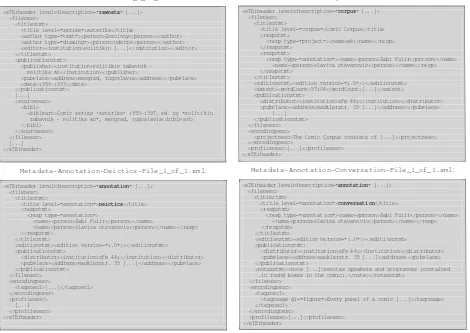
to explicitly represent the fact that a certain user only has access to the set of, say, six annotation layers (in this ex-ample they might be available free of charge for research purposes) but not to the primary data, because the primary data might be copyright-protected – for unrestricted access the user is required to provide proof-of-purpose of the pri-mary data (such as, for example, a CD ROM). It is exactly this scenario that applies to the German treebank TüBa-D/Z (Rehm et al., 2007b). A closely related scenario refers to widely used corpora that are created and distributed by a specific research group and that are extended with addi-tional or alternative annotation layers (that usually refer to new linguistic description layers) by other research groups. As the licence restrictions that apply to the original corpus and the annotation layers might be different, we need to be able to control access with regard to individual annotation layers. For this reason, every single annotation layer (as well as the corpus, the raw data, the primary data, and the setting) has an associated metadata record that, among oth-ers, contains information about potential access restrictions for the corresponding corpus files (see figure 1).
4.
The Metadata Schema eTEI
Due to our primary goals, we use open, community- as well as industry-accepted and, therefore, sustainable standards wherever possible. We store the metadata records and the corpora themselves in a native XML database. We currently use eXist but we are still in the process of evaluating other databases for the back-end. The underlying assumption is that XML-annotated datasets are more sustainable than, for example, data stored in a proprietary relational database management system (the risk being that it might prove dif-ficult or even impossible to run proprietary software on a modern operating system in, say, 15 years time).
Our generic metadata schema is based on the TEI P4 header (Sperberg-McQueen and Burnard, 2002) and extended by informational units that are missing in P4, but that are avail-able in Dublin Core (http://dublincore.org), the ISLE Meta Data Initiative (IMDI,http://www.mpi.nl/IMDI/), the Open Language Archives Community (OLAC,http: //www.language-archives.org), and that are among a set of requirements we collected.
Section 2 shows that multiple sets of annotation can refer to the same set of primary data. We do not follow the mono-lithic paradigm and treat the corresponding resource asone
was taken from one of the standards mentioned in the in-troduction, and (c) annotations that specify if an element or attribute is valid with regard to the five levels of metadata description.
We process these structured XML comments using scripts (Perl, Python) in order to produce an empty XML doc-ument instance with embedded docdoc-umentation and a Schematron schema. While the eTEI DTD can be used to validate the overall structure of an eTEI instance, the Schematron specification can be used to check whether all elements and attributes used in an eTEI instance conform to the current value of thelevelOfDescriptionattribute; as it is impossible to specify corresponding rules in a DTD, we decided to implement this step using Schematron.
The empty eTEI document contains embedded documen-tation. We generate an empty eTEI document instance by converting the DTD into an XML Schema description using Oxygen and instantiating the Schema. Afterwards a Python script converts the comments that contain the short doc-umentation remarks into<_doc>elements that precede the element they explain. These elements help users to assess the semantics of all elements and attributes. After editing an eTEI XML document instance, the user can activate an XSLT stylesheet that removes all<_doc>elements.
4.2. From Existing Metadata Records to eTEI
We process corpora and their metadata from three different research centres that have their own approaches for data handling. In the following three subsections we briefly dis-cuss these heterogeneous approaches and the state of the corresponding metadata collections.
4.2.1. SFB 441 (Tübingen University)
The metadata records of SFB 441 are encoded using the Tusnelda annotation standard (Wagner, 2005) that consists of inline annotation, and nested hierarchies without over-laps. It is based on TEI and CES, but was adapted to meet the specific research purposes of the SFB projects. Since eTEI is also based on the TEI header, the transition from Tusnelda to eTEI is straightforward, and not too much fur-ther processing is necessary. What is problematic, however, are numerous idiosyncrasies found in the existing metadata records. Most idiosyncrasies can be traced back to the rela-tive freedom given by the PCDATA content in most header elements. Plus, the metadata records were created by differ-ent researchers in differdiffer-ent projects. Elemdiffer-ent contdiffer-ent was entered inconsistently, yielding small, yet numerous differ-ences that make the option of automatic processing rather hard. Idiosyncrasies include:
• Character variations – capitalisation is a common
problem, differences exist even in the metadata from one and the same project, such as in, for example,
– <language>brazilian-portuguese</language>
– <language>Brazilian Portuguese</language>. Another type of variation occurs with special charac-ters, such as the German umlauts. The name “Tübin-gen”, for example, is written in two different ways, one with the original character (“ü”), and the other with its alternative international representation (“ue”).
• Delimiter usage – a common problem is the use of
different delimiters. In addition, whitespace is incon-sistently used, especially with regard to the SFB itself, its projects and their notation. In some cases, the SFB and its number are noted (sometimes in different lan-guages) along with the project number. In some cases, the SFB is omitted, in other cases, the principal inves-tigator is given in brackets.
– <creator>SFB 441, B3</creator>
– <creator>SFB441/project B8</creator>
– <creator>SFB 441 / Projekt B1</creator>
– <creator>B9</creator>
– <creator>B9 (Schlieben-Lange) </creator>.
• Abbreviations– often the full form of, e. g., a named
entity is reduced to its more common abbreviation:
– <dist>Seminar für Sprachwissenschaft</dist>
– <dist>SfS</dist>.
Similarly, there are some cases, in which the full name of a language is used in contrast to the standardised abbreviation:
– <language id="Russian"/>
– <language id="ru"/>
• Dates and numbers– there are several idiosyncrasies
with regard to dates and numbers. Sometimes a date expression is given in a complete form, in other cases only the final two digits of the year are noted, in mul-tiple cases the day and month are missing (sometimes they are swapped). In contrast, several date expres-sions contain dashes instead of periods.
– <pubDate>14.09.2001</pubDate>
– <pubDate>06.09.01</pubDate>
– <pubDate>1994</pubDate>
– <pubDate>09-13-2001</pubDate>
Numbers are also displayed in different ways. Version numbers, for example, are written both with and with-out minor numbers (version=’1’vs.version=’1.0’).
• Addresses – they contain several information units
and, therefore, multiple variations exist with regard to the notation and the level of detail specified in an ad-dress. In addition there are some cases of tag abuse when phone and fax numbers are included.
– <pubAddress>Nauklerstr. 35, 72074 Tübingen, Germany</pubAddress>
– <pubAddress>Nauklerstr. 35, D-72074 Tuebingen</pubAddress>
– <pubAddress>Nauklerstr. 35, 72074 Tübingen; tel: 07071-2977157, fax:
07071-295830</pubAddress>
• Named entities– there are multiple variations
concern-ing proper names. With regard to the names of per-sons, sometimes only the family name is specified (in contrast to both the first and the last name). Additional inconsistencies can be found in the names of sources (such as the names of newspapers).
Remove documentation using XSLT stylesheet
Schematron specification for semantic parsing
project−specific configuration XML editor Oxygen with
that includes documentation Empty XML eTEI template
(multiple formats, multiple sources, multiple inconsistencies) Heterogeneous collection of original metadata records − Annotated with documentation
− Annotated with additional usage constraints − Represent metadata on five levels of description eTEI−DTD
automatic generation
edit edit
activate
activate
copy and paste original data into template Transformation (e.g., into OLAC) Homogeneous collection of XML−based eTEI metadata records
import into XML database
XML−based eTEI metadata file
automatic generation of eTEI template syntactic XML parsing of eTEI document
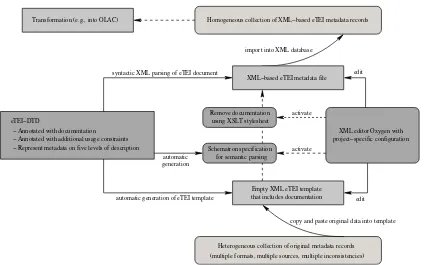
Figure 3: The integrated workflow for editing and parsing eTEI metadata records
4.2.2. SFB 538 (Hamburg University)
In SFB 538, large amounts of spoken as well as writ-ten corpora have been collected and processed. Whereas the majority of the written corpora have been encoded us-ing the TEI-, or TEI-compliant formats such as MENOTA (http://www.menota.org), the situation for the spoken lan-guage corpora is more complex. In many cases they are associated with extensive metadata sets that contain infor-mation not only on speakers, and transcriptions, but also on situational contexts, and communication settings. For these purposes researchers normally define customized sets of metadata for their specific research questions.
The majority of the spoken language corpora have been processed using the Exmaralda system (Schmidt and Wörner, 2005). The Corpus-Manager (CoMa) was de-signed as an integral part of EXMARAaLDA to meet the special demands of metadata analysis mentioned above. CoMa enables researchers to bundle Exmaralda transcrip-tions into corpora and to structure them according to their individual metadata (contained in the header) into commu-nications and speakers (Schmidt and Wörner, 2008). Thus it becomes possible to manage the complex relationship between speakers, transcriptions, and situational contexts. CoMa also allows the carrying out of metadata queries and application of filters to create subcorpora that only contain transcriptions with selected metadata attributes.
The individual and non-hierarchical metadata elements and structures cannot be integrated into a generic metadata scheme without an immense loss of information, of course. However, the transcriptions that constitute CoMa-based corpora still contain metadata that refer to speakers and annotations as well as settings and raw data. After run-ning through the preprocessing steps described in section 2, these records can be easily transferred into eTEI.
4.2.3. SFB 632 (Potsdam University)
In SFB 632, metadata are collected according to differ-ent community-specific standards. Three types of metadata records are to be distinguished, for different types of collec-tions, i. e., corpora of well-documented modern languages, historical documents, and typological data collections. As for collections of modern language, these include cor-pora of written language, in particular, newspaper articles, but also spoken language (e. g., radio news and parliamen-tary debates). The metadata of these collections can be compared to those at SFB 441 and SFB 538 with few prob-lems for the transformation into eTEI.
With regard to the historical corpora, the metadata of their primary data is specific, insofar as there is only a limited set of documents available for these languages (e. g., Old High German, Old Saxon), and most of these documents have a long editorial history. Therefore, metadata mostly concerns editorial information. These metadata, however, are often implicitly represented as many documents can be generally identified using their names alone. For example,Heliand
andMuspilliare medieval manuscripts whose denotations act like proper names. Thus, explicit metadata for primary data of corpus languages is generally sparse, because this kind of knowledge is taken for granted within the respective community. In the transformation to eTEI, this information is preserved, but not extended.
to LAF, PAULA operates on the basis of a graph-theoretic data model, and, therefore, different types of annotations can be transformed into PAULA losslessly – this also in-cludes different representations of metadata.
A PAULA project consists of a set of XML files with XPointers connecting files directly or indirectly with the primary data. There are basically four types of files: text filescontain the primary data,markablesdefine text spans that can be annotated, structure files define elements that are linked in a hierarchical structure, andfeature files spec-ify annotations assigned to markables and structure ele-ments. The files are organised by means of an AnnoSet, i. e., a specialised structure file that specifies the hierarchi-cal organisation imposed on the documents in the current PAULA project. This hierarchical organisation represents the grouping of markables or structure files together with the feature files pointing to these. This grouping corre-sponds to one single annotation layer. However, as the An-noSet is a structure file itself, also its elements can be sub-ject to feature specifications. These features may refer to a single XML document (structure, markables, feature, or text files), one annotation layer, or the project itself. Fea-tures that refer to the elements of an AnnoSet aredefinedas metadata, while features that point to other XML files are annotations. Thus, in PAULA metadata is notstructurally
distinguished from annotations, but functionally. There-fore, metadata can be processed and queried in the same way as other annotations. The following levels of metadata can be distinguished:
• Metadata of primary data (corresponding toprimary datametadata in eTEI), i. e., feature specifications that refer to the text file.
• Metadata of segmentations, annotations and layers
(corresponding toannotationmetadata in eTEI), i. e., feature specifications that refer to groups of markable, structure, or feature files.
• Metadata of documents (corresponding to setting
metadata in eTEI), i. e., feature specifications that re-fer to the AnnoSet file for a single document.
• Metadata of subcorpora and corpora (corresponding to corpusmetadata in eTEI), i. e., feature specifications that refer to the AnnoSet file for several documents.
This classification corresponds to the five levels of meta-data description presented in section 4 with the only excep-tion that raw data and primary data are currently not distin-guished in PAULA. Later versions will incorporate audio, and video files. Features that refer to these media files in an AnnoSet correpond to eTEIraw datametadata.
As both content and format of PAULA metadata and eTEI resemble each other, converters between both formats can be easily implemented. However, eTEI relies on consis-tent naming conventions for features that express meta-data which is not guaranteed by the PAULA format and, thus, PAULA-to-eTEI conversion requires manual pre-processing. Moreover, it should be noted that normalisation issues as pointed out in section 4.2.1 have been assessed in the PAULA metadata only to a limited degree. For every exported metadata entry, manual correction cycles with the eTEI editor need to be performed.
5.
An XML-Database of Metadata Records
The web-based sustainability platform has two main func-tional areas: (a) browsing of, and search within the database of corpus metadata, and (b) browsing of, and search within one or more corpora. Both functional areas rely on a database of metadata about the corpora contained in the platform. Following, we briefly discuss the system archi-tecture (section 5.1), the staging area (section 5.2), and the basic functionality of the front-end (section 5.3).
5.1. The Architecture
The sustainability platform consists of two main compo-nents: the front-end and the back-end. The front-end is the user visible part and is realised using JSP (Java Server Pages) and Ajax technology. It runs in the user’s browser and provides functions to search and to explore the meta-data records. Based on the metameta-data, the user can choose one or more resources for further processing, such as query-ing or downloadquery-ing. Query results can be displayed in for-mats such as KWIC or a tree view (Rehm et al., 2008a). The back-end component of the platform hosts the Java Server Pages and related files. It accesses two different databases, the corpus database and thesystem database. The corpus database is an XML database in which all re-sources and metadata are stored, allowing users to query the data using XQuery. The system database is a rela-tional database that contains all data about user accounts, resources (i. e., annotation layers), resource groups (i. e., corpora) and access rights to these resources. A specific user can only access a specific resource if the permissions for this user/resource tuple allow access. The system data is kept separate from the corpus data to allow for a cleaner separation of these repositories and for enhanced perfor-mance as well as security.
5.2. The Staging Area
A new resource is imported into the sustainability platform by copying all corresponding files into the staging area. The directory structure of the staging area is defined on six lev-els: the name of theorganisation, theorganisational unit, the name of theproject, the name of thecorpus, itsversion
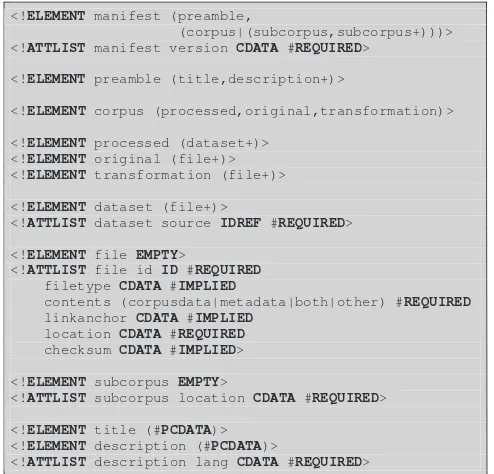
and the actualcorpus data, i. e., a set of files processed for the platform (see section 2), the original corpus data and a set of metadata files. Strict naming rules apply for the processed corpus files, for the metadata files, and for the directories, but it is not necessary to alter the names of the original file and directories as they are stored in separate directories below the processed corpus files. Furthermore, each corpus contains a manifest file. Manifest files, repre-sented in a simple XML format (see figure 5) act as corpus inventories and supply additional data about the files in-cluded in a corpus. They are automatically generated by the corpus normalisation tools described in section 2 and their contents are used by the import and export tools, and by the GUI.
permis-Metadata records − Corpus data (separated into individual annotation layers) − eTEI metadata records
− Original corpus data (original files, audio data etc.) − Manifest files (XML−based inventory list of a corpus) Staging area (specific subtree in the filesystem) contains: Import of resource
data and access restrictions defaults (tool−driven)
Import into XML database (tool−driven)
Manifest file (XML−based) to generate reports and statistics
Custom tools traverse the subtree
Front−end/Browser
Uses Java Server Pages (JSP) for metadata exploration/browsing and XQuery for corpus search Front−end/Browser
administration interface
SQL system database XML database
and Normalisation Corpus Processing Web−Based Sustain−
ability Platform
Staging Area
Corpus data
restrictions Access
Original corpus data (arbitrary XML−based formats)
copy copy copy copy copy
Corpus data
(normalised) in eTEI Dispatcher
eTEI−based metadata User
data data
Resource
eTEI editor Custom normalisation tools
metadata Original
Figure 4: Normalisation of original corpus data and metadata and the staging area of the web-based sustainability platform
<!ELEMENT manifest (preamble,
(corpus|(subcorpus,subcorpus+)))> <!ATTLIST manifest version CDATA #REQUIRED>
<!ELEMENT preamble (title,description+)>
<!ELEMENT corpus (processed,original,transformation)>
<!ELEMENT processed (dataset+)> <!ELEMENT original (file+)> <!ELEMENT transformation (file+)>
<!ELEMENT dataset (file+)>
<!ATTLIST dataset source IDREF #REQUIRED>
<!ELEMENT file EMPTY>
<!ATTLIST file id ID #REQUIRED
filetype CDATA #IMPLIED
contents (corpusdata|metadata|both|other) #REQUIRED
linkanchor CDATA #IMPLIED
location CDATA #REQUIRED
checksum CDATA #IMPLIED>
<!ELEMENT subcorpus EMPTY>
<!ATTLIST subcorpus location CDATA #REQUIRED>
<!ELEMENT title (#PCDATA)> <!ELEMENT description (#PCDATA)>
<!ATTLIST description lang CDATA #REQUIRED>
Figure 5: The DTD for manifest files
sions are chosen based on the restrictions defined in meta-data records. Since the resources come from three different research centres it is vital to have a common and consistent naming scheme for directories and individual files.
5.3. Accessing and Exploring Metadata and Corpora
To work with the platform, a user first needs to log in (the credentials are validated against the system database).
Then, the user can choose one or more corpora to work with. This is done based on the metadata records that can be searched and explored in several different ways. The permissions stored in the system database govern access to the data. After selecting a set of corpora to work with, the user can query or download them.
An administration interface enables administrator users to create, modify, or delete user accounts or specific access rights on resources. Figure 4 gives an overview of the work-flow and the individual components. The lower part of the figure shows the workflow for creating a processed corpus with associated metadata which are copied to the staging area (middle). The importer tool imports the respective data sets into the databases in the back-end (top). The front-end accesses the data using a dispatcher that checks the access control lists and that submits requests to the databases.